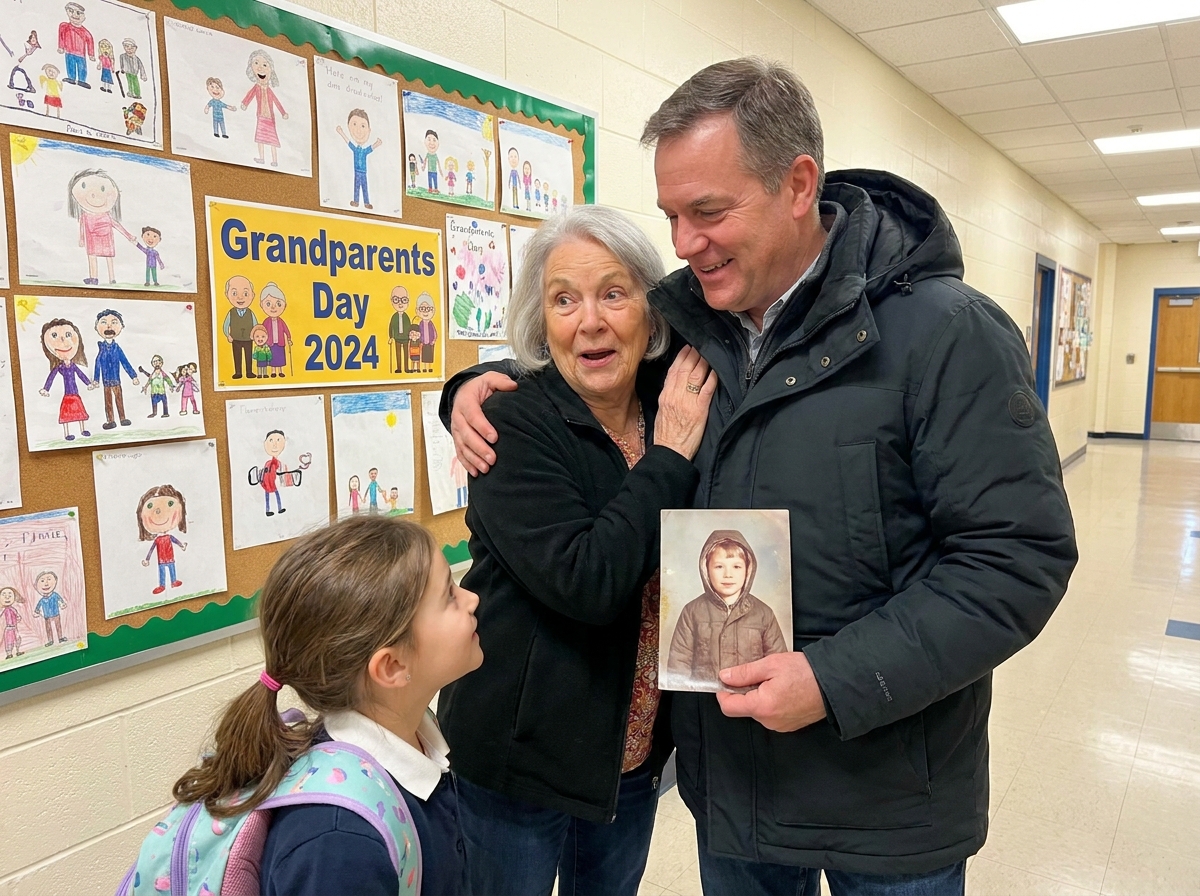
PART 1 — Emma’s Happy Tears
My granddaughter Emma came home crying.
Not the kind of crying that follows scraped knees or hurt feelings.
These were happy tears.
The kind children don’t quite know how to explain.
She burst through my front door, backpack bouncing against her shoulders, and wrapped her arms around me.
“Grandma!”
I set down the dish towel and knelt beside her.
“What happened, sweetheart?”
She wiped her eyes.
“A man paid for everyone’s lunch today.”
I blinked.
“What do you mean?”
“Everybody.”
She nodded vigorously.
“Even the kids who owe money.”
I smiled, relief softening my chest. “That’s very kind.”
“No, Grandma.” Her voice turned earnest in a way that made me listen harder. “Everybody.”
She grabbed my hand and pulled me toward the kitchen table, talking faster than she could breathe.
“Mrs. Jackson cried.”
“Who?”
“The cafeteria lady.”
“And Mr. Perkins, the principal, cried too.”
Now I was curious.
Emma lowered her voice dramatically.
“The lunch debt.”
“What about it?”
“Gone.”
“All of it.”
Later that afternoon, Principal Perkins called me.
“Mrs. Taylor?”
“Speaking.”
“I know this is unusual, but I was hoping you might stop by the school.”
“Is everything alright?”
“Yes.” His voice sounded emotional. “Someone left something specifically for you.”
For me?
At seventy-six, surprises were usually medical bills or birthday cards. Not mysterious phone calls. Not envelopes that sounded like they weighed more than paper.
When I arrived, Mr. Perkins met me at his office door. His eyes were slightly red—like he’d been crying recently, too.
He held an envelope.
“He asked me to give you this personally.”
“Who?”
He smiled softly.
“He didn’t say.”
I opened it there in the hallway.
Inside was eight hundred dollars in cash. My mouth fell open.
And beneath it was a handwritten note.
For the winter coat you bought me in 1987 at JCPenney.
I was nine.
My mother couldn’t afford one.
You paid forty-seven dollars.
I never forgot.
My hands started shaking. Forty years ago.
The principal quietly handed me a tissue because tears had already begun to fall.
PART 2 — The Coat, the River, the Receipt
After my husband Harold died in 1984, I threw myself into church work. I didn’t know what else to do with grief. So every Christmas season, our church held a coat drive.
People donated. I organized. And sometimes—when donations ran short and I still had to be the practical one—I quietly paid for coats myself.
Not because I had extra money. Lord knows I didn’t. I worked two jobs.
But children shouldn’t freeze.
Over the years, I bought coats for dozens of kids. Maybe more. I couldn’t remember every name. Mostly I remembered little pieces: missing mittens, a shy smile, a boy’s laughter when he realized the coat was his and no one would ever tease him for needing it.
And apparently… one more piece.
Mr. Perkins smiled through his own tears.
“He asked me to read you something else.”
“Please.” I dabbed my eyes.
He unfolded another page. Cleared his throat twice. Then read, carefully—like the words mattered enough to be handled with both hands.
“I became a teacher because of you.”
“I work at this school.”
“I see your granddaughter every day.”
“I never said anything because I didn’t know how to tell you…”
His voice broke. So did mine.
“…that I’m also the boy you saved from the river.”
The room spun.
“What?” I managed.
Mr. Perkins nodded, tears slipping down his face.
“He said you might not remember.”
And then I did.
Summer.
Not Christmas.
July—hot enough to melt asphalt. I’d been driving home from the grocery store when I saw children screaming near Miller Creek.
A little boy had slipped.
He couldn’t swim.
Without thinking, I jumped in. Fully clothed. Terrified.
But somehow I reached him.
Paramedics arrived. He was coughing, crying, alive.
His mother arrived ten minutes later—single, working two jobs, exhausted and scared. She hugged me so tightly I could barely breathe.
The boy’s name.
Michael Carter.
Nine years old.
Big brown eyes. Missing front tooth.
And I remembered the expression on his face when he finally realized he wasn’t going to die that day: not anger, not blame—just fear turning into relief, and relief turning into shame, because children know sooner than adults admit that being saved can feel like being small.
I couldn’t help him more than I had. I could only stay until he was steadied.
And apparently… he never forgot that either.
Mr. Perkins wiped his cheek and gave a small laugh.
“He remembers everything.”
“Does he—” I couldn’t finish.
“He works here.”
“Third grade.”
“He sees Emma?”
“Every day.”
“But why didn’t he tell me?”
Mr. Perkins smiled softly.
“Because he was afraid you’d think he was strange.”
I shook my head. “Strange?”
“He said heroes deserve peaceful retirements.”
I laughed through my tears, because it was absurd and tender and exactly like a person who’d been hurt learning how to survive gentle kindness.
PART 3 — The Man Who Cried First
Mr. Perkins told me he’d be here the next day.
I barely slept that night. I kept thinking about Michael—how the river didn’t take him, how years had carried him anyway, how life had shaped him into someone who still paid attention to hungry kids.
The next morning, I arrived early—twenty minutes early, then early again, like time could be controlled if I was desperate enough.
And there he was.
Standing outside Room 203.
Tall now. Forty-eight. Gray starting at his temples. Holding a stack of books.
He looked nervous.
So did I.
Then he smiled, and something in me connected the past to the present like a stitch tightening.
Not the man. The boy.
The missing front tooth.
The scared child wrapped in a blanket.
He started crying first.
“Mrs. Taylor,” he said.
I opened my arms.
He hugged me like forty years hadn’t passed. Like time was something you could push back if your heart wanted it badly enough.
Neither of us spoke at first.
Some things are too big for language.
Finally, he whispered:
“You remembered.”
“I didn’t at first,” I laughed, wiping my face.
“Fair enough.” He smiled through tears. Then he reached into his wallet and pulled out something yellowed with age. A receipt.
JCPenney.
December 1987.
Forty-seven dollars.
“I kept it,” he said, voice breaking on the word kept.
I stared.
“You kept the receipt?”
He nodded.
“Because no one had ever bought me something new before.”
That shattered me completely.
His mother—gone ten years earlier, cancer—had made him promise something before she died.
“When you can,” she’d said, “be the person she was.”
So Michael became a teacher. Not for money. Teachers don’t do it for money.
He did it because children needed someone.
Just like he once needed someone.
And every year, quietly, anonymously, he paid lunch debts. Bought shoes. Supplied backpacks.
Nothing dramatic.
Nothing public.
Kindness.
Simple kindness.
Then this year, he saw Emma’s name on his class roster. Emma, the granddaughter of the woman from the river.
He asked casually about her grandmother—how she picked her up, what she did, what she said.
Emma bragged, proudly:
“My grandma makes the best cookies.”
“My grandma says kindness matters.”
Her name was Margaret Taylor.
And Michael nearly dropped his coffee.
For weeks he debated whether to tell me. But the lunch debt reached a number that felt too loud to ignore—forty-two hundred dollars—and that’s what finally pushed him over the edge.
“No more waiting,” he told himself.
Christmas came early that year.
But the greatest gift wasn’t the money.
I refused to keep it alone.
So Michael and I used it to start something new:
The Harold and Helen Taylor Children’s Fund.
Named after my husband and Michael’s mother.
It provided coats. Lunches. School supplies.
And dignity.
Because children deserve dignity.
Word spread. Former students donated. Local businesses helped. Churches joined.
Within three years, we helped hundreds of families.
FINAL ENDING — A Kindness That Keeps Coming Home
One spring afternoon, I attended Career Day. Emma’s fourth-grade class stood up and announced what they wanted to be.
Doctor. Veterinarian. Astronaut.
Then Emma stood. Smiled.
“I’m going to be a teacher.”
Everyone applauded.
“And why?” her teacher asked.
Emma pointed—
At Michael.
Then at me.
“Because people changed their lives.”
“And I want to do that too.”
I started crying immediately.
Michael wasn’t far behind. When the day ended, he hugged me and whispered:
“You saved me twice.”
“No,” I corrected gently, wiping my face.
“You just took the long way around to thank me.”
Years later, on my eighty-fifth birthday, Michael gave me one final gift.
Not jewelry. Not flowers.
A framed photograph.
Inside were hundreds of children—children helped by the fund, children who’d graduated, children who became nurses, mechanics, soldiers, mothers, fathers, teachers.
And beneath the picture, one sentence:
Forty-seven dollars.
That was all it cost to change my life.
I cried harder than anyone in the room.
Because kindness doesn’t always arrive with fanfare.
Sometimes it looks like a winter coat.
Sometimes it looks like a sandwich.
Sometimes it looks like an old woman buying something for a little boy she barely remembers.
And sometimes…
Forty years later…
It comes home.
Through your granddaughter.
Wrapped in gratitude.
And reminds you that no act of love is ever truly small.
Because children remember.
And kindness—somehow—always finds its way back.
THE END