I wrote a letter to my high school sweetheart forty years ago. I never sent it. I folded it twice, slipped it into a hardback copy of Jane Eyre, and told myself I would mail it when I became brave enough. I never did.
Life moved on. Or at least, life pretended to. Last month, while cleaning my attic, I donated that same book to a small library sale, not knowing my whole past was still breathing between its pages. Three days later, my phone rang.
“Is this Margaret Collins?” a man asked.
His voice was careful.
Almost shaking.
“Yes,” I said.
“I found a letter inside a book. It was addressed to David.”
My heart stopped.
The kitchen around me disappeared.
The kettle on the stove.
The afternoon light through the curtains.
The stack of donation boxes still sitting by the door.
All of it vanished beneath one name.
David.
I gripped the phone tighter.
“Who is this?”
Silence.
Then he said, “I’m David Andrews.”
Forty years disappeared in one breath.
I sat down before my knees could give out.
For a moment, I was not fifty-nine years old in my quiet house in Vermont.
I was nineteen again, standing behind the bleachers at Westfield High, watching a boy with sun-browned hair and a crooked smile promise me he would come back.
David Andrews.
My first love.
My first heartbreak.
The father of the daughter he never knew existed.
He spoke again, softer this time.
“Margaret, are you still there?”
I tried to answer, but my throat had closed.
He cleared his throat.
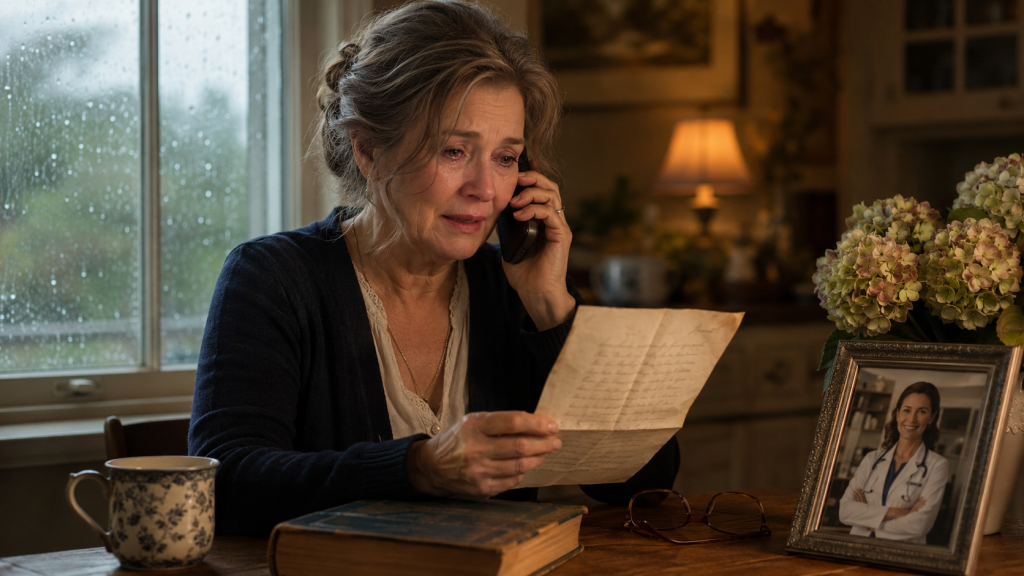
“I shouldn’t have called like this. I just… I found the letter. It was inside an old copy of Jane Eyre I bought at the library sale.”
My eyes filled.
The book.
My book.
The one I had carried from my childhood bedroom to my first apartment, then to the house where I raised my daughter, then to the attic when life got too crowded for old pain.
“What did it say?” I whispered, though I already knew.
David’s breath shook.
Then he read my own words back to me.
“David, I’m pregnant. I need you. Please come back.”
I covered my mouth.
The room blurred.
“I was nineteen,” I said.
“I know.”
“You had moved away.”
“I know.”
“My mother told me you didn’t want me chasing you.”
David went silent.
Then, almost painfully, he said, “Your mother told me you moved to California.”
I froze.
“What?”
“When I came back looking for you, she said you were gone. She said you moved west with family and didn’t want to hear from me again.”
I stood so quickly the chair scraped the floor.
“I never moved to California.”
“I know that now.”
My hand shook against the phone.
“My mother lied.”
The words felt strange in my mouth.
Not because I had never suspected it.
Because suspicion is a shadow.
Truth is a knife.
David’s voice cracked.
“Margaret, what happened to the baby?”
I closed my eyes.
For forty years, I had imagined this question.
In dreams.
In arguments I had with myself while washing dishes.
In quiet moments when my daughter smiled a certain way and I saw his face in hers.
“She’s alive,” I said.
He made a sound like the air had been punched out of him.
“She’s thirty-nine now. Her name is Hannah. She’s a doctor in Boston.”
I swallowed hard.
“She has your eyes.”
David started crying.
Not quietly.
Not politely.
He cried like someone had lost four decades in one sentence.
I leaned against the counter and cried too.
For the boy I loved.
For the girl I had been.
For the daughter who grew up asking why her father had left.
And for the letter that had waited forty years to be brave when I was not.
When David could speak again, his voice was broken.
“I searched for you for ten years.”
I pressed the phone to my ear.
“What?”
“I came back after my father got sick. Your mother told me you were in California. I wrote to the address she gave me. The letters came back. I asked people from school. Nobody knew anything. Then life moved on, but not really.”
He gave a weak laugh.
“I moved back five years ago. I’ve been coming to that library every Saturday, trying to find peace in old books. Instead, I found you.”
I looked toward the donation boxes by the door.
If I had kept that book one more week, he would never have known.
If someone else had bought it, maybe they would have thrown the letter away.
If David had chosen a different table at the library sale, the truth would have stayed buried.
Forty years of silence undone by a used book and a Saturday morning.
I sat back down slowly.
“David, I don’t know what to say.”
“Tell me about her,” he whispered. “Please.”
So I did.
I told him Hannah was born on a snowy March morning after twenty hours of labor.
I told him she screamed so loudly the nurse laughed and said, “That one came here with opinions.”
I told him she loved science before she could spell it.
That she collected rocks.
That she broke her arm at eleven climbing a tree because she wanted to see a robin’s nest.
That she graduated top of her class.
That she went to medical school on scholarships and sheer stubbornness.
That she became the kind of woman people leaned on in emergencies.
I told him she had his eyes.
His serious expression when thinking.
His habit of tapping a finger against a glass when nervous.
His crooked half-smile when trying not to laugh.
David listened without interrupting.
Every few minutes, I heard him breathe in sharply.
As if each detail was both a gift and a wound.
Finally, he asked, “Does she know about me?”
My throat tightened.
“She knows your name.”
“And what did you tell her?”
The shame came then.
Heavy and familiar.
“I told her you left before I could tell you.”
He was quiet.
I rushed on.
“That’s what I believed, David. I swear to you. I thought you left town, started over, and never looked back. My mother told me you knew enough to stay gone.”
“She hated me,” he said softly.
“She hated everyone who threatened her control.”
That was true.
My mother, Evelyn Collins, had been a hard woman.
Widowed early.
Proud.
Religious when it helped her judge people.
She thought appearances mattered more than happiness.
When I told her I was pregnant at nineteen, she did not hold me.
She did not ask if I was afraid.
She slapped me once across the mouth and said, “You will not ruin this family chasing a boy with no future.”
David had moved three states away that summer for a mechanic apprenticeship with his uncle.
We planned to write.
To call.
To make a decision once he had steady work.
I wrote the letter after the doctor confirmed my pregnancy.
Then I hesitated.
I was scared.
I wanted to tell him in person.
I wanted my mother’s permission.
I wanted the world to become kinder before I stepped into it.
But when I finally asked my mother to help me reach him, she came back two days later and said, “He knows. He said you should handle it yourself.”
I believed her.
Because she was my mother.
Because I was nineteen.
Because heartbreak makes lies sound like punishment you deserve.
I never sent the letter.
Instead, I hid it in the book and raised my daughter alone.
My mother helped only enough to make sure people thought she was noble.
At church, she called Hannah “a blessing.”
At home, she called her “your consequence.”
For years, I worked two jobs.
Receptionist during the day.
Cleaning offices at night.
I studied part-time and became a school secretary.
I learned to stretch groceries.
I learned which bills could be late.
I learned how to sew Halloween costumes from old curtains.
I learned to answer Hannah’s questions without breaking.
“Did my dad love you?” she asked once when she was seven.
I kissed her forehead.
“Yes.”
“Then why isn’t he here?”
I told her the only truth I knew.
“Sometimes people don’t come back.”
She cried that night.
So did I.
Now, forty years later, the person who had not come back was on the phone telling me he had tried.
David and I spoke for nearly two hours.
When we hung up, my hands were numb.
I sat in the kitchen long after the call ended.
Then I called Hannah.
She answered from the hospital.
“Hey, Mom. Everything okay?”
I opened my mouth.
No sound came out.
“Mom?”
“Hannah,” I said finally, “I need you to come home this weekend.”
Her voice changed immediately.
“Are you sick?”
“No.”
“Then what happened?”
I looked at the bookless space on my shelf.
“It’s about your father.”
Silence.
Then she said, “My father?”
“Yes.”
“I thought there was nothing left to say.”
“So did I.”
She came the next evening.
Hannah arrived in her navy coat, hair pulled back, overnight bag over one shoulder, doctor posture still wrapped around her even after a three-hour drive.
She looked so much like him that I almost started crying at the door.
“What’s going on?” she asked.
I took her bag.
“Come in.”
We sat at the kitchen table where I had helped her with homework, filled out scholarship forms, packed school lunches, cried over college acceptance letters, and avoided this truth for thirty-nine years.
I placed the old letter between us.
She stared at it.
“What is that?”
“A letter I wrote to David before you were born.”
Her face went still.
“You wrote to him?”
“I meant to.”
I told her everything.
The pregnancy.
The letter.
My fear.
My mother’s lie.
David’s phone call.
The library sale.
The fact that he had searched.
The fact that he had never known.
Hannah did not cry at first.
She listened with the stillness of someone trained to stay calm during emergencies.
When I finished, she picked up the letter.
Her fingers traced the faded ink.
“Grandma lied?”
“Yes.”
“She knew?”
“I believe so.”
“Did she know he came looking?”
I nodded.
Hannah leaned back.
Her face was pale.
For a long moment, she said nothing.
Then she stood and walked to the window.
Outside, snow had begun to fall lightly over the porch.
All the old seasons returning.
“I spent my whole life thinking he didn’t want me,” she said.
Her voice was quiet.
That made it worse.
“I know.”
“You let me think that.”
The words hit me in the chest.
“I thought it was true.”
“You never checked?”
“I was nineteen. Then I was surviving. Then I was ashamed. Then it had been too long.”
Hannah turned around.
Tears were in her eyes now.
“I’m not trying to hurt you, Mom.”
“I know.”
“But I need to be angry.”
I nodded, crying.
“You have every right.”
She pressed the heel of her hand against her forehead.
“I don’t know what to do with this.”
“Neither do I.”
“Does he want to meet me?”
“Yes.”
Her face crumpled.
“Is he married?”
“Widowed. His wife died six years ago. He has no children.”
Something in Hannah’s expression broke open.
“No children?”
“Not that he knew.”
She sat down slowly.
“I need time.”
“Of course.”
But time, after forty years, had become a strange thing.
There had been too much of it.
And suddenly, not enough.
Hannah stayed that night.
We did not talk much.
In the morning, she asked for David’s number.
I wrote it on a piece of paper because sending it by text felt too ordinary for something so impossible.
She stared at the paper for a long time.
Then she said, “I want you there when I call.”
So we sat side by side at the kitchen table.
Hannah dialed.
David answered on the second ring.
“Margaret?”
Hannah’s hand tightened around mine.
“No,” she said softly. “This is Hannah.”
Silence.
Then a sound.
A breath.
A sob swallowed too late.
“Hannah,” David whispered, as if her name was something sacred.
She closed her eyes.
“Hi.”
He tried to speak but failed.
She smiled through tears.
“You sound like Mom said you would.”
He laughed and cried at once.
“I don’t know what to say.”
“Me neither.”
“I’m so sorry.”
She swallowed.
“You didn’t know.”
“I should have found you.”
“You tried.”
“Not enough.”
Hannah wiped her cheeks.
“I don’t know if I can call you Dad.”
“I don’t expect that.”
“I don’t know what I want.”
“That’s okay.”
“But I think I want to meet you.”
On the other end, David broke.
“I would like that more than anything.”
They chose the library.
It seemed right.
The place where the letter came back to life.
The following Saturday, Hannah and I drove into town together.
She was calmer than I was.
Or better at pretending.
I saw David before he saw us.
He stood near the history section, holding a brown paper bag in both hands.
He was older, of course.
Gray at the temples.
Lines around his eyes.
But the crooked smile was still there, hiding nervously beneath fear.
When he turned, his eyes found mine first.
Forty years folded between us.
Then he looked at Hannah.
The paper bag slipped from his hands.
Books spilled across the carpet.
No one moved.
Hannah stared at him.
He stared at her.
And then she laughed softly through tears.
“Well,” she said, “I guess Mom wasn’t exaggerating about the eyes.”
David covered his mouth.
“I missed everything,” he whispered.
Hannah stepped closer.
“You’re here now.”
That was when he cried.
Not loud.
Not dramatic.
Just a man bending under the weight of all the birthdays, first steps, school plays, graduations, heartbreaks, and ordinary Tuesdays he had never been allowed to have.
Hannah reached out first.
She touched his arm.
Then he hugged her.
Carefully.
As if she might disappear.
I stood a few feet away, watching the two halves of my life meet in the quiet corner of a public library.
A librarian pretended not to cry behind the circulation desk.
David had brought something in the paper bag.
A small wooden box.
Inside were letters.
Dozens of them.
Returned envelopes.
All addressed to me.
Margaret Collins.
California addresses I had never lived at.
Letters he had sent over the years, hoping one might reach me.
Hannah picked one up.
The postmark was from 1984.
Another from 1987.
Another from 1991.
Her hands shook.
“You kept them?”
David nodded.
“I couldn’t throw them away.”
I opened one with trembling fingers.
Margaret,
I don’t know if this address is real. Your mother said you moved, but something feels wrong. If you get this, please call me. I don’t care what happened. I just need to know you’re safe.
I cried so hard I had to sit down.
For decades, I thought I had been abandoned.
He had been writing into a void my mother created.
Hannah read another.
Then another.
Each one softened something in her, but also deepened the grief.
Because love had existed.
It had just been intercepted by a lie.
We spent three hours in that library.
Then we went to a diner nearby.
David ordered black coffee and barely touched it.
Hannah asked questions like a doctor taking history.
Where had he lived?
What work had he done?
Had he loved my mother?
Had he hated her?
Had he known about the pregnancy?
Had he ever had children?
David answered everything.
Honestly.
Sometimes painfully.
“I loved your mother,” he said.
Hannah glanced at me.
“Do you still?”
David looked down at his coffee.
“I think some loves don’t stay the same, but they don’t disappear either.”
I looked away.
The room felt suddenly too small.
After that day, life did not become simple.
That is not how truth works.
Truth does not erase forty years.
It reveals them.
Hannah and David began speaking every week.
At first, cautiously.
Then more naturally.
He came to Boston to see the hospital where she worked.
She showed him her office, her framed diplomas, the coffee machine she hated, and the window where she watched sunrise after night shifts.
He cried when he saw the diploma.
She pretended not to notice.
A month later, she invited him to her birthday dinner.
Her thirty-ninth.
The first birthday he had ever attended.
He brought a small silver necklace with a tiny compass charm.
“I know I can’t make up for missing the road,” he said. “But maybe this can mean I’ll be there from here on.”
Hannah hugged him then without hesitation.
I watched from the kitchen doorway, holding the cake.
My heart ached, but it was not jealousy.
It was grief leaving the body slowly.
My mother was still alive then.
Ninety-one years old in a nursing home, sharp enough to hurt and frail enough that people assumed she could not.
For weeks, I avoided telling her.
Then Hannah said, “I want to ask her myself.”
So we went.
David came too, though he waited in the lobby.
My mother sat near the window, wrapped in a blue cardigan, watching birds at a feeder.
When she saw Hannah, she smiled.
“My girl.”
Hannah did not smile back.
“Did you tell David my mother moved to California?”
My mother’s face changed.
Not confusion.
Recognition.
Then annoyance.
After forty years, I knew the difference.
“Why bring up old messes?” she said.
I felt my stomach turn.
Hannah stepped closer.
“Answer me.”
My mother looked at me.
“You told her?”
“The letter did,” I said.
Her mouth tightened.
“You were a child.”
“I was nineteen.”
“You would have ruined your life.”
Hannah’s voice shook.
“My life, you mean.”
My mother looked at her.
“I protected this family.”
“No,” Hannah said. “You stole my father.”
For the first time, my mother had no ready answer.
Then she said the cruelest thing.
“You turned out fine.”
Hannah recoiled as if slapped.
I stepped forward.
“No thanks to your lie.”
My mother’s eyes narrowed.
“I did what needed doing.”
That was all the confession we ever got.
No apology.
No tears.
No remorse.
Just pride wearing the costume of protection.
We left without saying goodbye.
In the lobby, David stood when he saw our faces.
Hannah walked straight into his arms.
He held her while she cried.
That was the moment I understood that some stolen things can be returned, but never untouched.
My mother died seven months later.
At her funeral, I felt less grief than I expected.
More exhaustion.
I placed no lie in her eulogy.
I said she was complicated.
Strong.
Difficult.
A woman shaped by fear who often mistook control for love.
Some relatives looked offended.
Let them.
I was done polishing pain into family honor.
David sat beside Hannah at the funeral.
Not beside me.
That was right.
He was there for her.
Afterward, at my house, we found one final envelope in my mother’s old cedar chest.
It was addressed to David.
In my handwriting.
The letter I had written at nineteen had not been the only one.
There was another.
One I had given my mother to mail weeks later, after Hannah was born.
I had forgotten it completely.
In it, I wrote:
David, she is here. She is beautiful. I named her Hannah. If there is any part of you that loved me, please come see your daughter.
The envelope had never been stamped.
Never sent.
Hannah read it.
David read it.
Then we sat together in silence.
There are moments when anger becomes too large for shouting.
This was one of them.
A year has passed since David found the letter in the library book.
Our lives are still rearranging.
Hannah calls him David most days.
Sometimes, when she is tired, Dad slips out.
The first time it happened, she froze.
David did too.
Then he smiled carefully and kept talking as if his whole world had not just changed.
She has introduced him to her friends.
He keeps every photo she sends.
He learned how to text properly.
He sends too many weather updates.
He drives to Boston for hospital fundraisers and sits in the back, looking proud enough to burst.
As for David and me, people ask if we fell in love again.
The truth is more tender and less simple.
We are not nineteen.
We are not standing behind the bleachers with the whole world ahead.
We are older now.
Changed by marriages, losses, work, grief, and the long discipline of survival.
But there is affection.
There is forgiveness.
There is the strange comfort of someone who remembers who you were before life became heavy.
Sometimes we have coffee.
Sometimes we talk about Hannah.
Sometimes we sit quietly and let the past be in the room without asking it to become the future.
One afternoon, David handed me a copy of Jane Eyre.
Not the same one.
That one now sits in a glass display at the library with our permission, part of a small exhibit about found objects and local stories.
The note beneath it says:
A letter lost for forty years, found at a library sale, reunited a family.
David’s copy was newer.
Inside the front cover, he had written:
Margaret,
This time, nothing hidden.
—David
I cried when I read it.
Of course I did.
I have cried more this past year than I did in the previous twenty.
But tears are not always weakness.
Sometimes they are evidence that the frozen places are thawing.
Last month, the three of us went to the library sale together.
Hannah joked that we should inspect every donated book for family secrets.
David bought a mystery novel.
I bought a gardening book.
Hannah bought an old medical textbook she definitely did not need.
As we walked out, she linked one arm through mine and one through David’s.
For a second, I let myself imagine another life.
A life where the letter was mailed.
Where David came back.
Where Hannah grew up knowing both our voices at the dinner table.
Where my mother’s fear did not become our fate.
That life is gone.
But not everything is lost.
Hannah has her father’s eyes.
Now she also has his phone number.
His laugh.
His stories.
His presence at birthdays.
His hand to hold when grief over the missing years comes without warning.
And I have something too.
Not the past restored.
Not exactly.
I have the truth.
Late.
Painful.
Imperfect.
But finally alive.
I wrote a letter forty years ago and never sent it.
For decades, I believed silence was the end of the story.
But silence was only where the lie lived.
The truth was waiting in a book.
Between old pages.
Inside a library sale.
In the hands of the one man who needed to find it.
And when David Andrews read my words back to me, the girl I had been at nineteen finally got to speak.
David, I’m pregnant.
I need you.
Please come back.
He did not come back then.
Because no one let him know where to go.
But he came back now.
And sometimes, even after forty years, now is still enough to begin again.
THE END! THANKS FOR READING!