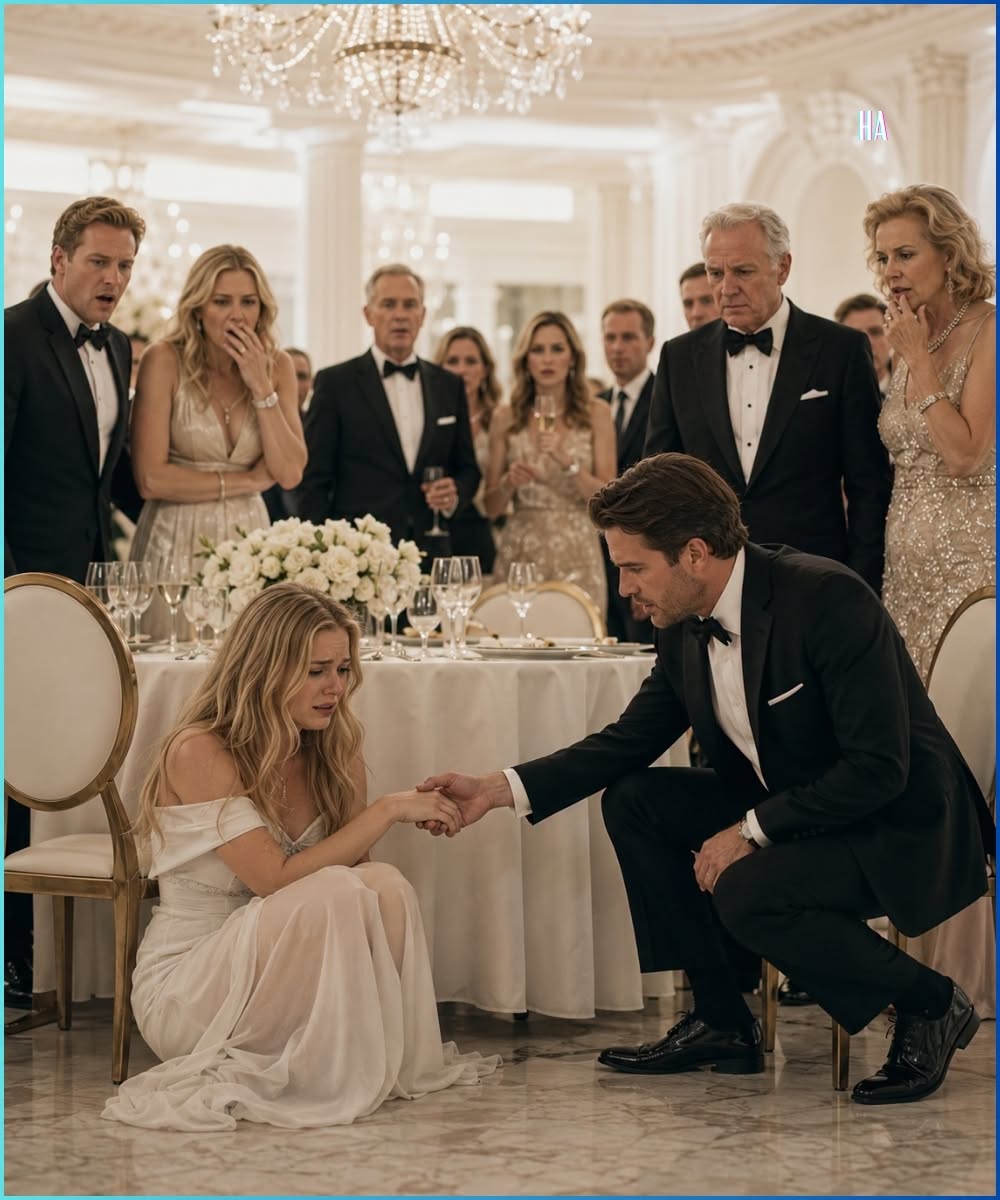
The silence lasted only three seconds.
It felt like an elevator dropping.
Gavin smiled.
“Both, I suppose.”
“That is usually a harder line to walk than people expect.”
Isabelle touched Gavin’s arm and murmured something in French. He did not respond. His attention was on Adrien now, fixed and narrow.
Lena picked up her fork even though her appetite had vanished.
She did not know who Adrien Vale was.
She did not know why he had chosen her.
But she knew the room was no longer laughing.
By the time the second course arrived, Warren Ashford had stopped pretending not to be interested.
He had asked Adrien about sectors, acquisitions, and the size of his transactions. Adrien answered each question with just enough information to make the next question inevitable and just enough restraint to make Warren work for it.
“Infrastructure,” Adrien said. “Manufacturing. Some technology. Mostly domestic.”
“What size acquisitions?” Warren asked.
“Varies.”
“Ballpark.”
Adrien lifted his wine glass and smiled faintly.
“Significant enough that this is a comfortable room. Modest enough that the work still interests me.”
Patricia made a small sound into her wine.
Warren did not laugh.
Lena sat beside Adrien with her shoulders tense and her mind turning faster than the conversation. She could not decide whether she had been rescued, recruited, used, or seen. Perhaps all four. That was what unsettled her most.
Then Uncle David leaned across the table.
“So you’re the reason Lena has been too busy for Christmas the last two years.”
Lena went still.
“David,” Patricia warned.
“I’m just saying.” David waved his fork as if it were a harmless thing. “She missed Christmas twice, Thanksgiving last year, Warren’s birthday dinner. We assumed she was focused on blueprints.”
Three people laughed.
This time, Warren did not.
Elaine did not.
Lena placed her fork down with deliberate care.
Before she could speak, Adrien did.
“She has been building things.”
His voice was even. Not loud. Not angry.
That made it worse for everyone else.
David blinked. “Excuse me?”
“Lena has been building things,” Adrien repeated. “The Greystone public library renovation. The Cormac Street adaptive reuse proposal. The municipal housing complex on Racine. The Cormac project alone is a seven-year construction timeline. The design phase has already taken two. That kind of work does not leave much room for holiday small talk.”
The table became still.
Lena turned to him slowly.
“You know about Cormac Street?”
“I looked you up,” Adrien said.
“When?”
“Before tonight.”
There it was.
A small, cold truth laid gently on the table.
Before tonight.
Lena felt the evening rearrange itself.
Warren leaned forward.
“Vale Dominion,” he said.
Adrien looked at him.
“That is where I know the name,” Warren continued carefully. “Vale Dominion Holdings.”
“I founded it,” Adrien said.
The table did not go quiet.
It froze.
Lena did not know the name, but she knew her father’s face. She knew the rare expression that crossed it now. Not fear. Not exactly. More like a man who had heard a door lock somewhere behind him.
“Vale Dominion Holdings,” Warren said again, as if putting a file in order. “The acquisition group running due diligence on the industrial corridor.”
“Among other things.”
“You’re behind the Kelner deal.”
“One of several.”
Warren’s hand tightened around his glass.
“The Harwick negotiation.”
Adrien set down his fork.
“The Harwick negotiation closed this morning.”
Warren’s eyes sharpened.
“That negotiation was tied to Ashford Industrial’s refinancing package.”
“Yes.”
“The refinancing package has been pending board approval for eleven months.”
“It is no longer pending,” Adrien said. “The board approval was one of the items resolved this morning.”
The silence that followed was so complete Lena could hear the ice shift in Patricia’s glass.
Warren looked at Adrien as if the man beside his daughter had turned from a social inconvenience into a structural threat.
“Are you telling me,” Warren said quietly, “that you control the Ashford refinancing package?”
“I’m telling you that Vale Dominion finalized its majority position in the Harwick Consortium this morning,” Adrien replied. “Which means, effectively, yes.”
Elaine Ashford, for the first time in Lena’s memory, had nothing to say.
Gavin stood from the adjacent table.
“What does that mean for existing executive agreements?” he asked.
Adrien turned toward him fully.
“That depends on what the existing executive agreements actually say.”
Gavin’s face changed.
Lena saw it. So did Warren.
Her father looked at her then, really looked, as if her navy dress and straight spine and quiet face were suddenly part of a calculation he had failed to run.
“Lena,” he said. “How long have you known this man?”
She thought of the flowers after her award. The card. The six weeks of silence.
“Long enough,” she said.
The echo of Adrien’s earlier answer landed across the table like a stone dropped into water.
Gavin excused himself to make a call.
No one stopped him.
Adrien watched him leave with the patience of a man who already knew where that call was going.
Eleven minutes later, Gavin returned without his jacket, his face pale under the ballroom light.
“The Harwick finalization was supposed to be contingent on Q4 projections,” he said.
“It was,” Adrien replied.
“And?”
“They came in satisfactory.”
“To whom?”
“To Vale Dominion’s restructuring board. The relevant body.”
“The existing leadership consultation process was not supposed to be bypassed.”
“It was not bypassed. It was completed in September. Documentation was distributed to all relevant parties.”
“I never received it.”
“Your legal representative did. September fourteenth.”
Warren set his fork down.
“What consultation process?”
Adrien’s attention shifted to him.
“The stakeholder consultation preceding the majority acquisition. Marcus Delvey was the primary contact on your side. He signed the acknowledgment forms.”
Warren went perfectly still.
“Marcus signed?”
“Yes.”
“Marcus Delvey has been my CFO for eleven years.”
“I know,” Adrien said. “He is at table twelve. Navy tie.”
Warren pushed back his chair and stood.
“I need to speak with you privately.”
“Of course.”
Adrien rose, but before he followed Warren, he looked at Lena. The look was brief. Not apology. Not reassurance exactly.
A comma, not a period.
Lena watched them disappear toward the corridor.
The room resumed in fragments. Elaine moved through guests with controlled urgency. Patricia touched Lena’s arm and whispered, “What is happening?”
“I don’t know,” Lena said.
But she did know one thing.
Something inside the Ashford empire had failed, and the walls were beginning to show where the damage had been hidden.
Gavin returned to her table before Warren did.
“How long have you known him?” he asked.
“You already asked me that.”
“No. Warren asked you that.”
“Why does it matter?”
“Because a man walked into this room, took your hand, sat at your family table, and six hours later my executive agreement is apparently tied to paperwork my attorney received three months ago.”
“Then you should call your attorney.”
His jaw flexed.
“Did you know about the acquisition?”
“No.”
“Did you know he was connected to it?”
“I met him tonight.”
“Lena.”
The way he said her name took her back four years.
Back to the kitchen of her apartment, the engagement ring on the counter, Gavin saying she was too interior, too quiet, too committed to work that did not move the needle.
She had loved him then.
Or she had loved the version of him she built because she was tired of being alone in rooms.
“I did not bring Adrien here,” she said. “He was here. He took my hand when I was walking out because nobody in this room cared whether I stayed or left. That is the beginning and end of my relationship with him. So whatever you are implying, Gavin, be careful. It says more about you than it says about me.”
Gavin sat back.
For one second, she saw something accurate move through his face.
Then he closed the door inside himself.
He stood and walked away.
Thirty seconds later, the corridor doors opened and Marcus Delvey came through them.
The CFO moved like a man whose plan had just been shot in the dark. Compact, sixty, tightly dressed, with a face built from decades of financial stress. He crossed toward the corridor, then stopped as Warren emerged.
The two men faced each other three feet apart.
Lena stood.
She reached them just as Warren said, in a voice so compressed it barely sounded human, “You signed acknowledgment forms without telling me.”
Marcus lifted his hands.
“They said it was a formality.”
“Three months,” Warren said. “You sat in my office for three months and did not tell me?”
“The deal was not supposed to close on this timeline.”
“But it did close,” Warren said. “This morning. And you knew enough to sign.”
“I was protecting the deal.”
Warren leaned closer.
“Whose deal?”
Marcus did not answer.
That silence was enough.
Adrien appeared behind Lena.
She turned to him.
“Gavin has a direct financial interest in this, doesn’t he?”
Adrien’s eyes met hers.
“Yes.”
“What does that mean?”
“When your father began refinancing the company’s primary debt position eighteen months ago, Gavin Mercer negotiated a private success fee with the Harwick Consortium.”
Lena felt the words enter her body one at a time.
“He was supposed to be representing Ashford’s interests.”
“Yes.”
“But he negotiated privately with the people across the table.”
“Yes.”
The eighteen months of their engagement rose in her memory.
Gavin late on calls. Gavin saying the deal was complicated. Gavin insisting timing was sensitive. Gavin asking casual questions about her father’s moods, her father’s board meetings, her father’s confidence in the refinancing.
And her, in love, answering because she had not known she was useful.
“How long have you known?” she asked Adrien.
“Eight months.”
“And you still took my hand?”
“Yes.”
“Did you know I would be here tonight?”
He did not look away.
“Yes.”
The honesty hurt worse than a lie.
“Why?”
“Because I needed to be in this room. Because certain conversations would not happen with me as a stranger at the edge of it. And because you were standing at the edge of it too, looking like someone who deserved the center.”
“So taking my hand was useful.”
“Yes.”
“And genuine?”
“Yes,” he said immediately. “Both things were true.”
Lena stared at him.
“I’m not sure that makes it better.”
“I know.”
He did not defend himself. That was what made her angriest. There was nothing to push against.
Then he said, “There is something else.”
She almost laughed.
“Of course there is.”
“Your Cormac Street proposal was never rejected.”
The floor seemed to tilt.
“What?”
“It was buried. Daniel Foresight reclassified it as non-urgent after giving it a high-priority internal score. Six days later, he met with Kelner Design Associates, who submitted a competing corridor proposal. Kelner had prior financial ties to him.”
Lena could not move.
Seven months of work.
Eight hundred pages of load calculations, sourcing plans, community impact reports, and phased construction models.
She had submitted it to Ashford Industrial and waited. Called. Followed up. Been told it was under review. Been told the division was transitioning. Been told nothing at all.
Eventually, she had stopped asking because reaching toward her parents’ world had always hurt more than pretending she did not want it.
“Who else knew?” she asked.
“Foresight. Gavin. Marcus knew the Harwick side. The audit suggests the connections overlap.”
Across the ballroom, Warren turned toward Gavin.
“Sit down,” Warren said.
Gavin sat.
And Lena understood that she had reached the moment that would decide who she became after this night.
She could step back.
She could let Warren and Adrien and the lawyers fight over the company while she returned to her apartment, her blueprints, her quiet life, and the old lie that leaving was the same as choosing peace.
Or she could step forward.
Her weight shifted before her mind caught up.
Adrien noticed.
Warren was already moving toward the podium.
Lena followed.
Part 3
At 10:43 p.m., Warren Ashford stepped onto the presentation platform at the north end of the Harrow Grand Ballroom and picked up the microphone.
The anniversary slideshow had ended hours earlier. The screen still showed a pale gold logo with Warren and Elaine’s initials intertwined like expensive vines.
The orchestra stopped.
Two hundred guests turned.
Warren did not use his speech voice.
Lena knew that immediately. He had a voice for rooms, a voice with pauses built into it, a voice that carried authority without admitting effort. This was not that voice.
This voice was older.
“I had a speech,” Warren said. “Elaine and I worked on it for two months. It is in my jacket pocket, and I’m told it is very good.”
A few people gave nervous smiles.
“I am not going to give it.”
The smiles disappeared.
Warren looked out over the room.
“Forty years is a long time to build something. Long enough that a man can confuse the building with what is inside it. Long enough to start protecting the structure and forget what the structure was meant to protect.”
Elaine stood twelve feet from the platform, silver gown motionless around her. Her face was stripped of performance.
“I learned something tonight,” Warren continued. “About decisions made inside my company without my knowledge. About people I trusted. About what they did with that trust.”
His eyes shifted to Lena.
“And I learned something about my daughter.”
Lena’s chest tightened.
“She submitted a development proposal to Ashford Industrial fourteen months ago. I did not know. I am standing here, in front of friends, family, employees, partners, and competitors, saying that I did not know my own daughter had submitted work to my own company.”
No one moved.
“People I trusted decided what was worth my attention. They decided her work was not.”
Warren’s jaw tightened.
“They were wrong.”
Lena looked at the floor because looking at him was suddenly too much.
“I have read enough of the summary to know they were wrong. Her proposal was strong. It was serious. It was the kind of work I claim this company exists to build.” His voice lowered. “And I did not see it because I was not looking.”
He turned fully toward her.
“I’m sorry.”
Just two words.
No explanation.
No defense.
No speech around them to make them easier for him.
Lena did not trust her voice.
She nodded once.
It did not heal twenty-nine years.
But it mattered.
Then Gavin stood.
“The proposal,” he said, addressing the room with a lawyer’s confidence and a desperate man’s posture, “was reviewed according to standard division procedure and held pending additional market analysis. That is normal for a capital-intensive initiative.”
“That has nothing to do with normal procedure,” Adrien said.
His voice was quiet, and it silenced the room more completely than shouting could have.
He placed a bound document on the podium. Printed, tabbed, prepared.
“The development review log shows Lena Ashford’s proposal received a high-priority score on the day it was submitted. It was then reclassified as non-urgent by Daniel Foresight and filed without board notice.”
At table nine, Daniel Foresight turned the color of old paper.
“Six days later,” Adrien continued, “Foresight had dinner with representatives from Kelner Design Associates. Kelner later submitted a competing proposal. Their proposal advanced. Lena’s did not. The corridor remained undeveloped.”
Gavin’s mouth tightened.
“That is circumstantial.”
“Yes,” Adrien said. “The wire transfers are less so.”
A sound moved through the ballroom.
Adrien turned a page.
“In February, one hundred forty-two thousand dollars moved from a Kelner subsidiary into a Delaware LLC. The registered officer of that LLC is Gavin Mercer.”
Gavin did not sit down.
Warren looked at him.
“Stop talking.”
Two words.
Gavin stopped.
Adrien faced the room.
“Vale Dominion Holdings finalized a majority acquisition of the Harwick Consortium this morning. That makes us controlling financial partner in the Ashford Industrial refinancing structure. Existing executive agreements are under review. Audit findings will be distributed to the board within seventy-two hours. Mr. Foresight, you should be available Monday at 9 a.m. with counsel.”
Daniel Foresight closed his eyes.
“The Cormac Street proposal,” Adrien said, turning to Lena, “will be re-entered into board development review under independent oversight. The initiative is seven years delayed. It will not be delayed further.”
Lena felt every person in the room looking at her.
For most of her adult life, that kind of attention had felt like exposure. Like danger. Like a bright light revealing every place she failed to match the Ashford family blueprint.
But tonight, standing on a platform beside her father and a man who had been both honest and calculating enough to terrify her, the attention felt different.
It felt like weight.
And weight, properly distributed, was something she understood.
Marcus Delvey cleared his throat near the corridor.
“I want to say something.”
Warren looked at him.
“I signed the acknowledgment forms because I believed the acquisition would protect the company,” Marcus said. “I thought the refinancing would secure the employee base. I thought the leadership disruption would be manageable. I was not doing it for personal benefit.”
Warren’s face was cold with grief.
“Your belief does not change what you did.”
Marcus nodded.
“No,” he said. “It does not.”
Elaine stepped onto the platform then, without drama. She took Warren’s hand. The gesture was so private the room almost politely looked away.
Before Lena did, she saw her mother’s face.
It said, I know.
Not everything. Not enough. But something.
Gavin picked up his jacket.
“This isn’t over,” he said to Lena.
The old Lena might have looked at the floor. Might have absorbed the threat and carried it home, where it would bloom into anxiety at two in the morning.
This Lena looked directly at him.
“Yes,” she said. “It is.”
For a moment, his face changed into something almost human.
Then he left.
Isabelle followed him without a word.
The corridor door closed.
The ballroom breathed.
Adrien stood beside Lena.
“You all right?” he asked quietly.
She took inventory. Her hands were steady. Her feet hurt. Her heart felt bruised and awake.
“I don’t know yet,” she said.
He nodded, as if that was the only honest answer.
The party did not end, exactly. Wealthy rooms rarely end just because truth enters them. The orchestra resumed. People spoke in lower voices. The event coordinator saved what could be saved. Plates were cleared. Champagne was poured for people who no longer wanted it but held it anyway because hands need assignments during disaster.
Patricia touched Lena’s arm.
“I didn’t know about the proposal,” her aunt whispered.
“I know.”
“I should have known more.”
Lena looked at her.
“Yes,” she said gently. “You should have.”
Patricia’s eyes filled. She nodded and let go.
That, too, was a beginning.
At 10:58 p.m., Warren found Lena near the edge of the ballroom.
He held the twelve-page summary of her Cormac Street proposal in one hand. Seven months of her life reduced to twelve pages a board could understand.
“The full version is eight hundred pages,” Lena said. “Load calculations. Material sourcing. Phased construction. Community impact. Everything.”
“I’m going to read all of it.”
“You should have read it fourteen months ago.”
“Yes,” Warren said. “I should have.”
She did not soften the truth for him.
For once, he did not ask her to.
“There will be consequences,” Warren said. “For Foresight. For Marcus. For Gavin. For everyone involved.”
“No quiet settlements that bury the documentation,” Lena said. “No protecting the machinery because it is embarrassing to open it up. Proper process.”
Warren studied her.
“When did you get this way?”
“I was always this way,” Lena said. “You were not paying attention.”
The words landed between them.
He accepted them.
“No,” he said. “I was not.”
It was not enough to repair a lifetime.
But Lena was an architect.
She knew the difference between a finished building and a foundation.
She could work with a foundation.
She found Elaine in the anteroom off the ballroom, sitting in a chair with her silver heels off, her perfect gown gathered around her, looking more like a tired woman than a host.
Lena sat across from her.
“I did not know about the proposal,” Elaine said.
“I believe you.”
“But I also did not ask,” Elaine continued. Her voice trembled in a way Lena had never heard. “I did not ask what you were working on. I did not ask what mattered to you. I let your father’s company become the architecture of this family, and when you did not fit inside it, I treated that like your failure.”
Lena looked at the single orchid on the small table between them.
“The note with the dress,” she said. “Something that does not make you disappear. I thought you were criticizing me.”
Elaine closed her eyes.
“I meant the room,” she whispered. “I meant I did not want the room to make you disappear the way these rooms always do. I should have said that. I wrote three words because saying what I mean is something I stopped practicing a long time ago.”
Lena’s throat tightened.
“I wore navy on purpose.”
“I know,” Elaine said, and for the first time that night she almost smiled. “You always do things on purpose, even when the purpose hurts you.”
“That sounds like Dad.”
“It is one of the things you got from him.”
Elaine reached across the table and touched Lena’s hand.
No air kiss. No performance. No social warmth polished for witnesses.
Just a hand reaching.
Lena turned her hand over and held on.
They sat that way until the music on the other side of the wall became soft enough to feel like memory.
The audit took eleven weeks.
It was not clean, because truth rarely arrives clean when it has been hidden under money.
Every Monday and Wednesday, Lena sat in Vale Dominion’s forty-first-floor conference room across from lawyers, accountants, forensic auditors, and Ashford executives who looked as if they had aged ten years since the anniversary dinner.
She read documents the way she read structural drawings. She looked for pressure points, weak connections, false supports, concealed loads.
Daniel Foresight resigned on the ninth day. He returned the Kelner referral fee and accepted a three-year bar from development-sector leadership. It was not spectacular, but it was permanent, and Lena had learned that permanent consequences mattered more than dramatic ones.
Marcus stayed because Warren asked him to, though not without consequence. His authority was restructured. His decisions were reviewed. He sat through a four-hour board session where every person at the table read what he had done and what it had cost. At the end, he said, “I understand, and I am sorry.”
No one comforted him.
No one destroyed him.
That felt like the correct temperature of justice.
Gavin’s settlement happened behind legal doors. The Delaware LLC, the transfers, and the conflict of interest were enough to trigger breach clauses in his agreement. Lena did not attend. She refused to build her future on the foundation of personal revenge. She had seen enough damaged structures to know what happened when the wrong material carried too much weight.
Isabelle sent one message through an intermediary.
I did not know about the arrangement when I became involved with him. I am sorry I was in that room.
Lena waited a day before replying.
I believe you. I hope you are well.
Then she let it be complete.
In the ninth week, Lena presented the Cormac Street proposal to the Ashford board.
Not the summary.
All of it.
Eight hundred pages. Two days. Load calculations, renderings, site models, community impact projections, traffic studies, material costs, affordable housing ratios, public courtyard plans, stormwater capture systems, and the full seven-year construction timeline.
When she finished, no one laughed about blueprints.
The board approved the project with no votes against.
Afterward, Lena sat alone in her car in the parking structure for twenty minutes.
She did not cry.
She did not feel triumphant.
She felt the strange lightness of a person who had carried something for so long that setting it down felt almost frightening.
Then she called her assistant.
“Book the first site survey for next Thursday,” she said.
Seven months later, on a gray spring morning, Lena stood at the edge of the Cormac Street industrial corridor in work boots, a three-year-old jacket, and mud on her left heel.
The first excavator waited behind orange fencing.
The land looked ugly to people who did not know how to see beginnings. Broken concrete. Damp soil. Rusted chain link. Warehouses with shattered windows and faded signs from companies that had died before Lena was born.
To her, it was beautiful.
Adrien arrived at 7:53 a.m., seven minutes before the first excavation.
No driver. No entourage. Just him, hands in his coat pockets, standing beside her like the morning belonged to neither of them and both of them.
“There should be a ribbon cutting,” he said.
“I am not building a shopping mall.”
“A ceremonial shovel, then.”
“Ceremonial shovels are for people who want photographs. I want to watch the foundation work.”
His mouth curved.
“You are going to watch all of it, aren’t you?”
“The foundation, yes. Four months minimum.”
“In that jacket?”
“This jacket is structurally sound.”
“It is three years old.”
“So are several bridges you have invested in.”
He laughed then, quietly, and Lena felt the sound settle beside her.
They had not rushed whatever was growing between them. She knew he was solitary. He knew she distrusted grand gestures. He had apologized once, clearly, for using the anniversary dinner to gain access to conversations he needed. She had told him she was still angry. He had said, “That is fair.” And then he had not tried to argue her out of it.
That mattered.
A man who could admit calculation without pretending it was purity was not simple.
Lena was no longer interested in simple.
“My father called this week,” she said.
“I know. He told me he would.”
“You two are talking?”
“Since the audit.”
“He is difficult.”
“He is easier when he is not protecting something.”
Lena considered that.
It was true.
Warren had been doing the work quietly. Meeting employee leadership. Changing board reporting policies. Calling Lena to ask about site surveys and listening for eleven minutes without redirecting the conversation. He had not become perfect. People did not become perfect because they were sorry.
But patterns could change.
Structures could be reinforced.
Foundations could be repaired if the damage was seen clearly enough and the people responsible stopped lying about the cracks.
“He asked if I was all right,” Lena said. “I told him yes.”
“And did you mean it?”
She watched the excavator lower its bucket into the earth.
“Yes,” she said. “But it felt smaller than I expected. I thought being all right would feel like something arriving. Instead it feels like this.”
“Like what?”
She looked at the survey stakes, the gray soil, the first clean line opening in the ground.
“Like a foundation,” she said. “You do not see most of it. But everything that comes after depends on whether it holds.”
Adrien was quiet for a moment.
“Is it solid?”
Lena looked at the site. At her drawings under her arm. At the beginning of seven years of work. At the man beside her, who had taken her hand in a room designed to erase her and then stayed long enough to help her face what came after.
She thought about the navy dress.
The forty-two chandeliers.
The cousin who laughed.
The father who apologized.
The mother who reached across a table with her shoes off.
The ex-fiancé who mistook her silence for usefulness.
And the blueprints that had always been real, even when no one wanted to read them.
“Yes,” Lena said. “It is.”
The excavator made its second pass. The earth opened in a long, clean line exactly where the survey stakes said it should.
Lena unrolled the drawings against the morning wind and looked at what was going to be built.
THE END