The investigator’s voice did not rise above the hush of the ballroom, yet it landed harder than any scream could have.
For the first time in my life, I saw my father hesitate.
Richard Brooks, the man who had built an empire from pressure, polish, and perfectly timed lies, stood beneath the crystal chandeliers with his jaw clenched and his eyes darting between me, Madison, the champagne flute in my hand, and the uniformed officers entering quietly behind Detective Aaron Vale.
Around us, the engagement party had transformed into a courtroom without walls. The string quartet sat motionless. The servers stood pale beside silver trays. Guests in silk gowns and tailored suits held their breath, suddenly aware that they had not come to witness a celebration.
They had come to witness a collapse.
“Detective,” my father said, recovering just enough to sound offended, “this is a private family event. Whatever misunderstanding my son has caused can be handled later.”
Detective Vale did not blink. “Mr. Brooks, a guest at your home reported possible drink tampering. Given the circumstances surrounding the death of your first wife, I’m not inclined to treat that as a misunderstanding.”
The room erupted in whispers.
My mother—my stepmother, though she had raised me longer than my real mother had lived—turned slowly toward Richard. Her face had gone bloodless.
“Your first wife?” she repeated. “What does that mean?”
Richard looked at her sharply. “Eleanor, don’t listen to this.”
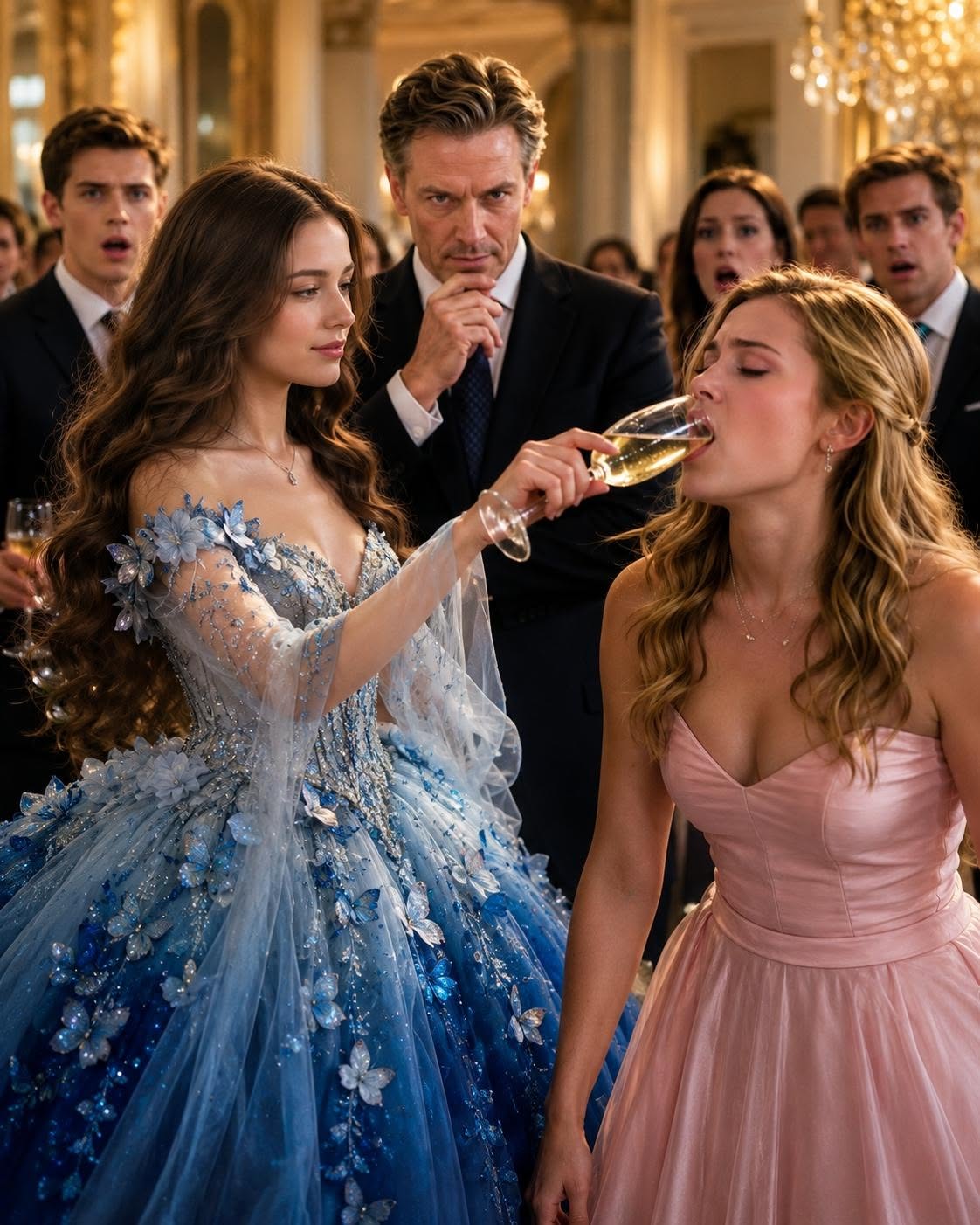
But Madison was still staring at the flute.
She was always the bright one in our family, the golden daughter, the one my father showed off to investors and senators and magazine editors. Madison Brooks never looked frightened. She looked polished, composed, untouchable.
Now her hands were shaking.
I stepped closer to her. “Madison, put the glass down.”
She looked at me as if waking from a dream. “I already drank it.”
Those four words sliced through me.
For one awful second, the entire world narrowed to her face. The color in her cheeks. The movement of her breathing. The slight tremor in her lips.
“Call an ambulance,” I said.
“I’m fine,” Madison whispered, though her voice was too thin to convince anyone.
Detective Vale signaled to one of the officers, who spoke quickly into a radio. Another officer moved toward the refreshment table, warning guests away from the champagne and carefully securing the bottles and glasses.
Richard stepped forward. “This is absurd. My daughter is perfectly fine.”
“Then you won’t mind if paramedics examine her,” Vale replied.
My father’s expression hardened. It was brief, but I saw it. So did Madison.
Not concern.
Calculation.
And that was the moment her faith in him broke.
She turned on him slowly. “Dad,” she said, barely louder than a breath, “why was my glass separate?”
Richard’s face softened instantly. The perfect father returned, the one who knew which tone could calm a frightened daughter and which smile could tame a room.
“Because you don’t drink the house champagne,” he said gently. “You always complain it gives you headaches. I asked them to pour you the imported one.”
Madison swallowed. “I never told you that.”
The silence that followed was colder than the marble floor.
My father’s eyes flickered.
It was tiny. Almost invisible.
But Detective Vale noticed.
So did I.
Richard laughed once, softly. “You must have. Or your mother mentioned it.”
Eleanor shook her head. “I didn’t.”
The detective moved closer, his black coat still wet from the rain outside. “Mr. Brooks, I’d like you to come with us to the study.”
“No,” Richard said. “Anything you have to say, say it here.”
Vale studied him for a moment. “Very well.”
My father’s mouth tightened.
Detective Vale turned slightly toward the crowd, not performing, not raising his voice, but making certain every word traveled.
“Earlier this evening, we received information suggesting that an attempt might be made to harm Madison Brooks during this event. That information was connected to an ongoing review of several old cases involving the Brooks family, including the death of Claire Whitmore Brooks seventeen years ago.”
My mother.
The name moved through the ballroom like a ghost finally given permission to enter.
I had been eight years old when Claire died.
For seventeen years, I had been told she suffered a sudden reaction to medication. For seventeen years, my father had stood beside her portrait in the west hallway every anniversary and spoken of grief with dry eyes and practiced sorrow.
For seventeen years, I believed him.
Until I found the letters.
Until I found my mother’s handwriting locked inside an old cedar box in the attic, hidden beneath files my father thought no one would ever touch.
If anything happens to me, look at Richard.
That was the first line.
I had read it three nights ago with the kind of disbelief that makes a person laugh because the alternative is screaming. Then I found bank records, old medical notes, a list of names, and one photograph of my mother standing beside a woman I had never seen before.
On the back, she had written: Mara knows everything.
I found Mara too late.
She was already dead.
A car accident, the police had said. Terrible weather. Poor visibility.
But Detective Vale had not believed in coincidences. Not after I brought him my mother’s letters. Not after he recognized one of the names in her notes.
And not after he told me that the woman in the photograph had once been an investigator herself.
Tonight was supposed to expose Richard.
I just hadn’t known Madison would be the bait.
The paramedics arrived through the main entrance, their equipment rolling over the polished floor. Madison tried to insist again that she felt fine, but the moment she stood, her knees weakened. I caught her before she could fall.
“Madison?” Eleanor cried.
My sister clutched my sleeve. “I feel dizzy.”
Every guest seemed to move at once, panic rippling through the room, but the officers held them back as the paramedics guided Madison into a chair and began checking her pulse, her eyes, her breathing.
Richard watched without stepping closer.
That, more than anything, made Eleanor begin to cry.
“Is she going to be okay?” I asked the paramedic.
“We need to get her to the hospital,” he said. “Now.”
Richard finally moved. “I’m going with her.”
“No,” Madison said.
It was quiet, but everyone heard.
Her eyes were fixed on him.
“No, Dad. I want Nathan.”
My father’s face turned gray.
For years, Madison had chosen him over me in every argument, every holiday, every inheritance meeting disguised as dinner. She had believed I was bitter. Reckless. Jealous. The disappointing son who couldn’t stop questioning the man everyone admired.
But now she reached for my hand.
And I took it.
“I’m coming,” I told her.
Detective Vale stepped into my path before I could follow the paramedics. “Nathan.”
I looked at him, furious. “Not now.”
“I need the flute.”
Only then did I realize I was still holding it.
My fingers had tightened around the stem so hard my knuckles ached. I handed it over carefully, and an officer placed it into an evidence bag.
Vale lowered his voice. “Stay with your sister. Don’t let anyone speak to her alone.”
I glanced at my father.
He was staring at me with such cold hatred that, for a moment, I saw the man my mother must have seen at the end.
Then he smiled.
Not for the guests.
Not for the police.
For me.
A promise.
The ambulance took Madison through the rain while the party behind us dissolved into chaos. I climbed in beside her, still holding her hand as the paramedics worked around us. Her engagement ring glittered under the harsh white light. It looked strange there, too bright against her trembling fingers.
“Julian,” she whispered suddenly.
Her fiancé.
I had forgotten him.
Julian Voss had stood near the bar when everything began, handsome, quiet, and elegant in the way men with old money often were. He had proposed to Madison six weeks earlier with a diamond large enough to become a headline. My father had approved immediately, which should have made me suspicious.
“He was there,” Madison murmured.
“Where?”
“At the refreshment table.” She squeezed her eyes shut. “Before Dad came over. Julian was talking to the server.”
My stomach tightened. “Are you sure?”
She opened her eyes. “I thought he was asking about the toast. But when you shouted, he disappeared.”
I looked through the ambulance window at the flashing red lights reflecting off the gates of the Brooks estate.
Julian had vanished.
By the time we reached St. Catherine’s Hospital, Madison’s dizziness had worsened, though she remained conscious. Doctors rushed her through double doors while I was stopped in the hallway and told to wait.
Waiting is a cruel thing when you have spent your whole life being lied to.
I paced beneath fluorescent lights, my suit still damp from the rain, replaying the evening from every angle.
The server’s nervous confession.
Richard’s panic.
Julian near the table.
Madison’s separate glass.
My mother’s letters.
The photograph.
Mara knows everything.
But Mara had not known everything. Or if she had, she had taken it with her into the grave.
Unless she had left something behind.
My phone buzzed.
Unknown Number.
I almost ignored it.
Then I opened the message.
Stop trusting Detective Vale.
Beneath it was a photograph.
My blood turned cold.
It showed Detective Vale standing outside a restaurant at night, shaking hands with Julian Voss.
The timestamp was from two days ago.
I stared at it until the screen blurred.
Another message arrived.
Your father is not the only liar in the room.
I called the number immediately.
Disconnected.
I tried again.
Nothing.
A nurse approached before I could think clearly. “Mr. Brooks?”
I shoved the phone into my pocket. “Is Madison okay?”
“She’s stable,” the nurse said. “The doctors believe she ingested a small amount of a sedative compound. Dangerous, but not immediately fatal at the dose she received.”
I gripped the back of a chair. “Sedative?”
“That’s the preliminary finding. We’re running full toxicology.”
Sedative.
Not poison.
Not murder.
Control.
My father had not meant for Madison to die in the ballroom. He had meant for her to become weak, confused, removable.
But why?
Before I could ask anything else, Eleanor rushed into the waiting area, soaked from the rain, mascara streaked beneath her eyes. She looked smaller than I had ever seen her.
“Nathan,” she said. “Where is she?”
“Stable. They’re treating her.”
She covered her mouth, relief nearly breaking her knees. I helped her sit.
For a few moments, she said nothing. Then she looked at me with eyes full of fear and shame.
“I should have listened to you.”
I had waited years to hear those words.
They brought me no satisfaction.
“What did you know?” I asked.
She flinched.
“That’s not an accusation,” I said, though it partly was. “But Madison almost got drugged at her own engagement party. My mother may have been murdered. If you know anything, tell me now.”
Eleanor twisted her wedding ring. “Your father has been under pressure.”
“From who?”
She shook her head. “I don’t know. He stopped taking calls in the house. He moved files out of the office. He dismissed two accountants last month. Then Julian came.”
“What does Julian have to do with it?”
Her lips parted, but before she could answer, Detective Vale appeared at the end of the hall.
I stood too quickly.
He walked toward us, calm and grave, as though he belonged in every crisis.
“How is Madison?” he asked.
“Stable,” I said. “Sedative, apparently.”
A shadow crossed his face. “That changes things.”
“Does it?”
He met my eyes. “What’s that supposed to mean?”
I pulled out my phone and showed him the photograph.
For once, Detective Vale’s composure cracked.
Only slightly.
But enough.
“Where did you get this?” he asked.
“Someone sent it to me.”
“When?”
“Five minutes ago.”
He reached for the phone. I pulled it back.
His gaze sharpened. “Nathan, this is evidence.”
“So explain it.”
Eleanor looked between us. “What’s going on?”
I kept my eyes on Vale. “Why were you meeting Julian two days ago?”
The detective’s jaw tightened. “Because Julian Voss is the person who warned us Madison might be in danger.”
That answer should have relieved me.
It didn’t.
“Then why did he disappear tonight?”
Vale’s silence lasted half a second too long.
“You don’t know,” I said.
“We’re looking for him.”
A cold laugh escaped me. “Fantastic.”
“Nathan,” he said quietly, “someone is manipulating you. That message was designed to make you distrust the investigation.”
“Or it was designed to make me stop trusting the wrong investigator.”
His face hardened. “Your sister is alive because we acted tonight.”
“My sister is alive because I stopped the toast.”
The words came out sharper than I intended.
Vale took the hit without reacting. “Yes. And if you want her to stay safe, you need to stop reacting and start thinking.”
I hated him for being right.
Eleanor rose slowly. “Detective, what is happening to my family?”
Vale looked at her with something almost like pity. “Mrs. Brooks, your husband may have been trying to prevent Madison from signing something tomorrow morning.”
Eleanor froze. “The trust transfer.”
I turned to her. “What trust transfer?”
She closed her eyes. “Madison’s inheritance from her maternal grandfather. She gains full control at twenty-six. Tomorrow she was supposed to sign papers separating her assets from Brooks Holdings.”
“Why would she do that?”
“Because Julian advised her to.”
There he was again.
Julian Voss, the perfect fiancé.
The warning source.
The vanished man.
The advisor.
I leaned against the wall, suddenly understanding why my father had approved the engagement so quickly. He thought Julian could be managed. Or bought. Or used.
But maybe Julian had been using all of us.
Vale’s phone rang. He answered, listened, and his expression changed.
“What?” I demanded.
He ended the call. “Richard Brooks has left the estate.”
Eleanor gasped. “The police let him leave?”
“He wasn’t under arrest. Not yet.”
“Where is he going?” I asked.
Vale looked at me. “That’s what we need to find out.”
Before anyone could move, another message appeared on my phone.
This one had no photograph.
Only an address.
The Whitmore Mausoleum. Midnight. Come alone if you want the truth about your mother.
I stared at the words until the hallway seemed to tilt.
Vale saw my face. “Nathan.”
I locked the screen. “It’s nothing.”
“Don’t lie to me.”
“That’s funny coming from you.”
He stepped closer. “Show me the message.”
I looked toward the doors where Madison was being treated. Then at Eleanor, trembling in the cold hospital light. Then at Vale, who may have been an ally, or another man with a carefully polished mask.
“I need air,” I said.
“Nathan.”
But I was already walking away.
I know how foolish it sounds now.
Every terrible decision feels obvious once the damage is done. But in that moment, with my sister alive but targeted, my father vanished, Julian missing, and my mother’s death clawing its way out of the past, I could not wait for permission from men who had spent years arriving too late.
The Whitmore Mausoleum stood on the oldest hill in Ashbourne Cemetery, where the city’s founding families buried their secrets beneath marble angels and iron gates. Rain fell in fine silver threads as I parked beyond the main road and climbed the hill on foot, my dress shoes sinking into wet grass.
Midnight had painted the cemetery black.
At the top of the hill, the mausoleum waited beneath two cypress trees, its stone doors carved with the Whitmore crest. My mother’s family had been wealthier than my father’s once. Older, quieter, harder to impress.
Richard Brooks had married into their world.
Then, somehow, he owned most of it.
A single lantern glowed beside the entrance.
Beside it stood Julian Voss.
His tuxedo was gone. He wore a dark coat, his blond hair damp from the rain. He looked less like a runaway groom now and more like a man who had never intended to marry anyone.
“You shouldn’t have come alone,” he said.
I almost laughed. “You told me to.”
“No,” he said. “I didn’t.”
The cemetery seemed to hold its breath.
I took a step back.
Julian raised both hands slowly. “I didn’t send the messages, Nathan.”
“Then who did?”
A voice answered from the darkness behind me.
“I did.”
I turned.
My father emerged between the gravestones, holding a black umbrella. His face was calm again, almost serene. The panic from the ballroom was gone. The anger too.
This was the Richard Brooks I knew best.
The one who had already decided the ending.
“Hello, son,” he said.
Julian moved toward me. “Nathan, listen carefully. Your father—”
A sharp crack split the night.
Julian staggered, clutching his shoulder, and fell against the mausoleum steps.
I froze.
Richard lowered the small pistol in his hand, his expression unchanged.
No blood showed in the rain-dark fabric, but Julian’s face twisted with pain as he slid to the ground.
“You always did interrupt,” Richard said to him.
My heart hammered against my ribs.
“Dad,” I whispered.
He looked almost disappointed. “Still? After everything?”
I could not move. I could barely breathe.
Richard stepped closer. “You were never supposed to be part of this, Nathan. You were supposed to remain exactly what you always were. Angry. Isolated. Easy to dismiss.”
“Why Madison?” I asked.
His mouth tightened. “Because your sister became sentimental. She started asking questions about the company. About the trust. About her grandfather’s money. Julian encouraged it.”
Julian groaned, trying to push himself upright.
Richard glanced at him. “Stay down.”
“What happened to my mother?” I asked.
For a moment, something like irritation crossed his face.
Not guilt.
Irritation.
“Claire was brilliant,” he said. “Too brilliant. She discovered irregularities in the merger accounts. She thought the Whitmore fortune had been stolen from her family.”
“Had it?”
Richard smiled faintly. “Fortunes are rarely stolen. They are surrendered by people too weak to protect them.”
My hands curled into fists. “You killed her.”
“I corrected a problem.”
The words were so cold, so empty, that for a second I did not understand them as a confession.
Then the meaning settled over me like ice.
My mother had not died because her body failed.
She died because my father wanted her quiet.
The rain tapped softly against his umbrella.
“Mara helped her,” Richard continued. “For years, I thought the matter ended with Claire. Then you found the letters. Then Mara’s old files resurfaced. Then Detective Vale started poking around.”
“You killed Mara too.”
Richard sighed. “Mara should have stayed forgotten.”
Julian’s voice came weakly from the steps. “He has the files, Nathan.”
Richard looked at him with annoyance.
Julian pressed a hand to his shoulder. “Claire copied everything. Not just financial records. Names. Accounts. Payments. Political favors. Richard doesn’t just own Brooks Holdings. He owns people.”
My father’s gaze returned to me. “And that is why this ends tonight.”
I laughed then.
Not because anything was funny.
Because after all the fear, all the confusion, all the years spent wondering why I never fit inside my own family, the truth was almost simple.
My father was not a complicated man.
He was only hungry.
“You think killing me fixes this?” I asked.
“No,” Richard said. “Killing you would create noise. Tragic, dramatic noise. But you attacking Julian after discovering his relationship with the police? That is believable. You always had a temper. Everyone knows it.”
He reached into his coat and removed something wrapped in cloth.
A knife.
He tossed it at my feet.
“Pick it up,” he said.
I stared at it.
Then I heard sirens.
Faint, distant, rising beyond the cemetery gates.
Richard heard them too.
For the first time, confusion crossed his face.
Julian started laughing through the pain.
Richard turned on him. “What did you do?”
Julian looked up, rain streaking his face. “I told him not to come alone.”
I looked down at my phone.
The call screen was open.
Detective Vale.
Connected.
I had pressed the button before leaving the hospital.
Maybe I had not trusted Vale completely.
But I trusted my father less.
Richard’s expression emptied.
Then he turned and ran.
The next moments fractured into motion: officers shouting from below, flashlight beams sweeping across the graves, Julian collapsing onto the steps, and me lunging after Richard because some reckless, wounded part of me could not let him vanish into the dark again.
He moved fast for a man in a tailored suit, cutting between monuments, slipping through the rain, heading toward the service road behind the mausoleum. I chased him past stone angels and family crypts, my breath burning, the cemetery spinning in flashes of lightning.
“Stop!” Vale shouted somewhere behind us.
Richard reached the service road, where a black car waited with its engine running.
The rear door opened.
Someone was inside.
I saw only a pale hand, a silver bracelet, and the edge of a woman’s face hidden beneath a veil.
Richard dove into the car.
I grabbed the door.
For one second, my father and I stared at each other through the rain.
His perfect mask was gone now. Beneath it was not fear, exactly, but rage at being seen.
“You should have stayed obedient,” he said.
Then the woman inside leaned forward.
And my heart stopped.
Because for one impossible second, beneath the veil, I saw my mother’s eyes.
The car lurched forward. The door ripped from my grip, throwing me hard onto the wet road. Tires screamed. Officers shouted. Gunmetal darkness swallowed the vehicle as it disappeared beyond the cemetery gates.
Detective Vale reached me moments later, dragging me upright.
“Are you hurt?”
I couldn’t answer.
My palms were scraped. My suit was torn. Rain ran down my face, or maybe it was something else.
Vale gripped my shoulders. “Nathan, look at me. Was it Richard?”
I nodded, but my mind was elsewhere.
The woman.
The bracelet.
The eyes.
Impossible, I told myself.
My mother was dead. I had seen her coffin. I had stood beside her grave. I had spent seventeen years speaking to a portrait because that was all I had left.
And yet—
Julian was taken to the hospital under police guard. The cemetery became a storm of officers, evidence markers, radios, and questions I answered like a man speaking from underwater. They recovered the knife, the lantern, the shell casing, and traces of blood from the mausoleum steps.
They did not recover Richard.
Nor the woman in the car.
By dawn, Madison was awake.
I stood beside her hospital bed as pale sunlight entered through the blinds. Eleanor slept in a chair nearby, exhausted beyond dignity. Detective Vale waited outside the room, giving us the first quiet moment since the toast.
Madison listened as I told her enough of the truth to wound her, but not enough to destroy her all at once.
When I finished, tears slid silently down her cheeks.
“He never loved us,” she said.
I wanted to deny it.
Instead, I held her hand.
“He loved owning us.”
She closed her eyes. “Julian?”
“Alive. In surgery.”
“Was he using me?”
I thought about Julian standing in the rain, warning me too late, bleeding on the steps of my mother’s mausoleum.
“I don’t know,” I said honestly.
Madison gave a broken little laugh. “That seems to be the family motto.”
A nurse entered then with a sealed envelope.
“Mr. Brooks?” she asked.
I turned. “Yes?”
“This was left at the front desk for you.”
Vale appeared immediately in the doorway. “Don’t open it.”
But I already knew.
The handwriting on the envelope was elegant, slanted, and familiar from the letters in the attic.
My hands went numb.
Nathan, it read.
Not Mr. Brooks.
Not Son.
Nathan.
Detective Vale moved closer. “Give it to me.”
I opened it.
Inside was a single photograph.
It showed my mother, Claire Whitmore Brooks, standing in front of the very mausoleum where Richard had confessed. She looked older than she had in any picture I remembered. Not twenty-nine, as she had been when she supposedly died.
Older.
Alive.
On the back, written in the same familiar hand, were seven words:
Your father lied about more than my death.
Madison stared at the photograph, then at me.
Outside the room, Detective Vale whispered something I could barely hear.
“My God.”
The hospital lights hummed overhead. Somewhere down the hall, a monitor beeped steadily, marking time in a world where the dead could return and the living could no longer be trusted.
I turned the photograph over again, searching for a date.
There was one.
Three weeks ago.
And beneath it, another line had been added in darker ink.
Find Mara’s daughter before Richard does.
I looked up at Vale.
His face had changed completely.
Because he knew.
He knew who Mara’s daughter was.
And from the terror in his eyes, I understood that Richard had not fled to escape the past.
He had fled because the most dangerous secret was still alive.