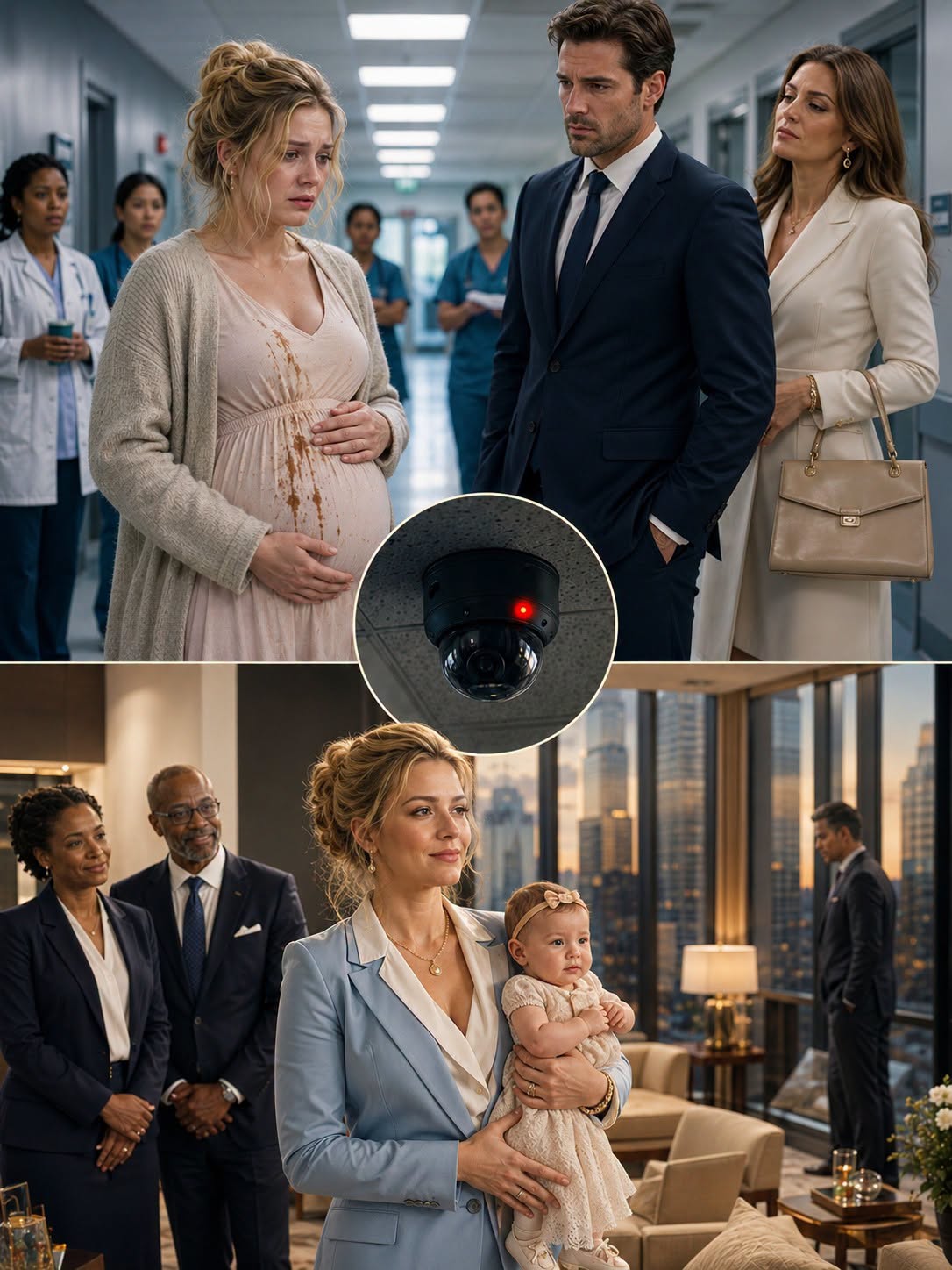
Part 1 — The Marble Floor Remembered Everything
Savannah Reed kicked me in the stomach in the middle of St. Catherine’s Medical Center, and my husband watched like I was a stain being removed from his life.
Not hard enough to break my ribs.
Not hard enough to make the world stop.
But hard enough for my hand to fly to my eight-month pregnant belly.
Hard enough for hot coffee to splash down the front of my blue maternity dress.
Hard enough for every nurse, every patient, every stranger beneath those polished hospital lights to understand exactly how little she thought I was worth.
Nothing.
My name was Emily Hartwell.
At least, that was the name printed on the marriage certificate locked in a silver safe inside the mansion I had not been allowed to enter for three days.
Before Preston Hartwell married me, I had been Emily Whitaker, the girl who ran a small nonprofit out of a rented office in Dallas and believed rich people were complicated, not cruel.
I had learned the difference.
Rich people could be generous when someone was watching.
Cruel people needed no audience.
Preston was both.
He stood three feet away from me in a charcoal suit, his hand resting at Savannah’s lower back as if she were the woman carrying his child.
His watch caught the hospital light.
I noticed that before I noticed the pain.
A ridiculous thing, really.
A pregnant woman on the floor, one palm braced against cold marble, coffee burning through cheap cotton, and all I could think was that the watch had cost more than the emergency wing where my mother had died.
Savannah bent over me with her perfect blonde waves and her white designer coat.
She always wore white when she wanted to look innocent.
It never worked on me.
“Maybe now you’ll stop pretending you belong beside him,” she said.
Her voice was low enough to be intimate and loud enough to wound.
A nurse behind the reception desk gasped.
An elderly man in a wheelchair whispered something to his daughter.
A little boy holding a plastic dinosaur stopped chewing his snack and stared.
I did not cry.
That disappointed Savannah.
I could see it in the small flicker around her mouth.
She had wanted sobbing.
She had wanted panic.
She had wanted the ugly collapse of a wife who finally understood she had lost.
But I had spent three years in the Hartwell family, and the first lesson of that house was simple.
Never bleed where they can photograph it.
My daughter moved beneath my hand.
A slow, firm press.
Alive.
Here.
Mine.
I breathed once.
Then again.
Then a third time, because rage without oxygen becomes grief, and I had no intention of giving Preston Hartwell the satisfaction of either.
I looked up at him.
“Are you going to say anything?”
His jaw tightened.
For one second, something passed behind his eyes.
Not love.
Not guilt.
Calculation.
Preston looked at Savannah, then at the growing circle of witnesses, then back at me.
“Don’t make this dramatic, Emily.”
The nurse at the desk made a sound like someone had slapped her.
Savannah smiled.
I nodded slowly.
“She kicked your pregnant wife in a hospital hallway.”
“She’s upset,” he said.
Three words.
That was all my marriage was worth.
Savannah was upset.
I looked down at the brown stain spreading over my dress.
The cardigan I wore had come from Target because Preston had blocked every personal card in my wallet three days ago.
He called it temporary.
His attorney called it strategy.
I called it what it was.
Punishment.
The Hartwell mansion had seven bedrooms, four staircases, a wine cellar, a glass conservatory, and a nursery I had painted soft green with my own hands.
I had not slept there since Preston told me Savannah was pregnant.
She was not, as far as I knew.
But Preston wanted me to believe she was.
He wanted the divorce fast, quiet, and humiliating enough that I would sign whatever he slid across the table.
I was supposed to leave with nothing.
Not the house.
Not the foundation.
Not my nonprofit.
Not my daughter.
That morning, he had followed me to St. Catherine’s because my attorney had asked for a medical record confirming the health of the baby.
Savannah had followed because cruelty gets bored when left outside.
Preston stepped closer and extended a hand.
The gesture was elegant.
Polished.
Camera-ready.
“Get up,” he said softly.
Then, lower, “People are staring.”
There he was.
The man I married.
Not concerned that his wife was hurt.
Not concerned that his unborn daughter had just been struck.
Concerned that strangers might misread the scene.
As if there were another way to read it.
I looked at his hand.
Three years ago, that hand placed a ring on my finger in a church full of white roses.
Two years ago, that hand signed the merger papers that folded my nonprofit into the Hartwell Family Foundation.
One year ago, that hand rested at my waist while he told donors I was the heart of everything they did.
Three nights ago, that hand gripped my wrist hard enough to bruise and said, “You will not embarrass me during this divorce.”
Now it wanted to lift me because the hallway had witnesses.
I did not take it.
I placed my palm flat against the marble and pushed myself upright.
The movement sent a sharp line of pain through my side.
I kept my face calm.
A nurse hurried forward.
“Ma’am, please don’t move too quickly.”
“I’m all right,” I said.
My voice sounded colder than I expected.
Savannah’s smile thinned.
Preston leaned close enough that his cologne cut through the smell of coffee and disinfectant.
“Emily, I’m warning you.”
That was when I looked over his shoulder.
At the black dome of the security camera in the corner.
The red light blinked once.
Then again.
Beautiful.
I smiled.
Not wide.
Not happy.
Just enough.
Preston saw it, and for the first time that morning, uncertainty touched his face.
Then a voice cut through the corridor.
“Step away from my niece.”
It was not shouted.
That made it worse.
The words were quiet, controlled, and powerful enough to change the temperature of the hallway.
Preston turned.
Savannah turned.
Every person in the corridor turned.
Dr. Malcolm Whitaker stood at the end of the hall in a navy suit beneath his white physician’s coat.
The hospital director.
The man whose name was engraved on the donor wall.
The man who could make surgeons, board members, and billionaires lower their voices simply by entering a room.
The man who had raised me after my mother died.
My uncle.
Preston went still.
Savannah’s face changed so quickly it almost looked painful.
“Director Whitaker,” Preston said.
He tried to smile.
It did not survive.
Uncle Malcolm walked toward us, his silver hair neat, his eyes fixed first on my belly, then on the stain across my dress, then on the red mark forming near my ribs.
He did not look at Preston again until he reached me.
“Emily,” he said.
For the first time that morning, my throat tightened.
“I’m fine,” I said.
“No,” he replied.
He turned his head slowly toward Savannah.
“You are not.”
Savannah lifted her chin.
“I didn’t mean to—”
“You kicked a pregnant woman in a medical facility with cameras, staff, and patients present,” Malcolm said.
His voice never rose.
“That is assault.”
Preston’s expression hardened.
“Let’s not use dramatic language.”
Malcolm looked at him.
It was the same look he had given a surgeon once after an avoidable death in the ICU.
That surgeon resigned before noon.
“Touch my niece again,” Malcolm said, “and the next conversation you have will not be with me.”
Savannah took half a step back.
Preston’s eyes narrowed.
“Your niece?”
There it was.
The first crack.
For three years, Preston had believed my family was dead, poor, irrelevant, or conveniently silent.
He knew my mother had died at St. Catherine’s.
He knew my father’s name was absent from every document I cared to share.
He knew I never invited blood relatives to dinners at the mansion.
He had assumed that meant I had no one.
Men like Preston rarely asked questions when the answer might make them less powerful.
Malcolm did not explain.
He turned to the nurse.
“Get Mrs. Hartwell into a private suite immediately.”
The nurse nodded so quickly her badge swung against her scrubs.
“Call OB, security, legal, and risk management,” Malcolm continued.
“Preserve the corridor footage from every angle.”
Savannah’s smugness evaporated.
Preston lifted a hand.
“Malcolm, this is a family matter.”
Malcolm looked at the hand as if it were something contaminated.
“You lost the privilege of calling this family when you stood there and watched.”
A security guard arrived from the elevators.
Then another.
The hallway began to move again, but differently now.
People whispered.
Phones disappeared into pockets.
A nurse wrapped a blanket around my shoulders.
The little boy with the dinosaur waved at me, solemn and scared.
I gave him the smallest smile I could manage.
Preston stepped toward me.
“Emily, we need to talk.”
“No,” I said.
The word landed cleanly.
His eyes flickered.
I had said no before, of course.
No, Preston, I don’t want the East Wing nursery in cream.
No, Preston, I don’t want to smile for donors while your mother calls me decorative.
No, Preston, I don’t want Savannah Reed joining the foundation as communications director.
Those no’s had been softened, negotiated, punished.
This one was not.
I looked at the security guard.
“I want to file a report.”
Savannah inhaled sharply.
Preston’s face went cold.
“You don’t know what you’re doing.”
I looked at him, one hand on my daughter.
“That’s the first wrong thing you’ve said today.”
Then I walked beside my uncle into the private wing of St. Catherine’s.
My legs trembled only after the elevator doors closed.
Part 2 — The Marriage Built for Cameras
The Hartwell wedding had been the kind of event people saved on Pinterest.
A white stone church in Highland Park.
Four hundred guests.
Ten thousand white roses.
A string quartet Preston pretended not to have chosen himself.
The Dallas papers called it a union of philanthropy and finance.
They printed a photo of Preston kissing my forehead beneath the church arch.
They did not print the moment his mother leaned in before the ceremony and told me, “Do not embarrass this family by looking overwhelmed.”
So I did not.
I walked down the aisle in a silk gown with sleeves of French lace, my mother’s pearl earrings, and a bouquet that smelled so sweet it made me dizzy.
Preston cried when he saw me.
Everyone talked about that for months.
No one knew he had learned exactly when to cry at Yale.
The first year of marriage was almost beautiful.
Almost is a dangerous word.
It makes a cage look like architecture.
Preston took me to dinners at restaurants where menus had no prices and women laughed like money had made them lighter.
He sent flowers to my office.
He remembered my coffee order.
He kissed the inside of my wrist in elevators.
He made me believe that control was simply attention wearing a better suit.
When he suggested my nonprofit, Clementine House, join the Hartwell Family Foundation, I hesitated.
Clementine House helped women and children leaving violent homes.
It was small but mine.
We had a legal clinic, a childcare fund, a shelter partnership, and a waiting list that kept me awake at night.
Preston said he could give it reach.
He said his family’s foundation could multiply our work tenfold.
He said, “You should not have to beg donors for scraps when you’re my wife.”
I wanted to believe that was love.
My uncle Malcolm warned me.
Not loudly.
He never needed to be loud.
“Do not surrender anything you built,” he said.
We sat in his kitchen the week before the wedding, sunlight on the old pine table, my mother’s photograph on the shelf behind him.
“I’m not surrendering it,” I told him.
“I’m scaling it.”
He watched me carefully.
“Then let my attorney read every page.”
That was how the first secret was born.
Preston thought my prenup was a formality.
He thought women without visible family accepted paper like weather.
But Malcolm’s attorney rewrote the agreement until it became a velvet-covered blade.
If Preston committed adultery and attempted to dissolve the marriage while I was pregnant, he forfeited all claims to marital property acquired through my nonprofit assets.
If he restricted my access to medical care, housing, or personal funds, the conduct clause activated.
If he endangered the child or failed to intervene in harm against me while pregnant, custody presumptions shifted.
If he used foundation resources to conceal an affair, the board could remove him for breach of fiduciary duty.
Preston signed it in a glass conference room while smiling at me.
He did not read every page.
Men like Preston did not read restrictions because they never imagined they applied to him.
My second secret was older.
Before my mother died, she placed her shares of Whitaker Health Holdings into a trust for me.
Whitaker Health owned medical buildings, equipment leases, outpatient clinics, and a quiet but powerful stake in St. Catherine’s.
I did not advertise it.
I did not spend it.
I did not wear it.
When people asked why I drove a ten-year-old Volvo while married to a billionaire, I said I liked the car.
That was true.
It was also true that money hidden from men like Preston was safer than money displayed for them to conquer.
He thought I was useful because I looked sincere beside him.
I thought he loved that sincerity.
By the second year, his corrections began.
Not insults at first.
Corrections.
“Don’t say that in front of donors.”
“Wear the emeralds, Emily, the pearls make you look provincial.”
“Smile less when my father speaks. It reads eager.”
“Don’t bring up domestic violence at dinner. This is a capital campaign, not a therapy circle.”
I learned the Hartwell family language.
Image meant obedience.
Discretion meant silence.
Gratitude meant surrender.
By the third year, Savannah Reed arrived.
She was hired as the foundation’s new communications director after a search process no one could explain.
Twenty-six.
Blonde.
Ambitious in the sharp, glittering way of women who mistake cruelty for confidence.
She called Preston “P” during meetings and touched his sleeve when she laughed.
The first time I asked about it, he smiled as if I had disappointed him.
“Please don’t become that kind of wife.”
That kind.
Meaning watchful.
Meaning inconvenient.
Meaning awake.
The affair became obvious at the Hartwell winter gala.
The event took place at the mansion, in the ballroom beneath chandeliers imported from France because Preston’s mother believed Texas light was vulgar unless filtered through something European.
Savannah wore red.
Not wine.
Not burgundy.
Red.
A dress cut low enough to make donors forget their wives.
Preston watched her cross the room with an expression he once reserved for me.
When I approached him, he took my hand and kissed it for the photographers.
His palm was cold.
“Try not to hover tonight,” he murmured.
I looked at Savannah.
She lifted a champagne flute.
A toast only I could see.
That night, I found one of her earrings in Preston’s study.
A small diamond star beneath his desk.
I held it in my palm for almost a minute.
Then I placed it inside a velvet box with the other things I had begun collecting.
Receipts.
Hotel key cards.
Board expense reports.
Foundation transfers marked “media consulting.”
Photos sent anonymously from someone on staff who still had a conscience.
Messages Preston forgot were backed up to the family iPad linked to our home office.
I did not confront him immediately.
That surprises people who have never lived with a charming liar.