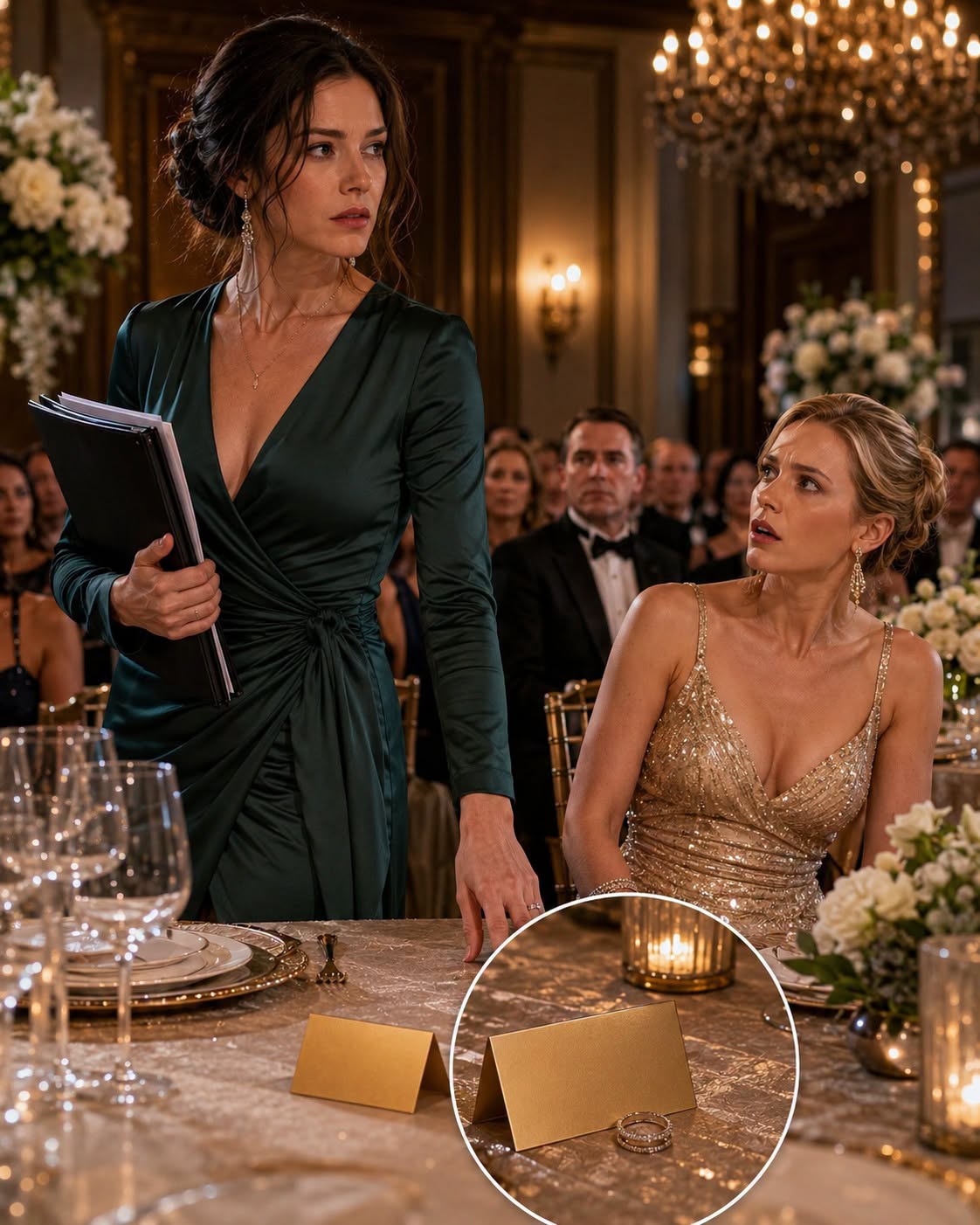
She Wore My Mother’s Bracelet to My Divorce Dinner. By Dessert, Their Whole Family Lost Everything.
My husband’s mistress wore a gold bracelet engraved **FAMILY ONLY** to my divorce dinner.
His mother gave it to her before dessert, right in front of me.
Everyone clapped as if my replacement had just been crowned.
My husband, Grant Whitaker, leaned back in his chair and smiled like a man who had already won.
“You should be happy, Ava,” he said, lifting his glass of champagne. “Someone at this table still believes in family.”
I didn’t cry. I didn’t throw my wine. I didn’t ask how a woman who had spent two years sleeping in my bed while I was at my mother’s hospital bedside had earned a bracelet meant for “family.”
I simply reached across the white linen tablecloth, took Tiffany Lane’s wrist gently in my hand, and turned the bracelet over.
On the inside clasp, beneath the engraving, was a tiny serial number.
CM-1187-04.
My breath went perfectly still.
Because that number matched the jewelry set missing from my mother’s estate inventory.
They had welcomed her with stolen inheritance.
And by the time dessert came, the room would understand exactly what that meant.
—
## Chapter 1: The Dinner They Thought Would Break Me
The Whitakers called it a divorce dinner.
They said it was civilized.
They said it was “good for closure.”
They said only bitter people walked away from a marriage without sitting down one last time with both families, sharing a meal, and proving there were no hard feelings.
But what they really wanted was an audience.
They wanted a stage.
And they wanted me sitting at the center of it in a cream silk dress, looking graceful while they cut the last pieces of me away.
The dinner was held at The Magnolia Room, a private dining space above one of Charleston’s oldest restaurants, the kind of place where the walls smelled faintly of bourbon, lemon oil, and family money. Tall windows looked out over King Street. Gas lamps flickered below. Rain tapped softly on the glass, turning the city into watercolor.
My mother would have loved the room.
That was the first cruel thing.
She had always loved Charleston in the rain. She said old Southern cities became honest when wet, their bright paint darkening, their cracks showing.
“Water tells the truth,” she used to tell me.
That evening, I sat beneath a chandelier shaped like magnolia blossoms and thought about how badly I wanted to hear her voice.
My mother, Celeste Monroe Caldwell, had been dead for seven months.
My marriage had died much earlier.
Grant had not cried at her funeral. He had checked emails in the hallway outside the chapel. When I found him there, lit blue by his phone, he had looked annoyed.
“Ava, I’m sorry, but investors don’t stop calling because someone passes.”
Someone.
My mother had paid the down payment on our first house. My mother had nursed Grant’s father through heart surgery when Charlotte Whitaker said she couldn’t handle hospitals. My mother had hosted every Thanksgiving Grant’s family pretended was theirs. My mother had welcomed him as a son.
To him, she had been someone.
To me, she had been the entire sky.
I had spent the last year of her life at St. Agnes Medical Center, sleeping in a recliner beside her bed, learning the rhythm of machines, memorizing the difference between pain and fear in her eyes. Grant had spent that year “working late.”
Only the work had long blonde hair, a Pilates body, and an Instagram feed full of captions about “choosing joy.”
Her name was Tiffany Lane.
She was twenty-nine, eight years younger than me, and she arrived at my divorce dinner wearing winter-white satin, pearl drop earrings, and the delicate confidence of a woman who had been promised she would never be held accountable.
Grant walked in with her hand tucked through his arm.
No one gasped.
No one looked embarrassed.
Charlotte Whitaker, my mother-in-law for nine years, rose from her seat and kissed Tiffany on both cheeks.
“Sweetheart,” she said warmly, “you look radiant.”
Then she looked at me.
“Ava.”
Just my name. Flat as a receipt.
I stood because my mother had raised me to stand when someone entered a room, even if that person had helped ruin your life. I smiled because the staff was watching, and I would not give the Whitakers the cheap satisfaction of seeming wounded before the first course.
Grant kissed his mother’s cheek, shook his father’s hand, and sat directly across from me. Tiffany sat beside him, close enough that their knees touched beneath the table.
The seating arrangement was deliberate.
Charlotte had placed me between Grant’s older brother, Wesley, and a cousin named Patricia who had once asked me, at Easter brunch, whether infertility was “mostly emotional.”
I had never been infertile.
Grant had told them that because explaining the truth would have made him look weak.
The truth was that after three miscarriages, two surgeries, and one doctor who told us Grant’s sperm motility was “statistically challenging,” Grant decided children were too expensive anyway.
Then he told his family I was the reason the Whitaker line might end.
That was the second cruel thing about that night.
Every lie they had ever told about me had a chair at the table.
Charlotte lifted her glass before the waiter had finished pouring.
“To endings,” she said, smiling across the table. “And to new beginnings.”
Everyone raised their glasses.
I raised mine too.
Not because I agreed.
Because I wanted both hands visible when the police asked later whether I had threatened anyone.
Grant’s father, Robert Whitaker, cleared his throat. He had the tired, folded face of a man who had chosen cowardice so often it had become his resting expression.
“Ava,” he said, “we all want you to know there’s no animosity here.”
I looked at him.
“No?”
He blinked, surprised that I had answered.
“No,” he repeated. “These things happen. People grow apart.”
Tiffany lowered her lashes, pretending humility.
Grant reached for her hand on the table.
“Sometimes,” he said, “people grow toward the person they should’ve been with all along.”
Wesley snorted into his wine.
Patricia murmured, “Beautiful.”
I took one sip of water.
Not wine.
Water.
I wanted a clear head.
Charlotte watched me the way a cat watches a bird it has already decided to kill.Preview
“You’re being very composed,” she said.
“Thank you.”
“I worried you might make tonight difficult.”
“I can see why you’d hope that.”
The table quieted for half a second.
Grant’s jaw tightened.
Charlotte smiled wider.Preview
“Oh, Ava. Still sharp. That’s one thing I’ll miss.”
I placed my napkin in my lap.
“You never liked sharp things unless they belonged to you.”
Grant leaned forward. “Let’s not do this.”
“I’m eating dinner,” I said softly. “That’s what I was invited to do.”
He stared at me, searching for cracks.
There were none.
Not visible ones.
Inside, yes, something was bleeding. Something had been bleeding for years. But grief, real grief, teaches you that not every wound deserves witnesses. Some pain is too holy to be performed for people who caused it.
So I sat there.
I smiled politely through the crab cakes.
I listened while Charlotte praised Tiffany’s “natural warmth.”
I listened while Wesley joked that Grant would finally have a wife who didn’t “live at hospitals and lawyer offices.”
I listened while Patricia asked Tiffany if she wanted children, and Tiffany squeezed Grant’s hand and said, “More than anything. I believe a home isn’t complete without babies.”
Charlotte put a hand to her chest.
“Oh, I knew it.”
I cut a piece of asparagus in half.
Grant looked at me, waiting.
I gave him nothing.
The less I reacted, the more careless they became.
That was the thing about cruel people. They mistook silence for surrender.
They never realized silence could be a locked door.
And behind mine, someone was already turning the key.
—
## Chapter 2: Family Only
Dessert was when Charlotte decided to crown the new queen.
The waiter had just cleared the dinner plates when she tapped her spoon against her champagne glass.
Tiny silver chimes moved through the room.
“Before dessert,” Charlotte said, rising, “I have a little something.”
Tiffany covered her mouth with one hand.
“Oh, Charlotte, no.”
Fake surprise is one of the easiest languages to read.
Charlotte pulled a navy velvet box from her handbag.
My pulse did not change.
Not yet.
Grant smiled.
Robert looked down at the table.
Wesley lifted his phone, probably to record whatever humiliation Charlotte had planned to post later in the family group chat.
“Ava,” Charlotte said, turning toward me with theatrical gentleness, “I hope you won’t find this awkward.”
“That depends,” I said.
Grant muttered, “Mom.”
But Charlotte was already committed.
She opened the box.
Inside lay a bracelet.
Gold. Heavy. Old.
Not modern old. Not antique-store old.
Family old.
The kind of gold that seems to hold warmth even under cold lights. A wide cuff with magnolia leaves etched around the edges and a small oval plate at the center.
Tiffany gasped.
“Oh my God.”
Charlotte lifted it from the velvet with reverence.
“This bracelet has always symbolized belonging,” she said. “It’s worn by women who understand loyalty, grace, and the importance of protecting the family name.”
A laugh moved around the table.
Not loud.
Worse.
Soft.
Shared.
Grant looked at me with open satisfaction.
I thought of my mother’s hands.
Slim fingers. Pale pink nails. A faint scar near her thumb from cutting peaches the summer I turned twelve. I remembered those hands fastening bracelets, stirring soup, signing checks, wiping tears, holding mine when the oncologist said the word metastatic.
My mother had loved jewelry not because it was expensive, but because she believed beautiful things should carry stories.
“Ava,” she once told me, opening the cedar-lined drawer where she kept her pieces, “never keep something precious in a box forever. Wear it. Let it hear laughter. Let it touch skin. Otherwise it’s just metal and stone.”
Charlotte stepped behind Tiffany.
The room tilted.
Just slightly.
I saw the bracelet’s inner curve as Charlotte opened the clasp.
There was an engraving.
FAMILY ONLY.
Tiffany extended her wrist.
Charlotte fastened it.
The clasp clicked.
Everyone clapped.
My skin went cold.
Not because of the words.
Because of the design.
Magnolia leaves.
Oval plate.
Hand-hammered gold.
My mother had owned a set called the Caldwell Magnolia Collection, commissioned by my great-grandfather for my great-grandmother in 1958. Necklace, earrings, ring, brooch, bracelet.
Five pieces.
Four had been found after my mother died.
One had been missing.
The bracelet.
I had spent months believing it had been lost. Misfiled. Removed for cleaning. Hidden by my mother in some place I had not yet discovered.
My probate attorney had told me not to panic.
“Estate inventories are messy,” Martin Hale had said. “Especially with old jewelry. We’ll keep looking.”
But I had known.
Some things do not walk away alone.
Tiffany held up her wrist, turning it toward the light.
“It’s perfect,” she whispered.
Charlotte kissed her cheek.
“You’re perfect for this family.”
Grant raised his glass.
“To family,” he said.
“To family,” everyone echoed.
I looked at the bracelet.
The room blurred at the edges.
For one second, one dangerous second, my body wanted to become sound. I wanted to scream so hard the chandelier shook. I wanted to reach across the table and tear that stolen gold from Tiffany’s wrist. I wanted to make them feel, physically, the vulgarity of what they had done.
Instead, I heard my mother.
Water tells the truth.
So I became water.
Still.
Clear.
Cold.
“Tiffany,” I said.
She turned to me, already smiling with pity.
“Yes, Ava?”
“May I see it?”
Grant laughed once. “Seriously?”
I kept my eyes on Tiffany.
“The bracelet,” I said. “It’s beautiful.”
Charlotte folded her arms.
“It suits her, don’t you think?”
“I’d like to see the craftsmanship.”
Tiffany looked at Grant. Grant shrugged, amused.
“Let her,” he said. “Maybe she can appreciate something without making it about herself.”
Tiffany extended her wrist across the table.
A mistake.
The first of many.
I touched her hand lightly, as if she were a nervous bride and I were a kindly aunt helping with a clasp.
The gold was warm from her skin.
I turned the bracelet over.
Inside the clasp, almost hidden beneath the hinge, was the number.
CM-1187-04.
My mother’s estate inventory had listed the missing item as:
Caldwell Magnolia Bracelet. Gold cuff. Serial CM-1187-04. Last confirmed appraisal: $286,000. Family historical value: irreplaceable.
I let go of Tiffany’s wrist.
Slowly.
Carefully.
Because I did not want my fingerprints pressing too hard into evidence.
I sat back.
Grant was still smirking.
“Well?” he said. “Is it up to your standards?”
I looked at him.
Then Charlotte.
Then the bracelet.
“Yes,” I said. “It’s exactly what I thought it was.”
Something flickered in Robert’s face.
Fear.
Small but real.
Charlotte missed it because she was too busy enjoying herself.
“I know this is hard for you, dear,” she said, “but family heirlooms go to family. And after tomorrow morning, legally speaking, you won’t be one of us anymore.”
I smiled.
That was when Grant should have been afraid.
Because I had not smiled like that once in nine years of marriage.
Not at him.
Not for him.
Not because of him.
“Charlotte,” I said, “where did you get the bracelet?”
Her eyes narrowed.
“It was in our family safe.”
“No,” I said gently. “It wasn’t.”
The room changed.
Not dramatically.
No thunder.
No gasp.
Just a subtle shift, like a house settling before the foundation cracks.
Grant set down his glass.
“Ava.”
I ignored him.
“Where did you get it?”
Charlotte’s chin lifted.
“I don’t owe you an explanation about Whitaker property.”
“Of course,” I said. “Then Grant can explain.”
Grant’s face hardened.
“I don’t know what game you’re playing.”
I looked at Tiffany’s wrist again.
“This isn’t a game.”
Tiffany pulled her hand back into her lap.
“What’s going on?”
No one answered her.
Because Tiffany, for all her cruelty, had not yet realized she was not a princess in this story.
She was packaging.
Charlotte sat down slowly.
Robert looked toward the door.
At that exact moment, the door opened.
Not loudly.
Just enough.
Martin Hale, my mother’s probate attorney, stepped into the Magnolia Room wearing a charcoal suit darkened at the shoulders by rain.
Behind him was a woman in a navy blazer carrying a slim black folder.
And behind her stood a uniformed Charleston police officer.
Grant went pale.
I reached for my water glass.
Dessert had arrived.
—
## Chapter 3: The Man at the Door With My Mother’s Truth
Martin Hale was not a dramatic man.
He did not storm into rooms.
He did not raise his voice.
He did not point fingers like a television lawyer.
He was seventy-one, silver-haired, and so precise in his habits that even his umbrellas looked legally binding. My mother had trusted him for thirty years because he had the rare gift of making rich people nervous without ever seeming impolite.
“Good evening,” Martin said.
Charlotte stood so quickly her chair scraped the floor.
“This is a private event.”
“Yes,” Martin replied. “I apologize for the intrusion.”
He did not sound sorry.
Grant pushed back from the table.
“Ava, what is this?”
I folded my hands in my lap.
“This is the conversation you invited by bringing my mother’s stolen bracelet to dinner.”
Tiffany made a small sound.
“Stolen?”
Charlotte snapped, “Don’t be ridiculous.”
Martin looked at the woman beside him.
“This is Elena Brooks, an investigator retained by the Caldwell estate. Officer Daniels is here because the item in question is part of an active theft report.”
The word theft landed on the table and shattered something invisible.
Patricia whispered, “Oh my God.”
Wesley stopped recording.
Grant stood.
“Absolutely not,” he said. “This is harassment.”
Martin opened his folder.
“Mr. Whitaker, on February 14 of this year, you accessed Safe Deposit Box 443 at Palmetto Trust Bank using a temporary authorization document signed by your wife while she was under emergency medical stress at St. Agnes Medical Center.”
My lungs tightened.
I remembered February 14.
Not because it was Valentine’s Day.
Because my mother had stopped breathing at 3:17 that morning.
She had come back after ninety seconds, but something in her eyes had not.
Grant had arrived at the hospital around noon carrying grocery-store flowers and a face full of inconvenience. He had placed a stack of papers beside my coffee and said, “The bank needs signatures for the estate planning transfers. Your mom asked me to help keep things organized.”
I had not read them.
That shame had sat inside me for months.
I had signed because my mother was dying.
I had signed because my husband stood beside me.
I had signed because betrayal is easiest when it wears a familiar voice.