HE GAVE HIS MISTRESS MY SEAT AT THE CHAMPIONSHIP. BY HALFTIME, HE LEARNED I OWNED THE TEAM.
Preview
His mistress sat in my owner’s suite at the championship game and told executives I was no longer welcome.
My husband draped my custom team jacket over her shoulders while security closed the glass doors in my face.
They thought the roar of seventy thousand people would swallow the insult.
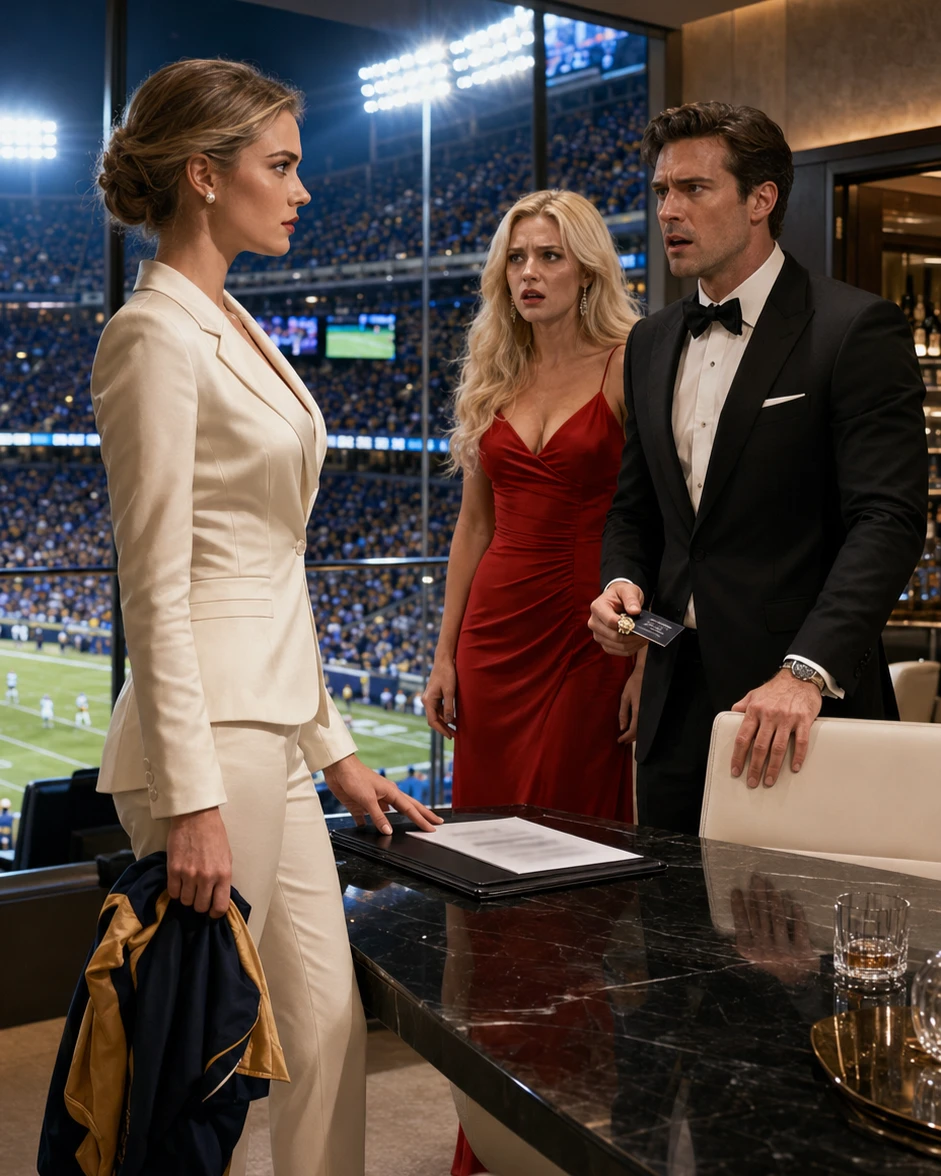
They did not know that fifty-one percent of the New York Monarchs was held in my trust.
They did not know I had spent six quiet weeks collecting bank statements, hotel footage, deleted emails, and corporate expense reports.
Most importantly, they did not know that the special board meeting scheduled for halftime had been called by me.
My name is Ava Monroe Caldwell.
I was twenty-seven years old that night, with a youthful heart-shaped face, gray-green eyes, and long dark-blond hair swept into a polished knot at the nape of my neck.
I wore an ivory silk suit, pearl earrings that had belonged to my mother, and the calm expression of a woman arriving exactly where she belonged.
Bennett thought I had come to save our marriage.
I had come to end his career.
PART ONE — THE DOOR THEY CLOSED IN MY FACE
Vanguard Stadium glittered against the Manhattan skyline like a crown made of steel and winter light.
The New York Monarchs were playing the Los Angeles Vipers for the league championship, and every private entrance was crowded with celebrities, investors, former players, and men who measured their importance by how quickly security stepped aside.
For three years, security had stepped aside for me.
That evening, a broad-shouldered guard named Travis placed one hand in front of the private elevator.
“I’m sorry, Mrs. Caldwell,” he said. “Your credentials have been deactivated.”
Behind him, the elevator doors reflected my face back at me.
Young, composed, and almost strangely peaceful.
“By whose authorization?” I asked.
Travis glanced at the tablet in his hand.
“Mr. Bennett Caldwell.”
My husband.
The man who had kissed my forehead that morning and told me he needed to arrive early for sponsor meetings.
The man who had left a note beside my coffee saying he hoped the championship would remind us of everything we had built together.
The man who had apparently instructed security to keep me away from the very suite my family had owned for twelve years.
I looked past Travis toward the elevator.
“Please check the controlling ownership file,” I said.
His face tightened.
“Ma’am, I was given a direct order.”
“I understand.”
I did not raise my voice.
I did not threaten his job.
Travis was not my enemy, and I had no intention of punishing an employee for following a fraudulent instruction issued by an executive.
“Would you ask Mr. Vale to come down?” I said. “Tell him Ava Monroe is at the private entrance.”
The use of my maiden name made Travis hesitate.
Before he could respond, laughter drifted from the security monitor mounted on the wall.
The live camera feed showed the owner’s suite on the forty-eighth level.
Crystal lights glowed over white leather seats and polished black marble.
Bennett stood near the glass with one hand resting on the waist of Sloane Mercer.
Sloane was twenty-nine, striking in the carefully manufactured way that luxury magazines loved.
Her platinum hair fell over one shoulder, her red dress was cut low enough to become a conversation, and on top of it she wore my navy-and-gold Monarchs jacket.
Not a replica.
Mine.
The jacket had been custom-made after my mother died, with her initials stitched in gold inside the collar and mine beneath them.
E.M.
A.M.
Eleanor Monroe.
Ava Monroe.
It had hung in a locked cedar cabinet inside my dressing room at home.
For Sloane to be wearing it, Bennett had not merely betrayed me.
He had entered my private closet, opened a case containing one of the last gifts my mother had ever planned for me, and placed it over his mistress’s shoulders.
On the monitor, Sloane turned toward a group of sponsors.
“Bennett says Ava gets emotional during big games,” she said, smiling as if sharing an intimate joke. “He thought it would be better for everyone if she stayed home.”
One of the executives looked uncomfortable.
Another stared into his drink.
Bennett laughed.
“She was never built for this level of pressure.”
The words should have hurt.
Instead, they clarified something.
A marriage can die slowly through unanswered messages, separate bedrooms, and excuses repeated until they lose their shape.
But sometimes it dies in a single clean moment.
Mine died while I watched my husband ridicule me on a security monitor beneath a stadium I owned.
I removed my gloves one finger at a time.
“Has Mr. Vale been called?” I asked.
Travis nodded.
A minute later, Marcus Vale came striding across the marble lobby.
Marcus was the fifty-two-year-old president of the Monarchs, a former linebacker with silver at his temples and an instinct for disaster.
He saw me, saw Travis blocking the elevator, and stopped so abruptly that the two staff members behind him nearly collided with his back.
“Ms. Monroe,” he said.
Not Mrs. Caldwell.
Ms. Monroe.
Marcus had been present when my mother placed the team shares in the Monroe Legacy Trust.
He knew exactly who I was.
“Why is she standing outside?” he demanded.
Travis held up the tablet.
“Mr. Caldwell revoked her access.”
Marcus took the tablet from him.
His expression changed as he read the authorization.
Then he looked at me.
“Did you approve this?”
“No.”
Marcus’s jaw hardened.
He entered a code and opened the ownership database.
For several seconds, no one spoke.
The crowd above us erupted as the Monarchs ran onto the field.
Even through forty-eight levels of steel and concrete, the sound rolled beneath our feet like thunder.
Marcus turned the screen toward Travis.
At the top of the controlling interest page was one line.
MONROE LEGACY TRUST: 51.4%.
SOLE TRUSTEE: AVA ELEANOR MONROE.
Marcus handed the tablet back.
“Open the elevator.”
Travis went pale.
“I’m so sorry.”
“You followed the information you were given,” I said. “The responsibility belongs to the person who gave it.”
The elevator doors opened.
Marcus stepped inside beside me.
“Do you want me to clear the suite before we arrive?” he asked.
“No.”
He studied my face.
“You’re sure?”
“I want every witness to remain exactly where Bennett put them.”
The elevator rose in silence.
My reflection moved across the mirrored walls, ivory silk against dark glass.
For six weeks, I had imagined confronting Bennett in a dozen different ways.
I had imagined asking why.
I had imagined placing photographs on our dining table, throwing his phone at him, or forcing him to look at the woman whose life he was dismantling.
But betrayal had burned through all my questions.
Why did not matter anymore.
The only question left was how much of my life I would allow him to take on his way out.
The answer was none.
When the elevator reached the owner’s level, Marcus touched the control panel.
“Ms. Monroe,” he said quietly, “your mother would be proud of you.”
My throat tightened for the first time that night.
Then the doors opened.
PART TWO — THE WOMAN WEARING MY NAME
The owner’s suite had been designed by my mother.
She had chosen the smoky quartz bar, the cream-colored walls, and the long curved window that made the football field appear close enough to touch.
She had also insisted that no guest be treated as more important than the stadium staff.
“Luxury means nothing,” she used to tell me, “if it requires someone else to feel small.”
Bennett had forgotten that lesson.
Or perhaps he had never learned it.
The suite was crowded with sponsors, board members, athletes’ families, league officials, and two local television personalities.
A string quartet played near the dining area while servers carried trays of champagne through the room.
Sloane stood at the center of everything, wearing my jacket as if she had inherited my life.
Bennett saw me first.
His smile disappeared.
Then Sloane turned.
For one instant, surprise flashed across her face.
It was quickly replaced by amusement.
“Ava,” she said. “You came.”
Every conversation in the suite softened.
Not stopped.
Softened.
People still pretended to study the field, but their attention shifted toward us with the precision of cameras changing angles.
Bennett crossed the room.
His tuxedo was perfect, his dark hair carefully styled, and the gold watch on his wrist had been an anniversary gift from me.
“What are you doing here?” he asked under his breath.
I looked at him.
“I’m attending the championship game.”
“You know what I mean.”
“I truly don’t.”
His eyes moved toward Marcus.
“This is a private event.”
“Yes,” I said. “It is.”
Sloane walked toward us, touching the sleeve of my jacket.
“You shouldn’t take this personally,” she said. “Bennett was trying to avoid a scene.”
I glanced at her hand.
My mother’s initials were less than three inches from her fingers.
“A scene?” I asked.
“You have been under a lot of stress.”
Her voice carried just far enough for the nearest sponsors to hear.
Bennett had clearly prepared her.
They wanted me unstable.
Jealous.
Humiliated.
If I cried, they would call me fragile.
If I shouted, they would call me dangerous.
If I accused them, they would deny everything and use my anger as proof that Bennett had been right to remove me.
So I smiled.
It was not a warm smile.
It was the kind of smile that made Bennett’s face lose color.
“You’re wearing my jacket,” I said.
Sloane looked down at it.
“Bennett gave it to me.”
“I know.”
“He said you wouldn’t need it anymore.”
A few people nearby went very still.
Bennett touched my elbow.
“Let’s speak privately.”
I looked at his hand until he removed it.
“You chose the audience,” I said. “We can use it.”
Sloane lifted her chin.
“This room is for people who understand the organization, Ava.”
I met her eyes.
“That is true.”
She mistook my agreement for surrender.
Her smile widened.
“Then you understand why Bennett asked you to leave.”
Marcus stepped forward.
“Mr. Caldwell does not have the authority to remove Ms. Monroe from this suite.”
Bennett turned sharply.
“I’m the executive chairman.”
“No,” Marcus said. “You are the acting commercial director and a nonvoting board observer.”
The room became silent.
Bennett’s expression hardened.
“That is a technical distinction.”
“It is an ownership distinction,” Marcus replied.
Sloane looked between them.
“Bennett owns the team.”
A sound escaped from one of the board members.
It might have been a cough.
It might have been a laugh.
Bennett’s eyes remained fixed on Marcus.
“This is neither the time nor the place.”
Marcus looked toward me.
“It is if the controlling owner says it is.”
Sloane’s smile disappeared.
Bennett turned slowly.
I walked to the center of the suite and placed my clutch on the marble bar.
Then I removed a thin black folder.
There were no dramatic envelopes.
No scattered photographs.
No hysterical accusations.
Only documents, signed and indexed.
“Would you like to tell her?” I asked Bennett.
His mouth tightened.
“Ava.”
“Tell Sloane who owns the Monarchs.”
“This is ridiculous.”
“Then it should be easy to answer.”
Sloane stared at him.
“Bennett?”
He said nothing.
Marcus picked up the tablet he had brought from downstairs.
“The controlling interest in the New York Monarchs is held by the Monroe Legacy Trust,” he said. “Ms. Ava Monroe is its sole trustee and beneficiary.”
A board member near the window added the part Bennett had been hoping no one would say aloud.
“She controls fifty-one point four percent of the franchise.”
The color drained from Sloane’s face.
I watched the truth move through the room.
Bennett had spent three years calling himself an owner.
He had appeared in photographs beneath that title, accepted awards beneath that title, and allowed business magazines to describe him as the visionary behind the franchise.
I had never corrected the articles.
Not because I believed him.
Because my mother had taught me that insecure men often reveal themselves faster when they think no one can challenge them.
Bennett had believed my silence was ignorance.
It had been observation.
Sloane turned toward him.
“You said the shares transferred after the wedding.”
“They did,” he snapped.
“No,” I said. “You received a revocable management proxy covering twelve percent of my voting rights.”
Bennett looked at me with something close to hatred.
“You gave me operational control.”
“I gave my husband limited authority to represent my interests.”
“You cannot revoke it without cause.”
“I had cause.”
His eyes flickered.
That small movement told me he knew exactly what I had found.
I opened the folder.
“Section eight of the proxy agreement terminates your authority upon fraud, undisclosed conflict of interest, misuse of corporate funds, or material breach of our marital agreement.”
Sloane took one step away from him.
Bennett gave a short laugh.
“You think rumors about an affair satisfy a corporate clause?”
“No.”
I looked around the suite.
“Bank records do.”
PART THREE — THE RECEIPTS BENEATH THE CHAMPAGNE
Six weeks earlier, a hotel in Napa Valley had charged forty-two thousand dollars to the Monarchs’ community outreach account.
The invoice described the expense as a youth leadership retreat.
There had been no youth leadership retreat.
There had been a three-night stay in a vineyard villa registered to Bennett Caldwell and Sloane Mercer.
The villa included a private chef, a heated pool, and a bedroom with windows overlooking the mountains.
I learned about the charge because a twenty-three-year-old accounting assistant named Mia Chen noticed that the hotel dates overlapped with a weekend when Bennett claimed to be meeting sponsors in Dallas.
Mia reported the discrepancy to her supervisor.
Her supervisor told her to delete the email.
Instead, she sent it to the confidential ethics address my mother had created years before.
That address went directly to me.
I did not confront Bennett.
I hired a forensic accounting firm.
Within eleven days, they found two hundred and eighty-six thousand dollars in payments to Mercer North Consulting.
Sloane was the sole owner of Mercer North.
The company had no employees, no permanent office, and no record of providing the marketing services listed on its invoices.
It did have a luxury apartment in Tribeca.
Bennett had paid the rent through a Monarchs sponsorship account.
It also had a black Range Rover, a monthly clothing allowance, and reservations at five hotels where Bennett had checked in using a second phone number.
The affair was almost a year old.
The theft was older.
Bennett had begun moving money ten months after our wedding.
At first, the amounts were small enough to resemble executive expenses.
Then he became confident.
Confidence made him careless.
By the time Sloane wore my jacket into my suite, I had every invoice, every transfer, every hotel receipt, and every message Bennett believed had been erased.
I placed a summary report on the bar.
“The total unauthorized expenditure is one point eight million dollars,” I said.
Someone near the windows whispered a curse.
Bennett did not touch the report.
“This is a domestic dispute,” he said. “It has nothing to do with the board.”
“Using company funds to support your mistress is not domestic.”
Sloane’s face flushed.
“I provided legitimate consulting services.”
“What services?” I asked.
“Brand positioning.”
“For which campaign?”
She opened her mouth.
Nothing came out.
I slid one page toward her.
“Mercer North billed eighty-six thousand dollars for the Monarchs Girls in Leadership campaign.”
Her eyes moved across the page.
“That was a strategic concept.”
“The campaign was created by our in-house community team three months before your company existed.”
She looked at Bennett.
He stared straight ahead.
I placed a second page beside the first.
“You also billed us for athlete media training.”
“I worked directly with Bennett.”
“Bennett is not an athlete.”
A few people lowered their heads to hide their expressions.
Sloane’s hand tightened around the edge of my jacket.
“You’re trying to embarrass me.”
“No,” I said. “You embarrassed yourself when you submitted invoices for work you did not perform.”
Bennett stepped between us.
“That is enough.”
I met his gaze.
“We have not reached enough.”
For the first time, fear appeared behind his anger.
He knew me well enough to understand that I never arrived with half a case.
I removed a small remote control from my clutch.
The television screens around the suite went dark.
The live broadcast disappeared.
In its place appeared a date, a time, and the grainy image of a private dining room inside the Fairmont Hotel.
Bennett turned toward the screens.
“No.”
His voice was quiet.
It was the first honest thing he had said all night.
The footage had been obtained legally through a court-authorized preservation request after our investigators traced the company card.
The image showed Bennett sitting across from Sloane and Grant Hollis, the senior vice president of a major sports betting sponsor.
Bennett’s voice came through the speakers.
The image showed Bennett sitting across from Sloane and Grant Hollis, the senior vice president of a major sports betting sponsor.
Bennett’s voice came through the speakers.
“When Ava’s shares transfer to me, Marcus is gone.”
Grant leaned forward.
“Can you guarantee the data access?”
“I can guarantee anything once the trust is under my control.”
Sloane laughed in the recording.
“She still thinks he loves her.”
My eyes remained on Bennett as the room listened.
On-screen, he lifted his glass.
“Ava thinks loyalty is a personality trait. It is really just a weakness people use when they have nothing else.”
The recording stopped.
No one moved.
Even the music had ended.
The musicians stood near the wall, their instruments lowered.
Bennett stared at the blank screen.
Sloane removed one arm from my jacket.
Her confidence had begun to collapse beneath the weight of facts.
Bennett looked at me.
“How did you get that?”
“That is your concern?”
“You had me followed.”
“I audited the executive who was stealing from my company.”
“I am your husband.”
“You were.”
The word landed between us.
Bennett’s face changed.
Not because I had exposed the affair.
Not because the room had heard him insult me.
Because he finally understood that I was no longer negotiating for the marriage.
“You cannot divorce me and take everything,” he said.
“I am not taking anything that belongs to you.”
“Half the trust is marital property.”
“No.”
I opened the folder to another marked section.
“Our prenuptial agreement classifies the Monroe Legacy Trust, all inherited shares, and all appreciation connected to those shares as separate property.”
Sloane stared at Bennett.
He had apparently told her a different version of our marriage.
He had probably told her that I was a decorative wife attached to family money he would soon control.
He had probably promised her this suite, this team, and the life she was wearing over her shoulders.
Bennett looked toward the board members.
“This is a private legal interpretation.”
A woman named Danielle Price stepped forward.
Danielle was the board’s general counsel and one of the best corporate attorneys in New York.
“It is not an interpretation,” she said. “I drafted the agreement.”
Bennett’s lips parted.
Danielle continued.
“The infidelity provision does not transfer assets to Ms. Monroe. It eliminates your claim to temporary support, terminates your management proxy, and removes all derivative privileges connected to your marriage.”
Sloane looked at him.
“What does derivative privileges mean?”
Danielle’s answer was mercilessly simple.
“The apartment, the vehicles, the club memberships, the company aircraft, the executive allowances, and access to this suite.”
Bennett’s hand closed around the back of a chair.
“You all knew about this?”
The board members said nothing.
I answered for them.
“They knew the documents existed.”
“You planned this.”
“No,” I said. “My mother planned for the possibility that I might one day trust the wrong man.”
That hurt him more than the accusation of theft.
Bennett had always hated the idea that my mother had seen through him.
In truth, she had met him only twice before she died.
She had never accused him of anything.
She had simply built safeguards around her daughter because love, in her view, should never require legal blindness.
Sloane slowly removed my jacket.
She held it out toward me.
I did not take it.
“You should keep it on until security arrives,” I said.
Her eyes widened.
“What?”
“The corridor is cold.”
PART FOUR — HALFTIME BELONGED TO ME
The Monarchs entered halftime trailing by ten points.
The crowd groaned as the players left the field, but the owner’s suite remained completely silent.
Marcus closed the doors.
Danielle placed a leather portfolio on the conference table.
The executives who had believed they were attending a championship reception now found themselves seated at an emergency board meeting.
Bennett stood at the head of the table.
“That meeting is not authorized.”
I took the chair opposite him.
“As controlling trustee, I authorized it at nine o’clock this morning.”
“You need forty-eight hours’ notice.”
“The fraud and material-risk exception allows immediate action.”
Danielle opened the portfolio.
“Notice was delivered electronically to all voting members at 9:04 a.m.”
Bennett looked around.
Every voting member was present.
That was the second reason I had allowed the humiliation to happen in public.
Bennett believed the room was filled with his admirers.
In reality, it was filled with witnesses who already had the audit report.
I had not invited them to watch me suffer.
I had invited them to watch him lie.
There is a difference between revenge and exposure.
Revenge seeks pain.
Exposure merely turns on the lights.
Danielle began reading the motions.
Immediate suspension of Bennett Caldwell from all executive functions.
Termination of his management proxy.
Revocation of building, digital, banking, and travel credentials.
Referral of the financial evidence to outside counsel and law enforcement.
Authorization for the Monarchs to seek repayment of misappropriated funds.
Bennett interrupted her.
“You cannot do this in the middle of a championship game.”
I looked through the glass toward the field.
“You chose the setting.”
His face twisted.
“This team was nothing before me.”
Marcus leaned forward.
“The Monarchs were valued at three point two billion dollars before you received a temporary office.”
Bennett turned toward him.
“I brought in the new sponsors.”
“You brought in one sponsor,” Marcus said. “And we now have evidence you offered that sponsor confidential player data.”
Grant Hollis, the executive from the hotel recording, had not come to the game.
His attorney had.
The attorney sat near the end of the table with a sealed statement in front of him.
Bennett saw it.
For the first time, his arrogance cracked completely.
“What is that?”
The attorney pushed the statement toward Danielle.
“Mr. Hollis has agreed to cooperate with the investigation.”Preview
Sloane made a small sound.
Bennett looked at her.
She took another step away from him.
“You said Grant was loyal,” she whispered.
Bennett ignored her.
His eyes returned to me.
“You have no idea what it takes to run this organization.”
I folded my hands.
“For the last eighteen months, I have personally approved every major acquisition, every stadium expansion proposal, and every community investment over five million dollars.”
His expression went blank.
“Marcus handled those.”
“Marcus presented them.”
I paused.
“I approved them.”
Bennett looked around the table as if hoping someone would deny it.
No one did.
He had spent years mistaking visibility for power.
He attended press conferences.
I reviewed debt structures.
He posed beside new players.
I negotiated the practice facility land purchase.
He accepted applause at charity dinners.
I funded the programs and read the impact reports after the cameras left.
Bennett had lived inside the photograph.
I had owned the frame.
Danielle called the first vote.
The motion to suspend him passed unanimously.
The second passed unanimously.
The third passed unanimously.
By the time the final vote ended, Bennett had lost his title, his office, his corporate accounts, his access credentials, and the temporary voting authority that had allowed him to pretend he controlled my inheritance.
It took nine minutes.
Three years of arrogance collapsed in nine minutes.
Bennett stood very still.
“You are making a mistake,” he said.
I looked at the man I had once loved.
He was handsome in the same way he had been on our wedding day.
The same dark eyes.
The same carefully controlled posture.
The same voice that had promised to protect my heart while signing an agreement designed to protect my future from him.
For a moment, I remembered the good years.
Sunday mornings in our kitchen.
Snow falling outside the windows of our first apartment.
His hand on my back at my mother’s memorial.
The night he told me I was the only home he had ever known.
Grief moved through me, quiet and deep.
Calm did not mean I felt nothing.
It meant my pain no longer had the authority to make decisions for me.
“The mistake,” I said, “was believing that loving you required me to underestimate myself.”
He looked toward the windows.
The second half was about to begin.
The crowd was rising again.
Sloane stepped closer to the bar.
“What happens to me?” she asked.
Danielle answered.
“Your consulting agreement is terminated, and the organization will pursue recovery of fraudulent payments.”
Sloane’s face went pale.
“You cannot prove I knew.”
I looked at her.
“You signed the invoices.”
“Bennett told me they were approved.”
“You also emailed him asking whether I had noticed the Napa charge.”
Her lips parted.
I removed one final page from the folder.
It was a printout of a message she had sent from Bennett’s second phone.
AVA IS TOO SHELTERED TO UNDERSTAND THE BOOKS.
MOVE THE NEXT PAYMENT BEFORE SHE ASKS QUESTIONS.
Sloane read it twice.
Then she sat down.
Bennett turned on her.
“You wrote that?”
She looked up at him in disbelief.
“You told me she never reviewed anything.”
“You should not have put it in writing.”
The room seemed to exhale.
There it was.
The loyalty between cheaters.
Not love.
Not sacrifice.
Only panic and blame.
Sloane stared at the man for whom she had risked her reputation and freedom.
Then she looked toward me.
Something changed in her expression.
It was not remorse.
It was realization.
She had not stolen my husband because she was irresistible.
She had been recruited by a man who needed an accomplice willing to flatter him.
I had not lost a prize.
I had uncovered a liability.
Security entered the suite.
Bennett’s posture stiffened.
“You’re removing me from my own team’s championship game?”
I looked at him.
“It was never your team.”
The words were quiet.
That made them travel farther.
One of the security officers held out his hand.
Bennett removed his credential badge.
Then his executive access card.
Then the gold Monarchs pin reserved for ownership representatives.
He placed each item on the table.
When he reached the door, he turned back.
“Ava, don’t do this.”
It was the first time he had used my name without contempt that night.
I wondered whether he had finally seen me.
Not the sheltered wife.
Not the source of money.
Not the young woman he believed could be manipulated by affection.
Me.
Ava Monroe.
Twenty-seven years old.
Still young enough to begin again and old enough to know that forgiveness did not require renewed access.
“You did this,” I said.
Security escorted him into the corridor.
Sloane followed several steps behind him, carrying my jacket over one arm.
At the doorway, she turned.
I held out my hand.
She placed the jacket in it.
For the first time all evening, she had nothing to say.
The doors closed behind them.
On the field, the Monarchs began the second half.
PART FIVE — THE WOMAN WHO OWNED THE ENDING
The suite remained quiet after Bennett left.
People waited for me to break.
They expected tears once the enemy was gone.
They expected rage, trembling hands, or the delayed collapse of a humiliated wife.
Instead, I carried my jacket to the coat closet.
I did not put it on.
Not yet.
The fabric smelled like Sloane’s perfume.
My mother’s initials remained untouched beneath the collar.
Marcus approached me.
“We can clear the room.”
I looked at the sponsors, players’ families, staff members, and board representatives who had witnessed everything.
“No,” I said. “The game is not over.”
That became the first decision of my ownership that the public ever heard about.
The champagne service resumed.
The string quartet began playing again.
The televisions returned to the broadcast.
But the atmosphere had changed.
The suite no longer belonged to a man performing power.
It belonged to everyone who had earned the right to be there.
I asked the catering team to join us after service.
I invited the stadium security supervisors upstairs.
I sent four empty seats to the community level, where students from the Monarchs Girls in Leadership program were watching the game.
Mia Chen, the accounting assistant who had refused to delete the first email, was working from the finance office two floors below.
I asked Marcus to bring her to the suite.
When she arrived, she looked terrified.
Mia was small, serious, and dressed in a navy staff blazer.
“I’m sorry,” she said. “I did not know this would happen during the game.”
“You have nothing to apologize for.”
“I thought I might lose my job.”
“You protected this organization.”
I held out my hand.
“Thank you.”
She shook it with tears in her eyes.
The board members applauded.
The sound was not loud, but it was real.
Mia stood straighter.
That moment mattered more to me than watching Bennett lose his title.
Power is not proven by how elegantly you punish the guilty.
It is proven by how safely you reward the brave.
On the field, the Monarchs began to recover.
A defensive interception led to a touchdown.
Then our rookie quarterback threw a forty-yard pass that brought the stadium to its feet.
The glass trembled with the noise.
By the final two minutes, the Monarchs were ahead by three.
I stood at the window with Mia, Marcus, and the four students from the leadership program.
One of the girls was fourteen.
She looked at me with wide brown eyes.
“Are you really the owner?” she asked.
“I am.”
“Why didn’t anyone know?”
I considered the question.
“Because I thought doing the work was enough.”
She frowned.
“Wasn’t it?”
“For a long time.”
I looked down at the field.
“But silence can create empty space, and the wrong people love to fill empty space with lies.”
The girl nodded as if filing the lesson away for later.
“What will you do now?”
“I’ll tell the truth.”
The Monarchs stopped the Vipers on the final drive.
The clock expired.
Vanguard Stadium erupted.
Gold streamers shot into the air.
Players ran across the field, coaches embraced, and strangers in the stands grabbed one another beneath the floodlights.
The New York Monarchs were champions.
Marcus handed me my jacket.
It had been cleaned by the suite staff during the second half.
I slipped it over my shoulders.
The lining settled against my silk suit.
My mother’s initials rested near my heart.
I walked onto the field surrounded by security, staff, and members of the board.
Reporters crowded near the championship platform.
They had already heard fragments of what happened upstairs.
News moved quickly in a stadium full of phones.
The league commissioner handed the championship trophy to our head coach.
The coach lifted it above his head, and the roar became almost unbearable.
Then he turned and placed it in my hands.
For twelve years, members of my family had avoided public ownership ceremonies.
My mother believed the players and coaches deserved the spotlight.
I believed that too.
But I also understood what the fourteen-year-old girl had taught me without intending to.
Sometimes visibility is not vanity.
Sometimes it is protection.
I stepped toward the microphone.
“My name is Ava Monroe,” I said.
The crowd slowly quieted.
“My family has been honored to help steward the New York Monarchs for more than a decade, and tonight I am proud to confirm that I will serve publicly as the controlling owner of this organization.”
Cameras flashed.
Somewhere in the stadium, Bennett was hearing the announcement.
I did not imagine his face.
I did not need to.
“This championship belongs to our players, our coaches, our staff, and the fans who never stopped believing in them,” I continued.
“It also belongs to every employee who chooses integrity when silence would be easier.”
Mia stood near the platform.
I looked at her.
She covered her mouth with one hand.
“Tomorrow, we begin a full review of our executive culture and financial safeguards,” I said. “We will repair what has been damaged, protect the people who told the truth, and build an organization worthy of the city whose name we carry.”
I lifted the trophy.
The stadium thundered.
For the first time that night, I allowed myself to cry.
Not for Bennett.
Not for the marriage.
For my mother.
For the young woman I had been when I married him.
For the version of me who had believed being loved meant making herself smaller so a man could feel important.
Those tears did not weaken me.
They washed something away.
Three days later, Bennett’s attorney requested a private settlement meeting.
I declined.
A week later, he sent flowers to our townhouse.
The card said he had made mistakes and wanted to come home.
The townhouse belonged to the Monroe Trust.
His belongings had already been packed and delivered to a storage facility.
I donated the flowers to the hospital across the street.
Sloane hired a lawyer and released a statement claiming she had been misled.
The emails made that position difficult to maintain.