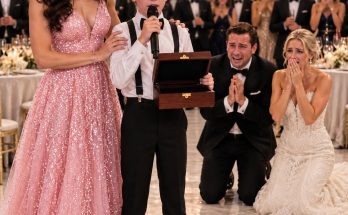
The moment my future mother-in-law called my father trash, five hundred wedding guests went silent.
Then my fiancée laughed, and something inside me became colder than the champagne in her hand.
The reception hall at the Pineview Estate glittered with crystal chandeliers, white roses, and enough gold trim to make the place look like a king’s palace.
Fiona’s family had insisted on everything, from the private estate and the full orchestra to the imported flowers and the guest list packed with politicians, executives, and people who measured worth by the price of a watch.
My father stood near the back of the room in his charcoal suit, which looked out of place among the tuxedos.
His sleeves were slightly too short, his shoes were polished but clearly worn, and his tie had belonged to my grandfather.
He had raised me alone after my mother died, working construction jobs and repairing industrial engines, and he had never once complained about the lack of luxury in our lives.
Fiona’s father, George Martinez, stepped onto the small stage and lifted his glass to toast the room.
“Before we officially welcome Blake into our family, we should acknowledge exactly where he came from,” he said, flashing a condescending smile toward the crowd.
A few people in the front rows chuckled, clearly amused by the setup.
Fiona’s mother, Beverly, turned her head and looked my father up and down with open disgust.
“That is not a father,” she said loudly enough for the microphones to pick it up. “That is just trash someone forgot to take out.”
Laughter rolled through the room like a wave of physical force.
My father lowered his eyes, his shoulders hunching slightly under the weight of the public insult.
I looked at Fiona, waiting for her to show horror, offer an apology, or display anything remotely human in response to such cruelty.
She simply covered her mouth with her hand, suppressing a laugh, and whispered, “Mom, please stop. You are going to embarrass him.”
“You have already done that,” I said, my voice cutting through the ambient noise of the room.
Fiona blinked, looking confused and slightly annoyed. “What are you talking about, Blake?”
I stood up, pulled the diamond wedding ring off my finger, and placed it firmly beside my untouched plate.
“The wedding is over,” I announced.
The room erupted into whispers and gasps as the guests began to murmur among themselves.
Fiona reached out and grabbed my wrist, her nails digging into my skin.
George rose so quickly from his chair that it fell backward, crashing onto the polished floor.
“You will sit back down right now,” he snapped, his face turning a deep shade of red. “Do you have any idea how much money this wedding cost to put together?”
“I understand exactly what it cost,” I replied, pulling my arm away from his daughter.
Beverly sneered at me from her seat. “You are throwing away the only real chance a man like you will ever have in this world.”
I walked over to my father, who looked as though he had aged ten years in the last few minutes.
His face carried the same quiet, heavy pain I had seen when the bills were overdue and he pretended he was not hungry so I could eat more.
“Dad, let’s go home,” I said softly, placing a hand on his shoulder.
Outside the hall, rain began to streak down the marble steps of the estate.
Behind us, I heard Fiona screaming my name, while a swarm of photographers rushed forward to catch the spectacle.
My father stopped beneath the massive stone portico, looking out at the dark driveway.
“Son,” he said, his voice unusually steady. “There is something I should have told you many years ago.”
A convoy of sleek, black SUVs turned through the iron gates, their headlights cutting through the heavy rain.
Several men in dark suits stepped out, immediately rushing toward us with umbrellas to keep us dry.
One of the men addressed my father with an intensity of respect I had never seen directed at him before.
“Mr. Henderson, the board is fully assembled and awaiting your instructions.”
My father looked at me, his eyes filled with a mix of regret and strength.
“Blake,” he said, “I am a billionaire.”
I stared at the long line of cars, then looked at the man whose hands were still scarred from the hard jobs I thought had kept us alive all these years.
He looked genuinely ashamed of his secret, not proud of his status.
Inside the hall, the orchestra had completely stopped playing, and the silence was deafening.
Through the glass doors, I saw George watching the convoy, and for the first time that day, the arrogant smile had vanished from his face.
I thought the billionaire confession was the biggest shock waiting for me that night, but I was wrong.
Inside the lead vehicle, my father handed me a high-end tablet displaying a complex corporate empire.
It was Henderson Strategic Holdings, a massive entity controlling interests in logistics, energy, medical technology, and commercial real estate.
His actual fortune exceeded twelve billion dollars.
“Why hide it all this time?” I asked, trying to process the scale of what I was looking at.
“Because money destroyed everyone I loved before you were born,” he said. “Your mother knew, and we agreed that you would grow up knowing the value of hard work, loyalty, and consequence before you ever inherited a cent of wealth.”
The construction jobs had been real, he explained, because he liked to work beside his employees anonymously, inspecting his companies from the ground level to keep people honest.
The small house, the rusted truck, and the constant budgeting had been conscious choices, not economic necessities.
Then his attorney, Natalie Jones, opened another digital file on the tablet.
Hale Development, which was George’s company, was currently collapsing under the weight of massive, hidden debt.
Henderson Holdings owned the very bank that had extended their credit facility, as well as the private investment fund that was currently preparing to rescue them.
“George has been begging us for meetings for eight months,” Natalie said. “He has no idea that your father secretly controls both the debt and the rescue capital.”
My stomach tightened as I realized the depths of their deception.
“Fiona must have known something was off,” I said, connecting the dots.
Natalie pulled up a series of text messages obtained by a private investigator after my father had noticed unusual, invasive searches into our family records.
Fiona had written to her mother three months earlier: Blake’s father is connected to the Henderson group somehow, so we need to marry first and confirm the details later.
She continued in the message: If the old man is actually valuable, we own the bridge to his fortune.
Another message from Beverly read: Keep pretending he is poor, because Blake is desperate to belong to our circle and he will tolerate anything if he thinks we are his ticket up.
My father looked away, clearly furious with himself for not seeing through them sooner.
I stayed completely calm, focusing on the tactical reality of the situation.
“I want every one of these messages preserved as evidence,” I said. “No threats and no public scenes, because we are going to do this legally.”
That surprised my father, but I had spent seven years working as a forensic accountant.
Fiona had always believed I reviewed boring, routine insurance claims for a living.
In reality, I traced concealed assets, fraudulent transfers, and high-level executive theft for federal litigation teams.
Arrogant people like the Martinezs often mistook my quiet nature for being insignificant.
Back at the estate, the family had already begun trying to transform the humiliation into a public relations victory.
George told the remaining guests that I had suffered a mental breakdown and needed medical help.
Fiona posed tearfully for the cameras, claiming that my father had manipulated me into leaving her at the altar.
Beverly even announced to the press that their lawyers would sue us for the total cost of the wedding and the reputational damage I had caused.
They truly believed they had regained control of the narrative.
By the next morning, Fiona had sent me twenty-seven separate messages.
The first one called me pathetic and weak, but the last one said she loved me and wanted to meet privately to talk things through.
I agreed to the meeting, but I chose my own office conference room, where every word could be legally recorded and documented.
She arrived wearing large designer sunglasses and carrying a new version of our prenuptial agreement.
“Sign this confidentiality clause,” she said, dropping the papers onto the mahogany table before me. “Transfer your interest in anything connected to your father, and my family might be willing to forgive this outburst.”
I almost admired the sheer audacity of her demands.
“You mocked him because you thought he was poor,” I said, watching her carefully.
She smiled, completely unbothered. “And now that we all know he isn’t, we should just be practical about how we move forward.”
Behind the mirrored glass of the conference room, Natalie and two veteran investigators heard every word.
Fiona had just confessed that love had never been a part of her plan, yet she still believed that her family’s social standing made her completely untouchable.