My mother practically worshiped my dropout brother while ordering me to bury my own medals. In front of two hundred officers, she mocked me, laughing, ‘You? A hero? You’re just a pathetic desk jockey!’ I stood there, feeling completely worthless and abandoned. But the mocking stopped the exact second a battle-scarred SEAL slammed the doors open and roared, ‘AS-01 on deck? SALUTE!
Section 1: The Briefing Room
“You? A hero?”
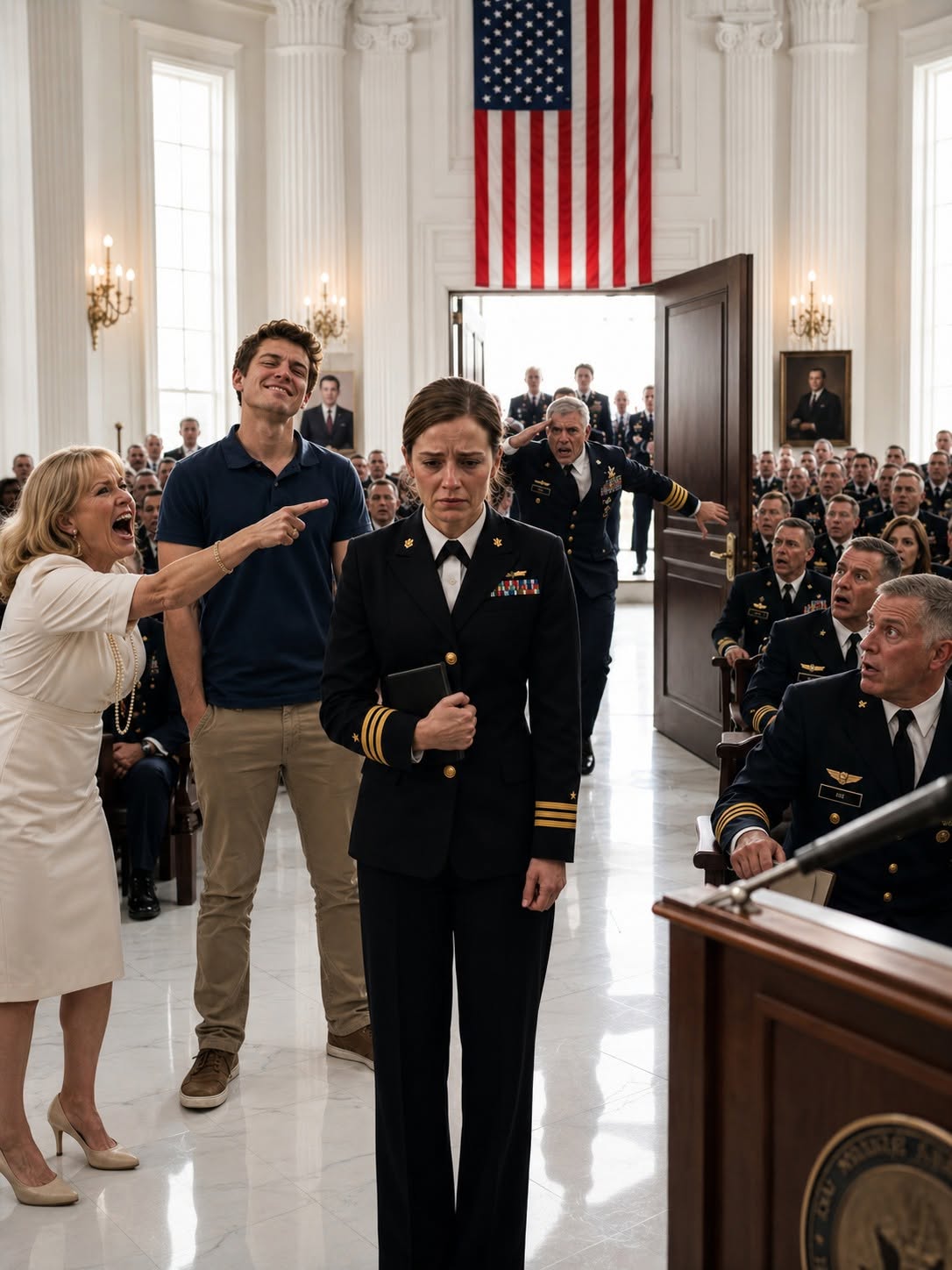
Admiral Margaret Vance’s laugh cracked across the strategic briefing room like a shattering plate. Two hundred uniformed officers sat beneath the harsh fluorescent lights, their eyes flicking between her four stars and my frozen face. Standing at the podium as if she owned the Navy, her silver hair pinned painfully tight, Margaret pointed a polished nail at me. “I apologize for my daughter, gentlemen. She gets confused sometimes. She thinks pushing files around makes her a warrior.”
Careful, ugly laughter hummed through the room. I sat in the third row, hands folded. I was Lieutenant Commander Sarah Vance, thirty-four, though my mother only used my rank as a punchline. “She is a low-level logistics girl,” Margaret continued, “a desk ornament. My son may not have finished college, but at least Leo has the instincts of a winner. Sarah hides behind spreadsheets and pretends she matters.”
My mouth tasted like metal. I had taken shrapnel through my jacket in places nobody in this room was cleared to know about, slept under desert rocks, and watched young men whisper their kids’ names before crossing borders that officially didn’t exist. But to her, I was still the girl who flinched when she slammed cabinets, the girl who hid her ribbons under a mattress because being proud made her furious. A colonel who had respectfully saluted me six months ago now stared intently at his legal pad. Margaret smiled. She could bend any room to her preferred reality.
“Stand up, Sarah,” she commanded suddenly. Chairs creaked. I rose slowly. She tilted her head with mock pity. “Tell these officers what you really do. Go on. Tell them about your heroic calendar invites and your dangerous paper clips.”
As more laughter erupted, my vision narrowed. I thought of my father, who died when I was nine. He used to kneel beside me and say, “Steady hands, steady mind.” He was the only one who saw me before my mother taught everyone not to.
“I serve where I’m assigned,” I said, my voice too calm.
Margaret’s face darkened because I hadn’t begged. “Sit down, before you embarrass yourself further.”
I was halfway back into my seat when the heavy oak doors burst open. A SEAL lieutenant staggered in, his field uniform caked in dust, his left sleeve torn over a bandaged forearm. The laughter died instantly. Margaret stiffened. “Lieutenant, this is a closed briefing.”
He ignored her, his sharp, desperate eyes sweeping the room. “I need UX-09,” he demanded, his rough breathing indicating he’d run straight from the flight line. “I was told the asset was here.”
Margaret gave a short laugh. “You are mistaken. There are no field assets in this room. Only senior command and support staff.”
The lieutenant’s gaze locked onto me. Relief washed over his battle-hardened face. He walked straight toward my row, ignoring Margaret’s vanishing smile, snapped his boots together, and delivered a salute so sharp the room flinched. “Ma’am,” he said, his voice shaking. “Thank God we found you.” Behind him, my mother’s perfect world went silent.

Section 2: The Hidden Ribbons
Before that salute destroyed her, my mother had spent thirty-four years building me small enough to fit under her shoe. It started long before briefing rooms.
At Thanksgiving in 2009, our McLean home looked picture-perfect from the street, smelling of roasted turkey and my mother’s perfume. Nothing was accidental. My father’s photographs were hung low in the hallway, overshadowed by Margaret’s medals in lit glass cases and my brother Leo’s prep school acceptance letter—framed despite him being expelled. My own picture was half-hidden behind a fern near the bathroom.
I was seventeen, with my top-tier military entrance exam scores folded neatly under my napkin. Across from me sat Uncle Raymond, my father’s quiet, watchful brother, who could read a room like weather. When the football game went to commercial, I cleared my throat. “Mom, I got my scores back. I qualified in the top one percent nationwide. I can apply for combat intelligence tracks.”
The silence came down hard. Margaret placed her fork down slowly. “Combat? The military is not for sensitive little girls who need applause. You would cry the first time someone raised their voice.”
“I don’t cry.”
“No, you go stiff like a kicked dog and pretend that is courage.”
“My scores are higher than Leo’s were,” I blurted out before fear could stop me.
The room turned ice cold. Margaret’s eyes snapped to mine. “Leave your brother out of your little performance.” Leo grinned from the sofa, where he sat with his shoes on the cream carpet. “Relax, Sarah. Maybe you can be a nurse on a ship or something.” Margaret’s face softened instantly toward him. “Your brother has natural leadership. He simply needs direction. I am speaking to a few people about opportunities for him.”
“He was expelled,” I said.
Uncle Raymond closed his eyes. Margaret stood up so fast her chair scraped the floor. “You think a test score makes you special? You think men will follow you because you can fill bubbles on a page? You are not a hero, Sarah. You are a problem with good handwriting.” Nobody defended me. I folded my scores smaller and smaller until the paper creased into a hard square.
That night, I locked my bedroom door and pulled a shoebox from beneath my mattress containing three marksmanship ribbons. The instructors had called me the best natural shooter they’d seen in years, warning me not to let anyone talk me out of it. I held them in the dark while Margaret’s voice floated up through the vents, mocking me to someone on the phone: “Can you imagine Sarah with a weapon?” I pressed the ribbons to my chest. I didn’t cry. A door inside me closed, and behind it, a different girl began taking notes.
Section 3: Becoming UX-09
The first time the military hurt me, strangers treated me like family. The first time my mother heard about it, she treated my broken bones like evidence.
At twenty-two, during advanced survival training in the Nevada desert, I slipped during a night climb. The fall tore my shoulder and cracked two ribs, landing me in a canvas medical tent three inches from a punctured lung. My instructors showed quiet kindness—one brought coffee, one brought a book, and a third just sat silently by my cot. Then my phone buzzed with a message from Margaret: “I told you this wasn’t a playground. You proved your stupidity. Quit now. Come home before you ruin yourself.” Twelve words that hurt more than a fist.
Six months later, I was facedown in swamp water during a classified selection course, mosquitoes around my eyes and muscles cramping, completely motionless. At dawn, a senior instructor noted my flawless camouflage. “You disappear well,” he said. “That is not a small thing.”
From then on, disappearing became my profession. Years passed in classified rooms and foreign dust. I earned medals nobody could photograph and citations locked behind doors my mother couldn’t enter. In public records, I was administrative support. In reality, I was attached to a special mission unit so compartmented that senior officers only knew my call sign: UX-09. Machines didn’t need mothers.
After one deployment, I returned with a severe shoulder bruise. At a garden party Margaret was hosting, a senator asked where I had been for seven months. As I opened my mouth, Margaret clamped her hand directly onto my injured shoulder, white-hot pain bursting behind my eyes. “Oh, Sarah was backpacking around Europe,” she lied brightly, her nails digging deeper. “Always searching for herself.” Across the pool, Leo lifted a beer; she had just bought him a new car for “trying again” at a job that lasted less than three months.
That evening, I related the incident to Master Chief Vance Knox, a retired operator with a titanium leg. He tapped the bar. “Your mother knows exactly what you are. She isn’t confused, Sarah. She’s scared. You earned in the dirt what she collected in ballrooms. That makes you dangerous to her.” My phone buzzed with a text from her demanding I scrub the roof tiles by 8:00 AM. Knox gave a humorless laugh. “That is not about roof tiles. That is a leash.” For the first time in my life, I turned my phone facedown and didn’t answer.
Section 4: The Staged Correction
The week before the briefing room incident, my mother tried to put me back in my place at the annual Navy gala in Washington. I chose to wear my dress white uniform, disregarding her orders to buy a cocktail dress. Two and a half gold stripes shone on my sleeves, and three precise rows of ribbons sat over my heart. I saw Margaret count them, her eyes hardening.
When a young intelligence lieutenant crossed the room and snapped to attention to greet me, Margaret stepped between us so quickly her perfume hit me like a wall. “Stand at ease,” she barked at him, before turning to me with a venomous smile. “Do not just stand there, Sarah. Senator Bell’s glass is empty. Go fetch him another gin and tonic.”
The circle quieted. The lieutenant looked from my ribbons to Margaret, understanding the staged correction. She wanted the room to see a subservient daughter before they could see an officer. I walked to the bar, every step feeling like swallowing glass. The bartender, an older vet, slid the drink across the wood with sympathetic eyes.