PART 2
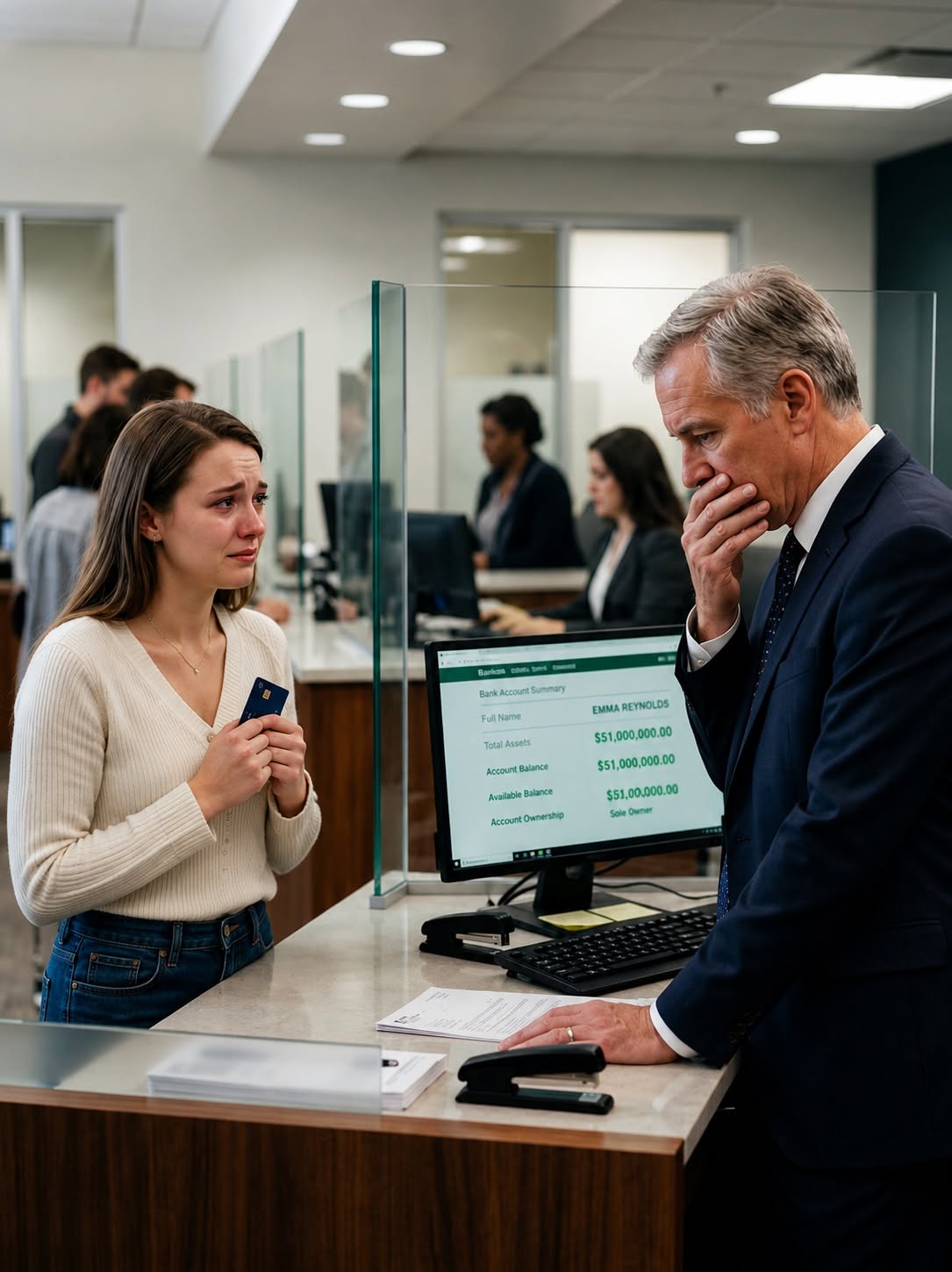
Mr. Collins shook his head and opened a file on the screen.
It was not a simple bank statement.
It was a vault of records—scanned documents, trust agreements, dated letters, legal seals, old photographs, and account ledgers stretching back nearly two decades. My father’s name appeared again and again, but not the way I remembered it.
Not Robert Reynolds, maintenance supervisor.
Robert Reynolds, founding beneficiary.
Robert Reynolds, primary asset holder.
Robert Reynolds, chairman.
I stared at the glowing monitor as if the words belonged to another language.
Mr. Collins folded his hands carefully on the desk. His expression had shifted from shock to something almost respectful, as if I had entered the branch as a desperate woman with a dusty card and suddenly become someone he was afraid to offend.
“Ms. Reynolds,” he said quietly, “your father was not merely a bank customer. He was one of the original private clients of Pacific Bay Bank’s wealth division.”
I laughed once, but there was no humor in it.
“My father fixed water heaters in apartment buildings.”
“Yes,” Mr. Collins said. “That was the life he chose to show you.”
The room seemed to tilt.
Outside the glass wall, customers waited in neat little lines. Someone signed a deposit slip. A child tugged on his mother’s sleeve. A printer hummed somewhere nearby. The ordinary world continued, rude and indifferent, while mine split cleanly down the center.
“He died seventeen years ago,” I said. “I handled everything after. There was nothing. No estate. No house. No stocks. Just medical bills and an old truck.”
Mr. Collins turned back to the screen. “What you handled was the public estate. This account was placed inside an irrevocable trust with specific access conditions. According to these documents, it remained locked until three requirements were met.”
He clicked another file.
My father’s signature appeared at the bottom of a page dated four months before his death.
I recognized the careful slope of his R, the heavy pressure of his pen. It made my throat tighten.
“What requirements?” I asked.
“One,” Mr. Collins said, reading from the document, “the beneficiary must be Robert Reynolds’s biological daughter, Emma Grace Reynolds. Two, the beneficiary must be at least thirty-five years old. And three…” He hesitated.
“And three?”
His eyes lifted to mine.
“The beneficiary must present the access card voluntarily, without having been instructed by any bank employee, attorney, spouse, or third party.”
A chill moved through me.
I thought of my father pressing that card into my hand all those years ago.
Keep this, he had said, for the day you truly have nothing left.
Not for a rainy day. Not for an emergency.
For the day you truly have nothing left.
My fingers curled against my palms.
“He knew,” I whispered.
Mr. Collins said nothing.
“He knew Michael would do this?”
“I can’t speak to what your father knew,” he replied, but his voice softened. “I can only tell you what he arranged.”
He opened another document. This one was a letter, scanned and preserved in color. The paper had yellowed at the edges. The handwriting was my father’s.
My breath caught before I read a single word.
Emma, my darling girl,
If you are reading this, then the world has finally taken enough from you that you remembered what I gave you.
I pressed one hand over my mouth.
The room blurred.
Mr. Collins looked away, giving me the only privacy he could offer inside a room made of glass.
I forced myself to keep reading.
You may be frightened. You may feel foolish. You may wonder why I kept this from you. I hope you will understand that money does not only change a life. It reveals the people standing closest to it.
Your mother and I learned that too late.
I stopped breathing.
My mother.
She had died when I was nine. A car accident, my father told me. Wet road, bad visibility, no one’s fault. I remembered the funeral in pieces: black coats, white lilies, my father kneeling beside her grave with both hands pressed into the grass as if he was holding the earth closed.
Mr. Collins watched my face.
“There are more letters,” he said gently. “Some personal. Some legal.”
“Why didn’t anyone tell me?” My voice broke. “Why did no one come find me?”
“Because your father specifically forbade it.”
I looked up sharply.
“The bank was not permitted to contact you. The trustee could not contact you. The attorneys could not contact you. You had to come here on your own with that card.”
“That’s insane.”
“It is unusual,” Mr. Collins admitted. “But legal.”
He clicked another page, and a list of conditions appeared.
My name.
My date of birth.
My old childhood address.
Then a line that made my skin prickle.
Spouse interference clause.
Mr. Collins’s mouth tightened.
“What does that mean?” I asked.
He took a moment before answering. “It means that if any spouse, fiancé, partner, or domestic companion attempted to access, claim, redirect, conceal, or legally attach the trust assets before the beneficiary activated them, that person would be permanently barred from any claim and referred for investigation.”
I stared at him.
“Michael,” I said.
The name tasted like metal.
Mr. Collins did not ask who Michael was. He only clicked another folder.
A red warning banner appeared on the screen.
PRIOR ACTIVITY FLAGGED.
My pulse began to hammer.
“What is that?”
Mr. Collins’s face had gone pale again. “Ms. Reynolds, before we continue, I need to ask whether your husband—or former husband—has any connection to banking, property development, private equity, or legal trusts.”
“My husband is Michael Donovan,” I said. “Real-estate developer. Donovan Urban Group.”
Mr. Collins inhaled slowly.
The kind of breath a person takes when a bad suspicion becomes a fact.
“Do you know him?” I asked.
“No,” he said, too quickly. Then he corrected himself. “Not personally. But his name appears in this file.”
Every sound vanished.
The hum of the printer.
The muffled conversations.
My own breathing.
Mr. Collins turned the monitor toward me again.
There it was.
Michael Donovan.
Not as my husband.
Not as an emergency contact.
As the subject of a suspicious inquiry.
“What did he do?” I asked.
Mr. Collins lowered his voice. “Seven years ago, an attorney representing a shell company requested information related to dormant Reynolds-family assets. The request was denied. Five years ago, another inquiry was made through a private investigator. Denied. Two years ago, a court filing attempted to identify hidden marital assets associated with your maiden name.”
My hands went numb.
“Michael knew.”
“I don’t know what he knew,” Mr. Collins said carefully.
I did.
Suddenly, memories snapped into place with cruel clarity.
Michael asking, years ago, whether my father had “ever invested in anything unusual.”
Michael laughing when I said no, then pressing again.
Michael insisting I sign financial disclosures without reading them because “lawyers make everything look scarier than it is.”
Michael hiring a tax consultant who asked strangely specific questions about my childhood, my parents, my father’s old mail.
Michael’s irritation whenever I used my maiden name.
He hadn’t thrown me away because I was worthless.
He had thrown me away because he thought he had already searched me empty.
The humiliation I had carried for three days hardened into something colder.
“Can he touch this money?” I asked.
“No,” Mr. Collins said. “Not from what I see here. In fact, based on the trust language and the activity flags, any attempt by Mr. Donovan to assert marital claim may trigger penalties. But you need legal counsel immediately. Not tomorrow. Today.”
“I have forty-three dollars.”
Mr. Collins looked at the monitor.
“You have significantly more than that now.”
The absurdity of it almost made me laugh again, but then the glass office door opened.
A woman in a navy suit stepped inside without knocking.
She was tall, silver-haired, composed in a way that made the room itself seem to straighten. Her eyes moved from Mr. Collins to me, then to the card lying on the desk.
“Emma Reynolds,” she said.
It was not a question.
Mr. Collins stood quickly. “Ms. Whitaker.”
The woman extended her hand. “Margaret Whitaker. Senior trust counsel for Pacific Bay Private Holdings.”
I shook her hand automatically. Her grip was firm and dry.
“I understand this is overwhelming,” she said, taking the chair beside me rather than behind the desk. “But we do not have much time.”
“Why?” I asked.
“Because the moment your father’s card was used, several automatic notices were released.”
“To who?”
“To the trustee. To the bank’s legal department. To a private security firm. And to your father’s former attorney of record.”
“That sounds like good news.”
“It may be,” Margaret said. “But one more notice was released as well.”
My stomach tightened.
“Because of the prior suspicious activity tied to Michael Donovan, the system automatically notified the fraud-prevention unit that the trust has been activated. If Mr. Donovan has anyone monitoring dormant filings or probate triggers, he may know soon.”
I gripped the edge of the chair.
“He kicked me out three days ago.”
Margaret’s eyes sharpened.
“Did he serve you divorce papers?”
“No. He said the lawyers took care of everything, that I signed everything. I don’t even know what that means.”
“Did you sign documents recently?”
I thought back. “Six months ago. He said we were refinancing the house and restructuring business assets. There were stacks of papers. He told me where to sign.”
Margaret’s mouth became a hard line.
“Did you have independent counsel?”
“No.”
“Did anyone explain the documents to you?”
“No.”
“Did you receive copies?”
I shook my head.
Margaret stood. “Then we begin there.”
Something about her certainty steadied me.
For three days, I had felt like a woman swept out of her own life, small and disposable. But Margaret spoke as if there were doors still available to me, doors Michael had hoped I would never see.
She turned to Mr. Collins. “Freeze all external transfer capability until identity re-verification is complete. Issue a temporary protected account under beneficiary control only. Notify Hargrove Security and have a driver sent to the branch immediately.”
My eyes widened. “Security?”
Margaret looked at me. “Ms. Reynolds, you walked into a public bank branch with an activated fifty-one-million-dollar trust tied to a man who may have spent years trying to locate it. You are not leaving here alone.”
I wanted to say that was ridiculous.
Then I remembered Michael’s face as he told me to leave.
Not angry. Not guilty.
Finished.
Like he had completed a transaction.
A transaction he may have planned for years.
Margaret’s phone buzzed. She glanced down and frowned.
“What?” I asked.
She didn’t answer immediately.
Then she turned the screen toward me.
A news alert had appeared.
DONOVAN URBAN GROUP ANNOUNCES MAJOR ACQUISITION BID IN DOWNTOWN SAN DIEGO REDEVELOPMENT PROJECT.
Beneath the headline was a photograph of Michael smiling at a podium.
Beside him stood Brianna.
Her hand rested lightly on his arm.
Margaret tapped the article. “This bid requires liquid proof of capital by the end of the week.”
I didn’t understand at first.
Then I did.
“He needed money.”
Margaret’s silence confirmed it.
“He thought he could take mine.”
“We need to determine whether he already tried.”
Mr. Collins printed a temporary access report. Margaret reviewed it page by page with frightening speed.
Then she stopped.
Her eyes narrowed.
“What is it?” I asked.
“Mr. Collins, pull the archived legal correspondence from September three years ago.”
He did.
A scanned letter appeared.
The letterhead made my heart stop.
Donovan, Pierce & Vale Legal Services.
Michael’s attorneys.
The letter requested clarification regarding potential residual interests connected to the estate of Robert Reynolds, deceased, and any assets that might be considered marital property through Emma Reynolds Donovan.
Margaret read it once, then again.
“Did Michael ever tell you he contacted this bank?”
“No.”
“Did he ever tell you your father may have had assets?”
“No.”
Margaret sat back.
“Then your husband has been lying longer than you think.”
The words should have broken me.
Instead, they settled over the ashes.
A strange calm filled me.
All at once I saw my marriage from a new angle—not as a slow cooling of love, not as a failure I had caused by being too quiet, too trusting, too dependent, but as a structure Michael had built around me. A beautiful room with hidden locks.
He had isolated me from friends because he called them jealous.
He had persuaded me to quit work because he called it practical.
He had placed the house in his name because he called it easier.
He had moved papers under my pen because he called it trust.
And when he thought he had extracted everything useful, he opened the front door and put me outside.
“Ms. Reynolds,” Margaret said, “where are you staying?”
I told her the motel name.
Her expression flickered just slightly.
“You will not return there.”
“My suitcase is there.”
“We’ll retrieve it.”
“I don’t have anything else.”
“You have yourself,” she said. “And now you have options.”
I looked toward the glass wall. A man in a gray suit stood near the entrance of the bank, pretending to read a brochure. He was too still. Too focused.
Margaret followed my gaze.
Her face changed.
“Mr. Collins,” she said quietly, “call security.”
The man looked up.
Our eyes met.
I had seen him before.
Not often. Not clearly. But he had been at Michael’s office holiday party two years ago, standing near the elevators. He had worn no name tag. Michael had introduced him to someone as “our compliance guy,” then quickly guided me away.
Now he was inside the bank.
Watching me.
“He works for Michael,” I whispered.
Margaret rose. “Emma, stand up slowly.”
The man turned and walked toward the exit.
One of the bank guards moved after him, but the man was already through the doors and onto the sidewalk.
Margaret stepped closer to me, shielding me from the view outside.
“This is no longer theoretical.”
My knees weakened, but I did not sit down.
For the first time since Michael had expelled me from my own home, fear was joined by anger powerful enough to keep me upright.
“What do we do now?” I asked.
Margaret looked at me as if she had been waiting for that question.
“Now,” she said, “we make sure Michael Donovan understands he chose the wrong woman to betray.”
Within an hour, I was no longer Emma Donovan, abandoned wife with a cheap suitcase and a motel key.
I was Emma Reynolds again.
The name appeared on fresh documents, temporary credentials, security forms, and a private-client intake file. Margaret guided me through each step, never rushing my signature, never asking me to trust what I had not read. Every time she placed a document before me, she explained its purpose in plain language.
It was a small kindness.
It nearly undid me.
A black SUV waited in the underground parking garage. A broad-shouldered man named Victor introduced himself as my security detail. He did not smile, but he opened the door with such professional calm that I climbed inside without argument.
Margaret sat beside me.
As the SUV pulled away, I watched the bank disappear behind us.
“Where are we going?” I asked.
“To a secure hotel under an alias,” she said. “Then we retrieve your belongings. After that, you meet your attorney.”
“I thought you were my attorney.”
“I represent the trust and the bank. Your father anticipated conflicts. He named a personal attorney for you.”
My father again.
Always one step ahead from beyond the grave.
“Who?”
“Daniel Voss.”
I turned to her.
Even I knew that name.
Daniel Voss had represented politicians, billionaires, and one famous actress whose divorce had filled every gossip site for six months. Michael used to sneer whenever Voss appeared on television, calling him a shark in a designer suit.
“He’ll never take me as a client.”
Margaret gave me the faintest smile.
“He already has.”
The hotel was nothing like the motel. It sat discreetly near the waterfront, all quiet marble and low lighting. No one stared. No one asked questions. Victor escorted us through a private entrance into an elevator that required a keycard.
The suite upstairs was larger than the apartment my father and I had lived in after my mother died.
I stood in the doorway, unable to move.
There were fresh clothes folded on the bed. Toiletries in the bathroom. A laptop on the desk. Food arranged beneath silver covers.
“Who paid for this?” I asked.
“You did,” Margaret said gently.
I almost told her that was impossible.
Then I remembered.
Fifty-one million dollars.
But the number still felt unreal. It was not money in my mind. It was a storm cloud. A weapon. A secret my father had hidden in my hands.
Victor left to retrieve my suitcase with two security staff. Margaret stayed while I washed my face, changed into a soft cream sweater and black trousers that fit surprisingly well, and tried to recognize myself in the bathroom mirror.
Without the motel’s yellow light, I could see how exhausted I looked.
But I could also see something else.
My eyes were no longer pleading.
At six o’clock, Daniel Voss arrived.
He was younger than I expected, maybe late forties, with dark hair touched by gray and an expression so controlled it gave away nothing. He carried no briefcase. Only a slim leather folder.
“Ms. Reynolds,” he said.
Not Mrs. Donovan.
Ms. Reynolds.
The name landed like a hand at my back.
We sat at the dining table while the city glowed beyond the windows. Margaret remained for the trust-related portion, then excused herself after handing Daniel a sealed packet.
Daniel opened it, read the first page, and went very still.
“What is it?” I asked.
He looked at me for a long moment.
“Your father left instructions for this exact scenario.”
A shiver moved through me.
“Exact?”
Daniel slid a page across the table.
At the top, written in my father’s hand, were the words:
If Emma is married to Michael Donovan when she activates the trust, proceed with Protocol C.
The room went cold.
I heard myself whisper, “How could he have known Michael?”
Daniel’s face was grim.
“Because Michael Donovan’s father knew yours.”
I stared at him.
“My father never mentioned the Donovans.”
“I’m not surprised.”
Daniel opened the folder and removed an old black-and-white photograph. Four men stood in front of a construction site. One of them was my father, younger and broader, smiling with a cigarette between his fingers.
Beside him stood a man I recognized from a portrait in Michael’s study.
Charles Donovan.
Michael’s father.
My skin prickled.
“What is this?”
“Before your father was a maintenance supervisor,” Daniel said, “he and Charles Donovan were partners in a development company.”
“No.”
“Yes.”
“My father hated developers.”
“After what happened, I imagine he did.”
My voice thinned. “What happened?”
Daniel tapped the photo once.
“Twenty-four years ago, your father discovered that Charles Donovan was using their company to launder money through construction projects. Your father gathered evidence and prepared to go to federal authorities. Before he could, your mother died in a car accident.”
The words struck so hard I could not speak.
Daniel continued carefully.
“The accident was investigated as weather-related. But your father never believed that.”
My hand flew to my mouth.
“Are you saying Michael’s father killed my mother?”
“I am saying your father suspected Charles Donovan was involved. He could not prove it. Not then.”
“Then why didn’t he tell me?”
“Because he believed you would be safer not knowing. He liquidated what he could, hid the proceeds legally through layered trusts, cooperated quietly with investigators, and disappeared into an ordinary life. The money in your account appears to be the compounded result of settlements, protected assets, and investments made under sealed agreements.”
I stood so fast the chair scraped against the floor.
My mother’s face flashed in my memory—laughing in the kitchen, flour on her cheek, singing badly to an old radio.
All my life, I had grieved an accident.
Now a stranger in a hotel suite was telling me it might have been the first move in a war I never knew existed.
“And Michael?” I demanded. “Did he marry me because of this?”
Daniel did not answer quickly enough.
The silence was answer enough.
“No,” I said. “No, he met me at a charity event. He pursued me for months. He said—”
My voice failed.
He said I was different.
He said he had never felt so peaceful with anyone.
He said my father would have wanted me protected.
Daniel’s eyes held mine.
“Emma, I don’t yet know whether Michael married you for access to the trust, revenge, leverage, or all three. But your father anticipated the possibility that a Donovan might enter your life.”
My laugh came out broken. “And he still let me marry him?”
“He was dead by then.”
The cruelty of that simple fact silenced me.
Seventeen years.
My father had been gone seventeen years, and still his fear had outlived him.
Daniel slid another document toward me.
“Protocol C grants me authority to file emergency actions on your behalf. We can challenge any documents you signed under potential fraud or coercion. We can freeze any attempted marital claims. We can subpoena Michael’s communications regarding your father’s assets. And we can stop his acquisition bid before Friday.”
That last sentence pulled my head up.
“How?”
“Michael’s company is overleveraged. If he anticipated access to your trust, then his current bid may rely on fraudulent capital assumptions. One carefully timed legal notice to his lenders and partners will force disclosure.”
I looked out at the city lights.
For twelve years, Michael had taught me to avoid conflict. To be graceful. To let him handle unpleasant things.
But grace had not saved me.
Silence had not protected me.
Trust had not been rewarded.
“What happens if we do that?” I asked.
Daniel’s mouth curved slightly, but it was not a smile.
“His deal collapses. His investors panic. His partners ask questions he cannot answer. And if he forged, concealed, or manipulated documents involving you, he may face more than civil penalties.”
Michael’s face appeared in my mind again, cold and bored as he dismissed me.
You had a good life with me.
Now it’s time to move on.
“Yes,” I said.
Daniel studied me. “Once we begin, he will know you are not powerless.”
“He already knows,” I said. “Someone followed me to the bank.”
Daniel turned to Margaret, who had reentered silently near the door.
She nodded. “Confirmed. Victor identified him from security footage. Private contractor tied to Donovan Urban Group.”
Daniel’s expression hardened.
“Then we move tonight.”
For the next two hours, my life became signatures, phone calls, encrypted emails, and documents spreading across the dining table like pieces of a battlefield map. Daniel explained every action before he took it.
Emergency petition.
Fraud preservation notice.
Marital asset injunction.
Trust activation confirmation.
Cease-and-desist.
Lender notification.
Investor disclosure demand.
Each document was a match.
Together, they were a fire.
At 9:17 p.m., Daniel sent the first notice.
At 9:24, the second.
At 9:31, the third.
At 9:46, Michael called me.
His name lit up my new phone, transferred from the cracked one I had carried out of the motel.
For a moment, my body reacted before my mind did. My stomach tightened. My shoulders drew in. Twelve years of habit tried to make me small.
Daniel looked at the screen.
“Do not answer unless you want to.”
The phone vibrated in my hand.
Michael Donovan.
My husband.
My captor.
My mistake.
I let it ring until it stopped.
A voicemail appeared seconds later.
Daniel connected the phone to a recorder and played it aloud.
Michael’s voice filled the room, smooth but strained.
“Emma. I don’t know what game you think you’re playing, but you need to call me immediately. You are confused, and whoever is advising you does not have your best interests at heart. We can still handle this privately. Don’t embarrass yourself.”
I smiled.
Just a little.
There he was.
Not apologizing. Not explaining.
Managing.
Another call came.
Then another.
Then Brianna.
Then an unknown number.
Then Michael again.
At 10:08 p.m., a text arrived.
Emma, you have no idea what your father was involved in. Call me before you get hurt.
The room changed.
Daniel read it twice.
Margaret moved closer.
Victor, who had been standing near the door, shifted his weight.
I stared at the message.
Before you get hurt.
Not before you make a mistake.
Not before you lose everything.
Before you get hurt.
Daniel photographed the screen. “That was foolish of him.”
But I barely heard him.
My father’s letter lay on the table beside the old photograph. His handwriting seemed to rise from the page.
Money reveals the people standing closest to it.
I picked up the phone.
Daniel said, “Emma.”
“I’m not calling him,” I said.
I typed one sentence.
What did my father know?
I sent it before fear could stop me.
For two minutes, nothing happened.
Then three dots appeared.
Disappeared.
Appeared again.
Finally, Michael replied.
More than he ever told you.
Then another message arrived.
Ask your lawyer what is in Vault 19.
Daniel went completely still.
The silence that followed was different from every silence before it.
It had weight.
Margaret turned slowly toward him.
“You know what that is,” she said.
Daniel did not answer.
“Mr. Voss,” I said, my voice barely above a whisper, “what is Vault 19?”
He closed the leather folder with deliberate care.
“It is a private evidence vault your father created before he died.”
My pulse pounded in my ears.
“What evidence?”
Daniel looked at Margaret, then at Victor, then back at me.
“Evidence your father believed could destroy the Donovan family.”
My throat went dry.
“Then why didn’t he use it?”
Daniel’s eyes darkened.
“Because the week after he secured it, he was diagnosed with late-stage pancreatic cancer. He died before he could decide whom to trust.”
The city outside the window glittered like nothing had changed.
But everything had.
My father had not simply left me money.
He had left me a loaded gun buried beneath seventeen years of silence.
And Michael knew where to point me.
Another text appeared.
This one was not from Michael.
Unknown number.
Do not open Vault 19.
The message sat on the screen, stark and impossible.
Then a second came through.
Your mother died because Robert Reynolds asked too many questions.
A third.
You have until midnight to walk away.
Victor crossed the room and checked the hallway through the peephole.
Margaret called bank security.
Daniel took my phone from my trembling hand and placed it flat on the table.
“Emma,” he said, “listen to me carefully. From this moment forward, assume Michael is not the most dangerous person in this story.”
I looked at the old photograph again.
My father.
Charles Donovan.
Two other men whose faces I did not know.
One had his hand on my father’s shoulder.
The other stood slightly behind Charles, smiling without warmth.
As I stared, something about him tugged at my memory.
Not from a photograph.
From real life.
A wedding guest.
A man who kissed my cheek after the ceremony and told Michael he had chosen well.
A man everyone called Uncle Victor.
My gaze lifted slowly toward the door.
Toward my security guard.
Victor stood with one hand inside his jacket.
His eyes met mine.
And then he smiled.