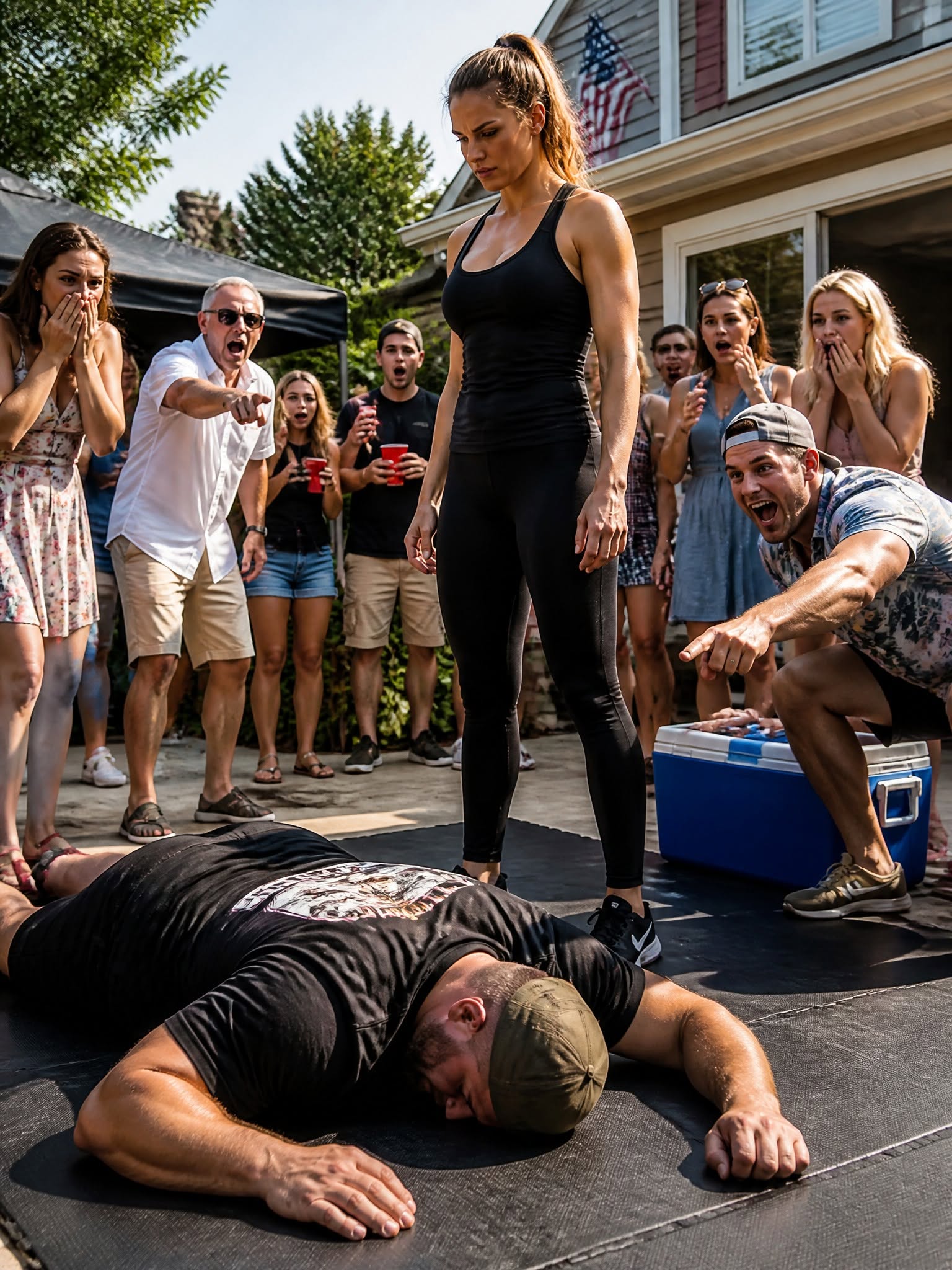
Look at her. A buck-twenty soaking wet,” my Green Beret brother-in-law smirked to the entire backyard barbecue, yanking me onto the sparring mat. “I’ll go easy on you, sweetheart. You’re somebody’s mom.” My sister giggled from the deck, “Careful, don’t break a nail.” Six seconds later, he was face-down on the dirt, completely knocked out. A man standing by the cooler went stone-rigid, his beer dropping to the grass. “That’s a Raider. STAND DOWN.
Part 1 — The Backyard Challenge
“I’ll go easy on you,” my brother-in-law said, grinning as he held a burger in one hand like this was all just casual fun.
Briggs Calder used to be a Green Beret. He was built like he never left the battlefield—broad shoulders, steady stance, the kind of man who could carry everything in one trip and still crack jokes about it. Now he stood in our backyard barbecue, acting like this was just another friendly family joke.
“You’re somebody’s mom,” he added with a laugh, reaching for my wrist.
Not aggressively. Not violently. Just confidently—like the outcome was already decided.
My sister Selah stood beside him in sunglasses and a relaxed smile, sipping lemonade like this was a show she already knew the ending to.
“Just don’t hurt yourself,” she said with a smirk.
A few people laughed. My parents chuckled along. Even the kids slowed down their play to watch.
I didn’t laugh.
I looked at his hand on my wrist. Then at the blue mat he had laid out on the grass—his little “friendly demonstration space.”
“I already said no,” I told him.
He waved it off. “It’s just thirty seconds. I’m not going to hurt you.”
Selah laughed again. “She’s just being dramatic.”
I turned to look at her.
She knew better. I wasn’t dramatic. I was the one who stayed quiet, fixed problems, carried weight, and avoided conflict because it was easier than disrupting everyone’s comfort.
But that afternoon, something in me felt different.
Juniper—my ten-year-old—was sitting nearby in the shade, watching everything without saying a word.
I set my plate down.
“One round,” I said.
The mood shifted immediately—chairs scraped, phones came out, music lowered. People were ready for entertainment.
“Put those away,” I said calmly.
They did.
Briggs stepped onto the mat, still smiling like this was harmless fun. “This’ll be quick.”
I slipped off my sandals and walked onto the grass.
An older man I didn’t recognize had been quietly watching from the cooler. He looked different from the rest of them—too still, too focused, like he understood something they didn’t.
Briggs rolled his shoulders. “Ready?”
“Are you sure?” I asked.
He nodded without hesitation.
That confidence lasted six seconds.
Then Briggs was on his back, staring up at the sky in stunned silence.
No one spoke.
No one laughed.
Even the backyard seemed to forget how to breathe.
I stepped back immediately. “You okay?”
He didn’t answer right away.
Then the older man slammed his bottle down.
“Stand down,” he said sharply.
Everything froze.
He walked forward, eyes locked on me.
“That’s a Raider,” he said. “Stop this now.”
And just like that, the entire backyard realized this wasn’t a joke anymore.

Part 2 — The Moment Everything Shifted
For a long moment, the only sound in Selah’s backyard was a cicada buzzing in the maple tree.
Then my mother finally spoke. “A… what?”
It wasn’t loud. It was uncertain—like she had misheard a word she didn’t understand.
Briggs pushed himself up onto one elbow. There was no anger on his face, no embarrassment either. Just shock. The kind that empties a person out completely. Grass clung to his shirt, and one knee stayed bent where I had redirected his balance—not through force, but through timing.
“That was…” he paused, swallowing. “That was clean.”
I extended my hand.
He didn’t take it right away.
The entire family was watching.
I kept my hand there.
After a beat, he finally grabbed it. I helped him up, though he did most of it himself. His pride had taken the heavier hit.
“You okay?” I asked.
“Yeah.” He brushed grass off his shoulder, but his eyes stayed on me differently now. Not as a relative at a barbecue. As something he hadn’t accounted for.
Orson stopped at the edge of the mat.
“Where’d you learn that transition?” he asked.
I stepped off and reached for my sandals. “A long time ago.”
“That wasn’t recreational training.”
Selah let out a sharp, uneasy laugh. “Okay, wait—what is going on right now?”
No one answered her.
Briggs kept looking at me. “Maren…”
Even the way he said my name had changed. More careful now. More measured.
I put my sandals back on and took my bracelet from Juniper. Her fingers were cold despite the heat.
“Mom,” she whispered, “are we leaving?”
“Not yet.”
Selah moved toward me quickly, her drink spilling slightly. “No, seriously—what was that? Since when do you do things like that?”
“I didn’t do anything special,” I said. “I ended a demonstration.”
“Don’t play it like that.”
My father stood slowly from his chair. “Maren. Answer your sister.”
That tone tried to pull me back into an old version of myself—the one who always explained, always softened, always made things easier for everyone else.
But I didn’t move back.
“I’m not a child,” I said.
Silence followed.
It was the first time I had said it like that.
Orson studied me closely. “You don’t owe anyone explanations here.”
“Like hell she doesn’t,” Selah snapped. “My husband is a Green Beret.”
“Former,” Briggs corrected quietly.
Selah turned on him. “That’s not the point.”
“It kind of is,” he said, still watching me. “She asked if I was sure. I said yes.”
“You were being polite,” she insisted.
“I wasn’t,” he replied. “I was overconfident.”
That landed differently.
A red cup rolled across the patio in the wind. A child laughed somewhere, then went quiet when no one joined in. Even the grill sounded different now, like it was waiting.
My mother stepped closer, forcing a gentle tone. “Maren, sweetheart… did you take some kind of class? Self-defense or something?”
There it was—the version she could accept. Something small. Contained. Harmless.
I looked at her.
At all of them.
“I’ve taken training,” I said.
Orson exhaled slowly, like that confirmed something he already suspected.
Briggs gave a short, quiet laugh. Not mocking—more like disbelief. “That’s one way to put it.”
Selah’s face tightened. “So now what? We’re supposed to believe you’re some secret fighter?”
“I didn’t ask you to believe anything,” I said.
Juniper stepped closer to me without letting go of my hand.
Orson leaned in slightly, voice lower. “You ever attached to MARSOC?”
The word changed the air.
Briggs straightened immediately.
I didn’t answer.
That was enough.
My mother frowned. “What’s MARSOC?”
“Marine Special Operations,” Briggs said slowly.
Selah gave a short, nervous laugh. “Maren was never anything like that.”
A drop of lemonade slid down her cup and hit the grass.
I looked at her.
“No,” I said quietly. “I wasn’t what you thought I was.”
And for the first time in a very long time, I didn’t try to soften it.

Part 3 — What I Never Told Them
I spent most of my adult life carefully avoiding the moment my family would finally ask the right questions.
Not because I was ashamed.
Shame never belonged to that part of my life. Exhaustion did. Grief did. Loneliness did. But not shame.
I left home at nineteen with a single duffel bag, two hundred dollars from waiting tables, and a father who told anyone who’d listen that I had “no real direction.” Selah was seventeen then—beautiful, magnetic, impossible to ignore. She cried at the airport like my leaving was a personal offense. My mother slipped a church bulletin into my bag and told me to call when I was “done with this phase.”
I didn’t call for thirteen weeks.
When I finally did, my voice sounded different enough that she asked if I was sick.
“No,” I told her. “Just tired.”
I didn’t tell her I’d learned to sleep through shouting. I didn’t tell her about the bruises on my hands or the mornings where the world felt like fog and failure and discipline I didn’t yet understand.
My family didn’t deal in complexity. They dealt in labels. Selah was “the pretty one.” I was “the reliable one.” My father was “traditional.” My mother was “sensitive.” Everything uncomfortable got renamed until it felt harmless.
So when I eventually came back—quiet job, steady life, a daughter who loved space books—they decided the missing years had simply been uneventful.
I let them believe that.
At first, it was easier.
Then it became automatic.
Eventually, it became a kind of cage I never noticed I was living inside.
Now, standing in Selah’s backyard, everyone was waiting for me to step out of it.
“What exactly did you do in the Marines?” Briggs asked.
Not mocking. Not curious in a shallow way. He sounded like someone trying to measure something real.
I glanced at Juniper. She was watching everything with quiet, unfiltered focus.
“I trained,” I said. “I taught. I worked in environments I don’t talk about at cookouts.”
Selah rolled her eyes. “That’s convenient.”
Briggs turned to her immediately. “Selah.”
“What? She disappears for years and suddenly we’re supposed to treat it like some classified legend?”
“Nobody asked for that,” I said calmly.
“You embarrassed my husband.”
“I stopped a situation he initiated after I said no.”
Selah scoffed. “Listen to you. You sound like a policy document.”
The old version of me would’ve absorbed that. Smiled. Redirected. Let it go because keeping peace had always been easier than defending myself.
But Juniper’s hand was still in mine.
So I didn’t.
“You turned me into a punchline,” I said. “Don’t get upset when I stopped playing the role.”
The yard changed—not loudly, but noticeably. My mother went still. My cousin looked away. Even Briggs shifted his weight, like he’d just realized something structural about the moment had changed.
Selah’s expression hardened.
Before she could answer, my father cut in. “Enough. This is a family gathering.”
“Then maybe the family should stop trying to entertain itself at someone else’s expense,” I said.
That hit harder than I expected.
His face flushed. “No one was humiliating you.”
I let out a small laugh—not sharp, just tired.
“Five minutes ago you were laughing while your son-in-law put his hands on me after I said no.”
Silence followed.
My father looked away first.
That told me more than any argument could have.
My mother touched his arm gently. “Maren, it was just joking around.”
“That’s what people say when they’re not the ones on the ground.”
A sprinkler clicked. Meat popped on the grill. Somewhere a child asked if something was wrong. The normal life of the backyard kept going, but the center of it had shifted.
Juniper leaned closer to me.
I crouched slightly. “You’re okay,” I told her.
Selah muttered, “Unbelievable.”
Orson, still quiet until now, narrowed his eyes at her.
But Briggs spoke first.
“I owe you an apology,” he said.
Selah blinked. “For what?”
“For assuming you couldn’t stop me.”
I studied him. He wasn’t performing anymore. There was no grin left, no audience left to play to.
“Thank you,” I said.
He nodded once. “That was faster than anything I’ve seen outside a selection course.”
A few people let out uncertain laughs, unsure if they were allowed to.
Selah didn’t laugh.
She took off her sunglasses slowly. “So what now? We’re all supposed to applaud because you turned a family barbecue into a lecture on boundaries?”
“I didn’t turn it into anything,” I said. “You invited me.”
“I invited my sister,” she snapped. “Not whatever this version of her is.”
And there it was.
Not the secret.
But the truth she hadn’t been able to say until now.
Juniper squeezed my hand again.
And for the first time, I understood something clearly:
The moment on the mat hadn’t been the conflict.
It had just been the signal that the real one had already begun.
Part 4 — After the Door Slammed
Selah stormed inside and slammed the patio door so hard the glass rattled in its frame.
The sound cut through the backyard like a fracture. Everyone pretended not to notice, which meant everyone definitely did.
My mother followed immediately—because that was always the pattern. Selah broke; my mother repaired. My father lingered for a moment longer, looked at me like I was the cause of it all, then went inside too.
Outside, the remaining relatives tried to restart the barbecue as if nothing had changed.
Someone turned the music back up. Someone asked about the food. The children returned to the sprinkler, but their eyes kept drifting toward the mat like it might still matter.
Briggs stayed with me.
“I should go talk to her,” he said.
“You probably should.”
He rubbed the back of his neck. “I just don’t want this left unresolved.”
I glanced toward the kitchen window, where Selah’s silhouette moved behind the glass.
“This isn’t about the mat,” I said. “So talking won’t fix it.”
Orson walked over with three unopened bottles of water and handed them out without ceremony.
“Hydration,” he said. “The most overlooked part of any family crisis.”
Juniper accepted hers quietly. “Thank you.”
“You’re welcome,” he replied, then looked at me. “You handled that well.”
“In what sense?” I asked.
“Every sense that matters.”
I twisted the cap off my bottle. My throat felt dry. “You recognized the movement.”
“I recognized the control,” he said. “And the restraint.”
Briggs looked between us. “You two actually know each other?”
“No,” I said.
“Never met her before today,” Orson added.
“But you called her a Raider,” Briggs said.
“I’ve seen enough people move like that to know what it looks like,” Orson replied.
I drank the water to avoid answering.
For a moment, I wasn’t in a backyard anymore.
I was somewhere else—dust, metal, early mornings that felt like the world hadn’t decided whether it was safe yet. A voice saying again when my body wanted to stop.
Then I was back under paper lanterns and the smell of grilled food.