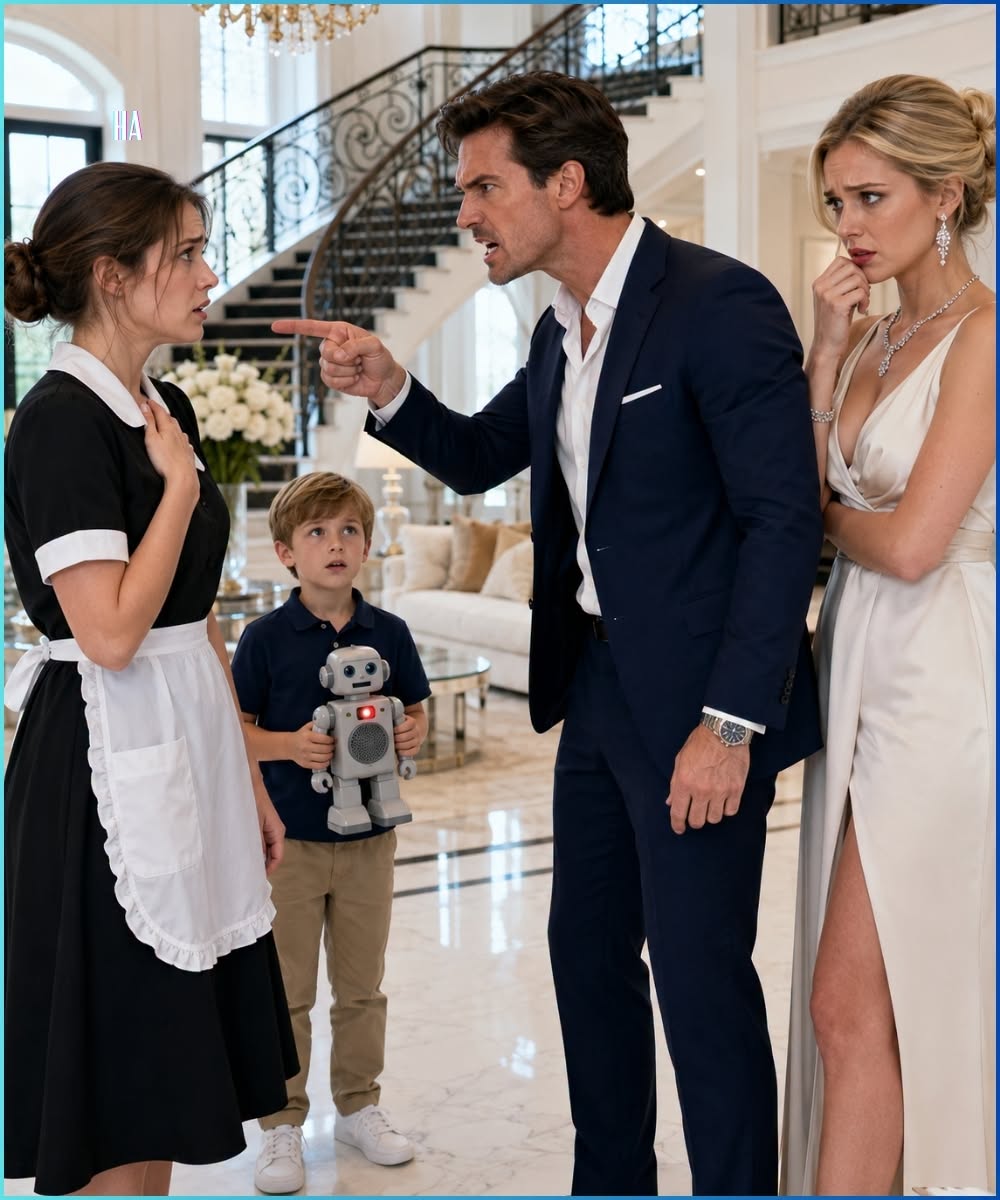
“She went home to rest.”
Ethan’s lower lip trembled. “You sent her away.”
Richard felt the sentence like an accusation. “Just for now.”
Ethan looked toward the table. “My recorder.”
Richard handed it to him, careful of the IV line.
Ethan gripped it with his good hand. “I need you to listen.”
Richard leaned closer. “To what?”
Ethan’s eyes filled.
“I recorded everything.”
Richard did not move at first.
There are moments in life when the truth approaches slowly enough that a person has time to refuse it. Richard had refused many truths in the past year. He had refused the truth that Victoria smiled differently when Ethan entered a room. He had refused the truth that Clara had grown quieter after his engagement. He had refused the truth that his son had stopped running into the foyer when Victoria arrived.
But sitting beside a hospital bed, looking at the fear in Ethan’s eyes, Richard felt refusal lose its power.
“What do you mean, you recorded everything?” he asked.
Ethan’s fingers trembled over the buttons. “Before I fell.”
Richard swallowed. “Why were you recording?”
“Because she was mad.”
A cold line moved down Richard’s spine. “Who?”
Ethan looked at the door.
No one stood there.
Still, he lowered his voice.
“Victoria.”
Richard’s first instinct was to say no.
Not because he trusted Victoria completely, though he thought he had. Not because the accusation seemed impossible, because suddenly it did not. His first instinct was to say no because if it was true, then he had failed his son twice. First by bringing danger into his home, then by blaming the one person who had tried to protect him.
“Play it,” Richard said.
Ethan pressed the button.
At first there was static. Then the faint echo of the upstairs hall. A child breathing too close to the microphone. Footsteps. The soft creak of the banister.
Then Victoria’s voice.
“Stop following me.”
Not the voice she used at fundraisers. Not the voice she used when photographers asked about wedding plans. This voice was low, sharp, stripped of warmth.
Ethan’s recorded voice answered, small and nervous. “I just wanted to show Clara my spaceship story.”
“I told you Clara is busy.”
“She said I could show her.”
A pause.
Then Victoria again, colder.
“That woman is not your mother.”
Richard’s hand tightened on the bed rail.
The recording continued.
“I know,” Ethan said.
“Then stop acting like she is.”
There was movement. A small gasp. Ethan’s real body in the hospital bed went rigid, as if hearing it pulled him back into the moment.
On the recording, his child’s voice shook. “You’re hurting my arm.”
“I am tired of you making your father feel guilty.”
“I want Clara.”
“No,” Victoria snapped. “That is exactly the problem. You and that maid are always in the way.”
Then came a sound Richard would hear in nightmares for the rest of his life.
Fabric pulling.
A quick scrape against the wall.
Ethan crying out, “Daddy—”
Then the terrible crack of the fall.
The recording cut into static.
Richard could not breathe.
For several seconds, the hospital room held only the monitor’s steady beeping and Ethan’s uneven breaths.
“That’s not all,” Ethan whispered. “It stopped because I dropped it.”
Richard sat slowly, the recorder heavy in his palm.
“Daddy,” Ethan said, tears slipping sideways into his hair. “I didn’t fall by myself.”
Richard closed his eyes.
He wanted rage to come first. Rage would have been easier. Rage would have given him motion, an enemy, something to do with his hands.
Instead, shame arrived.
He saw Clara in the hallway. He heard himself say, “You’re not helping your case.” He remembered Victoria’s hand on his arm, guiding his grief like steering a car.
“I’m sorry,” Richard whispered.
Ethan sniffed. “Are you mad at me?”
Richard looked up so fast the chair nearly tipped. “No. No, Ethan. Never.”
“I was scared you wouldn’t believe me.”
That broke him.
Richard leaned over the bed, careful not to touch the injured arm, and pressed his forehead against his son’s small hand.
“I believe you,” he said. “I believe you, and I am so sorry I didn’t ask sooner.”
The door opened.
Victoria stepped in wearing a camel coat, her hair smooth, lips painted soft pink. She carried a paper bag from an expensive bakery as if pastry could soften a hospital room.
“Oh,” she said, stopping. “You’re awake.”
Richard stood.
The recorder remained in his hand.
Victoria’s eyes flickered toward it. Just once. But Richard saw it now. He saw the calculation before the smile returned.
“What is that?” she asked.
“You know what it is.”
Her mouth curved faintly. “Richard, you look awful. Sit down.”
He pressed play.
Her own voice filled the room.
Stop following me.
Victoria’s face changed by inches. Not enough for a stranger to notice. Enough for Richard to understand he had never truly known her.
When the recording ended, she gave a small laugh.
“That toy has been dropped down a marble staircase. You can’t seriously believe it captured anything clearly.”
“I heard you.”
“You heard fragments.”
“I heard my son tell you that you were hurting him.”
Victoria glanced at Ethan. For the first time, anger showed through. “Children exaggerate.”
Ethan shrank back.
Richard stepped between them.
“Get out.”
Victoria blinked. “Excuse me?”
“Get out of this room.”
Her voice lowered. “Think carefully.”
“I am.”
“No, you’re reacting. You are exhausted, emotional, and about to destroy your life because of a child’s toy and a maid who has wanted my place from the beginning.”
Richard stared at her.
“My place?” he repeated.
Victoria’s eyes hardened. “Yes, Richard. Your house has been run by a woman you pay, and somehow I am the outsider. Your son looks at her before he looks at me. Your staff listens to her. Even you defend her when she oversteps.”
“She raised him when I could barely stand up straight after Madeline died.”
“She works for you.”
“She loved him.”
Victoria’s face tightened. “Love does not give her ownership.”
“No,” Richard said quietly. “But neither does a ring.”
For one heartbeat, neither of them spoke.
Then Victoria turned toward Ethan with a smile so thin it looked painful. “Sweetheart, you know I would never hurt you.”
Ethan looked at Richard’s back, not at her.
“I want Clara,” he said.
Richard pressed the call button for the nurse. “Security needs to escort Ms. Lane out.”
Victoria’s mouth opened slightly. “You will regret humiliating me.”
Richard looked at her engagement ring, at the glittering thing he had mistaken for a promise.
“I already regret letting you near my son.”
By noon, the hospital became a controlled storm.
Detective Aaron Moore arrived with a digital evidence bag, a quiet voice, and eyes that missed very little. Richard gave him the toy recorder. Ethan gave a statement with Clara absent because Richard had not yet earned the right to ask her to stand there.
Victoria was not arrested that afternoon. Not yet. Detective Moore explained that they needed to preserve the file, verify timestamps, compare it with security footage, and take formal statements. But his expression after hearing the audio told Richard enough.
“This changes the direction of the investigation,” Moore said.
Richard almost laughed.
The direction.
As if his life had been a road and not a cliff.
When the detective left, Richard stood in the hallway with his phone in his hand for almost five minutes before calling Clara.
She answered on the fourth ring.
“Mr. Avery?”
The formality hurt more than anger would have.
“Clara,” he said, and his voice failed.
Silence.
“What happened?” she asked.
“Ethan played me something. His recorder caught what happened before the fall.”
He heard her breath catch.
“What did it catch?”
Richard closed his eyes. “Victoria.”
On the other end, Clara said nothing.
“I need you to come to the hospital,” Richard continued. “Please. Ethan is asking for you.”
Still silence.
Then Clara said, “Do you believe him?”
“Yes.”
“Do you believe me?”
The question landed cleanly, without cruelty.
Richard deserved cruelty.
“Yes,” he said. “I should have believed you last night.”
“You should have.”
“I know.”
“I’m not coming for you,” Clara said.
“I know.”
“I’m coming for Ethan.”
Twenty minutes later, Clara walked into the pediatric wing wearing jeans, an old navy coat, and the same exhausted face she had worn when Richard sent her away. Ethan saw her through the open door and began crying before she reached the bed.
“Clara.”
“Oh, sweetheart.”
She crossed the room, stopped just short of grabbing him, then gently touched his hair. He leaned into her hand.
“I told him,” Ethan whispered.
“I know.” Clara smiled through tears. “You were very brave.”
“I was scared.”
“Brave people usually are.”
Richard stood by the window, watching them, understanding the shape of his failure more clearly with every second.
Clara did not look at him.
For two days, Victoria vanished into silence.
Her attorney called Richard’s attorney. Statements were made about misunderstandings, emotional distress, unreliable recordings. A publicist suggested a joint statement describing the incident as a private family matter. Richard fired him before he finished the sentence.
Then Detective Moore found the security footage.
The Avery mansion had no cameras pointed directly at the upstairs landing, because Richard had once wanted his home to feel less like a corporate building. But there was a camera in the hallway outside his office and another near the rear stairs. Together, they showed enough.
Victoria going upstairs three minutes before the fall.
Clara entering the laundry room with a basket.
Ethan walking down the hall with his recorder.
Victoria coming down the stairs less than thirty seconds after the impact, but from the upper landing, not her bedroom.
And then there were the text messages recovered from Victoria’s old tablet at the mansion.
I cannot marry into this house while that woman is still there.
The boy is impossible because everyone treats him like a shrine to his dead mother.
After the wedding, Clara goes. No discussion.
Richard read them in Detective Moore’s office with a numbness that felt like punishment.
“She resented him,” he said.
Moore’s expression stayed professional. “She resented his influence over you.”
“He’s six.”
“Yes,” Moore said. “And that made him easier to hurt.”
Victoria was arrested on a Thursday morning at a private airfield north of Atlanta.
She had a suitcase, a passport, and a ticket booked under her middle name.
The media found out before Richard got back to the hospital.
By evening, every local news station had the story. Billionaire’s fiancée arrested after child’s toy captures alleged assault. Housekeeper previously questioned. Young son hospitalized after mansion fall.
Clara saw the headline on a waiting room television and turned it off.
Ethan was asleep. Richard stood beside her.
“I’m sorry,” he said.
She kept her eyes on the blank screen. “You said that.”
“I’ll keep saying it.”
“That won’t fix what happened.”
“No,” he said. “It won’t.”
She finally looked at him. “Do you understand what she almost did?”
“She almost killed my son.”
“And she almost made you help her bury it.”
Richard’s face went pale.
Clara’s voice softened, but only a little. “That is the part you need to live with.”
He nodded.
For the first time since Clara had known him, Richard Avery looked less like a billionaire and more like a man standing in the ruins of his own judgment.
“I will,” he said.
Part 3
The trial began eight weeks later, on a gray morning that made downtown Atlanta look carved out of steel.
By then, Ethan’s cast had been replaced with a smaller brace. The cut on his forehead had faded to a pink line under his hair. He could climb stairs again, though he always paused at the first step and reached for the rail. At night, he still woke sometimes, calling for Clara in a voice too frightened for the quiet new house Richard had rented near the Chattahoochee River.
They had left the mansion before the indictment.
Richard said it was because of security concerns. Clara knew better. Ethan knew better, too.
The mansion had become a museum of the worst night of their lives. The staircase was still polished. The chandelier still glittered. The walls still held framed photographs of Richard shaking hands with governors, business leaders, and charity chairs. But all Ethan saw was the landing. All Clara heard was the fall. All Richard felt was the echo of a lie he had nearly accepted.
So they moved into a smaller house with white walls, warm wooden floors, and a kitchen that opened into the living room. No marble staircase. No long halls. No rooms where a child could disappear behind expensive silence.
Victoria pleaded not guilty.
Her defense team came polished and prepared. They painted her as overwhelmed by sudden motherhood, unfairly judged by a grieving household, and victimized by a malfunctioning toy. They suggested Clara had influenced Ethan. They suggested Richard had turned on Victoria to protect his family brand. They suggested the recording was incomplete, unclear, emotionally charged.
Then the prosecutor played it.
The courtroom heard Victoria’s real voice.
Stop following me.
You and that maid are always in the way.
You’re hurting my arm.
Then the fall.
No one moved.
Even the jurors who had spent the morning taking careful notes stopped writing.
Ethan sat between Richard and Clara in the gallery, headphones over his ears so he would not have to hear it again. Richard had not wanted him in the courtroom, but Ethan had asked to be there for the first day.
“I want to see where the truth goes,” he had said.
No adult had known how to answer that.
When Clara took the stand, Victoria watched her with a faint smile, as if the old order of things still existed and Clara was still just the help.
The prosecutor asked Clara about her role in the house.
“I was hired as a housekeeper,” Clara said. “But after Mrs. Avery passed, Ethan needed more than laundry and meals.”
“What did he need?”
Clara looked down briefly. “Someone to stay.”
The courtroom was quiet.
“Were you responsible for Ethan the night he fell?”
“I was working in the laundry room. He was nearby. He had been playing with his recorder.”
“Did you push Ethan Avery?”
“No.”
“Did you neglect him?”
Clara’s hands tightened in her lap. “No.”
The defense attorney stood on cross-examination, smiling with practiced sympathy.
“Ms. Bennett, isn’t it true you were deeply attached to Ethan?”
“Yes.”
“So attached that you may have viewed Ms. Lane as a threat to your position in the home?”
“No.”
“But you disliked her.”
“I distrusted her.”
A murmur moved through the courtroom.
The attorney smiled. “Because she was going to become Mrs. Avery?”
“Because Ethan became afraid when she entered a room.”
The smile faded.
“Objection,” the defense attorney snapped.
“Sustained,” the judge said. “The jury will disregard.”
But the jury had heard it.
Richard testified next.
He walked to the stand in a dark suit that cost more than some people’s cars, but no amount of tailoring could hide what the past weeks had done to him. He looked thinner. Older. Less certain.
The prosecutor asked when he first suspected Clara.
Richard closed his eyes for half a second.
“The night of the fall.”
“Why?”
“Because I was afraid and someone gave me a target.”
“Who?”
“My fiancée, Victoria Lane.”
Victoria’s expression did not change.
The prosecutor continued. “Do you regret that?”
“Yes.”
“What changed your mind?”
“My son told me he recorded everything.”
The recording was discussed again. The security footage. The messages. Victoria’s attempted departure. By the time Richard stepped down, he did not look at Victoria. He walked straight back to Ethan and sat beside him.
Then came the question everyone had feared.
Would Ethan testify?
The judge allowed special accommodations. Ethan would speak in a smaller room connected by video to the courtroom, with a child advocate present. Richard opposed it until Ethan asked him one simple question.
“If I don’t say what happened, will she say it didn’t?”
Richard had no answer.
So Ethan spoke.
On the screen, he looked impossibly small. His feet did not touch the floor. His good hand rested beside the red toy recorder, though the evidence copy sat safely in a sealed bag in court.
The prosecutor’s voice was gentle.
“Ethan, do you know why we’re here today?”
He nodded. “Because Victoria hurt me.”
Victoria looked down.
“Can you tell us what happened before you fell?”
Ethan swallowed. “I wanted to show Clara my story. I made a spaceship voice. Victoria told me to stop following her. I said I wanted Clara. She got mad.”
“What did she say?”
Ethan looked toward someone off camera. Probably the advocate. Then he looked forward again.
“She said Clara wasn’t my mom.”
Clara pressed a hand to her mouth.
“And then?”
“She grabbed my arm. I tried to pull away. She said we were in the way. Then I fell.”
“Did you jump?”
“No.”
“Did you trip?”
“No.”
“Did Clara push you?”
Ethan’s face changed. For the first time, anger replaced fear.
“No. Clara came after I fell. Clara cried.”
The prosecutor paused.
“Why did you press record?”
Ethan looked down at the toy.
“Because Clara told me if I was scared, I could save the sound and play it for a grown-up later.”
The courtroom held its breath.
“And were you scared?”
“Yes.”
“Why?”
“Because sometimes grown-ups believe pretty voices more than little ones.”
Richard bowed his head.
That sentence traveled through the courtroom like a crack through glass.
The defense tried to soften the impact. They asked Ethan whether he might have misunderstood. Whether he was dizzy before the fall. Whether he wanted Clara to stay in the house.
Ethan answered each question carefully.
Then the attorney asked, “Isn’t it true that Clara told you to blame Victoria?”
Ethan stared at her.
“No,” he said. “Clara told me to tell the truth even if nobody liked it.”
The defense ended quickly after that.
Victoria testified on the fourth day.
She wore navy, not cream. No diamond ring. Her hair was pulled back in a low knot. She looked serious, elegant, wounded in exactly the way cameras appreciated.
“I loved Richard,” she said. “I wanted to build a family with him.”
Her attorney guided her gently.
“Did you ever intend to harm Ethan?”
“Never.”
“Did you push him?”
“No.”
“What happened?”
Victoria looked toward the jury. “He was upset. He wanted Clara. He pulled away from me near the stairs. I reached for him, and he fell. I panicked because I knew they would blame me.”
The defense attorney nodded gravely. “Why would they blame you?”
“Because I was the outsider,” Victoria said. “Clara had influence in that house. Richard was emotionally dependent on her because of his grief. Ethan copied whatever she felt.”
From the gallery, Clara sat very still.
The prosecutor rose.
“Ms. Lane, you said you panicked because you feared being blamed.”
“Yes.”
“So you allowed Clara Bennett to be questioned for neglect.”
“I didn’t know what people assumed.”
The prosecutor lifted a document. “You told Detective Moore, quote, ‘We believe it was negligence.’ Do you remember that?”
Victoria hesitated. “I was emotional.”
“You also texted a friend two weeks earlier that Clara needed to be removed from the house.”
“I was frustrated.”
“You referred to Ethan as impossible.”
“I was overwhelmed.”
“You booked a flight under your middle name after police asked to speak with you.”
“My attorney advised me to take space.”
The prosecutor glanced at the jury.
“Did your attorney advise you to pack cash?”
Victoria’s jaw tightened.
“No.”
“Did your attorney advise you to remove your engagement ring and leave it in a drawer?”
No answer.
The prosecutor stepped closer.
“Ms. Lane, did you believe Ethan stood between you and Richard Avery’s fortune?”
“Objection,” the defense snapped.
“Withdrawn,” the prosecutor said smoothly. Then she turned back to Victoria. “Did you believe Clara Bennett stood between you and control of that household?”
Victoria’s face hardened.
“I believed Clara forgot her place.”
The silence that followed was devastating.
It was the first honest thing she had said all day.
The jury took less than six hours.
Richard, Clara, and Ethan waited in a small room away from the cameras. Ethan fell asleep with his head against Clara’s side, his hand tucked into Richard’s palm. Richard stared at that small hand and thought about all the rooms where he had been powerful, all the people who had stood when he entered, all the money that had taught him to confuse obedience with loyalty.
None of it had saved his son.
A child’s courage had.
A maid’s love had.
Truth had.
When the bailiff called them back, Clara gently woke Ethan.
“Is it over?” he whispered.
“Almost,” she said.
In the courtroom, Victoria stood beside her attorneys. For the first time, she looked afraid.
The foreperson rose.
Guilty on assault of a minor.
Guilty on child endangerment.
Guilty on obstruction.
Guilty on filing a false statement.
Victoria did not scream. She did not collapse. She turned and looked straight at Richard with a hatred so naked it seemed to strip the polish from her face.
“You chose them,” she said.
Richard looked at Ethan, then Clara.
“No,” he said quietly. “I finally chose the truth.”
The sentencing came later. Prison. Probation conditions after release. No contact with Ethan, Clara, or Richard. Restitution for legal costs related to Clara’s defense. The newspapers wrote about scandal for a week, then found newer blood.
But in the little white house by the river, healing did not follow a headline schedule.
Some nights Ethan still woke crying.
Some mornings Clara found Richard standing at the bottom of the stairs, even though these stairs were carpeted and short, his hand on the rail as if guarding a memory.
Some afternoons Ethan refused to go upstairs alone.
No one rushed him.
Richard canceled more business trips than he took. His board complained. Investors questioned his focus. One columnist wrote that Avery Capital’s founder had become distracted by personal drama.
Richard read the article at breakfast and set it aside.
Ethan looked up from his pancakes. “Are you in trouble?”
Richard smiled faintly. “No.”
“Because of me?”
“No, buddy. Never because of you.”
Clara poured coffee and said nothing, but Richard saw the approval in her eyes.
Weeks passed. Then months.
Ethan returned to school full-time. At first, he carried the toy recorder in his backpack. Not because he planned to use it, but because it reminded him he had a voice. Clara never told him to leave it home. Richard never asked him to be brave faster than he was ready.
One spring afternoon, Ethan came home with a construction paper certificate that said Courage Award in uneven marker.
“My teacher said courage is telling the truth when it would be easier not to,” Ethan announced.
Richard looked at Clara.
Clara smiled. “Your teacher sounds smart.”
Ethan shrugged. “I already knew that.”
That evening, Richard found Clara on the back porch. The river beyond the yard moved quietly under the pink light of sunset. She was folding a small blue hoodie, though the laundry basket was empty. Richard had learned that Clara folded when she needed time to think.
“I spoke with the family attorney today,” he said.
Clara stiffened. Old fear, he realized. A reflex he had helped create.
“It’s not bad,” he added quickly. “I’m setting up a trust for Ethan. Not just money. Terms. Protections. Decisions that require people who love him, not people impressed by my last name.”
Clara nodded slowly. “That’s good.”
“I want you listed as one of his guardians if anything happens to me.”
She turned toward him.
“Richard.”
“I know it is a lot to ask.”
“It’s not that.”
“What is it?”
Her eyes shone, but her voice stayed steady. “You understand that family isn’t something you can write into a document and make real.”
“I know,” he said. “That’s why I’m asking you. Not appointing you.”
Clara looked through the kitchen window. Ethan sat at the table drawing another spaceship, his tongue between his teeth in concentration.
“I’ll do it,” she said softly. “Not because of the trust. Because of him.”
Richard nodded. “I know.”
She looked back at him. “And I’m not staying here as a maid forever.”
“No,” Richard said. “You’re not.”
The next week, Clara began evening classes in child psychology at a local college. Richard adjusted the household schedule around her lectures without being asked. Ethan helped her study with flashcards, though he pronounced half the terms wrong and made both of them laugh.
Slowly, the house became less a place of recovery and more a place of living.
There were soccer cleats by the door. Grocery lists on the fridge. A crooked birdhouse Ethan and Richard built in the backyard. Burned grilled cheese sandwiches on rainy Saturdays. Clara’s textbooks stacked beside Ethan’s library books.
The toy recorder moved from Ethan’s backpack to his desk drawer.
Then from the desk drawer to a memory box on the top shelf of his closet.
One night, nearly a year after the fall, Ethan asked to see it.
Richard took down the box and set it on the bedroom rug. Inside were small things that mattered. A hospital bracelet. The Courage Award. A photograph of Ethan with his arm in a cast, smiling because Clara had drawn a superhero cape on it. And the red recorder, scratched but intact.
Ethan held it for a long time.
“Do you want to play it?” Richard asked.
Ethan shook his head. “No.”
Clara sat beside him. “What do you want to do with it?”
Ethan thought about that.
“Keep it,” he said. “But not because I’m scared.”
“Then why?” Richard asked.
“So I remember I told the truth.”
Richard felt his throat tighten.
Ethan placed the recorder back in the box and closed the lid.
Years later, people would still mention the case sometimes. They would call it shocking, tragic, unbelievable. They would remember the billionaire, the fiancée, the maid, the toy that caught a crime.
But Ethan would remember different things.
He would remember Clara’s hand in his hair when he woke in the hospital. He would remember his father saying, “I believe you,” even if it came later than it should have. He would remember the first morning he climbed the stairs without shaking. He would remember the day the recorder went into the box and stayed there.
Richard would remember different things, too.
He would remember that power did not make him wise. That grief had left doors open in his home. That a polished lie could sound like concern if spoken softly enough. That love was not proven by control, and family was not built by ceremony, money, or reputation.
It was built in the moments after everything broke, by the people who stayed to clean the blood from the marble, sit through the nightmares, tell the truth under oath, and choose tenderness when anger would have been easier.
And Clara, who had once walked out of a hospital barefoot and blamed, would remember the evening Ethan stood on a chair in the kitchen and announced he had written a new rule for the house.
He taped it to the refrigerator with a crooked magnet.
In big uneven letters, it said:
If someone is scared, we listen first.
Richard read it once.
Then again.
Clara saw his eyes fill and looked away to give him privacy.
Ethan grinned. “Good rule, right?”
Richard knelt in front of his son.
“The best rule,” he said.
Outside, rain began to fall softly against the windows, gentle and steady, washing the world clean in the dark.
Inside the little white house, no one raised their voice. No one hid the truth. No one had to record anything to be believed.
THE END