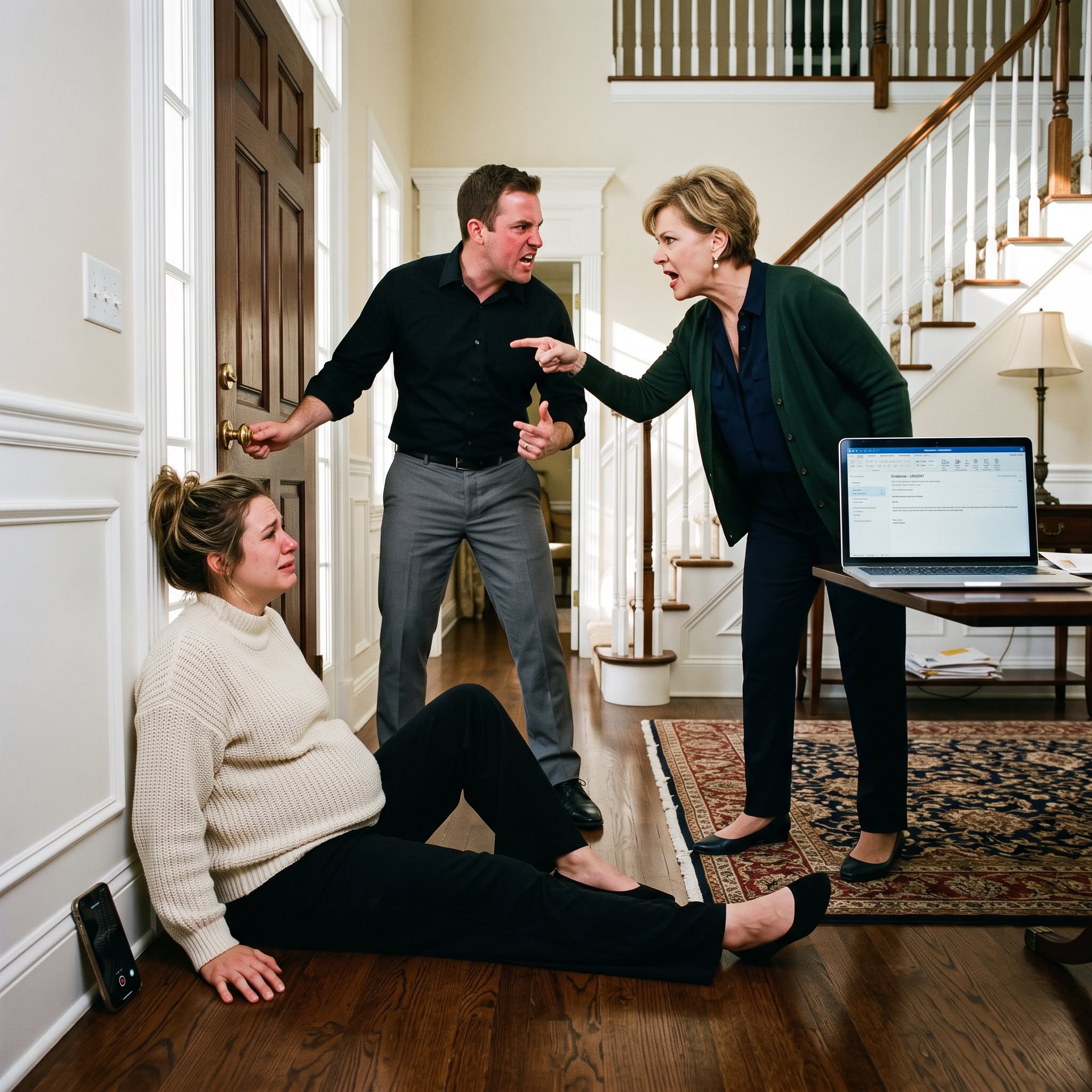
At thirty-nine weeks pregnant, I went into labor on my mother-in-law’s kitchen floor while my husband stood behind a locked door and told her not to open it.
The tiles were freezing against my knees. My water had broken ten minutes earlier, soaking through the hem of my gray dress, and every contraction tore through me so hard I could not speak.
“Grant,” I gasped, pounding once on the pantry door. “Call 911.”
On the other side, my husband’s voice stayed calm. “Not until you agree to stop fighting us.”
His mother, Diane, whispered, “What if something happens to the baby?”
Grant answered, “Then she should have signed the papers when she had the chance.”
I stopped breathing for one terrible second.
The papers were on the kitchen island. A property transfer. A bank authorization. A document giving Grant control over the inheritance my father had left me, including the house he swore would become our child’s nursery.
I had refused to sign them at dinner.
That was when Diane took my phone “to help me rest,” and Grant blocked the back door. When my labor pains started, they dragged the pantry shelf away and pushed me inside the narrow storage room like I was a problem to hide.
But they did not know about the second phone.
It was taped beneath the side pocket of my hospital bag, already recording since the moment Grant said, “No one leaves until she signs.”
Another contraction hit. I bit my sleeve to keep from screaming.
Diane knocked lightly. “Claire, be reasonable. You can still fix this. Sign the documents, and Grant will drive you to the hospital.”
I looked at the red recording light glowing from the half-open bag beside me.
Then I remembered the scheduled email.
Three days earlier, after Grant threatened to “make sure no one believed a hysterical pregnant woman,” I wrote everything down. I attached photos of the papers, recordings of his threats, and Diane’s messages. I scheduled it to send at 8:30 p.m. to my sister, my attorney, my doctor, and the county sheriff’s office unless I canceled it.
The clock on the wall read 8:29.
Grant said, “She’ll break in one more minute.”
At 8:30, my phone vibrated inside the bag.
The email was gone.
The contraction that came after that stole my voice completely. I curled on my side between bags of flour and canned soup, one hand pressed against my stomach, the other reaching for the hidden phone.
Outside the door, Diane was crying softly, but she still did not open it.
Grant sounded irritated. “Stop acting guilty. She’s manipulating us.”
I tapped the screen with shaking fingers and called 911 from the second phone. When the dispatcher answered, I could barely whisper my address.
“Locked pantry,” I breathed. “Labor. Husband refusing help.”
The dispatcher told me to stay with her. I put the phone near my face and let her hear everything.
Grant cursed when he heard the sirens six minutes later.
Diane panicked. “You said no one would come.”
“I took her phone,” he snapped.
The pantry door flew open just as red and blue lights washed across the kitchen windows. Grant reached for me, suddenly wearing a husband’s frightened face.
“Claire, thank God,” he said loudly. “She got confused and locked herself in.”
I stared at him from the floor. “You forgot the other phone.”
His expression collapsed.
Two deputies entered behind the paramedics. One saw the documents on the island. Another saw the chair Grant had wedged under the back door handle.
The dispatcher was still on the line.
When Diane tried to say it was a misunderstanding, my hidden phone played Grant’s own words from ten minutes earlier: “Not until you agree to stop fighting us.”
Nobody in that kitchen moved.
The paramedics lifted me onto a stretcher while I clutched the phone to my chest like it was the only witness I had left.
At the hospital, my sister Brooke was already waiting. She had received the scheduled email, opened every attachment, and called my attorney before racing to the emergency room.
“You’re safe now,” she said, brushing my hair from my damp forehead.
I wanted to believe her, but fear still had its fingers around my throat.
At 11:17 p.m., my son was born healthy, furious, and loud.
I named him Henry James, after my father.
Grant was not in the delivery room.
A deputy was sitting outside his interview room with my recording in evidence.
By sunrise, the story Grant and Diane planned to tell had already fallen apart.
The scheduled email had timestamps. The recording had their voices. The property papers had Grant’s fingerprints and Diane’s handwritten notes in the margins, including one line that made my attorney go silent.
Get signature before baby comes.
The hospital placed a privacy restriction on my room. Grant called nineteen times, then sent flowers with a card that said he had “panicked under stress.”
Brooke threw the card in the trash.
Diane tried a different approach. She called my doctor’s office, pretending to be concerned, and asked whether I was “mentally stable enough” to make decisions for the baby.
My doctor had already received the email.
He documented the call and sent it directly to my attorney.
Three days later, I left the hospital with Henry in my arms and a deputy escort at the door. I did not go back to Grant’s house. I went to Brooke’s, where the crib was borrowed, the curtains were mismatched, and nobody locked any doors.
The court hearing happened two weeks later.
Grant wore a navy suit and looked at the judge like a man expecting sympathy. Diane sat beside him with a tissue, whispering that she loved her grandson.
Then my attorney played the recording.
Grant’s face turned gray when his own voice filled the courtroom: “Then she should have signed the papers when she had the chance.”
Diane stopped crying.
The judge granted me temporary full custody, a protective order, exclusive control over my inherited property, and supervised visitation only after a separate review. Grant was also ordered to turn over every financial document tied to my accounts.
The criminal case took longer, but the damage was immediate.
Grant lost his job when the investigation exposed that he had tried to use my inheritance to cover business debts. Diane’s church friends stopped visiting after the court transcript became public.
Months later, Grant asked through his lawyer if I would consider reconciliation “for Henry’s sake.”
I looked at my sleeping son, safe in the nursery my father’s money had protected, and answered with one word.
No.
People think one email cannot save a life.
They are wrong.
Mine opened at exactly 8:30 p.m., while I was locked on a cold floor, and it carried the truth farther than my voice could reach.