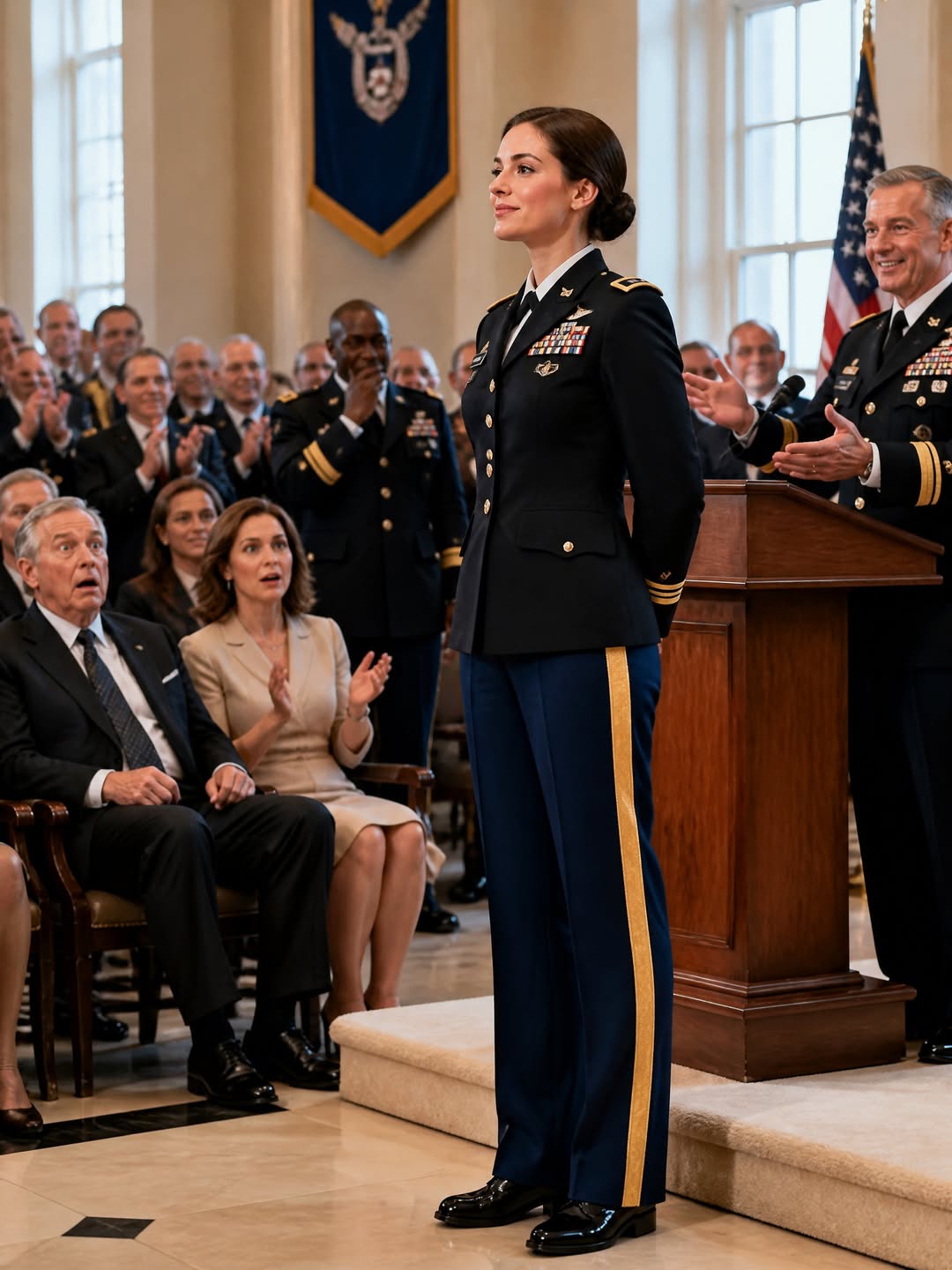
“What the hell is she doing here?” my father muttered. The entire room stood up in stunned applause. The Commander smiled, “Brigadier General Sable Rowan Vale. Our highest honor.” My family froze, completely motionless. All the pride instantly drained from my father’s face.
Part 1: The Name That Was Erased
My name is Sable Rowan Vale, and for most of my adult life, I learned how to disappear even while wearing a uniform.
That may sound dramatic until you spend twenty years in military intelligence, where the safest person in the room is often the one no one remembers seeing. I had sat behind tinted glass in cold command centers, listening to men with stars on their shoulders argue over maps. I had slept on transport aircraft with my boots still on, stared at satellite screens until my eyes burned, drank scorched coffee at three in the morning, and made calls that changed routes, delayed convoys, and kept names from becoming folded flags on coffins.
But to my family, almost none of that existed.
To them, I was still the daughter who left home too quietly. The one who did not smile in Christmas photos. The sister who never came back for barbecues, baby showers, or Thanksgiving football. The strange one. The difficult one. The one my father had stopped explaining to other people.
So when I drove through the gates of Fort Halder on a cold April morning for my father’s retirement ceremony, I did not expect a warm welcome.
I only expected military efficiency.
I did not even get that.
The base had been polished for the occasion. Fresh flags snapped in the wind. The grass was cut so low its sharp green scent slipped through the cracked window of my car. Ahead of me, official vehicles rolled through the checkpoint, carrying formally dressed families who smiled as if they were going to a wedding instead of the end of a forty-year command career.
My father, Lieutenant General Harlan Vale, loved ceremony. He loved clean lines, polished shoes, folded programs, and flags placed at identical angles. He loved anything that could be controlled.
Except me.
I stopped at the gate and handed my military ID to a young corporal. He could not have been more than twenty-two, his face still soft beneath his cap, though his posture was rigid enough to compensate.
He scanned the tablet.
Then scanned it again.
His eyes moved from the screen to my uniform, then back to the screen.
“I’m sorry, ma’am,” he said carefully. “I don’t see your name on the list.”
The wind pressed against my car door. Behind me, a short impatient honk sounded.
“My name is Sable Vale,” I said.
He swallowed. “I have Marion Vale. Penn Vale. Liora Hensley, guest of Penn Vale. But no Sable Vale.”
There it was.
Not an accident.
Not a typo.
A neatly arranged absence.
I looked past him toward the event building, where a white tent had been raised beside the auditorium. Rows of chairs waited beneath the fabric. The brass band was warming up, one bright trumpet note stumbling upward before going silent.
“My father is Lieutenant General Harlan Vale,” I said.
The corporal’s face shifted from confusion to panic. He looked at my ID again, this time truly reading it.
His mouth opened, then closed.
Behind me, a glossy black SUV pulled into the second lane. I recognized it immediately. My mother had always loved vehicles that made other people move aside.
The rear window lowered.
My younger brother, Penn, leaned out from the back seat, his dress uniform arranged as if he had been born wearing it. Beside him sat his fiancée, Liora, wearing pearl earrings and a smile that never reached her eyes. My mother sat in the front passenger seat, one hand resting on her necklace as if checking that the world was still in place.
Penn looked at the corporal, then at me.
For one second, his face tightened.
Then he gave a careless shrug.
“Clearance issue,” he called through the window. “She knows how it is.”
Liora laughed softly.
My mother did not look at me.
The SUV rolled forward.
The corporal stood frozen, trapped between the screen and the star on my shoulder.
“I can call someone to verify, ma’am.”
“No need.”
My voice was calm. That surprised him. It did not surprise me.
I had been left off more important lists than this. Promotion dinners. Family announcements. My mother’s birthday slideshow. My father’s official biography in the local paper, which mentioned “one son carrying on the proud Vale legacy” and somehow forgot the daughter who had deployed before Penn learned how to polish boots properly.
I parked the car, stepped out, and buttoned my jacket against the wind.
Only then did the corporal see my full dress uniform. The ribbons. The command insignia. The star.
His hand snapped up into a salute so fast his elbow almost cracked.
“General.”
The word fell between us like a shell.
I returned the salute.
“Carry on, Corporal.”
He lifted the barrier himself.
I walked through the gate, not because I wanted them to see me and not because I wanted revenge.
At least, that was what I told myself.
But every step across the clean pavement carried twenty years of swallowed words. Every glass window of that building reflected a woman my family had chosen not to know.
When I reached the auditorium doors, I saw my father through the glass.
He was laughing with the installation commander, one hand on the man’s shoulder, his silver hair bright under the lobby lights. He looked proud, relaxed, untouchable.
Then his eyes moved across the lobby and found me.
For half a breath, the smile fell from his face.
Not because he was surprised.
Because he recognized me.
That was when I understood something cold and clear.
He knew exactly who had been left off the list.

Part 2: A Ceremony for a Selective Legacy
The lobby smelled of floor wax, lemon polish, and expensive perfume. That was the first thing I noticed. Not the portraits on the walls, not the framed campaign photographs, not the glass cases full of challenge coins and old medals. For me, smell always came first. It had saved me more than once: burned wires, diesel where it did not belong, cheap cologne on a man who claimed he had never entered a room.
That morning, everything smelled like control.
The hallway had been arranged for my father’s final bow. His career covered the walls in glossy rectangles: Harlan Vale shaking hands overseas, standing beside a helicopter, speaking behind a podium, being watched by young soldiers as if he were carved from stone. Harlan Vale with Penn at his first commissioning, father and son glowing in matching dress blues.
There was not a single photograph of me.
I stopped in front of the display for less than two seconds.
Long enough to see the gap.
Not long enough to let it cut me.
A woman in a navy suit checked programs near the entrance. Her eyes moved over me, paused at my rank, then dropped to her clipboard.
“General, I’m so sorry,” she whispered. “I don’t have a reserved seat card for—”
“I know.”
Her face went pale. “I can find you a seat.”
“I’ll find one.”
Inside the auditorium, the crowd had settled into a carefully staged performance of respect. Rows of uniforms. Dark suits. Women in soft colors. Adult children pretending not to check their phones. The stage held a podium, two flags, a row of chairs for senior officers, and a large screen powerful enough to make any memory look official.
My family sat in the front row.
Of course.
My mother, Marion, wore cream wool and pearls. Penn sat beside her, his chest full of medals, his chin clean-shaven, his face bright with practiced pride. Liora leaned close to him, whispering behind the program.
My father stood near the stage, accepting handshakes.
I chose a seat across the aisle, three rows back, in the section for command guests. There was no name card for me. I did not need one.
An unfamiliar colonel looked at me twice. The second time, his eyes widened slightly. He knew enough to understand he did not know enough.
That was usually where people stopped.
The band finished warming up. Conversation thinned. The lights dimmed. The national anthem began.
Everyone stood.
I stood straight, hands at my sides, eyes forward. For one ridiculous second, I remembered being nine years old in our driveway, saluting my father when he left for deployment. I used the wrong hand. Penn laughed. My father corrected me gently in front of the neighbors, then later told my mother, “She wants attention too badly.”
After that, I stopped saluting that way.
When the anthem ended, applause spread through the room. We sat.
The ceremony proceeded exactly as expected. A chaplain gave the invocation. A senior aide spoke about duty. Then Major General Orson Brigg, the installation commander, stepped up to the podium and began telling the story of my father’s career.
He was good at it. I will give him that.
He spoke of discipline, strategic vision, devotion to soldiers, overseas deployments, training reforms, joint operations, and the long burden of leadership. My father lowered his eyes at the right moments. My mother dabbed beneath her eye with a tissue. Penn stared straight ahead, proud as a monument.
It was all very moving if you did not know what had been buried beneath it.
I did not mean actual bodies.
Not exactly.
I meant the family conversations cut short whenever I entered the room. The school letters my father never answered. The graduation he missed because Penn had a baseball injury. The first deployment call, when my mother said, “Your father is busy, but we are proud in our own way,” then hung up before I could tell her I was scared.
Onstage, General Brigg turned a page.
His voice changed.
Not much.
Just enough.
“Before we proceed with the final honors for Lieutenant General Vale,” he said, “there is one additional matter.”
A ripple moved through the front row.
My mother leaned toward Penn.
My father turned his head slightly.
General Brigg looked down at the paper, then across the room.
“Today, we recognize not only an outstanding career, but also a service member whose contributions were, by necessity, absent from public record for many years.”
My pulse did not quicken.
That was how I knew something was wrong.
No one had told me this was going to happen.
“Ladies and gentlemen,” Brigg continued, “please rise and welcome Brigadier General Sable Rowan Vale.”
The room went dead still.
Then chairs began to scrape.
Uniforms rose.
Heads turned.
My mother’s face changed first: confusion, then irritation, then something smaller and more frightened.
Penn looked as if the air had been slapped out of his lungs.
My father did not move.
General Brigg looked directly at me.
“Welcome, General.”
Those simple words still broke something.
I stood and walked toward the stage with every eye on my back. The carpet muffled my footsteps, but I heard them as if I were crossing an empty aircraft hangar. My father watched me approach. For the first time in years, he did not look through me or around me.
He looked at me like an order he had not expected to receive.
And with a calm that felt almost cruel, I wondered whether he was afraid of what I had come to reclaim.

Part 3: The Medal and the Video
General Brigg stepped aside when I reached the podium. That small movement told the room more than any introduction could have. Senior officers do not step aside by accident, especially at a ceremony like that.
The applause began too late.
That made it worse.
It started in the back, thin and hesitant, then spread row by row as people realized they were meant to honor me. The sound grew stronger, but I could hear the confusion beneath it. Applause has texture. Real applause rises like weather. Forced applause scatters like silverware dropped on the floor.
This was both.
A woman in dress uniform approached from the side of the stage carrying a narrow case. Colonel Mireya Ashe. I knew her, though we had never worked in the same unit for more than a week. She once found me coffee in a windowless building outside Stuttgart after seventy hours of crisis mapping. She did not say, “You look tired.” She said, “Drink this before you start turning wallpaper patterns into data.”
By military standards, that made her a friend.
She stopped in front of me and gave the faintest nod.
“General Vale.”
I nodded back.
She opened the case.
Inside was the medal I had refused to think about since the notification came through. Not because I did not care. Because some honors arrive attached to nights you are only trying to survive.
General Brigg returned to the microphone.
“For exceptionally distinguished service in defense intelligence, including leadership during Operation Glass Harbor and related joint security actions, the Department of Defense recognizes Brigadier General Sable Rowan Vale.”
He continued reading.
I heard phrases like “prevented mass-casualty events,” “coordinated interagency response,” “unconventional threat analysis,” and “personally assumed operational risk.”
Those words sounded clean.
The memories were not.
A blue-lit room. Rain hammering a metal roof in a country whose name still tightened my stomach. An analyst crying silently into her sleeve because she had been awake too long. A convoy marker blinking on a screen. A pattern no one believed. My own voice saying, “Stop them now,” while three men above me demanded proof I did not have time to provide.
If I was wrong, careers would end.
If I stayed silent, people would die.
Colonel Ashe placed the medal in my hand.
It was heavier than it looked.
My father’s entire retirement ceremony seemed to shrink around it.
Brigg gestured toward the microphone.
“General, if you’d like to say a few words.”
I did not want to.
That was the truth.
I had spent my career avoiding rooms like this. I did not enjoy being watched. I did not enjoy people deciding I mattered only after someone with authority gave them permission to believe it.
But my mother was looking at me as if I had built a life without asking my family’s permission, and Penn’s fiancée looked as if she had swallowed broken glass.
So I stepped forward.
The microphone smelled faintly metallic.
I placed my hands on both sides of the podium and looked over the room.
“For most of my career,” I said, “my work was not designed to be seen.”
No one moved.
“That is not a complaint. That is the job. Some people serve in front of cameras. Some serve in public command. And some serve in places where success means nothing happens, no headline appears, and no family receives a knock at the door.”
A few faces changed. Senior officers understood. Younger soldiers leaned in.
“My job was not to be remembered,” I continued. “My job was to notice what others missed. A wrong shadow in an image. A missing signal. A supply route too quiet. A name appearing in two places where it should not have appeared.”
I let that settle.
“I have been called distant, cold, absent. I have been told silence looks like arrogance, and duty looks like abandonment from the outside.”
My mother looked down.
Penn’s hand tightened around his program.
I kept my eyes forward.
“But I did not give my life to absence. I gave it to service. To soldiers who never knew my name. To families who got one more birthday, one more phone call, one more ordinary morning because someone behind a locked door refused to ignore a pattern.”
The room was so quiet I could hear the projector humming overhead.
Then I looked at my father.
Not for long.
Long enough.
“I did not come here today to take anything away from Lieutenant General Vale’s service,” I said. “His record stands. But mine does too.”
My voice did not break.
That mattered to me more than the medal.
“I spent years invisible because the mission required it. Today, it does not.”
I stepped back.
The applause came again, this time real enough to hurt.
I meant to move aside and let the ceremony continue. I thought my part was over.
Then the screen behind us flickered.
I turned.
General Brigg’s face tightened.
Colonel Ashe looked toward the sound table.
A staff sergeant raised both hands, confused, as if trying to say he had not touched anything.
The screen brightened.
A video appeared.
The man in the video sat in a dim room with beige walls and a folded American flag behind one shoulder. He wore a uniform that was not meant for ceremony, but one that had lived with the man wearing it. His hair was short. A scar cut through his left eyebrow. He looked directly into the camera.
“My name is Captain Elias Rook,” he said. “And if you are watching this at General Vale’s retirement ceremony, then someone finally decided the truth deserved a room.”
A murmur moved through the auditorium.
My father’s face went white.
And before Captain Rook said another word, I knew this was not an ordinary tribute video.

Part 4: The Truth From the Man Who Survived
Captain Elias Rook had been dead for eleven minutes when I first heard his name.
Not officially. Officially, he was missing with six members of his reconnaissance team after contact was lost during a mountain surveillance rotation. Unofficially, the first report used words like “presumed” and “unrecoverable,” words that in the military can be more brutal than simply saying dead.
I was in a secure operations room two oceans away, wearing yesterday’s shirt under my uniform jacket and drinking coffee so bitter it tasted like punishment.
That was the memory that returned when his face appeared on the screen.
Not pride.
Not honor.
Scorched coffee and rain against concrete.
In the video, Elias Rook leaned forward.
“Eight years ago, my team was assigned to a routine observation point,” he said. “At least, that’s what the paperwork called it. We were told the road was clear. We were told the signals were unrelated. We were ordered to proceed.”
He gave a short laugh without humor.
“Then a voice came over the secure channel and told us to stop moving.”
My hands went cold.
I had never told my family about Rook.
I had barely told myself.
“At the time, I didn’t know who she was,” he said. “No one did. She didn’t make a speech. She didn’t explain. She just said, ‘Captain, if you want to see sunrise, get your men behind stone and stay off that road.’”
Several people in the room shifted.
I remembered saying those words.
I remembered the colonel beside me shouting that I was exceeding authority. I remembered my finger hovering over the transmit button, then pressing down anyway. I remembered the heat signatures crossing the ridge exactly where they were not supposed to appear.
Rook lowered his gaze for a moment.
“We followed that order because something in her voice made disobeying sound stupid. Twenty-seven minutes later, the road we were supposed to take was gone.”
No one breathed.
“My youngest soldier was nineteen. He had a photo of his little sister taped inside his helmet. Another was two weeks from going home. I had a wife I had not seen in six months. We lived because Brigadier General Sable Vale saw the truth before anyone else wanted to admit it.”
I did not look at my father.
I could not.
Not yet.
Rook continued, his voice rougher now.
“When I later learned that decision nearly ended her career, I tried to file a statement. I was told the matter was classified. I was told to move on. But I do not move on from being alive.”
A strange sound came from the front row.
My mother.
Not quite a sob. Something smaller.
The video did not stop.
“So I am saying it now. To the soldiers in that room: some leaders stand where everyone can see them. Others stand in the dark and take the hit so others can walk into daylight. General Sable Vale did that for me.”
He paused.
Then his eyes narrowed slightly.
“And to Lieutenant General Harlan Vale, sir, I mean no disrespect. But if your daughter was absent from your story, it was not because she lacked honor. It was because you stopped reading before her chapter began.”
The screen went black.
The silence afterward was not empty.
It was crowded.
Everything old I had buried seemed to rise at once: the report my father never asked to read, the disciplinary investigation that vanished after the truth came out, the family dinner where Penn said, “Dad says you made enemies because you couldn’t follow the chain of command,” and my mother said, “Maybe one day you’ll learn humility.”
I had been thirty-two then.
Old enough to understand.
Still young enough to hope someone would ask what had happened.
No one asked.
Onstage, General Brigg stepped forward, but even he seemed unsure how to return the room to ceremony. My father remained seated, both hands open on his knees, staring at the blank screen.
Then Penn stood.
It was the wrong move.
Everyone knew it the moment he did it.
“Dad,” he said quietly, though the stage microphone still caught the edge of his voice.
My father did not answer.
Penn looked at me, and something like accusation crossed his face. Not because I had lied.
Because I had stopped allowing him to.
Liora pulled at his sleeve and whispered, “Sit down.”
He did not.
“Sable,” he said louder. “You could have told us.”
That was when the room turned against him.
Not violently.
Worse.
Morally.
Dozens of officers turned their heads. My mother closed her eyes. My father finally looked up.
I stepped to the edge of the stage.
Penn was still standing in the front row, jaw tight, cheeks red.
“I tried,” I said.
My voice carried without effort.
He blinked.
“When?”
“At Fort Brindle,” I said. “After the investigation. I came home for two days.”
Penn’s face faltered.
“You told me not to bring classified drama into Dad’s house.”
His mouth opened, then closed.
I looked at my mother.
“You told me I was upsetting him before a promotion board.”
She pressed the tissue against her mouth.
Then I looked at my father.
“And you said, ‘A good officer knows when silence is the price of service.’”
His face broke.
Not completely.
Just enough.
The whole auditorium heard it.
That was not revenge.
Revenge would have felt hotter.
This felt like a door opening in a house sealed for years, letting everyone smell the rot inside.
General Brigg announced a brief recess.
The ceremony dissolved into whispers.
I stepped down from the stage and walked toward the side hallway.
Behind me, my father called my name.
“Sable.”
For twenty years, I had wanted to hear that.
For twenty years, I had imagined turning around.
But when the moment came, I kept walking.

Part 5: No Longer Asking for a Seat
The hallway outside the auditorium was colder than the room. A service door at the far end had been propped open, letting April air slide across the polished floor with the smell of wet concrete, cut grass, and distant exhaust.
I stopped beside a glass case filled with old unit coins and looked at my reflection.
The medal now rested on my chest.
It looked strange there.
Not because I had not earned it.
Because my family had finally seen it before they saw me.
“Sable.”
My father’s voice followed me into the hallway.
I did not turn immediately.
He had used that tone when I was a child and climbed too high in the oak tree behind our house. Careful. Controlled. Afraid, but too proud to sound afraid.
I turned.
He stood ten feet away in dress uniform, the man of the ceremony, the silver-haired legend with polished shoes. Behind him, guests in the lobby pretended not to watch. My mother stood near the auditorium doors. Penn stood farther back, Liora gripping his hand.
Without the stage behind him, my father looked smaller.
“I didn’t know about Rook,” he said.
I almost laughed.
Not because it was funny.
Because it had become the family hymn.
“I didn’t know.”
“I didn’t know you were promoted.”
“I didn’t know it mattered.”
“I didn’t know you stopped coming home because every visit felt like a trial.”
I looked at him.
“You knew enough.”
He flinched.
Good.
I had survived men shouting at me over secure lines. I had survived officials demanding certainty from incomplete data. I had survived being called reckless by people who later accepted credit for results I had forced into existence.
But my father flinching still hurt more than all of it.
“I knew there had been an incident,” he said. “I knew you were under investigation.”
“You knew I came home.”
His eyes dropped.
“Yes.”
“You knew I asked to speak with you privately.”
“Yes.”
“You knew you left before breakfast.”
His jaw tightened.
Behind him, my mother whispered, “Harlan.”
He ignored her.
“I was angry,” he said.
“Angry about what?”
“The risk,” he snapped, then seemed startled by his own voice. He lowered it. “Angry about the way you operated outside the chain of command.”
I stepped closer.
“People were going to die.”
“You didn’t know that for certain.”
“No,” I said. “I knew it in time.”
The words landed.
A few officers in the lobby went still.
My father looked past me, toward nothing.
“I spent my career teaching officers that discipline saves lives.”
“And I spent mine learning that obedience can bury them.”
His eyes returned to mine.
There it was.
The real conflict.
Not just love.
Not just pride.
Doctrine.
He had not only rejected his daughter. He had rejected the kind of soldier I became, because admitting I was right meant admitting his rules had limits.
“You embarrassed me,” he said quietly.
That was the first honest thing he had given me.
Not an apology.
Honesty.
“When?”
“When you were investigated. When people asked questions. When I had no answers.”
I nodded slowly.
“So you invented one.”
His face tightened.
I continued.
“You decided I was arrogant. Disloyal. Difficult. You let Penn believe it. You let Mom repeat it. You let the whole family build a version of me that made my absence convenient.”
My mother stepped forward, pearls trembling at her throat.
“Sable, we were only trying to protect the family.”
I turned to her.
“No. You were protecting the image of one.”
Her eyes filled.
For one second, the old reflex rose in me: comfort her, make it easier, step back so she would not have to feel what she had done.
I let that reflex die.
Penn moved closer, his face stiff.
“You think you’re the only one who was hurt?”
I truly looked at my brother.
Penn Vale, the golden son, the boy who always got the front seat, the man who had just passed me at the gate and called my erasure a “clearance issue.”
“No,” I said. “I think you were the only one allowed to be hurt out loud.”
He stared.
Liora’s hand slipped from his.
That surprised me. Maybe her victorious smile had limits. Maybe she thought she was marrying into a noble military family, not a polished machine that consumed its inconvenient parts.
My father inhaled slowly.
“What do you want from us?”
The question should have been simple.
An apology. An admission. A seat at the table. A picture on the wall. My name printed correctly in the program.
But standing there, with the medal heavy on my chest and my family waiting as if I were a problem to handle before the reception, I realized I did not want those things anymore.
Not from them.
“I want the ceremony to continue,” I said.
My father blinked.
“I want you to retire with the honors you earned. I want the guests to eat their little sandwiches and say the right things. I want Penn to sit down before he makes this worse. And after today, I want all of you to stop mistaking my silence for permission.”
My mother whispered, “Permission for what?”
“Access.”
The word was quiet.
It still cut.
My father’s eyes widened.
I looked at all three of them.
“Today you left me off the list because you thought my presence was optional. From now on, it is.”
Then I walked past them toward the side door, not fast, not dramatic, simply done.
Outside, sunlight touched my face.
And for the first time that morning, I could breathe.
Part 6: The Program Without My Name
I did not leave the base.
That would have made the story too clean.
Instead, I walked to the memorial garden behind the auditorium, where the noise of the ceremony became a low indoor hum. The garden was small, enclosed by brick walls and trimmed hedges, with stone benches arranged around a bronze plaque. Someone had planted white tulips along the path. Their petals trembled in the wind like small flags surrendering.
I sat on the farthest bench and removed my gloves.
My hands were steady.
That annoyed me.
There are moments when the body refuses to match the soul. Inside, I felt like a house after a storm, furniture overturned, windows open, water on the floor. Outside, I was composed. Starched. Decorated. Impressive enough for strangers to admire and lonely enough for no one to understand.
The auditorium doors opened behind me.
I did not turn.
Light footsteps clicked on stone.
Not my father’s. Too light.
“I figured I’d find you near an exit.”
Colonel Mireya Ashe sat beside me without asking.
She smelled faintly of mint and paper. Her hair was pinned so tightly it looked like a tactical decision.
“You approved the video,” I said.
“Yes.”
“Without telling me.”
“Yes.”
I looked at her.
She did not look sorry.
“Rook sent it to my office three months ago,” she said. “He said if your father’s ceremony happened and you were still excluded from the record, he wanted it used.”
I watched a tulip bend in the wind.
“Elias always did have timing issues.”
“He is alive because you had worse ones.”
I laughed despite myself.
The smile faded quickly.
Mireya rested her forearms on her knees.
“There’s more.”
I closed my eyes for half a second.
“Of course there is.”
She handed me a folded program from the ceremony.
At first, I did not understand. Thick cream cardstock, my father’s name embossed in dark blue. I opened it and scanned the order of events, the speakers, the biography.
Then I saw the family section.
Lieutenant General Harlan Vale is joined today by his wife, Marion, his son, Major Penn Vale, and future daughter-in-law, Liora Hensley.
That was all.
No daughter.
Not an omission caused by lack of space.
An absence made official.
Something inside me went very still.
Mireya watched my face.
“I’m sorry.”
“Who wrote it?”
“The family submitted the biography.”
I looked toward the building. Through the windows, people were moving into the reception hall. My father’s guests. His legacy. His polished and carefully edited life.
I folded the program very carefully.
That carefulness scared me more than anger would have.
“Do you want me to pull Brigg aside?” she asked.
“No.”
“Sable.”
“No,” I repeated. “I’m not using command channels to fight a family war.”
“This isn’t just a family war. They erased a serving general from an official retirement program.”
“Then let the paper stay exactly as it is.”
She frowned.
I slipped the program into my jacket.
“Evidence?”
“Memory,” I said. “Those need documents too.”
Mireya was quiet for a while.
Then she said, “You don’t have to forgive them just because they’re ashamed now.”
I laughed softly.
“Advice or an order?”
“Professional observation.”
“From a colonel?”
“From someone who has seen too many women mistake recognition for repair.”
That sentence stayed with me.
Recognition for repair.
The ceremony continued without me. I could hear applause through the walls, muted but rhythmic. My father was receiving his final honors. Someone was probably speaking about sacrifice. People love that word when they are not the ones being placed on the altar.
My phone buzzed.
A message from Penn.
“Where are you?”
Then another.
“Dad wants you inside.”
Then a third.
“Please don’t make this ugly.”
I stared at that last one for a long time.
Please don’t make this ugly.
As if I had brought the ugliness, instead of opening the place where it had lived for years.
I typed one sentence.
“It was ugly before I arrived.”
Then I turned off the screen.
Mireya stood.
“Reception starts in ten.”
“I know.”
“You going?”
I looked at the white tulips, the brick wall, the bronze plaque engraved with names of soldiers whose families had probably kept every photograph.
“Yes,” I said.
Her eyebrows rose.
I put my gloves back on.
“They wanted a ceremony without me,” I said. “They don’t get another disappearance.”
Inside the reception hall, everything glittered with silver trays, white tablecloths, and the polite laughter of people who did not know the truth had just entered the room. Servers moved between clusters of officers with coffee and tiny sandwiches. A cake bearing my father’s rank insignia stood near the wall.
My family stood beside it.
Penn saw me first.
His face tightened with relief, then fear.
My father turned.
My mother clutched her pearls again.
I walked toward them with the folded program in my jacket and the medal on my chest, carrying the calm of someone who had stopped asking for a seat.
This time, before I reached the table, everyone made room.
Part 7: A Warning in the Reception Hall
The reception did not go quiet all at once.
It quieted in layers.
First, the officers near the cake stopped speaking. Then their spouses noticed and followed their eyes. Then the younger soldiers near the coffee urn turned. Within seconds, the room held that strange silence made by people pretending not to stare while staring with their whole bodies.
My father stood beside the cake, holding a glass of sparkling water. He looked tired. Not exactly old, but human in a way I rarely saw. My mother stood to his left. Penn to his right. Liora half a step behind.
For the first time in my life, they looked like a formation without a commander.
“Sable,” my father said.
I stopped in front of them.
The cake smelled of vanilla and sugar. Too sweet. The kind of smell that makes your teeth ache before you take a bite.
“I’m glad you came back.”
I looked at the cake, then at him.
“I didn’t come back for you.”
His hand tightened around the glass.
My mother made a small sound.
“Honey, not here.”
That word.
Honey.
She used it when she wanted obedience wrapped in softness.
I turned to her.
“You don’t get to manage my tone in public after erasing my name in print.”
Color drained from her face.
Penn stepped in.
“Sable, come on.”
I pulled the program from my jacket.
He saw it and looked away.
So he knew.
That surprised me less than it should have.
I held the program out toward my father.
“You may want this back.”
He did not take it.
After a long moment, Liora reached for it instead. Penn grabbed her wrist before she could touch it.
The room saw enough.
My father’s voice came low.
“I approved the biography.”
My mother whispered, “Harlan.”
He ignored her again.
Good.
Let one truth survive interruption.
“I approved it,” he repeated. “Your mother drafted it. Penn reviewed it. And I approved it.”
The room absorbed that like a soundless slap.
I nodded.
“Thank you for not lying.”
His mouth tightened.
“I thought including your name would raise questions.”
“It did anyway.”
“I thought—”
“You thought my absence was easier to explain than my presence.”
He looked at me.
“Yes.”
There it was.
Not enough.
But true.
My mother began to cry silently. Years ago, that would have softened me. Now it felt like weather happening behind glass.
Penn set his glass down hard enough to make the silverware jump.
“I was wrong at the gate,” he said.
I turned to him.
He stood straighter, as if an apology required parade rest.
“I should not have said that. The clearance issue thing. It was petty.”
“It was practiced,” I said.
His face reddened.
Liora looked between us, her mouth slightly open.
I almost felt sorry for her.
Almost.
She had entered this family thinking coldness was refinement. Today she learned it was only coldness.
Penn swallowed.
“I didn’t know how to talk to you.”
“So you chose cruelty.”
He looked down.
“No,” he said quietly. “I chose Dad.”
That landed.