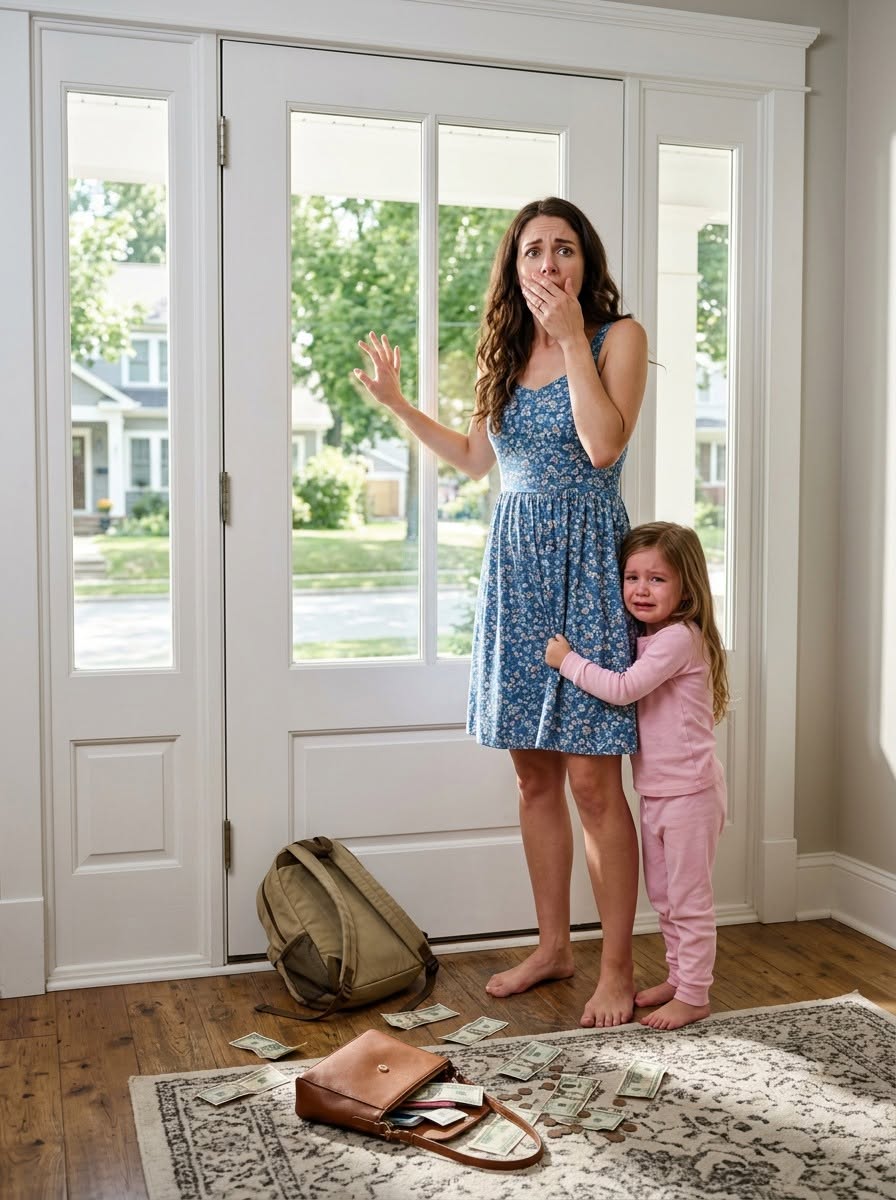
My husband had barely left for his business trip when my six-year-old daughter grabbed my sleeve and whispered, “Mommy… we need to run. Right now.” I stared at her, confused. “What? Why?” She was shaking so badly her voice cracked. “There’s no time. We have to leave the house now.” My heart dropped. I grabbed our bags, rushed toward the front door.That was the exact moment everything changed.
Part 1: The Quiet Collapse
I used to think the most frightening moment of a person’s life would arrive loudly—with sirens, breaking glass, or a final screaming argument that split a marriage apart. I never imagined mine would come as a terrified whisper from my six-year-old daughter in our kitchen, followed by the heavy click of our front door locking from the wrong side.
To understand that Saturday morning, you need to understand the year before it. By then, I had been living in a burning house and convincing myself the smoke was just bad weather.
I met Ryan Mercer when I was twenty-six, studying accounting at night while working double shifts at a downtown steakhouse. He was charming in a way that felt effortless at the time, though later I would understand how carefully rehearsed it was. He remembered details, showed up on time, and made me feel chosen.
We married eighteen months later on the lawn of his parents’ lake house. My mother, Diane, cried happy tears. I stood there in my white dress, looking at the water, believing I had built a safe and sensible life.
Our daughter, Sophie, was born three years later. Motherhood changed the way I saw everything. Ryan had never hit me, but his anger had its own architecture. He used his voice, his cold stare, and his polished condescension to make me feel small enough to stop asking questions.
The money problems began after Sophie turned two. Strange hotel charges appeared. Business dinners cost more than our mortgage. Ryan’s explanations were always smooth, complete, and ready before I even finished asking.
I believed him because admitting the truth would have meant admitting I had built my life with the wrong man.
So I became quiet.
His business trips multiplied. Two nights a month became four, then long stretches away. I stopped questioning him because every answer made me feel dizzy and foolish.
The only real protection I had was a thick blue folder my mother had forced me to create years earlier. It held birth certificates, social security cards, our marriage license, bank statements, and copies of important documents. I had once thought it was paranoia.
Later, it became the reason I could run.
That Friday night, Ryan paced downstairs, speaking softly on the phone. I was upstairs tucking Sophie into bed, unaware that my daughter had crept halfway down the stairs and was listening to words no child should ever hear.

Part 2: Sophie’s Warning
Saturday morning arrived gray and heavy. Ryan left for his supposed flight to Chicago at exactly 6:50 a.m., kissed my forehead by the door, and told me not to worry.
I locked the door behind him and started making coffee.
A few minutes later, Sophie appeared in the kitchen wearing unicorn pajamas. Her face was pale, and her tiny hands were clenched in the hem of her shirt.
“Mommy,” she whispered. “We have to run. Now.”
I tried to laugh because my brain wanted the world to stay normal.
“What? Why are we running, baby?”
She shook her head hard. “There’s no time. We have to leave the house right now.”
I crouched in front of her. “Did something scare you?”
She grabbed my wrist. Her hand was cold and clammy, and her whole body was shaking.
“I heard Daddy on the phone last night,” she said. “He said he was already gone. He said today is when it’s going to happen. He said we won’t be here when it’s over.”
My mind rejected the words at first.
“Who was Daddy talking to?”
“A man,” Sophie whispered, crying now. “Daddy said, ‘Make sure it looks like an accident.’ Then he laughed.”
Those words changed the shape of the room.
Ryan and I had fought about money, his temper, and his constant absences. But murder had never existed in the same universe as my marriage until my daughter said it in our kitchen at 7:18 a.m.
“Okay,” I said, my voice suddenly calm and strange. “We are leaving. Right now.”
I grabbed my tote, my phone charger, Sophie’s backpack, her inhaler, two granola bars, and Bun-Bun, her worn gray stuffed rabbit. Then I pulled the blue folder down from the cabinet above the microwave.
At the last second, I photographed Ryan’s printed flight itinerary, which he had left under his coffee mug. I did not fully know why yet. I only knew evidence disappears when frightened people move too slowly.
Sophie stood by the front door, whispering, “Hurry, Mommy.”
Every nerve in my body wanted to call 911, but my mother’s voice seemed to cut through the panic: Get out first. Be believed second.
I put one hand on Sophie’s shoulder and reached for the brass doorknob.
Before I touched it, the deadbolt turned with a heavy metallic thunk.
But my hand was nowhere near the lock.
Someone was locking us in from the porch.

Part 3: The Brother at the Door
Sophie froze against my leg. My heart slammed so hard I could taste metal. I shoved her behind me and searched the hallway for anything heavy enough to use as a weapon.
Then a familiar voice came through the door.
“Naomi.”
I stopped breathing.
“Naomi, it’s me. It’s Caleb. Open the door.”
Caleb was my younger brother, a homicide detective in a county thirty miles away. Ryan hated him because Caleb asked questions Ryan did not like answering.
My hands shook as I unlocked the door. Caleb stepped inside in jeans and a dark hoodie, not his uniform. His face was pale and urgent.
“Pack only what you cannot live without,” he said. “We don’t have time.”
“What is happening?”
“I got a call at three this morning from a friend in Fraud,” Caleb said quickly. “Ryan’s name came up in an investigation two months ago. Naomi, he took out a life insurance policy on you eight months ago. Two million dollars.”
The floor seemed to shift under me.
“I didn’t tell you because I didn’t have proof of intent,” he continued. “But last night, investigators intercepted a burner phone call. Ryan’s new real estate partner isn’t a real estate partner. He’s a fixer. The kind people hire when they want a fatal accident arranged.”
“He hired someone to kill me,” I whispered.
“We don’t have the full picture,” Caleb said. “But I have enough. You and Sophie are coming with me now.”
The next twenty minutes became a blur. I remember locking the door behind us out of absurd habit. I remember strapping Sophie into Caleb’s unmarked car while she clutched Bun-Bun. I remember holding the blue folder against my chest as if it could stop a bullet.
Caleb drove fast, constantly checking the mirrors while speaking in clipped police language through his Bluetooth.
He took us to his apartment, a place Ryan had never visited and did not know existed. Once inside, Caleb locked the door, closed the blinds, made Sophie a peanut butter sandwich she could not eat, and turned on cartoons to cover our voices.
Then he sat me at the kitchen table and asked me to take apart my marriage.
I told him everything. The hotel charges. The impossible trips. The odd names Ryan had mentioned at dinner. The missing money. The sudden absences. As I spoke, the terrifying picture of his double life finally began to form.
Part 4: The Trap
The detective assigned to the case arrived after noon. Detective Mara Quinn was calm, sharp, and careful with every word.
She explained that Ryan had taken out the life insurance policy through a shadow broker, using a structure meant to avoid standard red flags. Three months earlier, he had forged my signature to remove the joint-beneficiary clause and make himself the sole recipient.
The man Sophie heard him speaking to was already known to law enforcement. He had been arrested twice before for insurance fraud disguised as accidental deaths, though both cases collapsed before trial. This time, a wiretap from an unrelated investigation had captured Ryan’s voice.
“He discussed methods,” Mara said. “A fall in the garage. A slip on the stairs. Something that would not attract too much forensic attention, especially with a child in the house.”
I sat very still, listening to a stranger describe the planned mechanics of my death.
I had shared a bed, meals, and a child with a man who had calculated my value and placed an expiration date on my life.
Mara told me I had to remain hidden while they built the case. Ryan did not know about the wiretap, which meant his arrogance could be used against him.
Over the next forty-eight hours, I became my own forensic accountant. At Caleb’s kitchen table, I audited the remains of my marriage. I found hidden payments routed to an LLC later traced to the fixer. I matched Ryan’s fake travel itineraries against receipts from bars two towns away, proving he had been meeting the man while pretending to be in Chicago.
Then Ryan called.
My phone vibrated on the counter Saturday evening.
Mara gave me one slow nod.
Buy us time.
I answered.
“Hey, babe,” Ryan said warmly. “Just checking in from the hotel. You and Sophie okay?”
His voice made my skin crawl.
“We’re fine,” I lied. “Sophie went to bed early. I’m just watching TV.”