Chapter 1
I’ve been a dog owner my whole life, but nothing could have prepared me for the moment my veterinarian sliced open my Golden Retriever’s cast, dropped his surgical shears, and whispered, “Lock the clinic doors. Now.”
My name is David, and for the last four years, it’s just been me and my dog, Bailey.
We live in a quiet, heavily wooded part of Oregon. It’s the kind of place where your closest neighbor is a mile down a dirt road, and the cell service cuts out if the wind blows too hard. I moved out here for the peace and quiet. I wanted the isolation.
Bailey, a purebred Golden Retriever with a coat the color of autumn leaves, was the only companion I needed. He is the gentlest, most predictable dog on the planet. He’s terrified of thunder, he refuses to walk on wet grass if he can help it, and he never, ever wanders off.
At least, that’s what I thought until the storm hit last Tuesday.
It was late in the evening. The local news had been warning about a massive squall moving in from the coast, bringing heavy rain and potential flash floods. The wind was already howling through the towering Douglas firs that surrounded my property, making the old cabin creak and groan.
I let Bailey out into the fenced backyard to do his business before the worst of the rain started. I stood on the back porch, holding a flashlight, shivering in the sudden drop in temperature.
“Hurry up, buddy,” I called out, wrapping my jacket tighter around myself.
Usually, Bailey would do a quick lap around the oak tree, do his business, and sprint back to the warmth of the house. But this time, he lingered near the back of the fence. The area where the dense, uncharted state forest meets my property line.
Suddenly, a crack of thunder shook the ground so violently that I felt it in my teeth. The sky lit up in a jagged flash of white.
In that split second of illumination, I saw the back gate. The heavy wooden gate that I keep secured with a thick metal latch was wide open, swinging wildly in the gale.
And Bailey was gone.
Panic hit me like a physical blow to the chest. I sprinted out into the yard, the icy rain instantly soaking through my clothes.
“Bailey!” I screamed into the darkness, my voice instantly swallowed by the roar of the wind. “Bailey, come here! Here, boy!”
I ran to the open gate. I shined my heavy-duty Maglite into the woods, the beam cutting through the sheets of rain and illuminating nothing but wet trunks and swaying branches. There was no sign of him.
I spent the next six hours out there in the freezing downpour. I trudged through thick underbrush, sliding in the mud, calling his name until my throat was raw and tasting of copper. The woods behind my house stretch for over fifty miles. It’s a vast, unforgiving wilderness filled with steep ravines, predatory wildlife, and absolute darkness.
By 4:00 AM, hypothermia was starting to set in. I couldn’t feel my fingers, and I was trembling uncontrollably. Defeated, terrified, and utterly soaked, I stumbled back to the cabin.
I left the back door wide open, sitting on the kitchen floor wrapped in a blanket, staring out into the blackness, praying to hear the jingle of his collar.
Morning came, grey and miserable, and still no Bailey.
I called out of work. I printed out hundreds of flyers. I drove up and down the county roads, stapling them to every telephone pole, every bulletin board at the local gas stations. I called the animal shelters, the local sheriff’s department, the highway patrol.
“We’ll keep an eye out, David,” the dispatcher told me sympathetically. “But with the storm we just had, and out where you live… coyotes are a real problem right now. You need to prepare yourself.”
I refused to accept that. I spent the entirety of the second day back in the woods. I enlisted two of my neighbors, guys who knew the trails better than I did. We searched until the sun went down, finding nothing. Not a footprint, not a tuft of golden fur. Nothing.
It was as if the forest had simply opened its jaws and swallowed him whole.
By the night of the third day, the reality of the situation was starting to crush me. I was sitting in my living room in the dark. I hadn’t eaten. I hadn’t slept for more than twenty minutes at a time. I was just staring at his empty dog bed in the corner, the silence of the house pressing down on my eardrums.
I was just starting to draft a post for a local missing pets Facebook group, tears finally blurring my vision, when I heard it.
Scratch. Scratch. Scratch.
It was faint. So faint I thought the wind was playing tricks on my exhausted mind.
I froze, holding my breath.
Scratch… Whimper.
I threw my laptop off my lap, practically leaping over the coffee table, and sprinted to the back door. My hands were shaking so badly I could barely unlock the deadbolt. I yanked the heavy wooden door open.
There, huddled on the welcome mat, soaked to the bone and covered in thick, dark mud, was Bailey.
“Oh my god! Bailey!” I fell to my knees, grabbing him and pulling him into my chest. I didn’t care about the dirt. I buried my face in his wet neck, sobbing uncontrollably. He was freezing cold, shivering violently, and his breathing was shallow and ragged.
He didn’t lick my face like he usually did. He didn’t wag his tail. He just let out a low, pained groan and leaned all of his dead weight against me.
That’s when I pulled back to look at him. I needed to see if he was bleeding, if he had been attacked.
I scanned his body. He was terrifyingly thin for only being gone three days. His ribs were showing, and his eyes were dull and glazed over.
But it was his front right leg that made the blood freeze in my veins.
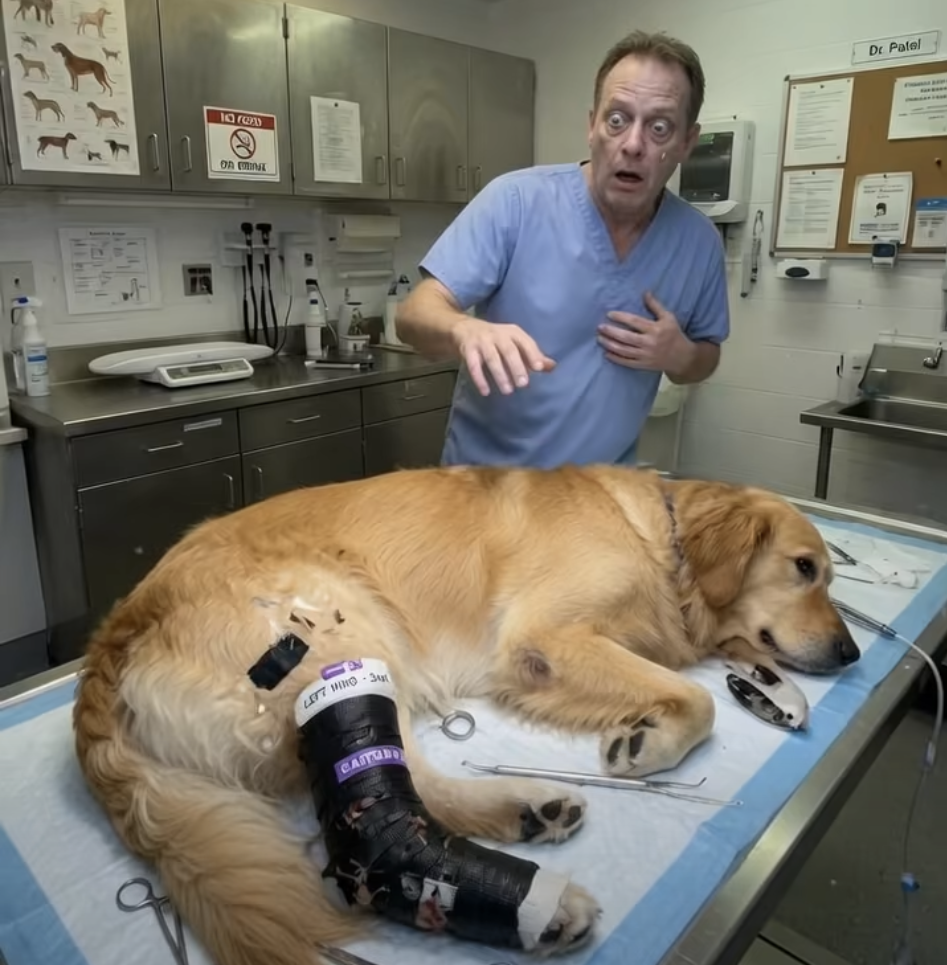
Bailey’s leg was completely encased in a cast.
I sat back on my heels, my mind completely short-circuiting. I reached out and touched it. It was rock solid.
But it wasn’t a normal veterinary cast. It wasn’t the clean, brightly colored fiberglass you see at a clinic.
This cast was crude. It was thick, heavy, and extremely dark, almost pitch black. It looked like it was made of industrial materials—layers of heavy-duty duct tape, something that felt like dried resin or tar, and tightly wound wire that dug slightly into his fur at the edges.
It smelled awful. Not just the smell of wet dog and forest mud. It smelled incredibly chemical, metallic, and distinctly like rotting meat.
My heart started to pound a frantic, terrifying rhythm against my ribs.
Who put a cast on my dog? Where had he been? If someone found him hurt, why didn’t they call the number on his collar? And why the hell would they set his leg and then just let him wander back into the pitch-black woods in a freezing storm?
I gently touched the top of the cast, and Bailey flinched violently, letting out a sharp yelp of agony. He bared his teeth—something he had never, ever done to me in his entire life—and scrambled backward, pressing his body against the kitchen cabinets in pure terror.
“Okay, okay, I’m sorry buddy. I’m sorry,” I whispered, holding my hands up.
Something was deeply, deeply wrong. The way he looked at me… it wasn’t just pain. It was trauma. Pure, unadulterated trauma. He looked terrified of human touch.
I didn’t waste another second trying to figure it out. I grabbed my car keys, grabbed my thickest winter blanket, and slowly, carefully wrapped it around him. He didn’t fight me this time; he just went completely limp. I carried him out to the truck and laid him in the passenger seat.
I sped down the winding mountain roads toward town, doing twenty miles over the speed limit. The closest 24-hour emergency veterinary clinic was a forty-minute drive, located in a strip mall on the outskirts of Portland.
The drive was agonizing. Every time I hit a pothole, Bailey would let out a low, shuddering moan. The chemical, metallic stench of the cast was quickly filling the cab of my truck, making my stomach churn. I had to crack the window just to breathe.
I kept glancing over at him. The cast was so incredibly bulky. It went all the way from his paw up past his elbow joint. Whoever did this had used immense force to wrap it. The more I looked at it in the dashboard lights, the more I realized how sinister it looked. It didn’t look like an attempt to heal him. It looked like a shackle.
I pulled into the empty parking lot of the emergency clinic just past 2:30 AM. The glowing neon sign buzzed loudly in the damp night air. I carried Bailey inside, practically kicking the glass doors open.
The waiting room was completely empty, bathed in harsh, buzzing fluorescent light. A young receptionist with dark circles under her eyes looked up from her computer, startled.
“I need help,” I gasped out, my arms burning from Bailey’s weight. “My dog. He’s been missing for three days. He just showed up at my door like this. Something is wrong.”
She took one look at Bailey, and her eyes widened. She immediately hit a button on her phone. “Dr. Evans? I need you up front right now. Hit by car, maybe? No… wait…” She frowned, leaning over the counter to look at his leg. “Sir, did you try to set his leg yourself?”
“No!” I yelled, perhaps louder than I intended. “I told you, he just showed up like this! Someone out in the woods did this to him!”
Before she could respond, the double doors leading to the back treatment area swung open. Dr. Evans walked out. He was a tall, imposing man in his late fifties, a veteran of emergency veterinary medicine who always looked completely unflappable. He had been Bailey’s vet since he was a puppy.
“David?” Dr. Evans said, surprised. He quickly walked over. “Put him on the scale. Gently.”
I lowered Bailey onto the cold metal scale. Dr. Evans immediately knelt down, ignoring the mud getting on his scrubs. He checked Bailey’s gums, his heart rate, and his pupils.
“He’s dehydrated. In shock. Heart rate is through the roof,” Dr. Evans muttered, all business. Then, his eyes fell on the heavy, black cast.
He reached out and tapped it with his knuckles. It made a dull, hard thud.
Dr. Evans frowned deeply. He leaned in closer, sniffing the air. His nose wrinkled in disgust. “What in the hell is this made of? Smells like automotive epoxy and… copper.”
“I don’t know, Doc. I swear to you, I opened my door ten minutes ago and he was like this. Who would do this?” I was shaking, the adrenaline wearing off and leaving me feeling weak and nauseous.
Dr. Evans didn’t answer right away. He ran his fingers along the edges where the heavy wire was wrapped tightly around the tape. He pressed slightly, and Bailey let out another sharp, agonizing yelp.
“It’s too tight,” Dr. Evans said sharply. “Way too tight. It’s cutting off the circulation to the paw. See how swollen the pads are? We need to get this off him immediately or he’s going to lose the leg.”
“Do it. Whatever you need to do,” I pleaded.
“Bring him back to Exam Room 3. Sarah, get the cast saw and some heavy-duty wire cutters. And prep an IV of fluids and a strong sedative.”
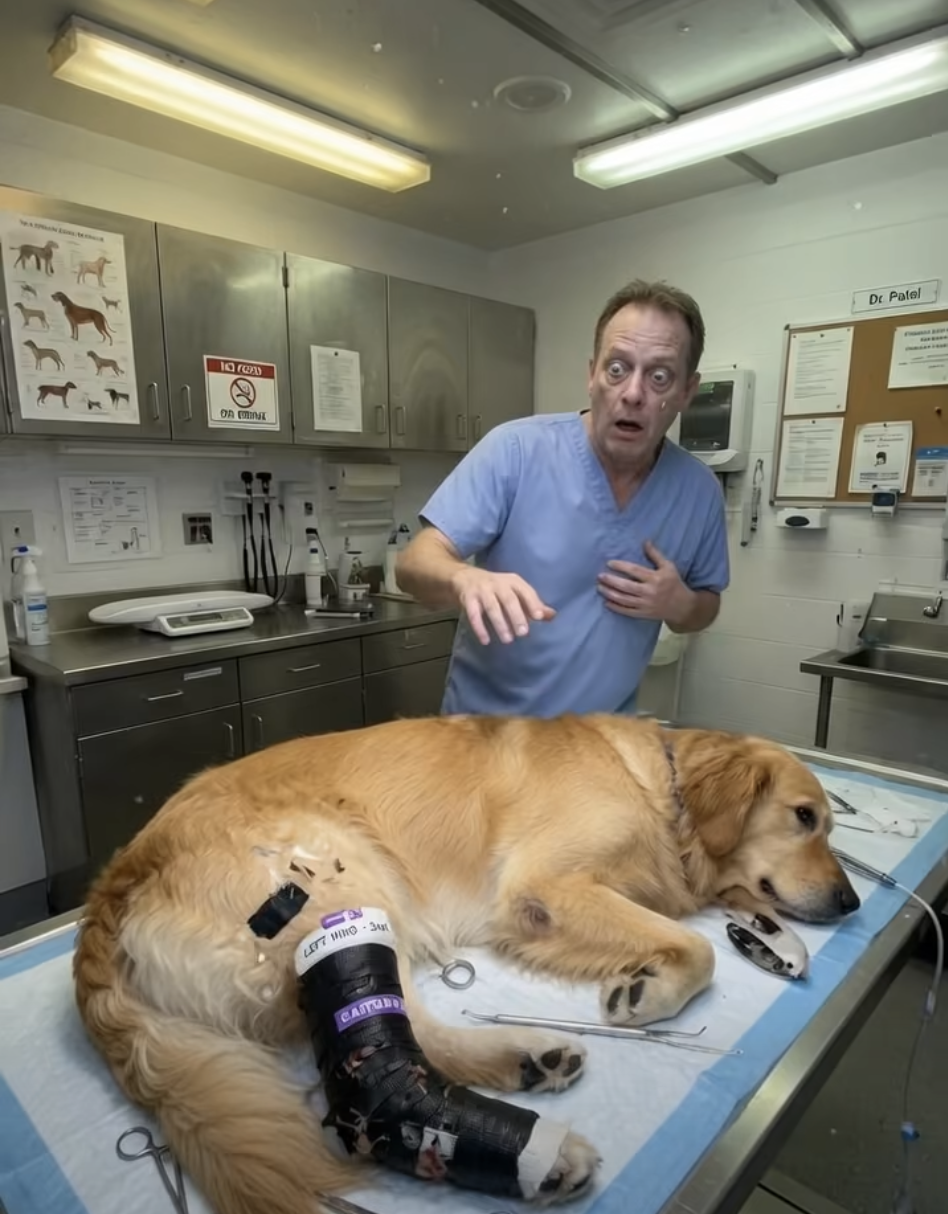
I carried Bailey into Exam Room 3. It was a small, sterile room with a stainless steel table in the center. I laid him down gently. He was too exhausted to fight anymore. He just laid his head flat against the metal, his eyes tracking my every movement with a look of pure dread.
Dr. Evans came in a moment later. He was wearing thick surgical gloves and carrying a small, motorized cast saw. It looked like a miniature pizza cutter on steroids.
“Okay, David. I’m going to need you to hold his head and shoulders. Keep him as still as possible. This saw won’t cut his skin, it only vibrates through the hard material, but the noise is going to scare him.”
I nodded, moving to the head of the table. I wrapped my arms firmly around Bailey’s upper body, burying my face against his good ear. “You’re okay, buddy. I got you. You’re safe now,” I murmured over and over.
Dr. Evans turned on the saw. It roared to life with a high-pitched, terrifying whine. Bailey tensed up immediately, letting out a low growl of panic.
“Hold him tight,” Dr. Evans warned.
He brought the spinning blade down onto the thick, black material of the cast.
Sparks actually flew.
Sparks. Dr. Evans pulled the saw back immediately, his eyes wide. “There’s metal under the tape. Thick metal. This isn’t just a splint.”
He swapped the saw for the heavy-duty wire cutters. He spent the next five agonizing minutes snipping away the thick, rusted wire that was bound tightly around the outside of the cast. Every time a wire snapped, the tension released slightly, but the awful, rotting, chemical smell grew stronger.
Once the wire was gone, Dr. Evans picked up the saw again.
“I have to push harder. Brace him.”
I squeezed Bailey tighter. The saw whined as Dr. Evans pressed it deep into the dark, resin-like material. Plumes of acrid black dust kicked up into the air, making us both cough.
Slowly, painfully, he managed to cut a straight line all the way down the side of the cast, from the elbow down to the paw.
“Okay,” Dr. Evans grunted, breathing heavily. He put the saw down. “I’m going to pry it open. The material is weirdly sticky. It might pull his fur.”
He grabbed two specialized metal tools and inserted them into the long crack he had just created. He squeezed the handles together to wedge the cast apart.
There was a sickening cracking sound, followed by a wet, tearing noise that made my stomach do flips.
The two halves of the heavy black shell finally split apart and fell away onto the metal table with heavy thuds.
I let out a huge breath of relief, looking down to see how bad the break was.
But I didn’t see a broken leg.
I didn’t see a leg at all.
I saw what was packed around the leg.
Dr. Evans froze. His hands, still gripping the metal tools, completely locked up. The color drained from his face so fast he looked like a corpse. He stared down at the table, his eyes unblinking, his jaw hanging slightly open.
The silence in the room became deafening, broken only by Bailey’s rapid, shallow panting.
“Doc?” I asked, my voice trembling. “Doc, what is it? How bad is the break?”
Dr. Evans didn’t answer. He slowly dropped the metal tools. They hit the floor with a loud clang that made me jump. He took one slow step backward. Then another.
He looked up at me, his eyes wide with a terror I had never seen in another human being.
“David,” he whispered, his voice cracking. “Back away from the table.”
“What? Why? What’s wrong?” I leaned forward to look.
“I said back away!” he suddenly barked, his voice laced with pure panic.
He stumbled backward until his back hit the counter. He reached behind him, blindly feeling for the wall phone. He didn’t take his eyes off the horrific mess of dark material, blood, and metal sitting on the exam table.
He ripped the phone off the wall receiver and hit a button.
“Sarah,” Dr. Evans said into the phone, his voice shaking violently. “Lock the front doors. Lock them right now. Pull down the security grates and call the police. Tell them we need an armed unit here immediately.”
He slowly hung up the phone and looked back at me.
“David,” he breathed, pointing a shaking, gloved finger at the open cast. “That isn’t… that isn’t a medical cast.”
I looked down at the table, my brain refusing to process what I was looking at.
Chapter 2
I looked down at the stainless steel table, my brain entirely refusing to process the horrific reality of what I was looking at.
There was no broken bone. There was no medical emergency with Bailey’s front leg. In fact, his golden fur had been meticulously, almost surgically, shaved away from his elbow down to his paw. The skin underneath was bruised and raw from the friction, but perfectly intact.
The heavy, black shell of the cast hadn’t been built to heal my dog.
It had been built to use him as a delivery vessel.
Packed tightly around Bailey’s shaved leg, filling the hollow void of the thick resin shell, was a chaotic, terrifying mass of objects wrapped in layers of clear plastic wrap and industrial grease. The stench of it—the metallic copper smell of old blood mixed with raw chemical epoxy—was suddenly so overpowering that I had to grab the edge of the metal table to keep my knees from buckling.
“Doc,” I choked out, my voice sounding incredibly distant to my own ears. “What… what is that?”
Dr. Evans was still pressed flat against the back cabinets of the exam room, his chest heaving violently under his white coat. He looked like a man who had just stared directly into the eyes of a ghost. He didn’t move. He didn’t blink. He just kept his terrified gaze locked on the table, his hand hovering near the wall phone he had just slammed down.
“Don’t touch it, David,” he whispered, his voice shaking with a tremor I had never heard from him in all the years I’d known him. “Just step back. Please, just step away from the dog.”
I couldn’t move. I was paralyzed by a cold, primal dread that was rapidly spreading outward from my chest, freezing the blood in my veins.
I looked closer at the debris sitting inside the split halves of the cast.
Nestled in the center of the plastic wrapping was a small, heavy metal cylinder, roughly the size of a soup can but capped tightly on both ends. It was completely wrapped in thick black electrical tape. Glued to the top of the cylinder was a small, square, black device with a tiny, rhythmic, blinking red light.
Blink.
Blink.
Blink.
It was a GPS tracker. Someone was tracking my dog. Someone had tracked him all the way from the deep woods behind my cabin, straight to my front door, and now, straight to this veterinary clinic.
But it wasn’t the blinking red light that had caused Dr. Evans to completely lose his mind with fear.
It was what was packed around the metal cylinder.
Tucked neatly against the cold steel of the tracker, pressed tightly against where Bailey’s bare skin would have been, was a small, incredibly dirty, pink canvas sneaker. It was a child’s shoe. A little girl’s shoe. It was stained with dark, rust-colored patches that I desperately prayed were just mud, but deep down, my gut screamed otherwise.
And tucked inside the small shoe, folded perfectly in half, was a Polaroid photograph.
Suddenly, the harsh, buzzing silence of the clinic was shattered by the screech of metal. Out in the waiting room, I could hear Sarah, the young receptionist, sobbing hysterically as she pulled down the heavy steel security grates over the front windows and doors. The loud CLANG of the deadbolts locking echoed down the hallway like a gunshot.
We were locked in.
“They’re coming,” Dr. Evans said, his voice dropping to a harsh, panicked whisper as he glanced toward the small, frosted window at the back of the exam room. “The police are coming. But David… whoever put that on him… they know exactly where he is right now.”
I looked down at Bailey. My sweet, gentle dog. He was laying perfectly flat on the metal table, shivering uncontrollably, his brown eyes darting between me and the open cast. He let out a low, heartbreaking whimper, a sound of pure exhaustion and fear.
I didn’t care about the tracker. I didn’t care about the danger. I took off my heavy flannel jacket and gently threw it over Bailey, covering his trembling body and shielding him from the horrific objects sitting right next to his paws. I leaned my forehead against his neck, closing my eyes, trying to ground myself in the familiar warmth of his body.
“I’ve got you,” I whispered into his fur, a tear finally breaking loose and sliding down my cheek. “Nobody is going to hurt you again. I swear to god.”
But my mind was racing at a million miles an hour. Who was out in those woods? The state forest behind my property was a massive, fifty-mile stretch of dense, unforgiving wilderness. It was notoriously dangerous, filled with steep ravines, hidden caves, and absolute isolation. Locals rarely ventured deep into it. It was too easy to get lost.
And someone out there had caught my dog during a raging storm. They hadn’t killed him. They had carefully shaved his leg, built a custom, heavy-duty shackle around it, packed it with a child’s shoe and a tracking device, and then let him go.
They sent him back to me.
Why?
The blinking red light reflected off the stainless steel table, casting a rhythmic, bloody glow over the exam room. Every time it flashed, I felt a fresh wave of nausea hit me.
“How long ago did the little Miller girl go missing?” Dr. Evans suddenly asked, breaking the suffocating silence. His voice was hollow.
I whipped my head around to look at him. My heart completely stopped.
“Emily Miller,” I breathed, the name tasting like ash in my mouth.
Emily Miller was a six-year-old girl who had vanished from a campground on the opposite side of the county forest nearly four years ago. It had been the biggest search and rescue operation in state history. Hundreds of volunteers, helicopters, tracking dogs. They scoured the woods for weeks. They found absolutely nothing. No trace. No clothing. No clues. Eventually, the search was called off. The community assumed she had wandered off and fallen victim to the elements, or worse, the local predator population.
I looked back down at the small, pink canvas sneaker sitting in the open shell of the cast.
My breath caught in my throat. I had seen that shoe before. It had been plastered on every billboard, every gas station window, every telephone pole in the county for an entire year. Last seen wearing pink canvas sneakers and a yellow raincoat.
“Doc,” I stammered, my hands shaking so badly I had to grip the edge of the table again. “You don’t think…”
“I saw the picture, David,” Dr. Evans interrupted, his eyes welling up with tears. He finally pushed himself away from the back counter, taking a hesitant step toward the table, though keeping a wide berth from the blinking GPS tracker. “Before I backed away… I saw the Polaroid folded inside the shoe.”
“What is it? What does it show?”
Before he could answer, the wail of police sirens pierced the night air. The sound started faint but grew rapidly louder, echoing off the wet asphalt of the strip mall parking lot outside. Flashing red and blue lights began to stroke violently through the gaps in the front security grates, painting the clinic hallway in chaotic, strobing colors.
“Police! Open up!” a deep, authoritative voice boomed from the front doors, followed by the sound of heavy fists pounding against the reinforced glass.
I heard Sarah scrambling to the front, her keys jangling frantically as she unlocked the deadbolts and threw open the security gate.
Heavy boots pounded down the linoleum hallway. Two state troopers burst into Exam Room 3, their hands resting cautiously on the grips of their holstered sidearms. They looked highly agitated, taking in the bizarre scene: a terrified vet backed against the wall, a soaking wet man clutching a shivering Golden Retriever, and a bizarre, black device sitting on the surgical table.
“Who called it in?” the lead trooper demanded. He was a large man with a thick mustache and eyes that instantly scanned the room for threats. “Dispatch said there was a hostage situation or a bomb threat?”
“I did,” Dr. Evans said, his voice trembling as he pointed a shaking finger at the table. “Officer, look at the table. Look at what was on the dog’s leg.”
The two troopers approached the metal table slowly. As they got closer, the smell hit them. The lead trooper visibly recoiled, bringing a hand up to cover his nose and mouth.
“Jesus Christ, what is that smell?” he grunted.
He leaned over the table, pulling a small, heavy flashlight from his belt and shining it directly onto the opened cast. The beam illuminated the thick black resin, the raw meat packed inside, the heavy metal cylinder, the blinking red tracker, and the dirty pink sneaker.
The trooper’s eyes narrowed. He recognized the shoe, too. Every cop in the county would recognize that shoe.
“Don’t touch anything,” the lead trooper ordered his partner sharply. He immediately unclipped the radio from his shoulder. “Dispatch, this is Unit 4. I need a hazmat team and a bomb squad unit at the emergency vet clinic on Route 9, immediately. We have an unidentified device with a live GPS beacon. And dispatch… I need you to get Detective Ramirez on the line. Right now. Tell him it’s about the Miller case.”
The room descended into a chaotic, terrifying holding pattern. The troopers forced Dr. Evans, Sarah, and me out of the exam room and into the small employee breakroom down the hall. They wouldn’t let me take Bailey. I fought them, screaming and refusing to leave my dog alone on that cold metal table, but the lead trooper physically restrained me.
“Sir, if that cylinder is an explosive, you are not staying in that room,” the trooper barked, shoving me back into the breakroom and standing guard at the door. “Your dog is fine for now. We have to secure the perimeter.”
For the next two hours, I sat on a cheap plastic chair in the breakroom, my head in my hands, listening to the muffled sounds of chaos outside. The bomb squad arrived. Heavy, muffled voices yelled orders down the hallway. The metallic clanking of specialized equipment echoed off the walls. Every single second felt like a lifetime.
All I could think about was Bailey. He was in that room alone, exhausted, terrified, lying next to a device that could potentially blow the entire clinic apart. I felt like a complete failure. I was supposed to protect him.
Finally, just past 5:00 AM, the heavy breakroom door swung open.
Detective Ramirez walked in. I recognized him from the news. He was the lead investigator on the Emily Miller case four years ago. He looked exhausted, his tie loose, deep bags under his eyes. He didn’t look angry; he looked profoundly disturbed.
He pulled up a chair and sat directly across from me. He placed a clear, plastic evidence bag onto the small folding table between us.
“Mr. Miller,” Ramirez started, his voice a low, gravelly rumble. “I need you to listen to me very carefully. The bomb squad cleared the device. It wasn’t an explosive. It was a heavy, waterproof storage canister. The kind hikers use to bury supplies.”
I let out a breath I didn’t know I was holding. “Thank god. And Bailey? My dog?”
“Your dog is fine. The vet is treating him now,” Ramirez said, holding up a hand to stop me from getting up. “Sit down. We have a massive problem on our hands.”
He tapped a thick finger against the clear plastic evidence bag on the table.
Inside the bag was the Polaroid photograph that had been folded inside the pink shoe.
“We opened the canister,” Ramirez continued, his eyes locking onto mine, searching my face for any sign of deception. “It was packed full of physical evidence. A child’s silver locket. A torn piece of a yellow raincoat. And a lock of blonde hair.”
My stomach plummeted. “Emily.”
“Yes,” Ramirez said grimly. “Someone has been living out in those woods for four years. Someone who took her. But that’s not why I’m sitting here with you, David.”
He slowly slid the plastic bag across the table toward me.
“I need you to look at this photograph. The vet said he saw it when he opened the cast. I need you to tell me if you know what this means.”
My hands were shaking so violently I could barely pick up the plastic bag. I held it up to the harsh fluorescent light of the breakroom.
I looked at the Polaroid.
The air rushed out of my lungs in a sharp, agonizing gasp. The room started to spin. I felt the sudden, violent urge to vomit.
The photograph wasn’t a picture of Emily Miller.
It was a picture of me.
It was a photograph of me, sleeping in my bed. The picture was taken from inside my own bedroom, looking down at my sleeping face from the corner of the room.
The lighting was dark, illuminated only by the flash of the Polaroid camera. But in the bottom right corner of the frame, holding the camera, was a reflection in my bedroom mirror.
It was the reflection of a man. He was wearing a filthy, oversized yellow raincoat. His face was entirely obscured by a crude, stitched-together mask made of what looked like tanned animal hide.
But it was the timestamp written in thick black marker at the bottom of the white border that made my heart completely stop beating.
Tuesday, 3:15 AM.
That was three nights ago. The exact night Bailey went missing. The night of the massive storm.
While I was outside, screaming my lungs out in the freezing rain, running through the pitch-black woods looking for my dog…
The man from the woods hadn’t just stolen Bailey.
He had been inside my house.
He had stood silently in the corner of my bedroom. He had taken a picture of my empty bed, waiting for me to come back.
And now, he knew exactly where I was. Because the red light on the GPS tracker was still blinking.
“David,” Detective Ramirez said, his voice cutting through my panic like a knife. He leaned across the table, his face incredibly tense. “Whoever this guy is, he didn’t just send your dog back as a sick joke. He sent the dog back as a warning.”
Ramirez pulled out his radio. “Unit 4, get an armed perimeter around this man’s cabin immediately. Nobody goes in or out.”
He looked back at me, his eyes dark and serious.
“He’s been watching you, David. And based on what else we found inside that metal canister… I don’t think he’s finished playing his game.”
Chapter 2
The harsh fluorescent light of the breakroom buzzed like a swarm of angry bees. I stared at the Polaroid photograph lying in the plastic evidence bag, my lungs refusing to take in air.
Tuesday, 3:15 AM.
The memory of that night flooded back, making me physically sick. I had spent hours screaming Bailey’s name in the freezing, pouring rain. I had dragged myself back inside, completely soaked and hypothermic, leaving the back door wide open in a desperate hope that my dog would run back inside. I had collapsed onto my bed, shivering so violently my teeth rattled, and passed out from sheer exhaustion for maybe an hour.
And in that hour, the monster had walked right through my open door.
He hadn’t just taken my dog. He had stood in the dark corner of my bedroom. He had watched me sleep. He had taken this picture.
“Mr. Miller… David,” Detective Ramirez said, his voice lowering to a steady, grounding tone. He could see I was on the verge of a complete panic attack. “Breathe. I need you to focus. You are surrounded by police right now. You are safe in this building. But I need you to look at the rest of what we found.”
I dragged my eyes away from the terrifying reflection of the man in the yellow raincoat and looked up at the detective. My throat felt like it was lined with sandpaper.
“What else?” I managed to whisper. “What else was in that metal tube?”
Ramirez reached into a thick brown manila folder he had brought into the room. He pulled out a small, incredibly weathered leather journal. The cover was stained with dark, irregular blotches and smelled faintly of the same sickening chemical odor that had been on Bailey’s cast.
“The bomb squad pulled this out from the bottom of the canister,” Ramirez explained, carefully flipping the book open with his gloved hands. “It’s a logbook. But it’s not a diary of what he’s done in the woods. It’s a surveillance log. And David… it’s about you.”
My heart, which had just started to slow down, suddenly slammed against my ribs.
Ramirez turned the journal so I could see the pages. They were filled with tiny, frantic, cramped handwriting in black ink. But it wasn’t just words. There were highly detailed, hand-drawn sketches.
I looked closer, and a wave of pure ice washed over my skin.
It was my cabin. The drawings were incredibly precise blueprints of my property. He had drawn the exact layout of my fence line. He had marked the location of my motion-sensor floodlights. He had even noted the blind spots where the cameras I installed last year couldn’t reach.
But it was the written notes that truly broke me.
October 12th. Target leaves for work at 7:15 AM. Dog is left inside.
November 3rd. Target buys groceries on Thursdays. Returns at 6:30 PM. Leaves spare key under the fake rock near the porch steps.
December 18th. Target sleeps on his right side. Leaves the bathroom window cracked for ventilation.
“He’s been watching me,” I choked out, pushing my chair back from the table. I felt entirely violated. My sanctuary, my quiet home in the woods, had been a glass cage. “For how long? How long has this guy been out there?”
“Based on the dates in this book,” Ramirez said grimly, closing the journal, “at least fourteen months. He knows your entire routine. He knows your dog. He knows exactly how isolated you are.”
“Why me?” I asked, my voice cracking. Tears of pure frustration and terror burned in my eyes. “I don’t know anyone out here! I keep to myself! Why would the guy who took Emily Miller care about me?”
Ramirez leaned forward, his face dead serious. “We don’t know yet. Serial predators, especially ones who manage to survive in deep wilderness, operate on logic we can’t understand. But based on this evidence, he didn’t stumble upon your dog by accident. He waited for that storm. He opened your gate to lure the dog out. He wanted to use your animal to deliver this message directly to the police.”
“He wanted you to find the tracker,” I realized, the horrifying truth dawning on me.
“Exactly,” Ramirez nodded. “He attached a live GPS beacon to an object containing evidence from our county’s most famous cold case. He knew the moment a vet saw it, they would call us. He wanted us to know he’s still out there. And he wanted to show us that he can get to anyone. Even someone locked inside their house.”
A heavy knock on the breakroom door interrupted us.
The lead state trooper from earlier poked his head in. “Detective? We have a perimeter set up around the clinic. The bomb squad is packing up. And the vet says the dog is ready.”
I didn’t wait for Ramirez to dismiss me. I shoved my chair back and practically ran out of the breakroom, rushing down the bright hallway toward Exam Room 3.
When I pushed the door open, the sickening smell was gone. The room had been cleaned.
And there, sitting up on a thick pile of blankets on the floor, was Bailey.
His front leg was wrapped in clean, white, professional bandages. He looked incredibly thin and exhausted, but the moment he saw me, his tail gave a weak, hesitant thump against the floor.
“Bailey!” I dropped to my knees, wrapping my arms around his thick neck. I buried my face in his fur, sobbing freely. I didn’t care who was watching. The relief of feeling his warm breath against my neck was overwhelming.
Dr. Evans stood by the sink, washing his hands. He looked pale and deeply shaken, but he offered a weak, reassuring nod.
“He’s a strong boy, David,” the vet said softly. “The circulation to the paw is returning. The skin was badly irritated by whatever chemical that lunatic used, but there’s no permanent muscle damage. We gave him a heavy dose of antibiotics and painkillers. He needs rest. A lot of rest.”
“Thank you, Doc,” I whispered, holding Bailey’s head against my chest. “Thank you for saving him.”
“Just take him and go,” Dr. Evans replied, his eyes darting nervously toward the front of the clinic where the police were still gathered. “I’m closing the clinic for the week. I… I need to be with my family.”
I didn’t blame him. Nobody who looked inside that black shell would ever be the same.
I carefully scooped Bailey up into my arms. He was heavy, but the adrenaline still coursing through my veins made him feel weightless. I carried him out into the waiting room.
The sun was just starting to rise, casting a pale, cold, gray light through the front security grates. The storm had finally broken, leaving the world outside looking washed out and dead.
Detective Ramirez was waiting for me by the front doors, flanked by three heavily armed state troopers holding rifles.
“Here is the plan, David,” Ramirez said, all business now. “You cannot go back to that cabin alone. In fact, I don’t want you staying there at all. It is an active crime scene, and we have an armed perimeter established around the property.”
“I don’t ever want to go back there,” I said honestly, holding Bailey tight. The thought of stepping foot in that bedroom made my skin crawl.
“I understand,” Ramirez nodded. “But we need your clothes, your dog’s food, your identification, and anything else you might need for the next few weeks. I have a safe house arranged for you in Portland. But we need to make a quick run to your cabin to pack a bag. You will be escorted by my tactical team. You will go in, pack your essentials, and get out. We will clear the house first. Do you understand?”
I swallowed hard and nodded. “Okay. Let’s get it over with.”
The drive back up the mountain was the most surreal experience of my life.
I sat in the back of an armored police SUV, holding Bailey in my lap. Ahead of us was a state trooper cruiser, and behind us were two more unmarked tactical vehicles. We wound our way up the wet, debris-covered mountain roads in a tense, silent convoy.
The higher we drove, the deeper we went into the heavy, ancient timber of the state forest. The trees seemed to close in around the road, blocking out the morning sun. I looked out the tinted window at the endless rows of dark trunks, knowing that somewhere out there, a man in a yellow raincoat was likely watching us.
We finally turned off the main highway and onto the long, dirt driveway that led to my property.
The area was completely locked down. Yellow police tape was strung across the oak trees. Several patrol cars were parked at odd angles across the lawn, their lightbars flashing silently in the gray morning mist. Heavily armed officers were walking the perimeter of the tree line, sweeping the dense brush with flashlights.
The convoy stopped right in front of my porch.
“Wait here,” the tactical team leader ordered. He and three other officers, all wearing heavy Kevlar vests and carrying assault rifles, stepped out of the vehicle. They moved with terrifying efficiency, stacking up against my front door.
I sat in the back of the SUV, my heart in my throat, watching them breach my home. They kicked the front door open, sweeping inside, their weapons raised.
“Clear right!” I heard faintly through the cracked window.
“Clear left!”
I sat there stroking Bailey’s head. He was whimpering softly, his body tense. He didn’t want to be here either. He kept looking toward the dense tree line at the edge of the backyard, his ears pinned flat against his skull. He knew what was in those woods.
Ten agonizing minutes passed before the tactical leader stepped back out onto the porch. He holstered his weapon and gave a thumbs-up to our SUV.
“House is clear,” he announced into his shoulder radio. “No signs of forced entry. Nobody inside. Bring the homeowner in.”
Detective Ramirez opened my car door. “Alright, David. Keep it quick. Ten minutes. Grab your clothes and let’s go.”
I left Bailey in the warm SUV with one of the officers. I didn’t want him stepping foot back in that house.
I walked up the wooden porch steps, my legs feeling like lead. As I crossed the threshold into my living room, a profound sense of wrongness washed over me. The house looked exactly the same as I had left it. My coffee mug was still on the table. My laptop was still on the couch.
But it didn’t feel like my home anymore. It felt contaminated.
Two officers followed me inside, standing guard in the hallway while I rushed into the bedroom.
I grabbed a duffel bag from the closet and started wildly shoving clothes into it. Jeans, shirts, socks. I didn’t care what matched. I just wanted to get out.
As I zipped the bag shut, I made the mistake of looking over at the corner of the room. The exact spot where the man had stood to take the Polaroid photograph.
I stared at the empty corner, imagining a man standing there in the pitch black, listening to me breathe. A cold shiver ran violently down my spine.
I grabbed my bag and rushed back out into the hallway. “I’m done. Let’s go.”
I walked into the kitchen to grab a few bags of Bailey’s expensive dog food from the pantry. As I opened the heavy wooden pantry door, I froze.
The smell hit me.
It was faint, much fainter than it had been at the vet clinic, but it was absolutely unmistakable. The smell of raw, chemical epoxy mixed with a metallic copper scent.
“Hey,” I said, dropping the dog food bag. My voice echoed loudly in the quiet kitchen. “Do you guys smell that?”
The tactical leader stepped into the kitchen, his brow furrowed. He took a deep breath through his nose. His eyes instantly widened.
“Guns up,” he whispered sharply to the other officer.
The two men instantly raised their rifles, their relaxed demeanor vanishing in a split second. They began sweeping the kitchen again, checking behind the island, checking the heavy wooden backdoor.
“We cleared this room,” the second officer muttered, sounding confused and defensive. “There’s nothing here.”
But the smell was getting stronger.
I slowly turned around, looking up.
Above the kitchen island, set directly into the ceiling, was the square wooden hatch that led up to the attic crawlspace. I had lived in this house for four years and had never once opened it. It was just a space for insulation and old wiring.
But as I stared at it now, my stomach completely dropped.
The edge of the wooden hatch was slightly misaligned. It wasn’t sitting flush against the ceiling frame. And pressed right against the small gap, smeared onto the white paint, was a fresh, dark smudge of black mud.
The tactical leader followed my gaze. He saw the hatch. He saw the mud.
He didn’t say a word. He just slowly raised his rifle, aiming it directly at the ceiling.
He unclipped his radio. “Ramirez. We have a situation inside. Need backup in the kitchen. Now.”
Within seconds, Ramirez and two more armed officers crowded into the small kitchen. They all stared up at the attic hatch. The chemical smell was definitely seeping down from the ceiling.
“David, get outside,” Ramirez ordered quietly, pushing me backward toward the living room. “Now.”
I didn’t argue. I backed away, but I couldn’t look away from the hatch.
The tactical leader grabbed a sturdy wooden chair from the dining table and dragged it silently under the hatch. He stepped up onto the chair, his weapon held tight against his shoulder. He reached up with his left hand, his fingers resting gently against the edge of the wooden panel.
The entire house was completely silent. The only sound was the heavy breathing of the officers.
The tactical leader pushed the hatch upward. It gave way with a soft, creaking groan.
He shoved the wooden panel entirely out of the way, creating a dark, square hole into the pitch-black attic. He quickly raised his flashlight, clicking it on and shining the blinding beam up into the darkness.
He poked his head up into the crawlspace.
For two agonizing seconds, absolutely nothing happened.
Then, the tactical leader screamed.
It wasn’t a yell of authority. It was a raw, primal scream of pure terror.
He violently flinched backward, losing his balance on the chair. He crashed down hard onto the kitchen floor, his rifle clattering against the tiles.
“Get back! Get back!” he yelled, scrambling backward like a crab, his eyes wide and fixed on the dark hole in the ceiling.
The other officers instantly leveled their weapons at the hatch, shouting commands into the darkness.
“Police! Show your hands! Come down right now!”
I was standing in the living room, my heart hammering a frantic rhythm against my ribs. I couldn’t see what was up there.
“What is it?!” Ramirez yelled, pulling the tactical leader up by his vest. “Is he up there?!”
The tactical leader was pale, his chest heaving. He pointed a shaking finger at the open attic hatch.
“No,” he gasped, his voice trembling with sheer horror. “He’s not up there. But he left something looking right at us.”
Ramirez shoved past him, stepping up onto the chair. He raised his flashlight and looked up into the attic.
When Ramirez climbed back down, he looked physically ill. He turned to me, his expression completely hollowed out.
“David,” Ramirez whispered, the authority completely stripped from his voice. “We need to leave. Right now. We need to evacuate this entire property.”
“Why?” I demanded, panic flooding my system. “What is up there?!”
Ramirez grabbed my arm and dragged me toward the front door.
“There’s a television monitor up there, David. Wired directly into the house’s power,” Ramirez said, pushing me out onto the porch into the cold morning air. “It’s turned on.”
“A monitor?” I repeated, totally confused. “Playing what?”
Ramirez stopped at the bottom of the porch steps. He looked back at my house, his face a mask of absolute dread.
“It’s playing a live camera feed,” Ramirez said. “A live feed of the inside of my police station. Looking directly at the cell where we locked up the evidence canister.”
My brain stopped working.
“He’s not hiding in your woods, David,” Ramirez continued, his voice dropping to a terrified whisper. “He was never just living in the woods.”
Ramirez looked out at the heavily armed state troopers surrounding my property, his eyes scanning their faces.
“He’s one of us.”
Chapter 3
“He’s one of us.”
Those four words hung in the freezing morning air, heavier than the gray storm clouds pressing down on the mountain.
I stood paralyzed at the bottom of my porch steps, the icy rain beginning to drizzle down again, soaking into my thin shirt. I looked out at my front yard. There were at least fifteen heavily armed men swarming my property. State troopers, tactical officers, local deputies. They were setting up perimeter wire, sweeping the brush, holding assault rifles across their chests.
They were supposed to be the cavalry. They were supposed to be my protection.
But as I looked at their faces, half-hidden behind tactical helmets and dark sunglasses, my stomach turned to absolute ice. One of these men had stood in my bedroom. One of these men had built that agonizing shackle around my dog’s leg. One of these men had taken Emily Miller.
And now, he was standing in my front yard, wearing a badge, watching us realize the truth.
“Ramirez,” I whispered, my voice barely audible over the crunching of heavy boots on my gravel driveway. “What do we do? How do we know who it is?”
Detective Ramirez didn’t look at me. His eyes were scanning the tree line, his hand resting rigidly on the grip of his holstered service weapon. His jaw was clenched so tight I thought his teeth might shatter.
“We don’t,” Ramirez muttered back, his lips barely moving. “The feed in the attic… it was a closed-circuit hack. Only someone with high-level security clearance at the precinct could access the evidence room cameras and stream them out here. The man who did this didn’t just stumble into this investigation. He is directing it.”
A terrifying wave of realization washed over me. “The search for Emily,” I breathed, feeling physically sick. “Four years ago. The dogs, the helicopters, the hundreds of volunteers…”
“He was leading the search parties,” Ramirez confirmed grimly. “He intentionally steered us away from wherever he was hiding her. He controlled the entire narrative.”
Suddenly, the crunch of gravel grew louder.
I snapped my head up. Walking directly toward us from the line of patrol cars was the lead state trooper from the veterinary clinic. The large man with the thick mustache who had forced me into the breakroom and taken control of the crime scene.
Officer Vance.
My heart slammed against my ribs with the force of a hammer. I remembered how he had reacted at the clinic. He had recognized the pink sneaker instantly. He had ordered his partner not to touch anything. He had immediately called for the bomb squad, ensuring the entire building was evacuated and cordoned off—giving himself total control over the evidence.
As Vance approached us, his face was unreadable. His dark eyes flicked from Ramirez, to me, and then up to the open attic window on the side of my cabin.
“Detective,” Vance said, his deep voice cutting through the ambient noise of the police radios. “My men said there was a situation inside. Everything clear?”
Ramirez stepped slightly in front of me, subtly blocking Vance’s direct line of sight to me.
“False alarm, Vance,” Ramirez lied smoothly, his voice remarkably steady. “Just some old wiring and raccoon damage in the crawlspace. Homeowner got spooked. We’re packing up.”
Vance stopped about five feet away from us. He didn’t relax his posture. His right hand hovered casually, yet deliberately, near his duty belt.
“Is that so?” Vance asked, a slow, sickening smile creeping onto his face. It wasn’t a friendly smile. It was the smile of a predator realizing its prey finally understood it was trapped. “Funny. Tactical said they found a live monitor up there. Said it was broadcasting the precinct.”
He knew. He already knew because he was listening to the encrypted radio channels.
Ramirez’s hand tightened on his holster. “Like I said. False alarm. I need you to order the perimeter to stand down, Vance. I’m taking Mr. Miller and his dog back to the city in my personal vehicle.”
“I don’t think that’s protocol, Detective,” Vance replied, taking one slow, heavy step forward. The air between them felt like a live wire, humming with lethal tension. “Mr. Miller is a material witness. He should travel in the armored SUV. With me. For his own safety.”
“He’s riding with me,” Ramirez countered, his voice dropping to a dangerous, authoritative growl.
Vance tilted his head, his dark eyes locking onto mine.
In that split second, looking into those eyes, I saw it. I saw the exact same cold, dead stare that I had imagined belonging to the man in the yellow raincoat. I remembered the Polaroid photograph. The height of the man in the mirror’s reflection. The broad shoulders.
It was him. I was standing five feet away from the monster.
“David,” Ramirez said sharply, never taking his eyes off Vance. “Go to my cruiser. Get your dog out of the SUV and go to my car. Right now.”
I took a step backward, my legs trembling so badly I could barely keep my balance. I turned and sprinted toward the armored SUV parked near the oak tree.
“Hey!” Vance barked.
I didn’t stop. I yanked the heavy door of the SUV open. Bailey was huddled in the backseat, whining in distress. I grabbed his leash, practically dragging him out of the vehicle.
Behind me, the fragile standoff shattered.
“Stand down, Vance!” Ramirez roared.
I spun around just in time to see Vance draw his weapon with terrifying speed. He didn’t hesitate. He didn’t issue a warning.
He leveled his pistol directly at Ramirez’s chest and pulled the trigger.
The gunshot was deafening, a violently loud crack that echoed off the mountainside. Ramirez jerked backward, crying out in pain as the bullet clipped his shoulder, spinning him around and sending him crashing hard into the wooden porch railing.
Complete and utter chaos erupted.
The other officers in the yard began screaming, raising their rifles, completely confused as to who was shooting at who. It was a nightmare scenario. Cops pointing guns at cops in the gray morning mist.
“He’s the suspect! Vance is the suspect!” Ramirez screamed from the ground, desperately clawing for his own weapon with his good arm.
Vance didn’t waste time trying to shoot the other officers. He whipped his head around, his eyes locking onto me and Bailey by the SUV. His mask of authority was completely gone. His face was twisted into a mask of pure, unhinged rage.
He raised his gun, aiming it directly at my face.
“Run!” I screamed at Bailey.
I dove to the ground, pulling Bailey down with me just as the passenger window of the SUV exploded into a shower of glass above our heads. Vance was firing at us.
There was no time to think. There was no time to get to Ramirez’s cruiser. The driveway was entirely exposed.
The only cover was the one place I had sworn I would never go again.
The woods.
“Come on, Bailey!” I yelled, scrambling to my feet. I dragged him toward the dense, towering tree line at the edge of my property.
I vaulted over the wooden fence, my boots hitting the soft, wet mud of the state forest. Bailey scrambled over right behind me, his injured leg wrapped in white bandages flashing in the dim light.
Gunfire was erupting behind us now—rapid, chaotic bursts as the tactical team finally engaged Vance. But I didn’t look back. I plunged blindly into the thick underbrush, branches whipping against my face and tearing at my clothes.
We ran. We ran with the kind of frantic, primal adrenaline that only exists when death is actively chasing you.
I pushed deeper and deeper into the wilderness, sliding down steep, muddy ravines, tearing through massive patches of thorny blackberry bushes. The air grew colder, the canopy of Douglas firs blocking out the sky completely. It was practically twilight in here.
After what felt like twenty minutes of agonizing, chest-burning sprinting, my legs simply gave out. I collapsed behind the massive, rotting trunk of a fallen redwood tree.
I pulled Bailey tightly against my chest, covering his muzzle with my hands to muffle his heavy, frantic panting. My own heart was beating so loudly I was terrified it would give away our position.
We sat there in the wet mud, surrounded by the suffocating silence of the deep woods.
The distant sirens and gunfire from my cabin had faded entirely. It was just the sound of the dripping rain.
I strained my ears, listening to the forest.
Snap.
A branch broke somewhere to our left. About fifty yards away.
My blood ran cold.
Crunch. Heavy boots stepping on wet pine needles. Methodical. Slow. Hunting.
He had followed us. He knew these woods better than anyone on earth. This was his domain. He had likely built bunkers and tunnels out here for years. We had just run straight into his web.
“David…”
The voice drifted through the trees. It was a sing-song, taunting whisper that made every hair on my body stand on end.
“You shouldn’t have gone to the vet, David. You ruined the game. I worked so hard on that cast. I wanted you to keep it.”
I squeezed my eyes shut, tears of pure terror leaking out. I had no weapon. I had a cell phone with zero bars of service. I was going to die out here, and nobody would ever find my body.
“I’ve been watching you for a long time,” Vance’s voice echoed, sounding closer now. Maybe thirty yards. The dense fog made it impossible to pinpoint his exact location. “You have such a quiet life. No family. No friends. Just you and the dog. I thought you would appreciate the company. I stood right next to your bed, David. I could have reached out and touched your face.”
I pulled Bailey tighter. But something was changing in my dog.
Bailey wasn’t shivering anymore. His body had gone completely rigid. The fur along his spine was standing straight up. He pulled his muzzle out of my hands, lifting his nose to the wind.
He smelled something.
It was faint, cutting through the scent of wet earth and pine. It was the sickening, metallic, chemical smell of the industrial epoxy. The exact same smell that had coated Vance’s gloves when he built that horrific cast.
Bailey let out a low, vibrating growl from deep within his chest. It wasn’t a sound of fear. It was a sound of absolute, instinctual hatred.
“Quiet,” I breathed desperately, trying to pull him back.
But Bailey had endured three days of torture at the hands of this man. He had been bound, starved, and terrified. And now, the man who had done it was coming for us again.
“I see your footprints in the mud, David,” Vance taunted, the crunching footsteps stopping just on the other side of the massive fallen tree we were hiding behind. He was right there. I could hear his heavy breathing. “Time’s up.”
Vance stepped around the edge of the rotting tree trunk, his pistol raised, his dark eyes locking onto me.
“Goodbye, neighbor,” he sneered, raising the gun to my head.
Before he could pull the trigger, a blur of golden fur exploded from the mud beside me.
Bailey didn’t bark. He simply launched himself through the air with every ounce of strength left in his starving, exhausted body.
He slammed directly into Vance’s chest.
Eighty pounds of desperate, angry dog collided with the officer. The impact threw Vance entirely off balance. The gun discharged wildly into the air, the bullet tearing through the branches above us.
Vance screamed in surprise, crashing backward into the thick mud, with Bailey landing squarely on top of him. Bailey’s jaws snapped aggressively, tearing at the thick Kevlar vest and Vance’s heavy jacket, his teeth seeking any purchase he could find.
“Get this mutt off me!” Vance roared, wildly swinging his arms to protect his face. He brought the butt of his pistol down hard onto Bailey’s ribs.
Bailey yelped in pain but refused to let go, his teeth locked viciously onto the sleeve of Vance’s uniform.
The momentary distraction was all I needed.
I didn’t run. The adrenaline and the pure, blinding rage of seeing my dog get hit finally boiled over.
I grabbed a heavy, jagged rock from the mud. I leaped over the rotting log and lunged at the struggling man.
Before Vance could turn his gun back toward Bailey, I brought the rock down with sickening force against the side of his tactical helmet.
The crack of stone against the reinforced plastic was violently loud. Vance’s eyes rolled back in his head. His grip on the pistol went entirely slack. He slumped sideways into the mud, completely unconscious.
I stood over him, my chest heaving, the bloody rock still clutched in my shaking hand.
Bailey immediately let go of the sleeve, limping over to me and pressing his wet, muddy head against my leg. He looked up at me, his brown eyes soft and entirely exhausted.
“Good boy,” I sobbed, dropping the rock and falling to my knees in the mud. I wrapped my arms around him, burying my face in his dirty fur. “You’re the best boy in the world.”
Ten minutes later, the woods were swarming with tactical officers.
They found us sitting on the fallen log, waiting. They swarmed Vance, ripping his badge off his uniform, stripping his weapons, and aggressively securing him in heavy iron shackles.
Detective Ramirez, his arm heavily bandaged and in a makeshift sling, pushed through the crowd of officers. He looked at Vance’s unconscious body, then looked at me and Bailey.
He didn’t say a word. He just gave a slow, deeply respectful nod, before turning back to his men.
“Tear these woods apart,” Ramirez ordered, his voice echoing through the trees with terrifying authority. “Bring in the ground-penetrating radar. Bring in the excavators. Find every single bunker, every single tunnel this monster built. We’re not leaving until we find Emily.”
It has been six months since that morning in the Oregon woods.
I never went back to that cabin. The police eventually bought the property under civil forfeiture laws to maintain the integrity of the massive crime scene.
Over the next few weeks, the news cycle exploded. The horrifying truth came to light. Officer Vance had used his position on the force, his access to evidence, and his knowledge of the search grids to operate as a phantom in the woods for nearly a decade.
Deep beneath the state forest, miles away from any hiking trail, they found his nightmare. A series of reinforced, underground shipping containers.
And inside one of them, they finally found the remains of Emily Miller.
It was a devastating discovery, but it finally gave her family the closure they had been agonizingly denied for four years. They held a massive, beautiful memorial service for her in the city. I didn’t attend, but I watched it on television, holding Bailey tightly on the couch.
Vance is currently locked in a maximum-security federal facility, awaiting a trial that he has absolutely no hope of winning. The evidence against him is a mountain. The journals, the GPS data, the horrific trophies he kept. He will never see the light of day again.
As for me and Bailey, we left Oregon entirely.
We moved to a bright, sunny coastal town in Florida. No dense forests. No isolated cabins. No dark, towering pine trees to cast long shadows over the yard. Just open beaches, salt air, and neighbors you can actually see from your front porch.
Bailey made a full recovery. The fur on his front leg grew back entirely, hiding the raw scars left by the chemical epoxy. He still doesn’t like the rain, and he refuses to go outside during thunderstorms, but he is happy again. His eyes are bright, he wags his tail when the mailman comes, and he sleeps at the foot of my bed every single night.
I still have nightmares. I still wake up in a cold sweat, imagining the heavy, metallic smell of that cast, or visualizing the dark silhouette of a man in a yellow raincoat standing in the corner of my room. Trauma like that doesn’t just wash away in the ocean.
But then I feel the warm, steady weight of Bailey leaning against my legs. I reach down, burying my hands in his golden fur, and listen to his steady breathing.
And I remind myself that we survived. We fought the monster in the dark, and we walked out into the light.