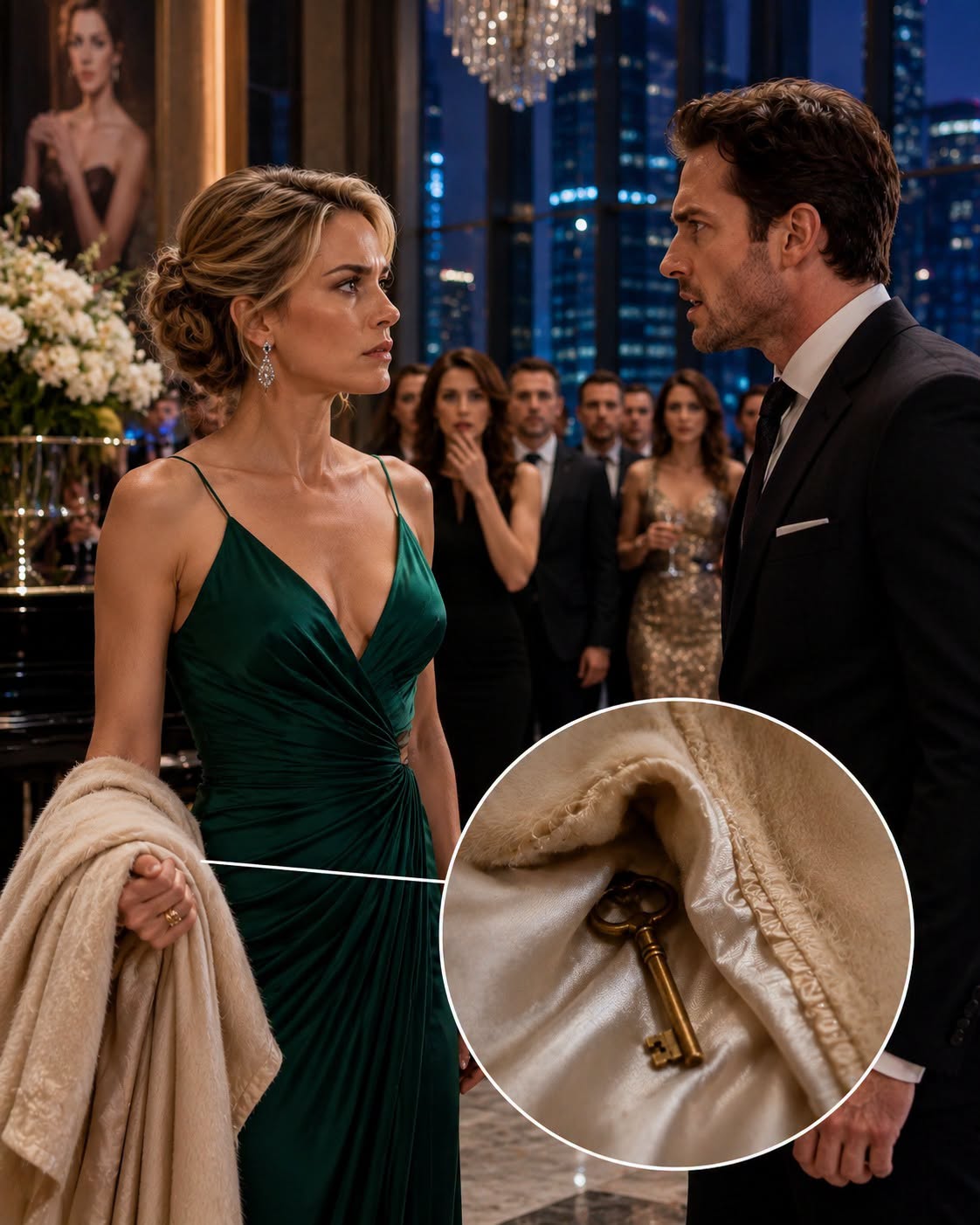
He Called It Fabric. The Hospital Called It Evidence
Preview
He let his mistress wear my mother’s fur stole at the winter hospital ball.
She stood beneath twenty thousand dollars’ worth of crystal chandeliers, smiling like she had been born under them, the ivory fur wrapped around her bare shoulders as if history were just another accessory. She touched the pearl clasp at her throat and told the chief of surgery’s wife it was “vintage glamour,” the kind of thing women in old money families forgot they owned.
My husband, Dr. Everett Harlow, leaned close enough for the photographers to catch the intimacy and whispered to me, “Don’t make a scene over fabric.”
Fabric.
He said it with that calm, expensive cruelty men use when they believe the room belongs to them.
So I did not scream. I did not cry. I did not rip the stole from Celeste Monroe’s shoulders, though every woman in that ballroom would have understood if I had. I simply smiled into my champagne and waited until the donor chair looked up from his table, stared at Celeste, then turned slowly toward my mother’s portrait in the east wing.
That was when he recognized it.
Not as glamour.
Not as fabric.
As evidence.
CHAPTER 1: THE WOMAN UNDER THE CHANDELIERS
In Boston, winter has a way of making wealth look holy.
Snow softens the edges of brownstone mansions. Ice turns bare branches into glass. Black cars slide up to hotel awnings like hearses polished for kings. And inside the Fairmont Copley Plaza, under chandeliers heavy as frozen rain, the donors of Whitcomb Memorial Hospital gathered to congratulate themselves for saving lives with money they would never miss.
Women moved through the ballroom in velvet and diamonds. Men wore tuxedos and the relaxed expressions of people who had never been told no by anyone whose name mattered. Waiters drifted between them with silver trays of champagne, smoked salmon, caviar on toast points, and tiny pastries shaped like snowflakes.
I arrived alone.
That was the first thing people noticed.
Not the black satin gown. Not the emerald earrings my mother had left me. Not the fact that I had spent two hours in a mirror training my face into something smooth enough to survive the evening.
They noticed that I, Madeleine Vale Harlow, wife of the youngest cardiac surgeon ever appointed to Whitcomb’s executive board, had walked into the hospital’s annual Winter Ball without my husband’s hand on my back.
There is a particular kind of pity rich women reserve for wives on the brink of public embarrassment. It does not look like pity. It looks like a smile held one second too long.
“Madeleine,” said Patricia Ames, wife of a pharmaceutical heir and chair of the silent auction committee. “You look stunning. Is Everett already here?”
“He is,” I said.
That was all.
I did not say that Everett had left our Beacon Hill townhouse two hours before me after receiving a text that made him smile in a way he had not smiled at me in eight months. I did not say that he had stopped wearing his wedding ring during surgery, then during conferences, then during dinners, until finally the pale band on his finger faded and I understood the marriage had gone first where the ring followed later.
I did not say that three days earlier, I had opened the cedar closet in my mother’s old house in Lenox and found the empty box.
White tissue paper. A loosened ribbon. The faint scent of lavender and old cedar.
The fur stole had been gone.
My mother’s stole.
The one she wore in the portrait that hung in Whitcomb Memorial’s east wing, just outside the pediatric cardiac unit she had funded after my younger brother died there at age seven. In the portrait, Eleanor Vale stood in a cream silk gown with the ivory mink around her shoulders, her face turned slightly toward the light, one hand resting over the pearl clasp at her throat. She looked like grace after grief. Like a woman who had lost a child and decided to build a wing so other mothers might not lose theirs.
When she died, the stole came to me with three things: her emerald earrings, her handwritten recipe for lemon cake, and a note folded into a tiny square.
A woman may forgive many things, Maddie. But she must never let a thief decide the value of what was stolen.
At the time, I thought she meant jewelry.
I was wrong.
I had spent three days wondering where the stole had gone. I had asked Everett once, gently, because I was still performing the role of a woman who believed her husband might choose decency if handed the opportunity.
He had barely looked up from his phone.
“Probably misplaced during the move from Lenox. You know those old houses. Things disappear.”
But nothing disappeared from my mother’s house.
Every object had a place, a story, a witness.
And tonight, as I stepped deeper into the ballroom and saw Celeste Monroe at the far end of the room, laughing with my husband’s hand at the small of her back, I knew exactly where the stole had gone.
It was draped over her shoulders.
For one suspended second, the ballroom seemed to tilt.
Celeste was thirty-one, eleven years younger than Everett, with golden hair cut into expensive waves and a face made for social media close-ups. She had joined Whitcomb Memorial’s development office eighteen months earlier as a donor-relations consultant and, within six months, had become the kind of woman everyone described as “magnetic” when they meant dangerous.
She knew how to touch a man’s arm as if sharing a secret. She knew how to laugh with her throat exposed. She knew how to dress like innocence and move like appetite.
Tonight she wore silver.
A liquid column of silk that left her shoulders bare, her collarbones glowing, her smile sharpened by diamonds I knew Everett had bought because the charge had appeared on a credit card statement he forgot I could still access.
But it was the stole that made her luminous.
My mother’s ivory mink wrapped around her like an inheritance.
Celeste looked directly at me across the ballroom.
Then she lifted one hand and touched the pearl clasp.
A small gesture.
Almost delicate.
A knife wrapped in a manicure.
Everett saw me then. For half a second, something like annoyance crossed his face. Not guilt. Not regret. Annoyance, as though I had walked into a room where he had carefully arranged my humiliation and ruined his pleasure by noticing it too clearly.
He crossed toward me with Celeste beside him.
“Madeleine,” he said.
Not darling. Not my love. Not even Maddie, which he had called me when we were young and hungry and living in a one-bedroom apartment near Mass General, before his name meant anything.
Just Madeleine.
“Everett.”
Celeste smiled. “Your gown is beautiful. Very classic.”
Classic, when spoken by a mistress wearing your dead mother’s stole, means expired.
“Thank you,” I said. “So is your fur.”
Her smile brightened. “Isn’t it divine? Everett found it. He said it had been sitting in storage forever. I told him it deserved to be seen.”
Something cold and clean moved through me.
Everett’s jaw tightened.
“Celeste,” he said softly.
But Celeste was enjoying herself too much. Women like her do not merely want the man. They want the wife to watch the transfer of power.
“She called it vintage glamour,” Patricia Ames whispered later to someone behind me.
I heard it.
Everyone heard everything in rooms like that.
Everett took my elbow and guided me three steps away, still smiling for the crowd.
“Do not do this tonight,” he said under his breath.
“Do what?”
“Make a scene.”
I looked at his hand on my arm. Long fingers. Surgeon’s hands. Hands that had touched my face the night my mother died and promised he would protect what was left of me.
“That belongs to my mother,” I said.
He sighed, not like a husband confronted with theft, but like a man delayed by traffic.
“It’s a fur stole, Madeleine.”
“It is my mother’s fur stole.”
“Your mother is dead.”
The sentence landed so quietly no one else could hear it.
That was Everett’s gift. He could carve you open without raising his voice.
I looked at him then, truly looked at him, and saw what grief and marriage and loyalty had hidden from me for years.
My husband was not a man who had made one mistake.
He was a man who had been waiting for me to become too tired to defend myself.
“Don’t make a scene over fabric,” he said.
Fabric.
The word settled between us, ugly and cheap.
Then a voice behind me said, “Dr. Harlow, I would choose your next sentence with great care.”
Arthur Channing stood a few feet away, leaning on his silver-tipped cane, his expression carved from old granite.
Arthur was eighty-two, a former federal judge, a widower, and the chair of Whitcomb Memorial’s donor council. My mother had trusted exactly three men in her life: my father, who died too soon; Arthur Channing, who never broke a promise; and, tragically, Everett Harlow, who broke every promise quietly.
Everett turned, irritation flickering across his face before he recognized the danger.
“Judge Channing,” he said. “Good evening.”
Arthur did not answer him. His eyes were on Celeste.
No.
On the stole.
He looked at the ivory fur, the pearl clasp, the faint silver embroidery near the inner edge. Then his gaze shifted toward the ballroom doors, beyond them toward the hospital across the square, toward the east wing where my mother’s portrait hung beneath museum glass.
“Mrs. Harlow,” Arthur said to me, and his voice softened. “Is that Eleanor’s?”
I heard the entire ballroom quiet inside my bones.
Everett’s face changed.
Celeste’s smile collapsed by one careful inch.
“Yes,” I said. “It is.”
Arthur looked at Celeste. “Take it off.”
Celeste laughed once, the sound brittle. “I’m sorry?”
“Take off Eleanor Vale’s stole.”
Everett stepped forward. “Judge, this is a misunderstanding.”
Arthur turned his head slowly. “I presided over racketeering trials for twenty-two years, Dr. Harlow. I know the fragrance of a misunderstanding. This is not it.”
No one moved.
Even the quartet near the stage seemed to falter, the violinist holding a note too long.
Celeste looked at Everett, waiting for him to save her.
He did not.
Cowardice is the final outfit betrayal wears.
With stiff fingers, Celeste unclasped the pearls and removed the stole. For a moment she held it like something contaminated. Then Arthur extended his cane, hooked the edge, and lifted it from her grasp without touching her skin.
He turned to me.
“Madeleine.”
I stepped forward.
The fur was warm from Celeste’s body when Arthur placed it over my arm.
I thought I might break then. Not because of the affair. Not because of the theft. But because the stole still smelled faintly of my mother’s cedar closet beneath Celeste’s perfume, and grief is cruelest when it reminds you that the dead cannot defend their own dignity.
Arthur leaned close.
“Say nothing tonight,” he murmured. “Let them think this is over.”
I met his eyes.
And there, behind the age and polish and public manners, I saw anger.
Not loud anger.
The old kind.
The kind that keeps receipts.
“The orchestra begins in six minutes,” he said. “Let them dance.”
So I stood beneath the chandeliers while Celeste fled to the powder room, while Everett smiled with the panic of a man recalculating risk, while the donors pretended not to have witnessed a public stripping.
The stole was returned to me before the orchestra began.
But the war began after the first waltz.
CHAPTER 2: THE QUIET WIFE WITH THE LOCKED DRAWER
Everett had always underestimated quiet.
He mistook it for softness, for weakness, for permission.
In our marriage, my quiet had been useful to him. It made him look dignified at dinners, stable in interviews, trustworthy in donor meetings. It allowed him to become the handsome surgeon with the elegant wife and the tragic family connection to the hospital. I was the daughter of Eleanor Vale, the woman whose money built Whitcomb’s east wing, and Everett wore my last name like a hidden cufflink.
He never understood that my mother had raised me in rooms where quiet women decided the fate of loud men.
The morning after the Winter Ball, Boston woke beneath six inches of snow and a sky the color of pewter. Everett came home at 7:12 a.m., still in his tuxedo shirt, bow tie hanging loose around his neck.
I was in the breakfast room, drinking black coffee beside the window.
The stole lay across the chair opposite me.
Not hidden.
Not folded.
Displayed.
Everett paused when he saw it.
For a moment, he looked almost young, the way he had when we met at a Harvard Medical School reception twelve years earlier. Back then he had been all sharp ambition and borrowed suits, a scholarship boy from Ohio with blue eyes and a hunger he disguised as discipline. I had admired that hunger. I had thought ambition meant he understood survival.
I had not yet learned that some people do not climb because they love the view.
They climb because they want someone beneath them.
“We need to talk,” he said.
I turned a page of the Boston Globe.
“Do we?”
He removed his cufflinks with surgical precision. “Last night was embarrassing.”
“Yes.”
“Celeste should not have worn it.”
“No.”
“But Arthur had no right to humiliate her like that.”
I looked up.
There it was.
Not remorse that he had stolen from my mother’s estate. Not concern that he had humiliated me in front of three hundred donors. Not fear that he had crossed a line any decent man would have recognized in the dark.
Concern for Celeste.
I set down my coffee.
“Did you give it to her?”
He exhaled through his nose. “Madeleine.”
“Did you open my mother’s cedar closet, remove the stole from its preservation box, and give it to your mistress?”
His face hardened. “Don’t use that word.”
“Cedar?”
“You know what word.”
“Mistress is an old-fashioned term,” I said. “But then again, so is adultery.”
He came closer to the table. “I am not doing this with you.”
“No. You are not.”
Something in my tone stopped him.
I had not raised my voice. I had not cried. Perhaps that frightened him more than any scene could have.
“What does that mean?” he asked.
“It means you should shower. You have surgery at ten.”
He stared at me. “That’s it?”
I smiled.
Not kindly.
“For now.”
Men like Everett think the explosion is the danger. They do not fear the woman who goes still. They should.
After he went upstairs, I carried the stole to my study and locked the door.
My study was the only room in the townhouse Everett never entered. Not because I forbade it. Because he found it boring. It contained no mirrors, no liquor, no framed awards with his name on them. Just shelves of estate files, trust documents, letters, photographs, and the old mahogany desk my mother had used to manage her charitable foundation.
In the bottom right drawer was a brass key.
Behind the second row of books was a narrow safe.
Inside the safe were three things Everett did not know existed.
The first was my mother’s original trust binder, not the sanitized copy Everett had seen during our marriage.
The second was a folder labeled Harlow—Contingency.
The third was a black phone I had purchased in cash four months earlier after seeing Celeste’s name appear on Everett’s encrypted messaging app.
I was not a detective.
I was not a lawyer.
But I was Eleanor Vale’s daughter, and Eleanor believed love should make a woman generous, not stupid.
I unlocked the binder first.
The Vale Charitable Trust was not just a philanthropic vehicle. It was a machine, built by my mother after my brother’s death with grief, money, and a mind sharper than any man in Boston had been willing to admit. The trust funded three hospital wings, two research chairs, an annual surgical fellowship, and the pediatric cardiac unit that had turned Whitcomb Memorial from a respected regional hospital into a national name.
Everett believed the trust was sentimental.
It was not.
It was conditional.
Every major gift came with clauses. Ethics clauses. Governance clauses. Asset-protection clauses. Image-use clauses. Morality provisions so elegantly written that even the hospital’s most expensive counsel had once called them “Eleanor’s little velvet traps.”
My favorite clause concerned the east wing.
If Whitcomb Memorial or any of its executive officers used the Vale name, likeness, restricted funds, or donated property to solicit funds while engaging in fraud, concealment, misappropriation, or reputational exploitation, the trust could suspend future disbursements, demand an independent audit, reclaim certain artifacts, and redirect up to eighty-two million dollars in future pledges.
Eighty-two million.
Everett knew about the number.
He did not know about the trigger.
That had been my mother’s genius. She understood men behaved differently when they believed a woman’s money had no teeth.
I opened the Harlow folder next.
It was thick.
Too thick.
Inside were copies of credit card statements, wire confirmations, event budgets, property records, screenshots, and photographs. Some I had collected. Some had been mailed anonymously to my office in cream envelopes with no return address. The first had arrived five months earlier, two weeks after I found lipstick on Everett’s shirt collar and told myself, like a fool, that lipstick could happen anywhere.
The envelope contained a receipt from Lemaire Jewelers.
One diamond tennis bracelet.
Forty-eight thousand dollars.
Charged to a hospital development account.
Approved by Dr. Everett Harlow.
Recipient: C. Monroe.
I had sat at my desk for a long time after reading that receipt, waiting for heartbreak to announce itself dramatically. It did not. It simply took off its shoes and moved into my chest.
After that, I began gathering.
A hotel suite at The Mark in New York during a cardiology conference Everett claimed had no overnight events.
A five-night stay in Aspen billed as donor cultivation.
A Cartier watch purchased through a “research advancement hospitality” line item.
A wire transfer to a Delaware LLC called Silver Orchard, which owned a Back Bay condominium I had never visited but whose lobby Everett had been photographed entering with Celeste at 11:43 p.m. on a Thursday.
The files were bad.
But not yet fatal.
Affairs destroy marriages. Misuse of charitable funds destroys careers. Misuse tied to a restricted donor trust destroys institutions.
What I needed was chain of custody.
Proof that the theft of my mother’s stole was not a private marital cruelty, but part of a larger pattern: using Vale property, Vale history, and Vale-restricted funds to elevate Celeste, erase me, and secure donor influence before Everett filed for divorce.
At 9:04 a.m., my black phone buzzed.
One message.
From Arthur Channing.
My office. Noon. Use the side entrance.
I stared at the words and felt, for the first time in months, the strange comfort of not being alone.
Arthur’s office occupied the top floor of a narrow brick building overlooking the Public Garden. It smelled of old paper, leather, and the faint medicinal peppermint he carried in his coat pockets.
When I arrived, he was standing by the window, cane in hand, watching children drag sleds through the snow.
“You look like your mother today,” he said.
I removed my gloves. “That sounds like a warning.”
“It is usually meant as one.”
He gestured to the chair across from his desk. A second man stood beside the bookshelves.
Tall. Dark suit. No wedding ring. The kind of stillness that made a room arrange itself around him.
“Madeleine, this is Julian West,” Arthur said. “He handles complex fiduciary litigation. Quietly.”
Julian inclined his head. “Mrs. Harlow.”
His voice was low and composed, with the kind of restraint that made every word feel selected, not spent.
“I did not ask for an attorney,” I said.
“No,” Arthur replied. “You asked for nothing. That has been your problem.”
I should have been offended.
Instead, I laughed once.
Arthur’s eyes softened. “Your mother made me promise something before she died.”
Preview
“My mother made everyone promise something.”
“This one concerned you.”
Julian placed a sealed envelope on the desk. Cream paper. My name written across the front in my mother’s slanted hand.
My throat closed.
“I was instructed to give you this,” Arthur said, “if Everett Harlow ever used the Vale name against you.”
I did not touch it at first.
Some letters are not paper. They are doors.
Finally, I opened it.
My mother’s handwriting rose from the page like a ghost with perfect posture.
My darling Maddie,
If Arthur is giving you this, then the man you love has mistaken access for ownership.
I am sorry.
I know you. You will want to be fair. You will search for the wounded boy inside the cruel man and call it compassion. But listen to me now: compassion without boundaries is how women become museums for other people’s damage.
You are not a museum.
The Vale assets were never transferred to your marriage. Everett has no claim. Not to the trust. Not to the Lenox house. Not to the east wing pledge. Not to the Cedar Archive. Not to the things I left in your locked drawer.
There is one more matter.
The stole is not valuable because it is mink.
It is valuable because of what is sewn beneath the left lining.
If it has surfaced in the wrong hands, assume the wrong hands are searching for what they believe is inside.
Do not confront.
Document.
Let them smile.
Then take back the room.
All my love,
Mother
I read the line twice.
What is sewn beneath the left lining.
My fingers went cold.
Arthur watched me with the patience of a judge waiting for a verdict.
“Did you know?” I asked.
“No. Only that the stole mattered.”
Julian spoke for the first time. “Where is it now?”
“In my study.”
“Has anyone else handled it since last night?”
“Arthur. Celeste. Everett, presumably.”
“Then we treat it as evidence,” he said.
The word moved through the room like a match struck in the dark.
Evidence.
Not fabric.
Evidence.
I looked down at my mother’s letter.
For the first time since the Winter Ball, I felt something besides humiliation.
I felt the old machinery of my blood begin to turn.
CHAPTER 3: THE PEARL CLASP DOES NOT LIE
By Monday morning, Everett had decided the situation was manageable.
That was another thing about men like him. They do not believe consequences exist until consequences enter wearing a suit.
He sent roses.
Two dozen white roses to the townhouse with a note that read:
Let’s not let one emotional night define us.
No apology. No admission. No mention of the stole.
I left the roses in the foyer until the petals began to brown, then asked Mrs. Alvarez, our housekeeper, to send them to compost.
At noon, Everett texted:
Dinner tonight. We need to discuss how to move forward with dignity.
Dignity, from the man who had dressed his mistress in my dead mother’s fur.
I typed one word.
No.
Then I called a textile conservator.
Her name was Dr. Miriam Cole, and she arrived at my townhouse with white gloves, a portable magnifier, and the brisk calm of a woman who trusted old fabric more than living people. Julian came with her. He did not sit. He stood near the study door, silent and watchful, while Miriam examined the stole on a linen-covered table.
“She’s been well preserved,” Miriam said.
I realized she meant the stole.
Then again, perhaps she meant my mother.
Miriam lifted the left lining delicately. The silk was ivory, hand-stitched, faintly discolored with age. Near the inside seam, beneath a fold so subtle I had never noticed it, was a line of stitching in thread nearly identical to the lining.
“Someone opened this recently,” Miriam said.
My heart kicked.
“How recently?”
She adjusted her magnifier. “Within weeks, perhaps. The thread tension is different here. And here.”
Julian’s expression did not change, but his eyes sharpened.
Miriam used a tiny seam blade to release four stitches. From beneath the lining, she withdrew a narrow strip of oilskin, folded three times and flattened by years of pressure.
Inside was not a jewel.
Not a letter.
A key.
Small. Brass. Numbered.
And a slip of paper with my mother’s handwriting.
Box 417. Boston Private Trust. Ask for Helen if she is still there. If not, ask who replaced honesty.
Despite everything, I smiled.
“That sounds like her,” Arthur said when I showed him later.
Julian did not smile, but something changed around his mouth, a softening so brief I would have missed it if I had not already begun to notice him.
Boston Private Trust occupied a limestone building on Federal Street, the kind of place with no advertisements and security guards who looked like retired Secret Service. Helen, as it turned out, was still there. She was ninety, bird-boned, and wore pearls at two in the afternoon.
When I handed her the key, she looked at me over half-moon glasses.
“Eleanor Vale’s daughter,” she said. “Took you long enough.”
“I didn’t know there was a box.”
“No. She said you wouldn’t until you needed it.”
Helen led us to a private room paneled in walnut. Julian remained by the door while I opened Box 417.
Inside were three sealed folders, a flash drive, and a velvet pouch.
The first folder contained property documents.
The second contained copies of restricted gift agreements between the Vale Trust and Whitcomb Memorial.
The third was labeled:
HARLOW RISK—TO BE OPENED ONLY UPON PATTERN CONFIRMATION.
My mother had prepared a file on my husband before he ever became my husband.
I sat down slowly.
Julian took one step forward, then stopped, as if giving me room to decide whether I wanted comfort or distance.
I opened the file.
There were background reports on Everett’s debts from medical school, his father’s bankruptcy in Ohio, a sealed disciplinary complaint from his residency involving unauthorized access to patient donor records, and a confidential memo from Whitcomb’s ethics office dated nine years before.
Subject: Dr. Everett Harlow—Boundary Concerns with Donor Families.
My stomach turned.
Everett had not found me by accident at that Harvard reception.
He had known who I was.
He had known what my family controlled.
The flash drive contained recordings.
Not hidden camera scandal. Not tabloid filth.
Meetings.
Audio files from my mother’s final year, when she was already sick but still chairing trust strategy sessions from her bedroom in Lenox. In one recording, her voice was weaker than I remembered, but her mind was all blade.
“If Dr. Harlow attaches himself to my daughter and later attempts to influence the trust, the protective clauses must activate automatically.”
Another voice, likely a trust attorney, asked, “Do you believe his intentions are financial?”
My mother’s pause was long.
“I believe ambition is not a sin,” she said. “But entitlement is.”
I covered my mouth.
Julian turned away slightly, granting me privacy without leaving.
The velvet pouch was last.
Inside was a signet ring I had never seen, gold and heavy, engraved with the Vale crest. Beneath it lay another note.
This belonged to your grandmother. Wear it when you need to remember that women in this family do not beg for seats at tables they paid for.
I laughed then. Not because it was funny, but because my mother had reached through death and placed a crown in my hand.
By the end of that week, Julian and I had built the first wall of the case.
Everett had used his position at Whitcomb to approve expenses tied to Celeste Monroe under donor cultivation budgets. Celeste had received jewelry, travel, clothing, and private lodging through accounts connected to hospital fundraising. Silver Orchard LLC, the company that owned the Back Bay condo, had been funded partly by a consulting stream from a nonprofit vendor with hospital ties.
The stolen stole was the emotional match.
The financial documents were the gasoline.
But the real fire came from Celeste herself.
She posted a photograph.
Of course she did.
Women like Celeste do not believe a thing has happened until strangers have admired it.
The photo appeared on Instagram three days after the ball, though she had wisely removed the stole from her shoulders before posting. Still, there it was in the carousel’s second image, visible on a chair behind her, ivory fur, pearl clasp, unmistakable.
Caption:
Some nights you don’t just attend history. You become part of it.
By then I understood enough to know she had not merely borrowed the stole.
She had been trying to become the new face of the Vale story.
Everett’s plan revealed itself through small, ugly pieces.
First, Whitcomb’s communications office sent me a draft invitation for the spring donor campaign. My mother’s portrait was on the cover, but my name had been removed from the honorary host list. In my place, Celeste Monroe appeared as “Legacy Ambassador.”
Legacy.
Ambassador.
I stared at the PDF until the words blurred.
Then came the revised seating plan for the hospital’s May board dinner. I was no longer at the head table. Celeste was.
Then Patricia Ames called with the false brightness of a woman delivering poison wrapped in tissue.
“Madeleine, darling, I just wanted to check on you. There are rumors, and of course I don’t believe rumors, but people are saying Everett may be making some changes. Personally and professionally. I thought you should hear it from a friend.”
A friend, in Boston, is often someone who wants to be first to see your face when the knife goes in.
“What kind of changes?” I asked.
“Oh, I’m sure it’s nothing.”
“Then say it.”
A pause.
“He may be petitioning the board to transfer Vale donor relations to his office directly. To streamline things. Celeste would be overseeing the campaign.”
I thanked her.
Then I hung up and called Julian.
He answered on the second ring.
“They’re moving,” I said.
“Yes,” he replied. “So are we.”
There is a rhythm to legal revenge that television gets wrong.
It is not dramatic at first. It is not a woman storming into a room with one perfect speech while violins swell. It is paper. It is dates. It is signatures. It is the slow, merciless assembly of facts until denial has nowhere elegant left to stand.
Julian taught me that.
He was not warm in the usual way. He did not flatter or soothe. He simply appeared wherever the next hard thing waited and made it less lonely.
When I had to review photos of Everett and Celeste entering hotels, Julian placed the file in front of me and said, “You can stop at any time.”
When I kept reading, he said nothing.
When I saw a receipt for a diamond bracelet charged to a pediatric fundraising account and my hands began to shake, he reached across the table and turned the page face down.
“Breathe first,” he said.
“I am breathing.”
“No,” he said quietly. “You are surviving. They are not the same.”
That was the first time I cried in front of him.
Not much.
Only enough to hate myself.
He handed me a linen handkerchief. Because of course he carried one. Men like Julian did not use tissues. They used objects that suggested their grandfathers had known how to apologize.
“I’m sorry,” I said.
“For what?”
“For being weak.”
His eyes lifted to mine.
“Mrs. Harlow, weak people do not document betrayal for five months before striking.”
I almost smiled.
“Madeleine,” I said.
He looked at me for a long second.
“Madeleine.”
There are moments when romance does not arrive like thunder. Sometimes it arrives as witness.
Someone sees you not as ruined, not as abandoned, not as foolish, but as a woman standing in the ashes with a match still in her hand.
I was not ready to love Julian West.
But I was ready to stop loving Everett Harlow.
That mattered more.
The decisive proof came from a woman named Tessa Grant, Celeste’s former assistant.
She contacted me through an encrypted email address Julian had set up after a hospital employee quietly told Arthur, “There are people who want to talk, but no one wants to be first.”
Tessa was twenty-six, exhausted, and angry in the way honest young women become angry when they discover prestige is often just theft in a tuxedo.
We met at a coffee shop in Cambridge where no one from Whitcomb would recognize me.
Tessa wore a puffer coat and no makeup. Her hands trembled around her paper cup.
“I can’t lose my job,” she said.
“You don’t have to tell me anything,” I replied.
She looked at me like she had expected a threat and did not know what to do with kindness.
“Celeste said you were unstable.”
I laughed softly. “Convenient.”
“She said if you came asking questions, we should document it and send everything to Dr. Harlow.”
“Did you?”
“No.”
“Why?”
Tessa swallowed.
“Because my little brother was treated in the east wing. Mrs. Vale came by his room once with stuffed bears. I was eight. I remember her coat.”
Her eyes dropped to her cup.
“I saw the stole at the ball. On Celeste. I knew what it was.”
That was the thing Everett forgot.
Hospitals remember.
Not the institution. Institutions can be bought, threatened, rebranded, seduced.
But nurses remember. Assistants remember. Mothers in waiting rooms remember. Children who survived remember the woman who built the place where they were saved.
Tessa opened her bag and removed a folder.
“I printed what I could before they locked me out of the donor system.”
Inside were emails.
Everett to Celeste:
Once the Vale campaign is under us, M won’t have leverage.
Celeste to Everett:
She still acts like the hospital belongs to her dead mother.
Everett:
Let her. By June, the board will see you as the future.
Celeste:
And the wife?
Everett:
Handled.
I stared at the word until it stopped looking like language.
Handled.
Not loved.
Not respected.
Handled.
Tessa turned another page.
“There’s more.”
A purchase order for archival wardrobe preservation, billed to the hospital, supposedly for “Legacy Campaign Visual Assets.”
Delivery address: Silver Orchard LLC.
Date: Three weeks before the Winter Ball.
Item description: Vale fur stole, ivory mink, pearl clasp, collected from Lenox estate by E. Harlow.
Not misplaced.
Not borrowed.
Collected.
Documented.
Billed.
Julian, who had been silent beside me, finally spoke.
“Tessa, would you be willing to sign an affidavit?”
She looked terrified.
Then she looked at me.
“I’ll do it for Mrs. Vale.”
My mother had been dead for four years.
Still, she was opening doors.
That evening, Everett came home earlier than usual.
I was in the dining room reviewing the final donor list for the spring campaign. The stole, now sealed in an archival evidence box, had been moved to a secure facility. Everett did not know that. He believed it was still somewhere in the house.
He poured himself a Scotch.
“We should discuss separation,” he said.
I looked up. “Should we?”
He leaned against the sideboard. He had dressed for dominance: navy suit, no tie, white shirt open at the throat, hair still damp from a shower taken elsewhere.
“I don’t want this to become ugly.”
I closed the folder.
“Then why did you make it ugly?”
His mouth tightened. “Our marriage has been over for a long time.”
“That is not an answer.”
“It’s the truth.”
“No. It’s a sentence men use when they want the moral convenience of inevitability.”
He stared at me.
The old Madeleine would have softened. The old Madeleine would have thought: He looks tired. This is hard for him too. Be reasonable. Be graceful. Be loved by being easy to leave.
That woman was gone.
Everett set down his glass.
“Celeste makes sense for my life now.”
There it was.
Not love. Sense.
A merger dressed as passion.
“She understands the demands of my work,” he continued. “She understands public life. She’s good with donors.”
“She’s good with your donor account.”
His eyes sharpened.
I watched the sentence enter him like a needle.
“What does that mean?” he asked.
“It means you should hire a personal attorney.”
For the first time, he looked genuinely afraid.
Only for a second.
Then arrogance returned, as loyal to him as a dog.
“You have no idea what you’re implying.”
“I know exactly what I’m implying.”
He stepped closer. “Be careful, Madeleine. You have lived a very protected life.”
I stood.
“Yes,” I said. “That was your first mistake.”
He blinked.
“You thought protection meant ignorance.”
I left him standing there, Scotch untouched, and walked upstairs to the bedroom we had not shared in months.
Behind me, my phone buzzed.
A message from Julian.
Board notified. Independent audit demand filed. Temporary injunction drafted. We move Friday.
Friday was the spring donor preview.
The first public event of the Legacy Campaign.
Celeste’s debut.
Everett’s power grab.
My mother’s portrait on every screen.
And my last night as the wife he thought he could handle.
CHAPTER 4: WHEN THE AUDIT WORE BLACK SATIN
On Friday night, I wore black.
Not widow black.
Not mourning black.
Execution black.
The gown was silk crepe, high at the neck, bare across the back, tailored so precisely it felt less like clothing than armor. My hair was swept into a low knot. On my right hand, I wore my grandmother’s gold signet ring. At my ears, my mother’s emeralds burned like green fire.
I looked in the mirror and saw three women.
My grandmother, who had survived a husband who gambled away nearly everything but the house.
My mother, who had turned grief into a hospital wing.
And myself, who had mistaken endurance for love until humiliation taught me the difference.
The Whitcomb Legacy Campaign preview was held inside the hospital’s east atrium, a soaring glass space connecting the old surgical building to my mother’s wing. At night, with the city lights beyond the windows and white orchids arranged along the marble stairs, it looked almost celestial.
Almost.
Preview
My mother’s portrait had been temporarily moved from the east corridor to the atrium entrance for the event. It stood under a spotlight, Eleanor Vale in cream silk and ivory mink, the pearl clasp at her throat shining softly.
For one second, I could not breathe.
Then Arthur appeared beside me.
“She would approve of the dress,” he said.
“She would say the neckline is severe.”
“She would approve of that too.”
I smiled.
Across the atrium, Everett saw me.
So did Celeste.
They stood together near the donor wall, surrounded by board members and photographers. Celeste wore pale gold tonight, her hair pinned with diamond clips, her expression carefully radiant. Without the stole, she looked less like old money and more like a woman auditioning for it.
Everett crossed the room quickly.
“You came,” he said.
“It is my mother’s campaign.”
His voice lowered. “This is not the place.”
I looked around at the marble, the orchids, the portrait, the donors sipping champagne beneath my family’s name.
“It is exactly the place.”
His eyes moved to Arthur, then to Julian, who stood near the entrance speaking with two men in dark suits.
“Who are they?” Everett asked.
“Consequences.”
He laughed once, but there was no humor in it. “You think you can intimidate me with some lawyer?”
“No,” I said. “I think the documents will do that.”
Celeste approached before Everett could answer.
“Madeleine,” she said, sweet as arsenic. “You look dramatic.”
“And you look funded.”
Her smile flickered.
Everett’s hand closed around her wrist. A warning. Not to protect me. To control her.
The program began at seven.
First came the hospital president, Dr. Leonard Voss, a man with silver hair and the moral flexibility of a curtain. He welcomed everyone to “a new chapter in the Vale legacy,” thanked the donors, praised Everett’s “visionary leadership,” and introduced Celeste as the new Legacy Ambassador.
Applause rose politely.
Celeste stepped onto the small stage.
She was good. I will give her that.
She spoke about history, healing, and “honoring the women who came before us.” She placed one hand over her heart when she mentioned my mother. She even looked toward the portrait with a practiced softness that made something ancient and violent stir behind my ribs.
Then she said, “Eleanor Vale understood that legacy is not something we inherit. It is something we choose to embody.”
Arthur muttered, “Good God.”
Julian, beside him, said, “Five more minutes.”
Everett took the stage after Celeste. Handsome, polished, beloved by people who confused confidence with character.
He spoke of innovation. Expansion. The future.
Then he said, “Tonight, we are proud to announce a restructuring of the Vale Legacy Campaign, bringing donor relations directly under clinical leadership to ensure alignment between philanthropy and patient outcomes.”
There it was.
The theft in a tuxedo.
He continued, “This transition will allow us to honor Eleanor Vale’s memory in a fresh and forward-looking way.”
Fresh.
Forward-looking.
Erase the daughter. Keep the dead mother. Spend the money.
He turned toward me with a smile that did not reach his eyes.
“And I know Madeleine shares our commitment to putting the hospital above personal concerns.”
Personal concerns.
My marriage.
My mother.
My stolen inheritance.
My public humiliation.
All of it reduced to personal concerns.
The room turned toward me.
Three hundred faces. Donors. Surgeons. Board members. Nurses. Reporters. People who had whispered about me for months. People who had pitied me. People who had watched Celeste wear my mother’s stole and wondered if I was too weak to take it back.
I stood.
Not quickly.
Not dramatically.
Just enough that the movement drew silence.
Everett froze.
Arthur lifted his cane and tapped it once against the marble floor.
The sound cracked through the atrium.
Julian stepped forward.
“Dr. Voss,” he said, his voice carrying cleanly without effort. “Before any restructuring is announced, you should be aware that the Vale Charitable Trust delivered formal notice this afternoon demanding an independent forensic audit of all funds, assets, likeness rights, archival materials, and campaign expenses connected to the Vale Legacy agreements.”
The room went utterly still.
Dr. Voss gripped the podium.
Everett’s face emptied.
Celeste looked at him, then at me.
Julian continued, “The trust has also filed for temporary injunctive relief preventing Whitcomb Memorial, its officers, employees, and agents from using Eleanor Vale’s image, donated property, or restricted funds in connection with tonight’s campaign materials.”
A board member near the front said, “What the hell is this?”
Arthur stepped beside Julian.
“This,” he said, “is what happens when a hospital forgets the difference between stewardship and appetite.”
Dr. Voss tried to recover. “Judge Channing, surely this can be handled privately.”
“It could have been,” Arthur replied. “Before Dr. Harlow’s mistress wore Eleanor Vale’s stolen fur stole at a donor event.”
The word mistress moved through the atrium like spilled ink.
Celeste went white.
Everett stepped down from the stage. “That is defamatory.”
Julian opened a black folder.
“No, Dr. Harlow. It is documented.”
A screen behind the stage, previously displaying my mother’s portrait, changed.
A scanned purchase order appeared.
Legacy Campaign Visual Assets.
Vale fur stole, ivory mink, pearl clasp.
Collected from Lenox estate by E. Harlow.
Delivery: Silver Orchard LLC.
A murmur rose.
Celeste took one step back.
Everett looked at the screen with the stunned rage of a man watching his own handwriting betray him.
“That was administrative,” he said.
I almost laughed.
Julian clicked to the next slide.
Expense approvals.
Lemaire Jewelers. Cartier. The Mark Hotel. Aspen lodging. Private car services. Wardrobe consulting. All billed through donor cultivation or campaign development accounts. All approved by Everett. Many connected to Celeste. Several tied to restricted pediatric funds.
Dr. Voss said, “Turn that off.”
No one moved.
Because the technician controlling the screen was not a hospital employee.
He worked for Arthur.
Julian clicked again.
Emails.
Once the Vale campaign is under us, M won’t have leverage.
Let her. By June, the board will see you as the future.
And the wife?
Handled.
I watched the word appear twenty feet tall against the glass atrium wall.
Handled.
There are humiliations that shrink you.
Then there are humiliations that return to their owner.
The room turned toward Everett.
For once, no one looked at me with pity.
Everett’s voice dropped to a dangerous calm. “Madeleine, stop this now.”
I stepped into the aisle.
“No.”
One word.
The most expensive word I had ever spoken.
He came toward me, forgetting the room, forgetting the cameras, forgetting that men who build reputations on control should never be seen losing it.
“You have no idea what you’re doing,” he said.
“I do.”
“You will damage the hospital.”
“No, Everett. You did.”
His face twisted. “After everything I gave you?”
That was when the last thread inside me snapped.
“What did you give me?” I asked softly.
He opened his mouth.
Nothing came.
Because men like Everett confuse taking up space in a woman’s life with giving her something.
I turned to the room.
“My mother built this wing after my brother died in a hospital bed thirty-seven feet from where we are standing. She did not build it so a surgeon could use her name to buy diamonds for his mistress. She did not donate restricted pediatric funds so two people could pretend theft was romance. And she did not leave her daughter a legacy so anyone in this room could decide it was more convenient without her.”
No one breathed.
I looked at Celeste.
“You wore glamour,” I said. “But the hospital remembered the donor.”
Celeste’s eyes filled with tears.
Maybe real.
Maybe not.
It no longer mattered.
Dr. Voss stepped away from the podium as two members of the hospital’s compliance committee entered with outside counsel. Behind them came a representative from the state attorney general’s charitable trust division.
Everett saw them and understood.
Not gossip.
Not scandal.
Law.
Arthur turned to the board members seated in the front row.
“Under the emergency provisions of the Vale agreements, I am calling for immediate suspension of Dr. Everett Harlow from all donor-facing and executive functions pending investigation.”
Dr. Voss began, “Arthur—”
“I am not finished.”
Arthur’s voice was old thunder.
“I am also resigning as donor chair effective after tonight, and nominating Madeleine Vale Harlow as interim chair of the Vale Donor Council.”
Gasps.
I turned to him.
This was not in the plan.
Arthur looked at me, and in his eyes I saw my mother again. Not gentle. Not sentimental. Certain.
He leaned closer.
“She paid for the table,” he murmured. “Sit down.”
The vote was not unanimous.
Power rarely dies without twitching.
But it passed.
Seven to three.
Everett stood motionless as his title was stripped in front of the same donors he had planned to use against me.
Celeste began crying in earnest when outside counsel asked her to surrender her hospital laptop and access badge.
Dr. Voss disappeared into a side corridor with two board members and the face of a man calculating whether loyalty or self-preservation would cost less.
And me?
I walked to my mother’s portrait.
The room parted.
I could feel Julian behind me, not touching me, not directing me, simply there.
I stood before Eleanor Vale in her cream silk gown and ivory stole.
For years, that portrait had hurt me. It reminded me of everything I had lost: my brother, my mother, the childhood before hospitals and grief and men who confused inheritance with weakness.
Tonight, for the first time, it looked less like a memorial.
More like a witness.
Everett approached me one last time.
His face was pale, his eyes bright with fury.
“You think this is winning?” he asked.
“No,” I said. “This is accounting.”
“You’ll regret this.”
I turned to him.
“I already regret you. Don’t flatter yourself by becoming a future tense.”
He flinched.
It was small.
It was enough.
Then Julian stepped between us.
“Dr. Harlow, my client has nothing further to say to you tonight.”
My client.
Not your wife.
Not your victim.
Not your handled problem.
My client.
Everett looked at him with hatred.
Julian did not blink.
That was when I knew something in my life had shifted permanently. Not because another man stood before me, but because I no longer needed one to stand between me and my fear.
Security escorted Everett from the atrium at 8:42 p.m.
Celeste followed twenty minutes later, wrapped in a borrowed coat that did not belong to anyone’s dead mother.
The donors remained.
Of course they did.
Scandal is terrible for institutions and excellent for champagne consumption.
But something strange happened after the first wave of whispers.
A nurse approached me.
Then another.
Then a woman whose daughter had survived surgery in the east wing. Then a man who told me my mother had paid for his son’s experimental procedure when insurance refused. Then Tessa, standing near the back, crying quietly when Arthur gave her a nod of approval that meant protection.
One by one, they did not ask about Everett.
They told me about Eleanor.
Your mother sat with us.
Your mother remembered my child’s name.
Your mother sent flowers every year.
Your mother never let donors forget the patients.
By the end of the night, my humiliation had become something Everett had not anticipated.
A resurrection.
CHAPTER 5: THE HOUSE ALWAYS WINS WHEN THE WOMAN OWNS IT
The investigation lasted eight months.
Eight months is a long time to be a headline.
Not national headline, not always. But Boston headline. Hospital headline. Society-page headline. The kind people pretended not to read and quoted with perfect accuracy at dinner.
SURGEON SUSPENDED IN WHITCOMB DONOR FUND PROBE.
VALE TRUST DEMANDS ACCOUNTING AFTER LEGACY CAMPAIGN SCANDAL.
MISTRESS OR MISMANAGEMENT? INSIDE THE CHARITY BALL THAT SHOOK BOSTON MEDICINE.
That last one was particularly vulgar. Patricia Ames sent it to three group chats and accidentally included me in one of them.
I replied with a heart emoji.
Then I muted her forever.
Everett hired an attorney known for defending men who wanted consequences translated into misunderstandings. His public statement expressed confidence, sadness, and a deep commitment to patient care. He described the affair as a “private marital matter” and the financial allegations as “administrative misclassifications made during a period of organizational transition.”
Julian read it aloud in his office and said, “That is six lies in one paragraph.”
“Only six?”
“I’m being charitable.”
By then I had filed for divorce.
Not separation.
Divorce.
Irreconcilable differences sounded too gentle, but the law prefers clean phrases. My private petition included dissipation of marital assets, reputational harm, theft of separate property, and a request that Everett be barred from claiming any interest in Vale-controlled entities.
He contested everything.
Then discovery began.
Discovery is where arrogance goes to drown.
Everett had assumed I knew nothing about money because I did not talk about it at dinner. He assumed I knew nothing about hospital governance because I did not interrupt him when he explained things incorrectly. He assumed I knew nothing about hidden assets because he did not know I had any.
The Vale fortune was not flashy.
We did not have yachts named after Greek goddesses or jets with initials on the tail. My mother believed visible money attracted visible parasites. The true assets sat quietly inside trusts, land agreements, minority stakes, medical patents, and a portfolio of healthcare real estate managed by Crownmere Capital.
Everett had heard of Crownmere.
Everyone in Boston medicine had.
He did not know I owned forty-six percent of it personally and controlled another twenty-two percent through my mother’s trust.
He learned during deposition.
Julian asked the question gently.
“Dr. Harlow, when you told my client she had lived a protected life, were you aware that she was the controlling beneficiary of the entity that owns the land beneath Whitcomb Memorial’s east wing?”
Everett’s attorney objected so loudly the court reporter stopped typing.
Everett stared at me across the conference table.
It was a beautiful moment.
Not because he realized I had money.
Because he realized I had known how not to mention it.
There is power in wealth.
There is greater power in being underestimated by a man who thinks wealth only counts when it announces itself.
Preview
The land lease beneath the east wing contained another Eleanor clause. If Whitcomb materially violated the restricted-use agreements or allowed donor funds connected to the Vale wing to be misappropriated, Crownmere could renegotiate lease terms, impose oversight, or, in the most extreme scenario, terminate expansion rights attached to the adjoining parcel.
The adjoining parcel was where Whitcomb planned its new $300 million cardiac innovation tower.
Everett’s dream.
His name was supposed to go on it.
Not anymore.
The board turned on him with the speed of people discovering morality after liability appears.
Dr. Voss resigned for “health reasons,” which in Boston often means a lawyer has advised you to develop symptoms.
Celeste was dismissed after the audit confirmed she had knowingly accepted improper benefits, falsified campaign expenses, and attempted to transfer archival materials into her personal possession. Her social media went dark for two weeks, then returned with a photo of a beach and a caption about choosing peace.
The internet did not choose peace.
Tessa Grant became a protected whistleblower and later accepted a position with the Vale Trust’s new patient equity initiative.
Arthur retired, officially.
Unofficially, he called me every Thursday at four and asked if I had fired anyone interesting.
Everett lost his board seat first.
Then his hospital privileges.
Then his fellowship appointment.
Then, after the attorney general’s office completed its review, he agreed to a settlement requiring repayment of misused funds, a charitable penalty, and permanent separation from all Whitcomb donor operations. The medical board issued sanctions. Not prison. People like Everett often avoid the endings ordinary people receive.
But he lost the thing he loved most.
Not me.
Not Celeste.
The room.
He lost the room where people applauded him.
The divorce finalized in early December, almost one year after the Winter Ball.
The hearing took forty-three minutes.
Everett wore charcoal gray and a face arranged into wounded dignity. Celeste was not there. She had left Boston for Palm Beach with a venture capitalist who sold wellness software to private hospitals. I heard this from Patricia Ames, who had created a new group chat without me and still somehow managed to inform me.
After the judge signed the decree, Everett approached me in the courthouse hallway.
Julian was speaking with opposing counsel a few feet away.
For the first time in months, Everett looked ordinary. Handsome still, but smaller. Stripped of title, institution, and borrowed legacy, he was just a man in an expensive coat who had confused access with ownership and could not understand why the door had locked behind him.
“Was any of it real?” he asked.
I could have pretended not to understand.
I did not.
“Yes,” I said.
He looked surprised.
Cruel men are always surprised to learn the women they hurt were sincere.
“I loved you,” I said. “That was real. Your failure to deserve it does not make me foolish for giving it.”
His eyes reddened, and for one dangerous second I saw the man I had married. Or maybe only the man I had invented because I needed somewhere to put my tenderness.
“I made mistakes,” he said.
“No, Everett. You made choices. Mistakes are what people call choices when they dislike the receipt.”
He looked down.
“I’m sorry.”
I waited to feel triumph.
It did not come.
Only a calm sadness.
Not for losing him.
For the woman I had been, the one who would have given anything to hear those words before they became useless.
“I hope one day you become the kind of man who knows what that sentence costs,” I said.
Then I walked away.
Outside, Boston was bright with new snow.
Julian stood near the courthouse steps, coat collar turned up against the wind.
“Congratulations,” he said.
“On being divorced?”
“On being free.”
I looked at him.
For months, something had lived between us unspoken. Not because we were noble, though I suppose we tried to be. Because I was still legally tied to a man who had used intimacy as strategy, and Julian was too careful with my dignity to turn rescue into romance.
But the divorce decree was folded in my handbag now.
My name was Madeleine Vale again.
No Harlow.
Not even hyphenated.
Snow caught in Julian’s dark hair. He looked serious, elegant, impossible to read.
“Do you always look like you’re about to cross-examine the weather?” I asked.
His mouth curved.
There it was. Rare. Devastating.
“Only when it’s withholding information.”
I laughed.
The sound startled me.
It had been a long time since joy arrived without asking permission.
Julian offered his arm.
Not possessively.
Not publicly.
Simply there.
I took it.
We walked two blocks through the snow without speaking. At the corner of Beacon and Charles, he stopped beside a black car but did not open the door.
“There is something I should say,” he said.
I looked at him. “That sounds ominous.”
“It is inconvenient.”
“Worse.”
“I am in love with you.”
The city seemed to quiet.
No orchestra. No chandeliers. No witnesses except snow, traffic, and a woman walking a golden retriever in a red sweater.
Julian continued, his voice steady, though his eyes gave him away.
“I have been for some time. I did not say it because you deserved a clean ending before anyone asked to become a beginning. I am saying it now because silence has been useful to too many men in your life, and I refuse to make you guess.”
My throat tightened.
A year earlier, I might have mistaken that speech for salvation.
Now I knew better.
No man saves a woman by loving her.
But a good man may stand beside her while she saves herself, and when the smoke clears, he may be brave enough not to pretend he did not see the fire.
“I am not simple anymore,” I said.
“I know.”
“I may never be easy.”
His eyes softened.
“Madeleine, I have never admired easy things.”
I looked away because the tears came quickly, and I was tired of crying in front of beautiful men.
But Julian was not Everett.
He did not reach for me as if emotion created entitlement.
He waited.
So I stepped forward on my own.
The kiss was gentle at first. Careful. A question asked against cold lips.
Then warmth.
Then certainty.
Not the violent certainty of possession.
The quiet certainty of arriving home to a house you rebuilt with your own hands.
When I pulled back, Julian rested his forehead against mine.
“I can wait,” he said.
“I know.”
“And?”
I smiled.
“And I am done waiting for my life to begin.”
That spring, Whitcomb Memorial unveiled the new Eleanor Vale Patient Justice Fund.
Not at a gala.
At the hospital.
In the east wing.
No champagne towers. No influencer photographers. No men using words like legacy while planning theft behind orchids. Just nurses, patients, families, doctors who still believed medicine was service, and a small group of donors who had survived the audit with their reputations intact.
The fund provided legal and financial advocacy for families denied critical care coverage. It paid for travel, second opinions, and emergency lodging. It created an independent ethics hotline run outside hospital leadership. Tessa helped design it. Arthur called it “your mother with better technology.”
My mother’s portrait returned to its place in the east corridor.
But we changed one thing.
Beside the painting, behind museum glass, we placed the ivory stole.
Cleaned. Restored. The pearl clasp shining softly.
A small plaque beneath it read:
ELEANOR VALE’S WINTER STOLE
Returned to the Vale family after attempted misuse during the 2025 Winter Ball.
Now preserved as a reminder:
Legacy is not inherited by proximity.
It is protected by courage.
The board argued over the wording for three meetings.
I won.
On the morning of the unveiling, I stood alone in front of the glass case before anyone arrived. Sunlight spilled through the corridor windows. Somewhere nearby, a child laughed. A nurse’s shoes squeaked softly against the polished floor. Life moved through the wing my mother had built from the worst day of hers.
Julian came to stand beside me.
By then, he had learned when to speak and when to let memory have the room.
After a while, he said, “Are you all right?”
I looked at the stole.
For so long, I had thought the night of the ball was the story of how I was humiliated.
It was not.
It was the story of how a careless man carried stolen history into a room full of witnesses.
It was the story of how my mother, dead four years and still better prepared than any of us, had sewn a key beneath silk and left instructions inside grief.
It was the story of how a mistress wore glamour, a husband called it fabric, and a hospital remembered the donor.
It was the story of how I stopped asking betrayal to explain itself and started letting evidence speak.
“I am,” I said. “I think I am.”
Julian took my hand.
Not because I needed holding up.
Because I wanted to be held.
The first families began arriving a few minutes later. A little girl with a pink cast on her arm pressed her face close to the glass and asked her mother if the stole had belonged to a princess.
Her mother smiled.
“Something like that.”
I crouched beside the girl.
“It belonged to a woman who loved this hospital very much,” I said.
The child looked at me solemnly. “Was she nice?”
I thought of my mother’s velvet traps, her locked drawers, her letters sharp enough to cut bone, her lemon cake, her diamonds, her grief, her refusal to leave her daughter defenseless.
“Yes,” I said. “But not only nice.”
The girl nodded as if this made perfect sense.
Children understand complexity better than adults. They know fairy tales are full of teeth.
That evening, after the unveiling, Julian and I drove to Lenox.
The house had been closed for most of the winter, but Mrs. Alvarez had gone ahead to warm the rooms and fill the kitchen with groceries. Snowmelt glittered along the long driveway. The old maples stood bare and dignified against the lavender dusk.
Inside, the cedar closet smelled exactly as it always had.
Lavender. Wood. Time.
The empty preservation box sat on the shelf where the stole had once been.
I touched the lid.
For months, I had imagined putting the stole back there, sealing it away from the world, protecting it from greedy hands and careless rooms.
But some things are not protected by hiding.
Some things survive by being witnessed.
So I closed the closet door.
Downstairs, Julian was in the kitchen attempting to open a bottle of wine with the wrong corkscrew. His competence, I was learning, had limits, and they delighted me.
“You’re enjoying this,” he said without looking up.
“Deeply.”
“This cork is structurally unsound.”
“The cork is fine.”
“It has chosen hostility.”
I took the bottle from him, opened it in three seconds, and handed it back.
He stared.
“Should I be embarrassed?”
“Only if you make a scene over cork.”
His laugh filled my mother’s kitchen.
It was a beautiful sound.
Not because it erased what had happened. Nothing erased that. Betrayal leaves marks even after the wound closes. But laughter does something better than erasure.
It proves the wound did not become the whole body.
We ate lemon cake at the kitchen island because I had made my mother’s recipe badly, and Julian claimed burnt edges were “textural sophistication.” We drank wine. We talked about nothing urgent. Outside, the night settled over the Berkshires, blue and cold and quiet.
Later, I walked into the parlor and found the old family photo albums stacked beside the fireplace. On top was a picture of my mother at twenty-six, standing beside my grandmother on the steps of this house. Both women wore dark coats. Both looked directly at the camera with the expression of women who already knew men would underestimate them and had decided to let them.
I sat on the floor and held the photograph for a long time.
Julian lowered himself beside me.
“Your mother would be proud,” he said.
“She would say I took too long.”
“She could say both.”
I smiled.
“Yes. She could.”
He brushed his thumb over my knuckles.
“What now?”
A year earlier, that question would have terrified me. I had built my life around maintenance. Maintain the marriage. Maintain the image. Maintain the donor relationships. Maintain the silence. I had mistaken continuity for peace.
Now the question felt open.
Luxurious, even.
Not because of money, though the money was mine and I would never again apologize for the power of it.
Because my life belonged to me.
“We keep the fund independent,” I said. “We expand the patient advocacy model. We renegotiate the cardiac tower lease with stricter oversight. We remove the last of Everett’s allies from procurement.”
Julian’s mouth twitched. “Romantic.”
“I wasn’t finished.”
“Oh?”
I leaned closer.
“Then we go to Paris in April. Not for healing. Not for escape. For oysters and museums and hotel sheets with absurd thread counts.”
His eyes darkened with warmth.
“That is a very strong strategic plan.”
“I thought you’d appreciate it.”
“I appreciate many things about it.”
He kissed me there, on my mother’s parlor floor, with snow at the windows and lemon cake still on my tongue.
And for the first time in a long time, love did not feel like surrender.
It felt like choosing.
CONCLUSION: THE ROOM I TOOK BACK
People still ask me about the stole.
Not directly, usually. They find softer ways.
Was it really as dramatic as everyone says?
Did Celeste know what she was wearing?
Did Everett understand what would happen?
Did you plan the whole thing?
The answers are simple.
Yes.
Yes.
No.
Not at first.
At first, I was only a woman standing under chandeliers while my husband’s mistress wore my dead mother’s fur.
At first, I was humiliated.
Then I listened.
To my mother’s letter.
To the nurse who remembered.
To the assistant brave enough to print the emails.
To the old judge who knew a misunderstanding from a crime.
To the lawyer who loved me without trying to own the ruins.
To the quiet part of myself that had been waiting years to speak.
The world teaches women to fear public humiliation as if it is death.
It is not.
Sometimes public humiliation is a doorway.
Sometimes it is the moment everyone looks at you, expecting you to collapse, and instead sees the outline of the woman you were before love taught you to shrink.
I did not destroy Everett because he betrayed me.
That would have been revenge, and revenge alone burns too quickly.
I destroyed the lie that made his betrayal profitable.
I destroyed the system that allowed a man to call theft romance, fraud vision, and a wife disposable because she was polite.
I took back my mother’s name.
I took back my own.
And when the next Winter Ball came around, Whitcomb Memorial did something different.
No ballroom.
No mistress in borrowed glamour.
No campaign built on stolen legacy.
They held a patient dinner in the east wing, with paper snowflakes made by children taped to the windows and a quartet playing softly near the nurses’ station. The donors came anyway. The good ones always do when the story is true.
Arthur attended in a wheelchair and pretended to hate it.
Tessa wore red lipstick and looked powerful enough to frighten a committee.
Julian stood beside me, his hand warm at my back, not guiding me, not claiming me, simply reminding me that tenderness can exist without a cage.
At the end of the evening, a little boy recovering from surgery asked if he could see “the famous princess coat.”
I walked him to the glass case.
He stared at the ivory stole with wide eyes.
“Why is it famous?” he asked.
I looked at my mother’s portrait.
Then at the corridor filled with families, nurses, light, and life.
“Because someone tried to steal it,” I said, “and instead it helped tell the truth.”
The boy considered this.
Then he grinned.
“Cool.”
I laughed.
“Yes,” I said. “Very cool.”
After everyone left, I stood alone for a moment beneath the soft hospital lights.
The stole rested behind glass.
My mother smiled from the portrait.
The east wing hummed with machines, footsteps, whispered prayers, and second chances.
Once, a woman wore glamour into a ballroom and thought it made her untouchable.
But the hospital remembered the donor.
And I remembered myself.