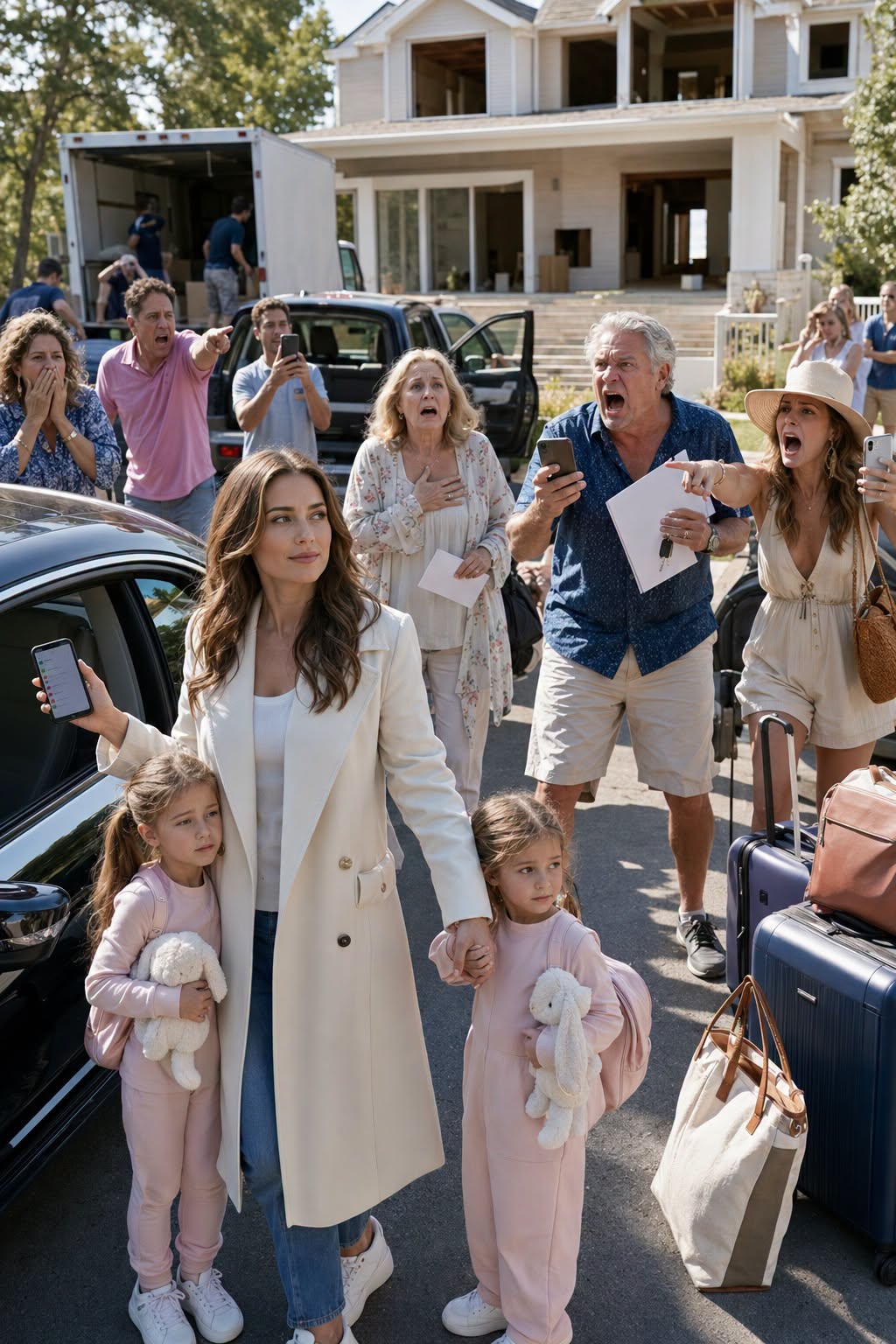
My Dad Cut My Twin Girls From the Family Cruise—Until His Entire Life Was Completely Ruined Same Day
In The Morning, My Dad Texted, “Plans Changed—You And The Twins Aren’t Coming. Your Sister Wants Only Real Family On The Cruise.” That Same Day, I Canceled The Payments, Sold The House They All Lived In, And Left Town With My Girls. When They Flew Back, The House Was Gone. “43 Missed Calls.”
### Part 1
The text came in while I was cutting strawberries into tiny hearts for my daughters’ lunch boxes.
It was 7:18 on a Thursday morning in August, the kind of humid Tennessee morning where the kitchen windows fogged at the edges even though the sun was already bright. My house smelled like blueberry muffins and toasted butter. The dishwasher hummed under the counter. Somewhere behind me, my five-year-old twins, Lila and June, were arguing in whispers over which crayon made the ocean look “more vacation blue.”
They had been drawing cruise ships for three straight days.
“Mommy,” Lila called from the breakfast nook, her dark curls bouncing as she leaned over her paper, “do cruise ships have ice cream every day?”
“Only if you finish your real food first,” I said.
June gasped like I had revealed a law of nature. “So we need practice.”
I smiled, sliding turkey sandwiches into two identical lunch boxes with their names stitched on the front. One pink, one yellow. Everything had to be equal in my house, because twins noticed betrayal in ounces, inches, and the number of blueberries in a muffin.
Then my phone vibrated hard against the granite countertop.
Not a soft buzz. A sharp, ugly rattle.
I glanced down and saw my father’s name.
Gordon Vale.
My stomach tightened before I even touched the screen. My father never texted early unless he wanted something, and he never wanted anything gently.
I wiped my hands on a dish towel and opened the message.
“Plans changed, Maren. I talked it over with Celeste last night, and we’ve decided that you and the girls aren’t coming on the cruise anymore. Celeste wants only real, traditional family structures on the ship for her engagement photos, and your presence makes things complicated with her future in-laws. Don’t cause a scene or make this difficult. We’ll talk when we get back in two weeks.”
For a second, the whole kitchen went silent.
Not actually silent. The dishwasher was still running. The girls were still whispering. A lawn mower buzzed somewhere down the street. But inside my body, everything stopped.
I read the message again.
Then again.
My father had not asked. He had announced.
He had not said he was sorry. He had instructed me not to make things difficult.
And my daughters, my sweet little girls who had spent two weeks telling their kindergarten teacher they were going on “Grandpa’s big boat,” had just been erased from a family vacation I had paid for.
“Mommy?” June asked. “Can I bring my dolphin swimsuit to school for show-and-tell?”
I looked up.
Both girls were staring at me now, their little faces open and trusting. Lila had drawn four stick figures standing on a cruise deck. One had gray hair. That was Grandpa. One had big sunglasses. That was Aunt Celeste. The other three were us.
I felt something cold move through my chest.
Not rage. Rage would have been hot and messy. This was cleaner. Quieter.
The kind of cold that comes when pain finally turns into proof.
I set the phone facedown on the counter.
“Not today, sweetheart,” I said carefully. “Today you just need your backpack.”
Lila frowned. “But Grandpa said we were all going.”
I tied her shoelace because my hands needed something to do. “Sometimes grown-ups change plans.”
“Is he mad?” June asked.
I kissed the top of her head. Her hair smelled like coconut detangler and sleep.
“No,” I said. “He’s just showing me something I should have believed a long time ago.”
They didn’t understand, and I was glad they didn’t.
After I dropped them off at school, I sat in the car for a full minute with both hands on the steering wheel. The morning sun bounced off the windshield so hard it made my eyes water, but I refused to cry. I had cried for my father enough when I was younger. I had cried when he missed my college graduation because Celeste had a dance recital. I had cried when he called my pregnancy “a public embarrassment.” I had cried when my mother died and he let me arrange the funeral while he sat in the den with Celeste, choosing sympathy posts for Facebook.
This time, I did not cry.
I opened my phone again and read his message one more time.
“Only real, traditional family structures.”
My daughters were not real family.
I was not real family.
But my credit card had been real enough when he needed the cruise deposit.
My company had been real enough when he needed vendor guarantees.
My signature had been real enough when his factory almost collapsed under unpaid freight invoices three years ago.
The red light changed. A horn tapped behind me.
I drove straight past my office entrance the first time because my mind was already moving faster than the road.
By the time I turned into the private underground parking garage beneath my headquarters, my hands had stopped shaking.
The building did not look like much from the street. That was intentional. Frosted glass, limestone, no loud signs. My father had always thought I rented “a few rooms downtown” for what he called my shipping paperwork business.
He had no idea there were four floors of legal, finance, compliance, and international operations above that quiet lobby.
He had no idea his life was held together by doors he had never bothered to look behind.
And by the time the elevator opened on the executive floor, I knew exactly which doors I was going to close.
### Part 2
My assistant, Naomi, looked up from her desk the moment I stepped out of the elevator.
She had worked for me long enough to read my face without asking the wrong questions. Her posture shifted. Her coffee cup lowered. The normal brightness in her eyes disappeared into something alert and professional.
“Conference room?” she asked.
“Legal, finance, compliance, and travel operations,” I said. “Now.”
She didn’t blink. “Ten minutes?”
“Five.”
Her fingers flew over the keyboard.
I walked into my office, shut the door, and finally let my shoulders drop. The room faced east, and white morning light spread across the polished floorboards. On my desk sat a framed photo of Lila and June at the county fair, faces sticky with cotton candy, each holding one of my hands.
Beside it was a small silver paperweight shaped like a ship’s anchor.
My father had given it to me when I was twenty-two. Not as a sweet gift. As a joke.
“Since you like pretending to be important with all that shipping nonsense,” he’d said, sliding it across the table while Celeste laughed.
I had kept it anyway.
Not because it hurt.
Because it reminded me that people who underestimate you often leave their fingerprints on the weapon they hand you.
I opened my laptop and pulled up the cruise file.
The Mediterranean suite package. Premium flights. Private transfers. Shore excursions. Formal dining upgrades. Celeste’s photography package. Her fiancé Everett’s family accommodations. Every receipt, every confirmation number, every authorization.
All under North Meridian Logistics Group.
My company.
Not Gordon Vale’s.
Not Celeste’s.
Mine.
When I entered the conference room, my team was already there. Naomi stood near the glass wall with a tablet. My chief financial officer, Martin Reyes, had his tie loosened and a spreadsheet open. My general counsel, Audrey Bell, sat with a yellow legal pad and the expression of a woman who had already guessed this meeting would not be polite. Compliance director Theo Grant folded his hands on the table, quiet and watchful.
I placed my phone in the center of the table.
“Read it,” I said.
Audrey leaned forward. Her eyes moved across the screen. Then Martin read it. Then Theo.
No one spoke for a moment.
Finally Audrey exhaled through her nose. “He put that in writing?”
“He did.”
Martin’s jaw tightened. “After you paid for all of it?”
“Yes.”
Theo tapped one finger once against the table. “What outcome do you want?”
That was why I paid him well. Not “Are you okay?” Not “Are you sure?” Just the only question that mattered.
I looked through the glass wall toward the city outside. People moved like tiny dark marks along the sidewalk. Delivery trucks rolled past. The world kept functioning, indifferent to the little cruelties families performed before breakfast.
“I want every asset separated,” I said. “Cleanly. Legally. Immediately.”
Audrey uncapped her pen. “Travel first?”
“Travel first.”
Martin turned his laptop toward me. “The cruise package is fully refundable until midnight because of the corporate protection clause we negotiated for executive retreat travel.”
I almost laughed.
Celeste had wanted luxury. I had bought protection.
“Cancel it,” I said.
“All of it?”
“The cruise. Flights. Transfers. Excursions. Photography. Dining upgrades. Anything connected to that reservation.”
Martin typed. “Reason?”
“Unauthorized use of corporate travel assets after change in approved attendee list.”
Audrey nodded. “Accurate.”
There was the first emotional reversal of the day. The sharp sting in my chest softened into something steadier as I watched my father’s power move turn into a billing issue.
“Next,” I said.
Theo already had another file open. “Vale Industrial Fabrication.”
My father’s company.
The name alone made the air feel heavier.
Vale Industrial had been my grandfather’s pride. It made specialized machine components, nothing glamorous, but useful enough to support two generations when it was managed honestly. My father inherited it and ran it like a kingdom, then a casino, then a museum of his own ego. He hated technology. Hated audits. Hated being questioned. He liked shaking hands with men at country clubs and telling stories about “building America with steel and grit,” even when half his parts were stuck in overseas ports because he ignored customs documentation.
Three years earlier, Vale Industrial had nearly died.
I was the one who saved it.
Not openly. Never openly. My father would rather drown than grab a rope with my name on it.
So I bought the debt through a holding company. Secured the factory land. Rebuilt the export licensing structure under North Meridian oversight. Guaranteed shipping routes through my international accounts. Quietly paid the penalties that would have ruined him.
He thought he survived because banks respected him.
He survived because I let him.
Theo slid a document across the table. “He missed two technical repayment milestones this quarter. We did not enforce because you requested flexibility.”
“End the flexibility.”
Audrey’s eyes lifted to mine. “Maren, once we issue default notice, the inventory freeze becomes automatic. Payroll disruption could start within days.”
“My father had years to run his business responsibly.”
“That is not an objection,” Audrey said softly. “It is a confirmation.”
I nodded.
Martin’s voice was lower now. “And the estate?”
For the first time that morning, my throat tightened.
The Vale house.
White columns. Green shutters. A wide porch where my mother used to drink iced tea and pretend she wasn’t lonely. A dining room where Celeste learned to interrupt me and my father learned to let her. A backyard where my daughters were once told not to touch the roses because “those were for guests.”
Six months earlier, a commercial developer had offered an inflated cash purchase for the entire block. Medical plaza expansion. Quick close. Clean title required.
The title was clean.
Because the house was not my father’s anymore.
It belonged to one of my holding companies after I paid off the liens he had hidden from everyone.
I had never sold it because a weak part of me still believed my mother’s home deserved mercy.
But houses did not love you back.
“Accept the developer’s offer,” I said.
Audrey stilled.
Martin stopped typing.
Naomi looked at me from the doorway, her face unreadable.
I picked up my father’s text and read the first line again.
“Plans changed.”
Then I looked at my team.
“Plans changed,” I said.
### Part 3
By 10:30, the cruise was gone.
Not delayed. Not modified. Gone.
A cancellation confirmation slid into my inbox with tidy corporate language that felt almost obscene in its calmness. The funds began reversing back through North Meridian’s protected account structure. The private photography package Celeste had bragged about for weeks disappeared with a click. The balcony suite she had posted online before ever stepping inside it returned to inventory.
I imagined her at the airport later, sunglasses pushed into her hair, laughing too loudly for Everett’s parents, showing off her manicure while my father played generous patriarch.
Neither of them knew the ship had already sailed away from them on paper.
The strange thing about revenge, if you do it correctly, is that it does not feel like revenge at first. It feels like accounting.
At 11:15, Audrey filed the default notices.
At 11:42, Theo’s compliance team suspended Vale Industrial’s export route authority under our management contracts.
At 12:06, warehouse collateral locks activated across three distribution centers.
At 12:40, two of my father’s biggest overseas customers received formal notice that future fulfillment would be reviewed pending compliance resolution.
Each step had a timestamp. Each timestamp had a clause. Each clause had been signed by my father, even if he had never bothered to read past the page where he saw temporary relief.
Around noon, Naomi came in with soup and a look that told me she knew I would forget to eat.
“You have seventeen missed calls from your father,” she said.
I glanced at my personal phone, which I had set facedown again.
“No voicemails?”
“Three.”
“Anything from my sister?”
Naomi’s mouth twitched. “Nine texts. She appears to believe your silence is jealousy.”
I took the soup but did not open the lid. “Of course she does.”
Celeste had always believed jealousy was the only possible explanation for any woman not applauding her.
She was thirty-one, two years younger than me, and had built an entire personality around being admired by people who did not know her well. Her luxury lifestyle blog was mostly sponsored candles, borrowed handbags, and photos taken in places my father paid for. She wrote captions about elegance and tradition while leaving restaurant servers in tears. She called herself a “family values bride” while treating my daughters like smudges on glass.
Everett Shaw, her fiancé, was the kind of polished corporate attorney she had always wanted. Tall, quiet, old Southern money, careful smile. His parents moved in circles my father worshipped from a distance. Celeste had spent months planning this cruise as her entry into their world.
She did not want family memories.
She wanted evidence.
And my daughters did not match the picture.
At 1:05, the developer’s attorney called.
I took the call in the small side conference room where the walls were covered in maps of freight routes and port access corridors. Sunlight turned the glass table white.
“Maren,” said Harris Lyle, the developer’s counsel, “we received your acceptance. I’ll be direct. Our client is prepared to close today if possession can be delivered unencumbered by Monday morning.”
“Define unencumbered.”
“No occupants. No personal property. No access disputes. Boarded and secured. Demolition prep begins Monday at dawn.”
My fingers rested on the cool glass. “Can your team handle perimeter security by evening?”
“Yes.”
“I’ll handle the contents.”
He paused. “That is faster than expected.”
“So was the decision that made it necessary.”
He was too professional to ask. “Then we’ll send the closing package within twenty minutes.”
When the call ended, I sat still for a moment.
This was the point where a softer daughter might have stopped. A softer daughter might have imagined her father coming home, seeing the sign, collapsing on the front lawn. She might have remembered birthdays, Christmas mornings, old photographs where everyone smiled because cameras rewarded lies.
I did remember.
I remembered being eight years old and carrying Celeste’s forgotten ballet shoes through rain because my father screamed that I had “one job as a big sister.”
I remembered being sixteen and winning a statewide scholarship, only for him to ask if I could skip the award dinner because Celeste was upset about a boy.
I remembered bringing newborn Lila and June to the Vale house, exhausted and terrified, and hearing him say, “You chose this life, Maren. Don’t expect everyone else to rearrange theirs around your mistakes.”
My daughters were not mistakes.
My life was not an inconvenience.
And I was done paying rent in pain for a place I already owned.
At 1:32, I signed the sale documents.
At 1:47, the wire confirmation arrived.
Seven hundred and fifty thousand dollars.
The number did not thrill me. It barely mattered. The house had stopped being a home years ago. The money was simply proof that something dead could still be converted into fuel.
I called a private moving company we used for executive relocations.
“This is Maren Hale,” I said. “I need a residential property cleared today. Everything packed, catalogued, and placed into secured storage under third-party access.”
The dispatcher hesitated only long enough to understand the scale. “Today?”
“Today.”
“Occupants present?”
“No.”
“Authorization?”
“I own the property.”
By 2:20, I was driving toward the Vale estate with two black SUVs behind me carrying legal staff and property managers.
The road to my father’s house curved beneath old maples. Late summer cicadas screamed from the trees. The sun was so bright against the white columns that for one dizzy second, I could see my mother standing on the porch in a blue dress, waving like she used to when I came home from college.
Then the memory vanished.
The house was empty. My father and Celeste were already at the airport, headed toward Miami, headed toward humiliation with boarding passes in hand.
I stepped out of my SUV and looked at the front door.
My key still worked.
Inside, the air smelled like lemon polish, old wood, and Celeste’s expensive perfume. Family portraits lined the hall. My father above the fireplace. Celeste in a white dress from an engagement shoot. My mother in a frame pushed slightly behind a vase, as if even in death she had been asked to make room.
There were no pictures of my daughters.
Not one.
That was the moment my sadness left.
And something final took its place.
### Part 4
The movers arrived at 2:45 in three large trucks that hissed to a stop along the circular drive.
They moved like a storm in uniforms.
Clipboards. Furniture blankets. Rolling bins. Label printers. Handheld scanners. Every drawer photographed before being emptied. Every item wrapped and catalogued. Every box numbered. Every room stripped with careful, professional speed.
I stood in the foyer while the house came apart around me.
A grandfather clock ticked beside the staircase. It had always annoyed me as a child, that heavy wooden heartbeat filling every silence. Now its sound grew louder as the walls emptied.
Tick.
A portrait came down.
Tick.
Crystal glasses disappeared into packing foam.
Tick.
My father’s leather chair was carried through the front door by two men who did not know he had once thrown a coffee mug past my head from that seat.
In the dining room, Celeste’s bridal magazines were stacked across the table in glossy piles. She had circled dresses, floral arrangements, terrace venues, European villas. A handwritten note in her looping script sat near a half-empty glass of sparkling water.
“Must keep cruise photos clean. No weird family complications.”
I stared at the words.
For a moment, my skin prickled.
Not because the cruelty surprised me. Because she had made it ordinary. A planning note between flowers and shoes. My daughters reduced to a complication in blue ink.
Audrey, who had followed me inside, saw my face and gently took the paper.
“Storage?” she asked.
“No,” I said. “Scan it.”
She nodded.
In my father’s study, we found the red herring I had half expected: a stack of unopened bills, bank notices, and letters from vendors. Proof that he had been pretending harder than even I realized. Not just careless. Desperate.
The room smelled like cigar smoke and dust. His mahogany desk was covered in framed awards from twenty years ago. On the wall hung a photograph of him shaking hands with a senator at a chamber of commerce dinner. Under the desk, one drawer stuck halfway open.
Inside were old envelopes from my mother.
I froze.
They were tied with a faded ribbon. My name was on one of them.
For one irrational second, I thought I had discovered something tender, something that might soften the whole day.
I opened the envelope with my thumb under the flap.
It was not a letter from my mother.
It was a bank document.
My college fund, withdrawn in installments during my senior year of high school.
Authorized by Gordon Vale.
Beneficiary transferred to Celeste Vale for “educational enrichment and family development.”
My ears rang.
I had worked two jobs through college because my father told me my mother’s medical bills had swallowed the account. I had believed him. I had thanked him for “doing his best.” Celeste had spent that same year in Paris for a fashion course she never finished.
I lowered myself into the desk chair.
The leather was still warm from sunlight.
Audrey stood in the doorway, quiet.
“You don’t have to keep going today,” she said.
I looked at the document again. My younger self rose in my mind, wearing a cheap black skirt to a scholarship interview, smiling too hard, pretending hunger was ambition.
“Yes,” I said. “I do.”
That was the information I had not expected. The betrayal was older than the cruise. Older than my daughters. My father had not become this man after my mother died.
He had simply stopped hiding it.
At 4:10, the last of the furniture was loaded.
At 4:25, the storage facility confirmed receipt of the first truck.
At 4:40, the developer’s security crew arrived with fencing panels, boards, warning signs, and heavy locks.
Neighbors began appearing on porches.
Mrs. Donnelly from across the street clutched a watering can to her chest. Mr. Price stopped his pickup near the curb and stared openly as workers boarded the lower windows.
I could feel the neighborhood’s curiosity pressing against my back.
Good.
My father had spent years performing success in front of these people while surviving on invisible support from the daughter he shamed. Let the curtains move. Let them whisper. Let the truth arrive wearing work boots and carrying plywood.
At 5:03, Harris Lyle pulled up in a gray sedan and handed me a certified closing receipt.
“Possession is formally transferred,” he said.
I signed the final acknowledgment on the hood of his car.
Behind him, a worker hammered the first orange notice into the lawn.
The sound cracked across the property.
Bang.
Bang.
Bang.
Each strike felt like a period at the end of a sentence I had been trying to finish for years.
By 5:20, the Vale house was no longer a home. It was a secured commercial site with boarded windows, locked gates, and a demolition schedule.
I stood outside the fence, holding my keys.
My personal phone lit up again.
Celeste.
A text preview flashed across the screen.
“Daddy says you’re being dramatic. Don’t embarrass us at the terminal.”
I almost smiled.
She still thought the terminal was where embarrassment would begin.
She had no idea it was where the truth was waiting for her in a pressed uniform with a clipboard.
### Part 5
I picked up Lila and June from school at 5:45.
They came running across the pickup lane with their backpacks bouncing and their faces flushed from playground heat. June had a sticker on her cheek. Lila held a paper crown made of yellow construction paper.
“Mommy!” June yelled. “I got line leader!”
“I was door holder,” Lila said, as if this were a competing executive position.
I hugged them both so tightly they squealed.
In the car, they chattered about snack time, a class hamster named Pickle, and whether clouds could get lost. They did not ask about the cruise until we pulled into our driveway and they saw my overnight bags near the front door.
“Are we going somewhere?” Lila asked.
I turned off the engine and looked at them in the rearview mirror.
Their faces were too young for family politics. Too soft for adult cruelty. I wanted to wrap the whole world in bubble wrap before it touched them.
“Yes,” I said. “We’re going on an adventure.”
June’s eyes widened. “With Grandpa?”
“No, baby.”
“Is Aunt Celeste coming?”
“No.”
Lila studied me with the serious expression she used when deciding whether adults were telling the whole truth. “Did we do something bad?”
The question hit me harder than anything my father had written.
I unbuckled my seat belt, got out, opened the back door, and crouched beside them.
“No,” I said, making my voice steady. “Listen to me. You did absolutely nothing wrong. Sometimes adults make unkind choices. When they do, we don’t chase after them and beg. We go where we are loved properly.”
June touched my cheek. “Are you sad?”
“Yes,” I admitted.
“Are we still having ice cream?”
That startled a laugh out of me, small and shaky. “Absolutely.”
Inside the house, I packed quickly. Not everything. Just passports, documents, favorite stuffed animals, school records, the girls’ tablets, my mother’s recipe box, and a few framed photos from our own life. My suburban home was already scheduled for premium rental through a property manager. North Meridian’s London hub had been ready for my relocation for months. I had delayed it because of school, guilt, and the old fantasy that if I stayed close enough, my father might become a grandfather worth having.
The fantasy ended that morning over strawberries.
At 7:30, Naomi arrived with travel folders and a calm smile for the girls.
“Are you the adventure lady?” June asked.
Naomi looked at me, then back at her. “I have been called worse things.”
The girls giggled.
By 9:10, we were at the private departure lounge. Not because I wanted glamour, but because I wanted quiet. I wanted my daughters away from airport chaos, away from the chance of running into my father or Celeste if their connection overlapped. The lounge smelled like coffee, leather, and expensive soap. Outside the windows, runway lights blinked against the dark.
My business phone buzzed with reports.
Cruise cancellation confirmed.
Export route suspension acknowledged.
Warehouse freeze executed.
Estate transfer complete.
Developer possession secured.
Vale Industrial emergency creditor notices delivered.
Everything was moving.
But my personal phone remained alive with drama.
My father called eleven times between 8:00 and 9:00.
Celeste texted twenty-three times.
At first, her messages were arrogant.
“You better not be planning to show up and cry.”
Then irritated.
“The cruise app isn’t showing our suite.”
Then confused.
“Why is the photography package gone?”
Then panicked.
“Maren, what did you do?”
I did not answer.
At 9:36, Everett Shaw called.
That made me pause.
I had spoken to Everett maybe five times. He was polite in the way attorneys were polite when they were still deciding whether someone mattered. He had never been cruel to my daughters, but he had never defended them either.
I let the call go to voicemail.
A minute later, a message appeared.
“Maren, this is Everett. I’m at the airport with your father and Celeste. There seems to be an issue with the travel package. Your name and company are coming up. Before this becomes more uncomfortable, could you please call me?”
Before this becomes more uncomfortable.
I stared at the phone until the screen dimmed.
He did not know uncomfortable yet.
At 10:15, our flight lifted into the night.
Lila fell asleep holding my hand. June slept with her forehead pressed against the window, her mouth slightly open, one pink shoe dangling off her foot.
Below us, the city became a grid of lights.
Somewhere in that grid, my father’s old house sat dark and boarded. Somewhere farther south, Celeste was probably standing at an airline counter, her perfect cruise outfit wrinkling under fluorescent lights.
For the first time all day, tears slipped down my face.
Quietly. Privately.
Not because I regretted what I had done.
Because I finally understood that I had not lost my family that morning.
I had only stopped financing the illusion that I still had one.
When the flight attendant dimmed the cabin lights, I opened my laptop and saw one last email from Audrey.
Subject: Emergency development.
I clicked it.
The first line made my pulse slow.
“Gordon attempted to access North Meridian-managed collateral through an unauthorized third-party request at 9:58 p.m.”
My father was not just panicking.
He was already trying to claw back what was no longer his.
And that meant the next phase would not be emotional.
It would be legal.
### Part 6
London greeted us with gray morning light and rain on the windows.
Not dramatic rain. Not movie rain. Just a steady, practical drizzle that made the runway shine like black glass. The girls pressed their faces to the window as the plane taxied, whispering about castles and whether British squirrels had accents.
I should have felt exhausted. Instead, I felt strangely awake.
A driver met us at arrivals with no sign, no fuss, just a quiet nod and a warm umbrella. The car smelled like new leather and peppermint. The girls fell asleep again before we left the airport road, their heads leaning together in the back seat like two flowers bent by the same wind.
Our new house sat near the water outside the city, close enough to reach North Meridian’s tech hub, far enough to hear gulls instead of traffic. It was not flashy from the gate. Stone walls, wide windows, dark roof, clipped hedges trembling with rain. But inside, it opened into light.
The girls woke up when they saw the view.
“Mommy,” June whispered, “is that the ocean?”
“River mouth,” I said. “Close enough for adventure.”
Lila spun in the entry hall. “Do we live here?”
I looked at the high ceiling, the pale floors, the rain sliding down the glass, and the suitcases waiting beside us like witnesses.
“Yes,” I said. “We live here.”
They screamed.
The sound bounced through the empty rooms, bright and wild, and for the first time in years, a house felt like something that could hold joy without demanding payment.
By afternoon, the girls were exploring their bedrooms and naming every corner. Naomi had arranged groceries, temporary school enrollment appointments, and a local pediatrician. My London operations director sent flowers with a card that said simply, “Welcome home.” No performance. No pity. Just welcome.
Then my business phone started lighting up.
Not from my father.
From everyone around him.
Factory managers. Vendor representatives. A regional bank officer. A customs broker in Savannah. Two board members who had ignored my warnings for months. Then Everett Shaw again.
I sat on the back terrace under a covered awning, wrapped in a sweater, watching water slap against the stones below. My laptop was open. Rain ticked softly against the roof.
Audrey appeared on video, her hair pulled back, her expression sharper than usual.
“Gordon is claiming he owns the factory land outright,” she said.
“He doesn’t.”
“No. But he’s telling vendors you committed elder financial abuse.”
I laughed once, without humor. “He’s sixty-two, not ninety-two, and he signed every agreement with independent counsel present.”
“We know. He knows. He’s looking for a sympathy angle.”
“What about the unauthorized collateral request?”
Audrey’s mouth tightened. “That is more serious. He tried to redirect inventory release through an old broker relationship. The broker refused and forwarded us the request. We are preserving it.”
“Do we notify regulators?”
“We may not have to. The bank already flagged suspicious activity after his emergency loan request this morning. There will likely be a corporate audit.”
I leaned back.
There it was. The information that shifted the emotional ground again.
My father’s collapse was no longer just the result of my withdrawal.
His own scrambling had turned a private failure into an official problem.
“Proceed carefully,” I said. “Everything documented. No insults. No drama.”
Audrey almost smiled. “You do realize your father has left six voicemails calling you dramatic?”
“He always hated mirrors.”
After the call, I finally listened to the messages.
The first voicemail was fury.
“Maren, you spoiled little ingrate, I don’t know what stunt you’re pulling, but you better fix this before I make you regret it.”
The second was confusion.
“The cruise line says the package was corporate-owned. That can’t be right. Call me.”
The third was Celeste screaming in the background while my father tried to sound controlled.
“Everett’s parents are asking questions. This is humiliating. You are ruining your sister’s life because you’re jealous.”
By the seventh, his voice had changed.
“Maren. The factory system is locked. I can’t access the shipping dashboard. People are saying there are notices. I need you to call me right now.”
By the twelfth, he sounded old.
“Where are you?”
I stopped listening there.
I put the phone down and walked inside.
The girls had built a blanket fort in the living room. Lila wore her paper crown from school. June had placed two stuffed rabbits at the entrance as guards.
“Mommy,” Lila said, “this is our castle.”
June nodded solemnly. “No mean people allowed.”
My throat closed.
“That’s a very good rule,” I said.
That night, after they fell asleep, Everett called again.
This time, I answered.
There was a long pause before he spoke.
“Maren?”
“Yes.”
His voice was quieter than I had ever heard it. “I need to ask you something directly.”
“Go ahead.”
“Did your father and Celeste know you paid for the cruise?”
“They knew my card was used.”
“That isn’t what I asked.”
Outside, the water moved in the dark.
“No,” I said. “They did not understand what that meant.”
Another pause.
Then Everett exhaled.
“Celeste told my family your daughters were removed because of behavioral concerns.”
My hand tightened around the phone.
“She lied.”
“I suspected that.”
“Did you?”
His silence answered before he did.
“I should have asked sooner,” he said.
“Yes,” I replied. “You should have.”
### Part 7
The crash came on Monday.
By then, my daughters had chosen bedrooms, spilled cereal on a rug older than they were, and decided that our new house needed a “morning muffin schedule.” Their world was already healing because children, when protected early enough, still know how to accept safety without interrogating it.
Mine was less simple.
At 4:17 p.m. London time, my secondary phone exploded.
Forty-three missed calls.
A row of voicemails.
Texts from numbers I recognized and numbers I didn’t.
My father. Celeste. The factory office. A neighbor. A former family friend from church. Everett. Even one message from Celeste’s future mother-in-law, written with the icy politeness of a woman who had learned something ugly in public.
I sat on the terrace with a mug of tea gone cold and watched the screen flash like an alarm.
Naomi, who had stayed to help with the transition, stood in the doorway.
“Do you want me to filter them?”
“No,” I said. “I’ll hear one.”
I chose my father’s latest voicemail.
His voice burst through the speaker, raw and cracked.
“Maren, where are you? Answer your phone right now. We just got back from the airport. The house is gone. There are fences everywhere. The windows are boarded. There’s a construction sign in the yard. The factory managers are saying our shipping licenses are frozen and inventory is locked. The bank called. They said auditors are coming. Celeste is hysterical. Everett ended the engagement at baggage claim. Do you hear me? He ended it in front of everyone. Call me back. You are destroying this family.”
Behind him, Celeste sobbed so loudly it distorted the audio.
For a moment, I saw them clearly.
My father standing outside the boarded house in the same linen jacket he had planned to wear on deck. Celeste with airport makeup streaked under her eyes, dragging a designer suitcase full of cruise outfits she would never use. The neighbors watching through blinds. The orange demolition notice glowing on the lawn like a verdict.
I did not feel joy.
That surprised me.
I had expected some sharp satisfaction, some triumphant burst. Instead, I felt a deep, tired calm. Like setting down a box I had carried for miles without realizing how heavy it was.
My phone rang again.
Gordon Vale.
This time, I answered.
For three seconds, neither of us spoke.
Then he shouted, “What the hell have you done?”
His voice still had that old command in it, the tone that used to make me stand straighter at twelve years old.
But I was not twelve anymore.
“I followed your instructions,” I said.
“What are you talking about?”
“You said you wanted only real family on the cruise. You made it clear that my daughters and I did not qualify.”
“This is not about that stupid text,” he snapped. “This is about you stealing my house and sabotaging my business.”
“Your house was owned by my holding company. Your business operated through routes guaranteed by my corporation. Your inventory was collateral under contracts you signed. Nothing was stolen.”
“You tricked me.”
“No,” I said. “I rescued you quietly, and you mistook silence for weakness.”
He breathed hard into the phone. In the background, Celeste screamed, “Ask her where my things are!”
“Your belongings are in secured storage,” I said. “The access information will be sent through counsel.”
“My things?” Celeste shrieked closer to the phone. “My wedding dress samples were in that house, Maren. My albums, my shoes, my sponsored items. You psycho.”
I closed my eyes.
The word should have hurt. It did not.
“Celeste,” I said, “you wrote that my daughters were weird family complications.”
The line went quiet.
My father spoke first. “What?”
“In your cruise notes. On the dining room table.”
“That was private,” Celeste said, her voice suddenly thin.
“So was my college fund.”
Another silence.
This one was different.
My father knew.
Celeste knew.
Even over the phone, I could feel the old secret crawling out from under the furniture.
“Maren,” my father said carefully, “that was a long time ago.”
“And this morning was not.”
“I am your father.”
“You are a man who spent years taking from me while teaching your favorite child to look down on my daughters.”
“That’s not fair.”
“No,” I said. “Fair was when I paid your debt and let you keep your pride. Fair was when I funded a vacation so my girls could have one good memory with their grandfather. Fair was when I kept your name clean after you nearly buried the company my grandfather built.”
His breathing broke.
“I didn’t know you’d go this far.”
That was the closest he would ever come to an apology. Not “I hurt you.” Not “I hurt them.” Only “I didn’t know consequences were possible.”
“You didn’t know I could,” I said. “That’s not the same thing.”
“Maren, please.” His voice dropped into a softer register, one I had wanted desperately as a child. “We can fix this. Come home. We’ll talk. I’ll tell Celeste to apologize.”
Somewhere inside me, the little girl who had waited for that softness lifted her head.
For one dangerous second, I wanted to believe him.
Then I looked through the glass doors into the living room, where Lila and June were dancing in pajamas, laughing under warm lamplight.
And the old spell broke.
“There is no home to come back to,” I said. “And there is no apology that buys access to my children.”
“Maren—”
“Do not contact me again except through legal counsel.”
“You can’t just cut us off.”
“I already did.”
I ended the call.
Then I blocked the number.
My hand trembled afterward, not from doubt, but from release.
For thirty-three years, my father had been the storm.
That evening, for the first time, he was only weather somewhere far away.
### Part 8
The legal aftermath lasted six months.
Not because my father had a case, but because denial is expensive when arrogant people hire lawyers to argue with documents.
He claimed I had manipulated him. Audrey produced signed agreements, independent legal confirmations, repayment schedules, default notices, and the broker request he had attempted after the freeze.
He claimed the estate sale was invalid. Harris Lyle produced the deed history, lien payoff records, holding company ownership, closing receipts, and possession transfer paperwork.
He claimed I had maliciously destroyed Vale Industrial. Theo produced three years of compliance warnings, missed deadlines, unpaid obligations, and the emergency collateral clauses that my father had signed with his own thick blue pen.
Every accusation he threw came back carrying his signature.
Celeste tried a different route.
She posted online.
Not my name at first. Just vague captions about “betrayal,” “jealous relatives,” and “women who hate traditional happiness.” Her followers offered sympathy for about forty-eight hours. Then someone from the airport posted a comment asking if this was about the cruise she had been denied boarding for after excluding two little girls.
The internet, which Celeste had worshipped like a god, turned its face toward her.
Everett never married her.
He sent me one handwritten letter two months after the engagement ended. It arrived on thick cream paper at my London office, forwarded through counsel. He did not ask for forgiveness. He did not ask to visit. He simply wrote that he had reviewed enough of the situation to understand that silence had made him complicit, and that he was sorry my daughters had been treated as obstacles to his family’s image.
I appreciated the letter.
Then I put it away.
Not every man who learns a lesson earns a place in your life.
My father and Celeste moved into a small apartment above an auto repair garage on the industrial edge of town. I knew because Audrey sent one final security report after Celeste attempted to show up at my old suburban house, only to find renters living there and a property manager who had never heard of her.
After that, I requested no more updates unless there was a threat.
I did not need to watch them suffer in installments.
That is another thing people misunderstand about walking away. They think peace means you keep checking whether karma is working. Real peace is when you stop needing the report.
In London, life became ordinary in the most beautiful way.
Lila and June started school in navy uniforms and came home saying “properly” with tiny, accidental accents. They learned to ride scooters along the river path. They made friends with a girl named Amelie whose father baked bread on Sundays. They stopped asking when Grandpa would call.
One night in February, June found the old paper crown from Tennessee tucked inside a memory box.
“Was this from before the adventure?” she asked.
“Yes,” I said.
Lila, who was building a tower of blocks on the rug, looked up. “Do we still have family there?”
I sat beside them.
The question did not hurt the way it once might have. Children deserve answers that are honest without being heavy.
“We have relatives there,” I said. “But family is made of people who take care of your heart.”
June thought about that. “So Naomi is family?”
“Absolutely.”
“Mrs. Bell with the serious glasses?”
I smiled. “In her own way.”
Lila placed another block on her tower. “Grandpa didn’t take care of our hearts.”
“No,” I said softly. “He didn’t.”
“Are you mad forever?”
I looked toward the window. Outside, evening turned the water silver. In the reflection, I saw myself sitting between my daughters in a house no one could take from us, wearing an old sweater, hair messy, face calm.
“No,” I said. “I’m not mad forever. I’m finished forever. Those are different things.”
That spring, North Meridian completed the largest merger of my career. We expanded into three new ports, opened a training program for women in logistics leadership, and moved our headquarters division into a restored building with wide windows and clean white light. At the opening, Lila and June stood beside me in matching dresses, each holding one end of a ribbon.
Naomi cried.
Audrey pretended not to.
After the ceremony, I took the girls to the waterfront. The air smelled like salt, rain, and roasted coffee from a cart nearby. Seagulls screamed overhead. June held my left hand. Lila held my right.
“Mommy,” Lila asked, “will we ever go on a cruise?”
I looked down at her serious little face.
For one second, I saw the old kitchen table, the strawberry hearts, the buzzing phone, the ship drawn in blue crayon.
Then I saw what came after.
The plane lifting into the night. The house full of rain light. The blanket fort with no mean people allowed. My daughters laughing in a place where no one measured their worth by someone else’s photo.
“Yes,” I said. “Someday.”
“With people who want us there?” June asked.
I squeezed her hand.
“Only with people who are lucky to have us.”
Two weeks later, I booked a summer trip. Not a luxury performance. Not a family photo opportunity. A quiet coastal sailing holiday with Naomi, her husband, their son, my girls, and two close friends who had loved us through the whole storm without asking for details they had not earned.
Before we left, Audrey sent one final sealed envelope to my office.
Inside was a formal notice from my father’s attorney. Gordon Vale requested mediated reconciliation and “reasonable restoration of family support.”
I read it once.
Then I placed it on my desk beside a printed copy of his original text.
“Only real, traditional family structures.”
For a long moment, I looked at both papers.
One was the door he closed.
The other was the window he wanted to climb through after the house burned down.
I dictated my response to Audrey in one sentence.
“No contact will be resumed, no financial support will be restored, and no access to my children will be granted.”
Then I signed it.
No shaking hands.
No tears.
No second thoughts.
That evening, I stood on the upper deck of my home while the girls chased each other across the lawn below, shrieking with laughter as the last sunlight caught in their hair. The water beyond the garden turned gold. Somewhere far away, my father and sister were living with the consequences of believing blood gave them ownership over everything I built.
I did not hate them.
Hate would have kept a room for them inside me.
I had given them enough rooms.
My father thought cutting my daughters from that cruise would remind me of my place. Instead, it reminded me that I owned the ground beneath his. Celeste thought “real family” meant the people who looked best beside her in photographs. Instead, she taught me that real family is whoever protects your children when cruelty comes dressed as tradition.
I never forgave them.
I simply stopped carrying them.
And once I did, my daughters and I finally became impossible to throw away.
THE END!