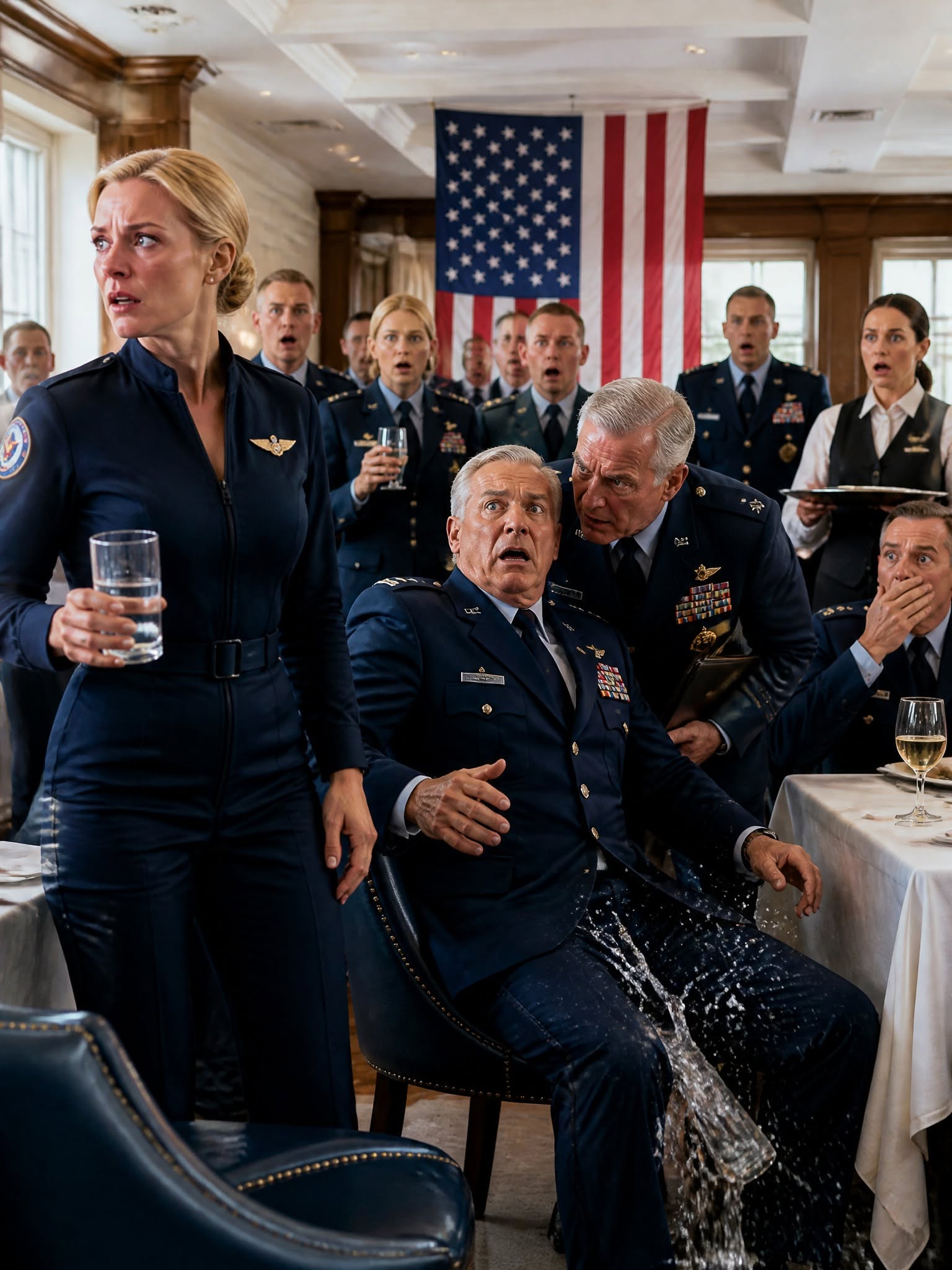
“Look at her, she’s not aircrew,” the Colonel sneered across the officer’s club, waving his glass at me. “Ladies don’t fly the heavy metal. They fly desks.” As his lieutenants smirked, I calmly finished my drink and stood up to leave. But before I could walk away, his commanding Admiral crossed the room, whispered something in the Colonel’s ear, and watched the Colonel turn pale as his glass shattered on the floor.
Part 1: The Officer’s Club
The lieutenant asked what I did, and I made the mistake of answering honestly.
We were standing near the far end of the bar inside the officer’s club, where the lights were too bright, the carpet smelled faintly of beer and polish, and everyone laughed a second too late because rank filled the room like loaded furniture.
The symposium reception had been going for nearly an hour. Navy, Marines, a few Air Force officers, and contractors in tailored suits moved carefully around admirals. I had come because my office expected me to come. I stayed because leaving early would have raised more questions than staying quiet.
The young woman beside me introduced herself as Lieutenant Junior Grade Nina Park, a surface warfare officer with nervous hands and the open face of someone who had not yet learned how many military rooms were designed to make her feel like a guest.
“What brought you here, ma’am?” she asked.
“Staff work, mostly.”
She nodded as if staff work sounded noble instead of slow death by calendar invite.
“What community are you from?”
I should have said operations. Headquarters. Something safe and bland.
Instead, because she had been kind and I was tired, I said, “I fly Hornets.”
Her eyes brightened. “Super Hornets?”
“Once upon a time.”
I said it softly. I did not mention combat, the ribbon waiting on my service dress uniform, or the night that still woke me with my hands clenched around invisible throttles.
A few feet away, a Marine colonel turned his head.
I had noticed him the moment I walked in. Broad shoulders, heavy waist, sunburned face, and the lazy confidence of a man applauded for too long. He held a glass of whiskey in one hand and a cluster of junior officers in the other.
His name was Colonel Grant Maddox.
At that moment, he was simply the man at the center of the laughter.
He looked me over slowly. I wore a charcoal dress. No uniform. No rank. No wings. Nothing that suggested I belonged near a cockpit, a carrier deck, or a conversation he considered his.
“She’s not aircrew,” he said, not to me but loud enough for me to hear.
His captains grinned.
Maddox lifted his glass. “Look at her. Ladies don’t fly the hard stuff. They fly desks.”
The laughter came fast.
A young Marine lieutenant beside him murmured, “Sir, maybe don’t.”
Maddox waved him away.
Nina froze beside me, ashamed as if she had invited the insult.
At first, I felt nothing. Then the old hurt opened beneath my ribs: not anger exactly, but the tired humiliation of being measured by a man who never imagined the ruler might be broken.
I smiled at Nina.
“You’ll do fine,” I told her. “This room is less frightening than it looks.”
Then I set down my water and turned toward the door.
I had built a life out of leaving rooms quietly.
Three steps from the exit, a chair scraped hard behind me.
The room changed before anyone spoke. Conversations folded inward. A laugh died halfway out. Even the bartender stopped moving.
I looked back.
Rear Admiral Thomas Reeve stood near the windows.
Two stars.
Senior officer at the symposium.
The man everyone had been orbiting all evening.
His eyes were fixed on me as if he had seen a ghost in a charcoal dress.
Then he started across the floor.

Part 2: The Night That Followed Me
Before I tell you what Admiral Reeve said, you need to know who I was before that room decided I was small.
My name is Commander Elise Warren, United States Navy. Naval aviator. Nineteen years in uniform.
I was born in 1983 in a small town where people described you by your parents before they used your name. I earned my commission at twenty-two, my wings at twenty-four, and trapped my first Super Hornet aboard a carrier when I was young enough to think terror and joy were the same thing if you survived them.
I was good.
That is still hard to say.
Women like me are trained to soften confidence into gratitude. We learn to say we were lucky, had great mentors, and were given chances. We smooth competence so no one cuts himself on it.
But the truth is simple.
I was good.
At twenty-eight, I was one of the best section leads in my squadron. My hands knew the aircraft before my mind had to ask. I could read weather in the horizon and trouble in a wingman’s breathing over the radio. I loved the jet because it did not care what I looked like, whose daughter I was, or whether men found me threatening.
It only cared whether I could fly.
And I could.
Then came the night that should have made my career and instead became the reason people lowered their voices when they said my name.
In my hotel room, my service dress uniform hung inside a garment bag. On the left breast was a ribbon I had stopped mentioning years earlier.
Distinguished Flying Cross with valor.
A beautiful piece of metal that had cost me almost everything.
Men looked at that ribbon and recalculated me. Some doubted it. Some resented it. Some treated it like an accusation. A woman with a valor award made certain men uncomfortable because it suggested the world was wider than the one they had been promised.
So I stopped pointing at it.
Then I stopped wearing my story at all.
For years, I lived on staff work: offices, readiness slides, flight schedules for people still on the path I had imagined for myself. I wrote evaluations for officers who would screen for command while my file sat under a shadow no one wanted to name.
“Messy,” they called it.
There had been an investigation. Questions. An after-action report written by Captain Roland Pierce, who had been safe aboard the ship while I was burning fuel over a ridge in the dark.
He wrote that I disregarded a lawful order.
He was not wrong.
He wrote that my decision was reckless.
That was the lie.
Some lies are false facts. Others are incomplete truth. The second kind lasts longer because it can wear a uniform.
I carried that lie for fifteen years through narrow promotions, billets I did not want, and rooms where men called me “solid” when they meant “finished.”
The worst part was not that people believed the lie.
It was that after a while, I began living as if it might be true.
At home, I had a folder I had not opened in six years. Inside were the citation, a photograph of me at twenty-eight, a letter from a mother whose son came home because of that night, and the memorial program for my wingman.
Jace Merritt.
Call sign Lantern.
Twenty-seven years old. Newly married. So cheerful it seemed irresponsible. He laughed with his whole body and kept a picture of his wife taped inside his kneeboard.
He flew like the jet had been born around him.
He died on the last pass.
People want clean stories. They want sacrifice to come with music and valor to leave everyone proud.
Real life is not that polite.
Sometimes you do the right thing, and someone still dies.
Sometimes the report makes you sound like the problem.
Sometimes the institution gives you a medal with one hand and buries you with the other.
By the time I walked into that officer’s club, I had become practiced at being buried.
Then Colonel Grant Maddox laughed and said ladies did not fly the hard stuff.
And across the room, a man I had never properly met stood up like a debt had finally found its collector.

Part 3: Raven and Lantern
The night that made the medal began with stale coffee and bad jokes.
Spring, 2011.
The ready room was freezing. The carrier hummed beneath us like a living machine. Someone had burned popcorn earlier, and the smell had mixed with coffee, boot leather, and jet fuel until it became the perfume of deployment.
Jace sat backward on a chair while I briefed the route.
“Boss,” he said, tapping his kneeboard, “if we divert, I want it known I selected the least tragic option.”
“You selected the one with the best vending machines.”
“Morale matters.”
“You’re a warrior poet.”
“I contain multitudes.”
That was Jace. Always light, never careless.
We launched at last light, two Super Hornets climbing off the carrier into a purple-edged sky. Our tasking was routine, which is what people call a thing until it stops being routine.
Then a strike fighter from another squadron went down.
Commander Thomas Reeve was in that jet then. Not an admiral. Just a man in a cockpit who suddenly became a man under a parachute in hostile country.
The radio changed first. Normal controller rhythm snapped into urgency. Frequencies crowded. Someone called the beacon. Someone confirmed ejection.
A pilot was alive on the ground.
That was the good news.
Everything else was bad.
Reeve had come down near a ridge where a reconnaissance team of seven was already pinned down. Enemy fighters were moving from higher ground. They had seen the jet fall and knew rescue would come.
They wanted to reach him first.
We were closest.
We had fuel, but not enough.
Every pilot knows bingo fuel. It is not a suggestion. It is math with a command voice. At bingo, you leave because a jet without fuel is not a weapon. It is a coffin with wings.
Captain Roland Pierce came over the radio from the ship.
“Raven Two-One, return to base.”
My call sign was Raven.
Jace was Raven Two-Two.
I looked at the fuel state, the ridge on the display, and listened to the young JTAC on the ground trying not to sound scared.
“Enemy closing from the north slope. Friendlies danger close. We need air now.”
Pierce repeated, “Raven Two-One, you are ordered to return to base.”
There are moments when everything complicated becomes simple.
Not easy.
Simple.
The book said leave.
The ridge said stay.
I keyed the mic.
“Raven Two-One is rolling in.”
Jace did not hesitate.
“Two-Two’s with you.”
For the next two hours, we held the line in the dark. We ran gun passes so low the ridge rose like a wall in the windscreen. Tracers crossed black rock. Muzzle flashes vanished under our fire. The JTAC talked us in, his voice cracking once and never again.
When we had ordnance, we used it.
When we had only guns, we used those.
When the guns ran low, we kept making passes anyway because sometimes the scream of a jet overhead is enough to make men press their faces into dirt and rethink their courage.
Reeve came up on his survival radio now and then. Calm. Precise. Reporting what he could see from the wash where he had taken cover.
He never asked if we were leaving.
I respected him for that before I knew his face.
The rescue helicopter was delayed, then delayed again. Weather. Terrain. Fire from the ridge. Every minute stretched. Every pass burned fuel we did not have.
Jace stayed steady.
At one point, he said, “If we get out of this, I’m telling my wife you were the bad influence.”
“You already tell her that.”
“Yeah, but now I’ll have evidence.”
He was smiling. I could hear it.
The helicopter finally checked in, low through the dark, searching for the survivors. It could not see the team at first.
So we drew them a road.
My tracers marked the ridge. Jace rolled lower to cover fighters moving too close.
“Raven Two-One,” he said, bright and calm, “I’m staying on the gun. Keep them off the team.”
“Lantern, climb.”
No answer.
“Jace, climb.”
Then the missile warning came.
Then static.
Then nothing.
There are sounds your mind refuses to process because understanding them would split you open.
I kept flying.
People misunderstand grief. Sometimes it does not stop you. Sometimes it keeps your hands doing what must be done because stopping would waste the life just lost.
The helicopter got in.
They pulled Reeve from the wash. They lifted the reconnaissance team from the ridge, all seven alive.
We had held the line long enough.
I brought a damaged jet back to the carrier in gray morning light with one side of the sky empty where my wingman should have been.
I trapped on the first pass because I knew I did not have a second one left in me.
When I climbed down, my legs gave out.
A chief caught my elbow and said, “Easy, ma’am.”
I remember thinking how strange that word was.
Easy.
Nothing was ever easy again.
Part 4: The Room Turns
They pinned the medal on me six weeks later in a hangar that smelled of hydraulic fluid and hot metal.