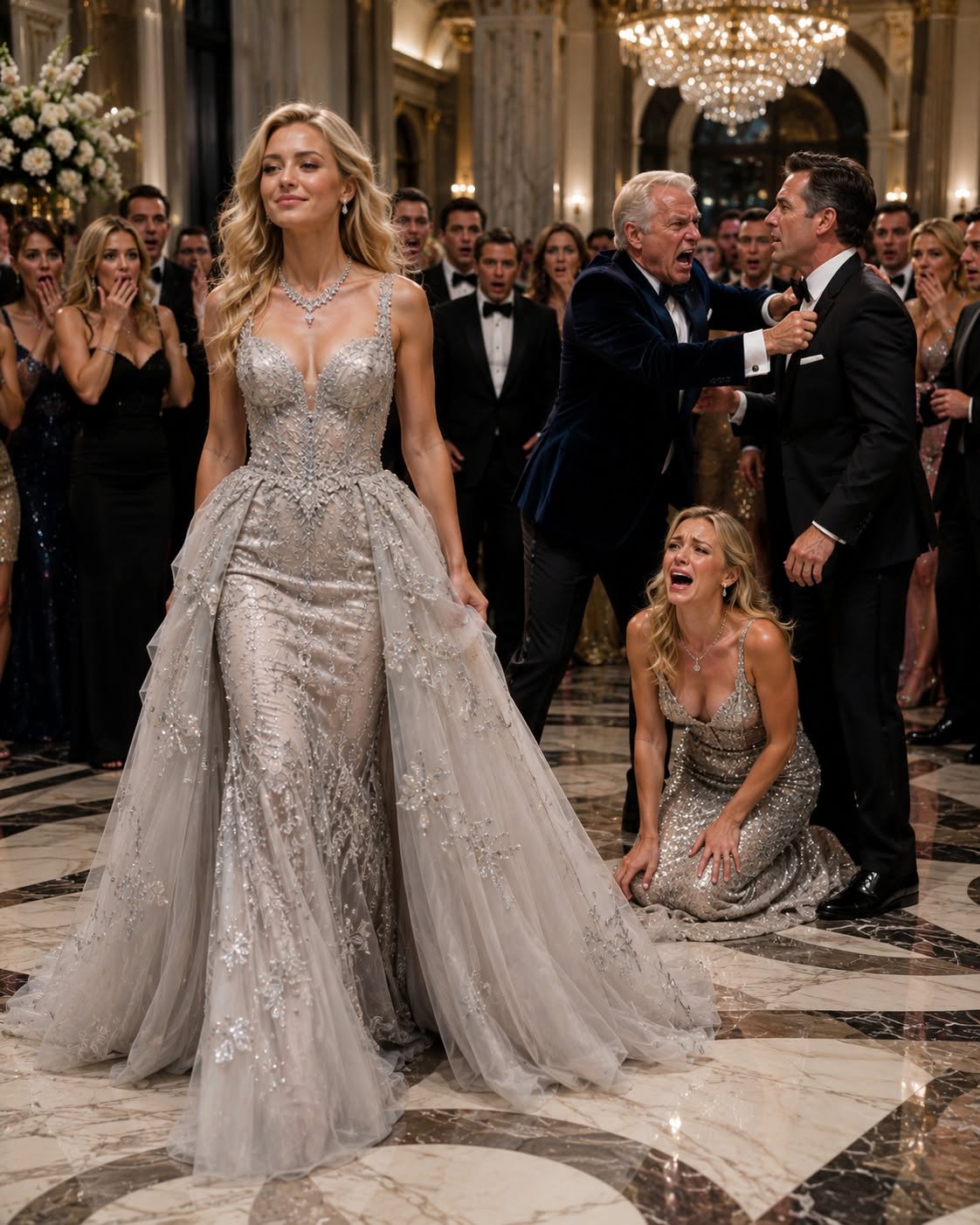
Light from the enormous crystal chandelier splintered across the polished marble floor, bathing the packed ballroom in a hard, glittering brilliance.
San Francisco’s wealthiest families filled the grand banquet hall of the Fairmont San Francisco, wrapped in couture gowns, custom tuxedos, and generations of carefully protected privilege.
At the arched entrance stood Grant Holloway and Celeste Monroe.
Grant’s arm rested heavily around Celeste’s waist, possessive enough to make their intimacy unmistakable. He wore a perfectly tailored midnight-blue tuxedo, while Celeste’s ivory silk gown clung elegantly to her body. Diamonds flashed at her throat every time she moved.
Their smiles were perfectly matched.
They welcomed the attention, the stares, and the whispers moving through the room.
Together, they looked exactly as they intended to look: the undisputed stars of the evening and the future faces of the Holloway dynasty.
I stood in the shadows beside a towering arrangement of white roses, holding a champagne flute that had gone warm nearly an hour earlier.
My name is Olivia Bennett.
I was still Grant Holloway’s legal wife.
For the past month, Grant had barely spoken to me inside our Napa Valley estate. He moved through our home with calculated coldness, punishing me with silence whenever I questioned him.
Now, in front of hundreds of people, he had chosen to display the collapse of our marriage with humiliating precision.
The whispers around me felt like thin needles.
“Who is the woman with Grant?”
“I heard Celeste was his college sweetheart.”
“She just returned from Europe. Her family has old money.”
“Where is Olivia? Wasn’t she supposed to host tonight?”
“Look over there. Eleanor Holloway seems delighted with Celeste.”
That was true.
Grant’s mother stood near the elaborate ice sculpture, holding Celeste’s hand with maternal affection.
Eleanor Holloway had never once treated me with that kind of warmth during my three years of marriage.
She was practically glowing as she introduced Celeste to friends and relatives, as though presenting the daughter-in-law she had always wanted.
Then the heavy mahogany doors at the far end of the ballroom flew open.
Richard Holloway, the ruthless patriarch and chief executive of Holloway Industries, stormed into the hall.
His face was dark with fury.
His sharp gaze swept over the crowd and immediately found Grant, who was still smiling with Celeste attached to his arm.
Richard didn’t look toward the shadows where I stood.
He marched through the ballroom as guests hurried to clear a path.
The forceful sound of his leather shoes struck the marble floor beneath the shocked silence.
He stopped directly in front of his son.
Without speaking, Richard raised his hand.
Smack.
The sound of the sla:p cracked through the ballroom.
Grant’s head snapped to the side.
A red mark immediately appeared across his cheek.
Celeste gasped and covered her mouth.
Eleanor’s pleased expression vanished.
No one moved.
No one spoke.
Richard pointed at his son with a trembling hand.
“You arrogant fool,” he said, his voice shaking with rage. “You still have the nerve to stand here smiling?”
Grant stared at him in disbelief.
Richard stepped closer.
“Do you have any idea what your wife did thirty minutes ago?”
Grant’s expression changed.
“She officially notified the board, our banking partners, and every major investor that she was withdrawing her three-hundred-million-dollar investment from Holloway Industries.”
The color left Grant’s face.
Richard continued.
“Because of the review triggered by her withdrawal, our primary liquid accounts have been temporarily frozen.”
His voice rose until it echoed beneath the chandelier.
“Are you satisfied now, Grant? Tell me. Are you happy?”
Grant swayed slightly.
The meaning of Richard’s words struck him piece by piece.
Three hundred million dollars.
Frozen accounts.
Corporate review.
The fantasy Grant had built around Celeste began collapsing in front of everyone.
His head turned sharply.
His panicked gaze moved through the crowd until it found me standing beside the flowers.
I calmly lowered my glass.
The crystal base touched the nearby table with a soft click.
In the silence, the tiny sound seemed impossibly loud.
Grant stared at me with shock, confusion, and sudden desperation.
I lifted my chin.
Then, under the breathless attention of San Francisco’s elite, I raised my hands and slowly began to applaud.
To understand why I was clapping, you have to return to one month earlier.
I had been sitting in the master bedroom of our Napa Valley estate, the cold blue glow of my laptop illuminating my exhausted face.
An encrypted email had arrived from a private investigator I hired the previous week.
The message contained more than a dozen photographs.
In the first image, Grant was opening the passenger door of his Aston Martin for a woman wearing a beige cashmere coat.
They were outside the international arrivals terminal at San Francisco International Airport.
The timestamp showed the picture had been taken three days earlier.
The next photographs followed them to an exclusive restaurant in Downtown San Francisco.
Grant leaned toward her across the table, listening with an affection I had not seen directed at me in years.
The final photographs showed Grant’s assistant handing the woman several luxury shopping bags.
One carried the unmistakable logo of an elite jewelry house.
The woman was Celeste Monroe.
Grant’s first love from college.
The legendary woman who had supposedly escaped him.
She had spent five years in Europe, married a wealthy technology executive, and divorced him soon afterward.
Now she had returned.
The investigator’s report was clinical.
Celeste had been in the city for three days.
Grant had personally collected her from the airport.
They had attended multiple private dinners.
She was staying in an executive suite at the St. Regis San Francisco, charged directly to Grant’s corporate expense account.
There was no confirmed physical intimacy, but their proximity and Grant’s spending exceeded any reasonable definition of friendship.
I closed the laptop.
The bedroom fell dark.
It was enormous, minimalist, and painfully expensive—exactly the style Grant preferred.
There was no warmth in it.
Much like our marriage.
A few minutes later, heavy footsteps sounded in the hallway.
Grant entered smelling of aged scotch and unfamiliar floral perfume.
He loosened his silk tie and frowned when he saw me awake.
“You’re still up?”
For the previous month, we had barely communicated.
When he returned home late, I usually pretended to be asleep or remained inside my office managing the investment portfolio I had built long before becoming his wife.
“Celeste is back,” I said.
Grant’s shoulders stiffened for one brief moment.
Then he forced himself to relax.
“Yes,” he replied casually. “She doesn’t know many people here anymore. I’m helping an old friend settle in.”
“How did you know?” he added.
“I saw the photographs.”
I stood and leaned against the entrance to the walk-in closet.
“Airport pickup. Private dinners. Luxury jewelry. Is that your standard hospitality package for an old college friend?”
Grant spun toward me.
The alcohol-softened expression disappeared from his face.
“You had me followed?”
“Your assistant made the investigator unnecessary.”
I gave him a cold smile.
“The receipt from the jeweler was sent to our household email account. Seventy-five thousand dollars for a diamond necklace. Very generous.”
Grant’s face darkened.
“Celeste just went through a terrible divorce. She’s emotionally fragile. I’m being supportive.”
“And the necklace?”
“A late birthday gift. It doesn’t mean anything.”
I let the lie hang between us.
“Will you also give her an office at Holloway Industries?”
Grant’s eyes shifted away.
“Or are you planning to bring her to the galas where you need a more agreeable companion?”
“What if I am?” he snapped.
Then the truth came out.
“Look at yourself, Olivia. All you do is stare at financial reports. Have you ever considered what I need from a wife? What my family requires publicly?”
His voice grew sharper.
“Celeste understands people. She comes from a respected family. At least I wouldn’t be embarrassed to be seen with her.”
That sentence cut deeper than I expected.
For three years, I had slowed my own rising career in the San Francisco Financial District to support his family.
I invested a massive portion of my inheritance into Holloway Industries.
I designed the financial strategy that saved the company during two major cash-flow emergencies.
I strengthened Grant’s fragile position with the board.
I endured Eleanor’s criticism and managed the family’s poisonous internal politics.
And after all of that, Grant considered me an embarrassment.
“You think I hum!liate you?” I asked.
Grant seemed to realize he had gone too far.
But his pride prevented him from apologizing.
“I didn’t mean it exactly that way. You simply need to adjust your attitude. The annual family gala is approaching, and everyone important will be there. My mother expects you to prepare properly.”
“Your mother expects it,” I repeated. “What do you expect?”
Grant remained silent.
“Who will stand beside you at the gala?” I asked. “Your wife or your understanding old friend?”
His expression hardened.
“Celeste knows how European society works. She’s elegant and worldly. She may be a better fit for this particular event.”
“Enough.”
My voice stopped him.
A painful pressure sat inside my chest, but beneath it was a much stronger feeling.
Clarity.
Grant wasn’t merely punishing me.
He was preparing Celeste to replace me publicly.
The gala would be her introduction.
“Grant,” I said, “we need to discuss divorce.”
He froze.
“What did you say?”
“Divorce.”
I opened the nightstand drawer and removed a thick legal document.
“My attorneys prepared the settlement. Review it. We can file by Friday.”
He stared at me as if I had spoken another language.
Grant had expected tears, screaming, or desperate bargaining.
Instead, I handed him a complete exit plan.
He snatched the papers and scanned the first pages.
The asset division was precise.
I requested the legal division of our shared property, the return of my personal assets, and full liquidation of my equity in Holloway Industries at current market value.
When he saw the amount, a muscle moved in his jaw.
Grant knew I was wealthy.
He had never understood how much of my money supported his family’s company.
“You want to remove your investment?” he asked.
For the first time, panic appeared beneath his arrogance.
“Do you understand how tight our cash flow is because of the new acquisitions? Pulling your capital now would strangle the company.”
“Your public replacement of your legal wife is trivial,” I replied. “But protecting your company is suddenly serious?”
“I never said I was replacing you!”
“You said Celeste was better suited to stand beside you.”
“You are being unreasonable. If Holloway Industries succeeds, you benefit too.”
It was the same tired argument.
Everything had to be sacrificed for the family, while Grant sacrificed nothing.
“Read the agreement,” I said.
I walked toward the door.
“Until you sign it, I will not attend another Holloway event. That includes the gala.”
I paused.
“And the money is mine, Grant. I decide where it goes. Good luck.”
I left the room.
The soft closing of the door sounded like the end of something permanent.
During the next two weeks, the Napa Valley estate became unbearably cold.
I moved into the east-wing guest room.
Grant initially waited for me to apologize.
When I didn’t, he increased his public appearances with Celeste.
He took her to private dinners and business events.
She gave him the attention his ego demanded.
But the investment clause in the divorce agreement continued haunting him.
Through a contact in the finance department, I learned that Grant had cornered the chief financial officer.
The CFO explained the reality.
My money was woven throughout Holloway Industries through several holding companies.
A sudden legal withdrawal would force emergency asset sales or extremely expensive bridge loans.
If the company failed to repay me, it could violate major debt agreements and trigger a chain of defaults.
Grant finally understood I wasn’t merely his inconvenient wife.
I was one of the pillars holding up his family’s empire.
He texted me twice.
His tone became softer, although still condescending.
He told me to stop throwing a tantrum and reminded me the gala needed its hostess.
I answered with one sentence.
Have you signed the agreement?
Eleanor made the situation worse.
She viewed social status as oxygen and had never approved of me.
I was too independent.
Too serious.
And after three years, I had not produced the heir she wanted.
Celeste appeared to be the perfect replacement.
“If Olivia wants a divorce, give it to her,” Eleanor told Grant one evening.
A loyal housekeeper later repeated the conversation to me.
“How much could she possibly have invested? Let her take her pocket money. Holloway Industries survived before she arrived.”
Those words revived Grant’s ego.
His family had deep connections throughout the financial world.
He convinced himself they could survive without me.
“Bring Celeste to the gala,” Eleanor told him. “Let everyone see who truly belongs beside you.”
The only obstacle was Richard.
Unlike his wife and son, he understood my financial importance.
But he was overseas negotiating a merger.
Eleanor promised to manage him when he returned.
That night, I overheard Grant inviting Celeste.
“Olivia isn’t attending,” he said. “You’ll be my only date. I’ll make certain you receive what should have been yours.”
I returned to the guest room and opened my laptop.
Inside an encrypted folder were years of carefully organized records.
Proxy agreements.
Shareholder resolutions.
Wire transfers.
And evidence showing Grant had used corporate funds to support several questionable shell companies.
I had collected the documents as insurance.
I had never intended to use them.