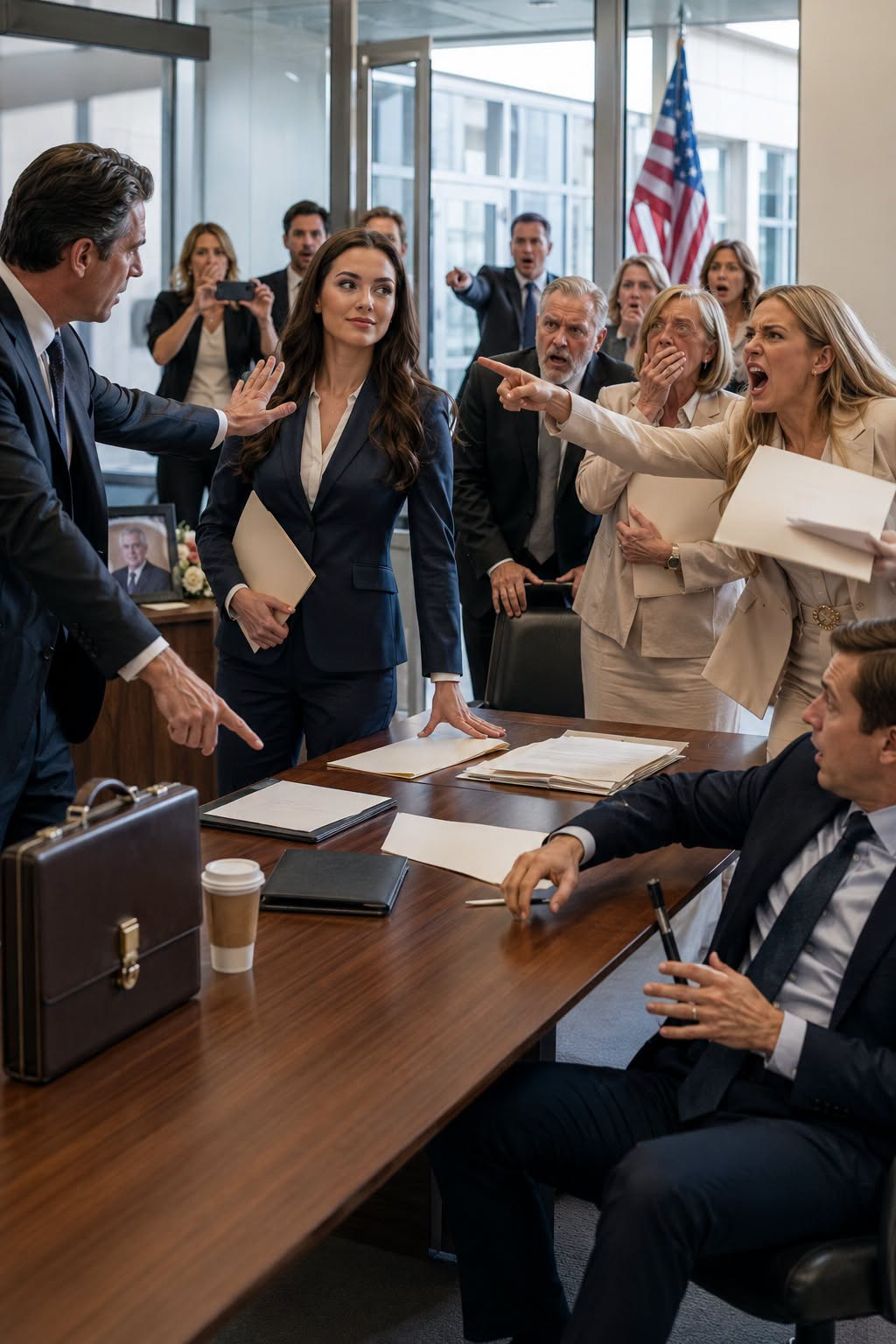
My Sister Inherited Everything While I Got a Patch of Dirt—Then My Worthless Land Made Me a Millionaire, and She Came Back Demanding Her Cut
My Father Left My Sister Everything In His Will—House, Money, Business. I Got Nothing. But One Year Later, I Became A Millionaire, And Now She’s Threatening To Sue Me For…
### Part 1
My name is Ethan Whitaker, and when my father died, my sister walked out of the lawyer’s office with the house, the company, the investments, and almost every polished piece of the life he had spent forty years building.
I walked out with fifteen acres of rocky dirt on a ridge outside a small Pennsylvania town, the kind of land people drove past without slowing down, the kind of land fathers left to sons when they wanted the world to know exactly how little that son mattered.
At least, that was what everyone thought.
My sister, Camille, certainly thought so. She was four years older than me, perfectly dressed even in grief, sitting across from me in the lawyer’s conference room with her knees angled to the side and her fingers folded on top of a leather notebook she did not need. Every time another asset went to her, her mouth tightened in that practiced expression people use when they are pretending not to smile.
The family home on Willow Creek Road went to Camille.
Whitaker Development, my father’s construction company, went to Camille.
The investment accounts, retirement funds, equipment yards, vehicles, and commercial properties went to Camille.
Then the attorney, Mr. Harlan Reeves, cleared his throat and said, “And to my son, Ethan Whitaker, I leave my parcel of land located on Old Quarry Ridge, approximately fifteen acres, recorded under parcel number 91-437-B.”
For a moment, the room went so quiet I could hear the old wall clock ticking behind Mr. Reeves’ desk.
Camille lowered her eyes to the table, but not before I saw the corner of her mouth twitch.
Old Quarry Ridge.
Everybody in our town knew that place. It was a scrubby stretch of uneven ground with poor drainage, jagged rock outcroppings, and soil so stubborn that even weeds seemed to grow there out of spite. My father had bought it decades ago, supposedly thinking he might develop it someday, then abandoned the idea after surveyors told him it would cost too much to make it useful.
“That’s it?” I asked, though I already knew the answer.
Mr. Reeves looked uncomfortable enough to loosen his tie. “That is the full real estate bequest made to you, yes.”
Camille let out a tiny breath that sounded almost like a laugh.
“Well,” she said, leaning back in her chair, “Dad always did have a sense of humor.”
I turned my head slowly toward her.
She gave me a soft, fake look of sympathy. “Don’t take it so hard, Ethan. You always liked playing with dirt, didn’t you?”
I did not answer.
That was what my life in the Whitaker family had always been reduced to. Camille was the builder. I was the boy with mud under his fingernails, rocks in his pockets, and questions nobody wanted to answer.
Our father, Martin Whitaker, had built Whitaker Development from one pickup truck and a borrowed concrete mixer into one of the most respected regional construction companies in the county. He had started with home additions and roofing jobs, then moved into commercial developments, municipal buildings, and roadwork contracts. People in town said his handshake was better than a signed agreement.
Camille loved that world from the beginning. As a kid, she sat at the kitchen table next to him with highlighters and graph paper while he reviewed bids. At fourteen, she could read a profit-and-loss statement better than most adults. At sixteen, she was already correcting subcontractor invoices. By the time she finished college, she had an office in the company building with her name on the door.
I was different.
I used to stand at road cuts and stare at the bands of earth exposed by machinery. Red clay, gray shale, limestone, sand pockets, strange little glittering flakes that caught the sun if you turned them the right way. I liked knowing what was underneath things. I liked understanding why the ground shifted, why water collected, why certain stones cracked clean while others crumbled in your hand.
My mother, Ellen, was the only person who treated that curiosity like a gift instead of a defect.
“Your brain just walks in a different direction,” she used to tell me, smiling as she wiped dirt off my cheek with her thumb.
My father was never cruel about it when I was young, but he was never proud either.
“Rocks don’t pay invoices, Ethan,” he would say, not angry, just disappointed in advance. “Buildings do. Roads do. Men who know how to make things happen do.”
When I chose environmental geology instead of construction management, the gap between us became a canyon.
He wanted me at the local college, studying business and working summers at Whitaker Development. I chose a university in Colorado, where the mountains looked like they had been cracked open to show God’s handwriting.
The night I told him, he stood in the kitchen under the buzzing ceiling light and stared at me like I had spit on the family name.
“You have a place here,” he said. “Most people would be grateful.”
“I am grateful,” I said. “But I don’t want to run construction sites. I want to study land before people build on it.”
Camille was leaning against the counter behind him, arms crossed, one eyebrow lifted.
Dad snorted. “So you want to become one of those consultants who gets paid to tell real workers what they already know?”
I looked at my mother, but she was staring down into the sink, her hands wrapped around a dish towel.
“I want to do work that matters,” I said.
My father’s face went still.
“And what do you think I’ve been doing all these years?”
That was the moment I lost him, I think. Not all at once, not in a dramatic explosion, but in the quiet way a door closes when nobody slams it.
After I left Pennsylvania, phone calls became shorter. Holiday dinners became careful and stiff. Camille became the dependable child, the one who stayed, the one who knew the employees and the clients and the secrets behind every contract.
I became the visitor.
When my mother died suddenly five years before Dad, the last soft bridge between us disappeared. I came home for the funeral and stood beside Camille in the front pew while my father stared straight ahead, stone-faced and unreachable. After that, he and I spoke once a month, sometimes less, mostly about weather, work, and whether I was “keeping busy.”
Camille, meanwhile, moved closer and closer to the center of his life.
She handled appointments. She handled accounts. She handled the company. She handled him.
I did not understand until much later how skillfully she also handled the story of me.
“Ethan doesn’t really want to be part of this family.”
“Ethan always thought he was too smart for us.”
“Ethan chose dirt over Dad.”
Maybe she never said those exact words. Maybe she did. By the time I heard versions of them from old family friends, the damage was already done.
Then Dad got sick.
Camille called me on a gray Tuesday morning while I was preparing for a field survey outside Boulder. I remember the smell of coffee in my rental truck, the dusty clipboard on the passenger seat, and the way my phone vibrated against the console like an insect trapped under glass.
“Dad has late-stage cancer,” she said when I answered. No hello. No easing into it. “The doctor says weeks. Maybe a month.”
I was on a plane before sunset.
By the time I reached the hospital, my father had already shrunk into someone I barely recognized. The man who once carried lumber on his shoulder and barked orders over bulldozers lay under thin white blankets, his wrists fragile, his skin waxy beneath the fluorescent lights.
Camille sat in the corner scrolling through her phone.
“He’s been sleeping most of the day,” she said. “Don’t expect a big reunion scene.”
For two weeks, I sat beside his bed and waited for words that never came.
Sometimes his eyes opened and moved toward me, but I could not tell if he knew who I was. Once, I thought he squeezed my hand. Another time, he whispered something I could not understand, and when I leaned closer, Camille stepped into the room and said, “The nurse needs to check him.”
He died just after dawn while Camille was at home.
I was the one holding his hand.
The nurse said softly, “Sometimes they wait until the room is quiet.”
I wanted that to comfort me, but it did not.
At the funeral, men I barely knew cried harder than I did. Former employees lined up to tell stories about my father paying hospital bills, saving jobs, forgiving mistakes, lending money, mentoring boys who had no fathers of their own. They spoke about a generous, loyal, complicated man, and I sat there feeling like I had missed the entire middle of my own father’s life.
Three days later, the will told me exactly where I stood.
Camille got the empire.
I got the dirt.
But just as the meeting ended, Mr. Reeves slid a sealed envelope across the table.
“Your father left this for you privately,” he said.
Camille’s eyes flicked toward it.
I put the envelope in my jacket pocket without opening it.
On the steps outside, Camille adjusted her sunglasses and said, “You shouldn’t look so wounded. You made your choice a long time ago.”
I looked at her, waiting.
She smiled faintly. “Dad gave the company to the child who stayed.”
Then she walked away.
I stood there with the April wind cutting through my suit, my inheritance nothing but useless land and a sealed envelope burning against my chest.
And for the first time since my father died, I felt something sharper than grief.
I felt like he had judged me from the grave.
### Part 2
I did not open the envelope until almost midnight.
My hotel room smelled faintly of cleaning spray and old carpet, and the little lamp beside the bed threw a yellow circle of light over the comforter. I had taken off my suit jacket, then put it back on, then taken it off again. The envelope sat on the desk like something alive.
My name was written across the front in my father’s blocky handwriting.
Ethan.
No “son.” No “dear.” Just my name, pressed so hard into the paper the pen had nearly cut through.
When I finally tore it open, my hands were steadier than I expected.
Inside was one sheet of paper.
Ethan,
Sometimes the thing people laugh at is the thing they never bothered to understand.
Trust what you studied.
Look beneath the surface.
Dad
That was all.
I read it once.
Then again.
Then a third time, slower, as if the paper might change if I gave it enough attention.
No apology. No explanation. No “I loved you.” No “I should have listened.” Just a riddle written by a dying man who had spent most of my adult life making me feel like my education was a fancy waste of time.
I laughed once, and it came out ugly.
“Look beneath the surface,” I muttered to the empty room. “Of course.”
I almost threw the letter away.
Instead, I folded it carefully and put it in my wallet.
The next morning, I rented a dusty blue sedan and drove toward Old Quarry Ridge.
The road bent north of town, past brown fields, old barns, and houses set far back from the pavement. I had not been out that way since I was a teenager. The ridge rose slowly out of the farmland, a long stony back under the white spring sky.
The entrance to the property was easy to miss. A rusted chain hung between two leaning posts, and an old sign warned people to keep out, though half the letters had faded into pale ghosts.
I parked by the roadside and climbed over the chain.
At first glance, the land was exactly as worthless as everyone believed.
Scrub brush snagged my jeans. Dead leaves crackled under my boots. The ground dipped and heaved unpredictably, and runoff had carved shallow channels through the clay. On the southern end, thin trees grew close together, their trunks twisting toward the light. On the north side, gray and reddish rock pushed out of the earth in jagged shelves.
But after ten minutes, my anger began to lose its grip.
Professional habit took over.
I stopped seeing the land as an insult and started seeing it as a question.
The drainage was poor, yes, but not random. Water collected along a slight depression that ran diagonally across the property. The rock formations were not ordinary either. Their layering was strange for that part of Pennsylvania, and in several exposed sections, I saw streaks of reddish-purple mineral staining that made me crouch down immediately.
I rubbed soil between my fingers. It was dense, gritty, and oddly heavy.
Near one outcropping, tiny dark crystals glittered in the seam of broken stone.
I took out my phone and photographed everything.
By the time I reached the highest point of the ridge, my shirt was damp beneath my jacket and my hands were stained red-brown. Below me, the valley spread out in soft farmland and silver roads. The town looked peaceful from that height, as if families there did not quietly measure the worth of their children in boardrooms and hospital rooms.
I sat on a rock and unfolded Dad’s letter again.
“Trust what you studied.”
The words irritated me and pulled at me at the same time.
Had he known something?
Or was I so desperate for meaning that I was turning a cruel inheritance into a treasure hunt?
I spent four hours on that land.
I collected soil samples in empty water bottles, labeled them with tape from my trunk, and took enough pictures to drain my phone battery. Then I drove to the public library and searched the county’s geological records on a computer that hummed like it was older than I was.
Most of what I found matched what I expected. Limestone, shale, old sedimentary formations, nothing remarkable.
Then I found a scanned report from the late 1960s.
It was poorly formatted, full of faded maps and technical language, but one paragraph made me sit up straight.
A narrow mineral anomaly had once been recorded along the ridge line north of town. The report mentioned unusual concentrations of rare elements in isolated samples, though no follow-up had been funded because the area was considered commercially unpromising at the time.
Rare elements.
Isolated samples.
Ridge line north of town.
I wrote down the report number, printed the map, and stared at it until the librarian announced they were closing.
That night, back in my hotel room, I emailed my photographs, notes, and rough sample locations to Dr. Malcolm Pierce, my graduate advisor from Colorado. He was semi-retired by then, but he still answered emails faster than anyone I knew when geology was involved.
I expected a reply in a few days.
He called me ninety minutes later.
“Ethan,” he said, and the sound of his voice made me sit up. “Where did you get these samples?”
“My father left me a piece of land in Pennsylvania,” I said. “Why?”
There was a pause.
“I can’t confirm anything from photographs, and I do not want you getting ahead of yourself,” he said, which was exactly what professors said when they were already ahead of themselves. “But the staining and formation pattern are interesting.”
“Interesting how?”
“Possibly rare earth mineralization. Maybe nothing commercially meaningful. Maybe something very meaningful.”
The room seemed to tilt slightly.
“Rare earths?” I repeated.
“Neodymium, dysprosium, possibly terbium indicators, but again, that is only visual speculation,” he said. “You need a proper survey. Core samples. Lab analysis. Confidentially, Ethan. Do you understand me?”
I looked at the folded letter on the desk.
“Yes,” I said. “I understand.”
After we hung up, I did not sleep.
I kept thinking about my father sitting in some doctor’s office six months before his death, signing a will that gave Camille everything obvious and left me the one thing only I would think to examine.
The next morning, I called three geological testing companies.
The first had a six-week wait.
The second wanted more money than I had available.
The third, Keystone Geological Services out of Harrisburg, had a cancellation and could send a crew in twelve days.
The survey would cost almost nine thousand dollars.
That was most of my savings.
I booked it anyway.
For the next twelve days, I lived between my hotel, the county records office, and Old Quarry Ridge. I mapped the property in sections. I researched mineral rights. I checked historical ownership documents. I studied old aerial photographs until my eyes burned.
Camille called once during that time.
I stared at her name on my phone for three rings before answering.
“Are you still in town?” she asked.
“For now.”
“I need you to sign a few remaining estate forms at Reeves’ office.”
“I already signed what they gave me.”
“There are always more forms,” she said, impatient. “Some of us are trying to keep Dad’s company running.”
There it was again. Some of us.
I said, “Email them.”
She was quiet for a beat. “You’re not still upset about the land, are you?”
I looked out the hotel window toward the dark outline of the ridge.
“No,” I said slowly. “Not the way you think.”
She laughed lightly. “Well, don’t get too attached. Maybe somebody will buy it for hunting someday.”
After she hung up, I realized my hand was shaking.
Not from anger this time.
From possibility.
And that scared me more than disappointment ever had.
### Part 3
The Keystone crew arrived on a cold morning with two trucks, portable drilling equipment, cases of instruments, and the kind of cheerful indifference professionals have before they realize a routine job might not be routine at all.
Their lead geologist, a compact woman named Dana Mercer, shook my hand at the gate and said, “You mentioned possible anomalous mineralization?”
“I mentioned visual indicators,” I said. “I’m trying not to sound insane.”
She smiled. “That’s usually how interesting projects start.”
For two days, the crew moved across Old Quarry Ridge like surgeons examining a stubborn patient. They drilled shallow cores, collected deeper samples, ran conductivity tests, scanned exposed rock faces, and marked the ground with little flags that fluttered in the wind.
At first, Dana’s face remained professionally blank.
By the afternoon of the second day, she had stopped making small talk.
That told me more than words could have.
When they packed up, she stood beside one of the trucks and looked toward the northern outcropping where the rock carried that strange reddish-purple cast.
“Preliminary field readings are unusual,” she said carefully.
“How unusual?”
She glanced at her crew, then back at me. “Enough that I would advise you not to discuss this with neighbors, relatives, potential buyers, or anyone who does not have a legal reason to know until the lab work is complete.”
My throat went dry.
“How long?”
“Ten days for preliminary lab results. Three weeks for the full report.”
Those ten days stretched longer than the two weeks I had spent beside my father’s hospital bed.
Grief had a shape. Waiting did not.
I returned to Denver only long enough to put my consulting projects in order, tell my manager I had family property matters to handle, and pack more clothes. I did not tell anyone the truth. Not yet. The discovery still felt too fragile, like speaking it aloud might scare it underground again.
When the preliminary report arrived, I opened it alone in my rental house kitchen with the blinds closed.
The executive summary was only two pages.
I read the first paragraph and had to grip the edge of the counter.
The samples showed commercially significant concentrations of rare earth elements across multiple zones of the property. Neodymium. Praseodymium. Dysprosium. Terbium. The estimated recoverable material, based on early sampling, could place the raw deposit value in the tens of millions.
Tens.
Of millions.
I sat down on the kitchen floor because my knees forgot their job.
For several minutes, I did nothing but listen to the refrigerator hum and the traffic passing outside.
Then I took out my father’s letter.
“Sometimes the thing people laugh at is the thing they never bothered to understand.”
I pressed the paper flat on the floor beside the report.
“Dad,” I whispered, “what did you know?”
That question became its own kind of haunting.
I hired a second firm to verify Keystone’s findings. Then a third consultant to review both reports. I retained an environmental attorney named Nora Leland, who had experience with mineral rights, land-use restrictions, and responsible extraction projects. She was blunt, sharp, and not easily impressed.
When she finished reviewing the reports, she removed her glasses and said, “You understand every mining company that hears about this will try to buy the land quickly and cheaply.”
“I assumed that.”
“No,” she said. “You assumed they would make offers. I am telling you they will try to convince you that control is a burden and cash is freedom. Do not believe them.”
I liked her immediately.
Within a month, despite confidentiality agreements, whispers began to move.
A man I did not know left a voicemail offering to buy the land for “recreational use.” A regional developer sent an inquiry through a third party. Two mining companies contacted Nora within forty-eight hours of each other, both with polite language and aggressively low valuations.
The first serious written offer was eleven million dollars.
I stared at the number for a long time.
A year earlier, I had been carefully budgeting grocery trips in Denver. Now someone wanted to pay me eleven million dollars for land my sister had mocked in a lawyer’s office.
I almost said yes.
Then I drove to Old Quarry Ridge.
The trees were fuller by then, the spring leaves bright and thin enough for sunlight to pass through them. I walked to the highest outcropping and stood where I had first realized the soil felt wrong in my hand. From there, I could see the town where my father had built houses, sidewalks, storefronts, and a name people spoke with respect.
If I sold the land outright, I would become rich.
If I kept control, I might build something.
That thought frightened me because it sounded like my father.
Nora helped me assemble a team. A sustainable extraction engineer. A financial advisor with experience in resource development. A community relations consultant. A retired regulator who understood permitting. Every meeting revealed another layer of complexity: water use, truck routes, environmental protections, worker safety, processing agreements, long-term restoration.
For the first time in my life, my geology background and my father’s world of building things stood in the same room and stopped fighting.
I formed Whitaker Earth Resources with a simple rule written into our operating documents: no extraction decision could override environmental safeguards for short-term profit.
Several potential partners walked away when they saw that clause.
One executive actually laughed during a video call and said, “You’re sitting on a once-in-a-generation deposit, Mr. Whitaker. Don’t let sentimental land ethics get in the way of wealth.”
I ended the call.
Two weeks later, I met with Northline Materials, a mid-sized company with a strong record in targeted extraction and land restoration. Their CEO, Adrian Cole, walked the property with me for three hours in muddy boots and asked more questions about drainage than profit margins.
“This ridge doesn’t need to be destroyed,” he said, crouching near a rock seam. “It needs to be understood.”
That was the sentence that made me choose them.
Negotiations were brutal. Northline wanted operational control. I refused. They wanted a larger profit share. I refused again. Nora called me stubborn. Adrian called me cautious. My financial advisor called me “emotionally attached to dirt.”
Maybe I was.
In the end, Northline agreed to fund initial development in exchange for forty-nine percent of operational profit over twenty years. I retained majority ownership and final authority over environmental and community-impact decisions. The contract also required local hiring, road improvements, continuous land restoration, and independent monitoring.
When I signed the final agreement, I thought I would feel triumphant.
Instead, I felt quiet.
The conference room overlooked the ridge, and the late afternoon sun turned the exposed rock almost purple. Everyone shook hands. Cameras clicked for internal records. Papers slid into folders.
I stood there holding the pen and remembered Camille’s voice.
“You always liked playing with dirt, didn’t you?”
By autumn, the first phase of operations began.
We did not blast the ridge open. We used targeted extraction, careful mapping, and restricted access zones. We hired local workers, including several former Whitaker Development employees who seemed unsure whether to call me Mr. Whitaker or Ethan.
The first month was chaos.
Permits, equipment delays, public meetings, questions, rumors, inspections, pressure, mistakes, corrections. I worked twelve-hour days and still woke up at night thinking of things I had missed.
Then the first processed shipment went out.
The revenue exceeded projections by almost thirty percent.
Rare earth prices had risen again, and domestic supply contracts were more valuable than anyone had expected. By the end of winter, Whitaker Earth Resources was valued on paper at more than forty million dollars.
My personal net worth became a number so large I could not connect it to myself.
I still lived in a rented two-bedroom house with uneven floors.
I still drove the same dented truck.
I still ate dinner over the sink some nights because exhaustion made plates feel optional.
But everything had changed.
People in town who used to say, “That’s Martin Whitaker’s boy, the one who moved out west,” now said, “That’s Ethan Whitaker, the one who found what was under the ridge.”
The attention made me uncomfortable.
The silence from Camille made me more uncomfortable.
At first, I assumed she was too busy running Whitaker Development to care. Then I started hearing things.
A supplier mentioned she had fallen behind on payments.
A former project manager told me several long-time employees had quit.
A banker I knew socially said, with careful vagueness, that construction lending had become “complicated” for some local firms.
I did not ask directly. I told myself it was none of my business.
Then, one rainy morning in March, I walked into my office and found Camille sitting in the reception area.
She wore a cream-colored coat, pearl earrings, and a smile so polished it could cut glass.
“Hello, Ethan,” she said. “I think it’s time we talk like family.”
And just like that, I knew the dirt had finally become valuable enough for my sister to remember we shared a last name.
### Part 4
Camille rose from the reception chair as if she owned the building and had simply been waiting for the staff to notice.
My assistant, Megan, looked from her to me with the careful expression of someone who could smell trouble but had not yet been introduced to it.
“It’s fine,” I said. “We’ll use my office.”
Camille followed me down the short hallway, her heels clicking against the concrete floor. I had chosen the office space for practicality, not performance. The walls were lined with maps, sample charts, framed permits, and one photograph of Old Quarry Ridge taken at sunrise. My desk was plain. My chairs were comfortable but not expensive. Nothing in the room announced millionaire.
Camille noticed that.
“Very understated,” she said, glancing around.
“I’m not sure if that’s a compliment.”
“It is,” she said smoothly. “Dad always hated unnecessary flash.”
That was her first move. Dad.
I sat behind my desk and waited.
She lowered herself into the chair opposite me, crossed one leg over the other, and looked at me as if we were siblings who had met for lunch every week for the last decade.
“You’ve done something impressive here,” she said. “I’ll give you that.”
“Thank you.”
“I mean it, Ethan. Really.” She smiled. “Turning that old ridge into this kind of operation? I don’t think anyone saw that coming.”
“No,” I said. “Not everyone.”
A tiny crease appeared between her brows.
She recovered quickly. “I’ve been thinking about Dad a lot lately.”
“So have I.”
“He would have wanted us to support each other,” she said.
There it was. The second move. Family.
I leaned back. “Camille, why are you here?”
For a second, irritation flashed through her face, bright and honest. Then the smile returned.
“Whitaker Development is going through a difficult period,” she said. “Nothing unusual in construction, of course. Rising material costs, labor shortages, cautious clients, banks getting nervous about perfectly viable projects.”
I had heard enough from other people to know she was sanding the truth down until it looked harmless.
“That sounds stressful,” I said.
“It is.” She looked toward the window. Rain streaked the glass, bending the view of the equipment yard outside. “But it’s also an opportunity. Your operation needs infrastructure. Roads, maintenance buildings, drainage systems, worker facilities. Whitaker Development has decades of experience building in this region.”
“We already have contractors.”
“Contracts can be changed.”
“Not easily.”
“Everything can be renegotiated if there’s enough value on the table.”
There she was.
Not grieving daughter. Not concerned sister. Operator.
Camille leaned forward, her voice warming as if she were offering me a gift.
“Think about it. Whitaker Development and Whitaker Earth Resources working together. Dad’s two legacies combined. You handle the land. I handle the building. We keep everything in the family.”
I did not answer immediately.
Because part of me, the old part, the younger part, wanted that to be real. I wanted to imagine Dad’s children finally standing on the same side of a table, building something that did not require one of us to shrink so the other could shine.
But I had learned to listen beneath words.
“What do you actually need?” I asked.
Camille’s eyes cooled slightly. “Capital.”
“How much?”
“Five million would stabilize operations and allow us to pursue several pending contracts.”
I almost laughed.
Not because five million was small. It was not. It was an absurd amount of money to ask from a brother she had not called once to ask how he was surviving grief.
“And what would I receive?”
She waved one hand. “Equity terms can be discussed later.”
“No. They can be discussed now.”
Her jaw tightened. “You have become very formal.”
“You arrived at my office asking for five million dollars.”
“I arrived asking my brother for help.”
“You arrived after telling me Dad gave the company to the child who stayed.”
The room changed.
Her face hardened, and for the first time that morning, the polite mask slipped.
“I was grieving,” she said.
“So was I.”
“You weren’t here for years, Ethan.”
“No,” I said quietly. “I was invited out of the family one disappointment at a time.”
She looked away.
I thought maybe that landed somewhere human.
Then she said, “You know this inheritance wasn’t balanced.”
I stared at her.
She continued, voice sharpening. “Dad could not have understood the value of that land. If he had known it was worth millions, he would never have left almost all of it to you.”
“Almost all of what? You inherited the house, the company, the investments, and everything liquid.”
“And you inherited the asset that turned out to be worth more than all of it combined.”
“Because I knew enough to investigate it.”
“Because you got lucky,” she snapped.
The word hit harder than I expected.
Lucky.
Not trained. Not persistent. Not careful. Lucky.
I opened my desk drawer and took out the plastic sleeve where I kept Dad’s letter. I had not meant to show her. Maybe I wanted to prove something. Maybe I wanted her to know he had not simply tossed me his garbage.
I slid it across the desk.
She frowned, then read it.
The longer she looked at the paper, the paler she became.
“He knew,” she whispered.
“I think he suspected.”
Her eyes lifted slowly. “He gave it to you on purpose.”
“Yes.”
Something bitter moved through her expression.
“He humiliated me,” she said.
I blinked. “He left you an entire company.”
“He made me think I had won,” she said, voice rising. “He let me sit in that room and believe I was the one he trusted.”
“You are angry because you thought I got nothing.”
“I am angry because he deceived me.”
“No,” I said. “You are angry because the thing you laughed at became valuable.”
She stood so fast the chair scraped backward.
“I carried him through his final years.”
“I know.”
“I kept the company alive.”
“Then keep it alive.”
Her mouth opened slightly.
I stood too, because I suddenly could not bear sitting beneath her judgment.
“I am not giving you five million dollars without terms. I am not transferring contracts because we share DNA. And I am definitely not handing you part of Whitaker Earth Resources because Dad left me land you didn’t respect.”
Camille’s eyes shone, but not with tears. With rage.
“You always thought you were better than us.”
“No, Camille. I thought there might be room for me somewhere.”
She picked up her purse.
“You have no idea what Dad wanted.”
“I have his will.”
“Wills can be challenged,” she said.
The words fell between us like a dropped tool.
For a moment, I heard only the rain hitting the window.
“Are you threatening me?”
“I’m telling you that if there were concealed assets, if Dad’s mental state was questionable, if the estate was settled under incomplete information, there are legal remedies.”
I looked at her across my desk and saw, with a strange calm sadness, that this was not a conversation anymore. It was a bid.
“I think you should leave,” I said.
She walked to the door, then turned back.
“Twenty percent ownership,” she said. “That is my reasonable offer. It keeps this private. It keeps us out of court. It keeps Dad’s name from being dragged through filings and depositions.”
“You want twenty percent of a company you mocked before it existed.”
“I want my fair share.”
“No,” I said. “You want mine.”
Her face went perfectly still.
“My attorney will contact yours,” she said.
After she left, I sat alone in my office while the rain washed the windows and the letter lay open on my desk.
For months, I had wondered whether my father’s final message was about geology.
Now I understood it was also a warning.
Sometimes the most dangerous things in a family were buried even deeper than minerals.
### Part 5
The letter from Camille’s attorney arrived the following Monday in a thick cream envelope that looked expensive enough to have its own ego.
Bradford, Sloane & Pike.
I recognized the firm name. Everyone in our county did. They handled disputes for people who preferred polished conference rooms over raised voices, though the damage was often the same.
Nora read the letter in my office while I paced.
Camille was claiming that Dad had concealed a major asset from the estate valuation, that his illness might have impaired his judgment, and that I had benefited from an unequal distribution based on information not properly disclosed during probate. The letter demanded a “good-faith settlement discussion” and suggested that twenty percent ownership in Whitaker Earth Resources would prevent unnecessary litigation.
Nora finished reading, set the pages down, and said, “It is weak.”
“That’s good.”
“It is also annoying.”
“That’s less good.”
“She probably cannot win on the facts,” Nora said. “Your father signed the will after a competency evaluation. The mineral discovery happened after transfer. You did not conceal what you did not yet have confirmed. And she accepted her inheritance without objection.”
“So we ignore it?”
“No. We respond carefully. But you need to understand something.” She tapped the letter with one finger. “Weak lawsuits can still become expensive, disruptive, and public. Discovery requests. Depositions. Business records. Delays with partners. A cloud over title if she gets aggressive.”
I stopped pacing.
“That is what she wants.”
“Possibly. Pressure.”
I looked out the window toward the ridge. The day was clear, and from my office I could see a line of trucks moving slowly along the service road we had reinforced before operations began.
My father had built roads like that. He had believed in foundations no one saw once the building was finished.
“What would you advise?” I asked.
“As your attorney? Offer a small settlement in exchange for a full release. Not because she deserves it, but because peace sometimes costs less than being right.”
I turned back. “And as a person?”
Nora’s mouth curved slightly. “As a person, I’d be furious.”
That night, I drove to Old Quarry Ridge instead of going home.
The work crews had left, and the access gate was locked behind me. I walked the marked path up to the observation point, where the land had been left undisturbed except for a wooden rail and a narrow gravel walkway. The air smelled like wet stone and pine needles. Somewhere below, water trickled through the drainage channel we had redirected and protected.
I sat on the same rock where I had first opened my mind to the possibility that my father had not insulted me.
The town lights blinked awake in the valley.
I took Dad’s letter out again.
By then the folds were soft from being opened so many times. The paper had a faint crease where my thumb always rested.
“Look beneath the surface.”
I was tired of that sentence and grateful for it.
What was beneath Camille’s lawsuit? Fear, maybe. Pride. Debt. The collapse of a story she had spent her whole life telling herself. She had been the chosen child. The responsible child. The one who knew how the real world worked. Then I had taken the one thing she dismissed and built something larger than the inheritance she thought proved her worth.
That did not excuse her.
But it explained the shape of the knife.
The next morning, instead of authorizing a settlement, I called three people.
The mayor.
The president of the local community college.
A retired foreman who had worked for my father for thirty-one years before leaving Whitaker Development under Camille’s management.
Within a week, I began forming something that had been sitting quietly in the back of my mind since the first revenue reports came in.
The Martin Whitaker Foundation for Land, Trades, and Community Renewal.
It would receive twenty-five percent of my personal distributions from Whitaker Earth Resources, not company ownership, not investor funds, mine. Its purpose would be specific: scholarships for local students in environmental science and skilled trades, grants for small local businesses, land conservation projects, and emergency support for workers affected by industry shifts.
Nora helped structure it so Camille could not claim I was hiding assets or moving ownership to avoid her. Every document was clean. Every transfer transparent. Every commitment voluntary and forward-looking.
“You realize this does not stop her lawsuit by itself,” Nora warned.
“I know.”
“So what is the strategy?”
I looked at the draft foundation charter on the table.
“To stop making my decisions around Camille.”
Two weeks later, I announced the foundation at a public town meeting.
The community center was fuller than I expected. Folding chairs covered the basketball court. The air smelled faintly of floor wax, coffee, and damp coats. Former Whitaker Development employees sat beside teachers, shop owners, township supervisors, parents, and students who looked half curious, half bored.
Camille sat in the back row.
I noticed her immediately.
She wore black, as if attending another funeral.
I stepped to the podium with no notes except my father’s letter folded in my pocket.
“My father built things in this town for most of his life,” I began. “Some were visible, like homes, offices, and roads. Some were harder to see, like jobs, second chances, and the confidence people gained when someone believed they could do good work.”
The room went very still.
I explained the ridge, carefully and simply. I did not exaggerate. I did not turn myself into a hero. I told them Dad had left me land many people considered worthless and a note reminding me to trust what I had studied.
I did not look at Camille when I said that.
Then I announced the foundation.
Scholarships for students who wanted to study geology, environmental engineering, construction trades, land management, and small business operations. Apprenticeship support for young workers entering skilled trades. Conservation funding to protect streams, woods, and farmland. Grants for local entrepreneurs who could show their work would serve the community and create jobs.
“The first scholarship,” I said, “will be named the Ellen Whitaker Memorial Scholarship, after my mother, who believed curiosity was not a weakness just because other people did not understand it.”
My throat tightened unexpectedly.
I paused, swallowed, and continued.
“The second will be named the Martin Whitaker Builders Grant, for students entering the trades, because my father believed honest work could change the direction of a life.”
People began clapping before I finished.
I saw old foremen wiping their eyes. I saw teachers whispering to students. I saw parents leaning forward with the cautious hope of people who had learned not to trust good news too quickly.
And in the back row, I saw Camille staring at me with an expression I could not read.
After the meeting, people crowded around with questions and handshakes. Some thanked me. Some asked how their children could apply. Some told stories about my father I had never heard.
When the room finally thinned, Camille appeared beside the folded chairs.
“This is clever,” she said.
I felt my tiredness settle deep into my bones. “Hello to you too.”
“A public generosity campaign while I’m pursuing legal remedies? Very clever.”
“This is not about you.”
She laughed once. “Everything about this is about me. You named programs after Mom and Dad. You made yourself the noble son. You made me look greedy without even saying my name.”
“I didn’t need to say your name.”
Her eyes flashed.
For one second, I thought she might shout.
Instead, she lowered her voice.
“Do you enjoy this? Watching me lose everything while you play hometown savior?”
That was when I saw the crack underneath the anger.
“How bad is it?” I asked.
She looked away.
For a while, the only sound was the janitor stacking chairs across the room.
Then she said, “Bad.”
The word was so small that it barely reached me.
“Whitaker Development?”
She nodded.
“Payroll is tight. Credit lines are strained. I mortgaged the house to keep two projects moving. Then one client pulled out, and another delayed payment.” Her mouth twisted. “Three senior people left last year, and more followed.”
“Why?”
“They said I changed too much too fast.” She looked at me, defensive even in confession. “I was trying to modernize.”
“Were you listening?”
She did not answer.
That answer said enough.
For the first time in years, Camille looked less like my rival and more like someone standing in the wreckage of a room she had personally set on fire, still insisting the smoke was someone else’s fault.
“I am not giving you twenty percent,” I said.
Her face closed.
“And I am not giving you five million.”
“Then we have nothing to discuss.”
“Yes, we do,” I said. “Drop the legal claim. Open your books to an independent restructuring consultant. If Whitaker Development can be saved responsibly, I’ll help fund an employee retention plan through a loan with strict terms, not a gift. If it can’t be saved, I’ll help protect the workers through the foundation.”
She stared at me.
“No ownership,” I said. “No bailout. No pretending the past didn’t happen.”
Her voice went cold again. “So charity with humiliation attached.”
“No. Accountability with boundaries.”
She picked up her purse.
“You sound just like him,” she said.
I knew she meant it as an insult.
This time, I was not sure it was one.
### Part 6
Camille did not drop the claim.
Not immediately.
Instead, she let her attorney file a petition that made the local paper by Friday.
The headline was restrained, but small towns do not need dramatic headlines. They provide the drama themselves over coffee, in grocery aisles, beside gas pumps, and outside church doors while pretending to ask about the weather.
Whitaker Estate Dispute Raises Questions Over Mineral-Rich Land.
That was enough.
By noon, my phone had fifty-two unread messages.
Some were supportive. Some were curious. Some came from people who had never spoken to me before but suddenly wanted to know whether I had “cheated Camille out of her half,” as if inheritances were pies and fathers were required to slice them evenly.
Nora filed our response, clean and firm.
Dad had been legally competent.
The will had been properly executed.
The land had been valued according to available information at the time of probate.
The mineral discovery was the result of post-inheritance analysis, investment, risk, and expertise.
Camille’s claim, Nora wrote, was speculative, unsupported, and designed to pressure settlement.
But legal truth and public emotion do not move at the same speed.
The hardest part was not the court paperwork.
It was watching my father’s name get pulled through conversations by people who knew only pieces of him.
Some said he must have been unfair.
Some said he must have known exactly what he was doing.
Some said Camille deserved a share because she stayed.
Some said I deserved everything because I discovered the value.
Everyone spoke like the dead could be simplified.
One afternoon, I found myself standing in front of Dad’s grave with the newspaper folded under my arm.
The cemetery was quiet except for wind moving through bare branches. I looked down at his name carved into granite and felt anger rise so suddenly that it surprised me.
“You could have just talked to me,” I said.
My voice sounded too loud among the stones.
“You could have told me what you suspected. You could have told her. You could have told both of us. Instead, you left a riddle and let us tear each other apart over it.”
A crow called from somewhere beyond the fence.
I laughed bitterly.
“Great answer.”
I stayed there until my hands went numb.
The preliminary hearing happened six weeks later in a county courtroom that smelled like old wood and photocopied paper. Camille sat with her attorney at one table. I sat with Nora at the other. We did not look at each other.
The judge listened patiently.
Camille’s attorney argued that the mineral potential should be considered a concealed estate asset because Dad may have suspected value before his death.
Nora argued that suspicion was not valuation, and that Dad had the legal right to leave specific property to a specific heir, especially property whose value required specialized post-transfer work to identify and develop.
Then Nora introduced the letter.
Not dramatically. Not like in movies. She simply submitted it as evidence that Dad intended me to apply my education to the property.
Camille’s attorney tried to twist that into proof of concealment.
The judge frowned.
“So your position,” he said, “is that Mr. Whitaker’s father may have left him a difficult-to-understand asset because he believed his son had the training to understand it, and that this somehow entitles the daughter to ownership after the son successfully did so?”
The courtroom went silent.
Camille’s attorney cleared his throat.
“That is a simplified characterization, Your Honor.”
“It is often useful to simplify things until they make sense,” the judge said.
I looked down at my hands to avoid looking at Camille.
The petition was not fully dismissed that day, but the judge narrowed it severely and ordered both sides into mediation before allowing any deeper discovery.
Nora whispered, “That was good.”
It did not feel good.
It felt like winning a fight nobody should have started.
Mediation took place in a neutral office with beige walls and a table too large for the room. Camille looked thinner than before. Her nails were unpainted. There were shadows under her eyes.
Her attorney opened with money.
Nora opened with law.
They went back and forth for three hours until I felt like my brain had become sawdust.
Finally, the mediator asked to speak with each of us separately.
When he returned from Camille’s room, his expression was careful.
“She is willing to withdraw the ownership demand,” he said, “in exchange for a substantial confidential settlement.”
“How substantial?” Nora asked.
“Three million.”
I stared at him.
Then I laughed.
I did not mean to. It just came out.
“No,” I said.
Nora put a hand near my arm, not touching, just warning.
The mediator said, “Mr. Whitaker, litigation risk—”
“No,” I repeated. “I will not pay my sister three million dollars for laughing at my inheritance, threatening my company, and dragging our father’s name into court because her business is failing.”
The mediator’s mouth tightened.
“What are you willing to offer?”
I looked at Nora.
She gave the smallest nod. My choice.
“I’ll offer what I offered before,” I said. “She drops the claim with prejudice. She opens Whitaker Development’s books to an independent restructuring consultant. If the business can be saved without throwing good money into a hole, I will provide a secured loan on fair terms, with oversight. If the business cannot be saved, the foundation will prioritize assistance for displaced employees, not executives.”
The mediator blinked. “Nothing directly to Ms. Whitaker?”
“No cash. No ownership. No reward for this behavior.”
When Camille heard the offer, she asked to speak to me alone.
Nora did not like it.
Her attorney did not like it.
I agreed anyway.
Camille entered the small conference room and closed the door behind her.
For a moment, neither of us sat.
Then she said, “You really hate me.”
I felt the sentence land in me, but not where she intended.
“No,” I said. “That would require more energy than I have left for this.”
She flinched.
“I was angry,” she said. “I still am. You have no idea what it was like staying with him. Managing the company, the doctors, the house, his moods, his regrets. You got to come in at the end and hold his hand like the devoted son.”
I took a slow breath.
“You’re right,” I said. “I don’t know what those years were like for you.”
Her eyes filled suddenly, and she looked away fast.
“But you don’t know what it was like to be erased from this family while still being alive,” I continued. “You don’t know what it was like to call home and hear politeness where love used to be. You don’t know what it was like sitting at that will reading while you smiled because you thought Dad had finally confirmed I was nothing.”
She whispered, “I didn’t smile.”
“Yes, you did.”
Silence.
Her face crumpled for half a second before she pulled it back together.
“I needed to believe staying meant something,” she said.
“It did mean something.”
“Not enough.”
“That was never mine to fix.”
She sat down slowly.
For the first time, she looked tired enough to be honest.
“I don’t know how to save the company,” she said.
The words changed the air in the room.
Not because they healed anything.
Because they were true.
I sat across from her.
“Then stop pretending you do.”
### Part 7
Camille withdrew the lawsuit two days later.
There was no apology attached to the filing. No heartfelt letter. No sudden embrace in a courthouse hallway. Just a signed agreement dismissing her claim with prejudice, meaning she could not bring it again.
Nora called it a clean win.
I did not.
Clean wins do not leave families looking like flood-damaged houses.
The independent consultant finished reviewing Whitaker Development’s books three weeks later. His report was brutal. Camille had overextended the company, chased projects outside its expertise, alienated senior staff, delayed maintenance on essential equipment, and used personal assets to keep business problems from becoming visible.
But the company was not completely dead.
Not yet.
A larger regional builder offered to acquire its remaining contracts, equipment, and name. They would not keep Camille as president, but they would retain most of the workers and honor several pension obligations that had been at risk.
Camille resisted for ten days.
Then she signed.
The sale did not make her rich. After debts, legal fees, and the mortgage situation, she walked away with enough to live carefully, not extravagantly. The house on Willow Creek Road went on the market. Watching the sign go up hurt more than I expected.
I did not buy it.
People assumed I would.
Camille assumed I might.
But that house had too many rooms full of ghosts, and I had finally learned that not every family thing needed to be preserved simply because it had once been expensive.
The foundation made its first grants that summer.
The Ellen Whitaker Memorial Scholarship went to a high school senior named Mara Keene, who wanted to study watershed restoration because her grandfather’s farm flooded every spring.
The Martin Whitaker Builders Grant went to two students entering electrical and carpentry apprenticeships.
We funded streambank repairs near the elementary school, helped a small machine shop upgrade equipment, and created a worker transition fund for employees affected by the Whitaker Development sale.
At the ceremony, I saw Camille standing near the back.
She had not told me she was coming.
She looked different without the armor of expensive suits and perfect posture. Her hair was pulled back simply. She wore a plain navy dress. She stood with her arms folded, not in judgment this time, but as if holding herself together.
After the students received their awards, she approached me.
“That girl,” she said. “Mara. She reminds me of you.”
I glanced toward the stage, where Mara was laughing with her parents, scholarship certificate tucked under one arm.
“How?”
“The way she talks about mud like it’s a language.”
I smiled despite myself.
Then Camille said, “I’m sorry.”
The words came so quietly that I almost missed them.
I looked at her.
She did not add excuses immediately, which made the apology feel unfamiliar enough to be real.
“I’m sorry for laughing at the land,” she said. “I’m sorry for what I said after the will. I’m sorry for the lawsuit.”
I waited.
Her eyes shone, but she did not cry.
“I spent most of my life thinking Dad’s approval was a ladder,” she continued. “If I stood higher than you, I mattered more. That is ugly, but it’s true. And when the ridge became valuable, it felt like the ladder broke under me.”
I listened, hands in my pockets.
“I don’t expect you to forgive me,” she said.
“Good,” I said softly.
She nodded once, absorbing it.
“I don’t,” I continued. “Not right now. Maybe not ever in the way you want. I can accept your apology without handing you access to my life again.”
Her mouth trembled, but she did not argue.
“That’s fair,” she said.
It was the first time I could remember Camille accepting a boundary without trying to negotiate it.
Over the next year, we became something quieter than reconciled.
Civil.
Occasionally cooperative.
Sometimes almost warm.
She took a job with the regional builder that bought Whitaker Development, not as an executive, but in project coordination. From what I heard, she was good at it when she was not trying to prove she was destined to be queen of the company. She had to earn trust from people who knew exactly how she had lost it.
I respected that more than I wanted to admit.
She also volunteered with the foundation twice a month, reviewing grant applications from small businesses. I did not put her on the board. I did not give her financial authority. I did not let guilt disguise itself as generosity.
But I let her help where help made sense.
One evening in late September, almost eighteen months after Dad died, I met Camille at Old Quarry Ridge.
She had asked to see the operation. Not the office. Not the reports. The land.
We walked the observation path as the sun lowered behind the trees. The extraction zones were carefully contained, and native grasses had already begun growing on restored sections. The air smelled of stone dust, leaves, and the clean metallic edge of approaching rain.
Camille stopped near the highest outcropping.
“So this is where you knew?” she asked.
“Not knew,” I said. “Wondered.”
She looked down at the reddish seam in the rock.
“I would have sold it,” she said.
“I know.”
“I mean immediately. For whatever someone offered.”
“I know that too.”
She laughed once, without bitterness. “Dad knew it as well.”
The wind moved through the trees.
For a while, we stood without speaking.
Then she said, “Do you think he was fair?”
I could have said yes.
I could have said no.
Both would have been too easy.
“I think he was trying to give each of us a test,” I said. “You got what was already built. I got what had to be understood. Maybe he thought that made sense. Maybe he was wrong in ways he didn’t live long enough to answer for.”
Camille nodded slowly.
“Do you hate him?”
I looked across the valley, where the town lights were beginning to glow.
“No,” I said. “But I don’t worship him either.”
That seemed to surprise her.
I pulled Dad’s letter from my jacket pocket. I still carried it more often than I admitted. The paper was soft now, worn at the folds.
Camille looked at it but did not ask to hold it.
“I used to think this letter explained everything,” I said. “Now I think it only explained where to start.”
“And where did it start?”
I looked at the land beneath our feet.
“With dirt,” I said.
For the first time in years, Camille laughed like my sister and not my opponent.
### Part 8
Two years after the will reading, I stood in the new community learning center built on the edge of town and watched students crowd around a table covered with rocks, soil samples, maps, and small models of sustainable extraction systems.
The building had wide windows, polished concrete floors, classrooms for trade programs, a small environmental lab, and a workshop where high school students could learn carpentry, electrical basics, land surveying, and equipment safety before deciding whether college was the only respectable path.
The Martin and Ellen Whitaker Center for Land and Building.
I argued against the name at first.
The foundation board overruled me.
Nora told me to “practice receiving something without turning it into a legal issue,” which was rude and accurate.
The opening ceremony drew half the town. Teachers, contractors, students, parents, local officials, former Whitaker Development employees, and workers from Whitaker Earth Resources filled the hall. There was coffee in paper cups, cookies on folding tables, and a nervous string quartet from the high school playing near the entrance.
I saw Camille arrive with her teenage son, Lucas.
I had not known whether she would bring him. For years, he had been a name in holiday cards and stiff conversations, another person caught in the cold space between adults. Now he was lanky, curious, and carrying a notebook already stuffed with questions.
He walked straight to the geology table.
Camille watched him, then looked at me.
“He’s been reading about mineral processing for three weeks,” she said. “It’s your fault.”
“Good.”
“He asked if he could intern here next summer.”
“He can apply like everyone else.”
She smiled. “I told him you would say that.”
“Then he’s already learning.”
The ceremony began with speeches. The mayor spoke too long, as mayors do. The community college president spoke warmly. A former Whitaker Development carpenter named Roy Benson told a story about my father hiring him after a bad year when nobody else would give him a chance.
Then Camille surprised me by stepping to the podium.
I had not known she planned to speak.
She held the microphone with both hands.
“My father built many things,” she said. “For a long time, I thought inheriting his company meant inheriting his purpose. I was wrong.”
The room quieted.
“Purpose is not a building, or a logo, or a bank account. It is what remains useful after pride has burned away.”
Her eyes found mine briefly.
“My brother Ethan understood something I didn’t. Land has layers. So do families. Sometimes what looks worthless is waiting for the right person to recognize it. Sometimes what looks successful is already cracking underneath. I learned both lessons the hard way.”
A year earlier, I might have braced for manipulation.
This time, I simply listened.
Camille took a breath.
“I am grateful this center exists. I am grateful students in this town will have choices. And I am grateful that my brother protected our father’s legacy even when I confused legacy with ownership.”
She stepped back from the podium before the applause began.
I did not clap right away.
Not because I was unmoved.
Because my throat had tightened too much to move.
When it was my turn, I kept my speech short.
I told the students that curiosity was practical. That skilled work deserved respect. That land remembered everything done to it, good and bad. That wealth without responsibility was just appetite wearing a suit.
Then I unfolded Dad’s letter one last time in public.
I did not read it dramatically.
I simply read the words.
“Sometimes the thing people laugh at is the thing they never bothered to understand. Trust what you studied. Look beneath the surface.”
I looked up at the room.
“My father left me land people thought was useless. I thought, at first, that he had left me his disappointment. I was wrong. He left me a question only my life could answer. I wish he had answered more of my questions while he was alive. I wish our family had been kinder. I wish grief did not turn old wounds into weapons.”
The room was completely still.
“But I have learned that an inheritance is not only what you receive. It is what you refuse to repeat.”
I folded the letter.
“I refuse to repeat silence. I refuse to repeat favoritism. I refuse to measure people only by the work I understand. And I refuse to let valuable things be dismissed just because they arrive covered in dirt.”
After the ceremony, people stayed for hours.
Lucas asked me if neodymium could be separated without harming groundwater, and when I gave him a real answer instead of a simple one, his face lit up. Camille stood nearby, watching him with an expression I recognized from old photographs of our mother.
Later, when the building had mostly emptied, I walked outside alone.
The evening was cool. The sky above town had turned lavender, and the ridge was visible in the distance, dark against the fading light. Somewhere up there, machines rested behind secured gates, native grasses grew over restored soil, and beneath the surface, the earth still held more secrets than any of us could claim to own completely.
Camille joined me on the sidewalk.
For a while, we stood side by side.
“I meant what I said in there,” she told me.
“I know.”
“I also know you still don’t trust me completely.”
“No,” I said.
She nodded. “I’m learning to live with consequences.”
That was all I had ever needed her to understand.
She turned toward the parking lot, where Lucas was waiting with his notebook under one arm.
“See you at the grant review next week?” she asked.
“Yes.”
She hesitated. “Ethan?”
I looked at her.
“Thank you for not saving me from everything,” she said.
Then she walked away.
I watched her go, not with resentment, not with forgiveness exactly, but with something quieter. Acceptance, maybe. The kind that does not open every door again, but stops standing in front of them with a weapon.
I had become a millionaire because of dirt.
That was the part people liked to repeat.
They liked the twist. The shock. The image of my sister walking out with everything shiny while I walked out with land nobody wanted, only for the land to become the most valuable inheritance of all.
But money was never the whole story.
The real inheritance was harder to spend and harder to explain.
It was the understanding that value hides under ridicule. That love can be real and still flawed. That family history can shape you without owning you. That boundaries are not cruelty, even when people call them that because they preferred you easier to control.
I never gave Camille a cut of my company.
I never paid her for the pain she caused herself.
I never pretended the lawsuit had not happened or that one speech erased years of comparison, cruelty, and silence.
But I also did not let bitterness become the only thing my father left behind.
Old Quarry Ridge still changes a little every season. In spring, water runs clear through the protected channels. In summer, students visit with clipboards and too many questions. In fall, the rock faces glow red-purple in the late sun. In winter, snow settles over the restored sections so gently that the whole place looks untouched.
Sometimes I stand at the highest point and think about the day I first climbed over that rusted chain, angry enough to reject the only gift my father had left me.
Then I look down at the soil beneath my boots and remember that I almost walked away before I understood what I was standing on.
That is what I tell the students now when they ask for advice.
“Don’t be too quick to believe other people’s labels,” I say. “Not about land. Not about work. Not about yourself.”
Because sometimes the worthless thing is not worthless.
Sometimes the forgotten son is not forgotten.
And sometimes the dirt everyone laughed at becomes the foundation for a life nobody saw coming.
The End.
THE END!