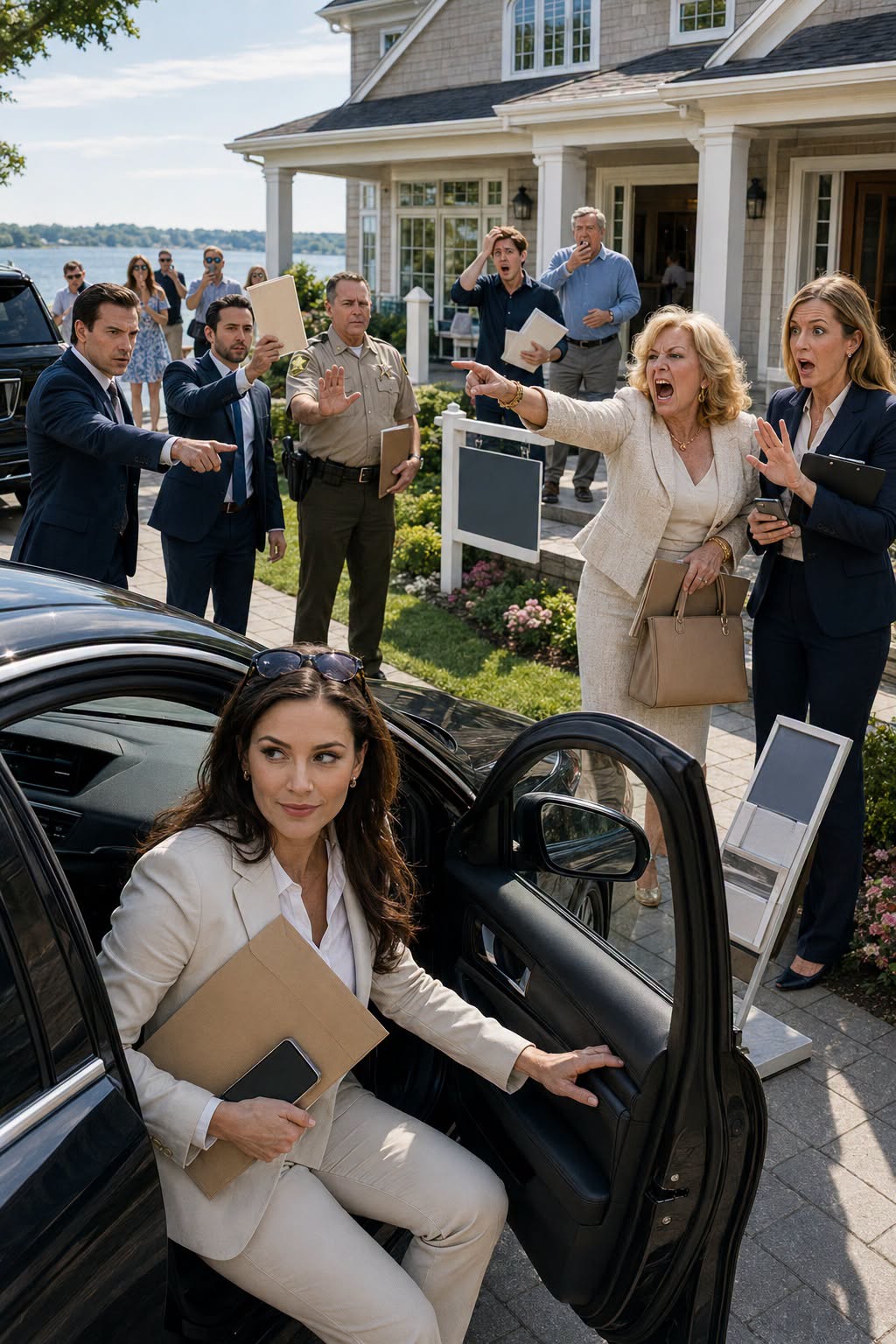
They Tried Selling My Beach House—Then The Real Estate Records Spoke
“This Vacation Home Is Family Property,” Mom Told The Realtor. I Watched From My Car As My Legal Team Arrived. The Property Records Would Silence Them All.
### Part 1
I was halfway through reviewing quarterly reports when my phone rang, and at first I thought about letting it go to voicemail because the numbers on the page already had my whole attention pinned down like a thumbtack.
The rain had been tapping against the office windows since lunch, that thin gray kind of city rain that makes every glass building look tired, and my coffee had gone cold beside my keyboard. I had a red pen in one hand, a stack of expense summaries in front of me, and exactly thirteen minutes before my next meeting when the caller ID lit up with a name I did not recognize.
Harbor & Shore Realty.
For a second, I wondered if it was spam, or maybe one of those agencies that called whenever a property record changed online. I owned one small condo in the city and one beach house three hours south, and neither one was on the market, so I almost ignored it.
Then something made me answer.
“This is Avery Whitcomb,” I said, still looking at the numbers.
A cheerful woman’s voice came through, polished and quick. “Ms. Whitcomb, hello. This is Sylvia Bell from Harbor & Shore Realty. I’m calling about the beach house at 19 Wren Dune Way in Harbor Bend. Your father, Graham Whitcomb, contacted us about listing the property.”
My pen stopped above the paper.
For a moment, the office went silent around me, even though I could still hear phones ringing outside my door and the low hum of printers from the hallway.
“I’m sorry,” I said carefully. “About what property?”
“The beach house at 19 Wren Dune Way,” she repeated, a little slower now. “Your father said it’s a family vacation property, and the family has decided it’s time to sell. He scheduled a walkthrough for tomorrow afternoon. I was calling to coordinate timing, since he mentioned you were one of the family members involved.”
I set the pen down so slowly it barely made a sound.
“There won’t be a walkthrough,” I said.
There was a pause. The kind where the other person smiles less but keeps the professional voice ready.
“Oh. I must have misunderstood. Mr. Whitcomb was very clear that the decision had already been made.”
“My father doesn’t own that house,” I said. “I do.”
Another pause.
This one was longer.
“I see,” Sylvia said, but her voice had lost its shine. “He told us it was a family-held property.”
“It isn’t.”
“He signed our listing agreement this morning.”
My hand tightened around the edge of my desk until my fingertips hurt.
“He signed an agreement to sell a house he doesn’t own,” I said. “You should verify ownership before you do anything else. The county records are public.”
“I’m very sorry for the confusion,” she said quickly. “I’ll contact Mr. Whitcomb and review the documentation.”
“Good,” I said. “And remove that appointment from your calendar.”
After I hung up, I sat there staring at my phone as if it might ring again and explain that the whole thing had been a mistake.
It didn’t.
The rain made soft streaks down the window, and in the reflection, I could see my own face looking back at me, pale and still. I had been angry before. I had been hurt by my family before. But this was different. This was not someone taking the last serving of food, or inviting themselves over, or pretending my boundaries were rude suggestions.
This was my father trying to sell my house.
I pulled up the county recorder’s website with fingers that felt oddly calm. Maybe too calm. The kind of calm that comes when your mind is moving faster than your emotions can catch up.
I typed in the address.
19 Wren Dune Way, Harbor Bend, California.
The record loaded.
Owner: Avery Lark Whitcomb.
Purchase date: April 2020.
Title status: clear.
Liens: none.
Co-owners: none.
Trust ownership: none.
My beach house. Not a family trust. Not a shared inheritance. Not my father’s retirement plan. Mine.
I clicked through every page anyway, because part of me wanted to find the hidden trap before it found me. I checked the deed. I checked the tax records. I checked the mortgage statement in my online files. My name, my signature, my payments, my insurance.
My house.
The one I had saved eight years to buy. The one I had found during a terrifying, uncertain spring when everyone else said real estate was too risky and I should keep cash under my mattress. The one I had renovated one weekend at a time, driving down with paint under my fingernails, a cooler in the back seat, and secondhand curtains folded across my passenger seat.
The one my family had slowly started calling “our beach place” until the word “our” became a hook.
I called my property attorney.
Malcolm Reed answered on the third ring. “Avery? Everything okay?”
“No,” I said. “My father just tried to list my beach house for sale.”
Silence.
Then Malcolm said, “Does he have any ownership interest?”
“None.”
“Power of attorney?”
“No.”
“Trust arrangement?”
“No.”
“Written authorization?”
“No.”
“Then he has nothing,” Malcolm said, but his tone sharpened. “What exactly happened?”
I told him everything.
When I finished, I heard him exhale through his nose. “I’ll send a cease and desist to the brokerage today. I’ll also put together a letter for your father. And Avery, I want you to record a declaration clarifying your sole ownership and occupancy rights. It will not be necessary legally if your title is already clean, but it makes the public record loud enough that nobody can pretend not to hear it.”
“Do it,” I said. “Whatever protects the property.”
After the call, I sat in my office with the quarterly reports still spread out in front of me, but the numbers had turned meaningless.
I remembered my grandmother’s hands, thin and soft, folding over mine in the nursing home three months before she died. I remembered the lavender lotion she liked, the squeak of her recliner, the way she always asked if I had eaten even when she could barely finish half a bowl of soup herself.
I remembered the letter she left me.
And then I remembered my father, signing papers that morning like the house had always belonged to him.
That was when my phone buzzed.
A text from my mother.
“The realtor called your father very upset. What did you say to that woman?”
My stomach sank, not because I was scared, but because I knew that text was only the first wave.
And I was standing on the shoreline with my shoes already wet.
### Part 2
I did not answer my mother right away.
I stared at the message until the screen dimmed, then brightened again when another text came in.
“We are trying to do something good for the whole family, Avery. Don’t make this ugly.”
That was my mother, Marla Whitcomb, in one sentence. She could take a match, toss it into dry grass, and then blame the smoke on the person who coughed.
I called her because texting gave her too much room to pretend she had been misunderstood.
She answered on the first ring.
“Why would you embarrass your father like that?” she demanded before I could say hello. In the background, I heard cabinets closing and a television murmuring too loudly. She was home, pacing through the kitchen, probably gripping a dish towel the way she did whenever she wanted to look wounded.
“Mom,” I said, “Dad tried to sell my house.”
“It is not just your house.”
There it was.
Not surprise. Not denial. Not “What are you talking about?” She knew.
I leaned back in my office chair and closed my eyes for one second.
“It is legally, financially, and factually my house,” I said. “Only my name is on the deed.”
“Your grandmother would have wanted all of her grandchildren to benefit.”
“My grandmother left that money to me.”
“Because you made yourself look like the only one who cared.”
My eyes opened.
That one landed hard, even though it should not have. Some insults do not surprise you, but they still bruise because they come from the person who knows exactly where you are soft.
“I visited Nana Elle twice a week for four years,” I said. “I drove her to appointments. I handled her prescriptions. I sat with her when she was scared. Nolan came twice that last year. Tessa came when she needed photos for her engagement slideshow. You and Dad visited on holidays.”
“People have responsibilities, Avery.”
“So did I.”
“But you were single,” Mom said, as if that explained everything. “You had more time.”
I looked at the framed photo on my bookshelf, the one from Nana Elle’s eighty-sixth birthday. She was wearing a blue sweater and holding a cupcake with one candle in it because the nursing home did not allow open flames for more than a few seconds. I was beside her, smiling with tired eyes after leaving work early and driving through traffic for almost two hours.
“I made time,” I said.
Mom gave a sharp sigh. “This is exactly what I mean. You act like you earned a bigger place in this family.”
“No,” I said. “I earned my own place in Nana’s life. She noticed. That was her choice.”
“And what did you do with that choice? You bought a beach house and dangled it in front of everyone.”
I almost laughed, but it came out empty.
I had not dangled anything.
When I bought the house, I had told them at Sunday dinner. My father had looked over his glasses and said, “A beach house? In this economy?” Nolan had said I should have invested in a fund. Tessa had asked if I was having some kind of early midlife crisis. My mother had been quiet until dessert, then said, “Well, don’t come crying when the roof collapses and you can’t afford it.”
Nobody offered to help.
Nobody even visited the first three months.
Then I painted the walls warm white. Replaced the stained carpet with pale wood flooring. Fixed the deck. Found a carpenter to rebuild the crooked breakfast nook. Hung linen curtains that moved like sails when the windows were open. Suddenly the house was not a mistake. It was a family resource.
The first time my mother called it “our little getaway,” I corrected her.
She smiled as if I had said something childish.
The second time, I corrected her again.
By the sixth time, everyone ignored me.
“You all have used that house more than I have,” I said. “Nolan gave keys to people I’d never met. Tessa hosted half her bachelorette weekend there without asking. Her friends left pink glitter in the bathroom grout and red stains on the couch.”
“It was one accident.”
“It cost me almost two thousand dollars.”
“Tessa offered to help.”
“Tessa sent me a laughing emoji and said, ‘That couch was too pale anyway.’”
Mom went quiet for half a second. Not because she felt guilty. Because she was rearranging the facts in her head.
“Your father and I are getting older,” she said finally. “We have to think practically.”
“By selling my property?”
“We were going to talk to you.”
“After signing a listing agreement?”
“Your father thought it would be easier once there was a professional opinion. He said if you saw the value, you would understand.”
I stood up and walked to my office window. Down below, traffic crawled through the rain. Red brake lights smeared across wet pavement like warning signs.
“What value?” I asked.
Mom hesitated.
That hesitation told me more than her words.
“Mom.”
“We found a place,” she said. “A beautiful retirement community near Rosefield. Your father put down a reservation deposit. We only have a limited time before they release the unit.”
My pulse thudded once, hard.
“How much?”
“That is not the point.”
“How much, Mom?”
She made a small sound of irritation. “Fifteen thousand.”
I gripped the phone.
They had not just imagined selling my house. They had already started spending the money.
“You put a deposit on a retirement home based on the sale of a property you don’t own.”
“It is not some random property,” she snapped. “It came from your grandmother’s money.”
“The money she left to me.”
“Family money.”
“No,” I said. “Her money. Then my money. Then my house.”
“You sound so cold.”
“I sound like someone reading a deed.”
She hated that. I could hear it in the silence.
“Your father is going to the house tomorrow,” she said. “The realtor still needs to see it.”
“No, she doesn’t.”
“Avery, don’t you dare make a scene.”
“At my own house?”
She lowered her voice, which somehow made it worse. “If you humiliate your father, you will regret it.”
I looked at the rain, at the gray line of buildings, at my own reflection standing straight in the glass.
For most of my life, that sentence would have worked on me.
It did not work anymore.
“Tell Dad I’ll see him tomorrow,” I said.
My mother inhaled sharply. “Avery.”
But I had already hung up.
That night, I barely slept. I kept seeing my father’s name on a listing agreement, his hand moving across a line that was meant for an owner. I wondered what he had shown the realtor. I wondered what lie had sounded official enough to make a professional believe him.
At 2:13 in the morning, I got out of bed and opened the old folder where I kept Nana Elle’s letter.
The paper still smelled faintly like cedar from the box where she had stored her things.
On the last page, in her careful, slanted handwriting, she had written, “Do not let them make you feel guilty for receiving what they never made time to earn.”
I read that line three times.
Then I noticed something tucked behind the letter that I had forgotten was there.
A photocopy of an old note my father had once asked Nana Elle to sign.
The top line read, “Family Asset Understanding.”
And suddenly I knew tomorrow was not going to be a misunderstanding at all.
### Part 3
The drive to Harbor Bend usually felt like a reward.
Once I left the city, the highway opened into long, pale stretches of road lined with eucalyptus and low hills, and by the time the first salt smell reached through the vents, I could normally feel my shoulders loosen. I would stop at the same small market for coffee and lemon cookies, then take the coast road where the ocean flashed silver between the houses.
That afternoon, I tasted nothing but anger.
The sky had cleared after the rain, and the sunlight was bright enough to make every windshield glare. My hands stayed fixed at ten and two. In the passenger seat, I had a folder from Malcolm with copies of my deed, tax statements, insurance documents, and the cease-and-desist letter he had already emailed to Harbor & Shore Realty.
Beside it sat Nana Elle’s letter.
I had brought it not because I planned to show it to my father, but because I needed to remember I was not crazy.
My family had a talent for making theft sound like tradition.
When I turned onto Wren Dune Way, the beach house came into view at the end of the lane, weathered cedar siding glowing in the white afternoon sun. The ocean was behind it, hidden by the dunes, but I could hear it faintly, that steady rush and pull like breath.
My father’s car was in the driveway.
So was a dark blue sedan I did not recognize.
And Nolan’s truck was parked crookedly near the curb, one tire half on the dry grass.
I parked behind them and sat for one second, watching through the windshield.
The front door was open.
My front door.
I stepped out, and the salt wind hit my face. Somewhere nearby, a gull cried over the rooftops. The house looked peaceful from the outside, almost innocent, with the porch chairs lined up where I had left them and the white planters full of rosemary and beach grass.
Then I heard voices inside.
“The open floor plan is excellent,” a woman was saying. “Buyers love this kind of natural light. The deck will need minor staging, but the ocean access is a major point.”
I walked in without knocking.
Sylvia Bell stood near the kitchen island with a tablet in her hand. My father was beside her, wearing the navy sweater he always wore when he wanted to look respectable. Nolan leaned against the sliding glass door like he belonged there, arms folded, jaw tight.
All three turned when they saw me.
“There won’t be any staging,” I said from the doorway. “Because there won’t be a sale.”
Sylvia’s face changed first. Embarrassment, then alarm.
“Avery,” my father said, like I had walked into his house uninvited. “I thought you were working today.”
“I was,” I said. “Then I found out you were giving tours of my property.”
Nolan pushed away from the door. “Come on. We don’t need to do this in front of her.”
“No,” I said. “I think we do.”
I looked at Sylvia. “Did you verify ownership after our call?”
She swallowed. “Mr. Whitcomb provided documents that suggested there was family interest in the property.”
“What documents?”
My father’s mouth flattened.
Nolan looked toward the kitchen counter.
That was where I saw it. A tan folder with my father’s handwriting across the tab.
Family beach house.
My stomach turned.
Dad picked up the folder before I could reach it.
“These are private family papers,” he said.
“Not if you used them to misrepresent ownership.”
His face reddened. “Watch your tone.”
I almost smiled. Not because anything was funny, but because some parents never realize their children grow up and stop shrinking at certain words.
“Show her the deed,” I said.
Dad did not move.
“Sylvia,” I said, opening my own folder, “this is the recorded grant deed. You’ll see my name as sole owner. No co-owner. No family trust. No partnership. No transfer agreement.”
Sylvia stepped closer and took the paper carefully, like it might burn her.
Dad said, “That property was purchased with inherited funds.”
“Funds inherited by me.”
“From my mother.”
“Your mother left them to me.”
His jaw twitched.
Nolan cut in. “This is exactly why everyone gets frustrated with you. You keep acting like the rest of us didn’t lose Nana too.”
I turned on him. “Did you visit her?”
He looked away.
“Did you sit with her when she forgot what day it was? Did you go with her to the cardiologist? Did you bring her soup when the nursing home food made her sick? Did you answer the phone at midnight when she was scared because she couldn’t breathe?”
Nolan’s face tightened. “I had kids.”
“You had excuses.”
The words left my mouth before I could soften them.
For one brief second, his expression cracked with something almost like shame. Then it hardened again.
Dad tapped the folder against his palm. “This is not about old grievances. This is about fairness.”
“No,” I said. “This is about you signing a listing agreement for a house you don’t own.”
Sylvia held my deed, her eyes moving quickly across the page.
“Ms. Whitcomb,” she said quietly, “I apologize. I should have independently verified the title before proceeding.”
“Yes,” I said. “You should have.”
Dad snapped, “Don’t speak to her like she did something wrong. I explained the situation clearly.”
“Did you?” I asked. “Did you tell her I agreed to sell?”
He looked at me.
And there it was.
The smallest pause.
Sylvia noticed too.
“You said all family members were aligned,” she said slowly.
My father’s face went from red to a strange gray-pink.
Nolan reached for the folder. “Dad, let’s just go.”
But I was done letting them carry papers out of rooms before I knew what was in them.
“What did you show her?” I asked.
Dad gripped the folder. “Nothing that concerns you.”
“It concerns me if my name is attached to it.”
“It is family history.”
I stepped forward and held out my hand. “Then let the family see it.”
For a second, we stood there in my sunlit kitchen, the smell of salt and lemon cleaner in the air, the ocean rumbling behind the glass doors, and my father holding a folder like it was a shield.
Then Sylvia spoke.
“Mr. Whitcomb,” she said, “if any document was presented as evidence of authority to list this property, I need a copy for compliance.”
My father looked at her as if she had betrayed him.
Slowly, angrily, he opened the folder.
On top was a photocopy of the same “Family Asset Understanding” I had found the night before.
But this copy was different.
At the bottom, under Nana Elle’s shaky handwriting, someone had added a line in darker ink.
“Beach property to be held for the benefit of all Whitcomb descendants.”
My breath caught.
Because Nana Elle had died before I bought the beach house.
And my father knew it.
### Part 4
For a few seconds, nobody moved.
The house seemed to sharpen around me: the white sunlight on the countertops, the faint scratch on the floor near the barstool, the smell of ocean air and old paper, the distant thud of waves beyond the dunes.
I stared at the added line until the words blurred.
“Beach property?” I said.
My father closed the folder. “Your grandmother’s intention was clear.”
I looked up at him. “She died before this house existed.”
Nolan’s eyes flicked toward Dad.
Sylvia went still.
My father’s expression barely changed, but I knew him well enough to see the muscles working in his jaw.
“She knew you planned to buy something,” he said.
“No, she didn’t. I didn’t even know I was buying this house until six months after she died.”
“She wanted her money to help the family.”
“Then why did someone add that line after the fact?”
Dad’s hand tightened on the folder.
Nolan said, “Avery, you’re making a huge accusation.”
“Am I?” I asked. “Or am I reading a document?”
Sylvia looked deeply uncomfortable now. “Mr. Whitcomb, I think I need to withdraw from this appointment immediately.”
Dad turned to her. “This is a family disagreement. You don’t need to overreact.”
“I’m a licensed agent,” she said, voice careful. “I cannot be involved in a listing where ownership authority is disputed, especially after being shown conflicting records.”
“There are no conflicting records,” I said. “There is one legal record. Mine.”
Sylvia nodded once. “I understand. Ms. Whitcomb, again, I apologize. I’ll notify my office that the property is not available for listing.”
She walked toward the door, tablet clutched to her chest.
My father followed her two steps. “Sylvia, wait.”
She did not.
The front door closed softly behind her.
That small sound felt like the first honest thing that had happened all day.
Nolan rubbed both hands over his face. “Great. Now you’ve made Dad look like some kind of criminal.”
“I didn’t make him alter a document.”
Dad’s eyes snapped to mine. “Careful.”
“No,” I said. “You be careful. You showed a realtor a paper implying Nana wanted this property held for everyone, even though the property was purchased after her death. Either you knew that line was meaningless, or you hoped nobody would check.”
He took one step closer. “Your grandmother was my mother.”
“And she chose not to leave the money to you.”
His face changed then.
For years, I had wondered what sat underneath his anger about Nana Elle’s will. I had thought it was disappointment, pride, maybe embarrassment. But standing there in my kitchen, I saw something sharper.
Resentment.
Not because he missed her.
Because she had seen him clearly.
Dad lowered his voice. “You have no idea what it feels like to be cut out by your own mother.”
I thought of Nana’s birthdays where I sat beside her while Dad sent flowers. I thought of the nights she asked me, “Did your father call?” and then pretended not to care when I said no. I thought of all the times she defended him anyway.
“I know what it feels like to show up,” I said.
Nolan made a disgusted sound. “You love holding that over everyone.”
“No,” I said. “You all hate being reminded there was a reason.”
Dad slammed the folder onto the kitchen island. Not hard enough to be violent, but hard enough to make the papers jump.
“We need the money,” he said.
There it was. Not fairness. Not Nana’s wishes. Money.
“For what?” I asked, though I already knew part of the answer.
“Mom and I found a retirement place.”
“You put down a deposit.”
His eyes narrowed. “She told you.”
“She did.”
Nolan looked surprised. “You already put the deposit down?”
Dad ignored him.
“How much were you planning to take from the sale?” I asked.
He stared at me like the question was insulting.
“All of it,” I said softly. “Wasn’t that the plan?”
Nolan shifted. “Dad said the proceeds would be split later.”
I turned to my brother. “Later when?”
He did not answer.
“Dad?” I asked. “Were you going to split it with Nolan and Tessa, or were you going to use it for the retirement unit?”
Dad’s silence moved through the room like cold water.
Nolan looked at him. “Dad.”
“It would have helped everyone eventually,” Dad said.
Nolan’s face changed. Just a little. The first red herring falling apart in front of him.
He had thought he was helping sell my house for his share.
My father had thought he was selling my house for himself.
I almost felt sorry for Nolan.
Almost.
I picked up the tan folder and pulled out the altered note before Dad could stop me.
“This stays with me.”
“No, it doesn’t,” Dad said.
“It was used to misrepresent ownership of my property. My lawyer will want to see it.”
Nolan stepped between us, palms up. “Nobody needs lawyers. Avery, just give him the paper.”
I looked at my brother.
“Three years,” I said. “For three years, I asked you all to stop treating this house like a public park. You gave out keys. You let people sleep here without telling me. You left doors unlocked. You let your friend’s cousin park a trailer in my driveway for a weekend.”
Nolan flushed. “That was one time.”
“Tessa threw a party here and lied about it. Mom brought her church friends for a women’s weekend and told me afterward. Dad just tried to sell the place. So tell me exactly when I should have believed words would be enough.”
Nolan had no answer.
I slid the paper into my folder.
Then I walked to the front door and opened it.
“Both of you need to leave.”
Dad laughed once, bitterly. “You’re kicking your father out of a house bought with his mother’s money.”
“I’m removing a man who tried to sell property he doesn’t own.”
His eyes went hard.
Nolan picked up his keys, but Dad stayed still.
“You think a deed makes you untouchable,” he said.
“No,” I said. “I think it makes me the owner.”
He walked past me so close his shoulder almost brushed mine. Nolan followed, quieter now, no longer performing outrage with the same confidence.
Outside, Dad stopped by his car and turned back.
“Your mother is going to be devastated.”
I stood on the porch, salt wind whipping my hair across my face.
“No,” I said. “She is going to be disappointed that the money was never hers.”
He got into his car without answering.
Nolan lingered for half a second, looking back at the house, then at me. For the first time all day, he seemed unsure who he was angry at.
Then he left too.
I watched both vehicles disappear down Wren Dune Way.
Only when the lane was empty did my hands start shaking.
I locked the door, leaned my back against it, and slid slowly down until I was sitting on the floor of my own entryway, the folder clutched to my chest.
That was when my phone buzzed again.
A text from an unknown number.
“Ms. Whitcomb, this is Sylvia. You need to know your father asked whether the sale could proceed if you were declared uncooperative or unreachable.”
I read it twice.
Then the room seemed to tilt.
Because he had not just tried to sell my house.
He had prepared for me to say no.
### Part 5
I sent the screenshot to Malcolm before I even stood up from the floor.
Then I sat there a while longer, listening to the house settle around me. The refrigerator hummed in the kitchen. The old deck creaked in the wind. Somewhere outside, dry beach grass scraped against the porch posts with a whispering sound that made the silence feel crowded.
My father had asked whether the sale could proceed if I was “uncooperative or unreachable.”
That phrase stayed in my head all evening.
Uncooperative sounded like a difficult woman in a conference room.
Unreachable sounded like someone whose consent could be stepped over because she was inconvenient.
By sunset, Malcolm called.
His voice had that controlled calm lawyers use when they are angrier than they want to sound.
“I have the text from the realtor,” he said. “I also reviewed the altered note you photographed. Do not discuss this further with your father except in writing. Do not take calls unless you are prepared to record them legally, and since you’re in California, assume you need consent. Let everything go through me.”
“What can he actually do?”
“Legally? Very little. Practically? Cause noise. Create confusion. Pressure a careless agent. Claim a promise existed. Make you spend money proving what the records already prove.”
I looked at the darkening windows. The ocean had turned steel blue, and the kitchen lights reflected back at me from the glass.
“He already made a deposit on a retirement place,” I said.
“That explains the urgency.”
“It doesn’t explain the entitlement.”
“No,” Malcolm said. “That part usually predates the paperwork.”
The next morning, a locksmith arrived at nine.
He was a broad, cheerful man named Pete who smelled faintly of metal filings and peppermint gum. He changed every exterior lock, rekeyed the storage shed, and installed a keypad on the side door. I had him disable the old spare key hidden in the fake sprinkler head because my mother knew about it, Nolan knew about it, and probably half of Tessa’s friends knew about it too.
At eleven, a security technician installed cameras facing the driveway, front porch, side gate, and deck stairs. I stood barefoot in the living room while he explained the app, watching each angle appear on my phone.
My house looked different through cameras.
Less like a dream.
More like something that needed defending.
By noon, the family messages started.
Mom: “Your father came home humiliated. I hope you’re proud.”
Tessa: “I cannot believe you accused Dad in front of a stranger. You’ve gone too far.”
Nolan: “You made this worse than it had to be.”
Mom again: “We raised you better than this.”
I did not answer.
Instead, I walked room to room and made a list of everything my family had left behind over the years.
A cooler in the pantry that was not mine. Three beach towels with Tessa’s initials. A cracked plastic dinosaur from Nolan’s youngest child under the guest bed. My mother’s floral mug in the cabinet, the one she always insisted made coffee taste better. Dad’s old fishing hat hanging in the mudroom.
Their things were everywhere.
Not because they owned the house.
Because I had been too tired, too hopeful, or too afraid of seeming mean to remove them.
By late afternoon, I had packed every item into boxes and labeled them by name.
I left them in the garage.
Then I sent one group text.
“All locks have been changed. No one has permission to enter 19 Wren Dune Way without my written approval. Personal items will be available for pickup from the garage this Saturday between 10:00 and noon. The house is not for sale. Do not contact agents, buyers, contractors, inspectors, title companies, or service providers regarding my property.”
The replies came fast.
Mom: “This is cruel.”
Tessa: “You’re acting insane.”
Nolan: “Saturday doesn’t work.”
Dad: “You do not get to erase this family from that house.”
I read that last one while standing in the kitchen where he had tried to make a realtor believe he had authority.
Then I typed back to him alone.
“You tried to erase me from ownership.”
He did not respond.
The next two days were strangely quiet.
Too quiet.
I worked from the beach house dining table, laptop open, legal folder beside me, ocean light moving across the floor as the hours passed. Every now and then, I caught myself listening for tires on the driveway.
On Friday afternoon, the camera app pinged.
Motion at the front porch.
I opened the feed and saw my mother.
She stood at my door wearing a cream cardigan and large sunglasses, holding a paper bag against her chest. The wind pushed her hair across her cheek. For one irrational second, she looked small, like an older woman visiting her daughter.
Then she lifted the doormat and checked under it for a key.
My throat tightened.
She checked the planter next.
Then the porch lantern.
Then she walked to the side gate and tried the latch.
Locked.
A minute later, my phone rang.
Mom.
I let it go.
She called again.
I let it go again.
Then she sent a text.
“I’m outside. Open the door.”
I replied, “No.”
Three dots appeared.
Disappeared.
Appeared again.
“I brought your grandmother’s recipe box. I thought maybe seeing something of hers would remind you who you are.”
I looked toward the shelf where Nana Elle’s actual recipe cards sat in a wooden box I had inherited with her letters.
My mother did not have Nana’s recipe box.
I zoomed in on the camera feed.
The paper bag she held had the logo of a local bakery printed on it.
She had brought pastries.
Not memories.
Not reconciliation.
Bait.
I typed, “Leave the property.”
She looked at her phone on camera, and even through the grainy feed, I saw her face harden.
Then my father appeared from the side of the house.
I sat up straight.
He had been out of view, waiting.
Mom said something to him, and he looked directly at the camera.
Not surprised.
Angry.
My phone buzzed again.
Dad: “Open the door, Avery. We are not doing this through a camera.”
I called Malcolm.
He answered, “What’s happening?”
“My parents are at the house. They were trying to find a key. Dad was waiting around the side.”
“Tell them in writing to leave. If they refuse, call local non-emergency and report trespass. Do not open the door.”
My pulse was fast now, but my voice was steady.
“I already told Mom.”
“Tell both.”
I sent the message.
“You do not have permission to be here. Leave now.”
On camera, Dad read it.
Then he did something that turned my stomach cold.
He took a folded paper from his back pocket and held it up to the camera.
Even from the feed, I could read the large typed words at the top.
“Notice of Family Claim.”
And beneath that, in smaller print, my name.
### Part 6
The police did not come with sirens.
They came quietly, two officers in a white patrol SUV, their tires crunching over the gravel as the afternoon light flattened across the driveway. By then, my parents had been on the porch for twenty-three minutes.
I knew because I had watched every second.
Dad had paced. Mom had cried once, or pretended to. Then she stopped crying when she thought no one was looking and checked her reflection in the dark window beside the door.
That hurt more than I wanted it to.
Not because I believed the tears, but because some small, stubborn part of me still wished they were real.
When the officers arrived, Dad immediately changed posture. Shoulders back, face tired, voice reasonable. The same version of himself he brought to bank appointments and parent-teacher conferences when we were kids.
I watched through the camera as he explained, gesturing toward the house.
The officer listened, then asked a question.
Dad showed him the paper.
The officer read it for less than ten seconds before handing it back.
Then he knocked on my door.
I opened it only after checking his badge through the window.
“Ms. Whitcomb?” he asked.
“Yes.”
He was younger than I expected, with sunburn across his nose and a calm face. His partner stood behind him near the porch steps.
“Your parents say there’s a civil property dispute. They say they have a family claim.”
“There is no family claim,” I said. “I’m the sole owner. I have documents.”
“May I see them?”
I handed him the folder Malcolm had told me to keep ready.
He looked through the deed, the tax statement, my ID, and the attorney letter. His expression did not change much, but something in his shoulders settled.
“This appears to be your property,” he said.
“It is.”
My mother made a wounded sound behind him. “She won’t even speak to us.”
The officer turned. “Ma’am, she doesn’t have to.”
That sentence should not have felt as powerful as it did.
But it did.
Dad stepped forward. “Officer, we are her parents. This house was purchased with inherited family funds. We’re trying to resolve a family matter.”
The officer looked at him. “Do you live here?”
“No.”
“Is your name on the deed?”
Dad’s mouth tightened. “Not currently.”
Not currently.
I almost laughed.
The officer’s eyebrows moved slightly. “Do you have a court order granting access?”
Dad said nothing.
“Then Ms. Whitcomb can ask you to leave.”
Mom looked at me over the officer’s shoulder. Her sunglasses were pushed up on her head now, and her eyes were wet in a way that looked more angry than sad.
“Avery,” she said softly, “is this really who you want to be?”
I thought of all the times that question had pulled me back into line.
When I did not want to host Thanksgiving.
When I refused to loan Nolan money after he never repaid the first loan.
When I told Tessa she could not borrow my car for a weekend trip.
When I asked my parents not to invite people to a house I owned.
Is this really who you want to be?
It meant, “Be easier.”
It meant, “Give us what we want.”
It meant, “You are only good when you are useful.”
I looked at her and said, “Yes.”
Her face changed as if I had slapped the air between us.
The officers waited while my parents left.
Dad walked down the steps first, stiff with humiliation. Mom followed, clutching the bakery bag so hard the paper crumpled. Before getting into the car, Dad turned back.
“This isn’t over.”
The officer beside me said, “Sir, I’d advise you not to return unless invited or ordered by a court.”
Dad got in without answering.
After they drove away, I thanked the officers and closed the door.
Then I stood in the entryway and shook so hard my teeth clicked.
Courage, I learned that day, does not always feel brave while it is happening. Sometimes it feels like nausea and cold hands and the terrifying knowledge that you cannot unknow what people are willing to do to you.
The “Notice of Family Claim” arrived by email the next morning from a lawyer I had never heard of.
Malcolm called it “a decorative threat.”
The letter claimed that I had repeatedly promised my family shared use of the beach house, that my grandmother’s inheritance was intended as a collective benefit, and that my parents had relied on this understanding when making retirement decisions.
“He says they relied on it,” I said, sitting at the dining table with the email open.
“That does not create ownership,” Malcolm replied. “It creates regret.”
“They included screenshots.”
“I saw.”
My stomach dropped. “And?”
“They’re selective. One shows you writing, ‘Of course everyone can enjoy it.’ Another shows, ‘I want this place to feel like home for all of us.’”
I remembered those messages.
The first was from the week after I bought the house, when Mom asked if they could come down for a weekend while I was there.
The full sentence had been, “Of course everyone can enjoy it when I’m hosting, but I’m not handing out keys.”
The second had been from a family thread after I finished the renovation.
The full message said, “I want this place to feel like home for all of us when we gather here, but please remember it is still my home and my responsibility.”
They had cut off every boundary.
Of course they had.
“Can we prove the full context?” I asked.
“Already did,” Malcolm said. “You still have the message history. I need you to export the thread.”
I did.
As the file downloaded, I scrolled through three years of conversations.
My own words appeared again and again.
“Please ask before inviting anyone.”
“No, Nolan, your friend cannot use it for a guys’ weekend.”
“Tessa, you need to cover the cleaning fee.”
“Mom, I am not comfortable with people staying there when I’m not present.”
“Dad, do not give the garage code to anyone.”
A whole history of me saying no politely.
A whole history of them hearing yes anyway.
By the end of the week, Malcolm responded to the claim with a letter so sharp it practically had edges. He attached the deed, the probate record, the purchase documents, the full text threads, the security footage of my parents trying to locate a hidden key, Sylvia’s statement, and the altered “Family Asset Understanding.”
Two days later, their lawyer withdrew the claim.
Not dismissed.
Not defeated in court.
Withdrawn.
Quietly.
Like a hand pulled back from a hot stove.
I expected relief to come rushing in.
Instead, what came was silence.
Mom stopped texting.
Dad stopped calling.
Nolan removed me from the family group chat.
Tessa posted a photo of Sunday dinner with everyone smiling around my parents’ table, and I only knew because a cousin sent it with the message, “I’m sorry. This feels wrong.”
My chair was not empty in the photo.
They had moved the chairs closer together so it looked like I had never belonged there.
That was the moment I finally cried.
Not when they tried to sell my house.
Not when Dad waved a fake claim at my camera.
Not when my mother checked under my doormat for a key.
I cried because they had erased my absence before I had even finished leaving.
### Part 7
Thanksgiving came six weeks later.
No invitation arrived.
Not by text. Not by email. Not through a cousin pretending to be casual. Nothing.
I knew the date, of course. My mother hosted every year at two in the afternoon, which meant she started complaining about the turkey by ten in the morning and blamed the oven by noon. Dad carved at the end of the counter like he was performing a ceremony. Nolan’s kids ran through the hallway. Tessa brought something store-bought and transferred it into one of Mom’s dishes before anyone arrived.
For thirty-four years, that day had a shape.
That year, it had a hole.
I woke up at the beach house to sunlight pouring across the bedroom floor and the sound of waves beyond the dunes. For a few minutes, I stayed under the quilt and let myself feel the ache honestly.
I missed them.
That was the part nobody warns you about.
You can be right and still miss people who hurt you. You can be safer without them and still grieve the version of family you kept trying to build out of scraps.
At nine, I made coffee and opened every window.
The air smelled like salt, rosemary, and the cinnamon candle I had lit in the kitchen. I put on soft music, rolled pie dough across the counter, and told myself I would not spend the day refreshing my phone.
At ten-thirty, my friend June arrived with sweet potatoes and two bottles of sparkling cider. At eleven, her brother Eli came with folding chairs. By noon, three coworkers and one neighbor from down the lane had joined us, carrying side dishes and awkward kindness.
Nobody mentioned my family until we were eating on the deck.
The ocean was bright and restless, throwing light off every wave. Gulls drifted overhead. Someone laughed so hard cider came out of her nose, and for the first time in weeks, I felt my chest loosen.
June touched my arm and said quietly, “You okay?”
I looked through the open doors at the house I had fought to keep.
There were still ghosts in it. Mom’s mug was gone, but I remembered where it used to sit. Dad’s fishing hat was boxed in the garage, but I still glanced toward the hook sometimes. The guest room no longer smelled like Tessa’s perfume, but I could remember the glitter in the grout.
“I’m getting there,” I said.
That night, after everyone left, I washed dishes alone.
My phone buzzed just as I was drying the last plate.
Tessa.
I almost did not answer.
Then I did, because curiosity is not the same as weakness.
“Hello?”
For a moment, all I heard was background noise. Plates clinking. A child laughing. My mother’s voice faintly saying something I could not make out.
Then Tessa said, “Are you really spending Thanksgiving alone to prove a point?”
I looked around the kitchen, still warm from cooking, with leftover pie on the counter and chairs scattered from a table full of people who had chosen to be with me.
“I’m not alone.”
She went quiet.
“Well,” she said, recovering, “Mom cried during dinner.”
“I’m sorry she’s upset.”
“That’s it?”
“What do you want me to say?”
“I want you to understand that this house has destroyed everything.”
I leaned against the counter. Outside, the deck lights reflected faintly in the glass.
“No,” I said. “The house revealed everything.”
Tessa made a frustrated sound. “You always do that now.”
“Do what?”
“Talk like you’re in court.”
“Maybe because everyone keeps acting like feelings can rewrite documents.”
She lowered her voice. “Dad is humiliated.”
“Dad tried to sell my house.”
“He thought he was doing what was best.”
“For himself.”
“For all of us.”
“Tessa,” I said, “did he tell you he was planning to use the sale money for Mom’s retirement unit before he split anything with you and Nolan?”
Silence.
There was my answer.
“What?” she said.
I closed my eyes.
“He didn’t tell you.”
“He said it would be handled fairly.”
“Of course he did.”
The background noise faded, like she had walked into another room.
“Are you saying he lied to us too?”
“I’m saying you should ask him what he planned to do with money from a house he didn’t own.”
She breathed into the phone for a few seconds.
Then, quietly, “Nolan thought we were all getting part of it.”
“I know.”
“And you weren’t?”
“I was getting robbed.”
The word sat there.
Robbed.
Simple. Ugly. True.
Tessa did not argue with it.
For the first time in months, she sounded less angry than uncertain.
“I shouldn’t have had the bachelorette thing there without asking,” she said, almost too quickly, like the apology had been hiding behind other words and slipped out by accident.
“No,” I said. “You shouldn’t have.”
“I thought you’d say yes.”
“You didn’t give me a chance to.”
Another silence.
Then she said, “I’m sorry about the couch.”
It was not enough.
But it was something.
“Thank you,” I said.
She waited, maybe expecting me to soften, maybe expecting the old Avery to rush in and make her discomfort disappear.
I did not.
Finally she said, “So what now?”
“Now I keep my house.”
“And us?”
I looked at the dark window and saw myself reflected in the kitchen, older than I had looked at the beginning of the year, but steadier too.
“That depends on whether you can have a relationship with me without access to my property.”
She did not answer.
When we hung up, I felt sad, but not guilty.
That was new.
Christmas was harder.
My mailbox stayed empty. No card from Mom with a snowflake stamp. No family photo. No invitation to the candlelight dinner Dad always pretended not to enjoy. My cousins were polite but careful, like I had become a subject people stepped around.
On Christmas Eve, my mother called.
I let it ring until voicemail picked up.
Then she called again.
This time I answered.
“Merry Christmas,” she said, voice thick.
“Merry Christmas.”
“I keep thinking about your grandmother,” she said.
I said nothing.
“She would hate this.”
The old Avery would have apologized.
The new Avery walked to the shelf, took down Nana Elle’s letter, and held it in her free hand.
“She hated being ignored while she was alive,” I said. “But everyone got over that.”
Mom inhaled sharply. “That is cruel.”
“No,” I said. “It is specific.”
Her voice hardened. “So this is it? You choose a house over your parents?”
I looked around the living room. The fire was low. The tree in the corner was small but bright, decorated with shells, silver ribbon, and one crooked ornament Nana Elle had made from painted clay.
“I choose not to let my parents take my house,” I said. “There’s a difference.”
Mom cried then.
Maybe for real.
Maybe because crying had always worked before.
Either way, I listened without moving toward surrender.
When she finally whispered, “I don’t know who you are anymore,” I answered, “I’m the person you taught not to trust words without proof.”
She hung up.
I stood there with the dead phone in my hand and Nana’s letter against my palm.
For the first time, the silence after a family call did not feel like punishment.
It felt like space.
### Part 8
A year changed the house.
Not all at once, but in small, steady ways.
I hired a property management company to handle occasional rentals during weeks I knew I would not be there. They used electronic codes that expired after checkout, professional cleaners, signed agreements, deposits, inspections. Every rule my family had treated like an insult, strangers accepted as normal business.
The rental income covered the mortgage.
Then it covered repairs.
Then it started building a separate savings account labeled, simply, “Wren Dune.”
I replaced the couch Tessa had stained. I planted lavender along the front path because Nana Elle had loved the smell. I fixed the outdoor shower, sealed the deck, and turned the smallest bedroom into a reading room with a deep chair facing the dunes.
The house became mine in a way it had not been when everyone else’s expectations were still hanging on the walls.
My family changed too, though not as cleanly.
Nolan was the first to show up differently.
He texted in February.
“I owe you an apology for giving people keys. I acted like it wasn’t a big deal because it was easier than admitting I was wrong.”
I stared at that message for a long time.
Then I wrote back, “Thank you for saying that.”
He asked if he could call.
I said yes.
The conversation was awkward, full of pauses and careful breathing. He admitted Dad had let him believe the sale would benefit all three siblings. He admitted he had been angry at me because it was easier than being angry at Dad.
“I still don’t think Nana should have left everything to one person,” he said.
“I know.”
“But that doesn’t mean I had the right to treat your house like mine.”
“No,” I said. “It doesn’t.”
He asked if he could bring the kids to see me sometime.
“To see me, yes,” I said. “To use the beach house, no.”
Another pause.
Then he said, “Okay.”
And the world did not end.
Tessa apologized in April, properly this time, with no couch jokes and no “but you know how weddings are.” She sent me a check for the old damages even though I had already replaced everything. I deposited it because refusing it would have been another way of protecting her from consequences, and I was done doing that.
Mom took longer.
She sent articles about forgiveness. Quotes about family. Photos from old albums where I was missing front teeth and Dad still had dark hair. I did not respond to most of them.
Then, in late summer, she wrote, “I miss my daughter.”
I sat with that one.
The sentence was simple enough to be dangerous.
I wanted to answer like a daughter. I wanted to say, “I miss you too,” and let the old pattern pull me home by the wrist.
Instead, I wrote, “I am willing to have lunch with you. The beach house is not part of the conversation.”
She did not reply for two days.
Then she agreed.
We met at a small café halfway between the city and Harbor Bend. The place smelled like toasted bread and orange peel, and the tables were too close together. Mom looked older when she walked in, or maybe I was finally seeing the age that had always been there beneath her performance.
She hugged me.
I let her.
Over soup and iced tea, she talked about her garden, Nolan’s kids, Tessa’s new job. I talked about work, the reading room, the lavender. We sounded almost normal if you did not listen too closely.
Near the end, she folded her napkin into a tight square.
“Your father won’t apologize,” she said.
“I know.”
“He thinks he was trying to correct something unfair.”
“He tried to sell my house.”
She looked down. “I know.”
It was the first time she had said those two words without wrapping them in excuses.
I waited.
She said, “I should have stopped him.”
“Yes.”
Her mouth trembled, but no tears came. “I was scared about money. About getting old. About being left behind.”
I softened a little, not enough to forget, but enough to see the fear under the greed.
“Being scared didn’t make the house yours,” I said.
“No,” she whispered. “It didn’t.”
We finished lunch quietly.
When we left, she asked, “Will you ever trust us again?”
I looked across the parking lot at the heat shimmering above the asphalt.
“Not the same way.”
She nodded as if that hurt, because it should have.
Dad never asked for lunch.
He sent one email in October, written like a business memo.
“Avery, your mother would like peace before the holidays. I hope you can put this matter behind us.”
I read it once.
Then I replied, “Peace requires truth. The matter is behind me, but that does not mean I am returning to the old arrangement. You do not have access to Wren Dune. You do not have authority over my property. You do not have my permission to discuss, list, enter, borrow against, or represent any interest in it. If you want a relationship with me, it will begin with respecting that.”
He did not respond.
But he also did not challenge it.
That silence told me more than another argument would have.
The next Thanksgiving, I did receive an invitation.
It came from Nolan, not Mom.
“We’re doing dinner at our place this year. No pressure. No beach house talk. I mean that.”
I went.
Not because everything was healed.
Because I wanted to know whether a new shape was possible.
Dinner was strange but civil. Dad stayed mostly quiet. Mom watched me too carefully. Tessa brought a pie and told me before anyone asked that she had baked it herself. Nolan’s kids hugged me like no time had passed, because children are sometimes kinder than the adults who raise them.
Halfway through the meal, Dad reached for the salt and said, without looking at me, “How’s the house?”
The table went still.
I set down my fork.
“It’s good,” I said.
He nodded.
No one asked to visit.
No one joked about summer weekends.
No one said “our beach house.”
It was a small thing, but I felt it move through the room like a door unlocking from the inside.
After dinner, Mom walked me to my car.
The air was cold enough to fog our breath. Somewhere down the street, a dog barked twice, and porch lights glowed along the quiet neighborhood.
“I’m glad you came,” she said.
“Me too.”
She hesitated. “Your grandmother really did love you.”
I looked at her.
For once, there was no accusation in her voice.
“I loved her too,” I said.
Mom nodded, eyes shining. “I know.”
That was the closest she came to admitting why Nana had chosen me.
I accepted it for what it was.
Not enough to erase anything.
Enough to leave without anger burning a hole through my chest.
Later that night, I drove to Harbor Bend instead of going back to the city.
The beach house was dark when I arrived, waiting behind the dune grass, solid and quiet under a sky full of stars. I parked in the driveway, entered my own code, and stepped inside.
The air smelled faintly of lavender and clean wood.
I turned on one lamp.
The living room glowed softly around me: the pale floors, the new couch, the shelves of books, the small clay ornament Nana Elle had made, now hanging from a hook near the window because I liked seeing it all year.
I walked to the file drawer in the reading room and pulled out the property records.
I did not need to.
I knew what they said.
But sometimes, after years of being told your reality is selfish, dramatic, cruel, or wrong, it helps to look at proof.
Owner: Avery Lark Whitcomb.
Clear title.
No co-owners.
No family trust.
No claims.
The records did not shout. They did not cry. They did not guilt-trip me, rewrite history, or ask me to be the bigger person so someone else could keep being small.
They simply told the truth.
My family had tried to turn my inheritance into their retirement plan, my generosity into permission, and my silence into consent. For a while, I had almost let them, because I thought keeping peace meant keeping everyone comfortable.
I know better now.
Peace is not the absence of conflict.
Sometimes peace is a locked door, a clean deed, a quiet house, and the moment you finally stop explaining ownership to people who only misunderstand because it benefits them.
I did not forgive my father.
Maybe one day I would stop caring enough to call it forgiveness, but I would never hand him back the power to confuse love with access.
I did not cut off everyone forever either.
I built something harder and healthier than that.
A family that could reach me without reaching for my keys.
A mother who could have lunch with me without mentioning the house.
A brother and sister who learned that apologies did not come with guest privileges.
And a beach house that remained exactly what Nana Elle’s final gift had allowed it to become.
Not a family asset.
Not a bargaining chip.
Not a retirement fund.
Mine.
The deed said so.
The records said so.
And finally, so did I.
THE END!