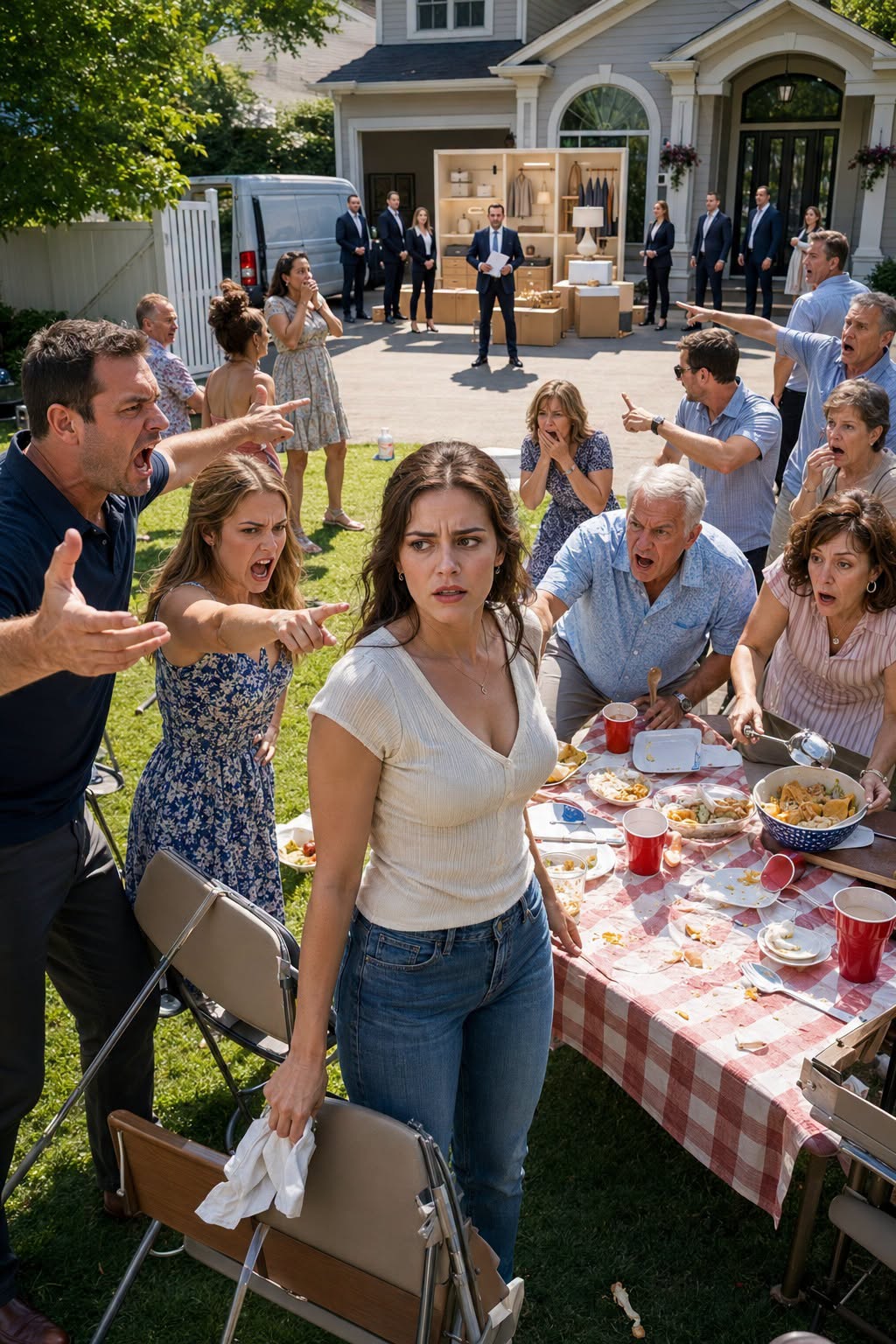
At a Family Barbecue, I Accidentally Brushed Against My Brother-in-Law. He Slapped Me, Threw Me Out—and Came Home to Find a Lawyer Changing His Locks
At A Family Barbecue, I Accidentally Brushed Against My Brother-In-Law. He Slapped Me In Front Of Everyone And Shouted, “Don’t You Ever Touch Me Again! Clean This Mess And Get Out!” My Sister Turned To Me And Said, “Apologize To Him Or Leave.” So I Walked Away. When They Returned Home, A Shop Was Waiting For Them.
### Part 1
The sound of the slap reached the far end of the backyard before the tray hit the ground.
One second, I was carrying a pitcher of lemonade between two crowded folding tables. The next, my brother-in-law’s palm cracked across my face, and the whole barbecue went silent.
Plastic cups bounced across the patio stones. Ice cubes scattered beneath the picnic table. Lemonade soaked through my canvas shoes, cold and sticky, while the grill hissed behind me as if nothing had happened.
I stood there with one hand pressed to my cheek.
Evan Mercer stepped closer, his jaw clenched and his eyes bright with anger.
“Don’t you ever put your hands on me again.”
“I didn’t,” I said.
My voice sounded strangely far away.
Someone had backed into me while I was carrying the tray. My shoulder had brushed Evan’s arm for less than a second. That was all.
He pointed toward the spilled drinks.
“Clean up your mess, then get out.”
There were twenty-three people in the yard.
My cousins had seen it. My aunt had seen it. Evan’s younger brother had been standing close enough to hear the air leave my lungs. My sister, Lauren, had been arranging hamburger buns three feet away.
Nobody moved.
Then Lauren walked toward us.
For one foolish heartbeat, I thought she was coming to check my face.
Instead, she stood beside her husband.
“Apologize to Evan,” she said.
I stared at her.
“Lauren, he slapped me.”
Her expression hardened, not with concern, but irritation.
“Apologize, Claire, or leave.”
The smell of charcoal and grilled onions suddenly made me nauseous. Red, white, and blue paper decorations fluttered beneath the patio roof. I had bought them that morning because Lauren had called three days earlier and said money was tight again.
I had brought the drinks, the fruit trays, the decorations, the extra folding chairs, and two packages of steaks Evan had specifically requested.
I looked around the yard I had helped prepare since eight that morning.
My aunt stared at her plate. One cousin picked up a fallen cup without meeting my eyes. Someone near the grill quietly turned the burgers.
My throat tightened, but my voice came out steady.
“No.”
Evan gave a short laugh.
It was the satisfied kind of laugh a person made when he believed your resistance proved his accusations.
Lauren pointed toward the side gate.
“Then leave.”
My cheek burned as I walked across the yard. My hands shook so badly that I had to hold them against my sides.
Behind me, Evan said loudly, “Always playing innocent.”
Nobody followed me.
At my car, I dropped my keys once, then again. The metal scraped against the driveway while forced laughter slowly returned behind the fence.
My phone buzzed in my pocket.
A notification appeared across the screen.
Whitmore and Hale Estate Counsel. Urgent call requested.
I barely registered it.
I sat behind the steering wheel, closed the door, and stared at the house where my own sister had chosen her husband’s pride over my dignity.
Through the fence, chairs scraped against concrete. Children began running again. Evan’s voice rose above the others, relaxed and confident now that I was gone.
I touched the swelling heat in my cheek.
For years, I had convinced myself that protecting family peace required patience.
That afternoon, something inside me finally understood the difference between patience and permission.
My phone buzzed again.
This time the message contained six words.
The occupancy agreement can be terminated today.
### Part 2
I drove home without turning on the radio.
At every red light, I caught my reflection in the rearview mirror. A red mark spread across my left cheek, visible even beneath the harsh afternoon glare.
I touched it once, then lowered my hand.
“I didn’t even do anything,” I whispered.
The words sounded childish the moment they left my mouth, like I was still hoping someone would step forward and confirm what I already knew.
I had done nothing wrong.
The problem was that nobody in my family had cared.
My townhouse was quiet when I entered. The air conditioner hummed above the kitchen, and the faint citrus scent of the candle I had lit that morning still lingered near the sink.
I placed my keys on the counter and leaned against it.
Beside the coffee maker sat a framed photograph of Lauren, me, and our grandfather, Walter Bennett, standing in his garden nine years earlier.
Lauren had one arm around my shoulders. Grandpa stood between us holding a basket of tomatoes, smiling as though his entire world fit inside that wooden frame.
Back then, Lauren used to call me her favorite little sister.
I turned the photograph facedown.
The memories arrived anyway.
When Lauren returned to work after her daughter was born, I watched baby Sophie almost every afternoon for eleven months. I rearranged my work schedule, kept bottles in my refrigerator, and learned which lullaby could stop Sophie from crying before sunset.
“We’d be lost without you,” Lauren used to say.
I never accepted money.
Years later, when Evan was unemployed for nearly five months, Lauren called me after midnight. She was crying so hard I could barely understand her.
Their electricity was two weeks from being shut off. Their water bill was overdue. Evan was too embarrassed to ask anyone for help.
“No one can know,” Lauren begged.
“They won’t,” I promised.
I paid both bills the next morning.
I never mentioned them again.
There were birthdays, Christmas dinners, emergency babysitting calls, grocery runs, and medical appointments. If Grandpa needed a ride, I canceled my plans. If Lauren forgot dessert, I crossed town to buy one. If Evan needed help moving furniture, I arrived before he did.
I had become the person everyone relied on and the person no one thought they needed to respect.
Evan’s behavior had not started with the slap.
It began with small remarks delivered in a joking tone.
“You’re still single?”
“You work too much.”
“You always need to prove something.”
Whenever I spoke at family dinners, he interrupted me. If I objected, Lauren smiled tightly and said, “That’s just Evan.”
Over time, everyone adopted the same excuse.
You know how he is.
I remembered parking in Evan’s preferred driveway spot the previous Thanksgiving. He entered the house carrying a cooler and announced, “Some people never learn basic manners.”
Everyone laughed.
I moved my car.
Not because he was right, but because I wanted the evening to remain peaceful.
Now I understood what all that peace had purchased.
It had taught Evan that he could keep escalating.
My phone vibrated for the third time.
I opened the voicemail.
“Good afternoon, Ms. Bennett. This is Nathan Whitmore from Whitmore and Hale. Please return my call regarding the occupancy agreement connected to your grandfather’s estate. Recent circumstances may require immediate legal action.”
I stared at the phone.
Grandpa had been dead for seven months.
The estate had been finalized quietly, exactly as he requested. Most relatives believed Lauren had inherited his house because she and Evan had lived there during the final years of his life.
The truth was more complicated.
I pressed the call button.
Nathan answered almost immediately.
“Claire, thank you for calling. Are you safe?”
The question broke something inside me.
Not “What happened?”
Not “Are you sure?”
Are you safe?
“Yes,” I said. “I’m home.”
“We received two messages from witnesses at the gathering.”
I closed my eyes.
“Already?”
“Your aunt contacted our office. So did Evan’s brother.”
That surprised me.
Neither had defended me in the yard.
Nathan continued carefully.
“As you know, the agreement allows Lauren and Evan to occupy the property temporarily. It also contains a condition concerning harassment, intimidation, threats, or abusive conduct directed toward you.”
“I remember.”
“If the reports are accurate, you have the right to terminate their occupancy.”
The refrigerator clicked off behind me, leaving the kitchen completely silent.
“If I do this,” I asked, “can it be handled legally? No shouting. No threats. No opportunity for Evan to twist it?”
“Yes.”
“How quickly?”
“We can serve notice today.”
I looked at the photograph lying facedown beside the coffee maker.
Grandpa had once told me that generosity without boundaries eventually became surrender.
At the time, I had thought he was talking about money.
Now I knew better.
“Move forward,” I said.
Nathan paused.
“Claire, once we begin, the consequences will be significant.”
“So were his choices.”
“All right,” he replied. “I’ll prepare everything.”
When the call ended, I remained at the kitchen counter for several minutes.
My face still hurt. My hands still trembled.
But for the first time that day, I did not feel powerless.
Across town, Evan was probably telling everyone that I would apologize by morning.
He did not know that a legal courier was already driving toward the house he believed belonged to him.
### Part 3
Back at the barbecue, the music eventually started again.
Someone lowered the volume, but nobody admitted doing it.
Children chased each other around the oak tree. Smoke drifted above the grill. Plates filled with hamburgers and corn, yet the adults ate without the usual conversations.
Evan stood beside the cooler with a soda in his hand, laughing louder than necessary.
“I’m telling you, she’s always been dramatic,” he said. “She brushed against me and acted like I attacked her for no reason.”
A few cousins glanced at one another.
Evan continued.
“Some people need to learn boundaries. Claire did this to herself.”
Lauren stood beside him with her arms crossed.
“She could have ended the whole thing by apologizing.”
That was when Aunt Denise finally spoke.
“Evan, I watched what happened.”
The yard became quiet again.
He looked at her over the top of his soda can.
“So did everyone else,” Denise continued. “Claire was carrying drinks. Mark bumped the table behind her. She lost her balance and touched your arm. Then you slapped her.”
Evan shrugged.
“You didn’t see it from my angle.”
“I saw enough.”
Lauren stepped forward before Denise could respond.
“My husband doesn’t owe anyone an explanation.”
Denise stared at her.
“Your sister walked out of here with a handprint on her face.”
“And she could have avoided the argument by showing some respect.”
Several relatives looked down.
Evan smiled.
“See? Lauren understands.”
The barbecue continued, but the mood had changed.
Whispers moved through the yard.
“That wasn’t self-defense.”
“Claire didn’t deserve that.”
“Someone should check on her.”
Evan’s younger brother, Ryan, stood near the garage with his phone in his hand. He had not spoken when I left. Now he typed a message, deleted it, then started again.
Are you okay? I’m sorry I didn’t step in.
A cousin named Madison sent another.
I saw everything. I’ll confirm it if you need me to.
Aunt Denise did more than text me. She searched the name of Grandpa’s estate firm, found the office number, and left a detailed message describing what she had witnessed.
Later, she would tell me she did it because Grandpa had once asked her a strange question.
“If anything happens to Claire after I’m gone, will you tell the truth even if Lauren gets angry?”
At the time, Denise had laughed nervously and told him nothing would happen.
Now she understood why he had asked.
By five o’clock, relatives began collecting purses, coolers, and children’s toys. Goodbyes were polite but brief.
Evan looked around the thinning yard.
“What is everybody so quiet about?”
“They’re tired,” Lauren said.
He believed her because he had spent years believing whatever explanation protected his pride.
While they loaded leftovers into the SUV, he smirked.
“Claire will call tomorrow pretending none of this happened.”
Lauren closed the cooler lid.
“She always comes around.”
“Exactly. People like her never stay mad.”
He slammed the tailgate.
Twenty minutes later, Evan turned onto their street and slowed the SUV.
A white sedan was parked in front of the house. Behind it stood a dark gray vehicle with a small company emblem on the door.
Three people waited near the front walkway.
A man in a navy suit held a leather briefcase. Beside him stood a locksmith with a metal toolbox. The third person carried a large sealed envelope.
Lauren leaned toward the windshield.
“Are they at the wrong house?”
Evan laughed.
“They must be.”
He parked and climbed out with the confidence of a man who believed every situation could be controlled through volume.
“Can I help you?”
The suited man stepped forward.
“Good afternoon. My name is Nathan Whitmore. I represent the legal owner of this property.”
Evan frowned.
“The owner?”
“Yes.”
Lauren exited the SUV more slowly.
“There must be some mistake.”
Nathan removed a card from his pocket.
“Before we proceed, may I confirm your identities?”
“I’m Evan Mercer.”
“And I’m Lauren Mercer,” my sister said.
Nathan nodded and accepted the sealed envelope from the courier.
He handed it directly to Evan.
Evan glanced at the first page.
The smile disappeared from his face.
My name appeared near the top.
Claire Bennett, legal owner.
“What is this?” he demanded.
Nathan remained calm.
“Before entering the house, I recommend reading page one.”
Evan tore open the envelope.
“This is ridiculous. Some kind of clerical mistake.”
Lauren moved beside him and read over his shoulder.
The afternoon sun reflected off the white pages. Evan flipped once, then stopped.
His eyes moved across the paragraph again.
Lauren reached for the documents.
“Evan, what does it say?”
He did not answer.
She took the papers from his hands and read aloud in a whisper.
“The legal owner of the property is Claire Bennett, pursuant to the final probate order and recorded deed following the estate of Walter Bennett.”
Lauren stared at Nathan.
“No. Grandpa left this house to me.”
Nathan opened his briefcase.
“No, Mrs. Mercer. Your grandfather granted you temporary occupancy. He transferred legal ownership to Claire.”
Evan stepped closer.
“We have lived here for six years.”
“That is correct.”
“We paid bills here. We renovated the basement.”
“You occupied the property under an agreement signed after the transfer.”
Nathan placed a certified deed on top of the envelope, followed by the probate order and a notarized occupancy contract.
Lauren recognized Grandpa’s signature immediately.
So did Evan.
Neither of them could call it fake.
Lauren turned the page, and her breathing changed.
“Why is Section Seven highlighted?”
Nathan looked toward the locksmith.
“Because Section Seven explains why you will not be entering the house tonight.”
### Part 4
Evan snatched the agreement from Lauren’s hands.
He read the highlighted section silently, his lips tightening with each line.
Then he read it aloud.
“Occupancy shall immediately terminate in the event of verified harassment, intimidation, threatening behavior, physical aggression, or abusive conduct directed toward Claire Bennett.”
He looked up.
“This proves nothing.”
Nathan’s expression did not change.
“The incident this afternoon was witnessed by multiple people.”
“You weren’t there.”
“No, but your family was.”
Nathan removed another folder.
Inside were written statements from Aunt Denise, Ryan, Madison, my uncle Paul, and two other relatives. Each account described the same sequence.
I had been carrying a tray.
Someone bumped into me.
I accidentally brushed Evan’s arm.
He slapped me.
Lauren demanded that I apologize.
When I refused, they ordered me to leave.
Evan flipped through the statements quickly.
“This is unbelievable.”
He pulled out his phone and called Uncle Paul.
“Tell this lawyer he has the story wrong.”
Paul’s voice was loud enough for everyone on the walkway to hear.
“I’m not lying for you, Evan.”
“You barely saw anything.”
“I saw you hit Claire.”
“You’re taking her side?”
“I’m taking the truth’s side.”
The call ended.
Evan immediately dialed Ryan.
His younger brother answered after several rings.
“Why did you write a statement against me?”
Ryan was silent for a moment.
“Because you slapped her.”
“She invaded my space.”
“She stumbled into you.”
“You’re my brother.”
“And Claire is family too.”
Evan’s face darkened.
Ryan continued.
“I should have stopped you. I didn’t. The least I can do now is tell the truth.”
He hung up.
Evan called Aunt Denise next.
She answered immediately.
“If you’re calling to pressure me, don’t.”
“You started this.”
“No, Evan. You did.”
“I barely touched her.”
“I heard the slap from across the patio.”
“She embarrassed me.”
“You humiliated yourself.”
The line went dead.
One by one, every call ended the same way.
Some relatives did not answer. Those who did refused to defend him.
The people who had remained silent in the yard had finally found their courage after there was no longer any personal risk.
Lauren sat on the front step.
“I told her to leave,” she whispered.
She looked toward the street, but I was not there.
The scene replayed in her mind anyway.
Me standing among spilled cups with my hand against my face.
Me searching her expression for one sign that she was still my sister.
Me walking through the gate alone.
“What have I done?” Lauren said.
Nathan closed the witness folder.
“Ms. Bennett made no threats against either of you. She instructed our office to enforce the agreement that already existed.”
Evan stared at the house.
“You can’t lock us out without notice.”
Nathan handed him another page.
“The occupancy agreement contains an immediate protective termination clause. However, Claire has authorized supervised access to collect essential belongings tonight. The remainder must be removed within fourteen days.”
“Fourteen days?”
“You may arrange times through our office.”
“This is my home.”
Nathan’s tone remained even.
“It is a property you were permitted to occupy under specific conditions.”
Evan turned toward the front door.
“I don’t care. I’m going inside.”
He took two steps.
The locksmith moved toward the entrance, inserted a new cylinder into the lock, and tightened it with a small metal tool.
Click.
The sound was quiet, but it stopped Evan completely.
Nathan spoke without raising his voice.
“Attempting to force entry would create additional legal problems. I strongly recommend against it.”
Evan stood on the walkway with his fists clenched.
Across the street, a neighbor slowly pulled weeds from a flower bed while watching everything.
Lauren covered her face.
“We have nowhere to go.”
Nathan looked at her.
“You have family, savings, vehicles, and two weeks to remove your belongings. Your grandfather provided you with nearly a year of reduced-cost occupancy after his death so you could prepare.”
Lauren lowered her hands.
“What do you mean, prepare?”
Nathan hesitated.
“There are details your grandfather instructed us to reveal only if the agreement had to be enforced.”
Evan laughed bitterly.
“More secrets?”
“Not secrets,” Nathan said. “Protections.”
He opened one final folder.
“Your grandfather expected this situation was possible.”
Lauren looked up sharply.
“Expected what?”
Nathan’s eyes settled on Evan.
“That one day, your husband’s temper would be directed at Claire.”
### Part 5
Nathan removed a letter written in Grandpa’s narrow, careful handwriting.
He did not hand it over immediately.
“Walter asked our firm to explain his reasoning only if the occupancy agreement was terminated. He hoped that would never happen.”
Evan crossed his arms.
“Then explain it.”
Nathan looked at Lauren first.
“Your grandfather transferred the property to Claire because she cared for him during the final years of his life without asking for compensation, recognition, or inheritance.”
Lauren flinched.
“She took him to appointments.”
“She took him to every appointment,” Nathan corrected. “She managed repairs, grocery deliveries, insurance paperwork, and home maintenance. She spent holidays with him when other relatives canceled.”
Lauren looked toward the porch railing Grandpa had repaired twice with temporary wooden braces.
“I had children,” she said weakly. “I was busy.”
“Walter understood that.”
Nathan’s voice held no accusation, which somehow made the facts more painful.
“He did not punish anyone for being busy. He simply chose to leave the home to the person he trusted to protect it.”
Evan gave a humorless laugh.
“So Claire was rewarded for playing the devoted granddaughter.”
Nathan’s eyes hardened for the first time.
“Claire did not know she would inherit the house until after Walter signed the deed.”
Evan said nothing.
Nathan continued.
“Your grandfather also wanted you and Lauren to have time to become financially independent. That is why he permitted you to remain instead of requiring an immediate move.”
Lauren looked confused.
“We paid rent.”
“You paid less than one-third of the market rate.”
Evan glanced at her.
She knew that was true.
For years, they had called the arrangement a family discount. They bought newer vehicles, took two expensive vacations, and remodeled the basement while telling everyone they could not afford a down payment elsewhere.
Nathan unfolded Grandpa’s letter.
“Walter believed the reduced rent would allow you to save enough to purchase a home within twelve months.”
Lauren’s mouth opened, then closed.
They had saved money.
Then they had spent most of it on a boat Evan insisted would improve their family life.
The boat was used seven times before spending a winter beneath a stained tarp.
Nathan continued reading from his notes.
“Walter also told our office that he had witnessed Evan’s temper more than once.”
Evan’s face tightened.
“What exactly did he claim?”
“He described an incident involving a broken dining chair after a disagreement over property taxes.”
“That chair was already damaged.”
“He described you shouting at Claire in the driveway because she asked you to move your truck so an ambulance could reach the front entrance.”
Evan looked away.
“And he described you punching a hole through the laundry-room door after Lauren suggested postponing a vacation.”
Lauren stared at her husband.
“You told Grandpa about that?”
“I didn’t have to,” Nathan said. “He was in the house.”
A long silence followed.
Nathan folded the letter.
“Walter’s instructions were specific. If Evan ever threatened, intimidated, or physically mistreated Claire, the occupancy agreement was to end immediately.”
Lauren’s voice shook.
“So Grandpa thought this would happen.”
“He feared it might. He hoped he was wrong.”
Evan stared at the front door.
“I never thought Claire would actually remove us.”
Nathan corrected him quietly.
“Claire did not create this consequence today. Your actions activated a consequence Walter created months ago.”
“That’s the same thing.”
“No,” Nathan replied. “It is not.”
For the first time, Evan’s anger faded into something smaller.
Defeat.
“I didn’t think she had it in her,” he muttered.
Nathan closed the folder.
“That may be the problem.”
Lauren pulled out her phone.
“I need to call her.”
“That is your decision. Whether she answers is hers.”
Lauren selected my name and pressed call.
At my townhouse, the phone rang beside me on the kitchen table.
I watched my sister’s name flash across the screen.
I did not answer.
After four rings, it went to voicemail.
“Claire,” Lauren began.
Her voice cracked.
“I’m sorry. I should have protected you. I should have stopped him. I kept choosing whatever made my marriage easier instead of what was right.”
She paused.
“You deserved a sister today. I wasn’t one.”
The message ended.
I listened to it twice.
Years earlier, those words might have sent me rushing back to comfort her.
That evening, they only made me tired.
An apology spoken after the locks changed did not tell me Lauren finally understood my pain.
It told me she finally understood her consequences.
### Part 6
The following morning, I woke before sunrise.
My cheek had faded from bright red to a dull purple shadow. It hurt when I smiled, so I avoided mirrors while making coffee.
There were seventeen unread messages on my phone.
Some came from relatives who had witnessed the barbecue.
I’m sorry I froze.
I should have spoken up.
Please tell me you’re okay.
Others were more cautious.
This has gotten out of hand.
Couldn’t everyone calm down first?
Think about what Sophie and Noah are going through.
That last message came from my mother.
She had not attended the barbecue because she was visiting a friend out of state, but Lauren had called her before midnight.
Mom left me a voicemail.
“Claire, what Evan did was wrong, but forcing your sister from her home affects the children. You need to consider the entire family.”
I listened once, then deleted it.
Lauren’s children were thirteen and sixteen, old enough to understand that their father had behaved badly and that adults were responsible for the conditions of their housing.
They were not being abandoned on the street. Lauren had a steady job. Evan was employed. They had savings, two vehicles, relatives nearby, and a recreational boat worth more than my first car and college tuition combined.
Still, the family instinct was immediate.
Ask Claire to absorb the damage so everyone else could remain comfortable.
Nathan called at nine.
“Evan has retained an attorney.”
“That was fast.”
“He contacted someone late last night. Their initial claim is that the termination clause is unreasonable and that the incident was exaggerated.”
“What happens now?”
“We follow the agreement. Their attorney can challenge it, but the deed, signed contract, witness statements, and prior documentation are strong.”
“What prior documentation?”
Nathan paused.
“Walter kept records.”
I set down my coffee.
“What kind of records?”
“Dated notes. Photographs of damaged property. A statement from a home-care nurse who overheard Evan threatening to make you regret interfering with the house.”
I remembered that afternoon.
Grandpa had fallen in the kitchen. I arranged additional nursing visits. Evan complained that the nurse’s presence invaded his privacy.
Later, in the driveway, he leaned close and said, “Keep acting like you own this place, and you’ll learn what happens.”
I had never told anyone.
Apparently, Grandpa had heard him through the open window.
“Why didn’t Grandpa say something to me?” I asked.
“He believed you would minimize it to protect Lauren.”
He was right.
Nathan continued.
“There is something else. Your grandfather wrote you a personal letter. We held it under his instructions until the occupancy matter was resolved.”
My chest tightened.
“Can I read it?”
“I’ll bring it this afternoon.”
At two, Nathan arrived with a sealed envelope.
We sat at my small dining table, where sunlight formed pale rectangles across the wood.
Grandpa’s handwriting appeared on the front.
For Claire, when she is ready to stop apologizing for surviving other people’s selfishness.
My eyes filled before I opened it.
The letter was three pages long.
Grandpa wrote that he had watched me become the family’s solution to every inconvenience. He admired my generosity but feared it had become the reason people believed they could neglect me without losing me.
He wrote about Lauren.
“She loves you in the way weak people sometimes love strong people,” he said. “She depends on your strength, then resents you for reminding her of her own weakness.”
He wrote about Evan’s anger and Lauren’s habit of defending him.
Then came the sentence that stayed with me.
“A house is not the greatest thing I am leaving you. I am leaving you permission to close a door.”
I pressed the paper against my chest and cried for the first time since the barbecue.
Not because I wanted Lauren back.
Because Grandpa had understood how difficult it would be for me to choose myself.
Nathan waited quietly.
When I could speak again, I asked, “Can Evan and Lauren fight this for years?”
“They can try.”
“Will they win?”
“Based on the evidence, unlikely.”
I looked at Grandpa’s letter.
“Then don’t offer a compromise.”
Nathan studied me.
“Not even an extended occupancy period?”
“No.”
“What about a financial settlement?”
“No.”
I folded the letter carefully.
“For once, they are going to live with the result of what they chose.”
### Part 7
Evan and Lauren moved into a furnished rental on the edge of town.
For two weeks, they collected their belongings under supervised appointments arranged through Nathan’s office. I stayed away during every visit.
Evan complained about the schedule, the locksmith, the cameras installed near the entrances, and the inventory forms he had to sign.
He claimed I was treating him like a criminal.
Nathan reminded his attorney that the procedures protected everyone.
Lauren sent me messages almost daily.
At first, they were apologies.
I’m ashamed of how I treated you.
I should have defended you.
I understand if you need time.
Then the messages changed.
The rental is costing more than we expected.
Sophie is having trouble sleeping.
Mom says you haven’t returned her calls.
Finally, the truth beneath the apology appeared.
Can we stay in the house until the end of the school year?
I did not respond.
Three days later, Mom came to my townhouse.
She stood on the porch holding a bakery box and wearing the worried expression she used whenever she wanted me to solve something unpleasant without calling it a demand.
“I brought lemon cake,” she said.
I let her inside.
She placed the box on the counter and looked at my cheek, where only a faint yellow mark remained.
“Does it still hurt?”
“Not much.”
“I’m sorry that happened.”
“Thank you.”
She waited for more, but I did not rescue her from the silence.
Mom sat at the kitchen table.
“Lauren knows she made a terrible mistake.”
“She made a choice.”
“People make choices under pressure.”
“She had enough time to walk across the yard and stand beside Evan.”
“She was shocked.”
“So was I.”
Mom rubbed her hands together.
“The children are miserable in the rental.”
“They have a safe place to live.”
“It’s temporary.”
“So was their agreement with Grandpa.”
She sighed.
“Claire, I am not defending Evan.”
“You’re asking me to remove the consequence of what he did.”
“I’m asking you to show compassion.”
“I showed compassion for years.”
Mom looked toward the coffee maker and noticed the photograph facedown beside it.
“Lauren is your sister.”
“I know.”
“Doesn’t that mean anything?”
“It meant everything when I paid her bills. It meant everything when I cared for her children. It meant everything when I kept quiet every time Evan humiliated me.”
My voice remained calm.
“But apparently, it meant nothing when he slapped me.”
Mom’s eyes filled with tears.
“She is afraid her marriage is falling apart.”
“That is not my marriage to save.”
“What if she leaves him?”
“Then she should leave because she finally understands who he is, not because she hopes I’ll reward her with a house.”
Mom stared at me for a long moment.
“You’ve changed.”
“No,” I said. “I’ve stopped negotiating against myself.”
She left the cake behind.
I never opened the box.
The legal challenge ended six weeks later.
Evan’s attorney reviewed Grandpa’s records, witness statements, and the signed agreement. Rather than continue toward a hearing they were unlikely to win, Evan and Lauren withdrew the challenge.
Evan had to pay part of the legal costs.
He blamed Lauren.
Lauren blamed me.
For all her apologies, she still told relatives that I had destroyed her family over one terrible afternoon.
That was when I stopped confusing regret with accountability.
A person could regret losing a comfortable house without regretting the cruelty that cost them the house.
I sent Lauren one final message.
“I accept that you are sorry. I do not accept responsibility for the consequences of your choices. I will not restore the occupancy agreement, and I am not willing to resume our relationship. Please contact Nathan regarding any remaining property matters.”
She called immediately.
I let it ring.
Then I blocked her number.
### Part 8
By late summer, the house looked different.
Not unrecognizable, just lighter.
I repaired the porch railing Grandpa had patched with mismatched boards. I painted the front room a soft cream color instead of the dark gray Evan had chosen. I removed the enormous television from above the fireplace and placed Grandpa’s old wooden clock on the mantel.
In the backyard, I restored the garden beds.
The first morning I planted tomatoes, I could almost hear Grandpa complaining that I had placed them too close together.
“Plants need room to grow, Claire.”
He used to say the same thing about people.
For several months, I lived in the house alone.
I expected the silence to feel lonely.
Instead, it felt honest.
No one shouted from another room. No one made a cutting joke and waited for everyone to laugh. No one called me dramatic when I objected to disrespect.
I began saying no more often.
When a cousin asked me to organize a birthday dinner with two days’ notice, I said I was unavailable.
When Mom suggested I should reach out to Lauren before Thanksgiving, I declined.
When Aunt Denise apologized for the fourth time for staying silent at the barbecue, I finally told her, “I appreciate that you told the truth afterward. But I’m not responsible for making you feel better about what happened.”
She nodded.
“You’re right.”
That response allowed me to trust her again more than any dramatic speech could have.
Evan’s place in the family changed too.
He still attended some gatherings, but people no longer laughed automatically at his remarks. When he interrupted others, someone told him to let them finish. When he insulted a cousin’s job, Ryan asked him why humiliation was always his favorite form of conversation.
Without silence protecting him, Evan seemed smaller.
Lauren stayed with him.
That told me everything I needed to know.
She mailed me a birthday card in October. Inside, she wrote that she loved me, missed me, and hoped family would someday matter more to me than anger.
I did not respond.
Family had always mattered to me.
That was why her betrayal had cut so deeply.
But being related to someone did not give them permanent access to my life.
The following June, nearly a year after the slap, I hosted a small barbecue in Grandpa’s backyard.
I invited Aunt Denise, Ryan, Madison, Uncle Paul, and a few friends from work. I did not invite Mom because she had recently given Lauren my new phone number after promising she would not. I did not invite anyone out of obligation.
The afternoon was bright and breezy. Corn roasted on the grill. Glass pitchers of lemonade sat safely in the center of the table instead of being passed through a crowd.
At one point, Ryan accidentally bumped my shoulder while carrying a plate.
He froze.
Then he gave me an embarrassed smile.
“Sorry.”
I looked at him and laughed.
“You’re fine.”
That tiny moment reminded both of us how simple ordinary decency could be.
No shouting.
No humiliation.
No demand that someone surrender their dignity to protect another person’s ego.
As the sun lowered behind the trees, Aunt Denise handed me a plate of grilled vegetables.
“Walter would be proud of what you did with the place.”
I looked around the yard.
Fresh flowers bordered the fence. Children played near the garden without fear of being yelled at. People spoke without measuring every word against Evan’s mood.
For years, I had believed peace meant preventing conflict.
Grandpa’s final gift taught me something different.
Real peace sometimes required allowing conflict to expose what everyone else preferred to hide.
I had not lost my sister when I refused to forgive her.
I lost the illusion that she had ever protected me the way I protected her.
There was grief in that truth, but there was freedom too.
Later that evening, after everyone left, I carried the empty plates inside. The kitchen smelled like charcoal, cut lemons, and the peach cobbler Madison had brought.
I placed Grandpa’s letter in the top drawer beside the recorded deed.
Then I locked the back door and stood alone in the quiet house.
I no longer wondered whether Lauren understood what she had done.
I no longer cared whether Evan believed the consequence was fair.
Their opinions had controlled enough of my life.
I touched my cheek, remembering the brief flash of pain, the spilled lemonade, and the silence of twenty-three relatives.
That slap had been intended to put me back in my place.
Instead, it forced me to decide what my place would be.
Not beneath Evan’s temper.
Not behind Lauren’s marriage.
Not inside a family that required me to suffer quietly so everyone else could enjoy dessert.
My place was here, in the home my grandfather trusted me to protect, surrounded only by people who understood that love without respect was not love worth keeping.
I turned off the kitchen light.
For the first time in years, closing the door did not feel like cruelty.
It felt like coming home.
THE END!