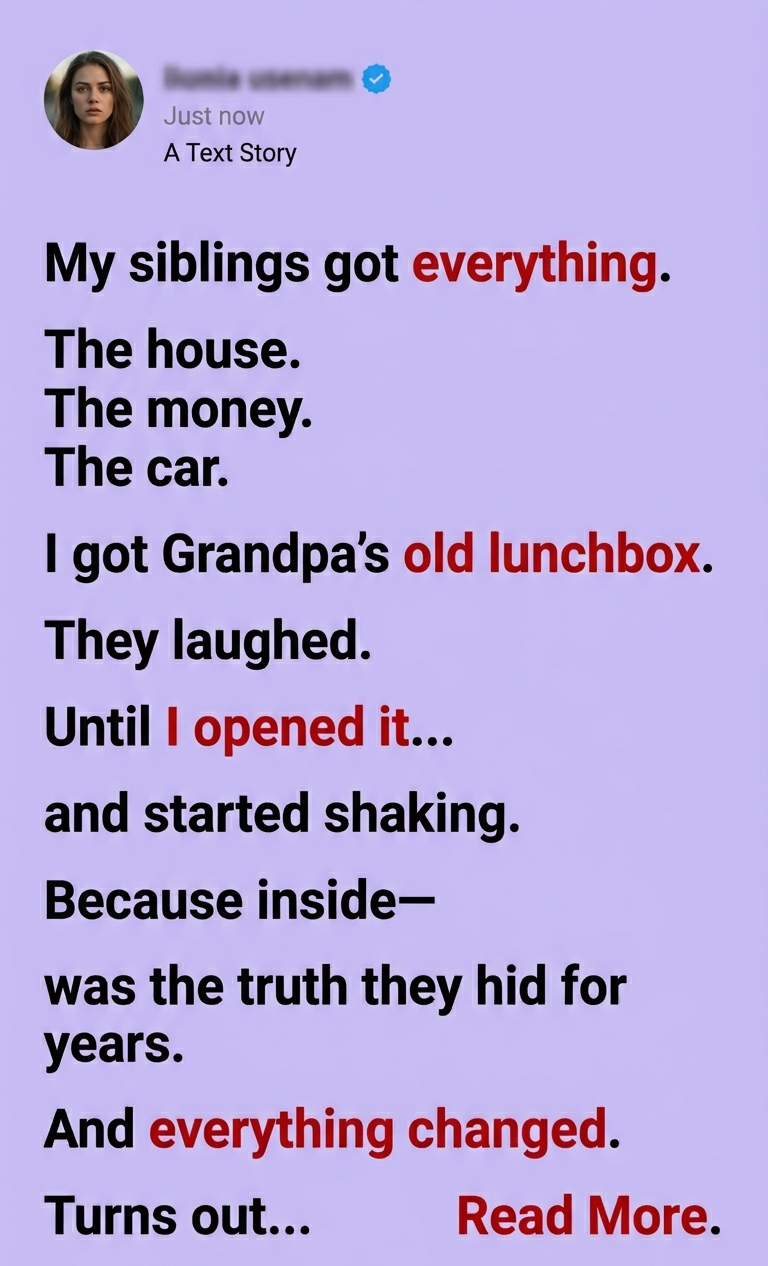
Inside the lunchbox was not a sandwich, not old tools, not random keepsakes.
It was a stack of envelopes.
Each one had my name written on it in Grandpa’s careful handwriting.
My fingers shook so badly I nearly dropped them.
There were dozens.
Some looked old, yellowed at the corners, like they’d been written years ago. Others were newer. On top of them sat a small velvet pouch, faded blue, and beneath that, a folded document sealed in plastic to protect it from moisture.
I opened the first letter.
My dearest girl,
If you are reading this, then I am gone, and I am sorry you are facing this day without me. I know how this must have looked in that room. I know what they must have thought. I also know what you must be feeling right now. So before you believe for one second that I left you the least, I need you to know this: I left you what mattered most.
By the time I reached the end of the first page, I was crying so hard I could barely see.
I wiped my face and opened the next envelope.
This one was dated ten years earlier.
It told the story of the day Grandpa learned that my siblings blamed me for our parents’ deaths. He wrote that he had heard things too—whispers, cruel remarks, bitterness that had hardened into something ugly over the years. He said he tried to correct them, tried to make them see that tragedy doesn’t need a villain, that grief can turn people cruel when they don’t know where else to put their pain.
Then came the line that made my chest cave in.
You were never the reason they died. You were the reason your mother and father fought to live as long as they did.
I covered my mouth and sobbed.
He had known. He had always known what they said about me. And he had carried the weight of making sure I would someday know the truth.
I reached for the plastic-wrapped document next.
It was a deed.
At first I didn’t understand what I was looking at. I read it once. Then again.
It wasn’t for the house Matthew had inherited.
It was for thirty-two acres of undeveloped land just outside town, land Grandpa’s father had bought decades earlier and never sold. I remembered him once mentioning property taxes, some old family parcel nobody cared about. I hadn’t thought much of it.
Attached was a second sheet—an appraisal.
The land was worth more than the house.
Much more.
My heart pounded so hard it felt painful.
Then I opened the velvet pouch.
Inside was Grandma’s wedding ring.
Not flashy. Not enormous. But the one thing Grandpa had never let out of his sight after she passed. I’d seen him hold it in his palm on lonely nights when he thought no one was watching.
At the bottom of the lunchbox was one last envelope, thicker than the others.
On the front, it said:
Open this after you’ve read everything else.
My hands were trembling so hard I almost couldn’t tear it open.
Inside was a letter and a bank envelope.
The bank envelope contained a passbook for an account I had never heard of.
Balance: $184,233.47
I stared at it, convinced I was reading it wrong.
The letter explained everything.
For years, Grandpa had been putting money aside. Overtime shifts. Pension savings. Small investments. The land had stayed in his name. The account had been made payable to me. The lunchbox had been the only way he knew to make sure no one took these things before I could get them.
And then I saw why he had done it this way.
If I had announced this in the will, they would have fought you for every dollar, every inch, every memory. They always looked at what was loud and obvious. They never understood value unless it was shiny and immediate. But you stayed. You cared for me when you had every reason to leave. You gave me dignity in old age. You gave me family when everyone else gave me distance.
I pressed the page to my chest and cried there on that park bench until the sun started slipping lower in the sky.
For the first time in my life, I didn’t feel forgotten.
I felt seen.
But Grandpa’s final paragraph changed everything.
There is one more truth you deserve to know. In the envelope marked February 14, open it only when you are ready. It contains something your siblings never knew.
I searched through the stack until I found it.
That letter was older than the rest.
I unfolded it carefully.
It explained that after the accident, Grandpa had received the full police report. My parents had not gone out because of me. They had gone out because Jessica—my oldest sister—had called them from a party, begging them to come get her because she was drunk and afraid to drive home with friends who had been drinking.
They had left in a hurry.
They had taken me because I had a fever and couldn’t be left alone.
On the way to pick her up, the truck hit them.
I stopped breathing for a second.
My whole body went cold.
All those years… all those accusations… all that hatred they dumped on me…
And the truth was that I had never been the reason.
If anything, Jessica had been at the center of the night they all used to condemn me.
Grandpa wrote that he never told the others because he feared it would destroy what little remained of the family. Jessica had broken down and confessed everything to him when she was nineteen. He said she carried guilt but never had the courage to admit the truth to the rest of us. So instead, she let them keep blaming me.
I read that page three times.
Then I laughed.
Not because it was funny.
Because after years of pain, the truth was so enormous, so bitter, so unbelievable, that my body didn’t know what else to do.
That night, I went home—the small house where I’d lived with Grandpa—and sat at the kitchen table with the lunchbox in front of me. I could still hear the echo of its latch from every morning of my childhood.
For the first time, I understood.
He hadn’t left me scraps.
He had left me protection.
He had left me proof.
And he had left me a future.
The next week, my siblings found out.
Not because I told them.
Because Matthew tried to refinance the house and learned there were unpaid liens Grandpa had quietly been covering for years. The house had value, yes, but nowhere near what they imagined after repairs and debts were deducted. Jake discovered the car needed a transmission replacement that cost more than he could manage. Kirk and Jessica got their $20,000, but after taxes and personal debts, it vanished quickly.
Then someone at the county office mentioned the land transfer.
That was when the calls began.
First Matthew.
“I think there’s been some kind of mistake,” he said.
“No,” I replied calmly. “There hasn’t.”
Then Jessica.
“You’re not actually keeping all that for yourself, are you?”
I almost laughed.
After everything, she still had the nerve.
“For myself?” I said. “You mean the property and money Grandpa intentionally left to me?”
There was silence.
Then she tried a different tone. Softer. Manipulative.
“We’re family.”
I looked at Grandpa’s empty chair by the window.
“Were we?”
She hung up.
A few days later, all four of them showed up at the house together.
Matthew did most of the talking. Jake paced. Kirk avoided eye contact. Jessica cried almost on cue.
They said Grandpa had been confused. That I had manipulated him. That it wasn’t fair.
Fair.
That word landed like a spark in dry grass.
I walked to the cabinet, took out the folder containing Grandpa’s letters, and placed it on the table.
“I know the truth about the accident,” I said.
Jessica’s face lost all color.
The room went dead silent.
Matthew frowned. “What truth?”
I kept my eyes on Jessica.
“You want to tell them,” I asked quietly, “or should I?”
Her knees practically gave out. She sank into a chair and started shaking her head before I’d even said another word.
“No,” she whispered. “Please.”
Matthew turned to her. “What is she talking about?”
And then, finally, after all those years, Jessica broke.
She admitted it.
The phone call. The party. The drinking. The panic. Grandpa knowing. The guilt. The silence.
Nobody said a word when she finished.
Matthew looked stunned. Jake looked sick. Kirk sat down like the strength had left his legs.
For once, no one looked at me with blame.
Only shame.
Jessica sobbed and tried to apologize, but I couldn’t even process it. I had dreamed of that moment so many times—imagined them finally knowing, finally understanding—and yet when it came, it didn’t heal me the way I thought it would.
It just made me tired.
Very, very tired.
“I took care of Grandpa because I loved him,” I said. “Not because I wanted what he had. He left things the way he did because he knew exactly who all of us were.”
No one argued.
Because no one could.
I sold part of the land the following year and kept the rest. I used the money to restore the house—not for Matthew, but for myself. Legally, the liens gave me an opening to negotiate, and in the end, he couldn’t afford to keep it. I bought it outright.
The same home my grandfather had fought to keep together became mine.
I placed Grandma’s ring in a small glass box by my bed.
And Grandpa’s lunchbox?
I never cleaned off the rust.
It sits on a shelf in the kitchen where I can see it every morning.
Sometimes, before the day begins, I rest my hand on it and remember the sound of coffee brewing at 5 a.m., the quiet strength of the man who chose me when no one else did.
Everyone thought he left me nothing.
But what he really left me was the truth.
And after a lifetime of being treated like I was worth less than everyone else, the truth was worth everything.
Chapter 2: The Truth They Couldn’t Hide
The house felt different after they left that day.
Quieter.
Not peaceful—just… emptied of something heavy that had been sitting on my chest for years.
I sat alone at the kitchen table, the same table where Grandpa used to drink his coffee every morning at 5 a.m. The lunchbox was in front of me again. I didn’t open it this time.
I didn’t need to.
I already knew what it held.
Truth.
Protection.
Love.
Three things no one else in that family had ever given me.
But now the truth wasn’t just mine anymore.
They knew.
And that changed everything.
The next few weeks were chaos.
Not loud chaos—no shouting matches or dramatic confrontations.
Something colder.
Lawyers.
Phone calls.
Emails.
Matthew tried to challenge the will. He claimed Grandpa had been “mentally compromised.” Jake backed him. Kirk stayed quiet but didn’t stop them. Jessica… she disappeared completely.
But Grandpa had thought of that too.
Every document was airtight.
Every transfer legal.
Every account sealed long before his health had declined.
There was nothing they could do.
And for the first time in their lives…
They couldn’t take something from me.
But the truth about the accident spread faster than I expected.
Not because I told anyone.
Because guilt doesn’t stay buried once it’s exposed.
Jessica started unraveling.
I heard from a cousin that she couldn’t sleep. That she was drinking again. That she kept saying, “It was my fault… it was always my fault…”
For years, she had let them blame me.
Let them look at me like I didn’t deserve to exist.
And now she had to live with the weight of that silence.
One evening, there was a knock at the door.
I knew who it was before I even opened it.
Jessica.
She looked… smaller somehow. Like life had finally caught up to her.
Her eyes were red, her hands trembling.
“I just want to talk,” she whispered.
I hesitated.
Not because I was afraid.
Because I didn’t know if I cared anymore.
But I stepped aside.
We sat in the living room, across from each other.
For a long time, neither of us spoke.
Then she broke.
“I’m sorry,” she said, her voice cracking. “I should’ve told the truth years ago. I wanted to… so many times. But I was scared.”
“Scared of what?” I asked quietly.
Her eyes filled with tears.
“That they’d hate me the way they hated you.”
The words landed softly… but they cut deep.
I let out a slow breath.
“And you were okay with them hating me instead?”
She didn’t answer.
Because there was no answer that could fix that.
“I was a kid,” she continued, desperate now. “I didn’t think it would turn into… all of this. I thought it would just go away.”
“But it didn’t,” I said. “It became my entire life.”
Silence filled the room again.
Heavy.
Unavoidable.
“I don’t expect you to forgive me,” she whispered.
“Good,” I replied.
Her head snapped up, surprised.
“Because I’m not there yet.”
Tears rolled down her cheeks.
“But I’m also not going to carry this anymore,” I continued. “Not the blame. Not the anger. Not the version of me you all created.”
I stood up.
“That ends now.”
She nodded slowly, like she understood.
Maybe she did.
Maybe she didn’t.
But for the first time… it didn’t matter.
Ending: What He Really Left Me
Months passed.
The noise faded.
The legal battles stopped.
My siblings went back to their lives—smaller now, quieter, without the confidence they once carried.
And me?
I stayed.
In the house.
With the memories.
With the truth.
I didn’t sell all the land.
Just enough to build something new.
A small home on the edge of it.
Simple.
Peaceful.
Mine.
Every morning, I wake up before sunrise.
Not because I have to.
Because I want to.
I make coffee the same way Grandpa used to.
And sometimes… I swear I can still hear that familiar click of his lunchbox.
People think inheritance is about money.
About houses.
Cars.
Numbers in a bank account.
But they’re wrong.
Because what Grandpa gave me…
Was something no one else could ever take.
He gave me the truth when everyone else gave me blame.
He gave me dignity when everyone else gave me silence.
He gave me love when no one else did.
And in the end…
That old, rusty lunchbox held more than anything they walked away with.
It held my freedom.