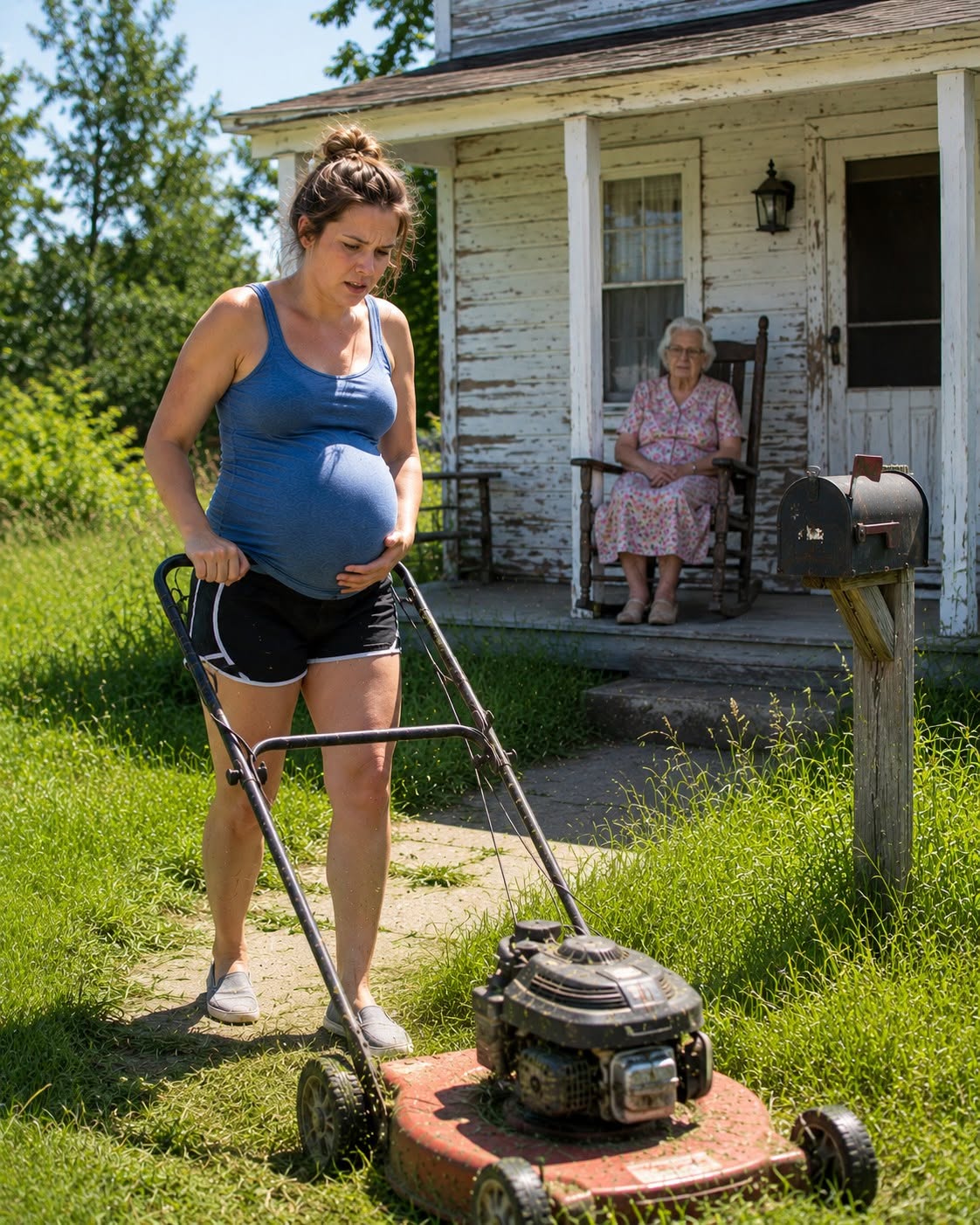
I cut the grass for the eighty-two-year-old widow living next door.
The next morning, a sheriff appeared at my front door with a request that made every drop of blood in my body turn cold.
At the time, I was thirty-four weeks pregnant and entirely alone.
My ex had walked out almost immediately after I told him I was expecting. He left me with the house payment, medical expenses, utility bills, and a mountain of financial problems I could barely look at without feeling another panic attack coming.
For months, overdue notices had been arriving faster than I could open them.
But last Tuesday was the moment everything finally seemed to collapse.
The temperature outside was ninety-five degrees. My lower back hurt constantly. My ankles were swollen, and I had just received the phone call I had been dreading.
The bank had officially started foreclosure proceedings on my home.
I stepped outside because the walls of my house suddenly felt too close. I could not breathe properly, and I needed air before the panic completely swallowed me.
That was when I noticed Mrs. Whitaker.
She was eighty-two years old and had lost her husband only three months earlier. She was attempting to push an old, rust-covered lawnmower through grass that had grown almost to her knees.
She could barely move it.
Every few steps, she stopped to catch her breath.
I should have turned around and gone back into my house.
I had enough problems of my own.
But I didn’t.
Instead, I walked across the yard, gently took hold of the mower, and told her to sit down in the shade.
Then I spent the next three hours cutting her lawn.
My ankles grew even more swollen. Sweat soaked through my clothes. My back screamed every time I pushed the mower through another patch of thick grass, and more than once, I had to stop and breathe through the tightening pain in my stomach.
But I finished.
When the last section of grass had been cut, Mrs. Whitaker took my hand between both of hers.
“You’re a good girl,” she said softly. “Never forget that.”
At the time, I didn’t attach much importance to her words.
That night, I barely slept.
Then, early the following morning, the sound of sirens dragged me out of bed.
They were right outside my house.
My heart dropped.
Someone knocked sharply on my front door.
When I opened it, a sheriff stood on the porch. Two patrol cars were parked behind him.
“Ma’am,” he said calmly, “we need to ask you some questions about Mrs. Whitaker.”
My stomach tightened.
“What happened to her?”
He paused before answering.
“She was found dead this morning.”
The entire world seemed to go silent.
“I… I was just with her yesterday,” I whispered. “I helped her with the lawn.”
His expression remained serious.
“We know,” he said. “That’s exactly why we’re here.”
My knees began trembling.
“Did I do something wrong? I only mowed her grass. I didn’t—”
“Then you won’t have any trouble explaining this,” he interrupted.
He raised one hand and pointed toward my mailbox.
Cold fear spread through my chest.
“Go ahead,” he said. “Open it yourself.”
My hands shook so badly that I could barely lift the metal lid.
I had no idea what might be waiting inside.
But the moment I saw it, I screamed.
Let me explain what was inside that mailbox.
And what Mrs. Whitaker had done before she died.
My name is Emily Carter.
I am thirty-two years old, thirty-four weeks pregnant, single, and facing foreclosure.
Yesterday, I cut the lawn of my eighty-two-year-old neighbor, Mrs. Whitaker.
She was recently widowed and struggling alone in ninety-five-degree heat.
This morning, a sheriff knocked on my door.
“Mrs. Whitaker was found dead,” he told me. “That is exactly why we’re here.”
Then he pointed toward my mailbox.
“Open it yourself.”
Inside was a large envelope.
It was heavy, official-looking, and addressed directly to me.
Resting on top was a handwritten note in shaky letters.
“You’re a good girl. Never forget that.”
What I found inside that envelope changed the course of my entire life.
But to understand why, I need to take you back to the previous day.
And explain why I was standing outside in the first place.
I’m thirty-two years old.
I was thirty-four weeks pregnant.
I was alone.
And the bank was preparing to take my home.
My ex, Brian, left as soon as I told him about the pregnancy.
He didn’t slowly distance himself.
He didn’t ask for time to think.
He simply packed his belongings, moved out, and stopped answering my calls.
He left me with an $1,800 monthly mortgage payment, household bills, prenatal appointments, medical expenses, and every other responsibility we had once planned to share.
I worked as a dental hygienist and earned approximately $48,000 a year.
Before becoming pregnant, that income had been enough to manage.
It wasn’t luxurious, but I could pay the bills and keep the house running.
After my hours were reduced and the medical costs began piling up, everything became impossible.
For six months, I had been drowning.
Each week brought another warning letter.
Overdue payments.
Late fees.
Credit card balances.
Medical invoices.
Interest charges.
Every time I thought I had reached the bottom, something else arrived in the mail.
Then last Tuesday, the bank called.
The representative’s voice was polite, almost gentle, which somehow made the words feel even worse.
Foreclosure proceedings had officially begun.
I had ninety days to pay $18,000 in missed payments and fees.
If I couldn’t, I would lose the house.
Eighteen thousand dollars.
I had exactly $340 in my checking account.
After the call ended, I sat alone in the kitchen staring at the wall.
The room began to feel smaller.
My chest tightened.
My breathing became shallow.
I imagined bringing my baby home from the hospital with nowhere to live.
I imagined packing our belongings into boxes.
I imagined sleeping on someone’s couch with a newborn in my arms.
I couldn’t breathe.
So I stepped outside.
That was when I saw Mrs. Whitaker in the yard next door.
She was eighty-two and had become a widow three months earlier after her husband, Walter, passed away.
She was pushing an old red lawnmower through grass that reached halfway up her calves.
The temperature was ninety-five degrees.
Her small body leaned forward with every step, but the mower barely moved.
At one point, she stumbled and grabbed the handle to keep herself upright.
I should have returned inside.
I was heavily pregnant.
I had just been told I might lose my home.
I had my own emergency to deal with.
But something would not let me ignore her.
I crossed the yard.
“Mrs. Whitaker, please let me do that.”
She turned around, startled.
“Oh, Emily, absolutely not. You’re pregnant. You shouldn’t be out here doing yard work.”
“Please,” I said. “Go sit in the shade. I’ll take care of it.”
“You have enough to worry about.”
“I know. But I can still help you.”
Before she could argue again, I gently took the mower from her hands.
She watched me for a moment, then slowly walked toward a chair beneath the covered patio.
I started pushing.
The grass was thick and overgrown. In several areas, I had to go over it more than once.
The heat pressed down on me.
Within fifteen minutes, sweat was running down my neck and soaking the back of my shirt.
My lower back began throbbing.
My ankles felt painfully tight inside my shoes.
But every time I considered stopping, I looked over and saw Mrs. Whitaker watching from the shade.
She looked so small sitting there alone.
So I continued.
I cut the front yard.
Then I moved to the side of the house.
Then the backyard.
It took nearly three hours.
Several times, my stomach tightened hard enough that I had to stop, hold onto the mower, and breathe until the pain passed.
Mrs. Whitaker kept asking me to stop.
“Emily, that is enough. Leave the rest.”
“I’m almost finished.”
“You’ve already done too much.”
“I want to finish it.”
And eventually, I did.
Every section of the lawn was cut.
The edges were not perfect, but the tall grass was gone.
Mrs. Whitaker brought me a glass of lemonade.
Then she reached for my hand.
“You’re a good girl,” she said quietly. “Never forget that.”
I smiled.
“It was only a lawn, Mrs. Whitaker.”
She looked directly into my eyes.
“No,” she said. “It was more than that. You’ll understand someday.”
I didn’t know what she meant.
I assumed she was simply emotional because she missed her husband.
I thanked her for the lemonade, walked home, and collapsed onto my couch.
That night, I barely slept.
Part of it was the physical discomfort of pregnancy.
Part of it was the occasional tightening in my abdomen.
But mostly, I stayed awake thinking about the foreclosure.
I kept calculating numbers in my head, even though I already knew there was no solution.
Early the next morning, sirens woke me.
For several seconds, I lay there disoriented.
Then I realized they were outside.
I pushed myself out of bed and looked through the window.
Two patrol cars were parked near Mrs. Whitaker’s house.
My heart immediately sank.
Something was wrong.
A few moments later, someone knocked hard on my door.
I opened it and found a sheriff standing on the porch.
“Ma’am, I need to ask you several questions about Mrs. Whitaker.”
“What happened?” I asked quickly. “Is she all right?”
His face softened slightly.
“She was found dead this morning. It appears she passed peacefully in her sleep.”
I covered my mouth.
“No.”
“I’m sorry.”
“I was with her yesterday. She seemed tired, but she was talking. She drank lemonade. She was fine.”
“We understand,” he said. “But she left several items behind, and we are required to follow certain instructions.”
“Items?”
“Yes. One of them concerns you. We need to verify a few details before it can officially be released.”
“I don’t understand. I only helped her with the lawn.”
“We know. That is exactly why we’re here.”
His words made my stomach twist.
“Can you explain the nature of your relationship with Mrs. Whitaker?”
“She was my neighbor,” I said. “I’ve lived here for three years. We spoke from time to time. I brought her groceries once when she was sick, and sometimes I collected her packages when she wasn’t home. Yesterday, I saw her struggling with the mower, so I helped.”
“Did she offer to pay you?”
“No.”
“Did you ask for payment?”
“Of course not.”
“Did she ever discuss her money, property, estate, or will with you?”
“No. Never.”
“Did she mention leaving you anything?”
“No.”
“What did she say after you finished the lawn?”
I thought for a moment.
“She held my hand and told me I was a good girl. She said I shouldn’t forget it.”
The sheriff nodded slowly.
“That is consistent with the written instructions we found.”
I stared at him.
“What written instructions?”
“I need you to open your mailbox.”
“My mailbox?”
“Yes, ma’am. Mrs. Whitaker arranged for something to be placed there this morning.”
My heart began pounding.
“What kind of thing?”
“Please open it.”
I stepped outside and walked toward the mailbox.
The sheriff followed several feet behind me.
My hands were already trembling when I reached for the lid.
Inside was a large manila envelope.
It was thick and surprisingly heavy.
My full name had been written across the front.
Emily Carter.
A folded note rested on top.
The handwriting was uneven and shaky.
“You’re a good girl. Never forget that.
—Eleanor Whitaker”
I pulled the envelope out.
My fingers struggled with the seal.
Inside were several legal documents, a handwritten letter, and a check.
I looked down at the amount printed on it.
$250,000.
I screamed.
The check slipped from my hand and landed on the ground.
I stared at the sheriff.
“What is this?”
“Mrs. Whitaker revised her will three weeks ago,” he explained. “It was done shortly after her husband’s death. She left detailed instructions that, in the event of her passing, certain documents and gifts were to be delivered immediately to specific individuals.”
“But this says two hundred and fifty thousand dollars.”
“Yes, ma’am.”
“There has to be some mistake. I cut her grass. That’s all.”
The sheriff picked up the check and carefully handed it back to me.
“Read the letter,” he said. “It may answer your questions.”
I unfolded the pages.
Mrs. Whitaker’s handwriting covered both sides.
Dear Emily,
If you are reading this, then I am gone.
Please do not be frightened for me. I am at peace.
Three weeks ago, I changed my will.
I have been watching you for the last three years—not in a strange way, but in the way neighbors notice each other’s lives.
I have seen you leave early for work.
I have watched you come home exhausted.
I have seen you carry groceries for other people even when your own hands were full.
I have watched you struggle without becoming bitter.
When Walter died, I began thinking seriously about what mattered.
It was not the house.
It was not the money.
It was not the furniture or the possessions we spent decades collecting.
What mattered was kindness.
What mattered was humanity.
What mattered were the small gestures people offered when they expected nothing in return.
Yesterday, you mowed my lawn.
You are thirty-four weeks pregnant.
You are tired.
You are frightened.
And you are facing problems of your own.
Two weeks ago, I accidentally noticed the foreclosure letter sticking out of your mailbox when I was collecting my own mail. I did not read it, but I recognized the envelope because Walter and I once nearly lost our first home.
I knew you were struggling.
You had every reason to walk back inside yesterday.
You could have looked at me and decided that my problem was not yours.
No one would have blamed you.
Instead, you spent three hours in ninety-five-degree heat cutting an old woman’s lawn.
You did it while pregnant.
You did it while exhausted.
You did it while your own life was falling apart.
That told me everything I needed to know about you.
The $250,000 comes from my estate.
Walter and I never had children.
We lived carefully, saved our money, and never cared much about expensive things.
The money has been sitting in accounts for years.
I have divided my estate among several people who treated me with kindness when they had nothing to gain.
You are one of those people.
Use this money to save your home.
Prepare for your baby.
Build a safe life for both of you.
You deserve that chance.
You’re a good girl, Emily.
Never forget that.
With love,
Eleanor Whitaker
I could not stop crying.
I stood beside the mailbox reading the letter again and again.
Two hundred and fifty thousand dollars.
At first, my mind kept reducing everything to the lawn.
All this because I had mowed a lawn.
But it wasn’t really about the grass.
It was about three years of being a decent neighbor.
It was about helping someone while my own life was collapsing.
It was about choosing compassion when it would have been completely understandable to walk away.
The sheriff spoke gently.
“We have already verified the documents. The will was properly prepared and legally witnessed. Mrs. Whitaker was evaluated and found mentally competent when she signed it. The check is valid. The money belongs to you.”
“I don’t know what to say.”
“You don’t need to say anything.”
“This can’t be real.”
“It is real.”
He explained that Mrs. Whitaker had left similar gifts to four other people.