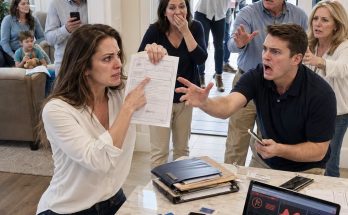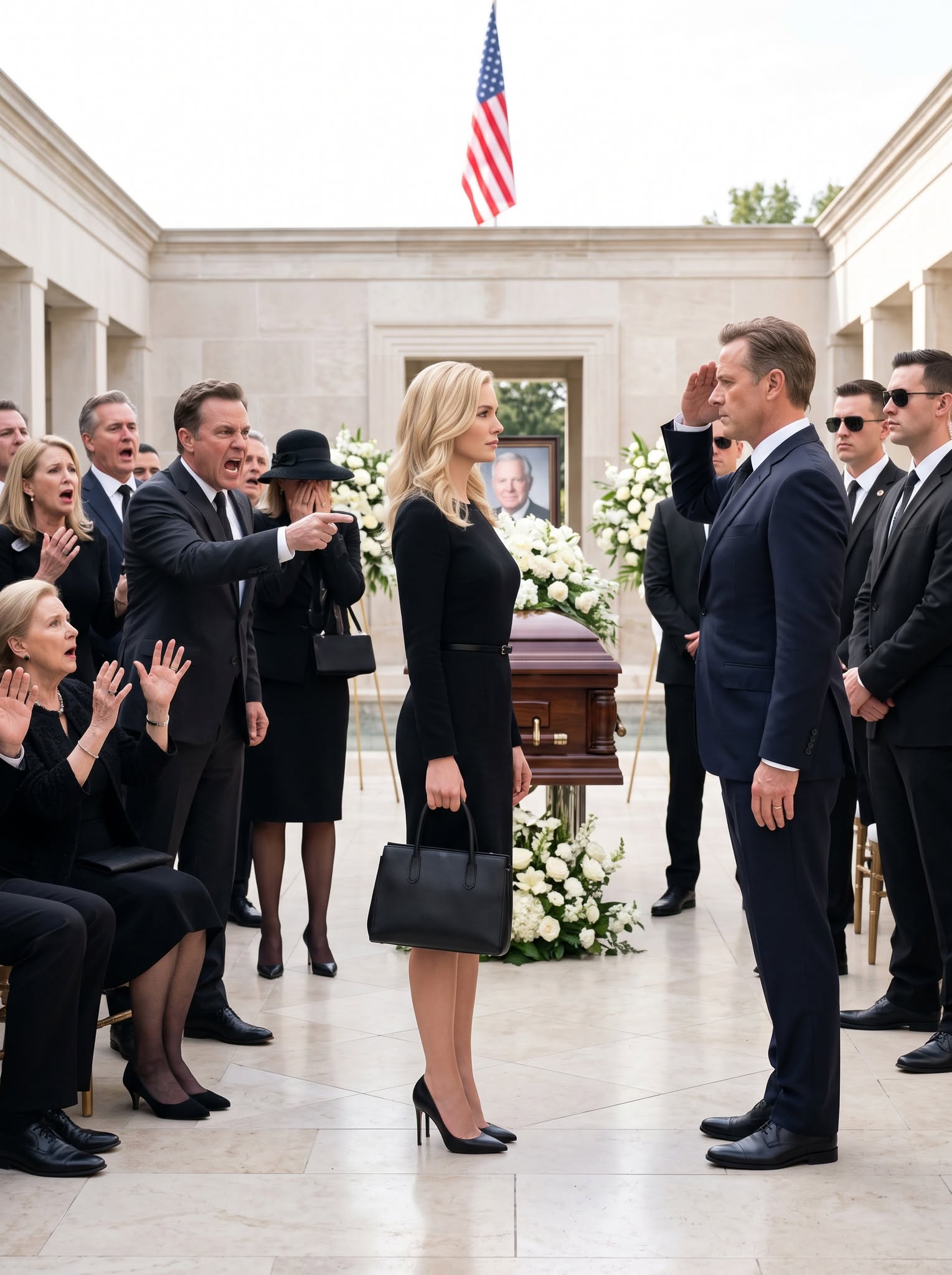
A decade after my family disowned me for becoming an Army doctor, I returned home for my grandfather’s funeral. My father took one look at me and sneered, “Still changing bandages?” But before I could respond, a high-ranking Pentagon official flanked by three bodyguards marched toward me and snapped to attention. “It’s an honor to see you again, Colonel Carter.” My father didn’t just stop talking—he completely froze.
Part 1: The Funeral Salute
The first thing my father said to me at my grandfather’s funeral was, “Still pretending the Army needs another doctor?”
He did not whisper it.
Richard Monroe never whispered when humiliation could be useful. He said it in the reception room of the Army Navy Country Club, loud enough for retired generals, lobbyists, and defense contractors to hear. My grandfather, General Arthur Monroe, had been buried less than an hour earlier.
I stood before him in my dress uniform, gloves tucked under one arm, rain drying on my shoulders.
“Hello, Dad,” I said.
He looked over my ribbons and medical corps insignia with the same smile I remembered from childhood.
“The family doctor finally came home,” he said. “Should we all line up for aspirin?”
One contractor chuckled. My younger brother, Caleb, laughed openly, as he always did when Dad gave him permission.
Caleb lifted his whiskey. “Evie, I didn’t know they let Army doctors leave base for family events.”
“They do for funerals,” I said.
His smile twitched.
Small victories are small, but I had learned not to waste them.
The room looked like every Monroe family performance: expensive grief, polished glass, defense money, and people networking beneath chandeliers. My stepmother, Diane, floated past with appetizers and refused to look at me.
I told myself to leave.
I had come for my grandfather, not for Richard, Caleb, Diane, or the family machine that turned grief into influence.
Then the room changed.
Conversations softened. Men adjusted jackets. A senator near the bar straightened. Power had entered the room, and everyone who chased it felt the charge.
I turned.
Thomas Whitmore, Deputy Assistant Secretary of Defense, stood at the entrance with three federal security agents behind him.
My father saw him too.
For the first time all afternoon, Richard Monroe stopped smiling.
Whitmore scanned the room, passed over my father, my brother, and the contractors, then stopped on me.
He walked straight toward me.
Not toward my father.
Toward me.
When he reached me, he gave a formal salute.
My body returned it before my mind caught up.
“Colonel Monroe,” he said. “It’s an honor to see you again.”
Behind me, Caleb’s glass froze halfway to his mouth.
Whitmore lowered his voice, but not enough.
“The men from Kandahar still ask about you.”
The room forgot how to breathe.
My father looked at my uniform again, differently this time, as if the fabric had changed while he was not watching.
Whitmore shook my hand.
“I came to pay respects to your grandfather,” he said. “He spoke of you near the end.”
That hurt more than any insult, because my grandfather and I had barely spoken in years.
Two minutes later, my father found me near the hallway.
“How do you know Thomas Whitmore?”
I looked at him, and for once, I did not feel sixteen.
“You meet certain people,” I said, “on the worst day of somebody’s life.”
Then I walked outside into the cold.
I had barely reached the wet stone steps when Whitmore appeared behind me carrying two paper cups of coffee. He handed me one, then opened his other hand.
In his palm lay my grandfather’s old silver lighter.
“He wanted you to have this,” Whitmore said.
My fingers went cold before I touched it.
Taped to the bottom was a folded strip of paper with my name on it.
And I understood the funeral had not ended.
It had just begun.

Part 2: The Lighter and the Warning
The lighter was heavier than I remembered.
My grandfather used to flip it open and shut when thinking. Click, pause, click. That sound lived deep in my childhood, beside leather chairs, old books, black coffee, and my father’s voice telling me to stop asking questions at dinner.
“Did he give this to you personally?” I asked.
Whitmore watched the parking lot.
“Two weeks before he died. He made me promise to put it in your hand, not your father’s.”
My name was written on the folded paper in my grandfather’s handwriting.
Evelyn.
“Why didn’t he mail it?”
“Because he trusted the mail less than people,” Whitmore said. “And he trusted people very little.”
That sounded like him.
Through the glass, I saw my father speaking too calmly beside Caleb. Diane sat stiffly on a cream sofa, twisting her wedding ring.
My family had always looked best from a distance.
From outside, we were legacy, politics, contracts, charity boards, and Georgetown dinners. Inside, everything had rules.
Do not embarrass the family.
Do not question your father in public.
Do not cry where guests can see.
Do not choose a life that cannot be turned into influence.
I learned those rules before cursive.
When I was twelve, a senator asked what I wanted to be. I said surgeon. My father smiled and pressed a hand to my shoulder.
“She means health policy,” he said. “She’s very bright.”
I decided under that chandelier that one day I would become something he could not translate for his friends.
Years later, when I accepted an Army medical scholarship, my father looked at me like I had tracked mud across a white carpet.
“We have connections at Johns Hopkins,” he said.
“I don’t want easy.”
That was the wrong thing to say in Richard Monroe’s house.
My trust access disappeared a week later. He called it a lesson in adult choices.
I called it the beginning of my real life.
Medical school was fluorescent lights, frozen dinners, panic, debt, and exhaustion. Residency was worse. The Army was worse than that.
But it was mine.
I became good because people needed me to be good. Steady hands. Clear orders. No drama in the trauma bay. No flinching when helicopters landed at two in the morning.
Whitmore’s voice pulled me back.
“Open the note somewhere private,” he said.
“Is this about my grandfather?”
His eyes shifted.
“Yes. And no.”
Before leaving, he looked back at me.
“Your grandfather made mistakes. Near the end, he tried to correct one.”
Then he left me in the cold with the lighter in my hand.
I peeled the paper loose enough to see the first line.
Do not let Richard touch the blue folder.
My pulse slowed.
Because fear in a hospital runs fast, but real danger often arrives quietly wearing your father’s name.
And I had no idea what blue folder my grandfather meant.

Part 3: The Blue Folder
The Monroe house looked exactly the same and completely wrong.
Stone gates. Wet hedges. Warm windows glowing against the February dark. Inside, guests murmured beneath portraits of my grandfather beside presidents, generals, and ambassadors.
My father loved that house because rooms like it made people lower their voices.
I kept the lighter in my coat and the note inside my glove.
Do not let Richard touch the blue folder.
The family attorney, Marcus Vale, soon gathered us in my grandfather’s study. It was the heart of the house: dark wood, green lamps, shelves of military history, and a framed retirement flag above the desk.
I noticed the locked file cabinet immediately.
One drawer had blue tape on the handle.
The attorney began with expected items: charities, old friends, property, military donations. The house went to my father. Caleb received shares in Monroe Defense Systems. Diane received jewelry and a trust.
For a long time, I received nothing.
Then Marcus cleared his throat.
“To my granddaughter, Colonel Evelyn Monroe, I leave my personal military journals, service medals, and full leadership authority over the Monroe Foundation for Wounded Service Members.”
My father’s head turned.
“What?”
Marcus did not look at him. “General Monroe was explicit.”
“The foundation belongs under the company umbrella,” my father said.
“No. It belongs to Colonel Monroe now.”
The study went still.
Then Marcus handed me a sealed envelope.
“This was to be opened privately.”
My name crossed the front in the same handwriting.
My father stood.
“I want to see that.”
I slid the envelope into my jacket.
“No.”
His eyes sharpened, and the old fear moved through me.
Then I remembered Whitmore’s salute.
I remembered Kandahar.
I remembered the old Marine general who had told me his grandson lived because of my surgical unit.
And I walked out without asking permission.
I was halfway down the hall when my father called after me.
“Evelyn, don’t make me come after you in my own house.”
I stopped at the den door.
Because behind the half-open door, on the wet bar, sat a blue folder.
Across its tab was one word:
Kandahar.
Part 4: Batch 17-D
I did not touch the folder immediately.
Not because I was brave.
Because I was afraid.
In the Army, you learn not to rush toward something just because every nerve screams that it matters.
The blue folder sat near a decanter, half hidden beneath old Army football programs.
I closed the den door almost all the way, leaving one inch open. Old habit. Always keep a line of sight.
Then I opened my grandfather’s envelope.
The letter was two pages.
Evelyn,
If you are reading this, I ran out of time or courage. Knowing me, likely both.
I sat on the leather sofa because my knees felt unreliable.
He wrote that he had followed my career more closely than I knew: promotions, deployments, surgical units, commendations I never told my family about because I was tired of watching them dismiss service or turn it into dinner conversation.
Then came the next paragraph.
Several years ago, I learned that Monroe Defense Systems approved battlefield medical supply shipments after internal warnings showed failure risks. I did not act quickly enough. That failure belongs to me. What I gathered is in the blue folder. What I already gave investigators cannot be taken back.
The room tilted.
Monroe Defense Systems was my father’s company. It supplied protective gear, logistics materials, and medical field equipment under Pentagon contracts.
Clean words.
Procurement. Support systems. Readiness.
The folder looked dirty now.
Inside were copies: contract numbers, memos, quality reports, redacted emails, meeting notes in my grandfather’s handwriting.
Batch 17-D.
Emergency trauma kits.
Tourniquets.
Hemostatic dressings.
Locking failures under heat stress.
Complaint reports from deployed units.
Kandahar returned in fragments: lights, dust, bleach, rotors, a young private trying to joke as his lips went pale, my hands inside gloves, a nurse shouting for another kit, a locking mechanism slipping under my fingers when it should have held.
At the time, we blamed battlefield chaos.
Sand. Heat. Bad luck. Human error.
But intentional approval after warnings was not war.
It was accounting.
The door opened.
Diane stood there.
For once, she looked directly at me.
“You shouldn’t be in here.”
I stared at her.
“Did you know?”
Her mouth opened, then closed.
That was answer enough.
She stepped inside and shut the door.
“Evelyn, you don’t understand what men like your father deal with.”
Men like your father.
Men with pressure. Vision. Burdens. Men whose choices everyone else had to survive.
“What did he deal with?” I asked. “Lower profit margins?”
Her eyes flashed.
“That company employs thousands.”
“And how many did it bury?”
She flinched.
I picked up the folder.
She reached for it.
I stepped back, folder against my chest.
“Don’t.”
For the first time, my stepmother looked afraid of me.
Not because I was cruel.
Because I was no longer manageable.
Then my father appeared in the doorway.
His face was calm.
Too calm.
Caleb stood behind him with a drink, confused.
My father’s gaze dropped to the blue tab.
Then he smiled.
“Evelyn,” he said softly, “put that down before you embarrass yourself.”
But his right hand was clenched so tightly his knuckles had gone white.
That was when I knew the folder was not just dangerous.
It was real.
Part 5: The Witness from Kandahar
My father was always polite when he was most dangerous.
He stepped into the den, closed the door behind Caleb, and lowered his voice.
“That folder contains private company material.”
“It contains battlefield failure reports.”
He held out his hand.
“Give it to me.”
“No.”
There it was: my name as command, my name as warning, my name as the old leash.
For years, that tone could lock my spine.
But the folder was not about me.
That made refusal easier.
I opened the folder and pulled out the first report.
“Batch 17-D. Heat-stress failures. Locking mechanism compromise. Internal warnings. Continued shipment approval.”
Caleb’s face changed.
“Those were flagged and resolved,” my father said.
“Before or after Kandahar?”
Silence.
My father looked at me with disgust.
“You always wanted to see this family as corrupt. It made your rebellion feel righteous.”
“My rebellion?”
“You chose hardship because you were addicted to proving a point.”
For one second, I saw myself at twenty-two, hands hidden under the table while he dismantled my future in a calm voice.
Then I saw Tyler Mercer.
Nineteen. Freckles. Dirt on his cheek. Apologizing for bleeding on my boots.
My anger became clean.
“You don’t get to psychoanalyze me while standing next to evidence.”
My phone buzzed.
Unknown number.
I answered.
“Colonel Monroe?”
An older woman’s voice, rough with fatigue.
“This is Mara Quinn. We served together at Kandahar. I got your number from Walter Reed.”
The room fell away.