The silver rattle made a clear, delicate sound when Eleanor Whitmore lifted it from its velvet case and held it above my six-week-old daughter.
At first glance, it looked perfectly suited to the elegant gathering surrounding us. The handle was engraved with curling vines, and a tiny crown sat at the top. White peonies filled tall glass vases along the conservatory windows, servers carried champagne between groups of relatives, and polished cars lined the circular driveway outside the Whitmore family estate near Charlottesville, Virginia.
Then Eleanor turned the rattle over.
Across the back were the words:
PROPERTY OF THE WHITMORE HOUSEHOLD.
Several guests laughed.
My daughter, Lily, slept against my chest in a pale blue wrap, unaware that her grandmother had commissioned an heirloom declaring ownership over her before she could even hold up her own head.
Eleanor smiled at the room before looking directly at me.
“Since my son was generous enough to bring you into this family, I thought the baby deserved something that explained where her future opportunities come from.”
More laughter followed.
My husband, Nathan, stood near the fireplace with an untouched drink in his hand. His discomfort showed in the way he adjusted his collar, but he said nothing.
The Whitmores believed I came from an ordinary family in western Ohio and worked as an administrative analyst for a federal agency. They knew my father had served in the military, but no one had ever asked what he had done or why senior government officials occasionally contacted me directly.
Eleanor preferred the simpler version.
To her, I was the practical daughter-in-law without social connections, inherited property, or a recognizable family name. She gave me kitchen appliances for birthdays, corrected my pronunciation at charity dinners, and once introduced me to a governor as the woman who kept Nathan organized.
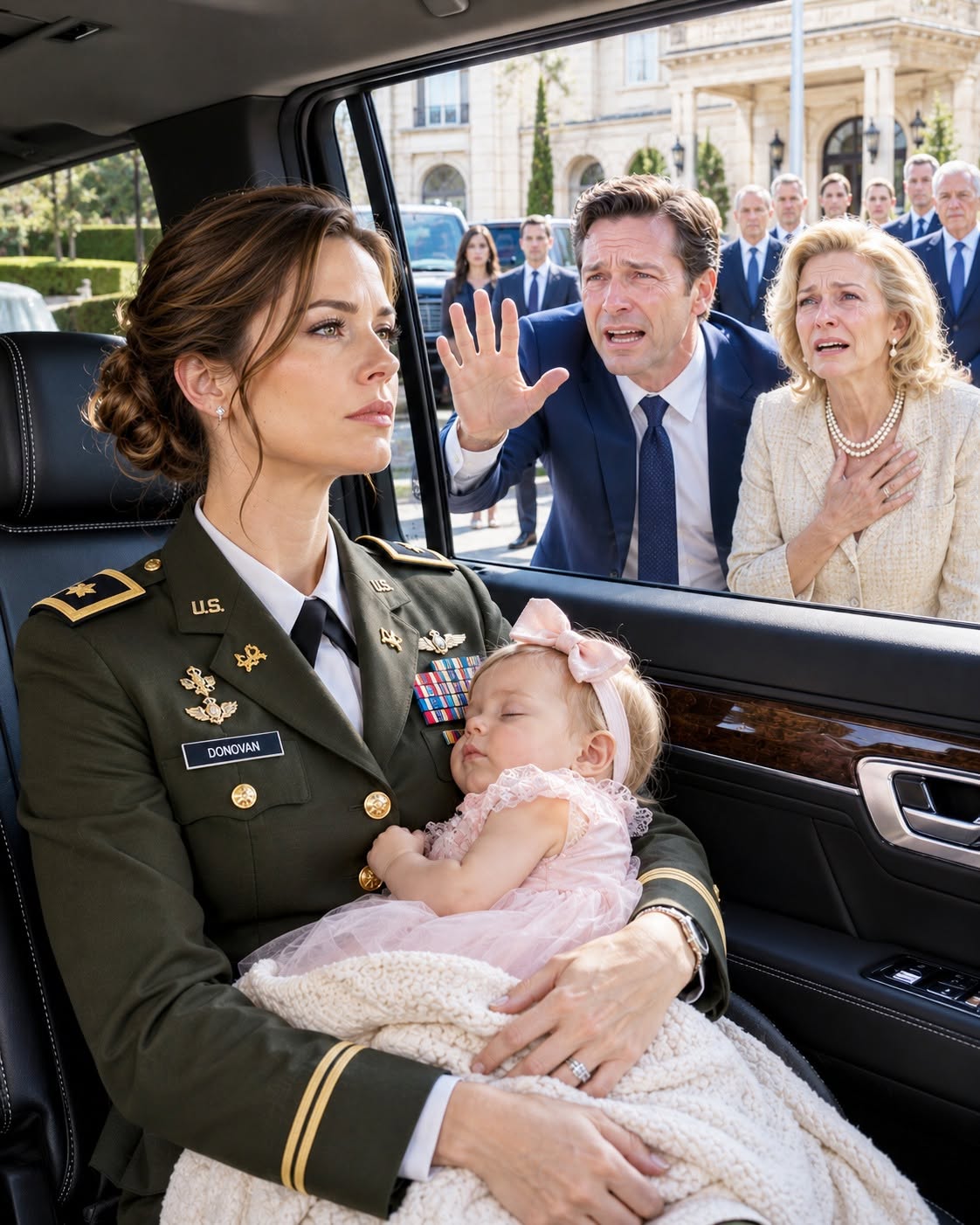
In reality, I was Lieutenant Colonel Claire Donovan, an intelligence officer assigned to a joint national-security command.
Most of my work could not be discussed outside secure facilities. For years, allowing Eleanor to underestimate me had seemed easier than explaining why silence sometimes protected more than pride.
Motherhood changed that.
Every humiliation I accepted could become a lesson Lily might one day believe she deserved.
I looked at the rattle again.
“Please put it back in the box.”
Eleanor’s smile narrowed.
“Do not be dramatic. It is a family joke.”
“A joke requires more than one person finding it funny.”
The relatives closest to us stopped laughing.
Eleanor stepped nearer and shook the rattle above Lily’s head. The sound startled her awake, and she began to cry.
“Give her to me,” Eleanor said. “You are making her nervous.”
I moved back.
“No.”
The single word silenced the conservatory more effectively than shouting would have.
Eleanor looked toward Nathan.
“Are you going to allow your wife to disrespect me in my own home?”
Nathan placed his glass on the mantel.
“Mother, perhaps we should put the gift away.”
His answer came too late and far too softly. Eleanor heard it as a suggestion instead of a refusal.
“This celebration is for my granddaughter, and I will not be lectured by someone who has spent three years resenting traditions she does not understand.”
I took my phone from the diaper bag and activated the camera.
Eleanor noticed immediately.
“What are you doing?”
“Preserving the context you will later insist everyone misunderstood.”
Her cheeks flushed.
I recorded the engraved rattle, the guests who had laughed, Eleanor’s expression, and Nathan standing several feet away like a man waiting for someone else to save his marriage.
Then I picked up the diaper bag.
“I am taking Lily home.”
Nathan followed me into the hallway.
“Claire, do not leave like this. Mother was trying to provoke you, and now you are giving her exactly what she wanted.”
I turned toward him.
“Your mother placed an ownership label on our daughter and waited to see whether you would defend us.”
“It was a vicious joke, but leaving will turn it into a permanent family conflict.”
“No, Nathan. Your silence already did that.”
I drove away without raising my voice.
My hands did not begin shaking until the estate disappeared behind the trees.
I sent the unedited recording to my father, General Michael Donovan, who had recently retired after nearly forty years in military intelligence.
He called immediately.
“Are you and Lily safe?”
“Yes.”
“Send me the guest list, every message from Eleanor, and anything involving money, property, medical decisions, or custody.”
His tone shifted slightly.
“Do not return to that estate alone.”
The following morning, Nathan came to our townhouse looking exhausted.
“My father has ordered everyone who attended yesterday’s gathering back to the estate at noon,” he said. “He says attendance is mandatory.”
I waited.
Nathan swallowed.
“Your father will be there. He is bringing an attorney and someone from his former command.”
At noon, the Whitmore estate looked almost exactly as it had the previous afternoon, except no one had opened the champagne.
The peonies remained in place, their edges beginning to curl in the heat. Uneaten pastries sat beneath glass domes while relatives occupied the sofas in uncomfortable silence.
I arrived in my own car with Lily sleeping against my chest.
My father stepped from a dark sedan behind me. He wore a charcoal suit instead of a uniform, but retirement had not changed the quiet authority in his posture.
Beside him were attorney Sarah Caldwell and retired Major Owen Price, who now worked in corporate and private-security investigations.
Dad looked at me first, then at Lily.
“How long has she been asleep?”
“About thirty minutes.”
He gently touched one finger against her covered foot.
“Excellent judgment. She has decided to avoid the meeting.”
Despite everything, I smiled.
Before we entered, Dad studied my face.
“This conversation belongs to you. I am here to support your decisions, not make them for you.”
That sentence mattered more than he probably understood.
Inside, Nathan waited near the doorway. His eyes moved from Lily to my father and then to Sarah’s document case.
“Claire,” he said quietly.
I acknowledged him with a nod.
Nathan’s father, Charles Whitmore, stood near the fireplace. He was a reserved man whose lifelong habit of avoiding conflict had allowed Eleanor to control the emotional climate of the family for decades.
Eleanor stood in the center of the room wearing pearls and a dark emerald dress.
The velvet box containing the rattle rested on the table in front of her.
Charles spoke first.
“Colonel Donovan, General Donovan, thank you for coming. Yesterday’s gathering became far more serious than anyone intended.”
Dad looked at the box.
“It became serious when your wife used an infant as a tool for public humiliation.”
Eleanor exhaled sharply.
“General, private family humor often sounds harsh to outsiders.”
“Patterns reveal intent more accurately than labels,” Dad replied. “My daughter has endured degrading remarks and gifts for years. Yesterday, the pattern reached her child.”
Eleanor turned toward me.
“So this is what you wanted, Claire. To arrive with powerful people and make me look cruel.”
Lily stirred against my shoulder. I rested a hand on her back.
“You already had an audience yesterday. Today, I want accountability.”
“For an engraved rattle?”
“For teaching everyone in this room that humiliating me earns approval. For treating Nathan’s silence as permission. And for trying to pass the same lesson to my daughter.”
Nathan stepped forward.
“Claire is right.”
Eleanor turned so quickly that her pearls shifted.
“You are tired and embarrassed.”
“I am embarrassed by myself,” Nathan said. “I kept calling your behavior complicated because admitting it was cruel would have required me to confront you.”
The admission hurt because I had needed it the day before, not after lawyers and parents had entered the room.
Still, late honesty was more useful than continued denial.
Charles closed his eyes briefly.
“Eleanor, apologize.”
She laughed in disbelief.
“You cannot be serious.”
“I am entirely serious.”
Sarah opened her case and placed a document on the table.
It did not demand money. It established boundaries.
Eleanor would have no unsupervised contact with Lily until trust was rebuilt. There would be no insulting gifts, remarks about my family, efforts to control photographs or medical information, or gatherings where guests were asked to surrender their phones to prevent documentation.
Eleanor stared at the agreement.
“You expect me to sign rules controlling my behavior inside my own family?”
“No,” I said. “I expect you to decide whether access to my daughter matters more than controlling everyone around you.”
Her expression shifted.
Lily was not a bargaining object. But protecting her required conditions Eleanor could understand.
Eleanor looked at Nathan.
“You would choose this woman over your own mother?”
His shoulders lowered as though he had carried that question since childhood.
“I am choosing my wife and daughter. That should never have been described as choosing against you.”
For the first time, Eleanor looked uncertain.
Charles opened the velvet box, removed the rattle, and handed it to Major Price.
“Take it away.”
Eleanor stepped forward.
“Charles, that belongs to the family.”
“No child in this family will inherit it.”
When Price placed the rattle inside an evidence pouch, Eleanor scoffed.
“Evidence? This is absurd.”
Sarah looked at the engraving.
“Preserving an object involved in a documented pattern is simply sensible.”
The word documented changed the atmosphere.
Eleanor signed last. She pressed the pen so hard that it nearly tore the paper.
The meeting might have ended there if the estate manager had not entered while Sarah gathered the signed agreements.
Mr. Harris had worked for the Whitmores for more than twenty years. He approached Charles with the hesitant posture of a man deciding whether conscience mattered more than employment.
“Sir, there is something you should know about the rattle.”
Eleanor’s face changed before he continued.
Charles noticed.
“What is it?”
Harris looked toward the velvet case.
“The package arrived yesterday morning through a private courier. Mrs. Whitmore did not order it.”
Nathan stared at his mother.
“You said you commissioned the engraving.”
Eleanor folded her arms.
“I said it came from the family. I never explained the purchasing details.”
“Was there a message?” Dad asked.
Harris nodded.
“A typed card was attached. I placed it in Mrs. Whitmore’s dressing room.”
Eleanor’s voice sharpened.
“It meant nothing, and I destroyed it.”
Major Price became alert.
“What did it say?”
Harris struggled to remember.
“Something about beginning with the child so the mother would remember who opened the gate.”
Coldness moved through me.
Lily continued sleeping peacefully against my chest.
Dad looked at Eleanor.
“Where are the remains of the card?”
“I threw them away.”
Charles’s disappointment appeared heavier than anger.
“You received an anonymous message referring to your granddaughter and still used the object at a party?”
“I assumed one of the cousins sent it as a prank. I thought displaying it confidently would deny the sender the satisfaction of embarrassing me.”
“You protected yourself by transferring the humiliation to my wife and child,” Nathan said.
Eleanor opened her mouth, but no answer came.
Harris led Price and Sarah to the dressing room. They returned with a small wastebasket and two pieces of a torn card.
Wearing gloves, Sarah placed the pieces together.
The first sentence matched Harris’s memory.
A second line followed:
ASK CHARLES WHY HE ERASED THE WOMAN WHO CREATED THE FIRST WHITMORE FOUNDATION.
Everyone turned toward Charles.
His face lost its color.
Eleanor sat down.
Nathan stared at his father.
“What woman?”
Charles gripped the fireplace mantel.
“My older sister, Margaret.”
No one from the younger generation appeared to recognize the name.
The Whitmores spoke constantly about their history. Their ancestors appeared in portraits, foundation brochures, university buildings, hospital wings, and plaques.
Yet Margaret Whitmore had vanished from every version of the story.
“What happened to her?” Nathan asked.
Charles looked toward the windows.
“Margaret created the community medical fund that later became the Whitmore Foundation. She organized the first clinics, found the original donors, and persuaded our grandfather to contribute unused property.”
“Then why have I never heard of her?”
Charles’s voice became rough.
“Because she refused to let the family decide which people deserved help.”
In the early 1990s, Margaret wanted the foundation to support migrant families, uninsured workers, and women leaving violent homes.
Charles’s father believed those programs would damage relationships with wealthy donors.
Margaret also became engaged to Dr. Rafael Ortiz, a physician from a working-class immigrant family. The Whitmore patriarch considered him unsuitable and threatened to destroy Margaret’s funding, inheritance, and professional reputation.
“Did she leave?” I asked.
Charles nodded.
“She resigned, married Rafael, and opened a small clinic in Colorado.”
Nathan looked at the portraits and silver-framed family photographs surrounding us.
“You erased her because she left?”
Charles’s eyes filled with shame.
“My father removed her name from the foundation records and credited the work to me. I was twenty-six, ambitious, and terrified of losing his approval. I allowed it.”
Eleanor looked at her husband.
“You told me Margaret had contributed briefly and later became unstable.”
“That was the story my father created.”
Dad kept his attention on Charles.
“Is she alive?”
Charles hesitated.
“I do not know. The letters stopped nearly twenty-five years ago.”
Sarah touched the torn message.
“Someone knows enough to connect Margaret’s erasure with Claire and Lily. We need to understand why.”
Charles led us into the oldest section of the estate, where a narrow office had remained locked since his father’s death.
The room smelled of leather, dust, and cedar polish. A large portrait of Charles’s father dominated one wall, presenting him as a dignified philanthropist instead of the man we had just heard about.
Charles removed the portrait, revealing a shallow wall safe.
“My father kept the original foundation records here,” he said. “I have not opened this in years.”
Nathan stared at him.
“You knew the documents existed?”
“I knew something remained. I told myself protecting the current foundation mattered more than reopening the past.”
Charles entered the combination.
Inside were ledgers, letters, legal documents, photographs, and a sealed envelope bearing Margaret’s name.
The earliest ledger recorded the donations Margaret secured, the properties she negotiated, and the clinic programs she designed.
Later pages had been altered. Her initials were crossed out, and Charles’s were written above them.
Another file contained a proposed settlement offering Margaret money if she abandoned all claims to the foundation and agreed never to use the Whitmore name professionally.
She had refused.
Among the photographs was one of Margaret standing beside Dr. Ortiz outside a modest clinic. A little girl, perhaps five years old, held Margaret’s hand.
The note on the back read:
Margaret, Rafael, and Sofia — Denver, 1999.
Charles lowered himself into a chair.
“She had a daughter.”
Eleanor tightened her grip on her handbag.
“You truly did not know?”
“No.”
Mr. Harris remained near the doorway.
“Sir, your father knew.”
Charles looked up.
Harris explained that the elder Whitmore received letters from Margaret for years. He instructed the staff to intercept them and ordered accountants to monitor her clinic.
One autumn, Margaret returned to Virginia with her daughter and asked to see Charles.
“Your father never told you she was here,” Harris said. “He sent them away through the garden entrance.”
Charles’s expression collapsed.
“Why did no one tell me?”
Harris lowered his eyes.
“Because employment in this house depended on obedience, and most of us were not brave.”
The honesty prevented Charles from blaming only the staff.
“Neither was I,” he said.
With Charles’s permission, Sarah opened Margaret’s sealed envelope.
The letter had been written shortly after that failed visit.
Margaret explained that Rafael had died unexpectedly, leaving her to raise Sofia and run the clinic alone.
She did not ask for an inheritance.
She asked only that the foundation restore her name to its original records and promise never to claim authority over Sofia.
The final paragraph was addressed directly to Charles.
You warned me once about what Father planned, but warning someone without standing beside them only gives them more time to understand that they are alone. I hope you eventually become braver than we were allowed to be.
Nathan turned toward the window.
I recognized the pain in his posture.
Margaret had described the same failure that shaped his response to Eleanor. He warned, softened, explained, and privately apologized, but he did not stand publicly beside the person being harmed.
“I became you,” Nathan told his father quietly.
Charles did not defend himself.
“Yes.”
Nathan looked at Lily and me.
“I do not want our daughter growing up inside this pattern.”
“Recognizing it cannot be the final step,” I said. “You will have to behave differently when doing so costs you something.”
He nodded.