Part 1: The Lawsuit
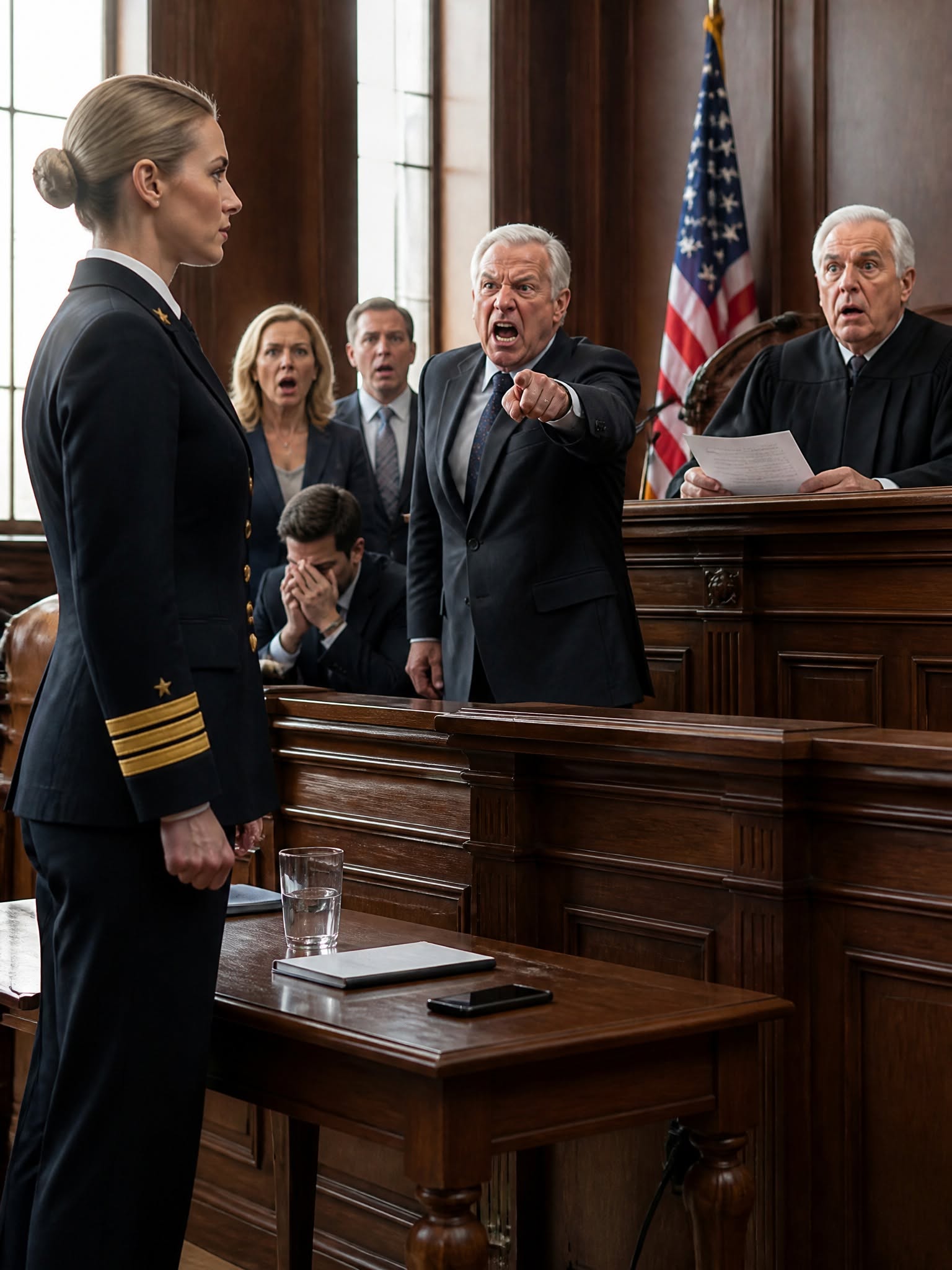
My father stood in federal court and told a judge I had invented my entire life.
Not exaggerated it.
Not misunderstood it.
Invented it.
Colonel Graham Voss, retired United States Air Force, buttoned his navy suit jacket the same way he used to button his dress blues: two sharp tugs, chin slightly raised, calm voice steady enough to sound like truth.
“No service,” he said.
A pause.
“No sacrifice.”
Another pause.
“All fiction.”
Behind him sat three men who had once served under him. My younger brother, Evan, sat at the end of the row, staring at the floor between his polished shoes.
I sat alone at the respondent’s table in a charcoal blazer, white blouse, and black slacks. No uniform. No medals. No attorney whispering beside me. Just a yellow legal pad, a capped pen, and one sealed envelope waiting in the clerk’s file like a match in dry grass.
Judge Marisol Reyes looked over her glasses.
“Colonel Voss, you understand you are testifying under oath.”
“I do, Your Honor.”
“And your position is that your daughter’s military record is fraudulent?”
My father turned just enough for the gallery to hear.
“My position is that Clara Voss has allowed people to believe she earned honors, rank, and benefits she did not earn. I am here to correct the record.”
Correct the record.
Those words moved through me colder than fear. Records were not corrected by confidence, volume, or blood. They were corrected by evidence.
My father’s attorney, Martin Hale, stood with a folder in hand. He had the dry eagerness of a man who enjoyed technicalities because they let him hurt people without raising his voice.
He claimed my advancement did not match “reasonable recollection.” He called my work support functions, administrative channels, and back-office assignments.
My father had used those phrases for fifteen years.
At barbecues, he introduced Evan as “my son, Captain Voss, following the right road.” Then he would gesture toward me and say, “Clara does support work for the Air Force.”
Support work.
The phrase followed me like smoke in wool.
Hale called three witnesses. One had never seen me in an operational setting. One had known me since childhood and said I did not speak with the confidence of a senior officer. One said the promotion process was too strict to allow mistakes—which was the first true sentence that morning.
I wrote the same word three times on my pad.
Memory.
When Hale finished, my father leaned back, almost smiling. He believed the hard part was over.
Then Judge Reyes turned to me.
“Ms. Voss, you may proceed.”
I stood.
My knees did not shake.
“Your Honor, the respondent requests permission to submit Exhibit G for review.”
Hale shot up. “Objection. Undisclosed.”
“It was disclosed six weeks ago,” I said. “Filed under seal with the exhibit index served to counsel.”
He flipped through his folder too quickly. His face changed before he sat down.
“Withdrawn.”
The clerk brought the envelope to the bench.
It was dark blue, heavy, and formal enough to outlive the man who had written it.
My father recognized the handwriting first.
All color left his face.
Judge Reyes placed one finger on the seal, and my father whispered, so softly only the front row could hear:
“Where did you get that?”
For the first time that morning, I looked at him.
And for the first time in my life, my father looked afraid.

Part 2: The Daughter Filed Under Harmless
I grew up in Colorado Springs in a house that faced the mountains but worshiped the wall in my father’s study.
That wall held photographs, challenge coins, plaques, commendations, certificates, a folded flag, and one silver-framed picture of my father shaking hands with a general whose name he mentioned more often than some relatives.
Every item had a story.
Every story had the same meaning.
Service made you real.
My father retired as a colonel when I was seventeen, but he never retired emotionally. He woke at 5:10, ran three miles even in snow, shaved like inspection was coming, and drank black coffee from a mug that said Aim High.
Evan loved it. He memorized aircraft silhouettes, wore Dad’s old flight jacket, and knew rank insignia before long division. When he got into the Academy, my father stood in the driveway with one hand on Evan’s shoulder and the other over his heart like a hymn was playing.
I joined through ROTC at a state school.
My father called it “a practical route.”
That was how he praised things he considered second-best.
I wanted to serve. I also wanted, quietly and desperately, to become something without being assembled from his expectations.
The problem was that my early work was hard to explain at dinner. Some was classified. Some sounded boring to anyone outside the building. Most of it happened in windowless rooms under fluorescent lights, inside acronyms no one outside the chain needed to hear.
I learned logistics, planning, crisis communication, personnel movement, risk assessment, and how to make seventeen impossible things happen by Thursday without letting anyone outside the team know there had ever been a problem.
When my father asked, “How’s work?” he did not mean it as a question.
He meant: confirm what I already believe.
So I said, “Busy.”
He nodded like that proved something.
At my first family gathering after commissioning, he introduced Evan as “the future of the Voss name” and me as “Clara, handling support work.”
One of Dad’s old friends asked whether I typed reports.
“Sometimes,” I said.
My father laughed.
“She keeps the machine moving. Not everyone needs to be out front.”
I could have corrected them. I could have said enough to change the temperature of the conversation.
But begging my father to believe me felt worse than being dismissed.
So I smiled, finished my food, and helped my aunt carry folding chairs back to the garage.
That night, my mother, Elaine, found me washing dishes.
The house was loud behind us, full of men laughing at stories they had told before. She dried a glass slowly and said, “He doesn’t know what to do with you.”
I stared into the sink.
“He knows exactly what to do with me. He files me under harmless.”
She was quiet.
Then she said, “Maybe harmless is easier for him.”
Before I could ask what she meant, my phone buzzed.
Unknown number.
A woman’s voice said, “Lieutenant Voss? Hold for General Mercer.”
The noise behind me fell away.
A man came on the line, voice low and fully awake.
“Voss, I need you in Nevada before dawn. Pack light. Bring nothing you cannot afford to have locked away.”
I looked through the kitchen window at my father laughing beneath porch lights he had strung himself.
Then I said, “Yes, sir.”
The next morning, before sunrise, I reported to a building with no sign on the door.

Part 3: General Mercer
General Thomas Mercer did not look like the kind of man my father admired, which made me distrust him for ten minutes.
He was not tall. He did not fill a room by trying to. His uniform looked worn in the exact way a uniform looks when it has stopped being clothing and started being skin. His eyes were clear enough to make lying feel childish.
He pointed to a chair.
“Sit.”
I sat.
He opened a folder.
“Clara Voss. Twenty-six. Strong evaluations. Weak self-advocacy. Excellent pattern recognition. Tendency to assume competence will be noticed without assistance.”
I blinked.
“That last part is in my file, sir?”
“No,” he said. “That part took ninety seconds.”
He turned a page.
“You have been recommended for a planning cell that does not exist on paper in the way people outside this building understand paper. You will not discuss the work with family. You will not correct people who misunderstand it unless duty requires correction. You will not use secrecy as a curtain to make yourself interesting.”
“Yes, sir.”
Then he asked, “What is the most undervalued skill in leadership?”
I thought of my father’s wall. Courage. Discipline. Vision. Presence.
Then I thought of real work: decision logs, after-action reports, email chains saved under boring labels, and the written record that survives after memory turns political.
“Documentation,” I said.
Mercer looked at me like I had said something useful.
“Correct.”
That was the interview.
For three years, he watched everything. He did not praise to soften the day. He corrected errors in red ink and once returned a twelve-page brief with only two words at the top:
Think harder.
I did.
The work came in waves: supply-chain failures, communication blackouts, extraction plans rewritten six times in eleven hours because every new fact made the previous plan useless.
Mercer’s rule was simple: write down what changed, who knew, who decided, and why.
“Memory is not a system,” he said during one midnight review. “Memory is a witness with bad lighting.”
I lived on burnt coffee, vending-machine almonds, and the fear of letting the team down. I missed holidays and birthdays. Once, I called home from a concrete stairwell to apologize for missing Christmas morning.
My father answered and said, “Support roles get busy too, I guess.”
I said, “Yes, sir.”
He said, “You don’t have to call me sir.”
But I did, because some habits are not respect.
Some are armor.
General Mercer noticed.
One evening, after a review, he kept me behind.
“You shrink on personal calls,” he said.
I closed my folder. “Sir?”
“You heard me.”
I looked at the blank screen.
“My father served twenty-four years. He has a specific idea of what military value looks like.”
“And you are not it?”
“Not to him.”
Mercer leaned back.
“Your father taught you to stand at attention. Useful skill. But you mistook standing at attention for making yourself smaller.”
Then he slid an evaluation draft across the table.
Mine.
Not inflated.
Not generous.
Accurate.
Every strength was specific. Every weakness was traceable. Every claim had evidence. Reading it felt like stepping in front of a clean mirror after years of seeing myself in warped glass.
“You do the work,” he said. “Let the record show it.”
At the door, he stopped.
“One question, Voss.”
“Yes, sir?”
“Why is your father still listed as your emergency contact if he does not know where your real life begins?”
I had no answer.
That night, I changed the form.
The next morning, my mother called before breakfast, crying so quietly I almost missed it.
Part 4: The Money Nobody Mentioned
My mother had been hiding bills in a cookie tin.
Not dramatic bills. Medical copays. Roof repairs. A second mortgage statement folded until the creases had gone soft. Ordinary paper cuts that bleed a family slowly.
She called from the laundry room with the dryer running behind her to cover her voice.
“Clara, I need to ask you something, and I need you not to tell your father.”
My father had always been responsible with money. Discipline, service, responsibility—those were his pillars. But retirement did not fit him the way he expected. Consulting came and went. Pride stayed. My mother’s diagnosis arrived quietly, then became expensive loudly.
I started sending money.
Then more.
I labeled it household support so my mother would not feel forced to lie to herself about it. She cried the first time the transfer cleared. I told her not to thank me. She did anyway.
For eight years, my father did not know.
Or maybe he did not ask.
That distinction mattered later.
During those years, my career moved in ways I could not explain at Thanksgiving. I learned to sleep on planes. I learned that authority was not volume. I learned that some rooms did not need the loudest person. They needed the person who remembered what had been decided at 2:13 a.m. when everyone else was angry, hungry, and wrong.
My father kept calling me support.
At Evan’s promotion party, he raised a glass and said, “My son understands what it means to lead from the front.”
Later, in the parking lot, my mother touched my hand.
“I’m sorry.”
“For what?”
“For letting him make you lonely in a room full of people.”
I could not look at her.
Then she said, “He is afraid.”
“Of me?”
“Of being passed by.”
I laughed because the alternative was worse.
“That’s ridiculous.”
“Yes,” she said. “Fear usually is.”
Her cancer returned the following spring. General Mercer was ill too, though he told almost no one.
I spent my days between secure rooms and hospital calls, between crisis briefs and my mother’s careful lies.
Near the end, she asked me not to confront him.
We were alone in her bedroom, late light moving through beige curtains.
“Clara,” she said, “promise me you won’t spend your life trying to make him see you.”
“I stopped doing that.”
She smiled faintly.
“No, sweetheart. You stopped asking out loud.”
After her funeral, my father introduced me to a retired major as “my daughter, Clara. Air Force support work.”
My mother’s ashes were not yet cold.
I looked at him and finally saw the reflex for what it was. Grief had taken everything familiar from him, so he put me back in my place.
Three months later, he found the transfers.
He called me at 6:42 on a Sunday evening.
“I didn’t know,” he said.
No hello.
No accusation.
Just that.
“I know,” I said.
Then he said, “Your mother should have told me.”
He did not say thank you.
He did not ask what I had given up.
He only said, “We’ll discuss this later.”
We never did.
Nine months after my promotion ceremony, I was served with his lawsuit.
Part 5: The Ceremony He Refused to Believe
The invitation went out on thick cream cardstock.
I argued against that, unofficially. Officially, I understood protocol. Unofficially, I wanted the day smaller, cleaner, less likely to bruise.
The ceremony took place on a bright October morning at Andrews. The hangar smelled of metal polish, floor wax, and jet fuel. People I had served with came in dress uniform and shook my hand with careful smiles.
General Mercer could not attend. Treatment had taken too much from him, though he still sent comments on documents at hours when no sick man should have been awake.
He sent one sentence instead.
Stand where the record placed you.
I kept the note in my pocket.
My father received his invitation two weeks before the ceremony.
Three days later, he called.
“There must be a mistake.”
I was in my office, holding a briefing packet while two majors argued politely outside the glass.
“What mistake?”
“This ceremony.”
There it was.
Not confusion.
Certainty.
I looked at the copy of the invitation on my desk, at my name printed with the designation I had spent fifteen years earning.
“It isn’t a mistake,” I said.
My father exhaled through his nose.
“Clara, I know how these things work.”
That was when I understood he might someday do something about it.
Not because he had evidence.
Because he had identity.
He did not come.
Evan did, but stood in the back. Afterward, near the coffee urns, he hugged me with one arm and said, “Big day.”
“Yeah.”
“I didn’t realize it had gotten this far.”
This.
As if my career were a misunderstanding that had wandered past the fence.
I wanted to ask whether he was happy for me. I wanted him to answer without checking our father’s face first.
Instead, I said, “It got here honestly.”
His jaw tightened.
“I didn’t say it didn’t.”
No, he had not said it.
That was the Voss family specialty: leaving the cruelest sentence implied and acting offended when someone heard it.