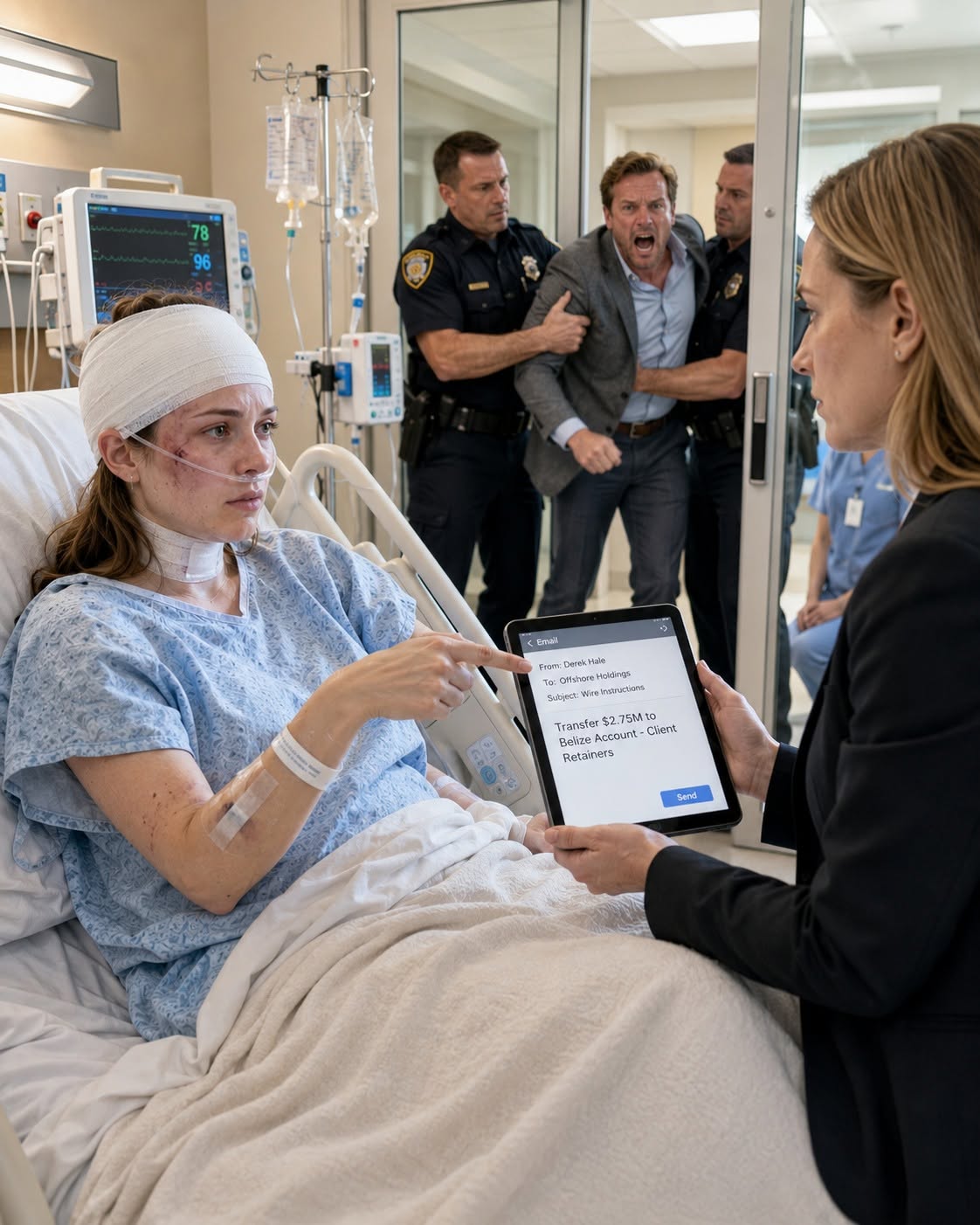
“My husband put me in the ICU, beaten and barely conscious… and my own parents told me it was my problem.”
I whispered the word “fine” through a damaged throat, never realizing that one bruised syllable would become the activation code for the complete destruction of three lives.
This is the story of a catastrophic miscalculation.
It is what happens when a violent man mistakes silence for stupidity.
For six years, I lived two separate lives. Publicly, I was the quiet financial manager married to a charismatic CEO. Privately, I was a woman who had learned to measure the temperature of a room by the angle of her husband’s jaw.
My husband, Derek Hale, believed pain purchased obedience.
What he did not know was that every time he hurt me, every time he underestimated me, every time he ordered me to stay quiet, I was learning.
And while he thought he was breaking me, I was quietly building the mechanism that would eventually destroy him.
The crystal glasses chimed softly during my parents’ thirty-fifth anniversary dinner.
We were seated inside a private dining room at Maison Rue, one of those restaurants where the menus had no prices and everyone looked wealthier under the amber lighting.
Derek sat at the head of the table.
He wore a perfectly tailored charcoal suit and poured an absurdly expensive bottle of Cabernet as casually as if it were water.
My mother, Margaret, looked at him with the adoration she had never once directed toward me.
“Derek, darling, we could never have secured the Lake Forest house without you and Emily,” she said, reaching across the table to touch his hand. “The bank was making such a fuss about your father’s old credit problems, but with the company backing the loan and Emily signing as guarantor, everything is finally possible.”
Derek smiled.
“Family takes care of family.”
I sat silently beside him.
I wore a high-neck cream blouse, the cuffs pulled low enough to cover the fading bruises around my wrist.
Beneath the table, Derek placed the sole of his Italian leather shoe on top of my foot.
Then he pressed down.
At first, lightly.
Then harder.
His face never changed.
He laughed at something my father said while grinding his heel into my toes.
Do not speak.
Do not take credit.
Do not draw attention.
A sharp pain shot through my smallest toe.
I did not react.
Six years had taught me how to swallow pain without changing my expression.
“Emily is my rock,” Derek said, finally releasing my foot.
He reached over and touched the back of my neck.
His fingers brushed the exact place where he had choked me against the bathroom wall three nights earlier.
“She handles all the little financial details so I can focus on the big picture.”
I lowered my eyes.
The little financial details.
Derek was the public face of Sentinel Advisory, a high-end corporate strategy firm.
Clients adored him.
My parents adored him.
Investors believed he was brilliant.
But I was the one who built the financial architecture beneath the company.
I understood the tax structure, the banking relationships, the corporate bylaws, and the emergency governance provisions.
Derek believed I was simply managing payroll.
He had never bothered reading the incorporation documents I drafted years earlier.
If he had, he would have known I legally owned thirty-eight percent of the company and possessed emergency fiduciary authority if the chief executive committed serious criminal misconduct.
He had no idea how vulnerable he truly was.
Dinner ended.
We stepped into the freezing November rain and climbed into Derek’s black Porsche.
The moment the doors closed, his charm disappeared.
“You moved your foot,” he said.
I stared ahead.
“You were hurting me.”
“I was showing affection.”
“You nearly broke my toe.”
He turned toward me.
His eyes became empty.
“When we get home,” he said quietly, “I’m going to teach you how to sit still.”
The iron gates closed behind us when we entered the estate.
The garage door came down.
The lock clicked.
And I knew exactly what was coming.
The next thing I remember clearly was the sound of an oxygen machine.
Click.
Hiss.
Click.
Hiss.
I was in Room 412 of Mercy General’s ICU.
Three fractured ribs.
A concussion.
A fractured cheekbone.
Severe bruising around my throat.
Every breath felt like broken glass moving through my chest.
A nurse named Rosa entered quietly.
She was in her late forties and had the observant eyes of someone who had seen too many lies.
“Your husband is outside,” she said. “He told the police you became dizzy and fell down the marble stairs.”
I closed my eyes.
“He brought white roses,” she added. “And he’s been crying in front of the nurses.”
“No.”
The word barely escaped my throat.
Rosa looked at the bruises around my neck.
“I’ll tell security he can’t enter.”
She turned away.
I reached for her sleeve.
“My phone.”
She brought it to me.
The screen was cracked, but it worked.
I called my mother.
It was six in the morning.
She answered sounding irritated.
“Emily? Do you know what time it is? We’re signing the final papers on the Lake Forest house this week.”
“Mom,” I whispered. “I’m in the ICU.”
Silence.
“Derek beat me. He almost killed me. I have broken ribs. I need somewhere safe to go when they discharge me.”
My father said something in the background about a wire transfer.
Then my mother sighed.
“Emily, you chose to marry him.”
I stared at the ceiling.
“He choked me until I passed out.”
“He is under enormous pressure providing that lifestyle for you.”
“Mom—”
“We cannot lose the house because of your domestic drama.”
My heart seemed to stop.
She continued.
“If Derek withdraws the financial backing, we lose our deposit. Go home, apologize for whatever you did, and fix your marriage.”
Then she hung up.
I lowered the phone.
For a few seconds, I felt like a child again.
A little girl still waiting for her mother to choose her.
Then something inside me went quiet.
Completely quiet.
The fear disappeared.
The daughter who wanted her parents’ love died in that hospital bed.
So did the wife who believed enduring violence could preserve peace.
“Fine,” I whispered.
Rosa returned carrying ice chips.
She stopped when she saw my face.
“Is there anyone else you can call?”
“Yes.”
I looked toward the closet.
“My laptop is in my overnight bag. Please bring it to me.”
She did.
Then my phone buzzed.
A banking notification appeared.
URGENT: GUARANTOR APPROVAL REQUIRED FOR FINAL ESCROW RELEASE – LAKE FOREST PROPERTY.
I opened the secure portal.
My parents were waiting for my signature.
The same people who had just told me to return to the man who nearly killed me because they wanted a house.
I selected one option.
REVOKE GUARANTEE.
Then I called my attorney.
“Rachel Morgan,” a sharp voice answered.
“It’s Emily.”
Her tone changed immediately.
“Are you safe?”
“I’m in the ICU. Derek did this.”
A pause.
Then Rachel became all business.
“The protective order is already being processed.”
“Good. Execute Emergency Directive One.”
“You’re invoking the fiduciary crisis clause?”
“Yes.”
I opened my laptop.
“Freeze the company operating accounts. Cancel Derek’s corporate cards. Block his access to vendor systems and revoke his executive credentials.”
“Done.”
“I’m sending you five years of internal ledgers.”
Rachel went silent.
“What am I looking at?”
“Embezzlement.”
I sent the encrypted folder.
“Derek has been skimming client retainers and moving the money through offshore shell companies. Send it to federal investigators.”
Rachel exhaled.
“Emily, this could put him in prison.”
“I know.”
By noon, Derek’s life had begun to malfunction.
He was having lunch with several executives when his corporate card was declined.
Then his personal card.
Then his banker informed him his accounts had been frozen pending review.
For the first time, he was facing something he could not intimidate with his fists.
Meanwhile, my parents called repeatedly.
My mother left furious messages.
My father screamed that the sellers were threatening a lawsuit and that they would lose the deposit.
I deleted every message.
They had traded their daughter for real estate.
Now they could pay market value.
Then Rachel emailed me.
Derek had broken into the company’s private server room.
He was downloading the master client database.
He planned to sell it to our biggest competitor, Titan Systems, for enough cash to flee the country.
Rachel asked what we should do.
I typed back:
Let him take it.
A cornered predator is dangerous.
But predictable.
I discharged myself from the hospital against medical advice.
Rosa begged me to stay.
Instead, she helped tape my ribs and button a black tailored suit over the bandages around my body.
“I have to finish this,” I told her. “Or he will never stop.”
Two hours later, I entered the headquarters of Titan Systems.
Rachel was waiting in the lobby with two federal agents.
“They’re monitoring the transaction,” she said. “Corporate espionage. Wire fraud. They just need him to complete the attempt.”
We rode to the fiftieth floor.
I sat at the head of a long conference table.
Fifteen minutes later, Derek stormed through the doors carrying a silver hard drive.
He expected to meet Titan’s CEO.
Instead, he found me.
He stopped.
Then rage transformed his face.
“You stupid bitch.”
He stepped toward me.
“You think you can take my company?”
“Sit down, Derek.”
The federal agents shifted near the door.
Derek noticed them.
Slowly, he sat.
“You didn’t build Sentinel,” I said. “You were the face. I built the company beneath you.”
“I’ll destroy you in court.”
“With what money?”
His expression changed.
I pointed toward the hard drive.