There is a specific kind of silence that descends on an emergency veterinary clinic at three in the morning. It isn’t a peaceful quiet. It’s a heavy, suffocating stillness, the kind that presses against your eardrums and makes you acutely aware of every ticking clock, every hum of the fluorescent lights, and every breath you take. It’s the silence of holding the line between life and death, of waiting for the sliding glass doors to burst open and deliver the next disaster.
My name is Chloe. For the past six years, I’ve been a senior veterinary technician at Westside Animal Emergency in downtown Chicago. I’ve seen it all. I’ve seen dogs hit by cars, cats pulled from house fires, and exotic pets suffering from the well-intentioned ignorance of their owners. I thought I had built a wall thick enough to protect my heart from the relentless influx of tragedy. I thought the blood, the tears, and the haunting wails of grieving owners had calcified my empathy into a professional, cold efficiency.
I was wrong. All it took was one dog. One violently trembling, broken dog, to tear that wall down to its foundation.
It was a Tuesday night in mid-November. The kind of night where the wind off Lake Michigan feels like a physical assault, carrying sleet that stings your face like crushed glass. The clinic was operating on a skeleton crew. It was just me, Maya at the front desk, and Dr. Elias Thorne.
Dr. Thorne is a brilliant surgeon, arguably the best in the city, but his bedside manner leaves a lot to be desired. He operates with a cold, almost robotic detachment. Three years ago, his wife was killed by a drunk driver while she was walking their two labradors. The dogs survived; she didn’t. Since that day, Elias hasn’t looked at an animal with anything resembling affection. To him, they are broken machines requiring repair. Flesh, bone, and blood. Nothing more. He saves their lives, but he refuses to touch their souls. Maya, on the other hand, is twenty-two, drowning in student loans, and possesses a heart so soft I often worry this job will physically break her. She’s the kind of girl who sneaks extra treats to the strays and cries in the supply closet when a euthanasia goes badly.
At 3:14 AM, the motion sensor above the front doors chimed.
I was in the back, sanitizing surgical instruments, when I heard Maya scream. It wasn’t a gasp or a startled yelp; it was a full-throated scream of pure horror.
I dropped the stainless steel tray I was holding—it hit the floor with a deafening clatter—and sprinted down the hallway. When I rounded the corner into the lobby, I froze.
A man, soaked to the bone and shivering violently, was standing just inside the doors. He was a Chicago beat cop, Officer Miller, someone we knew well because he often brought in strays. But tonight, his uniform was covered in a horrifying amount of dark, viscous mud and bright, arterial blood.
In his arms, he was carrying a large dog. It was a Golden Retriever mix, though you could barely tell the breed beneath the grime and injury. The dog’s golden coat was matted with ice, motor oil, and a terrifying amount of crimson.
“I need help! Now!” Miller bellowed, his voice cracking with panic. “I found him in the alley off 43rd. He was just… standing there. I tried to get him in the cruiser, but he wouldn’t move.”
“Bring him to Exam Room One!” I shouted, snapping out of my shock. I ran ahead, kicking the door open and flipping on the overhead surgical lights. The sterile, white room suddenly felt too small.
Miller laid the dog on the stainless steel examination table. The moment the dog’s paws touched the cold metal, something extraordinary and terrifying happened.
Most dogs in this condition—bleeding, freezing, in systemic shock—would collapse. They would melt into the table, their bodies surrendering to the trauma, their eyes rolling back as their consciousness faded.
Not this dog.
The moment Miller released his grip, the dog locked his four legs. His joints snapped into place with a rigid, unnatural stiffness. He stood perfectly square on the table, his head lowered, panting in short, jagged gasps. His entire body was shaking so violently that the metal table began to vibrate, emitting a low, continuous hum.
“Okay, buddy, okay, we’ve got you,” I murmured, my voice slipping into that soft, rhythmic cadence we use to soothe terrified animals. I reached out, my hands covered in blue latex gloves, and gently placed them on his shoulders. I applied a slight, downward pressure. “Let’s get you down. Lie down, sweetheart. You’re safe.”
The dog let out a sound I will never, ever forget.
It wasn’t a growl. It wasn’t a whimper. It was a guttural, frantic shriek—the sound of a creature staring directly into the abyss. He violently resisted my pressure, thrusting his shoulders upward, his claws scrabbling frantically against the slippery steel to maintain his footing. He locked his knees even harder.
“What’s wrong with him?” Miller asked, stepping back, wiping rain and sweat from his forehead. “When I found him, he was doing the same thing. Standing over a storm drain. He wouldn’t move. He wouldn’t sit.”
“I don’t know,” I said, my heart pounding in my chest. I looked into the dog’s eyes. They were a deep, muddy amber, but right now, the pupils were blown wide, swallowing the irises entirely. He was looking at me, but he wasn’t seeing me. He was looking through me. He was trapped in some unimaginable terror.
“Dr. Thorne! STAT!” Maya yelled down the hallway, her voice echoing off the tile.
Seconds later, Elias walked in. His white coat was pristine, his face an unreadable mask. He took one look at the dog, the blood pooling on the table, and my hands hovering over the animal’s back.
“Vitals?” Elias barked, instantly moving to the sink to wash his hands.
“I can’t get them yet,” I admitted, feeling a flush of professional embarrassment. “He won’t let me touch his underside, and he absolutely refuses to lie down. He’s rigid. Tetany, maybe? Toxins?”
Elias dried his hands, snapped on a pair of gloves, and approached the table. He didn’t speak to the dog. He didn’t offer a soothing word. He simply moved with clinical precision. He reached for the dog’s hind legs.
“Elias, wait, he’s panicked—” I started to warn him.
The moment Elias tried to bend the dog’s right hind leg to check the joints, the Golden Retriever snapped. But he didn’t bite Elias. Instead, the dog threw his entire body weight forward, almost hurling himself off the table just to avoid being forced into a lying position. I had to throw my arms around his waist to catch him, the sickening smell of wet copper and rotting garbage filling my nose.
The dog scrambled, his claws screeching on the metal, and forced himself back into a rigid, standing posture. He was panting harder now, thick ropes of saliva hanging from his jowls.
“What the hell?” Elias muttered, his eyebrows knitting together in genuine confusion. It was the first time in three years I had seen his professional armor crack. “Is there a spinal injury? Does lying down cause excruciating pain?”
“I don’t know,” I said, holding the dog steady, feeling the rapid, thrumming beat of his heart against my forearm. “It feels… psychological. Elias, look at his eyes.”
Elias leaned in close. He pulled a small penlight from his pocket and flashed it across the dog’s pupils. They contracted slowly, sluggishly.
“He’s severely hypothermic. Dehydrated. The blood is coming from a deep laceration on his left flank, looks like he caught it on some jagged metal,” Elias assessed rapidly, his eyes scanning the dog’s body without trying to force him down again. “Heart rate is through the roof. Probably around two hundred beats per minute. If he stays standing like this, his muscles are going to break down. Rhabdomyolysis. His kidneys will fail.”
“So we sedate him?” I asked, already reaching for the locked cabinet where we kept the Dexmedetomidine.
“No,” Elias said sharply. “With his heart rate this erratic and his temperature this low, sedating him might stop his heart completely. We need to stabilize him while he’s awake. Get warm IV fluids running. Start him on broad-spectrum antibiotics and pain meds. And for God’s sake, get him to lie down before his legs give out.”
Elias turned and left the room to prep the trauma bay, leaving me alone with the trembling animal.
“Okay, my friend,” I whispered, grabbing a heavy, heated blanket from the warmer. I draped it over his back. He didn’t flinch, but he didn’t relax either. I named him Atlas in my mind right then. Because he looked like he was carrying the weight of the entire world on his shattered shoulders, terrified that if he dropped it, everything would end.
Getting an IV catheter into a standing, shivering dog is a nightmare. I had to kneel on the floor, working at an awkward angle to shave a small patch of fur on his front right leg. Atlas watched me with those wide, terrified eyes. Every time I adjusted his leg, even slightly, he would let out a low, warning whine, bracing himself as if expecting me to sweep his legs out from under him.
“I’m not going to hurt you,” I promised him, my voice cracking. I slipped the needle into his vein, secured it with tape, and hooked up the warm saline line.
For the next two hours, the clinic became a bizarre waiting game.
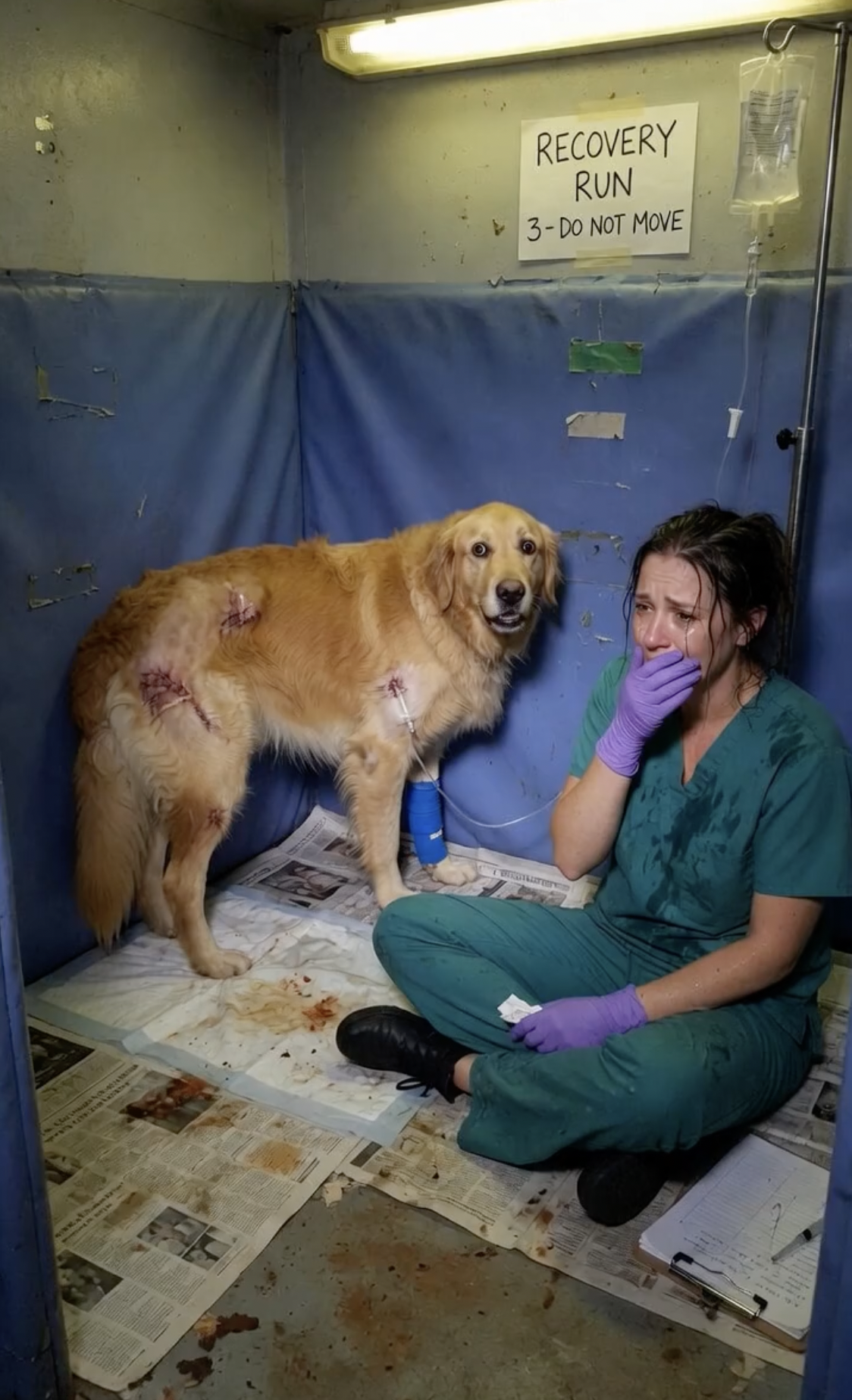
We moved Atlas to a large, floor-level recovery run in the back ward. We laid down thick, orthopedically padded blankets. We turned down the lights. We played soft, classical music. I sat in the corner of the run, a safe distance away, just watching him.
The fluids were helping. His shivering had decreased slightly, and the bleeding from his flank had been temporarily bandaged. But he was still standing.
It was an agonizing thing to witness. You could see the sheer exhaustion radiating from his bones. His eyelids drooped, heavy with fatigue. His head would slowly lower, sinking toward the floor as sleep threatened to overtake him. His knees would begin to buckle.
But the absolute second his chest dipped too low—the moment he felt the inevitable pull of gravity signaling that he was lying down—he would violently jolt awake. His head would snap up, his eyes wide and frantic, and he would force his trembling legs to lock straight again.
It was a torturous cycle. Sink, panic, stand. Sink, panic, stand.
At 5:00 AM, my back was aching from sitting on the floor. Maya came to the door of the run, holding two cups of lukewarm coffee. She had tears in her eyes.
“Why is he doing this, Chloe?” she whispered, sliding a cup over to me. “He’s so tired. Why won’t he just sleep?”
“I don’t know, Maya,” I sighed, rubbing my temples. “Animals do strange things when they’re traumatized. Maybe he was attacked while he was sleeping. Maybe lying down triggers a memory of pain.”
But deep down, my intuition was screaming that it was something else. I had seen traumatized dogs. I had seen dogs who fought sleep out of fear of their surroundings. But Atlas wasn’t afraid of us. He wasn’t aggressive. He didn’t flinch when I touched his head. He even leaned into my hand when I stroked his ears.
His fear wasn’t external. It was internal.
It was a desperate, calculated refusal. Like he was keeping a promise. Like he knew, with absolute certainty, that if he allowed his body to rest on that floor, something catastrophic would happen.
Elias stepped into the doorway, breaking the quiet. He looked exhausted, the shadows under his eyes stark against his pale skin. He looked at Atlas, who was currently swaying, his front left paw lifting slightly off the ground to relieve the pressure.
“His blood work came back,” Elias said, his voice void of emotion, though his eyes betrayed a deep unease. “His white count is astronomical. He’s fighting a massive infection. His CK levels—the enzymes that indicate muscle damage—are rising rapidly from the physical exertion of standing. If he doesn’t lie down and sleep within the next few hours, his body is going to consume itself.”
“Can we give him something mild? Just to take the edge off?” I pleaded.
“I gave him a micro-dose of Torbugesic for the pain an hour ago,” Elias replied flatly. “It should have made him drowsy. It clearly isn’t working. His adrenaline is overriding the medication. Whatever psychological block is keeping him on his feet, it’s stronger than the drugs.”
Elias turned to walk away, but stopped. He looked back at Atlas, staring at the dog for a long, heavy moment. For a second, I thought I saw a ghost of a memory flash across Elias’s face—a memory of his own sleepless nights, his own refusal to rest after his life had been shattered.
“Keep him comfortable,” Elias ordered quietly, turning away. “If he drops, call me immediately. We may have to intubate and ventilate if his heart gives out.”
I was left alone again with Atlas.
By 6:30 AM, the storm outside was breaking, pale gray morning light filtering through the high windows of the ward. Atlas was losing the battle.
His back legs were trembling so violently that they were almost vibrating. His breathing was ragged, wet, and shallow. I moved closer to him, ignoring protocol, and wrapped my arms around his thick neck. He smelled of rain, iron, and wet dog. He didn’t pull away. He rested his heavy chin on my shoulder.
“Please, Atlas,” I whispered into his fur, tears finally spilling hot down my cheeks. “Please just lie down. Whatever you’re guarding, it’s gone. Whatever you’re waiting for, it’s okay to let go. You’re going to die if you don’t sleep.”
I felt his body sag against me. For a fleeting second, he yielded. He let me bear his weight. His front legs buckled, and we slowly sank to the floor together.
I held my breath. Was he finally giving in?
His stomach touched the padded blanket.
Instantly, a sound tore from his throat that wasn’t a whine—it was a scream. It was the sound of a human heart breaking, channeled through a dog’s vocal cords. He thrashed with a sudden, explosive strength that knocked me backward onto the floor.
He scrambled up, his claws tearing at the blankets, gasping for air as if he had just been drowning. He backed into the corner of the run, pressing his body against the cold tile wall, his eyes fixed on the exact spot on the floor where he had just laid.
He wasn’t looking at the floor. He was looking at something I couldn’t see.
And then, I noticed it.
Hanging from his worn, frayed collar was a small, tarnished metal cylinder. A pill fob. In the chaos of his arrival, covered in mud and blood, I hadn’t seen it.
I slowly got up, raising my hands to show him I wasn’t going to force him down. I approached him inch by inch. He let me reach for his collar. I unthreaded the small metal cylinder and twisted the cap.
It was tightly sealed. Inside, there weren’t pills.
There was a tightly rolled piece of paper, stained with water and age.
With trembling fingers, I unrolled the paper. The handwriting was jagged, written in smeared blue ink, clearly penned by someone whose hands were shaking as badly as Atlas’s were now.
I read the words, and the air completely left my lungs. The temperature in the room seemed to drop ten degrees. I stared at the dog, the pieces of the puzzle violently snapping together in my mind, forming a picture so devastating I had to cover my mouth to stop myself from sobbing out loud.
“Oh, God,” I whispered, looking at Atlas, who was still standing, still refusing to die. “What have they done to you?”
Chapter 2: The Weight of the World
The piece of paper in my hand felt impossibly heavy, as if the waterlogged, torn fibers held the physical mass of a dying star. My breath hitched in my throat, snagging on a sob that I fiercely tried to swallow down. The fluorescent lights of the recovery ward hummed their relentless, sterile tune, oblivious to the fact that the universe inside this small, tiled room had just shattered.
I looked at Atlas. He was still standing in the corner, his back pressed against the cold wall. His golden fur, matted with mud and dried blood, clung to his emaciated frame. His chest heaved with shallow, jagged gasps, but his eyes—those wide, terrified amber eyes—were fixed on the floor. He wasn’t looking at the linoleum. He was looking at a memory. He was staring into an abyss of guilt so profound it was literally killing him.
My hands trembled so violently that the note fluttered like a trapped moth. I smoothed it out against my thigh, the smeared blue ink staining the fingertips of my latex gloves.
I read it again. I had to, just to make sure my exhausted mind wasn’t playing some cruel, hallucinatory trick on me.
To whoever finds him. >
His name is Atlas. He is—he was—a medical alert dog for my four-year-old son, Leo. Leo was born with a severe, rare cardiac arrhythmia. Atlas was trained to stand guard over his crib, and later his bed. He was trained to detect the subtle shifts in Leo’s scent and breathing when his heart rate dropped dangerously low. If Leo stopped breathing, Atlas was trained to stand on the bed and bark until someone woke up. He saved my boy’s life six times.
Three nights ago, my husband, Richard, got drunk. He was angry about the medical bills. He said he was tired of the dog whining in the house. He dragged Atlas outside by his collar and locked him in the detached, unheated garage.
That was the night Leo’s heart stopped. >
Atlas knew. Even from the garage, he knew. He tore his own paws apart trying to dig through the concrete floor. He broke his ribs throwing his body against the solid oak doors. I didn’t hear anything over the storm. When I found Leo the next morning, he was already gone. When I opened the garage, Atlas sprinted into the house and saw my baby.
Since that second, Atlas has refused to lie down. He thinks it’s his fault. He thinks if he sleeps, someone else will stop breathing. He thinks he failed his duty. >
Richard beat him for destroying the garage door, then threw him in the truck and dumped him somewhere in the city. I am trapped in this house, but I managed to slip this note into his collar fob before Richard drove away. Please. You have to save him. Tell him his watch is over. Tell him, “Stand Down, Atlas. Leo is safe.”
Please forgive me. I couldn’t save either of my boys.
A raw, ragged sound tore out of my mouth. It was half-gasp, half-sob, an ugly noise born from a place of pure, unadulterated heartbreak.
In my six years at Westside Animal Emergency, I had seen the absolute worst of humanity. I had seen animals starved, burned, and broken for sport. I had developed a thick, callous layer over my heart just to survive the twelve-hour shifts. But this? This wasn’t just cruelty. This was the destruction of a soul.
Atlas wasn’t just afraid. He was punishing himself. He was keeping a vigil for a little boy who was already gone, terrified that if he allowed his exhausted body to succumb to gravity, to rest, the nightmare would happen again. He was standing guard over a ghost.
“Oh, sweet boy,” I choked out, tears spilling hot and fast down my cheeks, blurring my vision. I didn’t care about protocol anymore. I didn’t care about professional distance. I dropped to my knees on the floor, ignoring the dampness seeping through my scrubs, and crawled toward him.
Atlas stiffened as I approached, his muscles locking tighter, his breathing escalating into a frantic pant.
“I know,” I whispered, my voice breaking. “I know what happened, Atlas. I know.”
I reached out and gently laid my hands on his chest. His heart was hammering against his ribs like a trapped bird beating its wings against a cage. The heat radiating from his body was unnatural—the fever from his infections warring with the hypothermia.
“Maya!” I screamed, turning my head toward the hallway. “Maya, get Dr. Thorne! Now!”
Footsteps slapped rapidly against the linoleum. Seconds later, Maya appeared in the doorway, her eyes wide with alarm. She took one look at my tear-streaked face and the crumpled note in my hand.
“What is it? Did he code?” she asked, panic lacing her voice.
“No, get Elias. Tell him to get in here right now.”
It took less than thirty seconds for Dr. Elias Thorne to appear. He strode into the ward, his face a mask of cold annoyance. He had been in the middle of charting, his reading glasses pushed up into his dark, greying hair.
“What is the emergency, Chloe? Vitals?” he demanded, his eyes scanning the room. He expected a medical crisis—a ruptured spleen, a seizing dog. He didn’t expect me, sitting on the floor, weeping openly.
“It’s not… it’s not a medical code,” I stammered, wiping my nose with the back of my forearm. I held up the trembling piece of paper. “I found this. On his collar. Inside a pill fob.”
Elias frowned, his jaw tightening. “I don’t have time for a scavenger hunt, Chloe. If the dog is stable—”
“Read it,” I snapped, my voice suddenly fierce, echoing off the tile. The sheer force of my anger seemed to startle him. I pushed myself up from the floor and shoved the damp paper against his chest. “Read what they did to him, Elias. Read why he’s dying on his feet.”
Elias caught the paper. He looked at me, his eyes narrowing slightly, before he looked down at the smeared ink.
I watched his face as he read. I watched the clinical, detached fortress of Dr. Elias Thorne undergo a seismic shift.
At first, his expression was merely impatient. But as his eyes scanned the jagged handwriting, reading the words medical alert dog and four-year-old son, his brow furrowed. His eyes darted faster across the lines. When he reached the part about the garage—about the dog tearing his paws apart while the child died inside—the color completely drained from Elias’s face. He turned a shade of pale that I had only ever seen on corpses.
His hands, the hands of a world-class surgeon, hands that never shook, began to tremble.
Elias Thorne was a man defined by a single, catastrophic failure. Three years ago, his wife, Sarah, had been walking their two black Labs, Duke and Daisy, in Lincoln Park. A drunk driver jumped the curb. The police report said Sarah had managed to shove the dogs out of the way just before the impact. When Elias arrived at the hospital, she was already brain-dead. The dogs had survived with minor fractures.
Elias had blamed himself. He had been scheduled to walk the dogs that evening, but he had stayed late at the clinic to finish a complex orthopedic surgery. He had chosen his work over his family, and that choice had cost him his world. After Sarah’s funeral, Elias surrendered Duke and Daisy to a rescue. He couldn’t look at them. He couldn’t bear the guilt in their eyes, the confusion as to why their mother never came home. He shut down entirely, becoming a brilliant but hollow shell of a man.
Reading this note—this desperate plea from a mother whose child had died while her protector was locked away—was like watching Elias stare into a mirror of his own darkest trauma.
The paper slipped from his fingers, fluttering to the floor.
Elias didn’t say a word. He slowly turned his head and looked at Atlas.
The Golden Retriever was swaying perilously now. The effort of standing for over twelve hours, combined with blood loss, infection, and shattered ribs, was taking its final toll. His front left knee buckled, dipping toward the floor. Atlas gasped, a horrific, wet sound, and violently threw his head back, forcing the leg to lock again. The sheer agony of the movement was etched into every line of his face.
“He thinks it’s his fault,” Elias whispered. His voice was completely stripped of its usual authority. It was the voice of a broken man recognizing a broken animal. “He thinks… he thinks if he sleeps, he kills him again.”
“Elias, his CK levels,” I urged, trying to pull him back to the medical reality. “His muscle tissue is breaking down. He’s going to go into renal failure. We have to make him stop.”
Elias took a slow, agonizing step toward the dog. He didn’t reach for a stethoscope. He didn’t check the IV line. He simply sank to his knees, his pristine white coat pooling on the damp, dirty floor.
He looked Atlas dead in the eyes.
“We have the release command,” I said, my voice shaking. “The note says the command is ‘Stand Down, Atlas. Leo is safe.’”
Elias nodded slowly. He took a deep, shuddering breath. He reached out and gently cupped the sides of Atlas’s face. The dog flinched, his eyes darting wildly, but he was too weak to pull away.
“Atlas,” Elias said. His voice was deep, resonant, and trembling with an emotion I hadn’t heard from him in three years. “Atlas, listen to me.”
The dog’s ears twitched. The amber eyes locked onto Elias’s dark ones.
“You did your job,” Elias whispered, a single tear escaping his eye and tracing a clean line down his pale cheek. “You did everything you could. You are a good boy. You are a brave boy.”
Atlas whined—a high, thin sound of pure distress. He tried to take a step back, but his hind legs dragged clumsily.
“Stand down, Atlas,” Elias commanded, his voice firm but breaking with sorrow. “Stand down. Leo is safe.”
The words hung in the air, heavy and loaded with desperate hope. I held my breath, waiting for the magical release, waiting for the psychological chains to break and for the dog to finally collapse into the safety of sleep.
Atlas stared at Elias. He blinked, a slow, heavy drop of his eyelids. His body swayed forward.
For a magnificent, heart-stopping second, I thought it had worked. Atlas let out a long, shuddering sigh. His front legs bent. His chest lowered toward the floor.
But as soon as the soft padding of the blanket brushed against his sternum, the trauma reasserted itself with violent, terrifying force.
It was as if an electric shock had ripped through his spine. Atlas shrieked—a sound that scraped the very bottom of my soul—and scrambled backward, his claws tearing at the blankets. He thrashed his head side to side, his eyes rolling back to show the whites. He fought his way back up to a standing position, panting so hard that bloody foam began to gather at the corners of his mouth.
He didn’t believe us.
The command wasn’t enough. The trauma was too deep, the guilt too heavily ingrained in his bones. He had heard the command, but his broken heart refused to accept it. He was a soldier who had lost his war, and no one could convince him the fighting was over.
“Damn it!” Elias shouted, slamming his fist against the floor. “Damn it, no! Atlas, please!”
“His heart rate is spiking!” I yelled, looking at the portable monitor we had hooked to his ear. The numbers were flashing red: 220, 230, 240. “Elias, he’s going into V-tach! He’s going to code!”
“Get the crash cart!” Elias roared, instantly shifting back into the surgeon. The emotional vulnerability vanished, replaced by sheer, frantic adrenaline. “Maya, get in here! Draw up 2 milligrams of Lidocaine, STAT! Chloe, get the oxygen mask!”
Chaos erupted in the small room. Maya sprinted down the hall, the wheels of the metal crash cart squealing against the tile. I grabbed the oxygen mask and forced it over Atlas’s muzzle. He tried to fight it, shaking his head, but he was losing his balance.
“He’s going down!” I screamed.
Atlas’s back legs simply gave out. They didn’t bend; they collapsed, as if the strings holding a marionette had been violently slashed. His hindquarters hit the floor with a sickening thud.
But even then, even as his back half was paralyzed by exhaustion and muscle failure, his front legs remained locked. He was half-sitting, half-standing, his chest heaving as he desperately tried to drag himself back upright using only his shattered front paws.
“No, no, no, buddy, stop fighting,” I begged, crying openly now, pinning his shoulders to prevent him from hurting himself further. “Please just stop!”
“Lidocaine is in!” Maya shouted, pushing the plunger on the syringe into his IV line.
Elias was on his knees, his hands pressed against Atlas’s chest, feeling the erratic, deadly flutter of the dog’s heart. “It’s not converting. He’s still in Ventricular Tachycardia. The stress is killing him. We have to sedate him, Chloe. We don’t have a choice.”
“You said sedation would stop his heart!” I yelled back over the screech of the monitor.
“If we don’t, his heart is going to explode anyway!” Elias snapped, his eyes wild. “Draw up Propofol. Give him enough to knock him out completely. We’ll intubate and breathe for him. It’s the only way to break the physical cycle.”
My hands shook as I reached for the Propofol. It was a massive risk. Pushing a heavy anesthetic into a dog with severe hypothermia, systemic shock, and a failing heart was practically a death sentence. But watching him tear his own muscles apart to stay awake was already a death sentence. We had to force him to rest.
I drew up the milky white liquid into the syringe. I looked at Elias for confirmation.
He nodded grimly. “Push it. Slow.”
I attached the syringe to the IV port. “Pushing Propofol,” I announced, my voice trembling. I slowly depressed the plunger.
One second. Two seconds. Three seconds.
Atlas stopped thrashing. His wide, terrified eyes suddenly lost their frantic focus. The heavy eyelids drooped. The tension in his locked front legs finally, mercifully, began to melt.
“He’s going under,” I whispered.
Atlas let out one final, quiet sigh, and his heavy head collapsed into my lap. His body went entirely limp. The absolute rigidity of his muscles surrendered, leaving nothing but a broken, emaciated frame resting against my legs.
“Heart rate is dropping,” Maya called out, her eyes glued to the monitor. “180… 150… 120. He’s converting to a sinus rhythm.”
“Get the endotracheal tube,” Elias ordered, his hands moving with lightning speed. He tilted Atlas’s head back, opening his jaw. I handed him the laryngoscope and the tube. Elias slid the tube down the dog’s trachea, inflating the cuff. “Hook him up to the ventilator. We need to breathe for him. Keep him under.”
For the next hour, we worked in absolute silence, save for the rhythmic, mechanical whoosh-click of the ventilator pushing oxygen into Atlas’s lungs. We placed warming blankets over him. We started aggressive fluid therapy to flush his kidneys and treat the rhabdomyolysis. We cleaned and sutured the deep laceration on his flank.
Through it all, Elias never left the dog’s side. He sat on the floor, his hand resting gently on Atlas’s chest, feeling the steady, artificial rise and fall of the dog’s breathing. He looked completely hollowed out.
“We forced him into sleep,” Elias murmured quietly, staring at the wall. “But we haven’t fixed the problem. When he wakes up… the nightmare is still going to be there. The guilt is still going to be there. He’ll just try to stand again.”
“We’ll cross that bridge when we come to it,” I said, though my heart sank because I knew he was right. We had paused the clock, but we hadn’t defused the bomb.
At 8:00 AM, the front door chime echoed through the quiet clinic.
Maya, who had gone to the front desk to manage the morning shift transition, appeared in the doorway of the ward a moment later. Her face was pale.
“Chloe… Dr. Thorne,” she said hesitantly. “Officer Miller is back.”
“Tell him the dog is stable for now, but critical,” Elias said without looking up.
“He’s not alone,” Maya swallowed hard, her eyes darting nervously down the hallway. “He brought someone with him. A woman. He found her wandering on an overpass on I-90. She was barefoot in the snow, trying to jump into traffic.”
My blood ran cold. I looked at the note, still lying on the floor where Elias had dropped it.
“Who is she?” I asked, though a sickening dread was already pooling in my stomach.
“Miller says her name is Sarah,” Maya whispered. “She’s wearing a hospital bracelet. She… she says she’s looking for her dog. She says she has to find him before her husband kills him.”
The air in the room vanished. Elias finally lifted his head, his dark eyes locking onto mine.
Sarah. The mother. The woman who had lost her son and written the note.
She was here.
“Bring her back,” Elias said, his voice terrifyingly calm. “Bring her back here. Now.”
Maya nodded and disappeared down the hall.
A moment later, I heard the heavy, squeaking footsteps of Officer Miller’s boots. Next to him were the soft, shuffling sounds of someone who had nothing left to live for.
When she stepped into the doorway, my breath caught in my throat.
She was young, maybe thirty, but she looked as though she had aged a decade in a single night. She was wearing a thin, grey hospital gown, her arms wrapped tightly around her shivering frame. Her bare feet were bruised and blue from the cold. Her face was a canvas of deep, purple bruises—a fresh, swollen black eye, a split lip, and a dark handprint gripping her throat.
But it was her eyes that shattered me. They were entirely empty. They held the same haunted, bottomless despair that I had seen in Atlas’s eyes just an hour ago.
Officer Miller stood behind her, looking grim and exhausted. “I found her on the bridge. She slipped out of Chicago Med. She was admitted yesterday after a severe domestic dispute. Her husband, Richard, is currently in custody. He put her in the ICU.”
Sarah didn’t look at Miller. She didn’t look at me. She didn’t look at Elias.
Her hollow eyes drifted downward, landing on the floor-level recovery run. They landed on the bundle of blankets, the tangled IV lines, and the ventilator tube. They landed on the motionless, golden head resting on the padded floor.
A sound escaped her—a microscopic, fragile whimper, like a dying bird.
She dropped to her knees. She didn’t care about the sterile environment. She didn’t care about the wires. She crawled across the floor, her trembling hands reaching out.
“Atlas,” she whispered, her voice cracking, completely shattered.
Elias moved back, giving her space. I watched, paralyzed by the sheer magnitude of the tragedy unfolding in front of me.
Sarah reached the dog. She buried her bruised face into his thick, matted neck. She wrapped her thin arms around his head, burying her sobs into his fur.
“I’m sorry,” she sobbed, her body rocking back and forth. “I’m so sorry, my brave boy. I couldn’t protect him. I couldn’t protect you.”
Atlas was heavily sedated. The Propofol was coursing through his veins, forcing his brain into a deep, chemical slumber. He shouldn’t have been able to feel anything. He shouldn’t have been able to hear anything.
But then, the impossible happened.
The heart monitor, which had been holding a steady, rhythmic beep… beep… beep, suddenly skipped a beat.
Beep-beep…
I stared at the screen. The heart rate began to climb.
120… 130… 140…
“Elias,” I whispered in panic. “The anesthesia. He’s fighting it.”
Elias leaned forward, his eyes wide. “That’s impossible. He’s on a continuous infusion. He’s effectively comatose.”
But the monitors didn’t lie. Atlas’s body was reacting. The scent of the woman weeping into his fur—the scent of the mother he had failed, the scent of the home he had been violently torn from—was piercing through the heavy veil of the drugs.
Underneath Sarah’s hands, Atlas’s chest hitched. He tried to breathe against the ventilator.
His front right paw, lying limp on the blanket, twitched.
Then, his eyes flew open.
They weren’t glazed with drugs. They were sharp, panicked, and painfully aware.
He saw Sarah. He smelled her tears. And his broken mind instantly made the connection.
She is here. Leo is gone. I am lying down. I have failed again.
Despite the tubes down his throat, despite the paralyzing drugs, despite the shattered ribs and the failing kidneys, Atlas did the one thing his trauma dictated he must do.
He fought gravity.
With a sudden, explosive surge of adrenaline that should have been medically impossible, Atlas threw his head back. He ripped his neck away from Sarah’s arms. He planted his front paws on the floor and violently shoved himself upward.
The ventilator tube snapped taut, the alarm blaring a piercing, high-pitched screech. The IV line ripped out of his leg, spraying a line of dark blood across the white tiles.
“Atlas, NO!” Sarah screamed, scrambling backward in terror.
“Grab him!” Elias roared, lunging forward.
But it was too late. Atlas was already up. He was swaying, gasping for air around the plastic tube lodged in his throat, his eyes rolling in absolute terror. He looked at Sarah, then looked at the floor, and his mind fractured completely.
He didn’t just lock his legs this time. He panicked.
He bolted.
He scrambled blindly forward, his back legs dragging, his front claws slipping on the bloody tile. He smashed into the metal doorframe of the run, the impact echoing with a sickening crack. He bounced off, disoriented, the ventilator tube slipping half-out of his airway, choking him.
“Close the door! Block the exit!” I screamed at Miller, diving across the floor to grab the dog’s hind legs.
Atlas dragged me across the linoleum, a 70-pound force of pure, unstoppable desperation. He was heading for the front lobby. He was heading for the glass doors. He had to get back to the house. He had to get back to the garage. He had to fix his mistake.
“Atlas, stop!” Sarah wailed, running after him.
Elias tackled the dog from the side, wrapping his arms around the animal’s torso. The three of us—Elias, myself, and the dog—crashed into the wall of the hallway. Atlas thrashed wildly, his jaws snapping in the air, not trying to bite us, but fighting the invisible demons that were suffocating him.
He was suffocating. The tube was lodged sideways in his throat. His lips were turning blue.
“He’s choking!” Elias yelled, struggling to hold the thrashing animal down. “I have to pull the tube! Hold his head!”
I pinned Atlas’s head against my chest, feeling the frantic, dying thud of his heart. Elias reached into the dog’s mouth and yanked the endotracheal tube out.
Atlas let out a horrific, strangling gasp. He inhaled sharply, but his lungs were too exhausted. The fight had drained the very last drop of life from his cells.
His eyes, wide and terrified, suddenly lost their focus. They drifted past me, past Elias, past Sarah. He looked toward the ceiling.
The tension in his muscles vanished. The frantic struggling ceased.
Atlas collapsed onto the hallway floor. He didn’t lock his legs. He didn’t try to stand.
He just fell.
And as his head hit the cold, bloody linoleum, the portable monitor attached to his ear emitted a single, continuous, terrifying sound.
Beeeeeeeeeeeeeeep.
“No,” Sarah whispered, her voice shattering the silence. “No, no, no, no!”
Elias stared at the monitor, his hands covered in blood. “He’s gone into cardiac arrest.”
“Start compressions!” I screamed, already moving my hands to his chest.
“Chloe…” Elias said, his voice hollow. He didn’t move. He just stared at the motionless golden dog.
“Elias, START COMPRESSIONS!” I roared, slamming the heels of my hands into Atlas’s ribs.
But Elias just looked at me, a profound, crushing defeat in his eyes.
“He finally laid down, Chloe,” Elias whispered. “He finally laid down.”
Chapter 3: The Ghost in the Machine
Beeeeeeeeeeeeeeep.
The sound of a flatlining heart monitor is not just a noise. It is a physical entity. It invades the room, sucking the oxygen out of the air, pressing against your eardrums with the weight of a concrete block. It is the sound of an ending, stark and absolute, broadcast through a cheap plastic speaker.
“Elias, START COMPRESSIONS!” I roared, my voice ripping through the sterile silence of the hallway.
I didn’t wait for him. I threw myself over Atlas’s limp, emaciated body. My knees slammed into the bloody linoleum, the impact sending a jarring spike of pain up my shins, but I barely registered it. I locked my elbows, stacked my hands, and drove the heels of my palms into the widest part of his ribcage.
One. Two. Three. Four.
The physical mechanics of CPR on a large dog are brutal. You aren’t just pressing; you are violently forcing the heart to pump blood through a body that has already given up. Beneath my hands, Atlas felt terribly fragile. His ribs yielded with a sickening, wet crunch—the cartilage snapping under the force of my compressions.
“I’m breaking his ribs,” I choked out, tears blinding me as I pumped. “Elias, help me! Don’t just stand there!”
But Dr. Elias Thorne was trapped in a purgatory of his own making. He was on his knees, his white coat stained with the dark, arterial blood of a dog who had just fought his way to the grave. Elias’s eyes were locked onto Atlas’s lifeless face. He wasn’t seeing the dog. He was seeing his wife, Sarah, lying on the asphalt of Lincoln Park three years ago. He was seeing the two black Labs sitting vigil by her broken body. He was paralyzed by the sheer, crushing repetition of his greatest failure.
“Elias!” I screamed, my voice cracking, desperate.
Five. Six. Seven. Eight. “Get him a milligram of Epinephrine! Maya, where the hell are the emergency meds?”
Maya came skidding down the hallway, slipping on the wet tile, her arms loaded with the red plastic tackle box that served as our crash kit. She dropped it next to me, her hands shaking so violently she could barely pop the latches.
“I… I have the Epi,” she stammered, tearing open a plastic wrapper with her teeth and jamming a syringe into the vial.
“Push it into the IV!” I ordered, not stopping my compressions. Sweat was stinging my eyes, mixing with my tears, dripping down my nose and landing on Atlas’s matted golden fur. “Flush it with saline! Come on, buddy. Come on, Atlas. Do not do this. Do not leave her here.”
I looked up at Sarah. The young mother was backed into the corner of the hallway, her bruised, swollen face buried in her hands. She was emitting a low, keening wail—a sound of such profound, prehistoric grief that it made the hairs on the back of my neck stand up. Officer Miller was hovering over her, looking utterly helpless, one hand resting awkwardly on her shaking shoulder.
“Epi is in,” Maya announced, her voice high and thin.
Nine. Ten. Eleven. Twelve.
Nothing. The monitor maintained its flat, unyielding screech. The line on the screen was a perfectly straight, green road leading to nowhere.
My arms were burning. Lactic acid was building in my shoulders, my triceps screaming in protest, but I couldn’t stop. If I stopped, the blood stopped. If the blood stopped, the brain died.
“Elias, I can’t keep this rhythm up,” I gasped, my breath coming in ragged, desperate heaves. “I need you to take over. Elias, look at me! God damn it, look at me!”
Something in my voice—the raw, unfiltered anger—finally pierced through the thick fog of his trauma.
Elias blinked. The glazed, hollow look in his eyes shattered, replaced by a sudden, terrifying intensity. The brilliant, detached surgeon didn’t just return; he roared back to life with a vengeance.
“Move,” Elias snapped.
It wasn’t a request. Before I could even shift my weight, Elias shoved me hard by the shoulder. I tumbled backward, sliding across the bloody tile. Elias took my place over the dog.
He didn’t just resume compressions; he attacked them. His movements were violently precise, driven by a furious, desperate energy. He wasn’t just fighting for Atlas’s life; he was declaring war on death itself. He was fighting for the wife he couldn’t save, for the little boy who had died in the dark, and for the broken mother weeping in the corner.
“Draw up another dose of Epi,” Elias barked, his voice echoing off the walls, stripped of all its usual coldness. “And get Atropine. Point-five milligrams. Hook up the portable ventilator. He’s not getting enough oxygen from the bag.”
I scrambled to my feet, my knees bruised and shaking, and grabbed the Ambu bag, forcing air down the endotracheal tube we had frantically re-inserted. Maya drew up the medications, her hands steadying under Elias’s sudden, commanding presence.
“Push the Atropine,” Elias ordered, his breath hissing through his teeth with every compression.
“Pushing Atropine,” Maya echoed.
“Come on, you stubborn bastard,” Elias growled, staring down at the dog’s face. “You don’t get to quit. Your watch isn’t over. You hear me? You don’t get to die on my floor.”
Two minutes passed. One hundred and twenty seconds of agonizing, bone-crushing violence. In veterinary medicine, the harsh reality is that CPR rarely works. Unlike on television, where a few pumps to the chest magically revive a patient, a full cardiopulmonary arrest in a dog suffering from severe trauma, systemic shock, and rhabdomyolysis is almost universally fatal. The odds were infinitely stacked against us.
“Elias,” I whispered, glancing at the clock on the wall. “It’s been almost three minutes of asystole.”
“I don’t care if it’s been a week,” Elias snarled, his face flushed, sweat dripping from his chin. “Draw up a third Epi. Get the defibrillator pads.”
“He’s not in a shockable rhythm, Elias,” I pleaded, the clinician in me warring with my heart. “He’s flatlined. Shocking asystole won’t do anything.”
“I said get the pads!” Elias roared. “We are going to internally pace him if we have to. I will crack his chest open right here in the hallway and squeeze his heart with my bare hands if that’s what it takes!”
I stared at him, stunned. This was a massive violation of protocol. Dr. Elias Thorne was a man of logic, of science, of detached calculation. But the man kneeling on the floor right now was operating purely on raw, unadulterated emotion. He was unhinged by grief.
Before I could move to get the pads, a sudden, sharp sound cut through the chaos.
Beep.
It was a single, solitary noise from the monitor.
Elias froze. His hands hovered over Atlas’s crushed chest. I stopped squeezing the Ambu bag. Maya stopped breathing. Even Sarah’s weeping seemed to pause, the entire hallway suspended in a suffocating vacuum of anticipation.
The green line on the screen spiked upward, creating a jagged, uneven mountain peak, before dropping back down to a flat line.
Beep.
Another spike. This one slightly wider, slightly stronger.
Beep… Beep… Beep.
“We have a rhythm,” Maya whispered, as if speaking too loudly would scare the heartbeat away.
“It’s wide and bizarre,” Elias said, his eyes glued to the screen. “Ventricular escape rhythm. His heart is trying to reboot, but the electrical pathways are fried. Push Lidocaine, two milligrams per kilo, slow IV push. We need to stabilize that rhythm before it degrades into V-fib.”
Maya pushed the drug. Slowly, agonizingly, the wide, chaotic spikes on the monitor began to narrow. The pauses between them shortened. The rhythm found a steady, albeit weak, cadence.
Beep. Beep. Beep. Beep.
“Heart rate is sixty,” I announced, feeling for a femoral pulse. It was there—thready, weak, like the fluttering wings of a dying moth, but it was there. Blood was moving. “He has a pulse.”
Elias collapsed backward, sitting on the bloody linoleum, his chest heaving. He wiped a hand across his face, leaving a streak of dark red blood across his cheek and forehead. He looked at me, and for the first time in three years, I saw tears standing in the brilliant surgeon’s eyes.
“Let’s get him back to the trauma bay,” Elias said, his voice dropping to a hoarse, exhausted whisper. “He’s not out of the woods. Not by a long shot.”
We lifted Atlas onto a rolling gurney. He looked worse than when he had arrived. His lips were cyanotic, a pale, terrifying blue. His body was completely flaccid, devoid of the rigid, frantic tension that had defined him for the past fourteen hours. He was alive, but he was empty.
As we rolled him past Sarah, she reached out a trembling hand.
“Is he…?” she choked out, her voice barely a rasp.
“He’s alive, Sarah,” I said gently, stopping the gurney for just a second. “His heart stopped, but we got him back. He’s very weak. We need to stabilize him in the back.”
Sarah nodded, her bruised face crumpling in fresh agony. She didn’t try to touch him. She just hugged herself tighter, shivering violently beneath the thin hospital gown.
Once we had Atlas hooked back up to the main ventilator, continuous EKG, and a barrage of IV fluids and pressors to keep his blood pressure from completely bottoming out, Elias stepped back. He stripped off his bloody gloves and threw them fiercely into the biohazard bin.
“Keep an eye on his oxygen saturation,” Elias ordered, moving toward the sink. “If his pressure drops below sixty, up the dopamine drip. I’m going to talk to the police.”
I stayed by Atlas’s head. I stroked his soft, golden ears, avoiding the crusted blood. “You gave us quite a scare, buddy,” I whispered to the unconscious dog. “But you can rest now. I promise you, you can rest.”
Ten minutes later, I walked back out to the lobby. The adrenaline was finally leaving my system, replaced by a deep, aching exhaustion that settled into my bones.
The waiting room was empty save for Officer Miller and Sarah. Miller had brought her a cup of hot tea from the breakroom, but it sat untouched on the table beside her. She was staring blankly at the wall, lost in a memory that I couldn’t even begin to fathom.
I sat down in the plastic chair next to her. I didn’t say anything at first. In veterinary medicine, you learn quickly that sometimes, the most profound comfort you can offer a grieving owner is simply sharing their silence.
“He was my son’s entire world,” Sarah whispered suddenly. Her voice was flat, devoid of inflection, the sound of a woman who had been hollowed out from the inside.
I turned my head to look at her. “Atlas?”
Sarah nodded slowly, her hollow eyes not leaving the blank wall. “Leo… Leo was born broken. Tetralogy of Fallot, complicated by a severe arrhythmia. The doctors told us he probably wouldn’t live past his first birthday. But he did. He fought so hard. And when he turned two, we got Atlas from a specialized charity that trains cardiac alert dogs.”
She finally turned to look at me. The deep purple bruising around her eye made the amber color of her iris look incredibly bright, remarkably similar to the eyes of the dog fighting for his life in the next room.
“Atlas wasn’t just a dog,” she continued, a single tear slipping down her battered cheek. “He was Leo’s shadow. Where Leo went, Atlas went. When Leo had a bad day, when his lips turned blue and he couldn’t catch his breath, Atlas would just lay beside him and press his massive head against Leo’s chest. It was like… like he was trying to lend my son his own heartbeat.”
I swallowed hard, feeling the lump in my throat expand. “He saved him?”
“Six times,” Sarah breathed out, a fragile, desperate pride cutting through her grief. “Six times in two years, Leo’s heart rate plummeted in his sleep. And every single time, before the medical monitors even registered the drop, Atlas knew. He would jump on the bed, stand over Leo, and bark. He had this specific bark—deep, urgent, terrifying. It woke us up. It gave us enough time to administer the emergency meds. He was our guardian angel. He kept the monster away.”
“What happened, Sarah?” I asked softly, knowing the answer from the note, but sensing she needed to say it out loud. She needed to purge the poison.
Sarah closed her eyes, and a violent shudder racked her frail body.
“Richard,” she whispered, the name sounding like a curse in her mouth. “My husband. He… he wasn’t always a monster. But the medical bills. The stress. The constant, suffocating fear that our child was going to die. It broke him. He started drinking. When he drank, he got angry. He resented the dog. He said Atlas was a constant reminder that our son was defective.”
She gripped the edges of her hospital gown, her knuckles turning white.
“Three nights ago, the storm hit,” she continued, her voice dropping to a harsh, strained whisper. “Richard came home blackout drunk. He had lost his job that afternoon. Leo was asleep. Atlas was sleeping at the foot of his bed. Richard just… snapped. He started yelling about the cost of the dog food. He grabbed Atlas by the collar. Atlas didn’t fight back. He never fought back. He was trained to be gentle.”
A sob caught in Sarah’s throat. She pressed her hand over her mouth, her shoulders heaving, but she forced herself to keep speaking.
“Richard dragged him downstairs. I tried to stop him. I begged him. That was when Richard hit me for the first time. He hit me so hard I blacked out. When I woke up, I was on the kitchen floor. The house was quiet. Too quiet. I ran up to Leo’s room. Leo was asleep, his chest rising and falling. I thought everything was okay.”
“Where was Atlas?” I asked, dread pooling heavy and cold in my stomach.
“Richard had locked him in the detached garage,” Sarah sobbed, tears flowing freely now. “It’s a heavy oak door. Soundproofed from the inside. I didn’t know. I was so dizzy from the concussion, I just lay down next to Leo and fell asleep.”
She stopped. The silence in the waiting room stretched out, thick and agonizing. I could hear the wind howling outside the clinic windows, a grim echo of the storm she was describing.
“I woke up at 6:00 AM,” Sarah whispered, her eyes wide with a horrific, remembered terror. “Leo was cold. He was so cold, Chloe. He was gone. The monitors had failed. The battery backup had died in the storm. And the one thing… the only thing that could have saved him…”
She broke down completely, burying her face in her hands, her wails echoing off the high ceilings of the lobby. I slid out of my chair and knelt on the floor in front of her, wrapping my arms around her trembling shoulders, holding her as she shattered into a million pieces.
“When I went outside,” she choked out against my shoulder, “the garage door… the inside of the door was destroyed. It was covered in blood. Atlas’s claws were torn completely out. He had chewed through the wood. He knew. He knew Leo was dying, and he couldn’t get to him. When Richard opened the door, Atlas didn’t attack him. He just ran past him, straight up to Leo’s room. And he saw.”
I closed my eyes, the image searing itself into my brain. The broken dog, his paws bloody and raw, standing over the lifeless body of the boy he was born to protect.
“He hasn’t laid down since,” Sarah wept. “Richard beat him with a tire iron to get him out of the room. He threw him in the back of his truck. He told me he was going to ‘take out the trash.’ I was trapped. He locked me in the house. It took me two days to break a window and escape. I’ve been walking the streets looking for him. I had to find him. I had to tell him it wasn’t his fault.”
Footsteps approached from the hallway. I looked up. Elias was standing there, a digital camera in his hand. His face was a mask of cold, hard stone, but his dark eyes were burning with a terrifying, righteous fury.
He had heard everything.
“Officer Miller,” Elias said, his voice flat, devoid of emotion, yet carrying the weight of an executioner’s gavel.
Miller stood up immediately. “Yes, Doc?”
Elias walked over to the desk and slammed the digital camera down on the counter. The loud crack made Sarah jump.
“I need you to call the precinct,” Elias demanded. “I need you to get a detective down here. A prosecutor. Whoever handles felony animal cruelty in this jurisdiction.”
“Doc, I understand you’re upset, but Richard is already facing domestic battery charges for what he did to his wife. Animal cruelty is a secondary offense in this state, it usually gets plead down—”
“You don’t understand,” Elias interrupted, his voice dropping an octave, taking on a dangerous, razor-sharp edge. He stepped into Miller’s personal space, completely disregarding the officer’s uniform and badge. “I just performed a full physical examination on that dog while he was comatose. I documented every single injury.”
Elias turned to look at Sarah, his expression softening just a fraction, a profound sorrow flickering in his gaze. “Sarah, what I am about to say is going to be incredibly difficult to hear. But I need this on the official record.”
Sarah looked up, her red, swollen eyes terrified. She nodded once.
“The laceration on Atlas’s flank wasn’t from jagged metal in an alley,” Elias stated, turning back to the cop. “It’s a clean, straight incision. Consistent with a blade. His fourth, fifth, and sixth ribs on the right side are completely shattered—not cracked, shattered. That requires localized, massive blunt force trauma. Like a baseball bat. Or a tire iron.”
Miller swallowed hard, pulling a small notepad from his breast pocket. “You’re saying the husband intentionally tortured the dog.”
“I’m saying he tried to execute him,” Elias hissed, his fists clenching at his sides. “But that’s not the worst of it. The pads of Atlas’s paws are practically gone. He dug through a solid oak door until he ground his own bones against the concrete. The level of psychological torment this animal was put through… it goes beyond cruelty. It is depraved indifference to life. This dog was tortured physically after his mind was broken.”
Elias pointed a trembling finger at the camera. “Those photos are evidence. I will testify in court. I will pay for the best lawyers in the city. I will make sure that man never sees the outside of a concrete cell for the rest of his miserable life.”
A heavy silence descended on the room. It was the absolute, resolute promise of a man who had finally found a target for his years of suppressed rage. Elias Thorne couldn’t punish the drunk driver who killed his wife. But he could damn sure punish the monster who broke this dog.
“I’ll make the call,” Miller said quietly, turning away and pulling his radio from his belt.
Elias let out a long, shaky breath. He turned to Sarah. He crouched down in front of her, ignoring the blood that was still smeared on his pants. He reached out and gently, incredibly gently, took her trembling hands in his own.
“Sarah,” Elias said softly. “Look at me.”
She slowly raised her eyes to meet his.
“I know what it’s like,” Elias whispered, the clinical wall completely gone, leaving only a broken widower speaking to a broken mother. “I know what it’s like to have the center of your universe violently ripped away. I know the guilt. I know the feeling that if you had just been there, if you had just done one thing differently, they would still be alive.”
Tears welled up in Elias’s eyes, threatening to spill over.
“Three years ago, my wife was killed. I wasn’t there. But my dogs were. And when I looked at them after she died, all I saw was my own failure. I pushed them away. I abandoned them when they needed me most, because I couldn’t bear the weight of my own guilt.”
He squeezed her hands, his voice thick with emotion.
“You did not abandon Atlas. You walked barefoot in a blizzard to find him. You fought for him. And right now, he is fighting for you. His heart stopped, Sarah. It literally stopped beating. But he came back. He is the strongest, bravest creature I have ever had the privilege of treating.”
Sarah sobbed, gripping Elias’s hands like a lifeline. “Is he going to live, Doctor? Please. He’s all I have left of Leo. He’s the only thing that remembers my boy’s heartbeat.”
Elias looked at her, and for the first time that night, I saw a flicker of absolute, unwavering resolve in his face.
“I don’t make promises I can’t keep,” Elias said firmly. “His body is failing. His kidneys are shutting down. He has massive internal trauma. But I swear to you, on my life, I will not let him die tonight. I will use every machine, every drug, and every ounce of knowledge I possess. But I need you to do something for me.”
“Anything,” Sarah whispered.
“When he wakes up,” Elias said, his voice dropping to a somber, serious tone. “The trauma will still be there. The psychological block that stops him from laying down will still be there. We can heal his body, Sarah. But only you can heal his mind. You have to be the one to convince him that his watch is over.”
Before Sarah could respond, the heavy double doors leading to the treatment area swung open. Maya stood there, her face ashen, her eyes wide with a mixture of awe and absolute terror.
“Dr. Thorne,” Maya breathed, her voice trembling so badly it was barely audible.
Elias stood up instantly, his surgeon’s instincts flaring. “Did he crash again? Is he in V-fib?”
“No,” Maya shook her head, stepping aside to hold the door open. “He’s… he’s waking up. The Propofol hasn’t fully metabolized, he should be comatose for another hour, but he’s fighting the ventilator.”
“That’s impossible,” I said, already running toward the back. “His brain was deprived of oxygen for three minutes. He should be completely out.”
“You don’t understand,” Maya said, grabbing my arm as I passed her, her fingernails digging into my skin.
I stopped, looking at her terrified face.
“He’s fighting the ventilator,” Maya whispered, tears pooling in her eyes. “Because he’s trying to stand up.”
Chapter 4: The Final Watch
The heavy double doors leading to the trauma bay didn’t just swing open; I hit them so hard with my shoulder that the hinges shrieked in protest. Elias was right on my heels, the bloody tails of his white coat snapping behind him like a tattered flag in a hurricane.
The sound hit us before the sight did.
It was a chaotic, terrifying symphony of alarms. The ventilator was screaming, a high-pitched, rhythmic beep-beep-beep that indicated a critical pressure blockage. The EKG monitor was flashing a bright, blinding yellow, the numbers dancing wildly as the sensors struggled to read a heart rate through massive kinetic interference.
And underneath the mechanical shrieks was a sound that made my blood run instantly cold.
It was a wet, choking, agonizing gag.
Atlas was awake.
He shouldn’t have been. Medical science dictated that the combination of the Propofol infusion, the three minutes of clinical death, and the sheer, catastrophic failure of his physical systems should have kept him comatose for hours. His brain had been starved of oxygen. His body had been pushed past the absolute limits of biological endurance.
But trauma doesn’t care about biology. Trauma is a ghost that haunts the nervous system, rewriting the rules of survival.
Atlas was lying on his side on the padded trauma table. His eyes were blown wide open, the pupils fully dilated, staring blindly at the harsh fluorescent surgical lights above. The endotracheal tube—a rigid piece of corrugated plastic designed to breathe for him—was still lodged deep in his windpipe.
And he was fighting it with the ferocity of a drowning man.
His front legs, the ones that weren’t shattered by the blunt force trauma, were scrabbling frantically against the stainless steel table. His claws—the few he had left after tearing them out on the garage door—scraped uselessly against the metal. He was trying to push himself up. He was trying to lock his elbows. He was trying to stand.
“His blood pressure is skyrocketing!” Maya yelled over the alarms, her hands hovering over the monitor, terrified to touch him. “He’s going to blow a vessel in his brain!”
“He’s biting down on the tube! He’s occluding his own airway!” Elias roared, lunging toward the table. “He’s suffocating himself!”
“If we pull the tube, his oxygen sats will plummet!” I warned, grabbing Atlas’s thrashing front legs, trying to pin them gently so he wouldn’t rip his IV lines out again. He felt like a live wire, vibrating with a desperate, manic energy. The heat radiating off his body was terrifying.
“If we don’t pull it, he’ll tear his own trachea apart!” Elias countered, his hands moving with the blinding speed of a seasoned trauma surgeon. “Turn off the Propofol drip. We need him fully conscious so his respiratory drive takes over. Deflate the cuff!”
I reached for the small pilot balloon hanging off the side of his mouth and depressed the valve with a syringe, pulling the air out of the cuff that held the tube securely in his airway.
“Cuff deflated!” I shouted.
“Hold his head steady, Chloe. Do not let him thrash.”
I wrapped my arms around Atlas’s thick, matted neck, pressing my cheek against his forehead. “I’ve got you, buddy. I’ve got you. Just hold still.”
Elias gripped the end of the plastic tube protruding from Atlas’s mouth. He didn’t hesitate. With one smooth, continuous motion, he pulled the tube free.
Atlas let out a horrific, rattling gasp. His chest heaved, pulling in a massive gulp of the cold, sterile air of the trauma bay. A mixture of bloody mucus and saliva sprayed across Elias’s scrubs.
For ten agonizing seconds, the dog just lay there, coughing and choking, his lungs burning as they were forced to work on their own again. I watched the oxygen saturation monitor clip attached to his tongue. It dipped dangerously low—eighty-five, eighty, seventy-eight—before his breathing finally hitched into a rapid, shallow rhythm, and the numbers began a slow, agonizing climb back into the nineties.
“He’s breathing on his own,” Elias panted, stepping back, his chest heaving as if he had just run a marathon.
But the relief was incredibly short-lived.
The moment Atlas registered that he was breathing, that he was awake, his shattered mind locked back onto its singular, tragic directive.
He felt the table beneath his ribs. He felt the gravity pulling him down.
I am lying down. I am asleep. Leo is going to die.
A sound tore from the dog’s throat. It wasn’t a bark. It wasn’t a whine. It was a scream of pure, undiluted panic.
Atlas threw his head back, his skull connecting hard with my jaw. The impact sent a shockwave of pain through my teeth, but I didn’t let go.
“No, Atlas, please!” I begged, tears blinding me.
Despite the crushed ribs on his right side, despite the profound muscle degradation, despite the fact that his heart had literally stopped beating an hour ago, Atlas planted his front left paw on the table. He pushed.
The sound of his broken ribs grinding against each other was audible—a sickening, wet crunch that made Maya clamp her hands over her ears and sob.
“Elias, he’s going to puncture a lung!” I screamed, struggling to hold the seventy-pound animal down without causing more damage. “We have to sedate him again! We have to knock him back out!”
“We can’t!” Elias yelled back, his hands hovering over the dog, afraid to apply pressure to the broken chest cavity. “His heart won’t take another induction! If we push more Propofol, he will code, and he won’t come back this time! He has to stop on his own!”
But Atlas wasn’t going to stop. He managed to force his front half up. He was half-sitting, his eyes wide and unseeing, staring past us into a nightmare that only he could see. His back legs, paralyzed by the rhabdomyolysis and the trauma, dragged uselessly behind him. He was a broken machine, operating on the phantom electricity of a broken heart.
He locked his front left elbow. The joint popped loudly. He began to sway, his head drooping from exhaustion, only to violently jerk back up the second his chin dipped too low.
Sink, panic, stand. Sink, panic, stand.
The torturous cycle had begun again. We had saved his life, only to return him to his own personal hell.
“Get her,” Elias said. His voice wasn’t a yell this time. It was a hollow, desperate whisper. He looked at me, his dark eyes brimming with unshed tears. “Get Sarah. Now.”
I didn’t need to be told twice. I let go of Atlas, trusting Elias to keep the dog from falling off the table, and sprinted back out to the lobby.
Sarah was exactly where I had left her, sitting in the plastic chair, staring blankly at the wall. Officer Miller was standing by the window, talking in hushed, furious tones into his radio.
“Sarah,” I gasped, skidding to a halt in front of her.
She looked up, her bruised, swollen face instantly draining of whatever little color it had left. “Did he… is he…”
“He’s awake,” I said, grabbing her icy hands and pulling her to her feet. “His heart is beating. But he’s doing it again. He’s trying to stand. Sarah, you have to come with me. You are the only one who can stop this.”
She didn’t argue. She didn’t hesitate. Despite her bare, bruised feet and the thin hospital gown, she followed me down the hallway with a fierce, terrifying focus. She was a mother who had already lost one child; she was not going to let the universe take the other.
When I pushed the doors open to the trauma bay, the scene was devastating.
Elias was standing next to the table, his arms wrapped loosely around Atlas’s chest, acting as a physical brace to keep the dog from collapsing sideways and breaking his neck. Atlas was panting so heavily that bloody foam was gathering at his jowls. His front leg was trembling violently, the muscle spasms visible beneath his matted golden fur.
Sarah stopped in the doorway. She took in the sight of the machines, the blood on the floor, and the broken, gasping creature being held up by the exhausted surgeon.
“Oh, my sweet boy,” she whispered, a sound of such profound agony that it seemed to suck all the air out of the room.
Elias looked up. He saw her standing there, shivering, broken, yet radiating a desperate kind of strength.
“Sarah,” Elias said, his voice remarkably steady, carrying the calm authority of a man who knew they were standing on the razor’s edge of a cliff. “I cannot fix this. Medicine cannot fix this. His body is destroying itself to keep his mind from facing its guilt.”
Elias looked down at the dog. Atlas didn’t seem to register Sarah’s presence yet. He was too consumed by the excruciating effort of staying upright.
“He is a soldier trapped behind enemy lines, fighting a war that ended days ago,” Elias continued softly, his eyes returning to Sarah. “You are his commanding officer. You are the only one who can give him permission to surrender.”
Sarah swallowed hard. She walked slowly toward the stainless steel table. She didn’t look at the blood. She didn’t look at the terrifying array of medical equipment. She only looked at Atlas.
She reached the edge of the table. Elias slowly stepped back, carefully releasing his supportive hold on the dog. Atlas immediately began to sway, his locked leg buckling under the weight of his own exhaustion.
Sarah reached out and gently laid her bruised hands on the sides of his massive, golden head.
“Atlas,” she whispered.
At the sound of her voice, the dog froze. The frantic panting hitched. His wide, terrified amber eyes slowly dragged themselves away from the invisible nightmare and locked onto her face.
He smelled her. He smelled the hospital soap, the copper tang of her own blood, and beneath it all, the scent of the woman who used to sit on the floor and rub his belly while Leo slept.
A tiny, high-pitched whine escaped his throat. It was a question. It was an apology.
I tried, the whine seemed to say. I tried to dig through the door. I couldn’t get to him.
Tears cascaded down Sarah’s cheeks, washing over the purple bruises on her face. She leaned in, pressing her forehead against his.
“I know,” she sobbed softly, her voice barely louder than the hum of the fluorescent lights. “I know you tried, my brave, beautiful boy. I saw the door. I saw your paws.”
Atlas let out another whine, this one longer, more desperate. He tried to shift his weight, to push himself taller, as if to prove he was still on duty, still vigilant. He was waiting for the punishment. He was waiting for her to yell at him, like Richard had.
But Sarah didn’t yell. She did something that shattered every single piece of professional armor I had left.
She climbed up onto the edge of the cold, bloody stainless steel table.
She ignored the sterile field. She ignored the IV lines. She gathered her thin hospital gown around her knees, and she sat down directly in front of the standing, trembling dog.
She reached into the pocket of her gown. Her hand was shaking violently as she pulled out a small, crumpled piece of fabric.
It was a tiny, faded blue baby sock.
“Do you know what this is?” she whispered, holding the small piece of cotton out to him.
Atlas’s nostrils flared. He sniffed the sock. It smelled faintly of baby powder, of old wood floors, and of a little boy who would never wear it again.
The reaction was instantaneous. Atlas’s eyes widened in recognition, but the terror in them seemed to fracture, replaced by a profound, bottomless sorrow. He let out a deep, shuddering sigh that seemed to rattle all the way down to his broken ribs.
“Leo is gone, Atlas,” Sarah said. Her voice broke on her son’s name, but she forced the words out, clear and unwavering. She had to break his heart in order to save it. “The monster came. And he took him. And there was nothing—nothing—that you or I could have done to stop it.”
Atlas stared at her, the sock resting in her palm. The rigid tension in his locked front leg began to waver.
“You didn’t fail him,” Sarah cried, cupping his face again, forcing him to look deep into her eyes. “Do you hear me? You gave him two extra years of life. You gave him two years of safety. He loved you. He loved you so much.”
Atlas blinked. A single, heavy tear—or perhaps just the physical manifestation of his exhausted body breaking down—rolled from the corner of his eye, matting the fur on his cheek.
“But he is safe now,” Sarah whispered, her thumbs gently stroking his cheekbones. “He’s in heaven. His heart doesn’t hurt anymore. He doesn’t need you to watch the door. The monster can’t get him.”
She shifted closer on the table, wrapping her arms fully around his thick neck, pulling his heavy head onto her shoulder.
“But I need you,” she sobbed into his ear. “I am all alone, Atlas. The monster hurt me, too. And I am so scared. I need my guardian back.”
I watched as the physical transformation rippled through the dog’s body. It was as if Sarah’s words were a key turning in a rusted, ancient lock. The phantom weight he had been carrying—the crushing, suffocating guilt of a failed duty—began to slide off his shoulders.
“But you can’t guard me if you’re dead,” Sarah said fiercely, pulling back just enough to look him in the eye again. “I need you to stay with me. I need you to live.”
She took a deep breath, her chest expanding, and she spoke the words that had been written on the waterlogged piece of paper. She didn’t say them as a command. She said them as a promise. She said them as a mother granting absolution to the soldier who had fought for her child.
“Stand down, Atlas,” Sarah commanded, her voice ringing out clear and strong over the beeping monitors. “Your watch is over. Leo is safe.”
The silence that followed was the loudest thing I have ever heard.
It wasn’t immediate. For five, agonizing heartbeats, Atlas simply stared at her. His front leg was still locked. His breathing was still ragged.
And then, he looked at the blue baby sock resting on her lap.
He lowered his massive head. He pressed his wet nose against the cotton fabric. He lingered there for a moment, inhaling the last remaining ghost of the boy he had loved.
When he lifted his head, the frantic, terrifying glare in his eyes was gone. They were just the eyes of a very old, very tired, incredibly broken dog.
He let out a long, low groan. It was the sound of a mountain crumbling.
His locked front elbow slowly, agonizingly, bent.
He didn’t fight it this time. He didn’t jerk back up in panic. He allowed gravity to take him. He yielded to the pull of the earth.
His front legs folded beneath him. His chest slowly lowered until it made contact with the cold steel of the table. His chin rested gently on Sarah’s bruised thigh, right next to the blue baby sock.
He laid down.
For the first time in four days, Atlas let his body touch the ground.
He let out one final, massive sigh, blowing a flurry of bloody bubbles from his nose. His heavy eyelids fluttered, dropping halfway, then closing completely.
“Elias,” I gasped in panic, my eyes darting instantly to the heart monitor. I was terrified that his heart, having finally fulfilled its final directive, would simply stop again.
Elias was already looking at the screen.
The green line was dancing. It wasn’t the erratic, jagged spikes of ventricular tachycardia. It wasn’t the flat, terrifying road of asystole.
It was a strong, steady, beautiful sinus rhythm.
Beep… beep… beep… beep.
“His heart rate is seventy,” Elias whispered, a look of absolute, transcendent awe washing over his exhausted features. “His blood pressure is stabilizing. He’s… he’s just asleep.”
Sarah collapsed over him. She buried her face in his neck, her hands gripping his golden fur as if he were a life raft in a stormy ocean. She wept, long, ragged sobs of grief, of relief, of a trauma finally beginning to drain from the wound.
Atlas didn’t wake up. He didn’t flinch. He just lay there, breathing slow and deep, his chest rising and falling in perfect rhythm with the woman who had saved his soul.
Elias stepped back from the table. He looked down at his hands, stained with the blood of a dog who had refused to die. Slowly, he reached up and unbuttoned his pristine, blood-soaked white surgeon’s coat. He slipped it off his shoulders and let it drop to the floor.
He looked at me across the room. The cold, detached, hollow shell of Dr. Elias Thorne was gone. In its place was a man who had finally seen a ghost put to rest, and in doing so, had finally begun to put his own to rest.
He didn’t say a word. He just nodded to me, a silent acknowledgment of the miracle we had just witnessed, and quietly walked out of the trauma bay, leaving the mother and the dog alone to heal.
It is strange how life resumes its normal pace after you witness something that alters the fundamental alignment of the universe.
The sun came up over Lake Michigan, casting a pale, golden light through the high windows of the clinic. The morning shift arrived, bringing with them the smell of fresh coffee and the mundane chatter of a new day.
We moved Atlas and Sarah to a private, quiet room in the back. We placed a thick orthopedic mattress on the floor. Sarah curled up next to him, falling into a sleep as deep and exhausted as the dog’s. We monitored his vitals closely, but the crisis had passed. The fever broke around noon. His kidney values began to slowly, agonizingly creep back toward normal ranges.
The physical healing would take months. His ribs would need time to knit. The pads of his paws would have to completely regrow. But he would live.
Two days later, Detective Reynolds from the Chicago PD’s Special Victims Unit arrived at the clinic. He had seen the photographs Elias took. He had read the clinical report Elias wrote—a forty-page document detailing every horrific millimeter of Atlas’s suffering.
Armed with Elias’s testimony, Sarah’s statement, and the physical evidence of the destroyed garage door, the District Attorney didn’t just charge Richard with domestic battery. They charged him with aggravated felony animal cruelty, a charge that carried a mandatory prison sentence. Richard tried to plead it down. The judge, after seeing the photo of Atlas’s bloody, padless paws, denied the plea instantly. Richard will spend the next eight years in a maximum-security cell, where he belongs.
It has been six months since that night.
A lot has changed at Westside Animal Emergency. Maya decided to go back to school to become a full veterinarian; she said watching Elias fight for Atlas convinced her she wanted to do more than just hold the clipboard.
And Elias?
Elias is different. The brilliance is still there, but the ice has thawed. Last month, a stray black Labrador mix was brought into the clinic with a broken leg. Instead of passing the post-op care to me, Elias sat in the recovery run with the dog for three hours, hand-feeding her chicken and talking to her in a soft, low voice. He adopted her the next day. He named her Hope.
As for me, I still work the graveyard shift. I still see the worst of what the world can do to innocent creatures. But I no longer believe that the darkness always wins.
Because every Tuesday afternoon, right around three o’clock, the front doors of the clinic slide open.
Sarah walks in. The bruises on her face have long since faded, replaced by a quiet, determined peace. She looks healthier, stronger.
And walking right beside her, with a slight, permanent limp but his head held incredibly high, is Atlas.
His golden coat has grown back, thick and shining. His paws are scarred, the pads pink and sensitive, but he walks on them with the steady grace of a king surveying his domain.
He doesn’t stand guard anymore. He doesn’t stare at the floor with wide, terrified eyes.
When Sarah sits in the waiting room chairs to chat with us, Atlas immediately walks over, circles twice, and drops heavily to the linoleum floor. He rests his massive chin on Sarah’s foot, closes his amber eyes, and lets out a long, contented sigh.
He sleeps.
He sleeps because he knows the monster is gone. He sleeps because he knows that even though he lost his first boy, he still has a mission. He is the keeper of a mother’s heart, the living memory of a child’s love, and the bravest soul I will ever have the privilege of knowing.
And sometimes, when the clinic is quiet and he is dreaming, I see his scarred front paws twitch against the floor, running through a field in a place far away, chasing a little boy who is finally, perfectly safe.
Note:
Trauma is not just a human experience; it is a profound physical and psychological wounding that affects any creature capable of love and loyalty. The scars we cannot see are often the ones that dictate our survival. Healing does not come from simply surviving the event; it comes from finding a new purpose on the other side of the pain. We must be patient with the broken, whether they have two legs or four, for sometimes the bravest thing a soul can do is finally allow itself to rest.