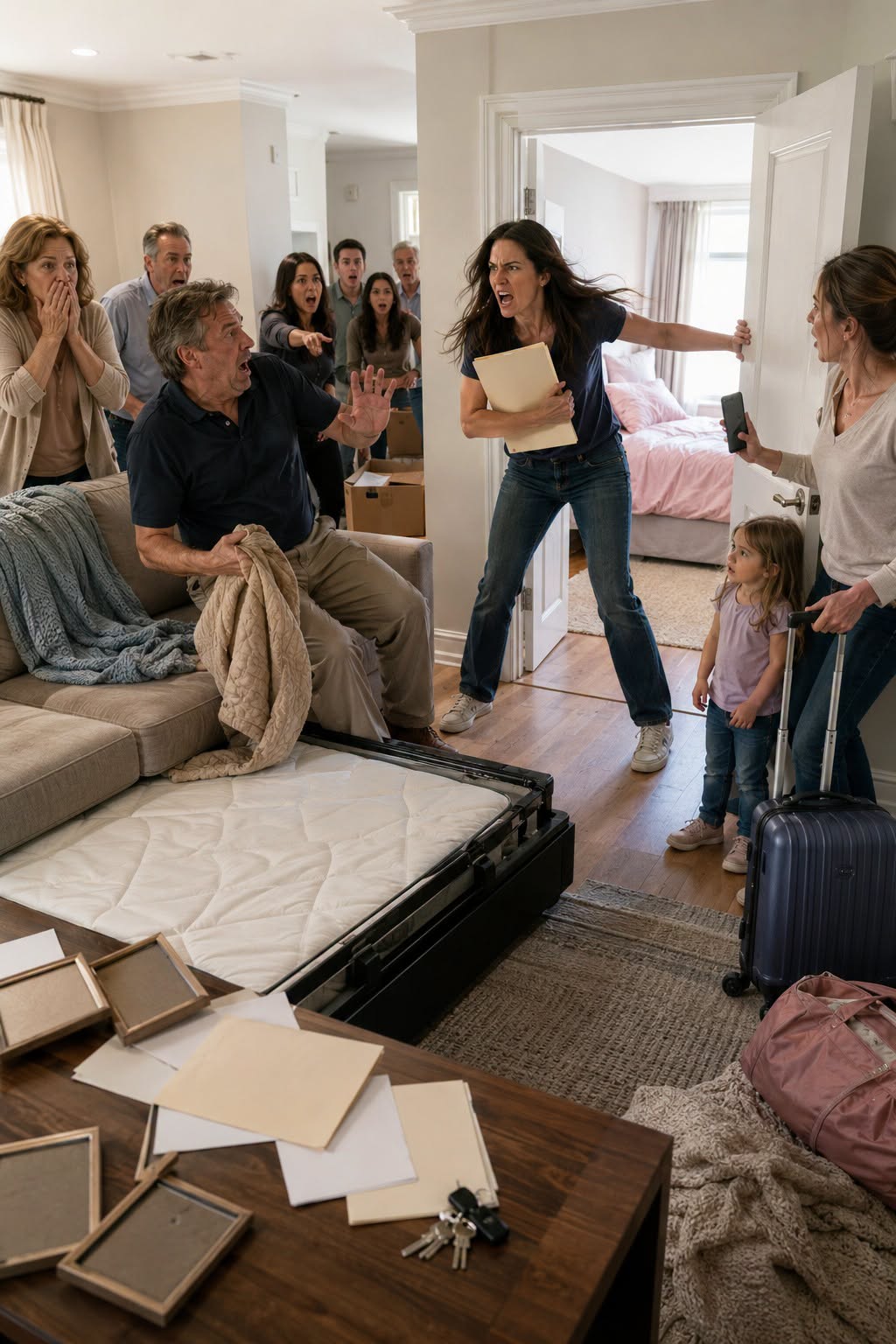
My Dad Demanded My Bedroom for My Sister’s Kid—So I Told Him to Share His Own
My Dad Casually Said, “You Can Sleep On The Pullout Couch.” After Deciding That My Bedroom Would Go To My Sister’s Daughter. I Just Stared At Him And Replied, “In My Own House, Not In A Million Years!”
### Part 1
My father announced that I could sleep on the pull-out couch while my sister and her daughter took both bedrooms upstairs.
He said it casually, between bites of turkey, as though he were deciding where to put the extra folding chairs after dinner.
For several seconds, the only sounds in my dining room were the soft crackle of the fireplace, the ticking clock above the doorway, and my mother’s fork tapping against her china plate.
I looked across the table at my younger sister, Megan, certain I had missed part of the conversation.
“What bedroom are you talking about?” I asked.
Megan gave me an impatient look. She was wearing the cream cashmere sweater I had bought her the previous Christmas, the one she had complained was slightly too beige. Beside her, my nine-year-old niece, Sophie, was separating peas from mashed potatoes with the edge of her fork.
“Your green room,” Megan said. “The one upstairs with the window seat. Sophie loves it, and she needs somewhere stable while I figure everything out.”
My fingers tightened around my wineglass.
The room she called “the green room” had not been usable for most of the six years I had owned the house. It had warped flooring, cracked plaster, rattling windows, and an ancient radiator that groaned whenever the temperature dropped below freezing.
Three months earlier, after years of postponing anything that felt remotely indulgent, I had finally renovated it.
I spent nearly nineteen thousand dollars.
I installed oak floors, custom bookshelves, a built-in reading nook beneath the bay window, linen curtains, warm lamps, and a small desk where I reviewed veterinary case notes when I did not want to sit in my downstairs office. The walls were painted a soft sage green that looked silver in the morning light.
After twelve-hour shifts at the animal clinic, emergency surgeries, frightened pets, and owners crying against my shoulder, that room had become the quietest place in my life.
Megan knew exactly what it meant to me.
She had watched me compare paint samples. She had sent me links to lamps and teased me for buying a mattress more expensive than the one in her apartment.
Now she was assigning it to her daughter as though she had reserved it through a hotel website.
I glanced at Sophie. Her shoulders were stiff, and her eyes remained fixed on her plate.
None of this was her fault.
“What exactly is happening?” I asked. “Start from the beginning.”
Megan sighed dramatically.
“My lease is ending. I told you that.”
“You said your landlord was increasing the rent.”
“Which means I can’t justify renewing it.”
“That isn’t the same as telling me you’re moving into my house.”
Dad set down his fork with a sharp scrape.
“Claire,” he said, using the slow, disappointed tone he had perfected when I was a child, “your sister is going through a difficult transition.”
Megan folded her arms.
“I’m not asking for much.”
“You haven’t asked for anything,” I said. “You announced that my room belongs to Sophie.”
Mom looked at me from the opposite end of the table.
“Please don’t make Christmas unpleasant.”
I almost laughed.
The room smelled of roasted turkey, cinnamon candles, and the expensive pine garland Mom had insisted I buy because my old decorations looked “a little depressing.” I had worked until nearly midnight the previous evening after performing emergency surgery on a Labrador that had swallowed part of a plastic toy.
Then I had woken at six to cook for everyone.
Megan arrived forty minutes late with Sophie and an empty container because she wanted leftovers. Dad brought a bottle of wine he knew I did not drink. Mom criticized my tablecloth before removing her coat.
Yet somehow, five minutes into dinner, I was the one threatening to make Christmas unpleasant.
“How long are you planning to stay?” I asked.
Megan shrugged.
“A few months. Maybe longer. The housing market is ridiculous.”
“And where will you sleep?”
She looked at Dad.
Dad cleared his throat.
“Well, obviously Sophie needs the renovated room. Megan can take your bedroom temporarily.”
I stared at him.
“My bedroom?”
“You have a perfectly good couch downstairs,” he said. “It pulls out, doesn’t it?”
For one strange, suspended moment, I could hear every sound with unnatural clarity—the wind brushing against the windows, the refrigerator humming in the kitchen, the second hand moving inside the clock.
I looked around the table at the three adults waiting for me to agree that the logical solution to Megan’s financial problems was for me to surrender my house room by room until I was sleeping in my own living room.
“Why can’t they stay with you?” I asked.
Dad’s mouth tightened.
“Our house isn’t set up for that.”
“You have four bedrooms.”
“One is my office, one is your mother’s sewing room, and the guest room is too small for both of them.”
“Then Sophie can have your bedroom,” I said. “You can sleep on your couch.”
His expression hardened.
“Don’t be ridiculous.”
That was when I understood the rule.
Sacrifice was reasonable only when it belonged to me.
Megan leaned back with the bored certainty of someone who believed the decision had already been made. Mom looked anxious but hopeful. Dad picked up his fork again.
They were waiting for the version of me they had spent years training—the dependable daughter who complained quietly, lost sleep privately, and eventually did whatever made everyone else comfortable.
Something inside me went perfectly still.
I lifted my glass and took a slow sip.
“All right,” I said.
Megan’s shoulders relaxed immediately.
“Thank you,” Mom whispered.
Dad nodded as though order had been restored.
Megan turned to Sophie and smiled.
“See? I told you Aunt Claire would understand.”
Sophie did not smile back.
Neither did I.
Because while they finished Christmas dinner, I had already begun deciding how to make sure none of them ever slept beneath my roof.
### Part 2
I served dessert, wrapped leftovers, loaded the dishwasher, and kissed my parents goodbye as if nothing had happened.
Megan lingered in the entryway, scrolling through her phone while Sophie struggled with the zipper on her coat.
“I’ll bring some boxes over next weekend,” Megan said. “You should clear your paperwork out of the desk. Sophie will need it for homework.”
I leaned against the doorframe.
“What are you doing with your furniture?”
“I’ll sell most of it. There’s no point paying for storage.”
“And Trevor?”
Her eyes flickered.
“What about him?”
“Is he moving in too?”
Megan rolled her eyes.
“Not immediately. Maybe later, depending on how things go.”
Of course they had not discussed it properly.
Megan was thirty-four years old, but planning had always been something other people did on her behalf. She drifted from one emergency to the next, each one eventually landing in my lap wrapped in the language of family duty.
When she lost her job at a boutique gym three years earlier, I covered her rent for four months.
When she needed a security deposit after separating from Sophie’s father, I transferred thirty-two hundred dollars before she finished asking.
I paid for Sophie’s science camp, school supplies, dental work, and two years of swimming lessons. I paid to repair Megan’s car, covered an overdue electric bill, and financed an online marketing course she abandoned before completing the fourth module.
Sometimes she asked sweetly. Sometimes she cried. Sometimes Mom called first to soften me up.
The money always left my account.
Very little of it returned.
I loved Sophie. That was the lever they used most often.
“You don’t want her to suffer because of adult problems, do you?”
No, I did not.
But somewhere along the way, preventing Sophie from suffering had become indistinguishable from preventing Megan from facing consequences.
After they left, I went upstairs and stood in the doorway of the renovated bedroom.
Moonlight spilled across the oak floor. The linen curtains shifted above the radiator. A mystery novel lay open on the window seat beside a folded gray blanket.
I remembered the week the contractors finished.
I had come home after losing an elderly golden retriever during surgery. I had known the dog might not survive, but I tried anyway because his owner had held my hands and begged me not to give up.
Afterward, I sat in that room with my shoes still on and cried until the sky went dark.
It was not merely a spare bedroom.
It was the first thing I had ever created entirely for myself.
No practical justification. No family emergency. No guilt attached.
I sat on the window seat and opened my laptop. For twenty minutes, I looked at photographs of the renovation without truly seeing them.
Then I called Dana Whitmore.
Dana had been my friend since college. She was also the real estate agent who helped me buy the house six years earlier.
She answered on the fourth ring, her voice thick with sleep.
“Claire? Is everything okay? Is there an emergency?”
“I want to sell.”
A pause followed.
“Sell what?”
“My house.”
Another pause.
“Your entire house?”
“Yes.”
“At eleven forty-five on Christmas night?”
“Yes.”
She became more alert.
“What happened?”
“My family decided to move into it.”
“Without asking?”
“They asked after deciding.”
“Did you tell them no?”
“I realized they don’t believe my answer is final.”
Dana was quiet for a moment.
Then her voice became businesslike.
“The neighborhood is hot, and the renovation will help. Are you thinking a normal listing schedule?”
“No. Cash buyers only. As-is sale. Fast closing—fourteen days if possible.”
“That will reduce the buyer pool.”
“I know.”
“You may leave money on the table.”
“I know.”
“Do you have somewhere to go?”
I looked around the room.
“My clinic owns a furnished cottage. Dr. Russell offered it to me if I accept his partnership proposal.”
My boss had been trying to convince me to buy into the practice for almost a year. He planned to retire gradually and wanted me to take over operations.
I had hesitated because partnership felt enormous. Permanent. Risky.
Selling my house felt even more enormous.
Yet sitting in the room my family had already redistributed, both decisions suddenly seemed simple.
The house was mine.
That meant I could sell it.
Dana arrived at twelve thirty wearing leggings and a wool coat over flannel pajamas. She carried her laptop, a tape measure, and the expression of someone who had heard enough about my family to skip unnecessary questions.
We drank coffee at my kitchen island and created the listing.
Three bedrooms. Two bathrooms. Updated kitchen. Finished basement. Fenced yard. Quiet street. Move-in ready. Cash offers prioritized. Closing within fourteen days preferred.
I already had professional photographs from the renovation, including bright images of the sage-green room and its window seat.
At two twenty-seven in the morning, Dana pressed the final button.
The listing went live.
At six forty-five, she texted me.
“Three showing requests already. One cash investor, one couple relocating for work, and one retired teacher represented by an agent I trust. I’m putting the sign up now.”
I stood at the upstairs window in my robe and watched her hammer the post into my snow-covered lawn.
The white sign looked almost cheerful beneath the pale winter sky.
FOR SALE.
My phone rang at seven twelve.
Mom.
I let it ring twice before answering.
“What is on your lawn?” she demanded.
“I assume you mean the sign.”
“Why is there a for-sale sign in front of your house?”
“Because the house is for sale.”
The silence on the other end was so complete that I heard her car indicator clicking.
“You’re selling your house?”
“Yes.”
“Since when?”
“Since last night.”
“Does your father know?”
“I haven’t spoken to him this morning.”
“What about Megan?”
“What about her?”
Mom made a strangled sound.
“Claire, this isn’t funny. Megan has already given notice to her landlord.”
I sat upright.
“When?”
Mom hesitated.
“When did she give notice?”
“Last week.”
I looked at the kitchen wall, suddenly colder than I had been while standing outside.
Megan had ended her lease before Christmas dinner.
Before asking me.
Before pretending there had been a discussion at all.
“She assumed you would help,” Mom said.
“She assumed correctly,” I replied. “I’m helping her understand what happens when she builds her future on property that doesn’t belong to her.”
Mom hung up.
At seven twenty-eight, Dad called.
At seven thirty-one, Megan called.
At seven forty, someone pounded on my front door so violently that the glass rattled.
When I opened it, Megan stood on the porch in sweatpants and an unbuttoned coat, her face pale with fury.
Behind her, Sophie waited inside the car.
Megan pointed at the sign on my lawn.
“What the hell is wrong with you?”
### Part 3
A curtain moved in the house across the street.
I stepped onto the porch and pulled the door closed behind me.
“Lower your voice.”
“You listed the house.”
“Yes.”
“You can’t do that.”
“I already did.”
“We had a plan.”
“You had a plan.”
“You said all right.”
“I said it because I was tired of explaining basic ownership to three adults during Christmas dinner.”
Megan stared at me as though I had spoken in another language.
“You’re selling an entire house just to spite me.”
“No. I’m selling it because owning it made you believe you had the authority to assign its rooms.”
“Where am I supposed to go?”
“Renew your lease.”
“I can’t afford the increase.”
“Find a smaller apartment.”
Her mouth fell open.
“A smaller apartment? Sophie needs her own room.”
“I agree.”
“And you have three bedrooms.”
“For approximately fourteen more days.”
The front door opened behind me.
Sophie stood there with her coat half-zipped, looking frightened.
“Mom said I could use the bathroom,” she whispered.
I stepped aside immediately.
“Of course, sweetheart.”
When the door closed again, I faced Megan.
“Do not bring her into this.”
“She is already in this. You’re making her homeless.”
“No. You ended your lease before receiving permission to move into my house. You created this situation.”
“You would really choose money over your niece?”
There it was—the familiar blade, polished through years of use.
I folded my arms against the cold.
“I paid your rent. I paid your security deposit. I covered Sophie’s camp fees, school supplies, dental treatment, and birthday parties. I’ve transferred you money so many times that my banking app suggests your name before I type a letter.”
Megan looked toward the street.
“Don’t stand on my porch and pretend I failed Sophie because I refuse to sleep on a couch in a house I bought.”
Her expression changed.
Not into guilt.
Into calculation.
“You always make everything about money.”
“Because you always ask me for money.”
“Family is supposed to help each other.”
“Name the last time you helped me.”
She opened her mouth.
Nothing came out.
Snowflakes caught in her messy hair.
“You don’t need help,” she said finally. “You have your career. You have savings. You have this perfect life.”
“My life didn’t appear by magic. I cleaned cages while I attended college. I studied between overnight shifts. I paid off student loans while you quit jobs every six months because every manager was supposedly jealous of you.”
“You think you’re better than me.”
“No. I think I’m responsible for me.”
Sophie emerged a minute later. Her cheeks were pink from the cold, and she avoided looking at either of us.
I crouched to zip her coat properly.
“Are you okay?”
She nodded, but her eyes were glossy.
“Mom said I was getting your pretty room.”
“I know.”
“Did I do something wrong?”
The question struck harder than anything Megan had said.
“No,” I told her. “Absolutely not. You did nothing wrong. Adults made a mistake, and it is not your job to fix it.”
Behind her, Megan looked away.
By noon, Dana had scheduled six showings. By that evening, we had two cash offers.
The stronger offer came from Howard Mills, a retired high school teacher moving closer to his daughter after his wife’s death.
He liked the downstairs bedroom because his knees were unreliable. He liked the fenced yard because he planned to adopt a dog. He loved the reading nook because his granddaughter stayed with him on weekends.
His offer was clean.
No financing contingency. No repair demands. Closing in fourteen days.
I accepted it.
The next morning, Dad arrived at my clinic.
I was examining an orange tabby named Pumpkin, who had attacked a strand of holiday ribbon and lost the argument, when my technician, Tessa, leaned into the treatment room.
“There’s a man at reception asking for you,” she said. “He says he’s your father.”
I closed my eyes briefly.
“Tell him I’m with a patient.”
“He says he’ll wait.”
Dad waited forty-five minutes.
When I finally entered the lobby, he stood near a display of pet dental brochures in his long wool coat, visibly offended that the world had not stopped for him.
“We need to talk.”
“I have ten minutes before my next appointment.”
“This isn’t something we discuss in ten minutes.”
“Then it will have to wait.”
He followed me into a consultation room and closed the door.
“What you’re doing is irrational,” he said.
“I accepted an offer this morning.”
His face changed.
“You did what?”
“The buyer is closing in thirteen days.”
“You need to cancel it.”
“No.”
“Claire, stop behaving like a child.”
I leaned against the stainless-steel counter.
“I’m not the one giving away somebody else’s bedroom.”
“Your sister is struggling.”
“She has been struggling for a decade.”
“She’s a single mother.”
“She receives child support. She works. She has options.”
“She can’t afford the apartment she has.”
“Then she must find one she can afford.”
Dad’s jaw tightened.
“You make good money. You live alone in a three-bedroom house. Explain why helping your sister is such an unbearable sacrifice.”
“Because it’s never a sacrifice for the person demanding it.”
He started to speak, but I continued.
“I paid forty-eight hundred dollars toward Mom’s dental work. I paid for your transmission. I gave Megan thirty-two hundred for her deposit and covered four months of rent. I paid for Sophie’s camps twice. I paid for Megan’s unfinished marketing course. I loaned you the money for your property taxes three years ago.”
Dad shifted.
“I have helped this family for years, usually without resentment. But the first time I spend money creating something for myself, Megan claims it for her daughter, and you agree so completely that you assign me to the couch.”
“Your niece is a child.”
“Yes, which is why she deserves a mother who plans responsibly and grandparents who stop teaching her that stability means taking someone else’s home.”
Dad’s face reddened.
Then he said something that made the entire situation clearer.
“Megan told us you had already offered.”
I stared at him.
“What?”
“She said you two had discussed her moving in months ago.”
I felt the anger drain from me, leaving something colder behind.
Megan had not merely assumed I would surrender.
She had been preparing everyone to pressure me long before Christmas dinner.
And suddenly I wondered how many other lies she had told to make my house feel like hers.
### Part 4
Dad avoided my eyes.
“She said you knew her lease was ending,” he continued. “She said you had mentioned that the house was too large for one person.”
“I said the property taxes were high. I never invited her to move in.”
“She made it sound settled.”
“That was intentional.”
He looked toward the closed door.
“Maybe she misunderstood.”
“No, Dad. People misunderstand dates or amounts. They don’t accidentally invent an offer to take over someone’s home.”
His mouth tightened, but doubt had entered his expression.
“What about Trevor?” I asked.
“What about him?”
“Megan told me he might move in later.”
For the first time, Dad looked genuinely surprised.
“She didn’t mention that.”
“Of course she didn’t.”
He remained silent.
“She wasn’t asking for temporary help,” I said. “She was building a household inside mine. Sophie in the green room, Megan in my bedroom, Trevor arriving whenever it suited them, and me downstairs on a folding mattress.”
“That couldn’t have lasted.”
“Why not? Who would have made them leave?”
Dad had no answer.
I opened the consultation-room door.
“My next appointment is waiting.”
He stood still for a moment.
“We’re your family.”
“I know.”
“You’re really going through with this?”
“Yes.”
He left without saying goodbye.
For the next several days, my phone became a machine for delivering other people’s outrage.
Aunt Melissa called to say I was being dramatic.
My cousin Paige suggested delaying the closing until Megan found another apartment.
Mom sent me listings for two-bedroom units, as if I were Megan’s personal assistant.
One relative I had not seen in four years messaged me to explain that successful people had a “moral duty” to support less fortunate relatives. When I asked whether he planned to house Megan himself, he stopped responding.
Megan posted a vague message online about people who valued property more than children.
She did not mention ending her lease before speaking to me.
She did not mention expecting my bedroom.
She did not mention Trevor.
Several people commented with sympathetic messages. A few called me cruel without using my name.
I took screenshots, then logged out.
The house filled with cardboard boxes. Each evening after work, I wrapped dishes in newspaper and labeled containers with a black marker.
The rooms began to echo.
Yet the quieter the house became, the calmer I felt.
On Friday afternoon, Sophie called me from her tablet.
“Are you mad at me?” she asked.
“No.”
“Mom said Christmas got ruined because I wanted your green room.”
I sat down on the floor beside an open box of books.
“You didn’t ruin anything.”
“But I told her I liked it.”
“You are allowed to like things. You are allowed to want things. Adults are responsible for asking permission and making honest plans.”
“Are you moving because you don’t want me there?”
The pain in her voice made me close my eyes.
“I am moving because I need a different life. You are still my niece, and I still love you.”
“Can I visit your new place?”
“Yes.”
“Will it have a green room?”
“Probably not.”
She considered that.
“Can we paint one?”
A laugh escaped me.
“Maybe.”
After the call, I sat on the bare floor for a long time.
Megan was not merely using Sophie as leverage with me. She was telling a nine-year-old child that the collapse of her housing plan was somehow connected to an innocent wish.
That evening, I called Megan.
She answered on the first ring.
“What?”
“Stop telling Sophie that I sold the house because she wanted the bedroom.”
“I never said that.”
“She just repeated it to me.”
“She misunderstood.”
The same excuse Dad had tried.
“No. You are making her feel responsible for your decision.”
“You are responsible.”
“I am not discussing the house anymore. It is sold.”
“You could still cancel.”
“I won’t.”
Her breathing sharpened.
“Then don’t pretend you care about my daughter.”
“I care enough not to teach her that guilt is a tool.”
“You’ve always hated helping me.”
“That isn’t true.”
“You loved feeling superior.”
“No, Megan. I liked believing my help mattered. I’m finally accepting that it only made you expect more.”
She hung up.
On Sunday morning, I woke to the grinding beep of a vehicle reversing into my driveway.
I looked through the bedroom window.
A rented moving van stood behind my car.
Megan climbed from the passenger side. Trevor emerged from the driver’s seat. Mom and Dad pulled up behind them.
Inside the open van were boxes, a mattress, two suitcases, Sophie’s pink desk chair, and several plastic storage bins.
For a moment, I simply stood there holding the curtain.
They had come to move in.
Not negotiate.
Not apologize.
Move in.
I walked downstairs without putting on a coat.
By the time I opened the front door, Trevor was lowering the van’s metal ramp.
“What are you doing?” I asked.
Megan slammed the passenger door.
“Moving my things in before you do something even more irresponsible.”
“The house is under contract.”
“Then cancel it.”
“No.”
Trevor rubbed his hands against the cold.
“Look, Claire, everyone’s emotional. Maybe we should talk inside.”
“You are not entering my house.”
His eyebrows rose.
“Seriously?”
Dad stepped forward.
“Enough. This has gone too far.”
“I agree.”
Mom looked exhausted.
“Claire, please. Megan has nowhere else to go.”
“She has an apartment until the end of the month.”
“She can’t afford to renew it.”
“Then she needs to find something she can afford.”
Megan pointed toward the van.
“We already paid for this rental.”
“That was another poor decision.”
Her face twisted.
“You cold, selfish—”
“Do not finish that sentence.”
Something in my voice stopped her.
I walked to the keypad beside the garage and entered the new code Dana had recommended after the listing went live.
The garage door lifted three inches.
Then I pressed the button again, and it closed.
“I changed the locks yesterday,” I said. “Your emergency key no longer works. The garage code no longer works. The security cameras are recording, and the buyer’s inspector will arrive this afternoon.”
Dad stared at me as though I had become unrecognizable.
“You changed the locks on your own family.”
“I changed the locks on my house.”
Megan stepped closer.
“You wouldn’t actually call the police on us.”
“I won’t need to, because you’re leaving.”
Behind the windshield of Megan’s car, Sophie sat in the back seat with her backpack in her lap.
That sight steadied me.
“I will say this once,” I told them. “Sophie is welcome in my life. I will spend time with her when visits are arranged properly. I will help with important school or medical expenses by paying providers directly. But none of you will ever use her to force me to surrender my home again.”
Megan’s eyes narrowed.
“So you get to play generous aunt while putting us on the street?”
“You are not on the street.”
“You know what I mean.”
“Yes,” I said. “I finally do.”
Trevor had gone very still.
He looked at Megan.
“You told me this arrangement was already agreed.”
Megan’s head snapped toward him.
“It was.”
“No,” I said. “It wasn’t.”
Trevor’s face changed.
“You said your sister offered.”
“She would have eventually,” Megan replied.
The words hung in the frozen air.
She would have eventually.
Not a misunderstanding.
Not desperation.
A strategy.
Push hard enough. Bring Sophie into it. Get Mom emotional. Let Dad apply pressure. Arrive with boxes. Create a situation too uncomfortable for me to resist.
Trevor stepped away from the van.
“I’m not getting involved in this.”
Megan stared at him.
“You already are.”
“No. You told me we were moving into a family property temporarily. You didn’t tell me you were forcing your sister out of her own bedroom.”
“It’s not like that.”
He looked at me, embarrassed.
“It sounds exactly like that.”
Ten minutes later, Trevor left in a rideshare.
Megan began to cry.
Mom blamed me for humiliating her.
Dad ordered me to reconsider.
I stood in my driveway in thin socks, the cold biting through my feet, and watched them unload nothing.
The van drove away full.
But before Dad left, he turned toward me and said, “You may win this argument, Claire, but you’re going to lose your family.”
I looked at the house behind me, then at the people who had tried to take it.
“No,” I said. “I think I’m finally finding out whether I ever had one.”
### Part 5
The inspection took three hours.
Howard arrived near the end wearing a brown coat and carrying a notebook filled with careful handwriting. He apologized for the tension in the driveway even though none of it had been his fault.
“I hope I’m not causing trouble,” he said.
“You’re not.”
He looked toward the moving van’s tire marks in the snow.
“My daughter warned me that buying a house during the holidays might get complicated.”
“This complication existed long before you made an offer.”
He nodded as though he understood more than I had explained.
Upstairs, he paused in the green room and ran one hand along the window seat.
“My granddaughter, Emma, already saw the listing pictures,” he said. “She says this room is hers.”
A week earlier, those words might have hurt.
Instead, I smiled.
“Make her ask before she moves in.”
Howard laughed, then looked slightly confused by the seriousness beneath my joke.
The closing remained on schedule.
Megan made one final attempt to stop it.
Three days before I was supposed to sign, Dana called me while I was treating a terrier with an infected paw.
“Your sister contacted the buyer’s agent,” she said.
My stomach tightened.
“What did she say?”
“She claimed she had tenant rights and that the property was involved in a family occupancy dispute.”
I stared at the clinic wall.
“She has never lived there.”
“I know. The buyer’s agent knows. But we need to document everything.”
That evening, I gathered utility bills, tax statements, security footage, and years of mail showing that I was the only resident. Dana’s attorney prepared a statement confirming that no tenancy existed.
Howard could have walked away.
He did not.
“My late wife had a sister like yours,” he told Dana. “I recognize the pattern.”
When Megan realized her claim had failed, she called Dad.
Dad called me twelve times.
I did not answer.
Mom left a voicemail asking why I was “turning the family into a legal battlefield.”
I saved it and returned to packing.
Thirteen days after Christmas, I signed the closing documents.
The title company’s office smelled faintly of coffee and printer toner. Rain tapped against the windows, melting the dirty snow along the parking lot.
Howard sat across from me, reading every page before signing. When we finished, he stood and shook my hand with both of his.
“I hope you know how much I appreciate this house,” he said. “Emma has already claimed the window seat.”
“It’s a good place to read.”
“I’m thinking about getting a dog too. Something older and calm.”
That made me smile properly.
“Call the clinic when you’re ready. I know several older dogs that deserve a quiet home.”
I placed the keys in his palm.
For a second, I felt the weight of everything I was leaving—the kitchen where I had cooked holiday meals, the back steps where Sophie had drawn with chalk, the bedroom where I had slept after my first successful solo surgery, the green room where I had finally allowed myself to grieve.
Then Howard closed his fingers around the keys.
The house was no longer mine.
To my surprise, that did not feel like defeat.
It felt like release.
By the end of January, I had moved into the cottage near the clinic.
It was smaller than my house—two bedrooms, a narrow kitchen, a tiny fenced garden with a crooked apple tree, and a wooden bench weathered silver by years of rain.
On my first night, I sat on the living-room floor surrounded by half-open boxes and ate noodles from a takeout container because I had not unpacked the plates.
The heater clicked unevenly. The refrigerator rattled every few minutes. One kitchen drawer refused to close unless I lifted it slightly.
It should have felt like a loss.
Instead, I slept better than I had in years.
Without the long commute, I arrived at the clinic before sunrise each morning. I noticed details I had missed when exhaustion ruled my schedule—the smell of coffee drifting from the bakery next door, the purple light over the parking lot, the way the kennel dogs became quiet when I walked past and spoke to them.
Dr. Russell and I finalized the partnership agreement in March.
For the first time in my career, I was not simply working endless hours for a salary. I was helping shape the clinic’s future.
I hired another technician, expanded the emergency schedule, renovated the recovery room, and established a small assistance fund for owners who could not afford urgent treatment.
I also adopted a dog.
Her name was Mabel, a senior beagle mix with cloudy eyes, stiff hips, and an unreasonable hatred of delivery trucks.
She slept beneath the crooked apple tree when the weather was warm and followed me from room to room as though she had appointed herself responsible for making sure I did not disappear.
Megan found a two-bedroom apartment twenty minutes from Sophie’s school.
It was smaller than the place she had surrendered, but it was clean, safe, and within her budget. She took additional shifts at work.
Trevor did not move in.
According to Mom, their relationship ended shortly after the moving-van incident. He had believed Megan had a long-term housing plan. Discovering that her plan required removing me from my bedroom made him question several other things she had told him.
For the first month, Megan did not speak to me.
Then Sophie called from her tablet.
“Can I come meet Mabel?”
“Of course.”
“Mom says you’re not allowed to give me money anymore.”
I paused.
“That isn’t exactly what I said.”
“She also says you ruined her relationship with Trevor.”
“I didn’t.”
“I know,” Sophie said quietly. “I heard what she told him.”
I sat down at my kitchen table.
“What did you hear?”
“She said you had promised the house after Grandma and Grandpa convinced you. But she told Trevor you offered it because you wanted us there.”
A chill moved through me.
Even after everything, another layer of the story was still coming loose.
“How long had she been telling him that?”
“Since summer.”
Summer.
Six months before Christmas dinner.
Megan had not made a desperate decision after losing her apartment.
She had spent half a year planning to take mine.
### Part 6
Sophie came to the cottage the following Saturday.
Megan dropped her off without getting out of the car. She kept both hands on the steering wheel and stared straight ahead while Sophie climbed from the back seat.
I did not wave.
Inside, Sophie knelt on the rug while Mabel sniffed her boots, sneezed dramatically, and then leaned her entire weight against Sophie’s legs.
“She likes me,” Sophie whispered.
“She likes anyone willing to scratch behind her ears.”
We baked chocolate-chip cookies, walked Mabel slowly around the block, and sat beneath the apple tree drinking hot chocolate from mismatched mugs.
Sophie told me about school, a science project involving bean plants, and a classmate who always stole the best seat during reading time.
For nearly an hour, she seemed relaxed.
Then she began peeling the paper label from her mug.
“Mom says you sold the house because of us.”
“I sold it because I needed a change.”
“She says you wanted to punish her.”
“I wanted to protect myself.”
“Was the green room really your bedroom?”
“It wasn’t the room where I slept every night, but it was mine.”
“Mom said adults don’t need special rooms.”
I looked toward the crooked branches above us.
“Adults need places where they feel safe too.”
She considered that.
“Mom should have asked.”
“Yes.”
“And Grandpa shouldn’t have told you to sleep on the couch.”
“No, he shouldn’t have.”
Sophie took a sip of cocoa.
“Why didn’t he let us stay at his house?”
There it was—the simple question none of the adults had wanted to answer.
“Because it would have disrupted his life.”
“But he wanted to disrupt yours.”
“Yes.”
Her face tightened in a way that made her look older than nine.
“That isn’t fair.”
“No.”
She leaned against my shoulder.
“I like your cottage better anyway. It has Mabel.”
After Megan picked her up, I stood in the doorway watching the car disappear.
Mom apologized in April.
Not perfectly. Not all at once.
She arrived one Sunday carrying a lemon cake and walked quietly through the cottage, noticing the small kitchen, the secondhand dining table, and the dog bed beside the fireplace.
“I thought you would change your mind,” she admitted.
“I know.”
“I thought you would calm down and realize selling the house was extreme.”
“It was extreme.”
She looked surprised.
“But it was also necessary,” I continued. “None of you believed me when I said the house was mine. The only boundary you understood was a closing date.”
Mom looked down at her hands.
“We shouldn’t have put you in that position.”
“No.”
“I worry about Megan.”
“So do I.”
“She’s working all the time.”
“That is what adults do when their expenses exceed their income.”
Mom flinched.
“You don’t have to sound so hard.”
“I’m not hard. I’m finished pretending consequences are cruelty.”
She cut the cake into uneven slices.
After a moment, she said, “Megan told us you had offered to let her stay. Your father believed her.”
“You believed her too.”
“She was very convincing.”
“You wanted to believe her because that meant you didn’t have to inconvenience yourselves.”
Mom stopped moving.
The knife remained pressed against the cake.
“We could have taken them,” she admitted softly.
“Yes.”
“Your father didn’t want Sophie using his office. He said he needed quiet.”
I let out a humorless laugh.
“And he assigned me to a couch.”
Mom’s eyes filled with tears.
“I didn’t think of it that way.”
“You didn’t want to.”
She did not argue.
I allowed Mom to remain in my life, but the relationship changed. I stopped giving her automatic access to my time. I no longer answered every call immediately or rearranged my schedule because she used the word “family.”
Dad took longer.
He did not apologize directly. That was not his style.
Instead, several months later, on my birthday, he sent a message.
“I drove past the old house today. There was a dog in the yard. The new owner seems to be taking care of the place. I understand why you did it, even if I didn’t at the time.”
I read it twice.
Then I replied, “Understanding it now does not erase what happened.”
Three dots appeared on the screen, vanished, then returned.
“I know,” he wrote.
It was not forgiveness.
It was not reconciliation.
It was the first honest sentence he had offered me.
As for Megan, our relationship remained frozen.
She stopped asking me for money, but she had not stopped blaming me. At family gatherings, she spoke around me rather than to me. When Sophie mentioned the cottage, Megan’s jaw tightened.
Then, near the end of summer, she appeared at the clinic without an appointment.
She stood in the lobby clutching a white envelope.
For one foolish second, I wondered whether it contained an apology.
She placed it on the counter between us.
“I need you to sign this,” she said.
I did not touch it.
“What is it?”
“A statement saying you agreed verbally to let us live in the house.”
I stared at her.
“The house I sold eight months ago?”
“I’m applying for housing assistance. They want an explanation for why I gave up my previous apartment.”
“And your explanation is that I broke a promise I never made?”
Her eyes hardened.
“I lost thousands of dollars because of you.”
“You gave notice without permission.”
“You knew I needed help.”
“That is not an agreement.”
“If you sign it, nothing happens to you.”
I slid the envelope back toward her.
“No.”
She looked at me with open contempt.
“You really don’t care what happens to us.”
“No, Megan. I care. I simply no longer agree to lie so you can avoid responsibility.”
She grabbed the envelope.
“One day Sophie will understand what kind of person you are.”
From the hallway behind her, a small voice answered.
“I already do.”
Sophie stood beside Tessa, still wearing her school backpack.
Megan’s face went white.
And for the first time, my niece was no longer looking down.
### Part 7
Megan turned sharply.
“What are you doing here?”
“Grandma brought me,” Sophie said. “She said Aunt Claire was going to check Mabel’s ear.”
Mom appeared from the waiting area, looking uncomfortable.
“I didn’t know Megan was coming.”
Sophie’s eyes moved from the envelope to her mother.
“Why do you want Aunt Claire to say she promised us the house?”
“This is an adult conversation.”
“But she didn’t promise.”
Megan’s voice sharpened.
“Sophie.”
“She didn’t.”
The lobby had gone quiet. Tessa discreetly guided another client into an examination room.
Megan crouched in front of her daughter.
“You don’t understand everything that happened.”
“I understand that you told Trevor she gave us the house.”
Megan froze.
Sophie continued, her voice trembling but clear.
“You told Grandma she only said maybe. You told Grandpa she already agreed. You told me I could have the green room. Everybody got a different story.”
“Sophie, stop.”
“No.”
The word was small, but it changed the air.
Megan stood.
“You’ve been talking about me with her.”
“I’ve been answering her questions honestly,” I said.
“You’re turning my daughter against me.”
“No. Your lies are doing that.”
Mom stepped forward.
“Megan, perhaps we should go.”
Megan gripped the envelope so tightly that it bent.
She looked at Sophie.
“Get your backpack.”
“I’m staying with Aunt Claire today.”
“That wasn’t the plan.”
“It was Grandma’s plan.”
Mom drew a breath.
“She can stay for the afternoon.”
“You don’t make decisions for my child.”
“And you don’t make decisions for my house,” I said. “Remember how that works?”
Megan glared at me, then walked out.
The glass door closed behind her with a hard rattle.
Sophie began crying only after the sound of Megan’s car disappeared.
I knelt beside her.
“You didn’t have to defend me.”
“I wasn’t defending you,” she whispered. “I was telling the truth.”
That afternoon, Sophie sat on the floor of my office while Mabel slept beside her. She drew a picture of the cottage with the apple tree leaning at an impossible angle.
Mom remained in the waiting room for nearly an hour before coming to speak with me.
“I didn’t know Megan had been telling everyone different versions,” she said.
“You didn’t ask questions because her story gave you a convenient answer.”
“That isn’t fair.”
“It is accurate.”
Mom looked through the office window at Sophie.
“What do we do now?”
“We stop rescuing Megan from the truth.”
Housing assistance did not require the false statement. Megan had exaggerated that too. She merely wanted documentation that framed her as the victim of a broken family promise.
Without my signature, she submitted the real explanation: she voluntarily ended a lease she could not afford to renew before securing another residence.
Nothing catastrophic happened.
She remained in her apartment. She continued working. Sophie remained in the same school.
Life went on without me absorbing the cost.
That was the revelation none of us could ignore.
Megan did not collapse when I stopped rescuing her.
She adapted.
The first time Sophie needed new glasses, Megan mentioned the expense during a phone call and then quickly added, “I’m not asking. I’ve already budgeted for them.”
It was a small sentence, but I heard the effort behind it.
“That’s good,” I said.
A pause followed.
“You could sound a little more impressed.”
“You’re paying for your daughter’s glasses, Megan. That is parenting, not a favor to me.”
She ended the call soon afterward.
I did not chase her.
My clinic partnership grew steadily. Dr. Russell reduced his hours, and I took over more of the administrative work.
The assistance fund helped thirteen families during its first year. Howard became one of its earliest donors after adopting an eleven-year-old spaniel named Walter from a local rescue.
He sent me a photograph of Walter sleeping beneath the green room’s window seat while his granddaughter read above him.
I stared at the image for a long time.
The sage walls were unchanged. The linen curtains still caught the afternoon light. My old shelves now held children’s books, framed photographs, and a ceramic dog made in an art class.
The room was loved.
Leaving it had not destroyed its meaning.
It had prevented that meaning from being taken from me.
On the first anniversary of the Christmas dinner, Mom invited everyone to her house.
I almost declined.
Then Sophie called and asked whether I would bring Mabel.
So I went.
Dad had converted part of his office into a small sleeping area with a twin bed, reading lamp, and blue quilt.
“For Sophie,” he explained awkwardly. “In case Megan ever needs help.”
I looked at him.
“You gave up part of your office?”
He cleared his throat.
“It seemed reasonable.”
A year earlier, that space had been too important to sacrifice.
Now he avoided my eyes because we both understood what the bed represented.
Megan arrived late carrying store-bought rolls. She barely acknowledged me.
Dinner remained polite until Dad began carving the turkey.
Then Sophie pointed toward the hallway.
“Grandpa, if Mom and I ever move in, do you have to sleep on the couch?”
Dad’s knife stopped.
Mom covered a cough with her napkin.
Megan’s face darkened.
Dad looked at me, then at Sophie.
“No,” he said. “If you ever need to stay here, we will make room without taking someone else’s bed.”
Sophie nodded as though checking an answer on a test.
“Good.”
Megan pushed back her chair.
“This is ridiculous. Are we going to keep punishing me forever?”
No one answered immediately.
Then Dad placed the carving knife safely on the platter.
“Nobody is punishing you,” he said. “We are just not pretending it didn’t happen.”
Megan looked around the table, waiting for someone to rescue her.
For once, no one did.
### Part 8
Megan left before dessert.
Sophie remained with my parents that night, and I drove home through light snow with Mabel snoring in the passenger seat.
I expected to feel victorious.
Instead, I felt tired.
For years, I had imagined that setting a boundary would create one decisive moment in which everyone finally understood me. I thought the truth would land like a judge’s gavel and make the family rearrange itself into something fair.
That was not what happened.
Boundaries did not transform Megan into an honest person.
They did not erase Dad’s entitlement or Mom’s habit of smoothing conflict by asking the most dependable person to surrender.
They simply stopped those habits from controlling my life.
That was enough.
I never returned to the relationship Megan and I had before.
We spoke when necessary about Sophie. We attended the same birthdays and school events. I remained polite, but I no longer offered money, emergency housing, career advice, or solutions she had not earned.
When she cried, I did not automatically reach for my wallet.
When Mom called to say Megan was overwhelmed, I replied, “I’m sorry she’s having a hard time,” instead of asking how much she needed.
When Dad suggested I could “help just this once,” I reminded him that phrases like “just this once” had shaped most of my adult life.
Eventually, they stopped asking.
Sophie continued visiting the cottage twice a month.
We painted the second bedroom pale blue—not green, because she decided she wanted something different. She chose star-patterned curtains and a yellow lamp shaped like a mushroom.
The room belonged to no one permanently. It was there for guests, reading, art projects, and the occasional sleepover.
The important difference was that I chose what happened inside it.
As the years passed, Sophie began recognizing more of the family pattern.
At twelve, she asked why her mother became angry whenever people said no.
At fourteen, she told me she had started saving part of every birthday gift because she never wanted money to feel like an emergency.
At sixteen, she found a weekend job at an independent bookstore.
Megan complained that school should be her only responsibility.
Sophie kept the job.
“I like knowing I can buy something without asking anyone,” she told me.
I understood that feeling more deeply than she knew.
Dad and I built a limited but honest relationship.
He never gave me the apology I once thought I needed. Instead, he changed small behaviors. He asked before making plans involving me. He stopped volunteering my time to relatives. When someone called me selfish at a family gathering, he replied, “Claire has done more for this family than most of us deserved.”
I did not forget the dining-room conversation.
I did not pretend his later understanding erased it.
But I allowed changed behavior to matter.
Mom became more direct with Megan. The first time Megan asked her to cover an overdue bill, Mom offered to help create a budget rather than writing a check.
Megan accused her of choosing my side.
Mom replied, “There shouldn’t be sides in basic responsibility.”
I heard about that conversation from Dad and smiled for the rest of the day.
Mabel lived four more years.
Her cloudy eyes worsened, her walks became shorter, and her hatred of delivery trucks remained passionate until the end.
On her final afternoon, I carried her beneath the crooked apple tree and sat with her on the wooden bench. Sophie, then thirteen, held one of her paws.
Afterward, the cottage felt unbearably quiet.
Howard brought Walter to visit a week later. He also carried a small wooden box his granddaughter had painted with green leaves.
“For Mabel’s collar,” he said.
We sat beneath the tree drinking coffee while Walter investigated the garden.
Howard told me the old house was doing well. His granddaughter still read in the window seat. He had replaced the radiator but left everything else unchanged.
“Do you miss it?” he asked.
“Sometimes.”
“Do you regret selling?”
I thought about Christmas dinner, the moving van, the changed locks, the cottage, the clinic, Sophie’s blue room, and Mabel sleeping beneath the apple tree.
“No,” I said. “I regret that selling was the only answer they believed. But I don’t regret giving it.”
Years later, I drove past the old house.
The front door was painted navy. A bicycle lay on the lawn. Through the upstairs window, I could see the edge of the linen curtains moving in the breeze.
I did not stop.
I no longer needed to prove that I had survived leaving.
I had built a life in which survival was no longer the goal.
Sometimes I still think about the nineteen thousand dollars I spent renovating that room. I picture the oak floor, the sage walls, and the afternoon light stretching across the reading nook.
I do not regret spending the money.
I do not regret leaving the room behind either.
That renovation taught me something I should have learned much earlier.
Peace is expensive.
Not only because hardwood floors, linen curtains, and custom shelves cost money, but because once people grow comfortable benefiting from your silence, protecting yourself will always feel cruel to them.
For years, I thought being the dependable daughter meant solving every emergency.
I thought being a good sister meant giving until nothing felt entirely mine.
I thought loving my niece meant allowing her mother to use my affection as leverage.
I was wrong.
Stability is not taking someone else’s bedroom.
Family is not permission to ignore boundaries.
Generosity is not measured by how quietly you allow people to erase you.
That Christmas, my father told me to sleep on a pull-out couch inside the house I had purchased, maintained, and filled with the pieces of a life I built alone.
I told him that if surrendering a bedroom was such a small sacrifice, he could share his own.
He refused.
So before sunrise, I put the entire house on the market.
Fourteen days later, I handed the keys to someone who understood that a home was a gift to be respected, not a resource to be seized.
My family believed I had sacrificed everything to win an argument.
They were wrong.
I sold a house.
What I kept was far more valuable—the right to decide where I belonged, who entered my life, and how much of myself I was willing to give away.
And that was the one thing they would never take from me again.
THE END!