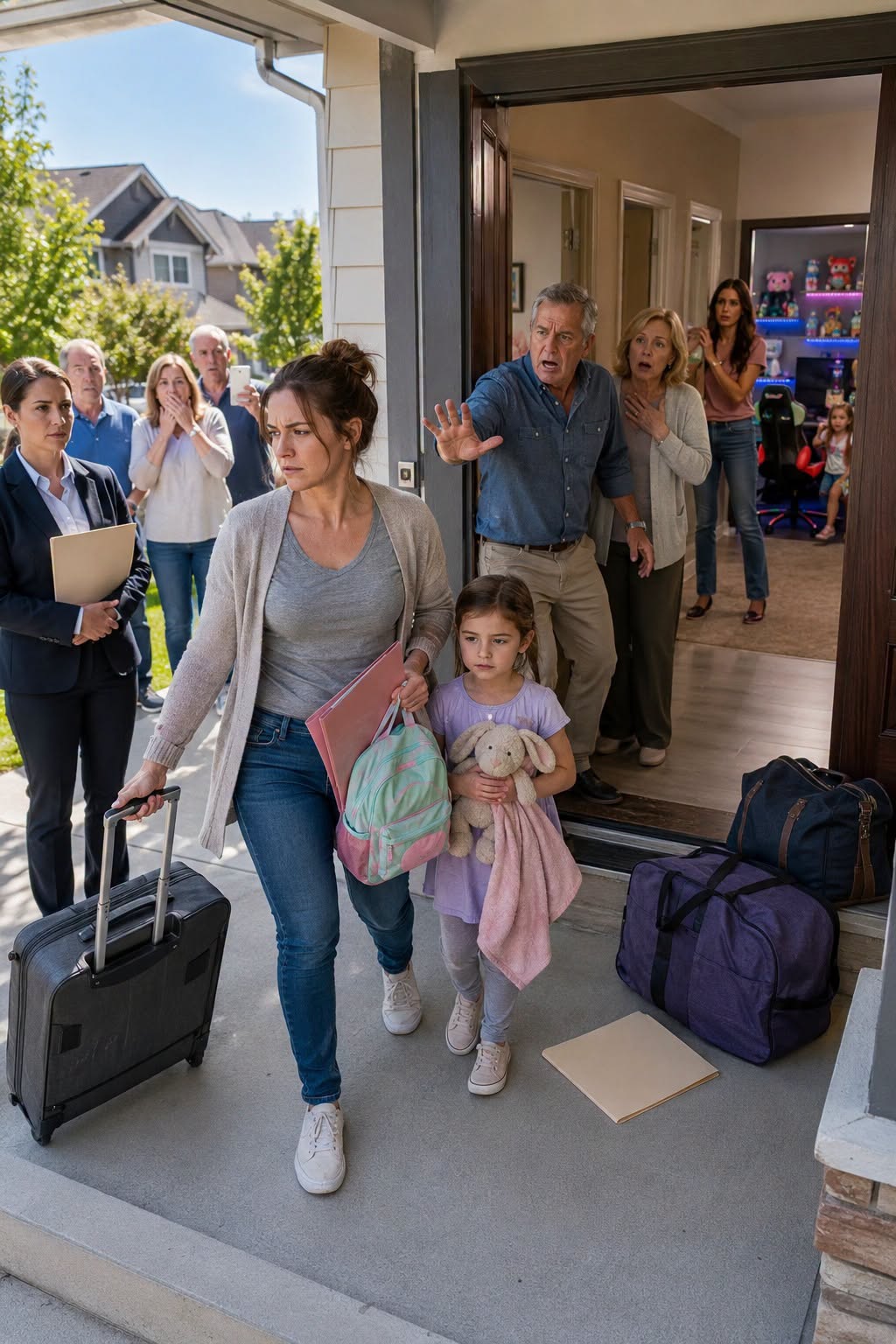
“We have NO SPACE for her,” my family said about my 5 year old Right in front of her…
After An Earthquake, I Asked To Stay At My Parents’ House With My 5-Year-Old Daughter. They Said, “Only Without The Child. No Space For Her.” My Sister’s Kids Each Had A Room, Plus A Game Room. I Didn’t Cry. I Just Said, “Noted.” Three Days Later, They Were Regretting Everything.
### Part 1
The earthquake lasted less than thirty seconds, but it was long enough to divide my life into before and after.
It began with a low growl beneath the floorboards, the kind of sound you feel in your teeth before your ears understand it. Then the kitchen cabinets started slamming open and shut. Glasses jumped from the shelves. Plates crashed across the tile one after another, sharp little explosions in the dark.
I grabbed the edge of the counter while the house twisted around me.
“Mommy?”
My five-year-old daughter, Lily, stood in the hallway wearing yellow pajamas and one sock. Her brown curls were flattened on one side from sleep, and she was clutching her stuffed fox, Jasper, against her chest.
Her eyes were huge.
I crossed the room as fast as the moving floor allowed and dropped over her, shielding her with my body until the shaking stopped.
For several seconds, there was only silence.
Then the smoke detector chirped.
A car alarm began screaming somewhere down the block.
“It’s okay,” I whispered.
The words came automatically, the way parents say things they desperately need to be true.
By sunrise, half the neighborhood was standing outside in coats and slippers. Chimney bricks littered the sidewalks. A water pipe had burst near the corner, turning the gutter into a muddy stream.
A city inspector arrived around nine wearing a scratched white hard hat. He walked through my little house with a flashlight, pausing at the foundation, the leaning kitchen wall, and the crack that now ran from the living-room window to the ceiling.
When he came back outside, he avoided my eyes.
“The structure shifted,” he said. “You can’t stay here until an engineer clears it.”
He pressed a red notice onto my front door.
The adhesive made a soft ripping sound beneath his glove.
That sound bothered me more than the breaking dishes had.
I stood on the lawn with Lily’s hand inside mine and stared at the house I had spent eleven years paying for. My flowerpots were still lined up beneath the window. Her little bicycle was tipped over by the garage. Everything looked almost normal if you ignored the red notice and the fact that the front door no longer closed correctly.
“Are we homeless?” Lily asked.
“No,” I said too quickly. “We’re just staying somewhere else for a little while.”
I called my insurance company first. Then three hotels. Then two temporary-housing agencies.
Every conversation ended with some version of the same answer.
No vacancies.
Long waiting list.
Call back Monday.
Finally, I called my mother.
She answered on the second ring.
“Elena? Are you all right?”
Hearing concern in her voice nearly broke me.
“The house isn’t safe,” I said. “The inspector says we have to leave. Can we stay with you while I figure things out?”
“Of course, sweetheart,” she replied immediately. “Come home.”
Come home.
Two words I had spent years pretending still meant something.
My parents lived five hours away in the two-story house where I had grown up. My older sister, Candace, had moved back in the previous year with her three children. Her boyfriend, Derek, had moved in six months after that.
It was crowded, but the house had four bedrooms, a finished basement, a den, and a formal dining room no one had used since my grandmother’s funeral.
I didn’t ask whether Lily was included in the invitation.
What mother would expect her adult daughter to abandon a five-year-old during an emergency?
We packed one suitcase each. I grabbed insurance documents, Lily’s school folder, a box of crackers, and the framed photograph from the day her adoption became official.
Before leaving, Lily stood in the driveway staring at our damaged house.
“Will my room still be there?”
“Yes,” I told her.
I didn’t know whether I was promising or praying.
It was almost sunset when we reached my parents’ neighborhood. Warm porch lights glowed behind trimmed hedges. The air smelled like fireplaces and damp leaves.
Lily sat up straighter when she recognized the street.
“Grandma’s house is really big,” she said.
“Big enough,” I answered.
My mother opened the door before I knocked.
She wore a cream sweater and the pearl earrings my father had given her for their anniversary. Her face softened when she saw me.
“Elena, thank God.”
Then Lily stepped out from behind my coat.
My mother’s smile disappeared.
“Oh,” she said. “You brought her.”
For a second, I genuinely thought I had misheard.
“Yes,” I said. “I brought my daughter.”
My mother glanced over her shoulder.
“We thought it would only be you.”
Lily’s fingers tightened around mine.
From the living room came the sound of children laughing and a video game blasting through the television. Someone had ordered pizza. Melted cheese and garlic floated through the doorway.
Candace appeared behind Mom with her phone in one hand.
Her hair was freshly styled, and she wore the expression she always used when inconvenience arrived wearing my face.
“You made it,” she said. “That drive must have been awful.”
“We’re tired,” I replied. “Where should we put our bags?”
Nobody moved.
Mom folded her arms.
“The house is completely packed. Candace and the kids have the upstairs rooms. Derek is using the den for work, and the basement is their playroom.”
“I can sleep on the couch,” Lily offered quietly.
My mother looked down at her.
“It’s not that simple, sweetheart.”
“It sounds simple,” I said.
Candace sighed.
“Elena, don’t turn this into a fight. Three kids already live here. Adding another one changes the whole routine.”
“She’s five, Candace. She doesn’t operate heavy machinery.”
Derek called from the living room, “I have conference calls early, so the den really can’t be disturbed.”
I looked past them.
His gaming console was glowing beneath the television.
A bag of chips rested on his stomach.
“Very professional,” I said.
Mom’s lips tightened.
“You can stay for a few nights. We’ll make room for you somehow. But Lily should stay with someone else until your situation is settled.”
The sentence seemed to drain every sound from the house.
“Without my child?” I asked.
“Just temporarily.”
Lily stared up at my mother.
“I’ll be good, Grandma.”
Her voice cracked on the last word.
Mom gave her a thin, uncomfortable smile.
“It isn’t about being good. We simply have no space for you.”
Lily burst into tears.
She didn’t wail or throw herself down. She cried the way frightened children cry when they are trying not to make adults dislike them more—silently, shoulders trembling, face pressed into my coat.
I felt something inside me go perfectly still.
I zipped her jacket to her chin.
“Come on, baby.”
“Where are we going?”
“Somewhere with space.”
Mom stepped forward.
“Elena, please don’t be dramatic.”
I looked at her, then at Candace, then at the bright hallway filled with framed photographs of Candace’s children.
There was not a single picture of Lily.
I didn’t shout.
I didn’t beg.
I simply said, “Noted.”
Then I carried our bags back to the car.
Three days later, my mother would call me screaming that I had destroyed the entire family.
But that night, all I knew was that my daughter had been rejected by the same people I had spent my whole life trying to earn a place beside.
### Part 2
The motel was five blocks from my parents’ house, squeezed between a tire shop and a twenty-four-hour diner.
Its sign promised low weekly rates and color television, as if color were still a luxury.
The room smelled of industrial bleach, old carpet, and the faint cigarette odor no amount of paint could hide. One lamp flickered when I turned it on. A crack ran across the ceiling between the two beds.
Lily sat on the edge of the mattress with Jasper in her lap.
“Is Grandma mad at me?”
“No.”
“Did I do something bad?”
“No, sweetheart.”
“Then why can’t I stay there?”
That was the question my mother had left me to answer.
I knelt and took off Lily’s sneakers.
“Some people don’t know how to make room in their hearts,” I said. “That’s their problem, not yours.”
She considered that with the solemn expression she used when learning new rules.
“Can hearts get bigger?”
“Yes.”
“Can Grandma’s?”
I tucked the blanket around her.
“I don’t know.”
She was asleep before I finished removing her second shoe.
I sat on the other bed fully dressed, listening to trucks pass on the highway. Each heavy rumble vibrated through the window and made my muscles tense.
Around three in the morning, Lily rolled over.
“Are we going home soon?”
“Soon,” I whispered.
I stayed awake until sunrise, staring at the ceiling crack and thinking about how easily I had walked back into an old role.
The extra daughter.
The one expected to adapt.
The child who needed less.
Candace had been the favorite for as long as I could remember. She was two years older, taller, louder, and naturally talented at making every room revolve around her.
When she broke a lamp practicing dance routines, Mom praised her confidence.
When I knocked over a glass while cleaning up the pieces, I was grounded for being careless.
Candace’s bedroom had two windows and a private bathroom. Mine had once been the laundry room. My father installed a narrow closet and called it cozy.
Her trophies filled the upstairs hallway.
Her friends crossed through my room to reach the backyard because no one thought to build another door.
Whenever I complained, Mom said, “You’re more independent than your sister.”
It sounded like praise until I understood that independence was simply the reward they gave me for receiving less.
At seventeen, I earned a scholarship to a university five hours away. I packed everything I owned into two suitcases and left before anyone could change my mind.
College was the first place where a closed door stayed closed.
I studied social work because I understood what it meant to become invisible inside a family. I liked case plans and measurable outcomes. I liked helping frightened people turn chaos into steps they could actually take.
My parents didn’t attend my graduation.
Dad said the drive was too long, and Mom claimed Candace needed help planning her wedding.
They mailed me a card with twenty dollars inside.
Two months later, Mom accidentally texted me an invoice for Candace’s wedding flowers.
The centerpieces alone cost more than my first car.
I told myself it didn’t matter.
That became another language I spoke fluently.
Years later, my work brought me to Lily.
She was two then, all dark curls and serious gray eyes, living with a young mother named Kelsey who moved between apartments, jobs, and promises too quickly for a toddler to feel safe.
Lily rarely spoke during my first visits.
She watched.
She noticed which adults kept their voices low. She remembered who returned when they said they would. She lined her crayons in perfect rows and panicked if one went missing.
One afternoon, she wrapped both arms around my neck as I prepared to leave.
Kelsey laughed.
“She does that with everybody.”
But Lily didn’t.
She did it with people who made her feel safe.
Three months later, Kelsey disappeared.
No goodbye. No forwarding address. Just an empty apartment with spoiled milk in the refrigerator and Lily’s purple cup sitting beside the sink.
Lily was placed in emergency foster care.
I knew the professional boundaries. I knew exactly why social workers weren’t supposed to become emotionally involved.
I also knew I couldn’t sleep because I kept picturing her standing at a stranger’s window, waiting for another adult to vanish.
I applied to become her foster parent.
The process took weeks of interviews, home inspections, references, and paperwork. By the time Lily came to live with me, I had memorized every rule except the one that would stop me from loving her.
Her first night in my house, she woke screaming.
I sat beside her bed until morning.
Three months later, she called me “Mommy” by accident.
She froze, waiting to see whether she had done something wrong.
I kissed her forehead.
“Go back to sleep, baby.”
The adoption became official the following year.
The judge smiled as he signed the final order.
“Congratulations,” he said.
I cried so hard I couldn’t thank him properly.
When I called my parents, Mom paused before saying, “That’s unexpected.”
Dad asked whether I understood how difficult it would be to raise “someone else’s child” alone.
Candace sent three heart emojis.
That was the celebration.
Still, I kept trying.
I brought Lily to meet them. I mailed school photographs. I drove five hours for holidays because I wanted her to have grandparents, cousins, and traditions.
During one visit, my father asked whether Lily knew she was adopted.
“Not yet,” I said. “We’ll explain it in a way she can understand when she’s ready.”
Mom nodded.
“You should tell her early so she doesn’t get confused and think she’s really part of the family.”
I nearly dropped my fork.
Later that night, I overheard her whispering to Candace in the kitchen.
“It isn’t the same,” Mom said. “You can’t just choose a child and pretend blood doesn’t matter.”
The next morning, I packed before breakfast.
But I returned the following Christmas.
And the Easter after that.
I told myself people could change.
I told myself Lily deserved the possibility of family.
Lying in that motel, I finally understood that the possibility had always existed only in my imagination.
At seven in the morning, I called my coworker and closest friend, Tessa Morgan.
She listened without interrupting.
Then she said, “Bring Lily here.”
“I don’t want to impose.”
“You aren’t imposing.”
“We might need more than a night.”
“Elena, I have a spare room. Bring your daughter.”
There was no pause. No calculation. No question about whether Lily counted.
An hour later, while Lily ate cereal from a paper cup, I looked through the financial documents I had grabbed from my house.
That was when I found the old property statement.
My name appeared beside my parents’ and Candace’s.
One-third ownership.
I had inherited it from my grandfather at seventeen.
For fifteen years, I had treated that share as if it belonged to everyone except me.
By noon, Lily and I were driving toward Tessa’s house.
And for the first time since the earthquake, I had a plan that did not involve asking my family for anything.
### Part 3
Tessa lived in a pale blue house near the edge of the city, where the streets curved around old oak trees and children left bicycles on front lawns without locking them.
When she opened the door, she didn’t ask how long we intended to stay.
She took one suitcase from my hand and shouted upstairs, “Harper, our guests are here.”
Her eight-year-old daughter appeared in mismatched socks.
“Do you like blanket forts?” she asked Lily.
Lily nodded.
“Good. I need an engineer.”
Within five minutes, the girls vanished upstairs with an armful of couch cushions.
Tessa led me into the kitchen and poured coffee into a mug that said World’s Okayest Adult.
“Stay until your house is repaired,” she said.
“That could take months.”
“Then stay for months.”
The coffee smelled dark and bitter. A pot of soup simmered on the stove. Somewhere upstairs, Harper laughed, followed by the thump of furniture being moved.
I pressed both hands around the mug.
“I don’t know how to thank you.”
“You could start by never apologizing for needing help during a natural disaster.”
That evening, Lily slept through the night.
I didn’t.
My body felt safe, but my thoughts kept circling the same facts.
My parents had denied shelter to my daughter while I legally owned part of the house.
Not symbolically.
Not emotionally.
Legally.
My grandfather had left equal shares to my mother, my father, Candace, and me in a complicated arrangement that was later consolidated into thirds after his estate closed. I had been young when the papers were signed, and my parents handled everything.
They told me ownership was only a technicality.
For years, I sent them two hundred dollars every month for taxes, insurance, and upkeep.
I never questioned the amount.
I never asked for receipts.
The following morning, I opened my banking app at Tessa’s kitchen table.
The automatic transfer was scheduled for Friday.
I canceled it.
One tap.
That was all it took to end fifteen years of paying for a place where my child was not allowed to sleep.
The silence afterward felt enormous.
“What did you just do?” Tessa asked.
“Stopped financing my own exclusion.”
She set a plate of toast in front of me.
“Good.”
Next, I searched for property attorneys.
I chose Dana Whitmore because her office biography mentioned partition disputes, inheritance fraud, and family-held real estate.
The word fraud caught my attention, though I had no reason yet to believe anything criminal had happened.
At least, no reason I could prove.
Dana’s office occupied the second floor of a brick building across from the courthouse. The waiting room smelled like lemon furniture polish. A clock ticked loudly above a shelf of legal books.
Dana was in her fifties, with silver-streaked hair and a voice that made every sentence sound already decided.
She read the deed twice.
“You own one-third as a tenant in common,” she said.
“So I can sell my share?”
“Yes, although finding an outside buyer for a partial interest in an occupied family home can be difficult.”
“What if they refuse to buy me out?”
“You can petition the court for a partition sale. The property would be appraised and potentially sold in full.”
I looked down at the copy of the deed.
“My parents live there.”
“That affects the emotional situation, not your ownership rights.”
“And my sister?”
“Same answer.”
I thought of Lily standing on the porch, offering to sleep on the couch.
“Start the process.”
Dana studied me for a moment.
“Partition actions are rarely pleasant. Once the notice arrives, your family will likely accuse you of retaliation.”
“It is retaliation.”
She raised one eyebrow.
“It is also the lawful resolution of a shared asset.”
“That sounds better.”
“We’ll use my version in court.”
She prepared a formal offer first, giving my family the opportunity to purchase my share at fair market value. If they declined, we would seek a sale.
I signed the authorization.
My hand didn’t shake.
The certified letter arrived at my parents’ house three days later.
I knew the exact moment because my mother called at 6:14 p.m.
I let it ring twice.
“Elena,” she said when I answered. “What have you done?”
“Hello to you too.”
“We received a letter from an attorney.”
“I assumed you would.”
“You’re trying to sell our house.”
“My share of the house.”
“It is our home.”
“Interesting pronoun.”
Candace began shouting in the background.
Mom covered the phone, but I still heard her.
“She’s doing this because of that child.”
“That child has a name,” I said.
Mom’s voice sharpened.
“You cannot punish your entire family because we didn’t have an extra bedroom.”
“You had a couch.”
“Derek works from home.”
“He was playing a racing game.”
“That isn’t the point.”
“No, the point is that you told a five-year-old she had no place in a house I help own.”
Dad took the phone.
His voice was softer, which had always been his preferred method of delivering the same cruelty.
“Elena, sweetheart, slow down. You grew up in this house.”
“I remember.”
“You have memories here.”
“I remember those too.”
“Then why would you force us out?”
“I’m not forcing anyone out. You can buy my share.”
A long silence followed.
Finally, Candace grabbed the phone.
“Where are we supposed to get that much money?”
“I don’t know.”
“You know Mom and Dad are retired.”
“You have a job.”
“I have three children.”
“So do you suddenly understand why children need shelter?”
She inhaled sharply.
“You’ve always been jealous of me.”
There it was.
The family’s emergency exit.
Whenever facts became uncomfortable, my feelings became the crime.
“I’m not discussing our childhood,” I said.
“You’re destroying us because Mom picked me.”
“No, Candace. I’m protecting my daughter because all of you rejected her.”
She laughed once, bitterly.
“She isn’t even—”
I ended the call before she finished.
Tessa found me standing beside the window, staring at Harper and Lily drawing chalk stars on the driveway.
“How bad?” she asked.
“Exactly as expected.”
“Do you feel guilty?”
I waited for guilt to arrive.
It didn’t.
“I feel awake.”
The following morning, my mother sent a message.
Please reconsider before this gets ugly.
I read it three times.
Not because I feared the threat.
Because I finally understood that my mother believed the ugliness had started with my response, not with Lily crying on her porch.
I forwarded the message to Dana.
Then I blocked the family group chat.
What I didn’t know was that my request to review the property records had already uncovered something much worse than favoritism.
And somewhere inside a bank file, my name had been used for a decision I had never made.
### Part 4
The public campaign began two days later.
Candace posted a long message online about “ungrateful adult children” who weaponized inheritance against elderly parents. She never used my name, but she included enough details that everyone knew.
Earthquake.
Adopted child.
Family home.
Within hours, relatives I hadn’t spoken to in years began messaging me.
Your parents sacrificed everything for you.
Family disagreements should stay private.
Think about the children.
That last one almost impressed me.
Candace had denied my child a couch, yet somehow her children were now sacred shields against consequences.
My mother shared Candace’s post with a broken-heart symbol.
An aunt commented that greed could destroy even the strongest family.
Tessa slid her phone across the table.
“You don’t need to read these.”
“Yes, I do.”
“Why?”
“Because Lily might see them someday.”
“She’s five.”
“She won’t always be.”
I pictured her at fourteen, searching our family name and finding dozens of strangers agreeing that her existence had ruined everyone.
My stomach tightened.
I saved screenshots for Dana, then deleted the applications from my phone.
The silence helped.
For approximately six hours.
Then Dana called.
“I found a complication,” she said.
I was sitting on Tessa’s back steps while the girls chased bubbles across the yard.
“What kind?”
“There’s a mortgage attached to the property.”
“I know. My parents refinanced years ago.”
“This is more recent than that.”
A bubble drifted past my knee and popped against the railing.
“How recent?”
“Seven years ago.”
“I didn’t sign anything seven years ago.”
Dana paused.
“Elena, according to the loan documents, you did.”
The air seemed to thin.
She emailed me the file while we were still speaking.
Four signatures appeared on the final page.
My father’s.
My mother’s.
Candace’s.
Mine.
Except it wasn’t mine.
The first letter leaned too far to the right. The final stroke curled beneath the line. Whoever had written it had studied my signature but copied the shape without understanding the motion.
It looked careful.
Practiced.
Almost respectful.
“That’s forged,” I said.
“I suspected as much.”
“How much was the loan?”
“Two hundred and eighty thousand dollars.”
I stood so abruptly that the screen door banged behind me.
Tessa turned from the kitchen.
“What happened?”
I couldn’t answer.
Dana continued.
“The money appears to have been used to pay existing debts, renovate the basement, and cover several personal accounts.”
“Whose personal accounts?”
“We’re tracing them.”
I already knew.
Candace’s failed boutique.
Candace’s custody attorney.
Candace’s new SUV after the old one was repossessed.
For years, my parents had described those things as proof she was rebuilding her life.
Maybe she had rebuilt it with my forged name holding up the foundation.
“We need to report this,” Dana said.
“To the bank?”
“To the bank and the appropriate authorities. A forged signature on a secured loan is serious.”
My first instinct was to ask what would happen to my parents.
That instinct disgusted me.
They had not wondered what would happen to me if the loan defaulted.
They had not wondered whether my credit, savings, or home could be affected.
They had simply signed my name and trusted my silence to protect them.
“Do it,” I said.
That night, I helped Lily wash paint from her fingers.
She had made a picture of two houses beneath a giant blue sun.
One house was cracked down the middle.
The other had four people standing outside.
“That’s me, you, Miss Tessa, and Harper,” she explained.
“What about Grandma and Grandpa?”
Her brush stopped.
“They don’t live in the safe house.”
Children understand more than adults want to admit.
The next morning, my father called from an unfamiliar number.
I almost ignored it.
“Elena,” he said when I answered. “We need to talk before lawyers make everything worse.”
“Did you sign my name on a mortgage?”
Silence.
Not confusion.
Not outrage.
Silence.
“Your mother handled the paperwork,” he said finally.
“Did you know?”
“We were under pressure.”
“Did you know?”
“Candace was going through a difficult divorce.”
“That isn’t an answer.”
“We intended to pay everything back.”
“You borrowed two hundred and eighty thousand dollars using my ownership share.”
“We kept the house in the family.”
“You used me as collateral.”
His breathing grew heavier.
“You’re making this sound criminal.”
“It is criminal.”
“Elena, listen to me. If you report this, your mother could lose the house.”
“You already lost the house when you forged my signature.”
“We raised you.”
The words came out hard, almost angry, as if parenthood were an invoice he had finally decided to collect.
“You were fed. You had clothes. You went to college.”
“I went to college on a scholarship.”
“You think that means we did nothing?”
“I think it means you don’t get to commit fraud because you bought me cereal twenty years ago.”
He lowered his voice.
“Your sister needed help.”
“My daughter needed one night.”
“That’s different.”
“Yes,” I said. “It is.”
I hung up.
The court hearing on the partition request was scheduled for the following week. Dana warned me that my parents’ attorney intended to argue that my grandfather’s share had been offset by the cost of raising me.
It was legally absurd.
Emotionally, it was perfectly consistent.
My family had always treated basic care as a debt I could never finish paying.
On the morning of the hearing, I drove five hours alone.
Fog lay low over the highway. Coffee cooled untouched in the cup holder. Every few miles, I remembered another moment I had explained away.
My parents asking me to sign blank tax forms after college.
Candace joking that Mom could imitate everyone’s handwriting.
A bank envelope disappearing from the table during Christmas dinner.
Clues that meant nothing until they meant everything.
When I entered the courtroom, Mom stared at me as if I were the one on trial.
Candace sat beside her in a navy dress, holding a tissue she never used.
Dad kept his eyes on the floor.
The judge reviewed their claim, turned one page, and frowned.
Then Dana stood.
“Your Honor, before discussing partition, we need to address a mortgage containing a disputed signature.”
My mother’s face went white.
Candace stopped pretending to cry.
And my father finally looked at me.
### Part 5
The courtroom became so quiet I could hear the heating vent rattling above the judge’s bench.
Dana handed the mortgage documents to the clerk.
“Our client denies signing this loan agreement,” she said. “We have requested the original paperwork and notified the lender.”
My parents’ attorney leaned toward them.
Candace whispered something to my mother, but Mom shook her head sharply.
The judge studied the signature page.
“Is fraud being alleged?”
“Yes, Your Honor.”
My father closed his eyes.
That tiny movement told me more than any confession could have.
Their attorney asked for a recess.
The judge granted fifteen minutes.
The moment we entered the hallway, Mom came after me.
“How could you bring this up in open court?”
Her perfume was the same floral scent she had worn on the night Lily and I arrived. For years, that smell had meant holidays and forced hugs.
Now it made my jaw tighten.
“How could you sign my name?”
“We did what we had to do.”
“You had to steal my identity?”
“Keep your voice down.”
People passed us carrying folders and coffee. A security officer watched from beside the elevator.
Candace stepped between us.
“The loan saved the house.”
“From what?”
Her expression shifted.
Only for a second.
But I saw fear.
“What happened to the money?” I asked.
“That’s none of your business.”
“My name is on the debt.”
“Mom and Dad used most of it.”
“Most?”
Candace folded her arms.
“I was dealing with legal expenses.”
“And the basement renovation?”
“Derek needed an office.”
I laughed.
The sound came out louder than I intended.
“You mortgaged my property so your boyfriend could have a game room, then told my daughter there wasn’t space for her.”
“It isn’t a game room.”
“Of course not. It’s a workspace.”
Mom reached for my arm.
I stepped back before she touched me.
“Elena, please. We can solve this privately.”
“You had seven years to tell me privately.”
“We were going to.”
“When?”
No one answered.
Dana appeared at my side.
“We’re returning to court.”
The judge dismissed my parents’ claim that my inheritance had been spent raising me. He described the argument as unsupported and legally irrelevant.
Then he ordered an accounting of the property and allowed the partition process to continue.
The mortgage issue was referred for investigation.
Outside the courthouse, Dad approached me alone.
He looked older than he had a week earlier. His shoulders sagged inside his brown coat.
“Your mother is frightened,” he said.
“So was Lily.”
“You’re comparing a child being disappointed to your mother facing criminal charges?”
“No. I’m comparing the way both were treated when they needed someone to protect them.”
He rubbed his forehead.
“We made mistakes.”
“A mistake is forgetting to mail a birthday card.”
“We were desperate.”
“So you chose me because you assumed I wouldn’t fight back.”
His eyes flickered.
There it was.
The truth.
They had not forged Candace’s signature because Candace would have screamed.
They forged mine because I had been trained to absorb damage quietly.
Dad stepped closer.
“If you stop the sale, we’ll find a way to repay you.”
“With what money?”
“We need time.”
“You already had seven years.”
“You’ll destroy this family.”
I looked through the courthouse doors at Mom and Candace standing together.
They were not speaking to him.
They were staring at me.
Waiting to see whether the old Elena would return.
The one who accepted less.
The one who apologized for reacting.
The one who confused endurance with love.
“This family was destroyed when you decided I wasn’t a person,” I said. “I’m just refusing to live in the ruins.”
I walked away.
The investigation moved quickly because the lender still had the original documents. A handwriting expert confirmed what Dana and I already knew.
The signature was not mine.
Security footage from the bank no longer existed, but account records showed that the money had been divided within forty-eight hours.
Nearly one hundred thousand dollars went toward delinquent property debt and an older loan.
Sixty thousand went to Candace’s divorce attorney and personal credit accounts.
Another forty thousand paid for renovations.
The rest disappeared through cash withdrawals and transfers.
When Dana showed me the accounting, I felt less anger than exhaustion.
My family had not made one desperate decision.
They had made dozens.
They had sat around tables, filled out forms, moved money, cashed checks, and renovated rooms.
At any point, one of them could have called me.
None did.
The lender declared the loan in default after learning that one owner’s consent had been forged. They demanded immediate repayment or sale of the collateral.
Suddenly, the partition was no longer the only force pushing the house toward the market.
My mother called every night from new numbers.
I stopped answering.
Candace left voicemails.
In one, she screamed that her children would lose their bedrooms.
In another, she cried and said family should forgive.
In a third, she accused me of enjoying their suffering.
She never said Lily’s name.
Not once.
Two weeks later, I received a letter in my father’s handwriting.
He apologized for “the confusion surrounding the documents.”
He wrote three paragraphs about his blood pressure, my mother’s sleeplessness, Candace’s children, and the humiliation of neighbors learning about the sale.
There was one sentence about me.
We never believed this would affect you.
That sentence stayed with me.
They had used my signature on a massive loan and never believed it would affect me.
Not because the risk was small.
Because in their minds, I was.
The court appointed an agent to list the property.
Professional photographers arrived on a Tuesday morning.
Candace posted a photograph of the moving boxes and wrote, I hope she is happy now.
I was not happy.
Happiness was too simple for what I felt.
I felt grief, relief, rage, and something almost like freedom.
Then Dana called with news that threatened to change the final division of the sale.
The mortgage had consumed nearly all the equity belonging to my parents and sister.
But because my signature was forged, my one-third interest might remain protected.
### Part 6
The house was listed for six hundred and eighteen thousand dollars.
I stared at the online photographs longer than I expected.
The rooms looked larger through a professional lens. The floors gleamed. The curtains were open, flooding everything with artificial cheer.
My childhood bedroom appeared as a “bonus storage area.”
The narrow bed was gone. So was the chipped white dresser where I had hidden college brochures beneath my socks.
Candace’s old bedroom was described as a spacious primary suite.
Even the real estate listing knew who had mattered in that house.
The basement looked almost luxurious after the renovation. Built-in shelves lined the walls. Two oversized monitors sat on Derek’s desk. A sectional couch faced a massive blank television.
There was enough floor space for six children to sleep comfortably.
Lily had been turned away from a house with more empty carpet than our entire motel room.
The first offer came within four days.
My parents rejected it, even though the court-appointed agent warned them they had limited authority to delay.
The second offer was higher.
A young couple with two children wanted to close quickly.
When I signed my approval, I imagined a little girl walking into that house and being told she could choose any room she wanted.
I hoped the walls treated her better.
Meanwhile, Derek left.
He packed his computer equipment, his clothes, and the expensive speakers purchased during the basement renovation.
According to Candace’s voicemail, he said the situation had become “too toxic.”
That was Derek’s special talent—benefiting from chaos, then becoming morally opposed to it once the benefits stopped.
Candace called me fourteen times the night he left.
On the fifteenth, I answered.
“You happy?” she demanded.
“No.”
“He abandoned us because of you.”
“He left because the free housing ended.”
“You don’t know anything about our relationship.”
“I know he had an office while my daughter had no couch.”
She began crying.
For a moment, the sound pulled me backward through time. Candace crying had always been an emergency. Mom rushed in. Dad fixed things. I apologized whether I had caused the problem or not.
But we were adults now.
No one was coming to assign me guilt.
“What do you want, Candace?”
“I want you to stop the sale.”
“I can’t.”
“You mean you won’t.”
“Both.”
“My kids are asking where we’ll live.”
“I suggest you answer them honestly.”
“You’re punishing children.”
“I offered to stay for a few nights during an emergency. You looked at Lily and said there was no room.”
“That was Mom.”
“You agreed.”
“I was stressed.”
“So was I.”
“You’ve always hated me.”
“No. I spent years wanting you to love me.”
She went silent.
That was the closest I came to saying something tender.
Then she ruined it.
“You were always weird about family,” she said. “Even adopting Lily was probably your way of proving you were better than us.”
I closed my eyes.
There it was again.
Lily transformed from a child into an argument.
A symbol.
An insult.
Anything except a person.
“Do not contact me again,” I said.
“Elena—”
“I mean it.”
I blocked her number.
The sale closed six weeks later.
After the outstanding mortgage, penalties, legal fees, and property costs were deducted, my parents’ and Candace’s combined portion was almost entirely gone.
My protected share came to a little over twenty-three thousand dollars.
It wasn’t a fortune.
It wasn’t revenge money.
It was enough to finish repairs on my own house and pay off the remaining balance of my mortgage.
Dana called after the funds cleared.
“Your parents are considering an appeal,” she said.
“Do they have grounds?”
“No meaningful ones.”
“Then let them consider it.”
“There’s another matter. The lender may pursue them separately for fraud-related losses.”
“Is my involvement required?”
“You may be asked to provide a statement.”
“I will.”
I had stopped protecting them from the natural shape of what they had done.
That evening, Tessa opened a bottle of sparkling cider because Lily and Harper wanted to make a toast.
“To the house getting fixed,” Harper announced.
“To my room,” Lily added.
“To people who make space,” Tessa said.
We touched our glasses together.
The next morning, a moving truck arrived at my parents’ house.
I knew because my mother sent photographs from another unfamiliar number.
Boxes on the lawn.
Dad carrying a lamp.
Candace standing beside a pile of children’s bicycles.
Underneath, Mom wrote:
We lost everything because of you.
I stared at the message until the words blurred.
No apology.
No acknowledgment of the forged signature.
No mention of the night they sent us away.
Just blame, polished smooth through years of practice.
I deleted it.
Then another message arrived.
This one was a photograph.
Lily’s drawing from the first time I had brought her to visit—the colorful family portrait my mother had accepted with a stiff smile.
It had been torn in half.
For several seconds, I couldn’t breathe.
Then I noticed something in the background of the photograph.
A stack of papers lay on the kitchen counter.
The top page contained my address.
My parents were not finished.
They had lost the house, but they had decided my home might become their next solution.
### Part 7
Two days after the sale closed, my father left a voicemail.
“We need to discuss temporary arrangements.”
I listened twice to make sure I understood.
Then my mother called.
“Elena, your father and I found a small studio, but it won’t be ready for three weeks.”
I stood in Tessa’s kitchen holding the phone away from my ear.
“And?”
“We need somewhere to stay.”
The audacity was so complete that I almost admired it.
“You want to stay with me?”
“We are your parents.”
“So you do remember our relationship.”
Mom exhaled sharply.
“This isn’t the time for sarcasm. We have nowhere suitable to go.”
“You have a car.”
“Elena.”
“You have savings.”
“Legal expenses consumed most of them.”
“You have relatives who supported you online.”
“They don’t have space.”
The words settled between us.
I looked through the window.
Lily and Harper were jumping over chalk lines in the driveway.
“No space,” I repeated.
My mother became quiet.
“That was different.”
“Explain how.”
“You had other options.”
“So do you.”
“We are older.”
“Lily is five.”
“I already told you, we misunderstood the situation.”
“You saw her standing behind me.”
“We thought she could stay with a friend.”
“And now you can stay with one of yours.”
Her voice changed.
The softness disappeared.
“If you turn us away, you are no better than we are.”
I almost laughed.
There it was—the family belief that boundaries erased history.
That refusing to rescue the people who harmed you was the same as harming them first.
“I’m comfortable with your opinion,” I said.
“Your grandfather would be ashamed.”
“My grandfather put my name on the deed because he wanted me protected.”
“We protected you your entire life.”
“You forged my signature.”
“That was your father’s decision.”
From across the room, Tessa raised her eyebrows.
Even after everything, Mom was still willing to push Dad beneath the bus if it gave her an extra inch of road.
“I’m not discussing this again,” I said.
“Where are we supposed to go?”
“Somewhere with space.”
I ended the call.
My parents stayed in a weekly rental until their studio was ready. Candace moved into a two-bedroom apartment with her children and took a second job at a medical billing office.
She continued posting quotations about betrayal, forgiveness, and toxic relatives.
I never responded.
The bank’s investigation resulted in a repayment agreement and legal penalties. My parents avoided jail, but only because they cooperated, had no prior record, and agreed to strict financial terms.
Candace blamed them publicly.
Privately, according to one cousin, she blamed me.
That was fine.
They could pass blame between themselves forever like a dish no one wanted to wash.
Three months after the earthquake, the repairs on my home were completed.
The foundation was reinforced. The damaged wall was rebuilt. New cabinets replaced the ones that had spilled their contents across the kitchen floor.
On the day we moved back, the house smelled like fresh paint, sawdust, and the lemon cleaner the contractors had used on the tile.
Lily ran from room to room.
“My bed!”
“My books!”
“My window!”
She pressed both palms against her bedroom wall.
“It doesn’t wiggle.”
“No,” I said. “It doesn’t.”
We unpacked slowly.
Tessa and Harper helped us carry boxes. We ordered pizza and ate it on the living-room floor because the table had not arrived yet.
Before sunset, Lily taped a handmade sign to the front door.
WELCOME HOME
The letters were crooked and covered in glitter. One corner kept peeling away, so she added six pieces of tape.
“It has to stay forever,” she said.
“Forever is a long time.”
“Good.”
That night, after she fell asleep, I sat alone in the repaired kitchen.
The refrigerator hummed. Wind moved gently through the trees outside. Somewhere down the street, a dog barked once and stopped.
For the first time in months, there was no one demanding something from me.
No calls.
No letters.
No accusations.
Just quiet.
I had used the sale money to pay the last portion of my mortgage. The transfer cleared that afternoon.
The house belonged to me completely.
Every wall.
Every window.
Every imperfect square foot.
I should have felt triumphant.
Instead, I cried.
Not for my parents.
Not for Candace.
I cried for the girl who had slept in a converted laundry room and believed she was lucky to have it. I cried for the college graduate scanning the crowd for parents who had never planned to come. I cried for the new mother who kept driving five hours because she thought enough effort could turn rejection into love.
Most of all, I cried for Lily on that porch.
“I’ll be good, Grandma.”
Children should never have to promise goodness in exchange for shelter.
The next morning, an envelope arrived without a return address.
Inside was a letter from Dad.
This time, he did not call the forgery a misunderstanding.
He admitted that Mom had copied my signature while he watched. He admitted that Candace knew. He admitted they chose my name because they believed I would never challenge them.
At the bottom, he wrote:
I hope someday you can forgive us and bring Lily to visit.
I folded the letter.
Then I placed it in the folder with the court documents.
Forgiveness, if it ever came, would not include access.
They had confused those two things for too long.
### Part 8
A year later, the anniversary of the earthquake passed almost unnoticed.
I remembered it only because Lily’s school held an emergency-preparedness drill. She came home carrying a bright orange checklist and announced that every family needed water, flashlights, snacks, and “a meeting location that is not near things that can fall on your head.”
We built an emergency kit together.
She chose crackers, fruit cups, two flashlights, batteries, a first-aid kit, and an extra stuffed fox because Jasper apparently required backup.
At the bottom of the container, I placed copies of our insurance documents, adoption papers, and the deed showing that the house belonged entirely to me.
Not because I expected another disaster.
Because security feels different when you know exactly where the proof is.
Lily grew taller that year. She started a children’s martial arts class focused on balance, discipline, and safe movement. The first time she earned a new belt, she searched the room for me before bowing.
I was there.
I would always be there.
Tessa and Harper remained part of our lives. Sunday dinners became routine. Sometimes the girls built forts across the living room using every blanket we owned.
I never complained about the space.
One afternoon, while they were arguing over the last frozen fruit bar, Lily asked whether Grandma and Grandpa still lived in their big house.
“No,” I said.
“Why?”
“They had to sell it.”
“Because they didn’t have room for me?”
The question caught me off guard.
I sat beside her on the porch swing.
“No, baby. They sold it because they made choices that had consequences.”
She leaned against me.
“Do they miss us?”
“I think they miss what we did for them.”
“That’s not the same.”
“No.”
She was old enough now to understand that families could be connected without being close. I told her the truth in simple pieces: my parents had made dishonest financial choices, treated us unfairly, and refused to take responsibility.
I did not tell her every detail.
She did not need to carry adult crimes inside a child’s heart.
My parents sent birthday cards.
I returned them unopened.
Candace attempted to contact me through cousins. She claimed she wanted the children to have a relationship.
I declined.
Her children were innocent, but allowing Candace back into our lives would have meant reopening a door she had never stopped trying to break through.
Some relatives called me cold.
Others quietly admitted they would have done the same.
Their opinions no longer directed my life.
The strangest change was how ordinary happiness became.
I started gardening again. Lily chose purple flowers and planted them in crooked rows. We repainted her room pale green after she announced pink was “for babies.”
I accepted a promotion at work, then reduced my evening caseload so I could attend school events without checking my phone every five minutes.
I even went on a few dates.
There was no dramatic romance and no sudden man arriving to repair what my family had broken. I didn’t need one.
My life was already whole.
Months later, I met a quiet architect named Noah through Tessa. We became friends before anything else. He never tried to rescue me, never demanded a place in Lily’s life, and never acted threatened by the fact that I had built a home without him.
We moved slowly.
That mattered more than fireworks.
One rainy evening, the three of us were eating soup in my kitchen when a heavy truck passed outside. The windows trembled slightly.
My spoon froze halfway to my mouth.
Lily noticed.
“It’s okay, Mom,” she said. “The house is strong.”
I looked at the repaired walls.
Then at my daughter.
“Yes,” I said. “It is.”
My mother sent one final email that winter.
She wrote that she and Dad had reflected on everything. She said they loved me, missed me, and wanted to begin again.
The message contained eleven paragraphs.
Only one mentioned Lily.
We never meant to make her feel unwelcome.
Not “We rejected her.”
Not “We hurt her.”
Not “We were wrong.”
They still described cruelty as a feeling Lily had accidentally developed.
I did not reply.
I no longer needed an apology badly enough to accept a counterfeit one.
People sometimes ask whether I regret forcing the sale.
I don’t.
I regret the years before it.
I regret every holiday when I taught Lily to accept crumbs because I was still starving for the same people’s approval. I regret telling her Grandma was shy when Grandma was simply unkind. I regret confusing shared blood with shared love.
But I do not regret choosing my daughter.
My parents lost their house because they borrowed against property that was not fully theirs, forged my consent, and assumed I would remain silent.
Candace lost her free home because she helped them.
Derek left because comfort had been the only thing keeping him there.
None of that was caused by a five-year-old needing shelter.
The earthquake damaged my foundation, but my family revealed the cracks that had been there all along.
In the end, the house was repaired.
So was I.
Not perfectly. Not completely. Some wounds become scars rather than disappearing.
But scars are evidence that the body stopped bleeding.
Lily no longer asks why there was no room for her at Grandma’s house.
She knows there will always be room for her here.
Room for her toys in the hallway.
Room for her drawings on the refrigerator.
Room for her fear when storms wake her.
Room for her mistakes, questions, laughter, and future.
That is what family means to me now.
Not blood.
Not obligation.
Not a debt collected from childhood.
Family is the person who opens the door, sees your child standing beside you, and says, “Come inside.”
My parents taught me that lesson by doing the opposite.
And I will never thank them for it.
I will simply live differently.
THE END!