The Papers Beside My Daughter

My daughter had been in the world for less than three hours when my husband placed divorce papers across the hospital blanket covering my legs.
Elodie slept against my chest, warm and impossibly small, one hand tucked beneath her chin. I was still trying to understand how a person I had never met before that morning could already feel more precious to me than my own breath when Nathan Shaw looked down at her with the detached disappointment of a man inspecting something delivered in the wrong color.
“I told you how much having a son mattered to me,” he said, smoothing the cuff of his expensive gray suit. “I can’t keep pretending this is enough.”
His mother, Judith, stood near the window of the private maternity room, her lips pressed into a satisfied little smile.
“The Shaw family needs someone to carry its name,” she added. “Fortunately, Nathan has another chance.”
Before I could ask what she meant, the door opened and Camille Foster entered. She was Nathan’s events director at the luxury hotel company he managed, a polished woman with shining auburn hair and the confident walk of someone who believed she had already won.
She placed one hand over her stomach.
“We’re expecting a boy,” she announced. “I’m almost three months along.”
For several seconds, the only sound in the room was Elodie’s soft breathing.
They watched me closely, waiting for tears, pleading, or anger. Nathan had always depended on my emotions arriving before my judgment. It made me easier to dismiss.
Instead, I kissed my daughter’s forehead.
“Give me the pen.”
Nathan tossed one onto the rolling tray beside my bed. I signed only the acknowledgment confirming that I had received the documents, but he was too pleased with himself to notice.
“You may remain in the Boston apartment for ninety days,” he said. “I’m trying to be fair.”
Then he kissed Camille’s cheek and walked out with her and Judith, leaving behind the faint scent of perfume and the assumption that my life had just collapsed.
The moment the door closed, I called my older brother, Graham.
He arrived twenty-five minutes later, still wearing the work boots and navy jacket from his job as a construction compliance manager. He read every page twice, photographed nothing, and placed the papers carefully into his briefcase.
“He used counsel employed by his hotel group,” Graham said. “They’re claiming your apartment, your family’s Cape Cod cottage, and part of the Caldwell Building Supply trust.”
“None of those things belong to him.”
“He knows that.”
I looked down at Elodie, whose fingers had curled around mine.
“Then let him believe I’m too tired to respond.”
Three days later, Nathan announced his engagement to Camille. Judith decorated her online posts with blue ribbons and wrote about the arrival of the family’s “long-awaited heir.”
I remained silent.
I moved into the carriage house behind my mother’s home in Concord, where I learned to measure time in feedings, laundry, and the peaceful minutes when Elodie slept against my shoulder. Then, before dawn one morning, an email arrived from the fertility clinic Nathan and I had visited years earlier.
Attached to our archived consultation file was a medical document that should not have been there.
Nathan had undergone a permanent sterilization procedure fourteen months before Camille’s pregnancy began. Follow-up testing confirmed that it had been successful, and there was no record of any reversal.
I read the dates again, hardly trusting my own eyes.
Then I called Graham.
“Don’t forward it,” he warned. “Don’t print it, and don’t mention it to anyone. We verify where it came from first.”
“You think it might be false?”
“I think someone wanted you to see it, and we need to understand why.”
I closed the laptop and looked at my daughter.
Nathan had built his new future around a child who almost certainly was not his, but exposing that truth was not my first concern. Protecting Elodie was.
The Silence That Protected Us
My mother, Margaret Caldwell, had spent thirty years turning my grandfather’s modest lumberyard into a respected regional building-supply company. She was practical, disciplined, and rarely frightened by powerful men, especially those who mistook a tailored suit for authority.
When she learned what Nathan had said in the hospital, she did not call him or publish an angry response. She made me soup, held Elodie, and waited until I had eaten before speaking.
“When you were born, your father counted your fingers three times,” she said. “When Graham arrived, he did the same. He wasn’t celebrating a daughter or a son. He was celebrating his child.”
Her eyes moved toward the sleeping baby.
“Some people see children as love. Others see them as legacy. You cannot persuade the second kind by begging.”
So I did not beg.
I hired Sylvia Bennett, a family-law attorney known for her quiet precision. She quickly established that the Boston apartment had been purchased through my trust before the marriage, the cottage belonged to my mother’s company, and the shares Nathan claimed had been transferred to me years before I met him.
Custody concerned her more.
“Right now, he ignores Elodie because it supports his story,” Sylvia explained. “If the financial claims fail, he may suddenly decide fatherhood is useful. Save every message, every refusal to visit, and every public statement.”
Weeks passed. Nathan did not once ask about Elodie by name.
Then the fertility clinic director called. She could not discuss Nathan’s private medical history, but she confirmed that the document had come from the clinic’s system and had not been altered. Someone connected to an attorney’s office had requested archived records shortly before the divorce filing.
Before ending the call, she gave me one warning.
“Be careful if anyone suddenly tries to reconcile.”
Nathan telephoned that evening.
“I’ve been thinking,” he began. “This situation has become more unpleasant than necessary.”
“You delivered divorce papers hours after our daughter was born.”
“Emotions were high.”
“Mine were high. Yours were organized.”
He paused before saying he wanted to see “the baby.”
“Have your attorney contact Sylvia,” I replied.
“We don’t need lawyers involved in everything.”
“You involved them before I left the hospital.”
His voice tightened.
“I’m trying to do the right thing.”
“No, Nathan. You’re trying to discover what I know.”
His silence lasted one second too long.
From that day forward, all communication went through counsel.
When Elodie was three months old, Graham arrived with a folder. Nathan’s company attorneys had requested information about my family trust six weeks before filing the divorce. They had also searched the fertility records under the name of Lucas Dane, a compliance officer recently hired by Nathan’s company.
Lucas had once been engaged to Camille.
Someone within Nathan’s circle was pulling at every loose thread, and one of those threads had reached me.
A week later, an invitation arrived for Nathan and Camille’s wedding at the Shaw estate outside Newport, Rhode Island. At the bottom, Judith had written, “We hope you will choose peace.”
My mother wanted me to throw it away. Sylvia wanted me nowhere near the ceremony.
I chose to attend briefly, accompanied by them and Graham, carrying only one sealed envelope. It contained no medical documents and no accusations—just a formal notice requiring all divorce discussions to remain with counsel and warning that false financial or parentage claims affecting inheritance would be reviewed.
I was not going there for revenge.
I was going because Nathan had erased Elodie from his new life, and I would not teach my daughter that disappearing was the price of keeping other people comfortable.
The Wedding Beneath the White Arbor

The Shaw lawn had been transformed with ivory roses, pale-blue ribbons, and rows of white chairs facing an elaborate arbor. Nathan stood beneath it in a dark suit, smiling as though the future had arranged itself exactly as he ordered.
Then he saw me walking across the lawn with Elodie on my hip.
His smile vanished.
“What are you doing here?” he asked when I reached him.
“You invited me.”
“My mother sent that.”
I offered him the envelope.
“Then thank her for me. This is from my attorney.”
He stared at it without taking it.
“You brought legal papers to my wedding?”
“You brought them to my hospital room.”
He accepted the envelope at last.
“What’s inside?”
“Boundaries.”
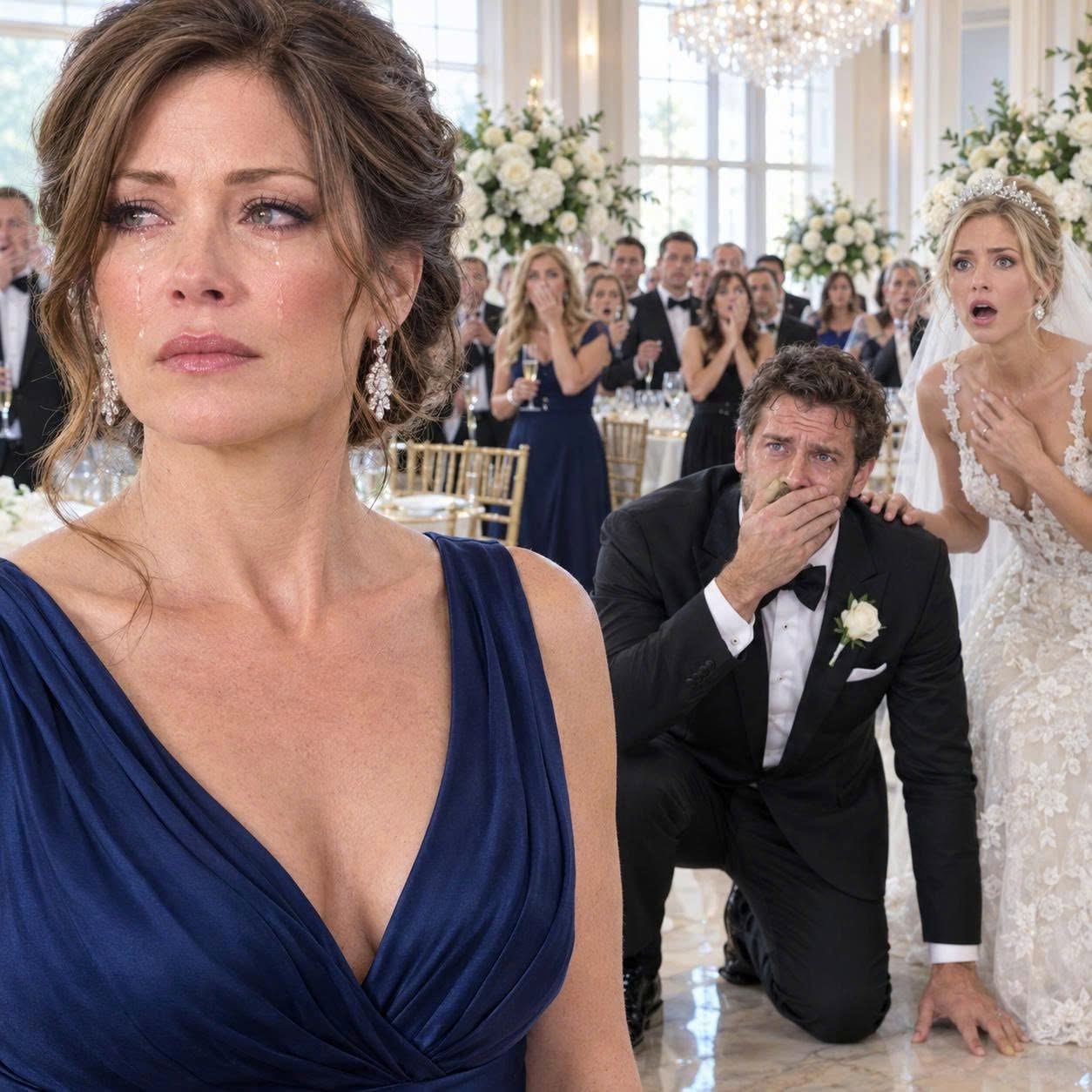
Before he could respond, the music changed and the guests stood. Camille appeared at the far end of the aisle in a flowing ivory gown, one hand resting over her stomach. When she noticed me, her steps faltered.
The ceremony had barely begun when another man appeared near the rear row.
Lucas Dane wore a slightly wrinkled gray suit and carried a folded document. Camille’s face lost its color when she saw him.
“I need five minutes,” Lucas said.
Nathan ordered him to leave, but Camille surprised everyone.
“No. Let him speak.”
Lucas handed the document to Graham. It was a copy of an emergency custody petition Nathan’s lawyers planned to file on Monday, claiming I was unable to care for Elodie and requesting temporary oversight.
“That document is privileged,” Nathan snapped.
“It was in the filing queue,” Lucas replied. “I resigned this morning. I won’t help you do this.”
Camille turned slowly toward Nathan.
“You told me Tessa didn’t want the baby.”
My name sounded strange in her voice.
“You told me she abandoned your marriage and that you were protecting your daughter.”
Nathan tried to take her arm, but she stepped away.
Then Lucas asked her to tell the truth.
Camille closed her eyes.
“I don’t know for certain that this baby is Nathan’s,” she admitted. “There was another possibility before Nathan and I began seeing each other.”
The guests became completely still.
Nathan had known there was uncertainty, yet he had allowed his mother to celebrate an heir and had discarded Elodie as though she carried no value. Camille removed her ring and placed it in his hand.
“This wedding cannot happen today.”
Judith protested, but Camille walked away from the arbor with Lucas following several steps behind, giving her space.
Nathan’s perfect celebration dissolved into murmurs. Then, cornered and desperate, he looked at my mother and smiled.
“Perhaps Tessa should ask why the birth of a daughter triggered a sealed alert in her father’s estate.”
My mother’s expression told me the question mattered.
“What is he talking about?” I asked.
She lowered her eyes.
“There is something in your father’s will we should have told you before Elodie was born.”
The Legacy My Father Hid

Back in my mother’s Concord home, I learned that my father had created a protective review for the first child born to me. If that child was a daughter, the review began immediately after her birth was registered; if the child was a son, it would not begin until he turned twenty-one.
At first, the distinction infuriated me.
Then my mother explained that my grandmother had grown up watching male relatives take control of property that should have supported her mother and sisters. Years later, she asked my father to ensure that future daughters in our family would never be left financially exposed.
The clause did not give Elodie more because she was worth more. It protected her earlier because history had taught my family who was most likely to be pushed aside.
Nathan had apparently discovered enough about the clause to realize that Elodie’s birth strengthened my protected position. His disappointment in the hospital had not been only about wanting a son. He had looked at our newborn daughter and seen a locked financial door.
With Lucas’s evidence, Sylvia blocked the planned custody petition. Nathan’s attorneys withdrew it before Monday.
A week later, my mother brought me an old wooden box containing a letter my father had written before he passed away. In it, he explained that wealth was not the heart of his plan; choice was. He wanted no spouse, relative, or business partner to turn a child into leverage.
His final instruction was simple: remain tender where tenderness belonged and become firm only where protection required it.
For the first time in months, I felt that Elodie and I were standing on solid ground.
Then Lucas asked to meet us at a crowded café.
He brought an email header showing that someone had sent Nathan an archived memorandum about the trust. The attachment carried my mother’s initials, although that did not prove she had sent it. A second document contained an older handwritten note.
Near the bottom, one sentence stood out:
The protected line may not descend from Tessa alone.
Graham’s face turned pale. My mother had not come to the meeting, and suddenly I understood that the secrets surrounding my father’s estate reached further back than my marriage.
I looked at Lucas.
“What does that sentence mean?”
He hesitated, glancing at Elodie asleep against my chest.
Then he placed one final page on the table.
“Tessa, there may have been another baby named in your father’s will.”