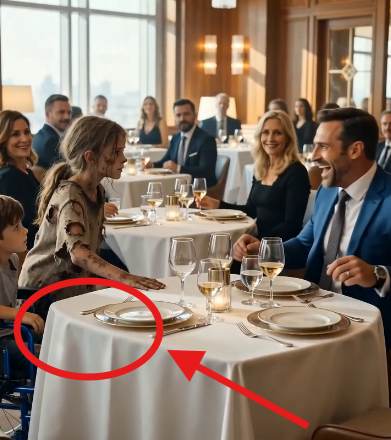
For one long second, no one in the restaurant moved.
Not the father.
Not the diners.
Not even the waiters hovering with trays halfway through the aisle.
Because the girl’s last words didn’t sound like fantasy.
They sounded like history.
He knows me.
The father stopped inches away from them, his hand still half-raised.
The boy, still gripping the girl’s fingers, was breathing differently now — faster, deeper, almost panicked, like something inside him was waking up before his mind could understand it.
The father’s voice dropped.
“What does that mean?”
The girl looked at him for the first time.
Not scared.
Not impressed.
Only tired.
“My mother used to bring me to your house.”
The father went still.
Because years earlier, before the wheelchairs and private specialists and carefully managed public grief, there had been a woman who worked quietly in the background of his estate. She came to cook sometimes, to help in the laundry, to fill in when staff didn’t show. She often brought along a tiny girl because she had no one to leave her with.
His son used to laugh when that little girl was there.
Really laugh.
Before the accident.
Before the long silence.
Before the specialists started speaking in measured voices about “permanent damage” and “limited response.”
The ragged girl looked back at the boy.
“You used to hold my hand when you were scared.”
That landed harder than anything else.
Because the boy’s grip tightened.
Instinctively.
Like his body remembered before his memory did.
The father’s face changed.
Not just anger now.
Fear.
Because suddenly this wasn’t a random child from the street making promises for food.
This was someone from before.
From the part of his son’s life that ended the night of the accident.
The girl moved closer.
Still kneeling.
Still holding his hand.
“Your father stopped letting me come after you got hurt.”
There it was.
The cruelty hidden beneath the elegance.
The father had called it protection at the time. He told himself his son needed calm, order, quiet rooms, expensive treatment — not reminders of simpler days, not poor children from the staff entrance, not attachments that didn’t fit the life he wanted to preserve.
But children don’t care about status when they choose each other.
And maybe healing had been waiting in a place money refused to look.
The boy leaned farther forward out of the wheelchair now, his other hand gripping the edge of the table.
The restaurant watched in total silence.
The father whispered, almost to himself:
“No…”
Not because he didn’t want it.
Because he did.
Too much.
The girl placed her other hand gently over the boy’s wrist.
“You told me once you’d dance when you got big.”
A pause.
“You remember.”
And maybe he did.
Not fully.
Not clearly.
But enough.
Because the boy’s lips parted.
And for the first time in months, maybe years, a sound escaped him that was not just pain or effort.
A broken little breath of recognition.
The father’s control cracked right there beside the white tablecloth and the polished plates.
Because now he understood the most unbearable possibility:
all the doctors, all the money, all the guarded routines had tried to heal his son’s body—
while the one thing his son’s spirit needed had been a hand he once trusted.
The ragged girl did not come for a miracle.
She came because she was hungry, yes—
but also because she knew him.
And he knew her.
And sometimes what looks impossible is simply what love remembers after everyone else gives up.