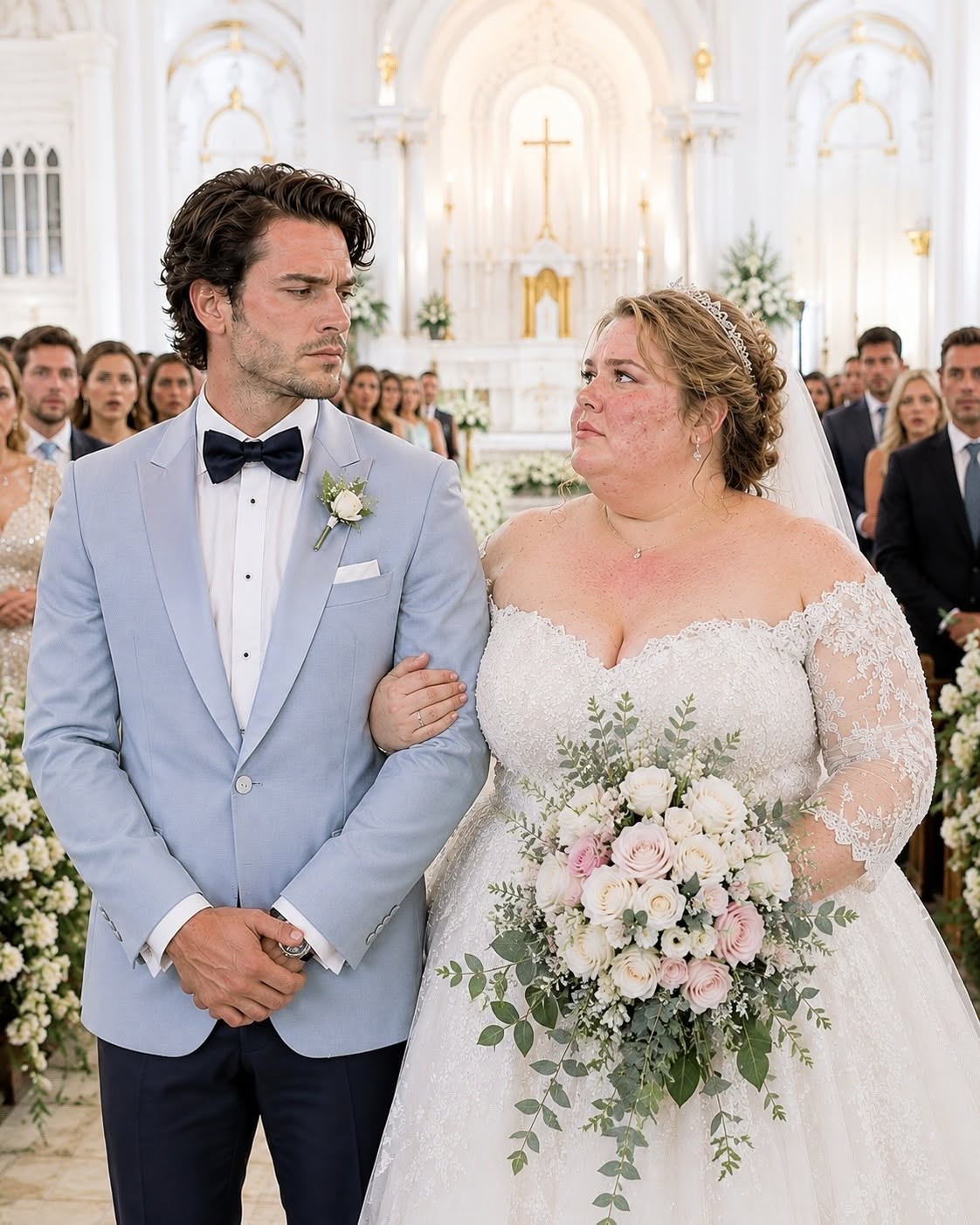
“Victor paid that man to marry his daughter because no one else would ever be willing to wake up beside a face like hers,” a woman in the front pew whispered.
The words traveled through the Cathedral Basilica of St. Joseph in San Jose like a flame catching dry paper. Evelyn Whitmore heard every syllable from the entrance, surrounded by white flowers, flashing cameras, and two hundred guests who had not come to celebrate her marriage. They had come to see whether the rumors were true.
At twenty-nine, Evelyn was tall, broad across the shoulders, and carried herself with a restrained confidence that people often mistook for coldness. A deep burgundy birthmark covered much of her left cheek and continued down the side of her neck. Near her temple, her dark hair grew noticeably thinner. Since childhood, she had endured cruel names that her own father never tried to stop.
Monster.
Disgrace.
The daughter no man would ever choose.
That was why Evelyn walked down the aisle without a veil.
She refused to hide her face for people who had already decided what it meant.
Waiting for her at the altar was Adrian Bennett, the heir to a family company ruined by a financial scandal. His father had died while being publicly accused of embezzlement. The Bennett Group’s accounts had been frozen, its contracts canceled, and its reputation destroyed. Adrian’s younger sister had been forced to leave college when there was no longer enough money to pay her tuition.
Victor Whitmore had offered to solve everything.
He would cover the Bennett family’s debts, finance a new investigation into Adrian’s father’s case, and use his influence to clear the Bennett name.
In exchange, Adrian had to marry Evelyn.
Three weeks earlier, during the only private meeting they had before the wedding, Evelyn had spoken without hesitation.
“My father says you’re desperate.”
“And I was told you don’t tolerate lies.”
“They probably told you I’m ugly too.”
Adrian held her gaze.
“They told me many things. I’d rather learn who you are before repeating any of them.”
It was not love.
But no one had spoken to Evelyn without false pity or cruelty hidden beneath humor. Adrian had not stared at the birthmark. He had not looked away from it either. He had simply looked at her.
That was why she agreed.
She needed a way out as badly as he did.
Her mother, Margaret, had died twelve years earlier after falling from the balcony of the Whitmore family estate near Lake Tahoe. The official report had classified her death as a tragic accident.
Evelyn had never believed it.
From that day forward, Victor placed her under the supervision of private doctors, kept her heavily medicated, and filled her medical records with diagnoses of emotional instability, paranoia, and uncontrollable behavior.
Whenever Evelyn questioned him, he pointed to those records.
Whenever she tried to leave, he called a doctor.
Whenever she protested, he said her reaction proved she was ill.
The night before the wedding, Evelyn found a small brass key hidden inside Margaret’s old sewing basket.
The moment she saw it, she knew it belonged to a locked file cabinet Victor had guarded for years.
She stitched the key into the inner corset of her wedding gown.
Only hours later, two men employed by Victor forced their way into her room. They grabbed her by the arms, emptied her drawers, searched beneath the mattress, and demanded to know what she had removed from her father’s office.
Evelyn admitted nothing.
They searched the room.
They searched her luggage.
They searched her pockets.
They never searched the dress.
During the wedding ceremony, as Evelyn and Adrian signed the marriage certificate, Victor rested one hand on his daughter’s shoulder for the photographers.
Evelyn recoiled so sharply that the pen slipped from her fingers and struck the floor.
Adrian noticed.
Victor smiled for the cameras as if nothing had happened.
That evening, at Redwood Crest Estate in Napa Valley, one of the housekeepers discovered blood staining the back of Evelyn’s wedding gown.
Evelyn locked herself inside the bedroom and refused to see the physician Victor had sent.
Adrian stood outside the door and knocked once.
“I won’t come inside unless you tell me I can,” he said. “But I need to know whether you’re hurt.”
For a long time, there was no response.
Then the lock clicked.
Evelyn stood beside the bed with the back of her gown loosened. The key sewn into the corset had pierced the fabric and cut into her skin.
But the fresh wound was not what stole Adrian’s breath.
There were old scars around Evelyn’s wrists.
More scars circled her ankles.
Pale lines crossed her back, some thin, some thick, as if she had been restrained for days at a time.
“Who did this to you?” Adrian asked.
He lowered himself to one knee so he would not be towering over her.
Evelyn pressed her lips together.
“My father,” she said at last. “And the doctors he paid to say it was all for my protection.”
In that moment, Adrian understood that he had not married the woman society called a monster.
He had married the only surviving witness to a family that was still trying to erase her.
And somewhere across the state, Victor Whitmore had just realized that Margaret’s key was no longer hidden where he had left it.
Adrian cleaned the cut without calling anyone.
He asked Evelyn’s permission before every touch.
He kept the bedroom door open.
And he promised that no physician selected by Victor would ever enter the estate again.
Evelyn did not completely believe him.
But it was the first promise anyone had made to her that did not sound like a warning.
During the weeks that followed, the marriage that had begun as a financial arrangement slowly began to change.
Evelyn examined Redwood Crest’s financial records and discovered years of fraudulent charges that had reduced employee wages and benefits. Adrian dismissed the estate manager and repaid every worker from his own remaining funds.
When a designer from Beverly Hills suggested dressing Evelyn only in dark, shapeless clothing to “minimize her size” and “draw attention away from her face,” Adrian ordered the woman to leave immediately.
Later, he found Evelyn in the library.
“I should have asked what you wanted before dismissing her,” he said. “I was angry, but it was still your decision.”
Evelyn studied him.
“No one has ever apologized to me for defending me badly.”
“Then you’ve been surrounded by people who apologize badly.”
She almost smiled.
Adrian gave her a list of other designers and told her she could choose one—or choose none at all.
It was still not love.
It was respect.
To Evelyn, respect already felt miraculous.
But Victor’s influence remained inside the house.
Dr. Whitman arrived one afternoon without an appointment and insisted he had legal authority to evaluate Evelyn’s mental condition.
Adrian met him at the entrance.
“You have no authority here.”
“Mrs. Bennett has a documented psychiatric history.”
“Documents written by you.”
“I have treated Evelyn since she was seventeen.”
“And you will never treat her again.”
Dr. Whitman attempted to step inside.
Adrian blocked the doorway.
The confrontation happened in front of the staff, the housekeeper, and two security guards.
For the first time, someone rejected the doctor’s authority publicly.
Two days later, Claire, Evelyn’s personal assistant, accidentally drank a cup of hot chocolate that had been prepared for Evelyn.
Within minutes, Claire collapsed unconscious.
An independent physician confirmed that the drink contained a dangerously high concentration of sedatives.
“It was meant for me,” Evelyn said as she stood beside Claire’s hospital bed. “My father never planned to let me live after the wedding.”
That same night, Evelyn led Adrian to a private archive at Redwood Crest.
Margaret’s documents had been transferred there according to instructions in a will Victor had been unable to overturn.
Evelyn inserted the small brass key into an old cabinet.
The lock opened.
Inside were letters, bank records, legal documents, and a notebook filled entirely with coded entries.
Evelyn recognized the system immediately.
Her mother had disguised financial transactions as household expenses.
“Candles” meant bribes.
“Laundry” meant withdrawals from the trust.
“Repairs” represented payments made to public officials.
For days, Evelyn and Adrian sat together at the library table decoding every page.
The truth emerged piece by piece.
Victor had been draining the inheritance Margaret left to Evelyn for years. It included ownership shares in a prestigious winery, several vineyards, commercial properties, and an investment fund that would legally transfer to Evelyn once she married or reached the age of thirty.
But the worst discovery waited inside a blue folder.
It contained records of payments made to an accountant, a journalist, and a government official who had all been connected to the investigation that destroyed Adrian’s father.
“My father was framed,” Adrian whispered. “Victor destroyed him because he discovered the missing money.”
Evelyn felt the room tilt around her.
“I was seventeen. I was locked inside clinics. I didn’t know any of this.”
Adrian did not answer immediately.
His silence lasted only a second.
But to Evelyn, it felt like a judgment.
“You think I knew,” she said.
“No.”
“You hesitated.”
“I did.”
The admission hurt, but the honesty kept her from walking away.
Adrian drew in a breath.
“You are not responsible for what your father did. I’m sorry. My anger answered before I did.”
At the bottom of the folder, they discovered a draft of a prenuptial agreement neither of them had ever seen.
The document contained a forged provision declaring that if Evelyn died while Adrian was under criminal investigation, her entire fortune would return to Victor.
Beside it were photographs of a dangerous curve on the coastal highway near Big Sur.
A handwritten note from the family attorney, Graham Pierce, was clipped to the pictures.
“Accident after the assets transfer. The husband will be the obvious suspect.”
Evelyn understood the entire plan.
Victor had deliberately selected a desperate man with debts, a ruined family name, and a father remembered as a criminal.
Evelyn was supposed to die.
Adrian was supposed to be arrested for murdering her.
Victor would regain control of every dollar he had stolen.
Before either of them could speak, the fire alarm began screaming.
Smoke poured beneath the archive door.
Adrian grabbed the blue folder.
Evelyn turned back for Margaret’s notebook.
A burning section of ceiling crashed between them.
The walls shook.
Glass shattered from the heat.
“Evelyn, get out!” Adrian shouted.
Through the smoke, Evelyn saw a shadow outside the corridor pulling the only clear exit shut.
A second later, a support beam collapsed directly onto Adrian.
“Adrian!”
Evelyn ran through the smoke.
The beam had crushed his shoulder and pinned him against the floor. He tried to push himself free, but the pain forced him down again.
For most of her life, people had called Evelyn awkward.
Too large.
Too heavy.
Unfeminine.
Useless.
That night, the strength they had mocked became the only thing keeping Adrian alive.
Evelyn planted both hands beneath the burning timber.
Heat scorched her palms.
She screamed until her throat felt torn open and lifted the beam just high enough for Adrian to drag his arm free.
Then she wrapped one arm around his waist and pulled him toward a service passage she remembered from childhood visits to the estate.
The emergency exit was blocked by a wooden door swollen from years of moisture.
Evelyn drove her shoulder into it.
Once.
Twice.
A third time.
The frame cracked.
On the fourth impact, the door burst open.
They fell onto the rain-soaked ground as flames swallowed the archive behind them.
Margaret’s notebook remained hidden beneath Evelyn’s coat.
They found shelter inside a small abandoned chapel at the far edge of the estate.
Adrian’s shoulder was dislocated. His face and clothing were covered in soot.
Evelyn was trembling.
Not because of the fire.
Because she had nearly lost the first person who had ever made her feel safe.
“I married you to save my family,” Adrian said, struggling through each breath. “I thought I could treat you fairly, remain distant, and fulfill the agreement. But I don’t want a company, an estate, or a restored name if the price is giving you back to your father.”
Evelyn watched him carefully.
“Victor will offer you everything again.”
“Then I’ll refuse him again.”
“Why?”
Adrian leaned against the stone wall.
“Because now, whenever you enter a room, yours is the face I look for first. Because I admire your mind, your courage, and even the way you argue when you know you’re right.”
“I usually am.”
“You usually are.”
Despite everything, she smiled.
Adrian continued.
“Because tonight you saved my life after everyone spent years insisting you were the one who needed to be rescued.”
He did not tell Evelyn she was beautiful merely to contradict the people who had insulted her.
He told her he loved the intelligence, humor, strength, and tenderness that the world had never taken the time to discover.
Evelyn kissed him first.
The next morning, investigators declared the fire an act of arson.
Traces of accelerant were found in the hallway.
Phone records revealed a call between Graham Pierce and a security guard who had disappeared shortly before the flames began.
Victor denied everything.
Then he did precisely what Adrian had predicted.
He offered to pay every debt still owed by the Bennett Group.
He promised to publicly clear Thomas Bennett’s name.
He offered to guarantee Natalie’s education and future.
Adrian needed to do only one thing.
Sign a statement claiming that Evelyn suffered from paranoid delusions, had started the archive fire herself, and required permanent commitment to a psychiatric institution.
Adrian rejected the offer in front of a notary and two independent attorneys.
Evelyn listened from the hallway.
For the first time in her life, someone had walked away from enormous wealth without expecting her to repay the sacrifice through obedience.
But Margaret’s documents still could not prove every part of the crime.
They still needed to identify who had changed Margaret’s medication on the night she died.
They needed proof of who authorized Evelyn’s forced confinements.
The answer came from Rebecca Hale, Margaret’s cousin, who had been missing for four years.
Rebecca had been living under another name in Seattle after Victor threatened to accuse her son of financial fraud.
She still possessed Margaret’s original letter.
In it, Margaret explained that she had discovered illegal withdrawals from Evelyn’s trust. She wrote that Thomas Bennett had tried to help her expose the fraud.
She also admitted she feared Victor and believed Dr. Whitman had been replacing her medication.
The final line read:
“If anything happens to me, it was not an accident.”
The hearing to remove Victor as administrator of Evelyn’s trust was held in San Francisco.
Judges, bank representatives, journalists, attorneys, and members of both families filled the room.
Victor expected a quiet proceeding handled behind closed doors.
Evelyn turned it into the moment she stopped asking anyone for permission to exist.
She entered wearing an emerald-green dress.
Her neck was uncovered.
Her hair was swept away from her face, revealing the thin patch near her temple rather than concealing it.
The courtroom fell silent.
Victor looked at her with contempt.
“Look at her,” he said. “She enjoys this attention. My daughter has always needed people to stare at her.”
Evelyn placed Margaret’s coded notebook on the table.
“No. You spent years making sure no one looked closely enough to see what you were doing to me.”
Victor produced Evelyn’s old medical records.
He claimed she had suffered paranoid episodes since adolescence. He said he had authorized hospitalization only to protect her from herself.
Then Adrian presented the invoices.
Dr. Whitman had received additional payments each time he signed an order to isolate Evelyn.
The psychiatric reports repeated identical descriptions, sometimes word for word, even on dates when the doctor had never examined her.
Claire testified about the drugged hot chocolate.
The independent physician presented the laboratory analysis.
The missing guard from Redwood Crest confessed that Graham had paid him to lock the archive door after the fire began.