PART 2
Mark stood in the maternity hallway with his hand still wrapped around the strap of the overnight bag he had brought too late.
For several seconds, the nurse’s words made no sense.
“She was discharged four days ago.
Isn’t she home?”
Home.
The word struck him with a force he had not expected.
Home was supposed to be the redbrick house in Bethesda with the half-painted nursery upstairs, three cribs arranged beneath a mural of pale clouds, and tiny white socks folded in a drawer Emily had organized twice because she was nervous and excited and trying to believe everything would be all right.
Home was where he had imagined returning after the delivery, exhausted but smiling, carrying flowers and apologies and the kind of explanations people accepted when they were tired enough to want peace.
But Emily was not home.
The babies were not home.
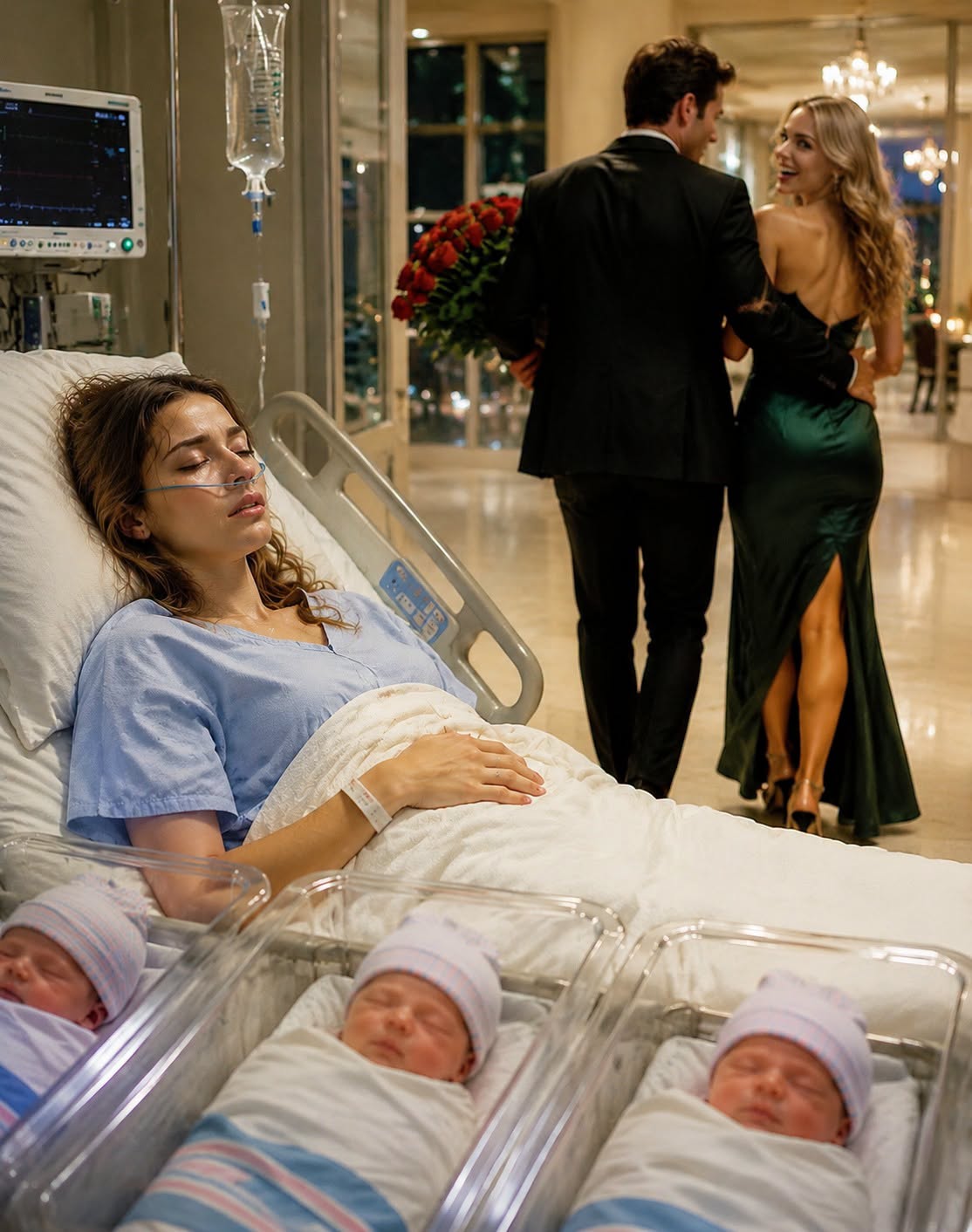
And the hospital room where his wife had nearly died was already empty.
“Where did she go?” Mark asked.
The nurse looked uncomfortable.
“Sir, I’m not authorized to release that information.”
“I’m her husband.”
“I understand.”
“No, you don’t.” His voice cracked.
“She had tripleTS. There was an emergency.
I was told she was here.”
The nurse’s face softened, but her eyes did not change.
“Mrs. Carter requested privacy after discharge.”
The words landed slowly.
Requested privacy.
From him.
Mark looked past her into the empty room again.
The bed had been stripped so clean it looked as if no one had ever suffered there.
A vase of flowers sat on the windowsill, the card unopened.
He recognized the arrangement.
His assistant had ordered it because Mark had remembered the hospital but forgotten the message.
Congratulations on the arrival of your daughters.
He had not written it himself.
“Are they alive?” he whispered.
The nurse hesitated.
That hesitation nearly brought him to his knees.
A door opened down the hall, and Dr. Naomi Patel stepped out wearing a white coat over blue scrubs.
She was not tall, but there was a steadiness in the way she walked that made people move aside without being asked.
“Mr. Carter,” she said.
Mark turned toward her.
“Where are they?”
Dr. Patel did not answer immediately.
She looked at the overnight bag in his hand, then at his face.
“Come with me,” she said.
She led him into a small consultation room with pale walls, a round table, and a box of tissues placed where too many families had reached for them.
Mark had never liked rooms like that.
They were too quiet.
Too honest.
Dr. Patel closed the door.
“Your wife survived a serious emergency,” she said.
“Your daughters were delivered prematurely.
They required immediate neonatal care.”
Mark gripped the back of a chair.
“My daughters?”
“Yes.
Grace, Lily, and Hope.”
Emily had chosen the names.
Alone.
He remembered her sitting on the edge of their bed weeks earlier with a notebook resting against her belly, asking whether he liked Grace or Claire, Lily or Rose, Hope or Hannah.
He had been answering emails and said, “Whatever you think is best.”
Whatever you think is best.
He had said it as if naming their children were one more household decision Emily could handle without him.
His throat closed.
“Are they alive?” he asked again.
Dr. Patel’s expression gentled.
“All three are alive.”
Mark exhaled sharply and pressed a hand over his eyes.
“But Hope remains fragile,” she continued.
“She was the smallest, and she had the most difficult start.”
“Can I see them?”
“That is not my decision right now.”
His hand dropped.
“I’m their father.”
“You are also the person we called repeatedly during the emergency,” Dr. Patel said calmly.
“You did not answer.”
Mark stared at her.
“I was told your phone went straight to voicemail,” she continued.
“Your wife asked for you until she could no longer speak clearly.
She signed the surgical consent herself while bleeding and in distress.”
“I didn’t know it was that serious.”
Dr. Patel’s voice remained professional, but something in it hardened.
“That is why we called.”
He looked down.
The truth was cruel because it was simple.
He had not been trapped in traffic.
He had not been unconscious.
His phone had not been dead.
He had looked at Emily’s name on the screen and turned the phone off.
“Can you tell her I’m here?” he asked.
“I can pass along a message if she permits it.”
“If she permits it,” he repeated.
“Yes.”
Mark sank into the chair.
The bag slipped from his hand and landed softly on the floor.
“What do I do?”
Dr. Patel sat across from him.
“You begin by understanding that Emily’s priority is recovery and the babies’ stability.
Not explanations.
Not argumenTS. Not panic.
If she chooses to speak with you, listen before you ask for anything.”
He nodded slowly, though his mind felt as if it had been emptied.
Dr. Patel stood.
“There is one thing she left for you.”
She opened a folder and removed a sealed envelope.
His name was written across the front in Emily’s small, careful handwriting.
Mark.
He took it with both hands.
Dr. Patel walked to the door, then paused.
“Mr. Carter?”
He looked up.
“Your wife was not angry when she left this hospital.
She was quiet.
There is a difference.”
After she left, Mark sat alone in the consultation room with the envelope unopened on the table.
For several minutes, he could not make himself tear the seal.
He thought of Madison’s smile across the candlelit dining room.
The white chocolate raspberry cake.
The private room.
The way she had touched his sleeve and said, “Just one afternoon, Mark.
One afternoon where you don’t choose guilt over what we had.”
He had told himself Emily was safe.
He had told himself hospitals called too often.
He had told himself he deserved closure.
But the truth was uglier than that.
When Emily needed him most, he had chosen someone who made him feel remembered over the woman who had trusted him with her fear.
At last, he opened the envelope.
There were only four lines inside.
Mark,
The girls are alive.
I am alive.
Do not come to the house tonight.
Do not come looking for us in anger or panic.
If you want to see your daughters, you will first have to face what happened without hiding from it.
Emily.
Mark read the note once.
Then again.
By the third time, the paper had begun to blur.
Across town, in a quiet family residence attached to a neonatal hospital, I sat beside three incubators beneath a row of soft blue lighTS.
The room smelled of sanitizer, warm plastic, and the faint milky scent of premature babies.
Machines breathed and blinked around me.
Tubes no thicker than thread curved gently against tiny cheeks.
Their diapers looked impossibly small.
Their hands opened and closed as if they were trying to hold on to the world.
Grace was the strongest.
She had come first with a thin cry that sounded offended, as though she had objected to the hurry.
Lily came next, red-faced and determined, kicking one foot free from her blanket whenever a nurse tucked her in.
Hope had arrived in silence.
For several minutes, I had not known whether my third daughter had made it.
I remembered asking again and again, “What about Baby C?” while the room spun above me.
Later, Nurse Lauren had leaned close to my ear in recovery and whispered, “She’s here, Emily.
She’s fighting.”
That was how my smallest daughter received her name before I ever saw her.
Hope.
She lay now inside the incubator nearest my chair, no longer than my forearm, her skin flushed and delicate.
Every breath she took seemed to require a decision.
I watched the rise and fall of her chest as if my love alone could keep the rhythm steady.
“You are doing beautifully,” I whispered to her.
“All three of you are.”
A soft knock sounded behind me.
Nurse Lauren stepped in with a paper cup of tea.
She had dark circles under her eyes, though her smile remained warm.
“You need to rest too,” she said.
“I rested for nine minutes.”
“That is not rest.
That is blinking slowly.”
I almost smiled.
She placed the tea beside me.
“Dr. Patel called.
Mark came to the hospital.”
My fingers tightened around the edge of the blanket draped over my lap.
“What did he say?”
“He asked if you were alive.
Then he asked about the babies.”
I looked back at Hope.
For four days, I had imagined that moment.
Sometimes I imagined Mark angry, offended that I had left.
Sometimes I imagined him frightened.
Sometimes I imagined him walking into the NICU and saying the perfect words, words that would undo the empty chair, the unanswered calls, the silence in the operating room.
But real life did not move backward.
It only asked what we would do with what remained.
“Did she give him the letter?” I asked.
“Yes.”
I nodded.
Lauren pulled a chair beside me.
“You don’t have to decide anything today.”
“I know.”
But part of me had already decided.
I was not going back to the woman I had been before 2:17 that afternoon.
That woman had made excuses for absence.
She had explained away coldness as stress, distraction as pressure, and loneliness as the price of loving someone important.
I did not hate Mark.
That surprised me.
Hate would have been easier.
Hate was clean.
It gave the heart somewhere to point.
What I felt was grief.
I grieved the marriage I thought we had.
I grieved the husband I had waited for.
I grieved the version of myself who had believed that if I was patient enough, gentle enough, understanding enough, Mark would eventually turn toward me completely.
Then Grace made a tiny sound, no louder than a kitten’s sigh.
I rose too quickly and winced from the pain in my abdomen.
Lauren steadied me.
“Careful.”
Grace settled before I reached her incubator.
Her little fingers curled, then relaxed.
My heart softened until it hurt.
“I can’t fall apart,” I whispered.
Lauren looked at the babies.
“You already did the hardest thing while terrified.
Healing is not falling apart.”
A tear slipped down my cheek.
“I was so scared,” I said.
“I know.”
“I kept thinking he would come.”
Lauren did not offer excuses for him.
That was one of the reasons I trusted her.
Instead, she said, “And when he didn’t, you still saved them.”
I looked at my daughters.
Grace.
Lily.
Hope.
Three tiny lives.
Three reasons I had signed my name with blood loss roaring in my ears.
Three reasons I had left the hospital quietly instead of waiting in the same room for a man who might return only after the worst had passed.
“I want him to see them,” I said softly.
“But not if he comes here still defending what he did.”
Lauren nodded.
“Then make the first meeting about truth.”
The next morning, Mark did not go to work.
For the first time in years, he ignored his calendar completely.
He drove home from the hospital just after sunrise.
The house looked exactly the same from the outside, which seemed impossible.
The hydrangeas by the porch were blooming.
The newspaper lay on the front walk.
A delivery box sat beside the door containing the baby monitor system he had ordered and never opened.
Inside, the silence felt enormous.
He walked upstairs to the nursery.
Emily had done most of it herself.
Pale cream curtains.
Three cribs.
Three name cards painted in soft gold letters, still propped against the bookshelf because he had promised to hang them and never had.
Grace.
Lily.
Hope.
On the rocking chair sat Emily’s hospital bag, half-packed, because the emergency had happened before she could bring the things she wanted.
A soft gray cardigan was folded on top, the one she wore when she was cold but refused to turn up the heat because she said babies were expensive.
Mark sat in the rocking chair and held the cardigan against his chest.
His phone lay on the floor where he had dropped it after powering it back on.
The missed calls filled the screen.
Emily.
Hospital Labor and Delivery.
Emily.
Nurse Station.
Emily.
Unknown Number.
Emily.
Each one had arrived while he sat across from Madison, listening to stories from a past he had never properly buried.
Then came the texTS.
Mark, they’re taking me to surgery.
Please answer.
Mark, I’m scared.
Please.
After that, nothing from Emily.
Only a message from Madison hours later.
I hope you got home safely.
Today meant more than you know.
Mark stared at the words until they seemed to lose meaning.
Then his phone rang.
Madison.
He almost let it go to voicemail.
But avoidance had already destroyed enough.
He answered.
“Mark,” she said, relieved.
“I’ve been trying to reach you.”
“My daughters were born.”
There was a pause.
“I heard.”
His chest tightened.
“How?”
“People talk.”
“Who told you?”
“Mark, don’t start like this.”
He stood slowly.
“Emily almost died.”
Another pause.
Softer this time.
“I’m sorry.”
“You knew she was in the hospital.”
“She was pregnant with tripleTS. Of course she was in and out of hospitals.”
“No,” he said.
“She was in labor.
There was an emergency.”
“I didn’t know that.”
He closed his eyes.
“My phone kept ringing.”
“You said hospitals exaggerate.”
“I said that because I wanted a reason not to leave.”
Madison sighed, and for a moment he heard the woman he had once loved—wounded, elegant, always able to make disappointment sound like poetry.
“You came because you wanted to,” she said.
The truth of it settled between them.
“Yes,” Mark said.
“And I should not have.”
“Are you blaming me?”
“No.
I am blaming myself.
But I need to ask you something.
Why that day? Why did you insist it had to be yesterday?”
“It was important.”
“Why?”
Madison was silent.
“Madison.”
Her voice changed.
“Because it was the anniversary of the day you proposed to me.”
Mark opened his eyes.
He had forgotten.
Or rather, he had buried it so deeply that when she invited him, he allowed himself to call it harmless.
Closure.
Friendship.
A kindness to someone from his past.
But Madison had remembered the date.
She had ordered the same cake they had served at their engagement party.
White chocolate raspberry.
His stomach turned.
“You told me it was a private celebration for your new gallery opening,” he said.
“It was,” she replied.
“Partly.”
“Partly?”
“I needed to know if you still remembered us.”
“My wife was having our children.”
“And before she was your wife, I was almost yours.”
The sentence did not sound cruel.
It sounded lonely.
That made it more dangerous.
Mark looked at the three name cards on the shelf.
Grace.
Lily.
Hope.
“No,” he said quietly.
“Not almost.
Not anymore.”
Madison inhaled.
“I can’t be the person you call when you want the past to feel alive,” he continued.
“And I can’t be the person who answers.”
“Mark—”
“I abandoned Emily.
I did that.
But I am not going to keep walking in the same direction.”
He ended the call before she could answer.
His hand shook.
It was not victory.
It was the first honest boundary he had drawn in years, and it came too late to protect the person who had deserved it most.
That afternoon, Dr. Patel arranged a meeting in a small family room near the NICU.
I arrived first with Lauren beside me, moving slowly because every step still pulled at the incision beneath my dress.
I had chosen a blue sweater because it made me feel less like a patient and more like a person.
My hair was tied back.
My face looked pale in the window reflection, but my eyes looked clearer than they had in days.
Mark came in carrying no flowers, no gifts, no excuses.
That gave me a little relief.
He stopped just inside the door when he saw me.
For a moment, all the words seemed to leave him.
I had seen Mark confident in crowded rooms, charming at dinner tables, calm during difficult business calls.
He was a man people listened to.
A man who knew how to recover quickly.
But standing before me now, he looked stripped of every practiced version of himself.
“Emily,” he said.
I folded my hands carefully in my lap so he would not see them tremble.
“Sit down, Mark.”
He did.
Lauren remained near the door.
Dr. Patel sat across from us, not as a judge, but as a quiet witness.
Mark looked at me.
His eyes were red.
“I am sorry,” he said.
The words were simple.
I waited.
He swallowed.
“I could say I didn’t understand how serious it was.
I could say I thought I had time.
But the truth is, I turned off my phone because I didn’t want to be pulled away.”
My chest ached.
There it was.
Not the whole wound, but the first clean edge of truth.
“Pulled away from Madison,” I said.
“Yes.”
Dr. Patel glanced down at her notes, giving us privacy inside her presence.
Mark leaned forward, elbows on his knees.
“There is no excuse.
None that matters.
You called me.
The hospital called me.
I ignored it.
You had to face surgery alone because of my choice.”
I stared at him for a long moment.
Part of me wanted to ask every question at once.
Did you love her?
Did you love me?
When you cut that cake, did you think of the babies?
How many times have I been alone in our marriage while sitting right beside you?
Instead, I asked the only question that mattered first.
“Why did you marry me?”
Mark looked stunned.
I watched him struggle.
Finally, he said, “Because I loved the peace I felt with you.”
That answer hurt more than I expected.
“The peace,” I repeated.
“You were kind.
Steady.
You made life feel possible after Madison and I ended.”
“So I was shelter.”
He closed his eyes briefly.
“At first, maybe.
Then I loved you.
I did.
I do.”
“But you never finished leaving her.”
He did not deny it.
The room felt very still.
I looked down at my hands.
My wedding ring had become loose after the delivery; it turned easily around my finger.
“I needed a husband in that operating room,” I said.
“Not a man divided between memory and responsibility.”
Tears rose in Mark’s eyes, but he did not interrupt.
“I needed someone to hold my hand when I thought Hope had died.
I needed someone to hear their first cries.
I needed someone to tell me I wasn’t alone.”
“I know.”
“No,” I said, and my voice trembled for the first time.
“You don’t know.
You can regret it.
You can imagine it.
But you do not know what it felt like to stare at an empty chair while three heartbeats were fading.”
He covered his mouth with his hand.
“I’m sorry,” he whispered.
I looked away, breathing through pain that was both physical and deeper.
“I am not deciding our entire marriage today,” I said.
“I’m too tired, and the girls need too much.
But I am deciding this: I will not return to the house with you right now.
I will stay near the NICU.
You may see the babies if you follow the hospital’s rules and mine.”
He nodded immediately.
“Anything.”
“You will not bring Madison into our lives again.”
“I won’t.”
“You will not ask me to make you feel better about what happened.”
His face tightened, but he nodded.
“I understand.”
“You will show up when you say you will.
If you cannot, you will say so honestly.”
“Yes.”
“And when the girls are old enough to ask about their birth, we will tell them the truth in a way that does not make them carry our pain.”
Mark looked at me then with something like awe and grief combined.
“They deserve that,” he said.
“So do I.”
His voice broke.
“Yes.
You do.”
Dr. Patel stood gently.
“Emily, are you ready?”
I turned toward the NICU doors.
For four days, I had guarded that room like it was the only safe place left on earth.
Letting Mark enter felt like opening a gate while still checking the sky for storms.
But my daughters were his daughters too.
And whatever happened between us, I would not build their lives on silence.
“Yes,” I said.
“He can see them.”
Mark washed his hands for the required amount of time.
Twice.
Lauren helped him put on a disposable gown, and he followed every instruction with almost painful attention.
When he entered the NICU, all the color left his face.
The room had that effect on people.
It humbled them.
It took every grand idea of parenthood and reduced it to breath, warmth, weight, and waiting.
I stood beside Grace’s incubator first.
“This is Grace,” I said.
Mark stared at the tiny baby beneath the blanket.
“She’s so small.”
“She’s the biggest.”
He let out a sound that was almost a laugh and almost a sob.
Grace stretched one hand, fingers opening like a flower no bigger than his thumb.
Mark looked at me.
“Can I touch her?”
I looked to Lauren.
“Two fingers,” Lauren said.
“Gentle pressure.
Don’t stroke.
Preemies can get overstimulated.”
Mark placed two trembling fingers against Grace’s back.
His face changed.
It was not instant redemption.
Life did not work that way.
But something inside him seemed to break open.
Not loudly.
Not dramatically.
Just enough for truth to enter.
“Hi, Grace,” he whispered.
“I’m your dad.”
I turned away, blinking hard.
We moved to Lily next.
She kicked beneath her blanket as if protesting the entire medical establishment.
“She does that a lot,” I said.
Mark smiled through tears.
“She looks angry.”
“She is determined.”
“That sounds like her mother.”
I did not answer, but the words did not wound me.
Then we came to Hope.
Mark stopped.
Hope’s incubator held more wires, more monitors, more careful warnings.
Her chest rose and fell beneath the gentle assistance of oxygen.
A knitted hat covered her head.
One hand rested near her face, fingers curled so tightly it looked as if she were holding a secret.
“This is Hope,” I said.
Mark pressed his lips together.
For a long time, he only watched her breathe.
“I didn’t know,” he said.
I knew what he meant.
He did not mean the emergency.
He did not mean the hospital.
He meant he had not known love could be this fragile and still fill a room.
I stood beside him, and for the first time since the surgery, we looked at the same child with the same fear.
Hope moved slightly.
Her tiny fingers opened.
Mark looked at Lauren.
“May I?”
Lauren nodded.
“Same as before.”
He placed two fingers inside the incubator.
Hope’s hand closed around the tip of one.
Mark bowed his head.
No one spoke.
Some moments did not need words.
They needed witnesses.
Over the next two days, Mark came when he said he would.
He arrived early, washed his hands, sat beside the incubators, and learned the language of machines.
Oxygen saturation.
Feeding tolerance.
Bradycardia.
Kangaroo care.
He wrote the girls’ weights in a small notebook because I had started doing it and he asked if he could help.
He did not ask me to come home.
He did not ask for forgiveness.
Sometimes we sat in silence on opposite sides of Hope’s incubator, watching numbers rise and fall.
Sometimes he brought food and left it beside me without comment because I forgot to eat.
Sometimes I woke from a brief nap in the family room and found him reading softly to Grace and Lily from a children’s book he had bought in the hospital gift shop.
It did not repair the past.
But it changed the present.
On the third evening, Hope breathed for two full hours with less support.
The nurse smiled when she told us.
I covered my face with both hands.
Mark stood frozen, as though moving might break the good news.
“She’s improving?” he asked.
“Slowly,” the nurse said.
“But yes.
This is a good step.”
Mark looked at me.
“Emily.”
I nodded, unable to speak.
For one brief moment, joy rose above everything else.
Not trust.
Not forgiveness.
Not certainty.
Joy.
Our daughter was still fighting, and that was enough for the evening.
Later, as I stood by the vending machines trying to decide whether crackers counted as dinner, Mark approached with two cups of soup from the cafeteria.
“Vegetable,” he said.
“No mushrooms.”
I looked at him.
“You remembered.”
“I remember more than I acted like I did.”
I accepted the cup.
We sat at a small table beneath fluorescent lighTS. Not exactly the place where anyone imagines discussing the ruins of a marriage, but perhaps that made it easier.
There was no romance to hide behind.
No music.
No candlelight.
Just soup, exhaustion, and truth.
“I spoke to Madison,” he said.
My hand stilled.
“I told her I can’t be part of her life anymore.”
I looked down at the steam rising from the cup.
“Did she accept that?”
“I don’t know.”
“That means no.”
A faint, sad smile crossed his face.
“Probably.”
“Why was that day so important to her?”
He hesitated.
I met his eyes.
“Truth, Mark.”
“It was the anniversary of the day I proposed to her.”
The words hurt, but not as sharply as they would have before.
Maybe because I had already imagined worse.
Maybe because the truth, once spoken plainly, had less room to haunt.
“And you knew?”
“Not until after.
Or maybe I did and refused to look at it.”
I absorbed that.
“She chose that day carefully,” I said.
“Yes.”
“But you chose to stay.”
He lowered his eyes.
“Yes.”
That mattered.
Not because it made Madison innocent or guilty, but because Mark was no longer trying to hand his failure to someone else.
“I need time,” I said.
“I know.”
“I don’t know what we will become.”
“I know that too.”
I looked toward the hallway leading back to the NICU.
“Right now, I only know who I have to be for them.”
Mark’s voice softened.
“And for yourself.”
I looked back at him, surprised.
He swallowed.
“I should have said that long ago.”
Before I could answer, his phone buzzed on the table.
Madison’s name flashed across the screen.
Neither of us moved.
It stopped.
Then a message appeared.
You need to hear the truth before Emily turns the girls against you.
My stomach tightened.
Mark’s face hardened with embarrassment and dread.
Another message arrived.
Ask her about the appointment at Harrington Fertility Clinic.
The cafeteria noise seemed to fade.
I stared at the screen.
Mark looked at me slowly.
“Emily?”
The name of that clinic had not been spoken in our marriage for monThS.
Harrington Fertility was where we had gone after my second miscarriage.
It was where doctors had told us that conceiving again would be difficult but not impossible.
It was where Mark had stopped attending appointments because work became busy, because hope became uncomfortable, because grief had made us polite strangers for nearly a year.
It was also where I had gone alone one rainy morning after a nurse called and said there had been a problem with our file.
Mark’s voice was quiet.
“What appointment?”
I stood so quickly the soup spilled across the table.
“Emily,” he said, rising too.
My pulse hammered in my ears.
Before I could answer, Dr. Patel appeared at the end of the hallway.
Her expression was serious, but not frightened.
“Emily.
Mark.
Hope is stable,” she said quickly.
“The babies are fine.”
I gripped the back of the chair.
Dr. Patel looked between us, then lowered her voice.
“But there is something we need to discuss.
The hospital just received a records request connected to the triplets’ birth certificates.”
Mark frowned.
“From who?”
Dr. Patel hesitated.
Then she said the name that made the floor seem to shift beneath me.
“Harrington Fertility Clinic.”
Mark turned toward me, confusion and fear rising in his eyes.
And in that moment, I knew the secret I had tried to untangle quietly before the birth had found us before I was ready.
Because Harrington had not called about insurance.
They had called because three months ago, they discovered that one frozen sample in their storage records had been mislabeled.
END OF PART 2 – LIKE, SHARE AND COMMENT “THE ENTIRE STORY” IF YOU WANT TO READ THE FULL STORY