Kicked Out on Christmas Eve—What My Grandmother Did Left Everyone Speechless
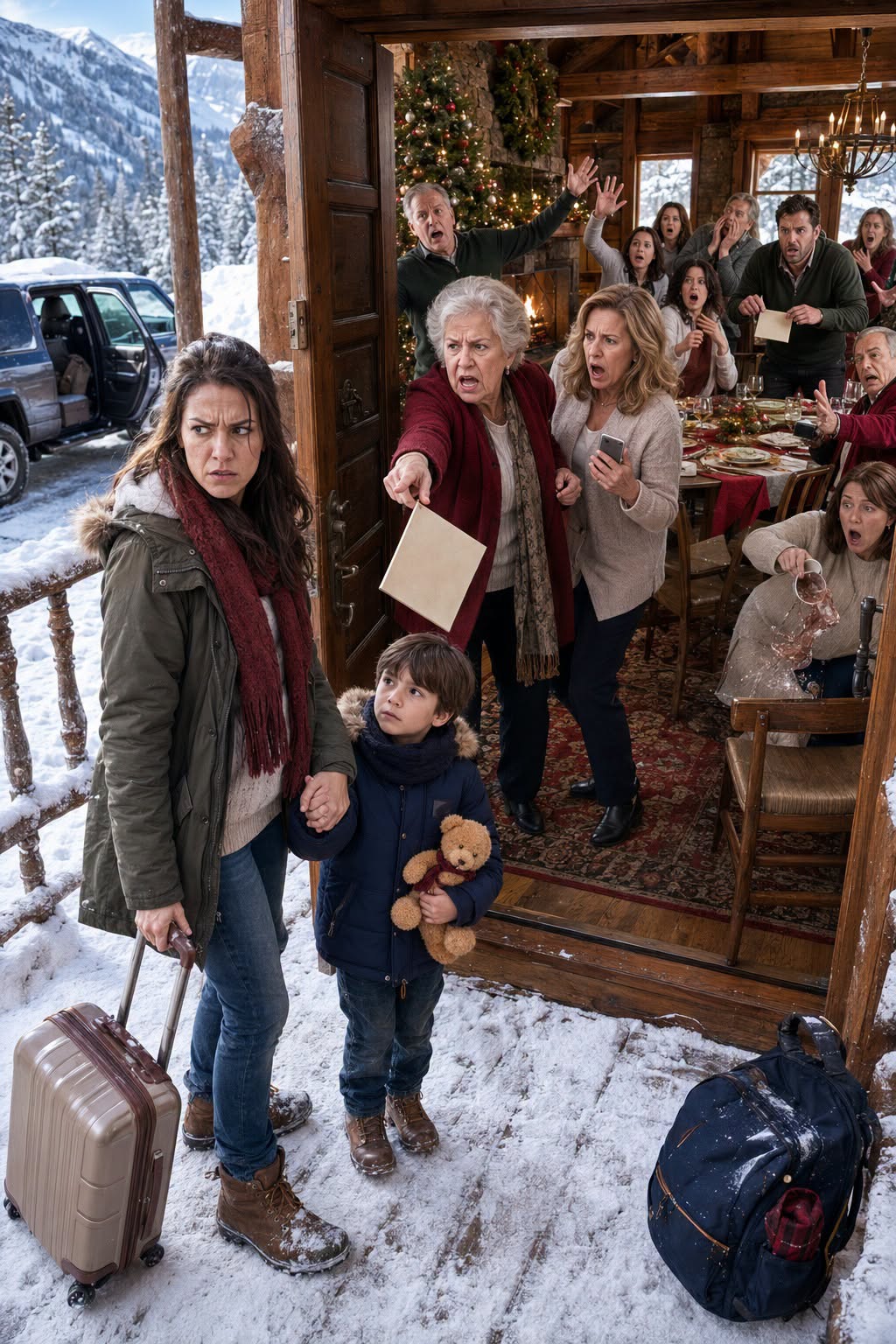
On Christmas Eve At My Grandma’s Lodge, I Arrived With My 6-Year-Old Son. My Mom Peeked Out And Coldly Said, “Go Home! There’s No Room Left.” So We Left. Ten Minutes Later, My Grandma Called, Furious: “Turn Around Right Now!” What Happened After We Returned Left My Parents And Brother Completely Stunned.
### Part 1
The cold on Christmas Eve cut through my red velvet coat before my mother even opened her mouth.
Behind her, Cedar Ridge Lodge glowed with amber firelight. Laughter floated through the doorway, mixed with the smell of roasted turkey, cinnamon, and fresh pine. Somewhere inside, glasses clinked beneath the soft music of a string quartet.
My six-year-old son, Eli, squeezed my hand.
“Mommy, can we go in now?”
We had driven almost two hours through thick snow to reach the lodge outside Pinehaven, Michigan. Eli wore the navy suit my father had once said made him look like “a proper young man.” He had spent the entire drive talking about decorating cookies with his cousins.
My mother, Denise, did not step aside.
Instead, she planted one hand against the heavy oak door and looked at us as though we were delivery workers who had arrived at the wrong address.
“I’m sorry, Natalie,” she said. “We have a strict capacity limit this year. Fire marshal regulations.”
For a moment, I thought she was joking.
I glanced past her shoulder. The entrance hall was crowded with distant relatives, neighbors, my father’s business acquaintances, and several men I recognized as my brother Grant’s old college friends. Most of them were holding drinks and laughing beneath a chandelier large enough to light a theater.
“Mom, it’s freezing,” I whispered. “We’ve been driving for two hours.”
“You weren’t included on the final guest list.”
Her voice was deliberately loud. Several people near the coatroom turned toward us.
Eli shifted closer to my leg.
“But you asked me to help plan the menu,” I said. “I paid for the flowers and sent the champagne.”
“That doesn’t change the capacity.”
“There are people inside who aren’t even family.”
My mother’s mouth tightened.
“Natalie, do not make this embarrassing.”
I almost laughed at the cruelty of that sentence. I was standing outside in the snow with her grandson, yet somehow I was the one embarrassing her.
“Can Eli at least come inside while we figure this out?”
“No.”
The word came so quickly that even she seemed surprised by it.
Eli’s fingers tightened around mine.
My mother looked past us toward the driveway, checking whether anyone else was arriving.
“You need to go home,” she said. “We’re already behind schedule.”
Then she closed the door.
The warmth vanished. The music became muffled. A second later, the lock clicked.
I stared at the dark oak grain inches from my face. Snow collected in my hair and melted against my scalp. Eli made a tiny sound beside me, not quite a sob, and that sound hurt more than anything my mother had said.
I walked him down the icy porch steps without looking back.
Near our sedan, he stopped.
“Did I do something bad?”
I knelt in the slush. Cold water soaked through my tights as I held both sides of his face.
“No, sweetheart. You did nothing wrong.”
“Then why doesn’t Grandma want me?”
My throat closed.
“She has too many guests.”
“But family makes room.”
He said it plainly, the way children say truths adults spend years avoiding.
I pulled him against my chest and felt him trembling through his little coat.
“You’re right,” I whispered. “Family should make room.”
After buckling him into the back seat, I turned the heater as high as it would go. Warm air coughed weakly from the vents while I sat behind the wheel, staring at the glowing windows.
This was not the first time my family had made me feel unwanted.
It was simply the first time they had done it in front of my child.
Through one window, I saw my brother Grant lift a glass while several guests laughed around him. He wore a new charcoal suit and the silver watch my father had bought him after his latest business failure. He looked comfortable, celebrated, completely at home.
I looked down at the dress my mother had told me to buy because “deep red photographs beautifully at Christmas.”
I had spent thirty years trying to earn a place in that house.
I had brought expensive gifts, solved last-minute problems, paid bills no one thanked me for, and smiled while my parents praised Grant for doing half as much.
That night, something inside me finally went quiet.
I shifted the car into reverse.
“We’re going home,” I told Eli. “We’ll make hot chocolate, wear pajamas, and have our own Christmas.”
“Just us?”
“Just us.”
The tires crunched over fresh snow as I backed away from the porch.
I did not know then that my mother had a reason for keeping me outside—one far uglier than simple favoritism.
And ten minutes later, a phone call from my grandmother would force me to turn around and discover it.
### Part 2
The road away from Cedar Ridge Lodge wound between tall pine trees, their branches heavy with snow. My headlights carved a narrow tunnel through the darkness while the heater hummed and Eli sniffled in the back seat.
I kept both hands locked around the steering wheel.
My mother’s voice repeated in my mind.
“You weren’t included on the final guest list.”
Grant had never needed a list.
Growing up, my brother existed at the center of our family, and the rest of us adjusted ourselves around him.
When Grant brought home a poor report card, my parents blamed the school and hired a tutor. When I earned straight A’s, my father said, “That’s what we expect from you.”
On Christmas mornings, Grant received bicycles, expensive electronics, and instruments he lost interest in within weeks. I received socks, winter boots, and coats purchased one size too large so they would last.
“You’re practical,” my mother always said. “You don’t need attention the way Grant does.”
For years, I believed being low-maintenance was a virtue.
Eventually, I understood that it merely made me easier to neglect.
At fifteen, I began working in a diner that smelled permanently of grease and burnt coffee. I saved my tips inside an old cookie tin beneath my bed. Grant spent summers traveling with friends while I worked double shifts and returned home with sore feet.
When I bought my first used car, my father inspected the rust around the wheel wells and told me I needed to learn financial responsibility.
Grant had already wrecked two cars by then. Dad replaced both.
Still, I kept trying.
I paid my own college expenses through loans, scholarships, and late-night catering jobs. After graduation, I started an event-planning company from my kitchen table. My first office consisted of a secondhand laptop, a folding chair, and a printer that jammed whenever I was in a hurry.
Within seven years, Everly Events had become one of the busiest planning companies in the county.
I arranged weddings, fundraisers, holiday galas, and business conferences. I knew when a caterer was cutting portions, when a florist had substituted cheaper flowers, and when a seating chart had been changed without permission.
Details were my livelihood.
My parents never praised what I built.
“You’ve always been organized,” Mom said after I landed the county arts gala.
That same week, Grant announced he was launching a luxury travel company despite never having worked in tourism. My parents gave him twenty thousand dollars.
The company disappeared within four months.
They called it an unfortunate market shift.
When Eli’s father walked away before Eli turned two, I built an even stronger wall around my life. I bought a small house, created college savings for my son, and stopped asking anyone for help.
But I never stopped hoping my parents would eventually look at me and say, “We see what you’ve done.”
That hope was the reason I had helped with Christmas Eve.
Mom had called almost daily for three weeks, asking about menus, table arrangements, and entertainment. I had negotiated reduced rates with vendors and paid for the champagne myself.
I thought working beside her meant I had finally become part of the family rather than its unpaid problem solver.
Instead, she had used my skills and locked me outside.
“Mommy?”
I looked into the rearview mirror. Eli’s face was barely visible above his scarf.
“Did Great-Grandma Evelyn know we were coming?”
My grandmother had built Cedar Ridge Lodge with my grandfather more than four decades earlier. After he died, she moved into a guest cottage and let my parents manage the main property.
She was eighty-two now, sharp-minded but physically slower. She had attended every school play and birthday my parents missed. When I graduated from college, she was the only family member sitting in the audience.
“She knew,” I said. “She was excited to see you.”
“Then why didn’t she come to the door?”
I had no answer.
We were approaching the highway when my phone vibrated in the cup holder.
Grandma Evelyn.
I almost let it ring.
I did not want to lie to her, but telling the truth felt equally impossible. I pulled onto the shoulder and answered.
“Merry Christmas, Grandma.”
“Natalie, where are you?”
Her voice sounded alert and irritated.
“I’ve been asking about you for nearly an hour. Where is Eli?”
I stared through the windshield at the falling snow.
“We were there.”
Silence.
“What do you mean, you were there?”
“Mom wouldn’t let us inside.”
The words came out small and broken.
“She said there was a capacity limit. She told us we weren’t on the list, and then she closed the door.”
I heard my grandmother’s cane strike something hard.
“She left you outside?”
“Yes.”
“With Eli?”
“Yes.”
Her breathing changed.
“Where are you now?”
“Near the highway. We’re going home.”
“No, you are not.”
“Grandma, I can’t go back.”
“You will turn that car around immediately.”
“She doesn’t want us there.”
“This is not Denise’s lodge,” Grandma said. “It is mine.”
Her voice carried a strength I had not heard in years.
“You will pull directly in front of the main entrance. Do not park with the guests. Bring Eli to the porch, and keep your phone on.”
“What are you going to do?”
“What I should have done a long time ago.”
The line went dead.
I sat motionless, listening to the tick of the turn signal.
Then I looked at Eli.
“Are we going back?” he asked.
“Yes.”
“But Grandma Denise said no.”
I turned the car around.
“Great-Grandma Evelyn said yes.”
As Cedar Ridge Lodge came back into view, I saw a figure standing alone on the porch in a dark green evening gown, gripping a cane against the wind.
My grandmother was waiting for us without a coat.
And from the way she stood, I knew she was not planning to ask anyone’s permission.
### Part 3
I parked directly in front of the entrance.
Grandma Evelyn came down one step as I helped Eli from the car. Snow clung to her silver hair, but she seemed not to notice the cold.
She wrapped both arms around him.
“My sweet boy,” she whispered. “You should never have been sent away.”
Eli buried his face against her dress.
Grandma looked at me next. Her eyes moved over my wet hair, my reddened hands, and the slush staining the hem of my coat.
“You’re shaking.”
“I’m fine.”
“No, you are not. But you will be.”
She turned toward the door.
The brass handle resisted for a moment. Grandma struck it once with her cane, then shoved the door open so hard it hit the stopper behind it.
Warm air rushed across us.
Near the fireplace, my mother stood holding a champagne glass while Grant entertained a group of guests. My father, Robert, was beside the bar cart, laughing with a local contractor.
At first, no one noticed us.
Then a woman near the entrance stopped talking. Her silence spread through the room until heads began turning one after another.
My mother saw me.
The smile fell from her face.
“Evelyn,” she said. “I thought you were resting.”
“I was.”
Grandma took Eli’s hand and led us into the center of the room.
“Then I received a phone call.”
Dad stepped forward.
“Mom, perhaps we should discuss this privately.”
“We have discussed too many things privately.”
My mother hurried toward us.
“Natalie, I told you the building is at capacity. You cannot simply return and create a scene.”
Grandma pointed toward the velvet sofa facing the fireplace.
“Natalie, sit down. Eli, sit with your mother.”
I obeyed because my knees were barely steady enough to hold me.
Grandma remained standing.
She was shorter than nearly everyone around her, but the room seemed to organize itself around her presence.
“My daughter-in-law has informed me that Cedar Ridge Lodge is operating under a strict capacity limit tonight,” she announced. “Is that correct?”
No one answered.
There was enough open floor space around the piano for another twenty people.
My mother forced a laugh.
“Evelyn, there are insurance requirements. You don’t handle the event planning anymore, so you may not understand.”
“I understand lies perfectly well.”
The air changed.
Grant set down his drink.
“Why are we turning this into a public trial?” he asked. “Natalie is always sensitive about everything.”
I looked at him.
“Your nephew was standing outside in the snow.”
Grant shrugged.
“He was in a coat.”
Grandma’s cane struck the floor.
The crack echoed through the lodge.
“Be silent.”
I had never heard her speak to him that way.
She reached into a pocket hidden in her gown and removed her phone.
“A month ago, I had security cameras installed around the property,” she said. “Several items have gone missing, and I became tired of being told I had misplaced them.”
My father’s expression tightened.
My mother’s hand froze around her glass.
Grandma crossed to the microphone stand left by the musicians. She held her phone beside it and tapped the screen.
A burst of feedback made everyone wince.
Then my mother’s recorded voice filled the room.
“Strict capacity limit this year. Fire marshal regulations.”
My own voice followed.
“Mom, it’s freezing. We’ve been driving for two hours.”
“You weren’t included on the final guest list. Go home.”
The door slammed through the speakers.
Then came Eli’s trembling question.
“Did I do something bad?”
Grandma stopped the recording.
No one moved.
A cousin near the staircase covered her mouth. One of my father’s business associates stared down at his shoes. My mother’s closest neighbor looked at her with open disgust.
Mom’s face turned bright red.
She began crying almost immediately.
“I was overwhelmed,” she said. “Hosting is stressful. I made a mistake.”
“You looked directly at a freezing child,” Grandma replied. “That was not a scheduling error.”
“I didn’t mean for it to sound cruel.”
“The cruelty was not in how it sounded.”
My mother turned toward Dad.
“Tell her. Tell everyone how much pressure I’ve been under.”
Dad cleared his throat.
“We all make poor decisions when we are tired.”
Grandma looked at him.
“You stood ten feet away when it happened.”
My father’s face lost color.
He had known.
That realization hurt almost as much as the closed door.
Grant stepped forward, irritation replacing the casual confidence he had worn moments earlier.
“This is ridiculous. You are destroying Christmas over Natalie. She barely comes around unless she wants everyone to applaud her business.”
I stood.
“I arranged half of this event.”
“And made sure everyone knew it.”
My mother wiped her cheeks.
“Please, Natalie. Do not start competing with your brother tonight.”
I almost answered, but Grandma raised one hand.
“Grant, bring me the silver presentation case.”
The request seemed unrelated, yet all three of them reacted.
My mother stopped crying.
Dad looked toward the hallway.
Grant blinked several times.
“What silver case?”
“The one containing the Hartwell serving set and ceremonial goblets. We use them for the Christmas toast every year.”
“The cabinet key is missing,” Dad said quickly.
Grandma’s eyes remained on Grant.
“The cabinet has not been locked since October.”
Grant shifted his weight.
“The door is stuck.”
“Then I will open it myself.”
“No.”
My mother said the word much too loudly.
Grandma reached into her pocket again.
This time, she removed a pink paper receipt.
My brother’s face turned gray.
“I found this beneath several torn envelopes in the office trash,” Grandma said.
She unfolded it slowly.
“The silver cabinet is not locked, and it is not stuck. It is empty.”
A murmur traveled through the guests.
Grandma held the receipt toward Grant.
“Would you like to explain why our family silver is sitting in a pawn shop thirty miles away?”
### Part 4
Grant stared at the receipt as though it had appeared by magic.
“I was going to get it back.”
His voice sounded younger than thirty-three.
Grandma kept the paper raised.
“When?”
“Next week.”
“With what money?”
“I have an investment closing.”
My father stepped between them.
“This has been blown out of proportion. Grant needed temporary liquidity.”
Grandma’s eyes narrowed.
“You have been teaching him impressive words.”
“It was not theft,” Dad insisted. “He borrowed the silver.”
“You cannot borrow property without the owner’s knowledge.”
Grant lifted both hands.
“I needed four thousand dollars for a business opportunity. The silver was just sitting in a cabinet.”
A shocked whisper moved through the room.
Grandma’s face changed.
Not anger. Something deeper.
“Those goblets were given to my grandmother on her wedding day in 1921,” she said. “She carried them through a bank failure, a house fire, and two wars. My husband and I used them at our wedding. Your father was baptized with water from one of those cups.”
Grant rolled his eyes.
“They are metal objects.”
“They are history.”
“They can be bought back.”
“The shop valued the collection at nearly fifty thousand dollars, and you accepted four thousand.”
“I was in a hurry.”
I watched my parents rather than my brother.
My mother stared at the carpet. Dad’s jaw worked as though he were chewing a response.
They had known.
The truth began assembling itself in my mind piece by piece.
I knew every cabinet in the lodge. I had spent three days creating the service plan for the event. Before dinner, I would have gone to the pantry for the special ladles and carving pieces kept beside the silver display.
I would have seen the empty shelves.
They had not excluded me because the room was full.
They had excluded me because I would notice what was missing.
“You knew I would find out,” I said.
My mother looked up.
“Natalie—”
“That is why you kept me outside.”
She moved toward me.
“You don’t understand how desperate Grant has been.”
“So you protected him by humiliating my son?”
“We were trying to prevent a family crisis.”
“You created one.”
Dad gave me the same irritated look he used whenever I corrected an invoice or questioned one of Grant’s stories.
“You have always been too intrusive.”
The accusation landed strangely.
For years, I had believed my competence made me boring. That my parents overlooked me because Grant was charming, reckless, and more interesting.
Now I saw something else.
They resented me because I noticed things.
I remembered the money that disappeared from my bedroom when I was sixteen. My mother had said I must have spent it. I remembered the tools stolen from Dad’s garage even though there had been no sign of forced entry. I remembered Grandma’s bracelet disappearing during a family reunion.
Every incident had been explained away.
Every time, Grant had needed money shortly afterward.
“You covered for him before,” I said.
My mother shook her head, but she could not meet my eyes.
“How many times?”
“That is irrelevant,” Dad replied.
Grandma turned sharply.
“It is very relevant.”
Grant looked around at the guests.
“Why is everyone staring? Families help each other.”
A man near the doorway quietly placed his drink on a table.
Grant noticed.
His confidence cracked.
“It was a loan,” he repeated. “I did not sell anything permanently.”
Grandma crumpled the receipt in her fist and dropped it at his feet.
“You stole from an elderly woman who trusted you.”
“I’m your grandson.”
“And Natalie is your granddaughter,” I said. “Yet you were comfortable letting her child freeze outside to protect me.”
Mom’s face hardened.
“Natalie always survives. She is strong.”
There it was again.
The excuse they had used my entire life.
I was strong, so I could be neglected.
I was responsible, so I could pay my own way.
I was independent, so I could be excluded.
Grant was fragile, therefore everyone else had to absorb the consequences of his choices.
Grandma looked toward the crowd.
“I apologize to each of you,” she said. “This gathering is over.”
My mother gasped.
“You cannot dismiss everyone.”
“This is my home.”
Guests began collecting coats without argument. The musicians packed their instruments. The caterers moved quietly through the dining room, covering trays and loading containers.
As people passed me, several touched my shoulder or whispered apologies.
My cousin Leah paused beside the sofa.
“I didn’t know,” she said.
“Neither did I.”
Within fifteen minutes, the lodge was empty except for the caterers in the kitchen and the six people whose secrets had ruined the evening.
The silence afterward felt enormous.
My mother stopped crying as soon as the final guest left.
She turned on Grandma with fury.
“Are you satisfied? You humiliated us in front of the entire town.”
“You accomplished that without my assistance.”
“Who will ever invest in Grant now?”
“Hopefully no one.”
Dad poured himself a drink with shaking hands.
“We will recover the silver tomorrow. Then we can forget this happened.”
Grandma sat in the chair across from him.
“No.”
Dad paused.
“No what?”
“No one is forgetting anything.”
The clock above the mantel chimed ten.
Grandma looked at my parents, then at Grant.
“You will pack your belongings and leave Cedar Ridge Lodge before midnight.”
Grant laughed.
It was a short, disbelieving sound.
“You cannot throw us out of our own house.”
Grandma reached into her velvet purse and removed a folded deed.
Then she placed it on the table between them.
“That,” she said, “is your final mistake. You have spent so many years pretending this lodge belongs to you that you have forgotten to check whose name is on it.”
### Part 5
My father did not touch the deed.
He stared at it while the fire cracked behind him.
Grandma unfolded the paper herself and pressed one finger beneath the owner’s name.
“Evelyn Rose Hartwell,” she read. “Sole owner of Cedar Ridge Lodge and the surrounding fifty-two acres.”
Mom’s lips parted.
“You told us we would inherit it.”
“I said we would discuss the future. I never transferred ownership.”
“We have managed this property for twelve years.”
“You have lived here without rent for twelve years.”
Dad’s face darkened.
“I maintained the building.”
“You used lodge accounts to pay household expenses.”
“That money covered operational costs.”
“Did the city condominium also qualify as an operational cost?”
My mother turned toward him.
“You said she didn’t know about that.”
Grandma’s expression remained calm.
“I know about the condominium. I also know twenty-eight thousand dollars disappeared from the maintenance reserve last year.”
Dad set down his glass.
“We intended to repay it.”
Grandma glanced toward Grant.
“That sentence appears to be a family tradition.”
My mother grabbed the edge of the table.
“You cannot expect us to drive two hours in a snowstorm on Christmas Eve.”
Grandma looked at me.
“Oh, is it dangerous outside tonight?”
Mom flinched.
“That was different.”
“How?”
“Natalie had a car. She had somewhere to go.”
“So do you.”
“The condominium is barely furnished.”
“Then perhaps you should have spent maintenance money on furniture instead of pretending it belonged to you.”
Grant crossed his arms.
“I’m not leaving.”
Grandma studied him for a moment.
“I reported the theft before Natalie returned.”
His arms dropped.
“What?”
“The police are coming to collect the pawn receipt, review the security footage, and take my statement.”
My mother hurried toward Grandma.
“You called the police on your own grandson?”
“I called them about a man who removed fifty thousand dollars’ worth of property from my home.”
Grant’s eyes darted toward the windows.
“Grandma, listen. We can resolve this privately.”
“That opportunity ended when a child was locked outside to hide your theft.”
“I can explain everything.”
“Then remain here and explain it to the officers.”
He did not remain.
Grant snatched his keys from the sideboard and rushed toward the door. Mom called his name, but he never looked back.
Seconds later, his truck engine roared outside. The tires spun over the icy driveway before catching, and the red taillights disappeared between the trees.
My mother stood at the window.
“He left us.”
“He always does,” I said. “He stays only while someone is protecting or paying him.”
She turned toward me.
“This is your fault.”
I had heard those words in many forms over the years. Every boundary I set was cruel. Every question I asked was disrespectful. Every consequence Grant faced was somehow caused by me.
This time, the accusation did not reach me.
“I did not steal the silver.”
“You came back.”
“Grandma told me to.”
“You knew returning would create trouble.”
“No, Mom. I thought I was returning to a Christmas party. The trouble was already here.”
Grandma checked the clock.
“You now have one hour and forty-five minutes.”
Dad’s anger gave way to pleading.
“Mother, we can discuss this tomorrow.”
“No.”
“We are family.”
“You remembered that word only after the money stopped.”
He lowered his voice.
“What do you expect us to do?”
“Pack what you need. Leave the keys on the entry table. My attorney will contact you regarding the remaining belongings.”
My parents waited for her to soften.
She did not.
Eventually, they went upstairs. Soon, drawers slammed and luggage wheels scraped across the hallway. Their voices rose behind closed doors as they blamed each other for the missing silver, the condominium, and Grant’s escape.
Grandma sat beside me.
Eli had fallen asleep with his head in my lap. His cheeks were pink from the fire, and one hand still held the broken candy cane Grandma had given him.
“I should have stopped this years ago,” she whispered.
“You didn’t know everything.”
“I knew enough.”
She stared at the dying fire.
“I kept telling myself your parents would become more responsible if I gave them time. I told myself Grant would grow up. And I told myself you were strong enough to survive without my interference.”
I looked at her.
“Everyone uses my strength as permission to hurt me.”
“I know.”
Her voice broke.
“I am sorry.”
That apology was different from my mother’s. Grandma did not defend herself or ask me to comfort her. She simply acknowledged what she had allowed.
At eleven forty-five, my parents came downstairs with expensive luggage and winter coats.
Mom stopped beside the door.
“I hope you are happy, Natalie. You have destroyed this family.”
I looked at Eli sleeping peacefully.
“I did not destroy it.”
“You turned Evelyn against us.”
“No. I stopped protecting you from the truth.”
Dad opened the door. Cold air swept into the room.
He looked at me as though waiting for me to change my mind.
I did not.
Mom stepped onto the porch.
“One day, you will regret choosing pride over your parents.”
“One day, you may understand that dignity and pride are not the same thing.”
She left without answering.
The oak door closed behind them.
This time, the lock clicked with them on the outside.
Grandma exhaled and leaned back against the sofa.
Then she looked toward the dark hallway leading to her study.
“Put Eli in the guest room,” she said. “After that, you and I need to discuss my will.”
### Part 6
Grandma’s study smelled of cedar, old paper, and the faint lavender scent she had worn for as long as I could remember.
The room had always felt mysterious when I was a child. Shelves climbed from floor to ceiling, filled with ledgers, photographs, and leather-bound books. My grandfather’s desk stood beneath a green glass lamp, its surface polished smooth by decades of use.
Grandma sat behind it and opened a thick binder.
“My estate plan,” she said.
I remained standing.
“This can wait until morning.”
“No. Your parents have spent years benefiting from my habit of postponing difficult decisions.”
She pointed toward the chair.
“Sit.”
I did.
The pages inside the binder were covered with handwritten notes and colored tabs.
“For many years, I intended to divide everything equally,” she said. “One portion for your father, one for Grant, and one for you.”
“That sounds fair.”
“It sounds fair. It is not wise.”
She turned several pages.
“If your father inherits the lodge, he will mortgage it to pay Grant’s debts. If Grant receives a direct share, he will sell it or borrow against it. And if you receive only one-third, they will pressure you until you surrender control.”
I could already imagine the calls.
Mom would say I was selfish.
Dad would insist that Grant deserved another chance.
Grant would claim selling the property was the only practical solution.
“They would never let me operate it,” I admitted.
“No.”
Grandma removed a fountain pen.
“I am instructing my attorney to revise everything.”
“Grandma, you should not make a decision while you’re angry.”
“I am not angry.”
She looked toward the doorway through which my parents had left.
“I am finally clear.”
She drew a line through an entire paragraph.
“The lodge, the land, the investment accounts, and the controlling interest in the business will pass to you.”
I stared at her.
“No.”
“Yes.”
“That is worth millions.”
“That is why it cannot be handed to people who treat money like oxygen and responsibility like punishment.”
“They will say I manipulated you.”
“They already blame you for their actions.”
She closed the binder halfway.
“Natalie, I did not choose you because you were mistreated tonight. I chose you because you have spent your entire adult life proving you can build and protect something.”
I looked down at my hands.
They still carried faint red marks from the cold.
“I started Everly Events with less than two thousand dollars,” I said. “This is different.”
“Is it? You understand staffing, vendors, contracts, marketing, guest safety, and financial records. Your mother treated this place as a stage for impressing people. Your father treated it as a private account. You will treat it as both a home and a business.”
The responsibility frightened me more than the money.
“I have a company. Eli has school.”
“Then we will create a plan.”
“We?”
Grandma smiled faintly.
“I am old, not dead.”
She reached across the desk and covered my hand.
“I have one condition.”
“What is it?”
“You and Eli move here.”
My eyes filled before I could stop them.
Grandma continued softly.
“I do not want to spend my remaining years in that cottage while this house becomes colder and emptier. I want to hear a child running down the hallway. I want breakfast at the kitchen table. I want to teach you how this property works while I still can.”
For thirty years, I had stood at the edge of that lodge, hoping someone would invite me closer.
Now Grandma was offering me the keys.
“Are you certain?”
“I have never been more certain.”
I nodded.
“We’ll move in.”
Her smile deepened.
“Good. Tomorrow, my attorney will begin the paperwork. Tonight, we celebrate Christmas.”
It was nearly one in the morning, but neither of us was ready to sleep.
We carried blankets into the living room. Grandma warmed leftover rolls and made cocoa while I placed a few wrapped gifts beneath the tree. Eli woke when he smelled chocolate.
“Did everyone go home?” he asked.
“The people who were unkind left,” Grandma said. “The people who belong are still here.”
We opened gifts beside the fire.
Eli gave Grandma a clay ornament he had made at school. The paint was uneven, and his name was written backward on the bottom. She held it as though it were more valuable than the missing silver.
At three in the morning, headlights swept across the windows.
Two officers arrived to speak with Grandma. I took Eli upstairs while she gave her statement and handed over the pawn receipt.
The following afternoon, Grandma’s attorney came to the lodge.
By then, my phone contained twenty-three missed calls.
Most were from my mother.
Several were from Dad.
Grant sent one message.
“You will pay for this.”
I showed it to the attorney, who told me not to reply.
So I didn’t.
For once, I did not defend myself, explain my intentions, or offer a solution.
I simply blocked the number.
But my family had spent too many years depending on my guilt to surrender quietly.
And before New Year’s Day, they launched one final attempt to force their way back into the lodge.
### Part 7
My parents arrived six days after Christmas with an attorney who looked embarrassed to be standing beside them.
By then, Eli and I had moved into the east wing. Most of our belongings remained in boxes, but his drawings were already taped to the refrigerator, and his winter boots sat crooked beside Grandma’s cane near the entrance.
The lodge felt different.
Not transformed yet, but awake.
I watched my parents’ car stop near the front steps. Mom stepped out wearing dark glasses despite the cloudy afternoon. Dad carried a folder beneath his arm.
Grandma’s attorney, Margaret Shaw, was already seated in the study.
We had expected them.
Mom entered as though she still owned the place.
“I want to speak to Natalie alone.”
“No,” Grandma said.
My mother removed her glasses.
“You have always interfered between me and my daughter.”
Grandma’s eyebrows rose.
“Your daughter was thirty years old before I finally interfered.”
Dad placed the folder on the desk.
“This eviction was unlawful.”
Margaret opened it, read the first page, and slid it back.
“It was not an eviction under a rental agreement. You were licensees occupying a property owned solely by Mrs. Hartwell. Written notice regarding your remaining possessions has been provided.”
“We managed the lodge.”
“You received compensation.”
“We improved it.”
“You used property funds.”
Their attorney cleared his throat.
“Perhaps a negotiated transition would be more productive.”
Mom looked at me.
“We are willing to forgive everything if you convince Evelyn to restore the original inheritance plan.”
I almost admired the confidence required to phrase it that way.
“You are willing to forgive me?”
“You humiliated us publicly.”
“I was sitting on the sofa while Grandma played the recording.”
“You returned after I told you to leave.”
“You locked my child outside.”
“It was one mistake.”
“No. It was the final mistake.”
Dad leaned toward me.
“Grant is facing serious charges. Your mother is under enormous stress. This is the moment when family should unite.”
“Grant stole from Grandma.”
“He made a poor financial decision.”
“He pawned property that did not belong to him.”
“He was desperate.”
I looked at both of them and realized nothing had changed.
They were not sorry for what they had done. They were sorry the consequences had reached them.
Mom lowered her voice.
“Natalie, think carefully. If you accept this inheritance, Grant will lose his future. Your father and I will lose our retirement. Everyone will know you took advantage of an elderly woman.”
Grandma started to speak, but I raised my hand.
“I have spent my entire life thinking carefully,” I said. “I thought about every word because the wrong one upset Grant. I planned every holiday because you expected me to fix everything. I paid for things I was never thanked for. I stayed quiet while you treated responsibility as proof that I needed less love.”
My mother’s face tightened.
“That is dramatic.”
“No. Locking your daughter and grandson outside on Christmas Eve to conceal a theft was dramatic.”
Their attorney looked down at his notes.
Dad tried another approach.
“If you cut us off now, you may never have parents again.”
The threat would once have terrified me.
Instead, I felt tired.
“I have spent thirty years without the parents I needed. The only difference is that I am no longer pretending.”
Mom’s eyes filled with tears.
This time, I did not rush to comfort her.
“You’re choosing money over family,” she whispered.
“I’m choosing peace over manipulation.”
Margaret stood.
“The meeting is concluded.”
My parents left without apologizing.
Grant’s case moved forward during the following months. Grandma recovered the silver before it was sold, but several pieces had been damaged. Grant accepted a deal that required probation, restitution, and steady employment.
He blamed me in every message he sent before I blocked each new number.
My parents moved into their city condominium. Through relatives, I heard they spent most of their time arguing about who had cost them the lodge.
They occasionally mailed letters.
Mom wrote that Christmas should be about forgiveness.
Dad wrote that family disputes should never become legal matters.
Neither acknowledged Eli.
I stopped opening the envelopes.
With Grandma’s guidance, I reviewed every lodge account. The problems were worse than expected—unpaid invoices, inflated vendor contracts, personal expenses hidden as repairs, and reservations promised without deposits.
For six months, I worked from before sunrise until after Eli went to bed.
I kept Everly Events operating while rebuilding the lodge’s finances. I replaced unreliable vendors, hired a new maintenance crew, and converted unused rooms into event suites.
One of the new employees was a grounds manager named Caleb Turner. He was patient, hardworking, and careful around Grandma’s rose garden. We became friends slowly, then something warmer, without promises or pressure.
For the first time, affection did not feel like an audition.
By autumn, Cedar Ridge Lodge was profitable again.
Yet the real victory came one evening when Eli ran through the ballroom laughing, and I realized I no longer tensed at the sound of a car entering the driveway.
The lodge had stopped feeling like the place where I had been rejected.
It had become ours.
Then, three weeks before Christmas, a handwritten invitation arrived from my mother.
She wanted us to attend a “family reconciliation dinner.”
At the bottom, she had added one sentence.
“Evelyn should bring the revised estate documents so we can finally settle this fairly.”
I read it once, placed it in the fireplace, and watched the flames take it.
### Part 8
One year after my mother closed the door in my face, I stood inside Cedar Ridge Lodge preparing to open it for everyone else.
Morning light poured through new linen curtains. The dark wallpaper had been replaced with warm cream paint, and the old ballroom no longer smelled of dust and expensive perfume. It smelled of pine garlands, orange peel, and gingerbread baking in the kitchen.
We had transformed the annual private Christmas party into a community benefit for the Pinehaven children’s shelter.
Every ticket funded winter clothing, meals, or temporary housing. Local shop owners donated food. Volunteers filled the dining room with wrapped gifts. The guest list included teachers, nurses, mechanics, retirees, and families who had never been invited to Cedar Ridge before.
The actual fire-code capacity was posted beside the entrance.
No exceptions. No invented rules.
Eli slid across the polished floor in his socks, carrying a gingerbread man with crooked candy buttons.
“Mom, look!”
“It’s perfect.”
“One eye is bigger.”
“That gives him character.”
Grandma entered from the kitchen wearing a red velvet dress. She leaned on her cane, but her steps were stronger than they had been the previous winter.
“The chef’s gravy needed salt,” she announced.
Caleb followed behind her with two cups of hot cider.
“She told him it needed a soul.”
“It needed both,” Grandma replied.
I accepted a cup from Caleb.
Our relationship had grown quietly. He never pushed me to trust faster than I was ready. He did not try to rescue me or take control of the lodge. He simply showed up, did what he promised, and treated Eli with kindness.
It felt ordinary.
That was what made it precious.
Near noon, Grandma and I stood beside the front windows as cars began appearing along the snowy driveway.
“Do you miss them?” she asked.
I knew whom she meant.
My parents had not attended any counseling or taken responsibility. Their letters continued for several months, moving from anger to guilt, then to financial requests.
Mom wanted help paying condominium fees.
Dad wanted access to an old lodge investment account.
Grant wanted Grandma to withdraw her demand for restitution.
I answered none of them.
“I miss the parents I imagined,” I said. “Sometimes I still wish they would call and say they understand what they did.”
“And if they did?”
“I would listen. But I would not let them back into my life merely because they found the correct words.”
Grandma nodded.
“An apology without change is another request for access.”
“I know.”
The first guests began climbing the porch steps.
A volunteer opened the inner door, letting in a burst of cold air and cheerful voices. Children shook snow from their hats. An elderly couple carried pies. A family from the shelter arrived with three nervous children who stared up at the enormous Christmas tree.
Eli hurried to greet them.
He showed the youngest boy the cookie table and introduced him to Grandma as though he were hosting the entire event himself.
I watched my son move through the lodge without hesitation.
He did not ask whether he belonged.
He knew.
That was what I had wanted for him from the beginning—not money, property, or revenge. I wanted him to grow up without confusing rejection for love.
Grandma touched my arm.
“You built something good here.”
“We built it.”
“No,” she said. “I built a lodge. You built a home.”
By evening, the ballroom was filled with music and conversation. Donations exceeded our goal. Volunteers carried more gifts into the shelter van, and the kitchen staff packed extra meals for families who could not attend.
Near the end of the night, I stepped onto the porch alone.
Snow drifted across the driveway in soft white sheets. The cold touched my cheeks, but it no longer felt like punishment.
I remembered standing in that exact place while my mother blocked the warmth with her body.
For years, I had believed love was a door controlled by someone else. I thought I could earn entry by being useful enough, quiet enough, or successful enough.
But some doors are not closed because we are unworthy.
They are closed because the people behind them need us outside—confused, apologetic, and willing to beg.
My mother did not exclude me because I had failed.
She excluded me because I saw too clearly.
She knew I would notice the empty silver cabinet. She knew I would ask questions. She knew I would not accept another excuse for Grant.
My competence had never made me less lovable.
It had made me dangerous to their lies.
The front door opened behind me.
Eli stepped outside and wrapped both arms around my waist.
“Why are you out here?”
“Just thinking.”
“Are you cold?”
“A little.”
He took my hand.
“Then come inside.”
I looked through the doorway.
Grandma was laughing beside the fire. Caleb was helping volunteers stack chairs. Children chased each other beneath the garlands, and the restored silver goblets gleamed safely inside their cabinet.
The lodge was full.
Yet there was room for us.
I followed Eli across the threshold and closed the door against the snow.
Not because I was shutting anyone out.
Because, at last, I knew exactly who deserved to be let in.
THE END!