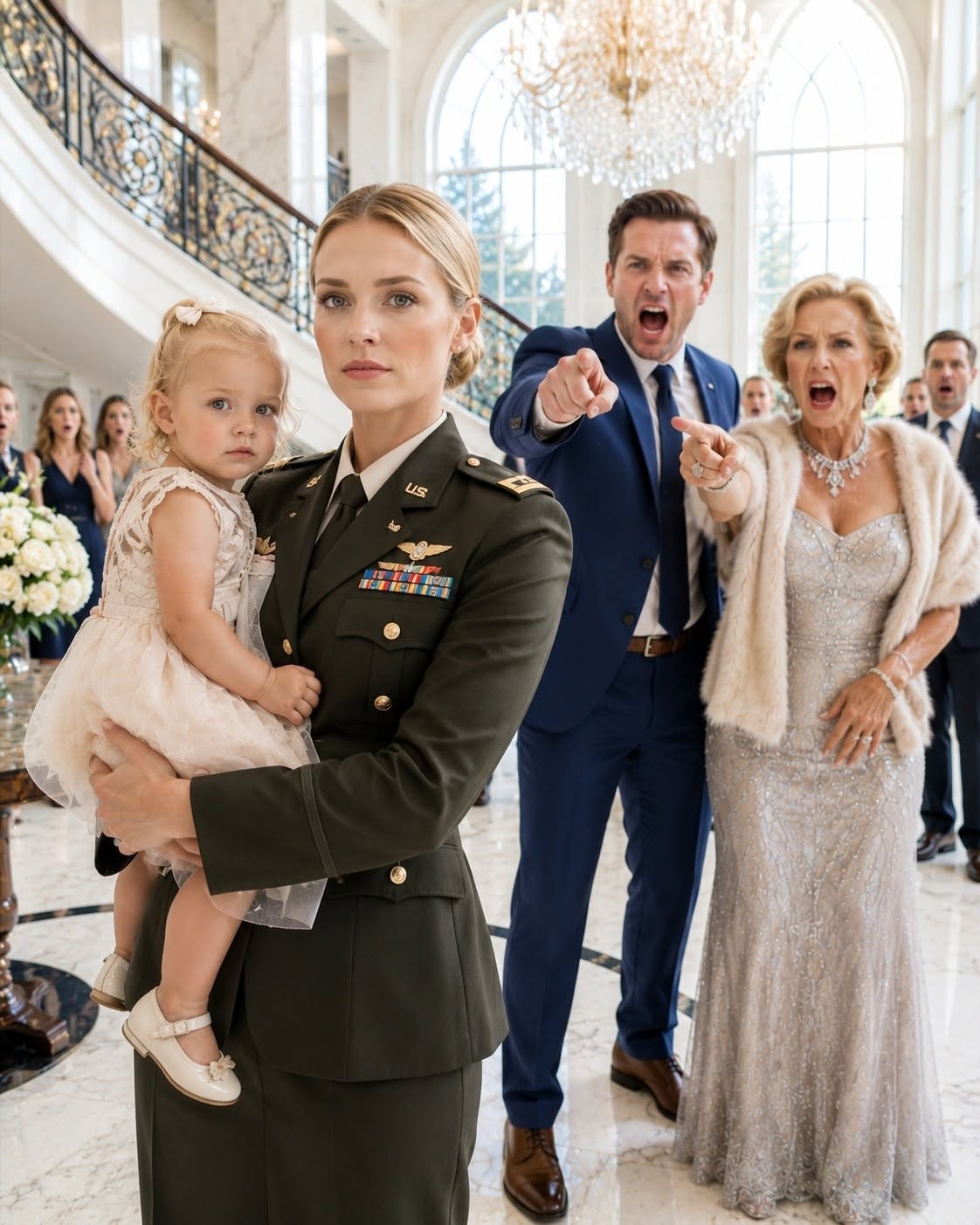
“Don’t ever hold that child again as though she belongs to this family.”
My mother-in-law’s voice cut through the living room like china smashing against a marble floor. I had just walked through the front door, still dressed in uniform, my cap tucked beneath one arm and my one-year-old daughter sleeping against my chest. I had driven directly from Joint Base Lewis-McChord, exhausted, my shoulders aching after an endless day, yet smiling more brightly than I had in weeks.
Two hours earlier, my husband, Caleb, had sent me a message:
“Don’t be late. Mom has something special planned for you.”
During the entire drive home, I imagined every possibility except the one waiting for me. I thought perhaps they had finally decided to accept Lily. I thought my mother-in-law, Margaret, might finally have understood that family isn’t created by an impressive last name, but by sleepless nights, constant care, and a love stubborn enough to survive anything.
I was mistaken.
The living room was crowded. Aunts. Cousins. Sisters-in-law. Close family friends. They were all seated as though they had purchased tickets to watch me break. No one greeted me. No one asked about the baby. Not one person smiled.
Caleb stood beside the coffee table in a perfectly pressed white shirt, an expensive watch around his wrist, and an expression I had never seen on his face before. He didn’t resemble the man I had married.
He looked like a prosecutor waiting to deliver a conviction.
“What is going on?” I asked, tightening my arms around Lily.
Margaret rose slowly from her chair. She wore a cream dress, pearls around her throat, and the expression of a woman who had spent her entire life believing she had the right to control everything—including the air in the room.
Caleb picked up a white envelope and threw it onto the table.
“DNA test results,” he said. “Lily isn’t my daughter.”
The entire room went still.
It felt as though the floor had vanished beneath my feet.
Not because I doubted myself.
Not because I was afraid of the truth.
But because, in one vicious instant, I understood that they had arranged an entire performance to humiliate and destroy me in front of everyone.
The sound of the envelope striking the glass woke Lily. Her tiny fingers immediately clutched the fabric of my uniform.
“That isn’t true,” I said quietly.
One of Caleb’s aunts gave a bitter laugh.
“They all say that.”
Caleb no longer looked at me like a husband.
He looked at me as though I had already been removed from his life, expelled from his home, and stripped of every right I had ever possessed.
“For months, you made me support another man’s child,” he said. “And then you walk in wearing that uniform as though everyone should still respect you.”
“You need to be very careful about what you’re accusing me of,” I replied.
Margaret moved toward me.
“She still thinks she can threaten us.”
Then she pointed at the front door.
“Leave my house.
Take that child with you.”
The word that hurt more than any insult she could have chosen.
Lily understood nothing.
Her eyes were wet.
Her hair clung to her forehead.
Her small mouth trembled.
“This is my home too,” I said.
Caleb gave a cold, humorless laugh.
“Not after tonight.”
Margaret lifted a second folder.
“We’ve already consulted an attorney. If you agree to a private divorce, Caleb may choose not to report you for family fraud. But you will surrender everything—the accounts, the property, the investments, and any claim you have to the land in Oregon.”
That was when I finally saw the real plan.
This wasn’t merely about humiliation.
It was calculated.
The Oregon land had belonged to my grandfather. Before his death, he transferred it into my name. Years later, when Caleb and his family began investing heavily in real estate projects, that property became one of their most valuable potential assets. Several months earlier, Margaret had repeatedly pressured me to sign papers she claimed would “make the legal process easier.”
I had refused every time.
Caleb stepped closer, his jaw rigid.
“Don’t make this worse than it already is, Madison. Admit what you did and walk away.”
“I didn’t do anything wrong,” I said.
“But all of you did.”
Whispers moved through the room.
Margaret smiled as though the outcome had already been decided.
“Listen to her. The little soldier thinks she can give this family orders.”
At that exact moment, the front door opened behind me.
I hadn’t touched it.
No one announced a guest.
A deep, authoritative voice filled the entryway.
“Captain Madison Reed.”
Everyone turned.
General William Hayes entered with two senior military officers beside him. His uniform was immaculate, his expression calm, and his eyes severe enough to change the weight of the entire room.
No one moved.
Caleb’s face turned pale.
The general surveyed the room, then looked at Lily, and finally at the paper lying on the coffee table.
“I came to deliver your promotion orders personally,” he said. “But it appears I’ve arrived in the middle of a very different ceremony.”
Margaret immediately tried to reclaim control.
“This is a private family issue.”
Without asking permission, the general picked up the document. He placed his reading glasses on his face, studied the paper for several seconds, and then looked up.
“Who requested this DNA test?”
Caleb swallowed.
“I did.”
“Where is the official chain of custody?
Who collected the samples?
Which accredited laboratory produced this report?”
The silence grew so heavy that even Lily stopped crying.
Caleb blinked several times.
“I… I don’t know.
It was sent to me online.”
The general folded the paper with slow, unsettling calm.
“This document does not prove that the child is not yours.”
He looked around the room.
“It proves something much more serious.”
When Margaret reached for the report, trying to rip it from his hand, one of the officers stepped in front of her.
That was when I understood that the night would not end with them throwing me out.
It would end with the first mistake they had made.
I left the house with Lily sleeping against my chest and my heart burning beneath a layer of stone.
I didn’t leave because the general ordered me to.
I didn’t leave because Caleb had won.
I left because my daughter should not have been forced to breathe the poison inside that room for one more minute.
Sometimes leaving is not defeat.
Sometimes it means carrying the only thing worth saving away from the battlefield before the real fight begins.
My friend Lauren opened the door to her Seattle apartment without asking a single question.
She simply pulled me into her arms.
“The guest room is ready,” she whispered.
“Breathe first.
We can talk afterward.”
Lily fell asleep almost immediately inside a borrowed crib.
I remained in the kitchen, still dressed in uniform, watching my phone vibrate continuously across the table.
Caleb: 31 missed calls.
Margaret: 12 messages.
One of Caleb’s cousins:
“Don’t make this more complicated, Madison. Think about your reputation.”
Then the voice messages started arriving.
At first, Caleb sounded furious.
“You left because you know you’re guilty.”
Then his voice changed.
“Come back. We can still settle this tonight.”
Finally, he sent the message that froze every trace of anger inside me.
“Mom is transferring the family trust documents tomorrow. If you want a quiet divorce and some money, don’t fight us. Sign the papers and disappear with the baby. Don’t force us to ruin you publicly.”
I gave the phone to Lauren.
She read the message in silence.
Her expression changed.
“They never wanted to prove anything about Lily,” she said.
“They were trying to frighten you into surrendering your property.”
I nodded.
General Hayes had not gone home either.
As soon as he saw the supposed DNA report in my living room, he ordered his contacts to verify it.
Within an hour, they confirmed the obvious.
The laboratory listed on the document had been closed for more than a year.
The certification seal was counterfeit.
The format had been copied from a template available for download online.
But the forged paternity report was not the worst part.
The money was.
At five the following morning, I entered a military legal office in Arlington, Virginia.
Across from me sat Attorney Rebecca Collins, a specialist in protecting the assets of active-duty service members.
Beside her, two investigators from the Financial Crimes Division examined a thick blue folder.
“Captain Reed,” Rebecca said, “your husband and his mother have been preparing this for several weeks.”
She pushed several documents toward me.
The evidence was all there.
Three wire transfers completed within forty-eight hours.
Almost six million dollars removed from a shared account and sent to a shell company in the British Virgin Islands.
There had also been an attempt to alter the internal records of the family business and accuse me of violating a morality provision in the family trust.
The provision stated that any spouse found guilty of “fraud, adultery, or documented family deception” could lose all rights connected to jointly held investments.
The false accusation involving Lily was the key they intended to use.
My stomach turned.
They had not simply called my daughter illegitimate.
They had used her as an instrument for theft.
“They assumed that because you were stationed on base, you wouldn’t be monitoring legal filings or financial records,” one investigator explained. “But your accounts are covered by military security protocols. When unusually large sums were moved, the system automatically issued an alert.”
Rebecca turned another page.
“There’s more.”
A receipt for ninety-nine dollars appeared on the computer screen.
It came from a fraudulent online paternity-testing website.
The email used for the purchase belonged to Caleb.
The credit card belonged to Margaret.
Lauren covered her mouth with one hand.
“They’re monsters.”
I didn’t cry.
Not anymore.
I asked only one thing.
“What do we do next?”
Rebecca gave me the faintest smile.
“At ten this morning, they’re holding a family meeting at company headquarters to remove your name from the ownership records. Margaret intends to visit the bank first and access the safety deposit box. We aren’t stopping her yet.”
“Why?”
“Because we need her to handle the documents.
We need her signature.
We need complete forensic evidence of what they are attempting.”
I looked at the clock.
It was 7:18 a.m.
At that exact moment, Caleb sent another message.
“Final chance. If you refuse to sign today, no one will believe you tomorrow.”
I locked the phone.
For the first time in eight months…
I wasn’t afraid of him.
I felt precise.
At 9:56 a.m., I stepped out of a black SUV in front of Parker Development Group in downtown Chicago.
I was no longer wearing my uniform.
I wore a dark tailored suit, my hair pulled neatly back, and a folder tucked beneath my arm.
Inside the building…
My husband and his mother were only minutes away from signing documents intended to steal everything I owned.
They still didn’t understand that the door they were about to open…
Did not lead to my destruction.
It led directly to theirs.
The boardroom at Parker Development Group smelled of costly coffee, polished wood, and inherited arrogance.
Caleb sat comfortably at the head of the conference table, smiling like a man who had already divided the spoils before possessing them.
Margaret stood beside the floor-to-ceiling windows, her pearls around her neck and a black folder clutched tightly against her chest.
Surrounding them were the same relatives who had filled my living room the night before to witness my humiliation.
Now they were waiting to sign official records.
Now they expected to erase me.
“Let’s finish this quickly,” Caleb said, glancing at his watch. “Madison hasn’t answered all morning. She’s probably speaking with military attorneys who have already told her she can’t fight us.”
One of his uncles laughed.
“She’ll learn.
No one deceives this family and walks away.”
Margaret placed the black folder on the table.
“Once everything is officially recorded, the Oregon property returns to the main trust.
And as for the child…
That will be Madison’s problem.”
The double doors opened.
There was no dramatic crash.
Only a clean, dry click.
I walked inside without rushing.
Every face turned toward me.
Caleb froze with his pen hovering above the papers.
Margaret opened her mouth, but no sound came out.
Behind me entered Attorney Rebecca Collins, two Financial Crimes investigators, a forensic accountant, and General Hayes.
The room seemed to lose all color.
“Madison,” Caleb said, starting to rise.
“This meeting is private.”
“Not anymore,” Rebecca replied.
Margaret was the first to recover.
“Security!
Remove this woman immediately!”
No one came.
The lead investigator set a thick case file on the table.
“Building security has already been instructed not to interfere.
This meeting is now being conducted under judicial authority.”
One of Caleb’s cousins moved away from the table as though it had suddenly become dangerous to touch.
Caleb forced a nervous laugh.
“Judicial authority?
This is a family dispute.
My wife deceived me.
We have DNA evidence.”
Rebecca connected her laptop to the conference-room monitor.
An enormous image filled the screen.
The digital receipt.
The browsing history.
The download time.
The falsified template.
Caleb’s email account.
Margaret’s corporate credit card.
“Are you referring to this DNA report?” Rebecca asked.
“The one purchased for ninety-nine dollars from a fraudulent website using a credit card linked to your mother’s business account?”
Caleb said nothing.
Margaret moved toward the screen.
“That doesn’t prove anything.”
The forensic accountant changed the image.
The financial transfers appeared.
Dates.
Amounts.
Recipient accounts.
The shell company.
“Almost six million dollars transferred within forty-eight hours,” the investigator said.
“Attempted concealment of marital property.
Financial fraud.
Document forgery.
Misuse of personal identity for attempted property seizure.”
Murmurs spread around the boardroom.