Chapter 1
I’ve been a dog owner for over twelve years, but absolutely nothing could have prepared me for the living nightmare that spilled out of my Golden Retriever’s cast.
If you have a dog, you know they aren’t just pets. They are your shadows. They are your family.
My Golden Retriever, Buster, is my entire world. I got him when I was going through a brutal divorce, and that dog saved my life. He’s ninety pounds of pure, goofy affection.
But right now, looking at the pale, terrified face of my veterinarian, I felt the air leave my lungs.
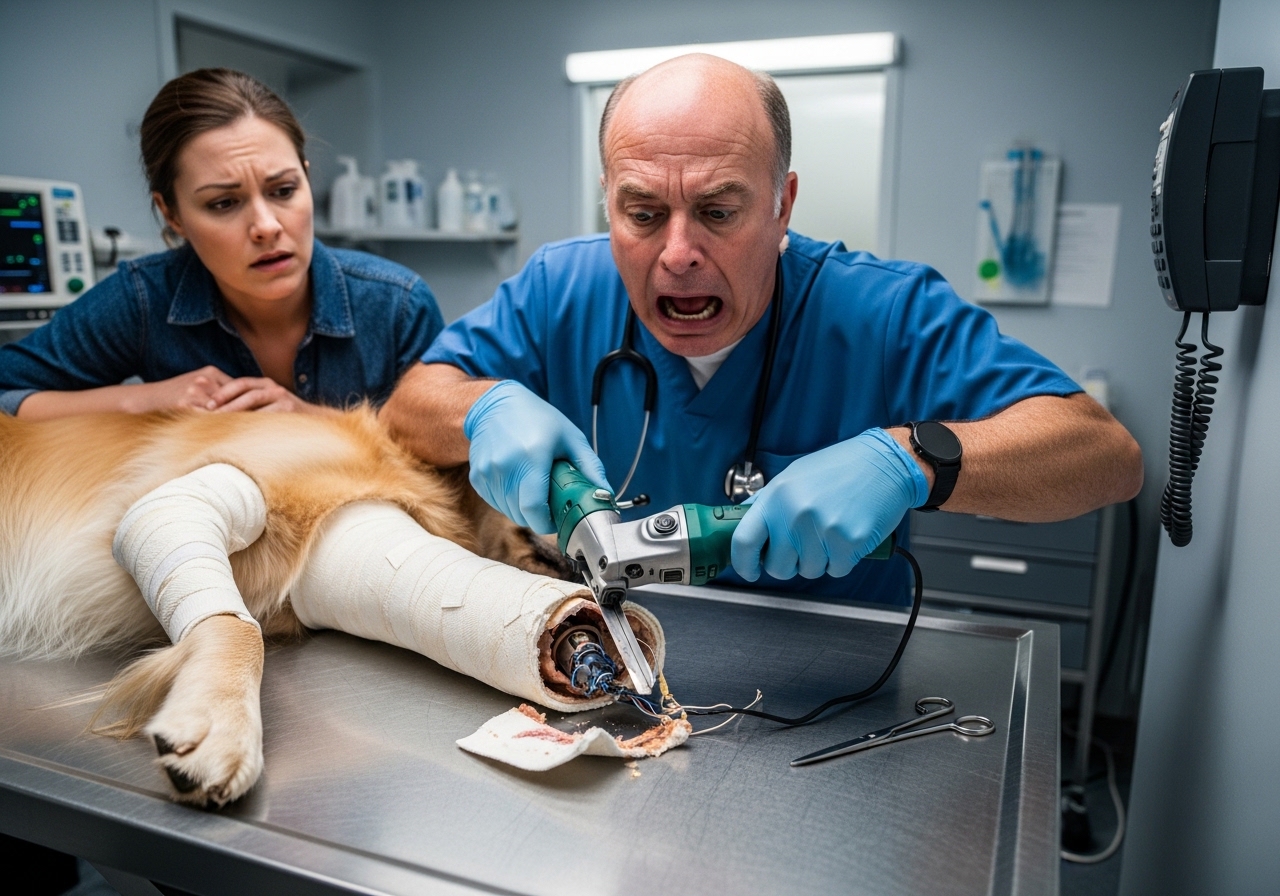
Dr. Evans didn’t say a single word to me. He just dropped the cast saw onto the metal tray. His hands were shaking so violently that the metal clattered against the stainless steel table.
He took three steps back, staring at Buster’s exposed leg as if it were a bomb about to go off. Then, he turned, locked the examination room door, and grabbed the phone off the wall.
“Yeah, I need police,” Dr. Evans whispered into the receiver, his voice trembling. “Right now. Send everyone.”
To understand how we ended up locked in a sterile veterinary exam room waiting for the cops, I have to take you back to a rainy Tuesday afternoon, exactly four weeks ago.
It was supposed to be a normal day.
I live in a quiet suburb just outside of Seattle. The weather is usually miserable, but Buster loves the rain. We were at Centennial Park, doing our usual afternoon routine.
Buster was chasing a tennis ball near the edge of the parking lot. He was usually so good about staying away from the cars.
I looked away for maybe three seconds to check a text message.
Then, I heard the sound that still wakes me up in a cold sweat. The screeching of wet tires on asphalt, followed by a sickening thud, and then a yelp of pain so loud it echoed across the entire park.
“Buster!” I screamed, dropping my phone in the mud.
I sprinted toward the parking lot. A massive, black lifted Silverado had backed over the curb.
Buster was lying in the wet grass, crying out in a high-pitched, agonizing wail that tore my heart into pieces. He was trying to drag himself toward me, but his right hind leg was dragging uselessly behind him at a horrific angle.
A man jumped out of the driver’s seat of the truck.
He was a big guy, probably in his late forties, wearing a faded Carhartt jacket and a baseball cap pulled low over his eyes. He looked panicked. Sweating profusely despite the cold Seattle rain.
“Oh my god, buddy, I’m so sorry!” the man shouted, rushing over. “I didn’t see him! He just darted behind my tires!”
I wasn’t listening to him. I fell to my knees in the mud, cradling Buster’s head. My hands were covered in dirt and rain. I was crying uncontrollably, trying to calm my dog down.
“We need a vet,” I choked out, panicking. “My normal vet is thirty minutes away across town. He can’t make it that far.”
The driver’s eyes darted around the parking lot. He seemed hyper-aware of his surroundings.
“Listen to me,” the man said, his voice suddenly very firm. “My brother owns an emergency animal clinic just two blocks from here. Apex Veterinary. It’s literally around the corner. Put him in my truck. I’ll pay for everything. I swear to god, I’ll cover it all.”
I was in shock. Buster was whimpering in agony. I wasn’t thinking clearly. I just wanted my dog to stop hurting.
“Okay,” I sobbed. “Okay, please, help me lift him.”
We gently loaded Buster into the back seat of the Silverado. The inside of the truck smelled overwhelmingly of pine air fresheners. It was so strong it made my eyes water, but I ignored it. I sat in the back, holding Buster’s head in my lap, whispering to him while the man sped out of the park.
True to his word, the clinic was incredibly close. It was tucked into a rundown strip mall next to a closed-down laundromat.
The sign above the door just said “Apex Vet” in cheap vinyl letters.
The man ran inside first. By the time I carried Buster through the glass doors, a man in green scrubs was already waiting.
The clinic felt off. It was dimly lit, freezing cold, and the waiting room was completely empty. There were no pet food displays, no dog posters on the walls, no receptionist. Just the man in scrubs.
“Bring him back here, right now,” the man in scrubs said curtly.
They took Buster from my arms and rushed him through swinging double doors. I tried to follow, but the man from the truck stopped me.
“Hey, let them work,” he said, putting a heavy hand on my shoulder. “My brother is the best. He’ll fix him up. Sit down. Drink some water.”
I sat in that freezing, silent waiting room for almost two hours. The truck driver paced back and forth near the front window, constantly checking his phone. He barely spoke to me.
Finally, the swinging doors opened.
The vet walked out, pulling Buster on a rolling gurney. My heart leaped. Buster was awake, though heavily sedated, and his right back leg was encased in a massive, thick green fiberglass cast.
“It was a clean fracture,” the vet said, avoiding my eyes. “I set the bone and casted it. He needs to keep this on for four weeks. Absolutely no running. Don’t get it wet.”
“Thank you,” I breathed out, tears of relief in my eyes. “How much is it? I need to give you my insurance info—”
“I got it,” the truck driver interrupted.
He pulled a massive wad of hundred-dollar bills from his jacket pocket and counted out a stack onto the front desk. It must have been over two thousand dollars in cash.
“Like I said, my fault,” the driver mumbled, not looking at me either. “Take care of the dog.”
And just like that, the driver walked out of the clinic, got into his Silverado, and drove away.
I loaded a sleepy Buster into an Uber and went home. I thought I had just experienced a terrible accident with a weirdly lucky resolution. I thought the driver was just a guilty guy trying to make things right.
I was so incredibly wrong.
For the first two weeks, Buster seemed to be recovering. He was groggy and hated the cast, but that was expected.
But by the third week, things started getting strange.
The cast was enormous. Much thicker and heavier than any cast I had ever seen on a dog. Buster could barely drag it around the house.
Then came the smell.
It started faint. I thought maybe Buster had peed on the edge of the cast by accident. But no matter how much I wiped the exterior with damp cloths, the smell grew stronger.
It didn’t smell like a dirty dog. It smelled chemical. Sharp, acrid, and metallic. It smelled like bleach mixed with something rotting.
By week four, Buster’s behavior changed drastically.
He stopped eating. He would lay on his bed for hours, staring at the wall, panting heavily. Whenever I touched the cast, he would growl—something my sweet Golden Retriever had never done in his entire life.
One night, I woke up at 3 AM to the sound of frantic scratching.
I ran into the living room and found Buster frantically chewing at the top edge of the green fiberglass. He had chewed his own fur raw trying to get inside the cast. His gums were bleeding.
When I pulled him away, I noticed a fine, white powdery substance leaking from the top edge of the fiberglass where he had been chewing.
Panic set in. The clinic, Apex Vet, wasn’t answering their phones. Their number just rang and rang until it hit a generic voicemail box.
I didn’t trust them anymore. Something was horribly wrong with my dog.
The next morning, I loaded Buster into my car and drove thirty minutes across town to see Dr. Evans, the veterinarian who had taken care of Buster since he was an eight-week-old puppy.
Dr. Evans’ clinic is bright, warm, and filled with people. As soon as I carried Buster into the exam room, Dr. Evans frowned.
“What on earth is that?” Dr. Evans asked, pointing at the massive green cast.
I explained the whole story. The park, the truck, the cash, the weird clinic.
As I spoke, Dr. Evans knelt down and examined the cast. He felt the weight of it. He leaned in and smelled the strange chemical odor radiating from the fiberglass. His frown deepened into a scowl.
“This is all wrong,” Dr. Evans muttered. “This isn’t how we cast a dog’s leg. It’s way too thick. It’s poorly wrapped. And the weight… this thing must weigh ten pounds. No wonder his hip is hurting.”
“Can you take it off?” I asked, my voice shaking with anxiety. “He’s been chewing at it. He’s miserable.”
“I’m taking it off right now,” Dr. Evans said firmly. “I need to see what they did to his leg. I’ll take some X-rays after.”
He reached into the cabinet and pulled out the cast saw. It’s a loud, scary-looking tool, but the blade vibrates rather than spins, so it cuts through hard materials without cutting skin.
I held Buster’s head, stroking his ears to keep him calm.
Dr. Evans turned on the saw. It whined loudly.
He pressed the blade against the top of the thick green fiberglass. Dust flew into the air. He pushed down, dragging the saw in a straight line down the length of Buster’s leg.
It was taking much longer than usual. The material was incredibly dense.
Finally, Dr. Evans made a second cut on the other side. He put the saw down, grabbed a pair of cast spreaders, and wedged them into the groove.
“Alright buddy, let’s get this heavy thing off you,” Dr. Evans cooed to Buster.
He squeezed the handles of the spreaders. With a loud, snapping CRACK, the thick fiberglass shell broke open, splitting into two halves.
The moment the cast opened, a sickening, overpowering chemical stench hit the air. It was so strong it burned the back of my throat. I had to cough and cover my mouth.
I leaned forward to look at Buster’s leg, expecting to see irritated skin or maybe a poorly healed bone.
But that’s not what was inside the cast.
Buster’s leg was there, yes. But surrounding his leg, packed tightly into the massive hollow space of the oversized cast, were dozens of tightly wrapped, heavy packages wrapped in thick gray duct tape and layers of plastic wrap.
The white powder I had seen the night before was spilling out of a package that Buster’s teeth had managed to puncture.
Dr. Evans froze.
The blood instantly drained from his face. He stared at the packages, then looked at the white powder on the stainless steel table.
He didn’t say a word to me. He just dropped the cast spreaders. They hit the metal tray with a deafening clatter.
He took three steps back, his eyes wide with absolute horror. He backed up until he hit the door. He turned the deadbolt, locking us inside.
Then, he grabbed the phone off the wall.
“Yeah, I need police,” Dr. Evans whispered into the receiver, his hands shaking so badly he could barely hold the plastic. “Right now. Send everyone.”
CHAPTER 2
The plastic receiver of the landline phone clattered back into its cradle on the wall. The sound echoed in the small, sterile examination room like a gunshot.
Dr. Evans didn’t turn around to face me. He stood facing the wall, both hands planted flat against the pale yellow wallpaper, his head bowed. He was breathing heavily, his shoulders rising and falling in sharp, jagged movements.
“Dr. Evans?” my voice broke the silence. It sounded small. Weak. “What… what did you just do? Why did you call the police?”
He slowly turned around. The warm, comforting demeanor of the man who had treated my dog for twelve years was entirely gone. In its place was a pale, sweating stranger. His eyes were locked on the examination table. Not on my dog. On the broken green shell resting beside him.
“Don’t touch it,” Dr. Evans said. His voice was barely a whisper, but the authority in it pinned me to the spot. “Whatever you do, do not touch the table. Do not touch the powder. Do not touch the cast.”
“What is it?” I pleaded, taking a half-step forward.
“I said stay back!” he snapped, raising a hand.
I froze. My heart was hammering against my ribs like a trapped bird.
I looked past him, forcing my eyes to focus on the grotesque display spilling out of the thick fiberglass shell.
Nestled around Buster’s injured leg, perfectly molded into the cavity of the oversized cast, were at least five rectangular packages. They were tightly wound in silver duct tape, then shrink-wrapped in multiple layers of clear plastic.
They looked like bricks. Small, heavy, identical bricks.
And from the top of the cast—the exact spot where I had caught Buster frantically chewing in the middle of the night—one of the plastic packages had been punctured by his sharp teeth.
A fine, stark white powder was spilling out from the tear, dusting Buster’s golden fur and gathering in a small, ominous pile on the stainless steel table.
“Is that…” I couldn’t even bring myself to say the word out loud. It felt absurd. It felt like I was trapped in a terrible movie. “Are those drugs?”
“I’ve been a vet in this city for thirty years,” Dr. Evans said, his voice trembling as he backed away to the furthest corner of the room, near the sink. “I’ve seen people try to hide small baggies in collars. I’ve seen people try to get prescription meds by hurting their own pets. But this…”
He pointed a shaking finger at the table.
“This is distribution level,” he swallowed hard. “That looks like pure fentanyl or cocaine. Given the way they packed it… the extreme lengths they went to… they used your dog as a mule. They packed his cast with narcotics so they could move it without arousing suspicion.”
The words hit me like a physical blow to the stomach.
I felt the blood drain from my face. My knees turned to water, and I had to grab the back of the plastic visitor’s chair to keep from collapsing onto the linoleum floor.
They used my dog. The truck driver. The accident at the park. The massive wad of cash. The fake, empty clinic. It hadn’t been an accident at all.
They had targeted us. Or maybe they just saw an opportunity when Buster ran into the parking lot. They hurt my dog, broke his leg, and used the “treatment” as a cover to smuggle thousands of dollars’ worth of illegal narcotics right under the nose of the police. And they made me carry it into my own home.
“Oh my god,” I choked out, a wave of intense nausea washing over me. “Buster. He… he was chewing on it last night. I found him chewing on the cast.”
Dr. Evans’ head snapped up. The terror in his eyes was instantly replaced by sharp, clinical panic.
“What?” he practically shouted. “He ingested it? When? How long ago?”
“I don’t know!” I cried, panic finally breaking through my shock. “Three AM? I pulled him away, but there was powder on his gums. I wiped it off, but—”
A low, guttural whine interrupted me.
We both looked at the table. Buster was no longer sitting up. His massive golden head had drooped onto the cold metal. His eyes were wide, the pupils dilated so far that his warm brown irises were almost entirely black.
Thick, rope-like strands of saliva were dripping from his jowls, pooling onto the stainless steel.
“Buster!” I screamed, lunging forward.
“No! Stay back!” Dr. Evans intercepted me, grabbing my arms and shoving me back toward the wall. “If that’s fentanyl, even a speck of that powder getting on your skin or into your lungs could cause a fatal overdose. You cannot touch him right now!”
“He’s dying!” I sobbed, struggling against the vet’s grip. “Look at him! He’s dying, you have to help him!”
Buster’s back legs began to twitch. The twitching quickly escalated into violent, rhythmic spasms. His jaws clamped shut, and a terrifying, wet gurgling sound erupted from his throat.
He was having a seizure.
My best friend. The dog that had slept at the foot of my bed through the darkest years of my life. The dog who wiped away my tears when I felt completely alone in the world. He was seizing on a cold metal table, his body shutting down from a massive narcotic overdose, and I couldn’t even hold his paw.
“Damn it, damn it, damn it,” Dr. Evans cursed rapidly. He let go of me and scrambled toward the locked medical cabinets above the sink.
His hands were shaking so badly he dropped his keys twice before finally jamming one into the lock. He ripped the cabinet door open, pulling out boxes of vials and plastic syringes.
“What are you doing?” I cried out, pressing my back against the wall, utterly helpless.
“Narcan! Naloxone!” Dr. Evans yelled, tearing the plastic cap off a glass vial with his teeth. “It reverses opioid overdoses. I keep it for police K9s who accidentally inhale drugs during raids. If it’s fentanyl, this might buy us time. If it’s cocaine or meth, this won’t do a damn thing and his heart is going to explode.”
He drew the clear liquid into the syringe with practiced, albeit trembling, speed.
He didn’t bother putting on gloves. He didn’t have time. He approached the seizing dog, keeping his body as far away from the spilled powder as physically possible.
Buster was thrashing violently now, the broken halves of the fiberglass cast clattering against the metal table.
“Hold on, buddy. Hold on,” Dr. Evans muttered.
With incredible precision amidst the chaos, the vet found a vein in Buster’s front leg and pushed the needle in, depressing the plunger.
Seconds ticked by. They felt like hours.
The gurgling in Buster’s throat sounded like he was drowning. I slid down the wall, pulling my knees to my chest, sobbing into my hands. I prayed to a God I hadn’t spoken to in years. I begged for my dog’s life. I offered to trade places with him.
Gradually, agonizingly slowly, the violent thrashing began to subside.
Buster’s body went limp. His breathing was incredibly shallow—just faint, ragged gasps—but the seizure had stopped.
Dr. Evans backed away from the table again, staring at the empty syringe in his hand. He let out a long, shaky breath.
“It was an opioid,” he whispered. “The Narcan worked. But it’s only temporary. The half-life of the drug in his system is longer than the antidote. He’s going to crash again. He needs an IV drip, he needs his stomach pumped, he needs a full crash cart.”
“Then do it!” I screamed, tears streaming down my face. “Save him!”
“I can’t!” Dr. Evans yelled back, his voice cracking. “I can’t treat him on that table! That powder is airborne. It’s a biohazard. If I contaminate my clinic, if I accidentally inhale it while trying to intubate him, we both die in this room!”
Before I could process the absolute horror of his words, the wail of sirens pierced the quiet morning air.
It wasn’t just one siren. It sounded like an entire fleet. The screeching of tires echoed from the parking lot outside. Doors slammed.
A heavy fist pounded on the locked door of the examination room. The solid oak rattled in its frame.
“Police! Open the door!” a deep, booming voice shouted from the hallway.
Dr. Evans rushed to the door and twisted the deadbolt.
The door violently swung open. Three police officers burst into the tiny room. They didn’t have their guns drawn, but their hands were resting on the holsters, their eyes sweeping the room with intense, aggressive focus.
“Who called 911?” the lead officer demanded. He was a tall, heavily built man with a shaved head and a tactical vest over his uniform.
“I did,” Dr. Evans said, raising his hands in the air. He immediately pointed to the table. “Officer, stop right there. Do not step any closer to that table. There is an active breach of unknown narcotics. I suspect high-grade fentanyl. My patient punctured a concealed package.”
The lead officer’s eyes locked onto the table. He saw the thick green cast, the silver duct-taped bricks, and the pile of white powder sitting inches from my dying dog’s nose.
The officer’s demeanor changed instantly. He took a sharp step backward, throwing his arm out to physically block the other two officers from entering the room.
“Back out! Everyone out into the hallway, right now!” the officer barked.
He looked at me, then at the vet. “Both of you, out of the room. Move! We’re treating this as a Level A Hazmat situation.”
“My dog!” I screamed, scrambling to my feet. “I’m not leaving my dog! He needs a doctor! He just overdosed!”
“Ma’am, you need to step out of the room immediately,” the second officer said, stepping forward and grabbing my arm tightly.
“No! Please! Let Dr. Evans help him!” I fought against the officer’s grip, digging my heels into the linoleum.
“I can’t help him if the room isn’t secure!” Dr. Evans pleaded with me, his eyes wide with sorrow. “Go with the officers! I’ll do everything I can once the fire department clears the air!”
The officer dragged me out into the brightly lit hallway of the clinic. The door to Exam Room 3 slammed shut behind me, sealing my dog inside with the poison that was killing him.
The waiting room of the clinic was sheer chaos.
Other pet owners were being ushered out the front door by police officers. Sirens continued to wail outside. Through the large front windows, I could see two fire trucks pulling into the parking lot, followed by an ambulance. Men in thick, yellow hazmat suits were already climbing out of the rigs, carrying heavy oxygen tanks.
I was pushed down onto a plastic chair in the corner of the waiting room. An officer stood directly in front of me, blocking my view of the hallway.
“Are you the owner of the animal in that room?” he asked. He pulled a small notepad from his chest pocket. His tone wasn’t comforting. It was cold. Suspicious.
“Yes,” I sobbed, wiping my nose with the back of my trembling hand. “His name is Buster.”
“And how did those packages get inside your dog’s cast?”
“I didn’t put them there!” I cried out, looking up at him defensively. “He got hit by a truck a month ago! The guy who hit him paid for the vet. A place called Apex Clinic. They put the cast on!”
The officer stopped writing. He slowly lowered his pen. He looked at me for a long, unblinking moment.
“Apex Clinic?” he repeated, his voice dropping an octave.
“Yes! It’s just two blocks from Centennial Park. The truck driver took us there. I didn’t know!”
The officer didn’t write anything down. He reached up and pressed a button on the radio attached to his shoulder.
“Dispatch, this is Unit 4. I need a detective down here right away. We’ve got a live one connected to the Apex location.”
Static crackled on the radio. “Copy that, Unit 4. Detective Miller is en route.”
“What does that mean?” I asked, my voice shaking. “Why are you looking at me like that? I’m telling you the truth!”
“Ma’am, you’re not under arrest,” the officer said firmly. “But you’re not leaving this building until the detectives speak with you.”
For the next hour, I sat in that hard plastic chair, trapped in a waking nightmare.
I watched hazmat crews wheel a heavy, sealed plastic containment unit into the hallway. I watched them go into the room where my dog was dying. I couldn’t hear Buster. I couldn’t see him. I didn’t even know if his heart was still beating.
Nobody would tell me anything. Every time I asked an officer about my dog, they just told me to sit down and wait for the detective.
Finally, the glass front doors of the clinic pushed open.
A man in a wrinkled gray suit walked in. He looked exhausted. He had deep, dark bags under his eyes and held a steaming paper cup of coffee in his hand. He flashed a gold badge to the uniform officers at the door and walked straight over to me.
“I’m Detective Miller, Narcotics Division,” he said, pulling up a chair and sitting backward on it, facing me. “You’re the owner of the K9?”
“Yes,” I said, my voice hoarse from crying. “Please, is he alive?”
“The fire department cleared the table. Your vet is working on him right now,” Miller said flatly. He didn’t offer any false hope. “But we have a much bigger problem right now. You told the patrol officer that a truck driver took you to a place called Apex Veterinary Clinic to get that cast put on?”
“Yes! Four weeks ago. He paid in cash. A huge wad of hundreds.”
Detective Miller took a slow sip of his coffee. He stared at me over the rim of the cup, his eyes piercing straight through me.
“That’s a very interesting story,” Miller said quietly. “Especially since it’s completely impossible.”
“What are you talking about?” I asked, confusion warring with the terror in my chest.
“Apex Veterinary Clinic shut down five years ago,” the detective said, his voice hard as stone. “The owner lost his license for operating a pill mill. The building has been condemned and boarded up since 2021. The city cut the power and water years ago.”
I stared at him, my brain refusing to process the words.
“No,” I shook my head violently. “No, you’re wrong. I was there! There was a waiting room. There was a vet in green scrubs. I sat in the chair for two hours while they put the cast on!”
“Whoever you met in that building,” Miller said, leaning in closer, “was not a veterinarian. And that wasn’t a clinic. You walked into a cartel distribution staging area. And they used your panic over your injured dog to turn you into a blind mule.”
I couldn’t breathe. The walls of the waiting room felt like they were closing in on me.
“They packed over five kilos of pure fentanyl into that cast,” Miller continued relentlessly. “Street value of roughly half a million dollars. They broke your dog’s leg intentionally. They casted him with the product. And then they sent you home.”
“But… why?” I whispered, tears spilling down my cheeks again. “Why wouldn’t they just keep the dog? Why give him back to me?”
“Because moving five kilos of fentanyl in a duffel bag gets you pulled over and thrown in federal prison for life,” Miller explained darkly. “But nobody pulls over a crying woman taking her injured Golden Retriever home from the vet. You were their camouflage. You drove it right past the state police checkpoints without breaking a sweat.”
“I didn’t know!” I pleaded.
“Here is the part that should really terrify you,” Miller said, setting his coffee cup down on the floor. “They didn’t just give you the dog and walk away out of the goodness of their hearts. Cartels don’t just lose half a million dollars of product. They always come back to collect.”
“What do you mean?” I asked, my voice barely audible.
“I mean,” Miller said, his eyes narrowing, “someone has been watching your house for the last four weeks. Waiting for the cast to come off. Waiting for the right moment to break in, take the fiberglass shell, and disappear.”
Right at that exact second, as the detective’s horrifying words hung in the air, a sharp buzz vibrated against my thigh.
It was my cell phone in my coat pocket.
I slowly reached into my pocket. My hand was shaking so badly I almost dropped the device. I pulled it out and looked at the cracked screen.
It was an SMS text message from an unknown number.
I opened the message. There were no words. Just a single photograph.
It was a picture taken from across the street of Dr. Evans’ clinic. It showed the police cars out front. The fire trucks. And through the large glass window, it showed me, sitting in the plastic chair, talking to the detective.
A second message chimed through immediately after the photo.
You should have left the cast alone.
CHAPTER 3
I stared at the cracked screen of my phone, my brain refusing to process the image.
It was me. Sitting in this exact chair. Wearing the olive-green rain jacket I had thrown on hastily this morning. The angle of the photo indicated it was taken from the parking lot across the street, right between the flashing red and blue lights of two squad cars.
The second message glared up at me in stark, cold text: You should have left the cast alone.
My lungs seized. I couldn’t pull air in. I felt a cold, prickling sensation wash over my scalp and travel down my spine. The clinic waiting room around me suddenly felt like a glass box, exposed from every single angle.
“Hey,” Detective Miller’s voice broke through the rushing sound in my ears. He noticed my sudden silence. “What is it? Look at me.”
I couldn’t speak. I just slowly turned the phone around so the screen faced him.
Miller’s tired, drooping eyes widened a fraction of an inch. The exhausted detective vanished, replaced instantly by a hardened, hyper-alert predator. He didn’t gasp. He didn’t ask questions.
He moved.
Miller snatched the phone from my trembling fingers. In one fluid motion, he stood up, drew his heavy black service weapon from his shoulder holster, and pressed the radio button on his chest.
“All units, this is Miller. We have an active surveillance and hostile threat on site. The suspects are outside the perimeter. Lock down the building. Nobody comes in, nobody goes out. Get away from the windows now!”
The waiting room erupted into organized chaos.
The uniform officer who had been standing near me immediately unholstered his gun, grabbing my arm and yanking me out of the plastic chair.
“Move, move, move!” the officer yelled, practically dragging me toward the hallway.
I stumbled over my own feet, my sneakers squeaking against the linoleum. We rushed past the reception desk. I heard the sickening shatter of glass as one of the officers used the butt of his heavy flashlight to smash the front window blinds, pulling them down violently to block the view from the street.
“Get her to the back! Inner room, no exterior walls!” Miller barked from behind us.
The officer dragged me down the hallway, past the exam room where Buster was. I tried to dig my heels in, turning my head to look at the heavy wooden door.
“Buster!” I screamed, my voice tearing at my throat. “I need to get my dog!”
“Keep moving!” the officer shoved me forward, ignoring my pleas.
He forced me through a heavy, lead-lined door into the clinic’s X-ray room. It was tiny, freezing cold, and smelled sharply of antiseptic and old film chemicals. There were no windows. The walls were thick and soundproof.
The officer shoved me into a corner behind the massive, bulky X-ray machine and stood in the doorway, his gun pointed down the hall.
A moment later, Detective Miller slipped into the room, shutting the heavy lead door behind him. The sudden silence was deafening. The wail of the sirens outside was muffled to a faint, distant whine.
Miller kept his gun drawn, held close to his chest. He pulled out his phone with his free hand and started typing furiously with his thumb.
“We’re pulling intersection cameras,” Miller said, his voice a low, tense whisper. “We’re going to find whoever took that picture. But I need you to listen to me very carefully, and I need you to focus. Can you do that?”
I was hyperventilating. I wrapped my arms around my knees, pressing my back against the freezing concrete wall. I nodded, though my entire body was shaking violently.
“The people who put that cast on your dog are not street-level dealers,” Miller said, his eyes scanning the dark room as if expecting someone to drop from the ceiling. “Five kilos of pure product means cartel. They are organized. They are ruthless. And they are desperate. They just watched a small fortune roll into a police perimeter.”
“Why did they text me?” I sobbed, tears blurring my vision. “Why tell me they’re watching?”
“Intimidation,” Miller replied instantly. “They want you terrified. If you’re terrified, you might do something stupid, like try to run. Or maybe they wanted to see if the police were onto the cast yet. That text was a test to see our reaction.”
“Did we fail?” I asked, a fresh wave of panic rising in my chest.
“We confirmed their worst fear,” Miller said grimly. “We locked down. They know we found the product. Which means their timeline just moved up from ‘wait and see’ to ‘salvage operation’.”
He knelt down in front of me, putting his face level with mine.
“I need to know everything that happened over the last four weeks,” Miller demanded softly. “Every weird car on your street. Every wrong number on your phone. Every time you felt like the hair on the back of your neck stood up. Did you see anyone?”
I squeezed my eyes shut, trying to force my panicked brain to think. I dug through my memories of the last month.
I thought about the rainy walks with Buster. The late nights in my living room.
“I… I don’t know,” I stammered. “I live in a busy neighborhood. There are always cars.”
“Think harder,” Miller pressed, his tone urgent but steady. “Did you hire anyone? Plumbers? Electricians? Food delivery drivers who lingered too long?”
Then, a memory slammed into me like a physical blow.
It was two weeks ago. Buster had been struggling with the heavy green cast, so I had been leaving him in the backyard during the day while I worked from home, so he wouldn’t have to navigate the hardwood floors.
I had gone into the kitchen to get a glass of water. I looked out the window facing the alleyway behind my fence.
There was a man.
He was standing on the hood of a rusted white work van, peering directly over my six-foot cedar fence into my backyard. When I tapped on the window, he immediately jumped down, got into the van, and sped off.
At the time, I convinced myself it was just a nosy utility worker checking the power lines.
“A white van,” I whispered, opening my eyes to look at Miller. “Two weeks ago. A guy was standing on the hood, looking over my backyard fence. Looking at Buster.”
Miller cursed under his breath. “Did you get a plate number?”
“No,” I shook my head. “He drove off too fast. And… and my trash cans.”
“What about them?”
“Last week. I woke up and my trash cans were completely tipped over. Bags torn open. Trash everywhere. I thought it was raccoons. But the gate to my backyard was unlatched. I never leave it unlatched because of Buster.”
“They were probing your security,” Miller said, his jaw tightening. “Checking if you had cameras. Checking your locks. They’ve been planning the extraction for weeks. Waiting for the vet appointment when the cast was supposed to come off naturally. You brought him in early because he started chewing it.”
“He was chewing it because it was hurting him,” I cried, the memory of Buster’s bloody gums returning to me. “Is he okay? Please, Detective. You have to tell me what’s happening to my dog.”
Before Miller could answer, the heavy lead door of the X-ray room groaned open.
I flinched, my heart leaping into my throat.
It was Dr. Evans.
He looked like he had aged ten years in the last hour. His green scrubs were stained with sweat and a terrifying amount of blood. He was pulling a tall metal IV pole behind him, the plastic bags of clear fluid swinging wildly.
“Dr. Evans!” I scrambled to my feet, ignoring the officer’s warning hand. “Buster? Is he…”
“He’s alive,” Dr. Evans said, his voice ragged and breathless. “But he’s in a critical state. His heart rate is dangerously low. The Narcan wore off faster than I anticipated. The concentration of that powder… it’s lethal. I had to hit him with a second dose, and I’ve got him on a continuous intravenous drip to flush his kidneys.”
“Can I see him?” I pleaded, taking a step toward the door.
“No,” Dr. Evans said, stepping in front of me to block the exit. “He’s heavily sedated. He’s intubated. A fire department medic is in there bagging him manually because my clinic ventilator isn’t meant for an animal his size in complete respiratory failure.”
I buried my face in my hands, letting out a wretched, guttural sob. The image of my sweet, goofy Golden Retriever with a tube down his throat, fighting for his life on a cold metal table, was too much to bear.
“We have a massive problem, Detective,” Dr. Evans turned to Miller, his professional facade cracking entirely. “We can’t keep him here. I don’t have the equipment to sustain him long-term. And the hazmat team says the ventilation system in Exam Room 3 is compromised. The powder is circulating. They’re shutting down the HVAC for the whole building.”
“We can’t move him,” Miller said flatly. “Not yet. The perimeter isn’t secure. We have hostiles watching the front door.”
“If we don’t get him to the emergency animal hospital downtown in the next twenty minutes, he is going to die,” Dr. Evans stated, his voice devoid of emotion, delivering a pure medical fact. “His organs are shutting down.”
I looked up, staring at Miller through my tears. “You have to let us go. We need an ambulance for him.”
“Ma’am, there is a cartel hit squad sitting in the parking lot across the street,” Miller said, rubbing his face with his free hand. “If we wheel a stretcher out the front doors, they will light us up. They don’t care about the dog. They care about the five kilos of product sitting on the table next to him. And they care about eliminating witnesses.”
“Then we go out the back!” I yelled, desperation making me bold. “Take him out the alleyway!”
“The alley is a fatal funnel,” Miller shot back. “It’s a narrow corridor with zero cover. If they have someone watching the back door, it’s a shooting gallery.”
He pressed his radio again.
“Dispatch, Miller. I need a tactical SWAT unit to my location right now. I need an armored BearCat vehicle to pull right up to the front doors of this clinic for a medical evac. ETA?”
The radio crackled. The dispatcher’s voice sounded incredibly tight.
“Miller, SWAT is mobilized but traffic is gridlocked on I-5 due to a semi-truck rollover. ETA is thirty-five minutes. You are on your own with patrol units until they arrive.”
Miller swore loudly, punching the concrete wall with his fist. “Thirty-five minutes. We don’t have thirty-five minutes.”
Suddenly, the lights in the X-ray room flickered.
They buzzed loudly, dimming to a sickly yellow hue, before shutting off completely.
The entire clinic plunged into pitch-black darkness.
The silence that followed lasted for exactly three seconds.
Then, the backup emergency generator kicked in with a loud, rumbling roar. Faint, red emergency lights snapped on in the corners of the ceiling, casting long, bloody shadows across the cramped room.
“Power’s cut,” Miller said, his voice dropping to a terrifyingly calm whisper. He racked the slide of his handgun, chambering a round. The metallic clack-clack sound made my blood run cold.
“They didn’t cut the power from the street,” Dr. Evans said, his eyes wide in the red light. “The main breaker box for this strip mall is located in the alleyway. Right next to our back door.”
Before anyone could react to that horrifying piece of information, a deafening crash echoed from the rear of the clinic.
It wasn’t a knock. It wasn’t someone trying a handle.
It was the sound of heavy metal tearing violently away from its frame. Someone had just rammed a vehicle into the reinforced steel back doors of the clinic’s loading dock.
A cacophony of shouts erupted from the front waiting room as the uniform officers reacted to the noise. Boot steps thundered down the hallway.
Then came the sound that I will never, ever forget.
The sharp, staccato crack-crack-crack of semi-automatic gunfire echoing through the narrow hallways of the veterinary clinic.
“Get down!” Miller roared, shoving me physically to the cold concrete floor.
He kicked the heavy lead door of the X-ray room shut, plunging us into total darkness just as a scream tore through the clinic.
It was one of the police officers.
I lay flat on the freezing floor, my hands clamped tightly over my ears, squeezing my eyes shut. I could hear the drywall in the hallway shattering as bullets ripped through the clinic. I could hear glass breaking, alarms blaring, and men shouting in a language I didn’t understand.
“Stay down, do not move an inch!” Miller yelled over the chaos.
He positioned himself behind the massive X-ray machine, aiming his weapon at the lead door.
“Dr. Evans!” I screamed, realizing the vet was no longer in the room with us. “Where is he?!”
Miller didn’t answer. He was entirely focused on the door.
I realized with absolute, crushing horror that Dr. Evans had slipped out of the room just before the shooting started. He had gone back out into the hallway.
He had gone back for Buster.
The gunfire intensified. The smell of burning gunpowder began to seep under the crack of the lead door, mixing with the sharp scent of antiseptic.
I was trapped in a dark room, curled into a ball, while a cartel hit squad tore through a suburban veterinary clinic to retrieve a fortune in drugs packed inside my dog’s broken leg.
Then, the heavy lead door of our hiding spot began to slowly, agonizingly push open.
CHAPTER 4
The heavy, lead-lined door of the X-ray room groaned, the thick hinges protesting as a sliver of dull red emergency light spilled into our pitch-black hiding space.
I stopped breathing. My heart slammed against my ribs so hard I thought it might crack them.
Detective Miller didn’t hesitate. He dropped to one knee, bringing his heavy black handgun up. He aimed directly at the widening gap, his finger tightening on the trigger.
“Police! Show your hands!” Miller roared over the deafening sound of gunfire still echoing from the front lobby.
A body fell through the doorway, collapsing hard onto the freezing concrete floor.
It wasn’t a man with a gun.
It was Dr. Evans.
He was on his hands and knees, gasping for air. His green scrubs were soaked in sweat. But he wasn’t alone. Trailing behind him, dragged across the rough linoleum on a thick canvas drop cloth, was Buster.
“Help me!” Dr. Evans choked out, scrambling backward to pull the heavy canvas fully into the room.
I didn’t think about the bullets. I didn’t think about the cartel. I scrambled across the dark floor on my hands and knees, grabbing the edge of the canvas and pulling with every ounce of strength I had left in my body.
Together, we dragged my ninety-pound Golden Retriever over the threshold.
Miller lunged forward and slammed the lead door shut, throwing his full body weight against it until the heavy metal latch clicked into place, sealing us back into the darkness.
I threw myself over Buster’s body.
He was so cold. It was the first thing that registered in my panicked brain. The warm, vibrant dog that used to sleep on my feet felt like a statue carved out of ice.
A thick plastic tube was taped to his snout, snaking down his throat. Dr. Evans was holding a blue, football-shaped plastic bag attached to the end of the tube. He squeezed it rapidly, forcing air into my dog’s lungs.
“Is he… is he gone?” I sobbed, pressing my face into Buster’s soft neck fur. It smelled faintly of that awful chemical odor, mixed with the familiar scent of wet dog.
“He’s hanging on by a thread,” Dr. Evans panted, his chest heaving. “But the power cut stopped his IV pump. The medic in the room ran to the front to help the officers when the truck hit the back doors. I couldn’t leave him on that table.”
“You went back out there,” Miller said, his voice a mixture of anger and absolute disbelief. “You walked into a crossfire for a dog.”
“He is my patient,” Dr. Evans said simply. He didn’t look up. He just kept rhythmically squeezing the blue bag.
A fresh burst of automatic gunfire tore through the hallway right outside our door. The sound was so incredibly loud it vibrated in my teeth. The drywall cracked and splintered as bullets chewed through the walls.
Dust fell from the ceiling, raining down on us in the dark.
“They breached the hallway,” Miller whispered. He moved away from the door, pressing his back against the wall beside the frame. He checked the magazine of his gun in the dim red light of the emergency fixture. “They’re clearing the rooms. Looking for the product.”
“You need to take over,” Dr. Evans said, suddenly grabbing my shoulder.
I looked up at him in shock. “What?”
“I need both hands to find a vein,” the vet explained, his voice urgent and tight. “I have a portable push-dose of epinephrine. If his heart stops, I need to inject him immediately. You have to breathe for him.”
He shoved the blue plastic ambu-bag into my trembling hands.
“Squeeze it every three seconds,” Dr. Evans commanded. “A deep, firm squeeze. Don’t stop. Don’t rush it. Count in your head. One, two, squeeze. If you stop doing this, he dies. Do you understand me?”
I looked down at the plastic bag in my hands. I looked at Buster’s sunken, dark eyes.
“One, two,” I whispered, my voice shaking. I squeezed the bag.
I heard the quiet rush of air fill my dog’s lungs. His chest rose beneath my arm.
“Good. Keep doing exactly that,” Dr. Evans said. He pulled a small penlight from his pocket, holding it in his mouth to illuminate Buster’s leg as he searched for a vein.
One, two, squeeze.
Outside the heavy door, the shouting grew louder. Heavy boots stomped against the linoleum. Men were yelling in Spanish, their voices frantic and angry.
I heard doors being kicked open down the hall.
One, two, squeeze.
Tears streamed down my face, dripping off my chin and landing on the heavy canvas beneath us. I focused everything I had on that blue bag. I blocked out the gunfire. I blocked out the terror.
The only thing that mattered in the entire universe was the rhythm of my hands. I was keeping my best friend tethered to this earth.
Footsteps stopped right outside our door.
Someone grabbed the heavy metal handle. They rattled it violently. The latch held.
“Locked!” a gruff voice yelled from the hallway.
“Shoot the lock!” another voice commanded.
Miller raised his gun, pointing it directly at the center of the heavy door.
“Get your heads down!” the detective hissed.
Dr. Evans threw his body over Buster, shielding the dog’s head. I curled my body over the ambu-bag, squeezing my eyes shut.
One, two, squeeze.
The deafening blast of a shotgun erupted from the hallway.
Sparks flew across the dark X-ray room as heavy lead slugs slammed into the thick metal door. The sound was like a physical blow to the head. My ears rang with a high-pitched, agonizing whine.
The door dented inward, but the lead lining held. The heavy deadbolt didn’t give way.
“Forget this room!” the gruff voice outside shouted over the ringing in my ears. “Exam 3! The cop out front said Exam 3!”
The footsteps hurried away from our door, moving further down the hall.
“They’re going for the drugs,” Miller whispered, slowly lowering his weapon. He let out a long, shaky breath. “They found the room.”
One, two, squeeze.
I kept the rhythm going, though my hands were cramping and slick with sweat.
“Detective,” Dr. Evans said quietly, looking up from Buster’s leg. “Exam Room 3 is where the fire department set up the hazmat containment.”
Miller nodded in the dark. “I know.”
“You don’t understand,” Dr. Evans continued, his voice tight with a sudden, terrible realization. “The ventilation system in that room is shut off. The cast is broken open on the table. The white powder… it’s aerosolized. It’s hanging in the air like an invisible fog.”
Miller looked at the vet, his eyes widening as the implications sank in.
“Those men kicking down that door,” Dr. Evans whispered, “they aren’t wearing hazmat suits.”
One, two, squeeze.
A massive crash echoed from down the hall as the cartel members kicked the door to Exam Room 3 off its hinges.
We heard them rush inside. We heard frantic shouting.
“Where is it?!” a voice yelled.
“On the table! Grab the bags!”
Then, there was a sudden, chilling silence. The shouting stopped entirely.
It was replaced by a sound that will haunt my nightmares for the rest of my life.
A wet, desperate gasp. The sound of a man trying to pull air into lungs that were rapidly shutting down.
Then came the thud of heavy bodies collapsing against the thin drywall.
“Oh my god,” someone in the hallway wheezed, the voice slurring heavily.
The cartel hitmen had just walked blindly into a concentrated cloud of pure, weapons-grade fentanyl. The very poison they had forced into my dog’s broken leg was now coating their lungs.
A man stumbled out of Exam Room 3. We could hear his heavy boots dragging against the floor. He collided violently with the wall right outside our door.
He slid down the drywall, his gear scraping against the paint.
He let out one final, gurgling breath, and then the hallway went completely silent.
Miller didn’t move. He kept his gun trained on the door. He didn’t say a word. The irony of the moment hung heavy in the freezing dark room. They had come to kill everyone to get their money back, and their own greed had marched them straight into a lethal trap.
One, two, squeeze.
I didn’t stop. I couldn’t stop. My arms felt like they were made of lead, but I kept pushing the air into Buster’s chest.
Suddenly, the floor beneath us began to vibrate.
It started as a low rumble, deep in the earth, and quickly grew into a massive, mechanical roar.
“Get down!” Miller yelled again.
A second later, the entire front wall of the veterinary clinic exploded inward.
The sound of shattering glass, tearing metal, and collapsing brick was absolute chaos. A massive, heavily armored black vehicle—a police BearCat—had just driven straight through the front waiting room, crushing the receptionist’s desk and destroying the front half of the building.
The cavalry had arrived.
“Police! Nobody move! Drop your weapons!” an amplified voice boomed from a loudspeaker outside.
Dozens of heavy boots flooded the building. Tactical flashlights cut through the dust and darkness like laser beams. I heard the sharp commands of SWAT officers clearing the front rooms, securing the surviving suspects, and checking the bodies in the hallway.
Someone pounded on our heavy metal door.
“Police! Is anyone in there?” a muffled voice yelled.
“Detective Miller, Narcotics!” Miller shouted back, moving toward the door. “I’m in here with two civilians and an injured K9! We need a medical evac right now!”
The door was yanked open.
Three men in heavy green tactical gear and gas masks filled the doorway. They swept the room with the blinding beams of their rifles, instantly lowering them when they saw us on the floor.
“We need a stretcher!” one of the SWAT officers yelled over his shoulder. “Move!”
Two medics in heavy gear rushed into the tiny room. They didn’t ask questions. They just dropped a collapsible backboard onto the floor next to the canvas.
“On three,” the medic said, grabbing the corners of the canvas.
“I have the bag,” I said, my voice cracking. I refused to let go of the blue plastic.
“You keep bagging him, ma’am,” the medic nodded at me, his eyes gentle despite his intimidating gear. “Don’t break the rhythm. One, two, three, lift!”
They hoisted Buster onto the backboard.
We moved as a single unit out of the dark X-ray room and into the hallway.
The devastation was unbelievable. The clinic looked like a war zone. The walls were riddled with bullet holes. Medical supplies were scattered everywhere.
As we rushed past Exam Room 3, I forced myself to look straight ahead. I didn’t want to look at the bodies of the men who had done this to us. I didn’t want to see the broken green cast on the table.
We burst through the shattered front entrance of the clinic.
The cold Seattle rain hit my face, mixing with the sweat and tears on my cheeks. The parking lot was filled with red and blue flashing lights. There were easily thirty police cars, ambulances, and fire trucks swarming the property.
They loaded Buster into the back of a massive, boxy ambulance.
Dr. Evans climbed in right behind him, instantly hooking Buster up to the vehicle’s heart monitors and oxygen tanks. A paramedic gently took the blue bag from my cramped, aching hands.
“We’ve got him now,” the paramedic said softly. “You did great. You saved his life.”
I collapsed onto the bench seat inside the ambulance, pulling my knees to my chest, and finally let the adrenaline crash out of my system. I sobbed uncontrollably as the ambulance sirens wailed, rushing us toward the emergency animal hospital downtown.
The next three days were a blur of sterile waiting rooms, bad coffee, and whispered conversations with detectives.
The police dismantled the cartel ring. The truck driver who hit Buster was arrested trying to board a flight to Mexico. The men in the clinic were either dead from the fentanyl exposure or in federal custody.
But none of that mattered to me.
The only thing that mattered was the quiet, rhythmic beeping of the heart monitor in the ICU ward of the downtown animal hospital.
I sat in a hard plastic chair next to Buster’s recovery cage for seventy-two hours straight. I refused to go home. I refused to eat anything more than vending machine crackers.
The fentanyl overdose had severely damaged his kidneys, but Dr. Evans’ quick thinking with the Narcan had saved his brain.
However, the leg could not be saved.
The cartel hadn’t just broken it; they had shattered the bone to fit the packages tightly inside the cast. The lack of proper blood flow and the chemical burns from the leaking drugs had caused severe necrosis in the tissue.
On the fourth day, the surgeons amputated Buster’s right hind leg.
When he finally woke up from the surgery, groggy and confused, I was the first thing he saw.
I opened the cage door and slid inside, sitting on the soft blankets next to him. I was careful not to touch his bandages.
Buster looked at me. His warm, chocolate-brown eyes were cloudy from the pain medication, but they were focused. He let out a soft, tired sigh, and rested his massive head gently on my thigh.
He licked my hand once, his tail giving a weak, slow thump against the floor of the cage.
He was missing a leg. He was scarred. He had been through hell and back just because some monsters saw an innocent animal as a tool for their greed.
But he was alive. He was still my shadow.
Two months later, we moved away from Seattle.
I sold the house in the suburbs. I couldn’t walk past that park anymore. I couldn’t look out my back window without thinking of the white van.
We moved to a quiet, isolated cabin in the mountains of Oregon.
Buster adapted to walking on three legs with the incredible, resilient grace that only dogs possess. He runs a little slower now. He gets tired faster. But he still loves chasing tennis balls, even if he trips over his own paws sometimes.
Every night, before I go to bed, I double-check the deadbolts on the heavy wooden doors. I check the security cameras I installed around the perimeter of the cabin.
Then, I walk into the bedroom.
Buster is always there, curled up at the foot of the bed, waiting for me.
I sit down next to him, burying my hands in his thick golden fur. I listen to the steady, comforting rhythm of his breathing in the quiet mountain air.
One, two, breathe.
They tried to use him to carry their poison. They tried to turn my best friend into a weapon.
But as I look at him now, sleeping peacefully, I know they failed. Because a dog’s heart is too pure to be corrupted by the darkness of men.
They took his leg. But they couldn’t take his spirit. And they couldn’t take him away from me.