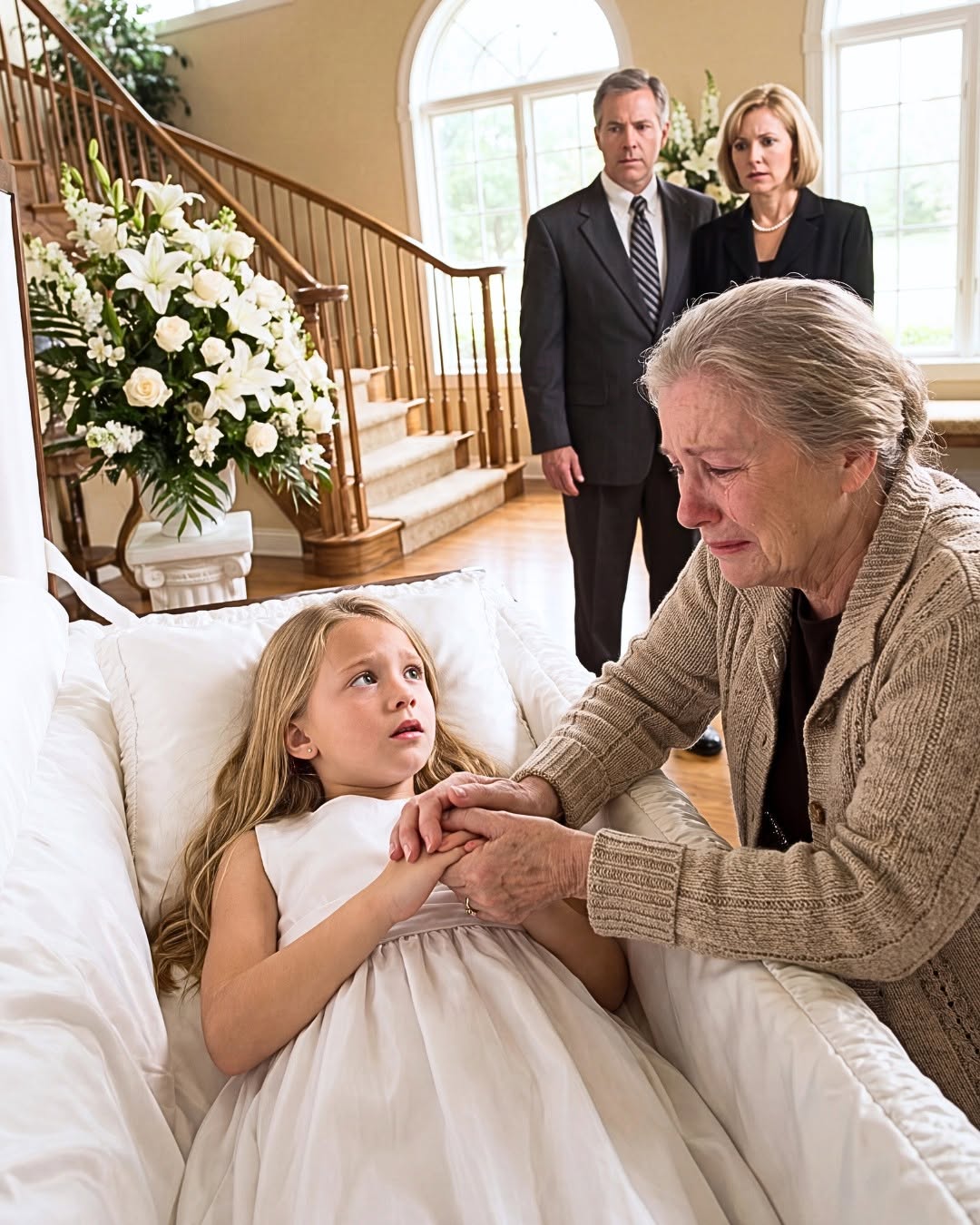
“Don’t shut the coffin… Sophie is still breathing.”
Margaret could not tell whether she had truly heard her granddaughter’s voice or whether grief was playing some merciless trick on her. It was almost eleven at night. Her son’s house in Chicago’s Lincoln Park neighborhood was silent, and in the center of the living room, the small white coffin remained surrounded by lilies, candles, and funeral wreaths sent by people who had barely known the child.
Jason and Rebecca had gone upstairs to rest. According to them, they had not slept in two days since six-year-old Sophie had “died” from a respiratory infection. The funeral was scheduled for the following morning. Margaret had stayed downstairs because she could not bear to leave without stroking her granddaughter’s hair one final time.
She walked toward the coffin and raised the lid.
Sophie opened her eyes.
It was barely a movement. Only a weak blink and a slight tremor in her lips. But beneath the white dress, her chest rose and fell. She was alive. Her skin was pale, her body burned with fever, and both wrists were secured by metal restraints attached to the coffin’s lining.
“Grandma…” she whispered. “I behaved. I didn’t scream.”
Something inside Margaret broke apart.
She tried to release her, but the restraints were locked with two small padlocks. This was no medical error and no mistake made by a funeral home. Someone had fastened the child in place so she could not climb out.
Margaret searched frantically beneath the pillow, under the sheet, and along the inner edge of the coffin. Beneath the lining, she discovered a tiny key held in place with clear tape.
As she opened the locks, she remembered every excuse she had heard during the previous months: “Sophie is asleep,” “the doctor said she shouldn’t have visitors,” “she gets anxious around you,” “you need to respect how we choose to raise her.” Margaret had believed Rebecca was controlling and that Jason, as usual, preferred to avoid confrontation. She had never imagined anything this horrifying.
Sophie did not cry when her grandmother lifted her from the coffin. Instead, she wrapped both arms around Margaret’s neck with desperate strength.
“Daddy said that if I woke up, I would ruin everything.”
Margaret felt her knees weaken, but she forced herself to keep moving. She wrapped Sophie inside her black shawl and headed toward the service staircase. Her purse and cellphone were still in the living room, too far away to reach safely. Then she remembered the landline telephone in the laundry room.
With shaking fingers, she dialed 911.
“There is a living child who has been declared dead,” she said. “She is hurt, drugged, and I found her restrained inside a coffin.”
A door opened upstairs.
“Mom?” Jason called.
Margaret locked the laundry-room door. Sophie began trembling violently in her arms.
“Don’t let him take me back, Grandma.”
The doorknob twisted hard.
“Open the door,” Jason ordered. “You don’t understand what you’re doing.”
“The police are on their way.”
A cold silence followed—not the silence of surprise, but of calculation.
Then Rebecca appeared in the hallway.
“You took her out?” she asked, nearly choking on the words.
Jason tried to silence her, but she lost control.
“She wasn’t supposed to wake up!”
Sirens began to sound in the distance.
Sophie raised her face, her eyes dull and glassy, and said something that transformed Margaret’s fear into a monstrous certainty.
“I don’t have normal sleep, Grandma… I have needle sleep.”
The patrol cars arrived before Jason managed to break down the door.
When police officers entered the laundry room, they found Margaret clutching Sophie while Rebecca screamed that it had all been “a special medical treatment” and Jason insisted that his mother was confused because of grief.
No one believed them.
The red marks around the child’s wrists, her fever, the bruise on her ankle, and the open coffin in the living room told another story. Paramedics placed her inside an ambulance. When Jason attempted to move closer, Sophie hid behind her grandmother and began crying without making a sound.
At Cook County Medical Center, doctors diagnosed severe dehydration, anemia, dangerously low body weight, and traces of sedatives. These were not medications given on a single occasion. Someone had been keeping her drugged for weeks.
“Who gave you the injections?” a pediatrician asked.
Sophie looked at Margaret before answering.
“Mommy. Sometimes Daddy held me so I wouldn’t move.”
Police arrested both parents before sunrise.
At dawn, investigators searched the house. In the master bathroom, they discovered unprescribed medication vials, used syringes, and a notebook in which Rebecca had recorded dosages beside comments such as “slept seven hours” and “didn’t complain during the visit.” On Jason’s computer, they found a forged death certificate. The physician whose name appeared on the document swore he had never examined Sophie.
Investigators also learned that the funeral home had accepted the child without conducting an inspection because Jason had paid in cash and demanded a private, immediate service with no embalming or additional preparation.
But the most disturbing evidence was found on Rebecca’s phone.
She had sent several messages to her sister:
“With Sophie being sick, we’ll never have a normal life.”
“Oliver deserves all our attention.”
“When this is over, we’ll say it was a respiratory complication.”
Oliver was the couple’s younger son, a two-year-old boy. Since his birth, Sophie had gradually disappeared from the family’s photographs. On social media, Rebecca posted hundreds of pictures of the little boy, while almost nothing remained of her daughter except a few older portraits.
Margaret remembered canceled birthday celebrations, unanswered calls, and something Jason had told her several months earlier:
“Rebecca is exhausted from raising such a difficult child.”
Sophie was not difficult. She was sick, frightened, and growing weaker because her own parents were keeping her sedated.
The lead detective asked Margaret to come to the station and placed photographs of the coffin, the padlocks, and the hidden key on the table.
“I need to ask you a painful question,” he said. “Do you believe they knew she was still alive?”
Margaret thought about the rushed funeral, the forged death certificate, and Rebecca’s words.
“Yes.”
The detective nodded solemnly.
“We believe so too.”
At that moment, a child-protection worker entered carrying an envelope. Investigators had recovered a deleted recording from the hallway security camera. Only seventeen seconds could be restored.
In the footage, Jason carried an unconscious Sophie toward the living room. Rebecca walked behind him holding the padlock key.
Just before the recording ended, Jason’s voice could be heard saying:
“Tomorrow, once she’s buried, no one will be able to question us.”
And the worst part was that Sophie, motionless in his arms, was still breathing.
For the next forty-eight hours, Chicago spoke about Sophie as though she were the subject of an impossible story: “the girl who woke up at her own funeral.”
Margaret refused to listen.
She remained at her granddaughter’s hospital bedside, learning to recognize every expression of fear. Sophie woke in terror whenever a nurse closed a curtain, cried whenever she saw a syringe, and hid food under her pillow. She asked permission to drink water. She asked permission to speak. She even asked permission to use the bathroom.
The child psychologist explained that the abuse had not begun with the coffin.
“The coffin was only the final stage in a long chain of mistreatment,” she said. “Before that, there was isolation, starvation, sedation, threats, and punishment.”
Margaret wondered how many warning signs she had failed to understand. She remembered one Christmas when Sophie had not come downstairs for dinner because she was “too sleepy.” She remembered a summer afternoon when the child appeared with a bruise and Rebecca said she had fallen from her bicycle. She remembered how Jason avoided meeting her eyes whenever Margaret asked why Sophie looked so thin.
Child protective services temporarily removed Oliver from his parents’ custody and placed him with a foster family while authorities decided who could care for him. Margaret asked to take him, but officials were firm: Sophie’s condition had to become stable first.
The child asked about her brother.
“Is Oliver all right?”
“Yes, sweetheart,” Margaret answered. “He is somewhere safe.”
Sophie closed her eyes.
“He isn’t bad. He didn’t do anything.”
That sentence revealed another painful truth. Sophie did not hate the little boy for whom her parents had pushed her aside. Instead, she had spent months taking care of him whenever Rebecca left the house and Jason locked himself inside his office to work. She brought him water, gathered his toys, and sang until he fell asleep.
The investigation moved rapidly. Prosecutors reconstructed the previous year of family life through text messages, purchases, prescriptions, and witness accounts.
Jason, an accountant for a real-estate firm, presented himself to the world as a respectable and responsible man. In private, he avoided every confrontation with Rebecca, even when he knew her choices were putting Sophie in danger.
Rebecca was obsessed with presenting the image of a flawless family. She followed online groups that rejected traditional medicine and promoted dangerous treatments. But her extreme beliefs did not explain everything. She had deliberately lied, obtained medication illegally, and invented symptoms to justify keeping her daughter isolated.
When Sophie developed a respiratory infection, Rebecca refused to take her to the emergency room. She feared the doctors would discover the child’s malnutrition and the restraint marks on her body. Instead, she treated her at home with cough syrups, incorrectly administered antibiotics, and sedatives.
Jason watched the fever grow worse.
He did not call an ambulance.
One night, Sophie stopped responding. Her breathing was weak and difficult, but she was still alive. Rebecca panicked. She said that if they took the child to a hospital, they would both go to prison and lose Oliver.
Then Jason made the decision that would define the remainder of his life.
Instead of saving his daughter, he chose to save himself.
Using documents from his workplace, he fabricated a death certificate. He paid a small funeral home that was struggling financially and claimed that a private physician had already examined the body. He told the funeral director that their religious beliefs did not permit embalming or preparation.
Rebecca purchased a white dress, flowers, and two small padlocks.
During questioning, she insisted that they had restrained Sophie only “in case she experienced spasms.” But forensic experts proved that the restraints were positioned specifically to prevent the child from sitting up.
The key taped beneath the lining may have been the darkest detail of all. Jason had hidden it there so he could remove the locks shortly before burial and ensure that no one saw the marks on her wrists. He never expected his mother to lift the lining.
Prosecutors also recovered a conversation accidentally recorded by Rebecca’s phone assistant.
“What if she wakes up during the viewing?” Rebecca asked.
“We give her another dose,” Jason replied.
“What if someone notices?”
“My mother is old. We’ll say she became confused.”
Margaret listened to the recording in the prosecutor’s office. She did not cry. She stared at the wall, unable to reconcile the man’s voice with the boy she had raised, the teenager she had helped through school, or the son for whom she had worked double shifts after becoming a widow.
But it was him.
He had planned, paid, forged, and ordered.
Blood did not erase the truth.
One week later, Jason requested that she visit him in jail. Margaret refused twice. The third time, she agreed because she needed to know whether even a small piece of conscience remained inside him.
They sat on opposite sides of a glass partition.
Jason looked pale and unshaven.
“Mom, everything spiraled out of control,” he said the moment he lifted the telephone. “I never wanted Sophie to die.”
Margaret watched him silently.
“Rebecca was desperate. She said they would take Oliver away from us. I thought Sophie was never going to wake up.”
“You restrained her inside a coffin.”
“I only…”
“You forged her death.”
“I was afraid.”
“She was six years old.”
Jason lowered his eyes.
“I need you to testify that I was always a good father. Tell them Rebecca made the decisions.”
Margaret felt an unexpected calm settle over her. Until that moment, some part of her had still hoped he would apologize, even though an apology would have changed nothing. But her son had not asked how Sophie was doing. He had not asked whether she was eating, sleeping, or still suffering from fever.
He only wanted a shorter sentence.
“I will not lie for you,” she said.
“I am your son.”
“And she is my granddaughter. More importantly, she is a child you were supposed to protect.”
Jason struck the table with his palm.
“You’re going to ruin my life!”