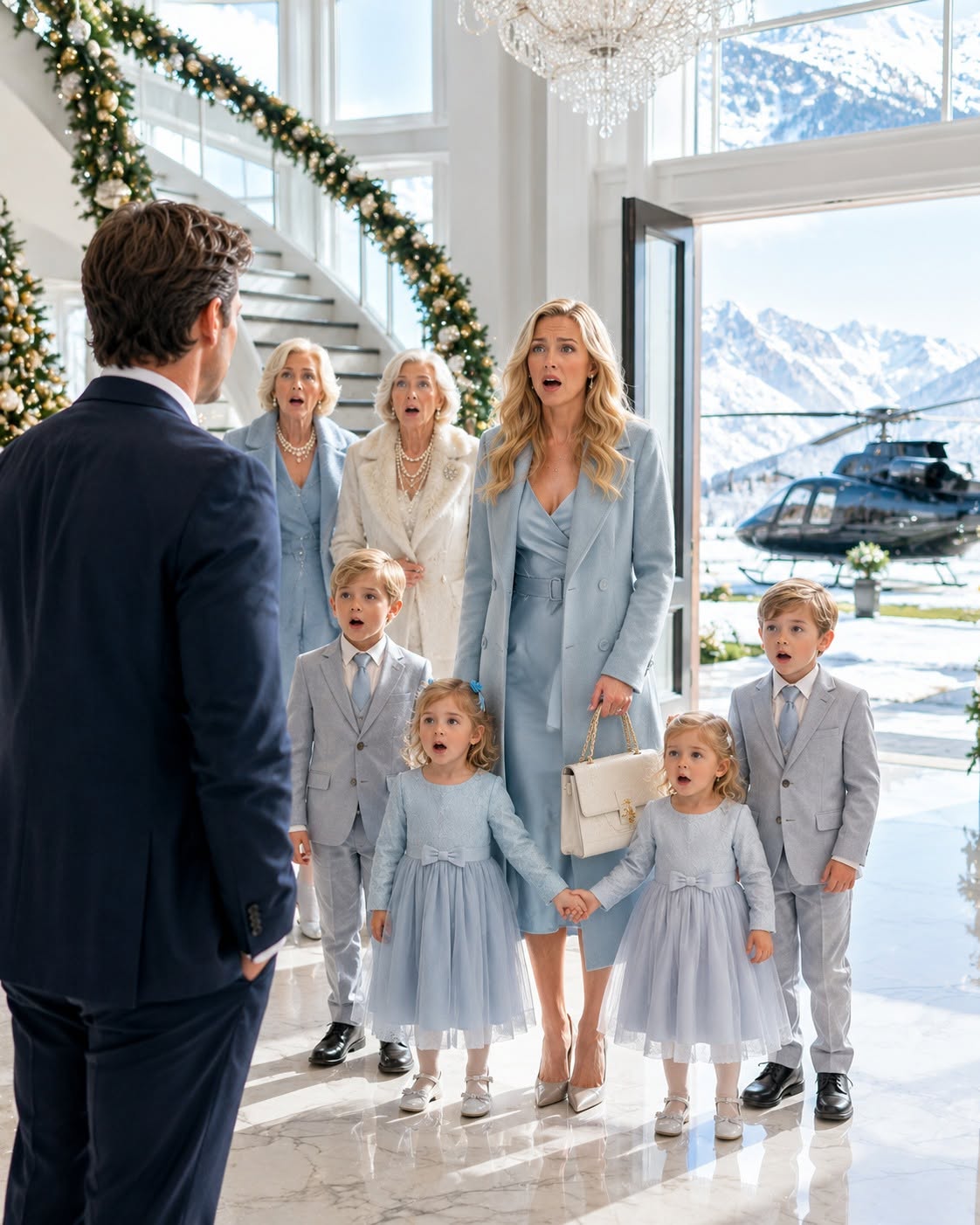
“Are you my father?”
Emma asked the question quietly, without accusation or fear, carrying the innocent curiosity of a child into a room full of adults who had suddenly forgotten how to breathe.
Ryan opened his mouth, but no words came.
Beside him, the elegant brunette in the emerald dress gripped the back of a chair. Her engagement ring flashed beneath the Christmas lights while the color disappeared from her face. Diane stood near the shattered champagne glass with both hands against her chest, staring at my children as if the front door had opened and delivered a truth she had spent eight years trying not to imagine.
Lucas moved closer to me. Mason studied Ryan with careful interest. Lily watched every adult in the room, reading their expressions the way she always did when something felt wrong.
Emma tilted her head, still waiting.
I rested one hand on her shoulder.
“That is something the adults need to discuss first,” I said.
Her eyebrows pulled together. “But he looks like Mason when Mason gets angry.”
A strange sound escaped someone nearby. It was not laughter. It was panic attempting to disguise itself.
Ryan blinked and finally found his voice.
“Danielle.”
My name sounded unfamiliar in his mouth after so many years.
“Ryan,” I answered.
Diane took one unsteady step forward.
“Four?”
The word trembled between us.
“Yes,” I said. “Four.”
Her eyes filled with tears. “You had four babies?”
“I had four children,” I corrected gently. “Babies grow up.”
Something inside her seemed to fold inward. Not dramatically. Not for attention. She looked like a woman realizing that nearly an entire childhood had happened without her.
The brunette turned toward Ryan.
“You told me she lied.”
The mood in the room changed instantly.
Ryan swallowed. “Vanessa, I—”
“You told me there was no child,” Vanessa said. Her voice was controlled, which made it far more dangerous than shouting. “You said she invented the pregnancy to trap you.”
My children looked at me. Four confused faces, unable to understand every word but fully aware that something painful was happening.
I kept my expression calm for them.
“This discussion is not continuing in front of the children,” I said.
Ryan’s father, George, appeared in the dining room doorway. He looked thinner than I remembered. His silver hair was neatly combed, though his Christmas sweater sat crooked around the collar.
He stared at the children, then at me.
His face held something I had not expected.
Shame.
“Danielle,” he said softly. “There is a family room down the hall. The children can have hot chocolate there.”
“No,” Mason said immediately.
I looked down at him.
His jaw had tightened. Ryan’s jaw.
“We came with Mom,” he said.
“And you are staying with me,” I assured him. “But adult conversations can be very boring.”
“Or frightening,” Lily whispered.
I knelt in front of them, straightened Emma’s sleeve, and brushed melting snow from Lucas’s hair.
“Nothing frightening is going to happen,” I said. “You are safe, you are loved, and we will leave whenever we decide to leave.”
Lucas studied my face. He was the oldest by seven minutes and treated that difference as a serious responsibility.
“Promise?”
“I promise.”
A teenage girl stepped cautiously from behind the Christmas tree. I did not recognize her, but she had Diane’s eyes and a gentle, uncertain smile.
“I can stay with them,” she offered. “I’m Megan. I suppose I’m their cousin.”
The word cousin came out awkwardly, but kindly.
Diane made a small sound, as though hearing it had opened another wound.
I looked at Megan. “Thank you.”
The children hesitated before following her toward the family room. Emma stopped at the doorway and looked back at Ryan.
“You still didn’t answer me,” she said.
Ryan flinched.
When they disappeared down the hall, everyone in the room seemed to exhale.
Vanessa turned fully toward Ryan.
“I want the truth.”
He dragged one hand down his face. “I didn’t know.”
A bitter laugh nearly escaped me.
“You chose not to know.”
“That isn’t fair.”
“No,” I replied steadily. “What was unfair was changing your telephone number after I told you I was pregnant. What was unfair was having your attorney tell mine that you wanted no contact. What was unfair was calling me a liar before you ever spoke to a doctor.”
Diane covered her mouth.
Ryan stared at me. “I never received an ultrasound.”
The room became silent again.
“What?”
“I never saw one,” he said. “I heard your voicemail. I received the message saying you were pregnant. I assumed—”
“You assumed I invented four children?”
“No. At the time, I thought you invented one.”
Vanessa closed her eyes for a moment.
George stepped forward. “Ryan.”
His tone carried a warning.
I turned toward him. There was something in his expression that sent a cold current through me.
“What do you know?”
He looked at Diane.
She refused to meet my eyes.
My heartbeat changed.
For eight years, I had survived by sealing away the past. I had prepared myself for Ryan’s disbelief, Diane’s tears, belated apologies, and questions my children deserved to have answered.
I had not prepared myself to discover that the story I knew was incomplete.
“Diane,” I said.
She finally looked at me. Guilt had aged her eyes more than time ever could.
“I thought I was protecting him,” she whispered.
Vanessa stepped away as though she needed distance from all of us.
Ryan stared at his mother. “Protecting me from what?”
“From repeating the same mistake.”
“Repeating?” I asked.
George said her name again, but she raised one hand.
“No,” Diane said. “Those children are under my roof, and they should have been part of my life. I will not lie anymore.”
The fire cracked behind us.
She looked directly at me.
“You sent a packet,” she admitted. “Medical documents. An ultrasound, a letter from your doctor, and correspondence from your attorney. It came here because Ryan had moved back home after you separated.”
My mouth went dry.
“I never saw it,” Ryan said.
“No,” Diane whispered. “You didn’t.”
Vanessa’s voice cut sharply through the room.
“Because you hid it?”
Diane nodded.
A broken sound left Ryan’s throat.
“Mom.”
“I believed she was manipulating you,” Diane said quickly. “You were drinking too much. You had lost the Seattle account. Your business was struggling. You told us the marriage was already over.”
“Our marriage was ending because he disappeared whenever life became difficult,” I said.
Ryan looked at me and, for once, did not defend himself.
“I opened the packet,” Diane continued. “I saw the ultrasound. I read something about multiple heartbeats. I did not understand everything. I panicked.”
“You panicked,” I repeated.
“I called your apartment, but you had already moved. I told myself that if it were real, you would return. You would fight harder.”
Her words landed quietly, but they cut deeper than shouting.
I remembered myself at twenty-five, carrying four fragile lives, sleeping upright because breathing became difficult. I remembered creditors calling, building a company from a borrowed computer, attending medical appointments alone, and pretending I was not terrified.
I remembered hospital lights, premature cries, incubators, and my mother sitting beside me before she died, rubbing slow circles across my back.
I remembered whispering apologies to four tiny cribs because their father had chosen not to be there.
“You expected a pregnant woman to fight harder for a family that had locked her outside,” I said.
Diane began to cry. Silently. Completely.
Ryan turned toward the fireplace and gripped the mantel.
“You allowed me to believe there was no evidence.”
“You wanted to believe that,” George said.
Ryan spun around. “What is that supposed to mean?”
“It means your mother hid the packet,” George answered, “but she did not make you cruel. She did not force you to ignore Danielle’s calls. She did not make you sign divorce papers without facing her. She did not make you disappear.”
Ryan stared at him.
Christmas music drifted faintly from another room, cheerful and horribly inappropriate.
Vanessa slowly removed her engagement ring.
Ryan noticed.
“Vanessa, wait.”
She placed it on a side table with devastating calm.
“I am not leaving because you have children,” she said. “I am stepping away because I need to decide whether I was engaged to a man who made one terrible mistake or a man who has built his entire life around avoiding the truth.”
Then she turned to me.
“I’m sorry. I know that does not repair anything.”
“No,” I said. “But I appreciate you saying it.”
She nodded and walked toward the hallway.
Ryan looked like a man surrounded by locked doors.
Then laughter rose from the family room. Emma’s bright giggle, followed by Mason’s quieter chuckle.
A child’s laughter can be merciful. That morning, it felt like a bell ringing over a battlefield no one wanted to acknowledge.
Diane turned toward the sound.
“May I meet them?”
“No.”
Her face crumpled.
“Not like this,” I added. “Not while everyone is overwhelmed and secrets are still coming out.”
She nodded quickly. “Of course.”
Ryan took one step toward me.
“Danielle, I need to see them.”
“You already have.”
“That isn’t what I mean.”
“I know.”
His eyes were wet, and I hated that part of me still recognized the man beneath the years. The man who used to dance barefoot with me in the kitchen. The man who cried during a documentary about abandoned animals and denied it afterward. The man who once kissed my forehead every morning before the mornings became distant and the kisses disappeared.
But memory is not forgiveness.
Regret is not repair.
“They know about you,” I said.
Ryan froze.
“I never told them you were dead. I never told them you were evil. I told them their father was not ready to be part of our family and that adults sometimes make choices children cannot fix.”
He lowered his head.
Lucas appeared in the hallway with hot chocolate foam above his lip.
“Mom?”
I turned immediately. “Yes?”
“Megan says there is a piano. Can Lily play it?”
Lily peeked around him, hopeful but nervous.
“Ask the person who owns it,” I said.
Everyone looked at Diane.
She wiped her cheeks.
“Yes. Of course she can.”
Lily entered the living room, her hands clasped in front of her blue velvet dress. She approached the upright piano beside the window as though it were something fragile and alive.
Diane moved to open the keyboard cover, but Lily did it herself.
“What should I play?” she asked me.
“Whatever feels right.”
She began playing “Silent Night.”
The first notes were hesitant, then steadier. Music had always been Lily’s quiet way of expressing what she could not explain.
She played while snow drifted beyond the windows. She played while adults stood among garlands, ornaments, and half-exposed truths. She played while Ryan looked at his daughter not as evidence of a mistake, but as a real person with a gift he had never known existed.
Emma, Mason, and Lucas entered, followed by Megan. They gathered around the piano and began singing softly.
Diane pressed one hand to her mouth.
George sank into an armchair.
Ryan cried without making a sound.
I did not comfort him.
When the song ended, Lily looked at us.
“Was that good?”
George’s voice broke. “It was beautiful.”
Mason immediately turned toward the presents under the tree.
“Are any of those for children?”
Megan laughed. “Some of them are. Grandma always buys extras.”
Diane looked at me, silently asking permission.
I gave her the smallest nod.
The next hour passed in cautious pieces.
The children ate too many cookies. Megan showed Lucas a card trick. Mason questioned George about the miniature train circling the tree and listened eagerly to an explanation about its engine.
Emma sat near Vanessa, who had returned quietly and was holding a cup of tea. Her engagement ring remained on the table, but her kindness remained intact.
Lily played two more songs.
Ryan stayed near the edge of the room, watching as though he were standing outside a life that might have belonged to him.
At one point, Mason approached him.
“Do you like trains?”
Ryan crouched slowly. “I used to.”
“Why did you stop?”
Ryan glanced at me.
I kept my expression neutral.
“I suppose I forgot.”
Mason considered this.
“That happens to adults.”
“It does.”
“You can remember again.”
Ryan stared at him for a long moment.
“I would like that.”
Mason nodded, satisfied, and returned to the train.
It was not a reconciliation. There was no dramatic embrace or instant forgiveness. It was simply a child offering a man a small truth without understanding how much it weighed.
By early afternoon, the house had softened, but it had not healed. Healing was far too large a word for a single Christmas morning.
Diane asked whether the children could stay for dinner.
“No,” I said.
Before she could argue, Ryan spoke.
“Danielle is right.”
Everyone turned toward him.
“This is too much for them,” he said. “It is too much for all of us.”
I studied him, surprised.
He met my eyes.
“May I ask for time? Not custody. Not demands. Just an opportunity to earn whatever contact you believe is appropriate.”
The Ryan I remembered would have argued that being their father automatically entitled him to a place in their lives. He would have cared more about appearances than responsibility.
This man looked like someone finally standing in the ruins of his own decisions.
“I am not making promises today,” I said.
“I understand.”
“No, you don’t. Perhaps one day you will.”
He nodded.
As I helped the children gather their coats, Diane disappeared upstairs.
When she returned, she carried a white envelope yellowed with age. My name was written across the front in my handwriting from eight years earlier.
My body went cold.
“I kept it,” she said. “I don’t know why. Throwing it away felt worse.”
Ryan stared at it as though it were alive.
Diane held it toward me, but I hesitated.
That envelope did not contain only medical records. It contained the voice of a frightened younger woman begging to be believed.
Finally, I accepted it and slipped it inside my coat.
Outside, the helicopter waited against the snow-covered lawn. The children said polite goodbyes. Emma hugged Megan. Lucas shook George’s hand with serious dignity. Lily thanked Diane for allowing her to play the piano.
Those few words nearly destroyed her.
Ryan stood on the porch while the children climbed aboard.
Emma paused at the door.
“Are we coming back?”
I looked at Ryan.
He remained silent. For once, he understood the answer was not his to give.
“We will talk about it,” I told her.
She accepted that and climbed inside.
Before I followed, Ryan called my name.
“Danielle.”
I turned.
“I’m sorry.”
Snow gathered on his shoulders. His voice held no charm, excuses, or self-defense.
I looked at the man who had broken my heart, the father my children had never known, the son of a woman whose fear had turned into cruelty, and the fiancé of a woman now questioning everything.
I felt anger.
I felt grief.
But I also felt something unexpected.
It was not forgiveness.
It was a loosening, a small space where the past no longer had its hand around my throat.
“I believe you are sorry,” I said. “What you do with that feeling will matter more.”
Then I climbed into the helicopter.
As we rose over the lawn, the Carter home grew smaller below us. The children pressed their faces to the windows and waved.
Diane stood in the snow with her hands clasped beneath her chin. George raised one arm. Megan waved wildly. Vanessa stood apart from them, silent and thoughtful.
Ryan did not wave.
He only watched.
That night in Houston, after baths, leftover gingerbread, and four excited retellings of “the Christmas helicopter,” I tucked each child into bed.
Lucas asked whether Ryan was truly their father.
“Yes,” I said.
He thought about it.
“Was he afraid of us?”
“No. I think he was afraid of the truth.”
Mason asked whether Ryan might come to see his science fair project someday.
“Perhaps.”
Lily asked whether Diane was sad because of her.