I’ve been working animal rescue in downtown Seattle for over nine years, dragging dogs out of the worst situations imaginable, but absolutely nothing prepared me for the sickening reality of what I found under the matted fur of that stray Golden Retriever.
It started on a Tuesday in late November. The kind of bitter, relentless rain that soaks straight through your boots and makes the city look completely gray.
I was doing a routine sweep of the alleys behind the industrial district. We get a lot of dumped animals out there. People think because there are dumpsters, the dogs will find food. They don’t. They just find rats, broken glass, and freezing temperatures.
I was driving my beat-up rescue van, barely going five miles an hour, keeping my eyes peeled. That’s when I saw him.
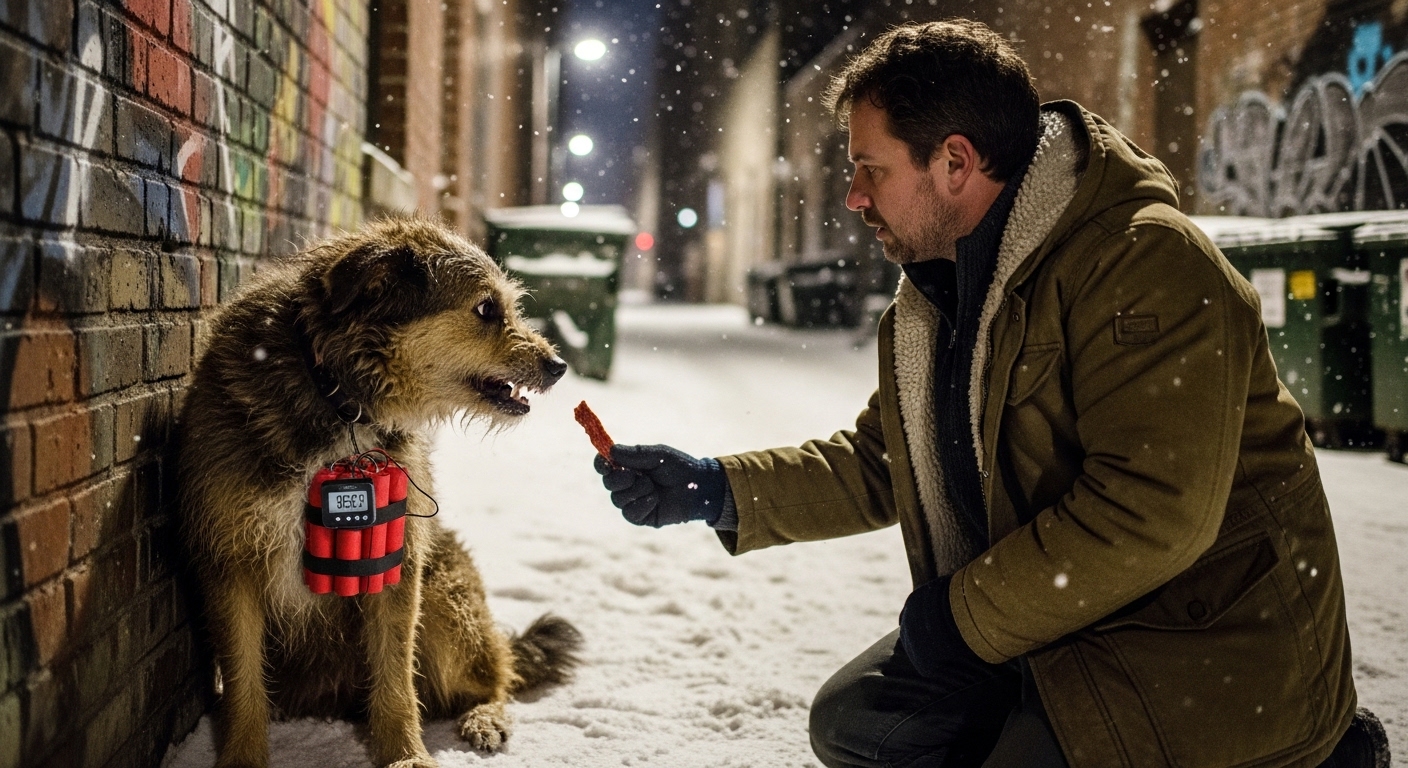
He was wedged in a narrow gap between a rusted industrial dumpster and a brick wall. A Golden Retriever. But he didn’t look golden. He looked like a pile of dirty, wet rags shivering in the shadows.
I pulled the van over, killed the engine, and grabbed my slip lead and a bag of high-value treats—hot dogs, mostly. You learn quickly that a hungry stray will ignore kibble, but they’ll risk their lives for a cheap piece of meat.
As I walked closer, I immediately noticed his posture. It was wrong.
Usually, a terrified stray will face you head-on, ready to bolt backward, or they will try to make themselves as small as possible in a corner. This dog was doing neither.
He was standing, but his entire right side was pressed so hard against the rough brick wall it looked like he was trying to merge with it. His left side was totally exposed to me.
“Hey buddy,” I said softly, crouching down about ten feet away. Keep your voice low, keep your eyes averted. Rule number one.
He didn’t growl. He didn’t bark. He just let out this low, rattling whine that sounded like it was scraping the back of his throat. His brown eyes were wide, tracking my every movement.
I tossed a piece of hot dog halfway between us. It landed with a soft smack on the wet concrete.
The dog looked at the meat. He licked his lips. He was starving. You can always tell by the hollows right above the eyes. But he didn’t move.
“It’s okay,” I whispered, tossing another piece, this one landing only a foot from his paws.
He stretched his neck forward, straining. But his back right leg and his right shoulder remained locked against the brick. It was unnatural. He was sacrificing his balance just to keep that side protected.
My mind started racing through the usual suspects. A car strike. A severe bite wound from a larger dog. Maybe a massive abscess. Whatever it was, the pain must have been agonizing for him to refuse to move that side even an inch.
I spent the next two hours in the pouring rain, inching closer. My knees were soaked through, my hands numb from the cold.
Eventually, hunger won. He finally stepped away from the wall.
When he moved, he didn’t limp exactly. His gait was stiff, heavy. Like he was dragging a weight. As he turned to grab the hot dog, I finally got a look at his right side.
There was a massive, unnatural bulge running along his ribcage.
It wasn’t a clean lump like a tumor. It looked jagged, misshapen, stretching the skin and matting the fur outwards. It was easily the size of a football, completely distorting the dog’s anatomy.
He grabbed the meat and immediately tried to press back against the wall, but I had already moved to block the gap. I needed to secure him.
He panicked for a second, trying to scramble past me, but he was weak. So incredibly weak. I managed to loop the slip lead over his head. He gave up instantly, collapsing onto his left side, hiding the bulge against the wet ground.
I sat there with him for a long time, just stroking his head, letting him know I wasn’t going to hurt him. He smelled like motor oil, wet earth, and something metallic.
“We need to get you to the clinic, buddy,” I told him. “We need to get that looked at.”
Getting him into the van was a nightmare. He refused to let me pick him up. Every time my hands went anywhere near his right side, he thrashed with a desperate, terrified energy. Not aggressive. Just pure, unadulterated panic.
I eventually had to slide a flat transport board under him and lift him that way.
The drive back to the clinic took thirty minutes. The whole time, I kept glancing in the rearview mirror. He was lying in the crate, shaking violently, his right side pressed hard against the plastic wall of the kennel.
When we got to the clinic, Dr. Harris was already waiting. I had called ahead and told him I was bringing in a severe trauma case.
We wheeled the transport board straight into the examination room. The bright fluorescent lights made the dog look even worse. He was emaciated, covered in fleas, and shivering uncontrollably.
“Let’s get a look at this,” Dr. Harris said, snapping on his latex gloves.
We muzzled the dog as a precaution. Even the sweetest dogs will bite when they are in excruciating pain.
Dr. Harris tried to gently roll the dog over to expose the right side. The dog fought us, whining loudly through the muzzle, trying to dig his claws into the stainless steel table to stay flat.
“Easy, easy,” I shushed him, holding his front legs steady. “You’re okay.”
Finally, we got him turned.
The bulge was huge. Up close, the fur was so densely matted with dirt and dried mud that it formed a hard, impenetrable shell over the swelling.
“It’s hard as a rock,” Dr. Harris muttered, tracing the outline of the mass with his fingers. “I’ve never felt an abscess or a tumor like this. The margins are completely irregular.”
“Car accident?” I asked. “Maybe internal swelling pushing outward?”
Dr. Harris shook his head. “No. The tissue around it isn’t inflamed in the way I’d expect from blunt force trauma. Hand me the clippers. I need to see what’s under this matting.”
The buzzing of the clippers made the dog flinch, but he stayed still, exhausted.
As Dr. Harris pushed the heavy-duty blades into the thick, filthy fur covering the mass, the clippers struggled. They jammed twice.
“This isn’t just mud,” Dr. Harris said, his voice tightening. “There’s something caught in the fur. Something hard.”
He switched to surgical scissors, carefully snipping away chunks of the matted hair.
I leaned in, holding the dog’s head, watching closely as the first large chunk of fur pulled away.
And then I saw it.
It wasn’t swollen tissue. It wasn’t a tumor. It wasn’t bone.
Beneath the thick layer of dirt and hair, strapped tightly to the dog’s ribcage with thick, industrial-grade duct tape, was a tightly wrapped package wrapped in heavy black plastic.
Dr. Harris stopped cutting. He looked at me, his eyes wide above his surgical mask.
The package was heavy, firmly secured tight against the dog’s skin. The edges of the tape were cutting into his flesh, causing raw, weeping sores.
I reached out, my fingers trembling slightly, and pressed against the black plastic. It was completely solid. Unyielding.
I looked at the dog. He was staring at me, his breathing shallow and fast. He hadn’t been protecting an injury. He had been protecting this. Someone had forced him to carry this.
“Doc,” I said, my voice barely above a whisper. “Get me a scalpel.”
CHAPTER 2
Dr. Harris didn’t move immediately. He just stared at the heavy black plastic strapped to the Golden Retriever’s side, the silver scalpel resting untouched on the metal tray beside him.
The silence in the examination room was suddenly deafening.
The only sound was the dog’s ragged, uneven breathing and the relentless drumming of the Seattle rain against the clinic’s frosted windows.
“Did you hear me, Doc?” I asked, my voice tight. “Hand me the scalpel.”
Harris blinked, pulling his eyes away from the package to look at me. His face had gone pale under the harsh fluorescent lights.
“We need to call the police,” Harris said, his voice dropping to an anxious whisper. “Right now. We don’t know what’s in that thing. We don’t know who strapped it to him.”
“I am going to call the police,” I replied, keeping my hands firmly but gently on the dog’s shoulders to keep him steady. “But I’m taking this off him first. Look at the tape.”
I pointed to the edges of the thick, silver duct tape. Whoever had done this hadn’t just wrapped it around his torso. They had wound it so tightly that it was completely restricting his ribcage.
The edges of the tape had dug deep into his skin. The constant friction from him walking, from him pressing against that brick wall to hide the bulge, had worn the skin completely raw. There was dried blood and yellow fluid weeping from beneath the adhesive.
The dog let out another low, rattling whine. He was in sheer agony.
“He can’t breathe right,” I said. “It’s acting like a corset. Pass me the blade, Harris. Carefully.”
Harris hesitated for one more second before picking up the scalpel by its surgical steel handle and handing it to me.
I took a deep breath. My hands were shaking slightly. In nine years of animal rescue, I had seen dogs chained to radiators, dogs starved to the bone, dogs used for fighting.
But this was different. This felt calculated. Cold.
“Okay, buddy,” I murmured to the dog. “I’m going to get this off you. Just stay incredibly still. Don’t move an inch.”
I found a spot near his shoulder blade where the tape was slightly lifted from the skin. I slid the dull back edge of the scalpel under the thick tape, angling the sharp edge upward and away from his flesh.
I applied pressure. The tape was incredibly thick—industrial strength, the kind reinforced with nylon threading.
With a sickening rip, the first layer gave way.
The dog flinched violently, crying out through the nylon muzzle.
“Hold him!” I barked.
Harris leaned his weight over the dog’s back, pinning him securely to the stainless steel table. “I’ve got him. Keep going. Fast.”
I worked the blade down the side of the black plastic package, slicing through layer after layer of the heavy-duty tape. The sheer volume of tape was staggering. It must have taken ten minutes just to wrap the dog up like this.
As the tension of the tape finally snapped, the heavy package immediately sagged downward, pulling away from the dog’s ribcage.
The Golden Retriever let out a massive, shuddering gasp.
It was the sound of air finally filling lungs that had been compressed for God knows how long. His whole body relaxed into the table, exhaustion completely taking over.
“Grab the package,” I told Harris. “Don’t let it pull on his skin.”
Harris cupped his gloved hands under the heavy, black plastic brick. “Christ, this thing weighs at least five pounds,” he grunted.
I carefully peeled the remaining adhesive away from the raw, weeping sores on the dog’s side. The skin underneath was incredibly inflamed, radiating a terrible heat.
Once the package was completely free, Harris lifted it and set it down heavily on the metal counter across the room. It landed with a dull, solid thud.
We both stood there for a moment, just looking at it.
It was roughly the size of a large brick, completely mummified in heavy black trash bag plastic and waterproof tape.
“Check his vitals,” I told Harris, wiping the sweat off my forehead with the back of my arm. “Clean those wounds and get him on an IV drip. He’s severely dehydrated.”
“What about that?” Harris asked, nodding toward the black brick.
“I’m going to see what our friend here was forced to carry.”
I walked over to the counter. Up close, the package had a faint, chemical smell. It wasn’t overpowering, but it was there—acrid and sharp, like bleach mixed with acetone.
My heart hammered against my ribs. I knew what things like this usually contained. Seattle is a major port city. The I-5 corridor is a massive artery for narcotics moving up and down the West Coast.
But using a stray dog as a mule? Walking him around the industrial district? It didn’t make any sense. A dog could run off. A dog could get hit by a car.
Unless he wasn’t supposed to be running loose.
I took the scalpel and pierced the outer layer of the black plastic.
I dragged the blade down the center. The plastic parted, revealing another layer of clear vacuum-sealed plastic underneath.
The chemical smell instantly grew stronger.
Beneath the clear plastic was a tightly packed, solid block of pure white powder.
I froze.
It wasn’t a small amount. Five pounds of tightly packed narcotics. I wasn’t a cop, but I watched the news. Depending on what exactly that powder was—fentanyl, cocaine, heroin—there could be hundreds of thousands of dollars sitting on this veterinary clinic counter.
“Oh, my god,” Harris whispered. He had stepped away from the dog and was standing right behind me, staring over my shoulder. “Is that…”
“Don’t touch it,” I snapped, stepping back instinctively. “If that’s fentanyl, and that vacuum seal is compromised, just inhaling the dust could drop us both.”
“We need to call 911 right now,” Harris said, his voice pitching up in panic. He began stripping off his latex gloves so fast they tore. “I’m calling them.”
“Wait,” I said, my eyes catching something else.
“Wait for what?!” Harris yelled, already reaching for the landline on the wall. “We have half a million dollars of cartel drugs in my clinic!”
“Harris, look.”
I pointed at the package.
Embedded right in the center of the white powder, pressed tight against the clear vacuum-sealed plastic, was a small, square, black device.
It was no bigger than a matchbox.
And in the very center of the black device, a tiny red LED light was blinking.
Blink.
Blink.
Blink.
The bottom dropped out of my stomach.
It was a GPS tracker.
And it was active.
The realization hit me like a physical punch to the gut.
Whoever owned this package hadn’t lost it. They knew exactly where it was.
When I found the dog, he was wedged between a dumpster and a brick wall. He was hiding. He was terrified. He wasn’t just hiding from the elements; he was hiding from the people who had strapped this to him. They must have been looking for him.
And I had just put him in my rescue van and driven him straight to this clinic.
“Harris,” I said, my voice completely devoid of emotion. “Put the phone down.”
“Are you insane?” he shot back, the receiver already in his hand. “I am calling the cops!”
“If you call 911, how long will it take for a cruiser to get here?” I asked, turning to face him. “Ten minutes? Fifteen? It’s pouring rain, it’s rush hour traffic.”
“I don’t care how long it takes!”
“Look at the light, Harris!” I yelled, losing my cool for a fraction of a second.
Harris looked at the blinking red dot.
“It’s a tracker,” I explained, keeping my voice as steady as I could. “They know the dog moved. They tracked it moving at thirty miles an hour down the highway. They know it stopped here.”
Harris slowly lowered the phone. The color completely drained from his face.
“They could be pulling into the parking lot right now,” I said.
As if on cue, the heavy silence of the clinic was broken by a sound outside.
It was the distinct crunch of tires rolling slowly over the wet gravel in the clinic’s back parking lot.
My blood went cold.
The clinic was closed. It was past 7:00 PM. No one was supposed to be here except Harris and me.
We both stood completely frozen, listening.
Outside, a heavy vehicle engine idled for a moment. A low, throbbing diesel rumble.
Then, the engine was cut off.
A heavy vehicle door slammed shut.
Then a second door.
“Kill the lights,” I hissed at Harris.
“What?”
“Kill the lights! Now!”
Harris lunged for the wall switch. The bright fluorescent lights snapped off, plunging the examination room into darkness.
The only illumination came from the amber glow of the streetlights filtering through the frosted glass of the back door.
And the slow, steady blinking of the red light on the counter.
Blink.
Blink.
Blink.
I grabbed the heavy metal slip lead from my pocket and wrapped the nylon cord around my fist, leaving the heavy brass ring dangling like a makeshift weapon. It was pathetic, but it was all I had.
The Golden Retriever let out a soft, confused whimper in the dark.
“Shh,” I breathed, moving to the table and placing my hand gently over his snout. “Quiet, buddy. Please.”
Footsteps.
Heavy, deliberate footsteps crunching on the gravel outside, moving directly toward the clinic’s back entrance. The employee entrance.
Harris was backed against the far wall, his hands pressed over his mouth, his eyes wide with absolute terror.
The footsteps stopped right outside the heavy steel door.
I held my breath.
A shadow fell over the frosted glass. The silhouette of a broad-shouldered man standing just inches away on the other side.
Then, the brass doorknob slowly began to turn.
CHAPTER 3
The heavy brass doorknob stopped turning.
It hit the resistance of the steel deadbolt with a hard, metallic clank that echoed through the pitch-black examination room like a gunshot.
I had locked that door behind us the second we wheeled the transport board inside. It was a paranoid habit I’d picked up from working late-night shifts in the sketchy parts of downtown Seattle, but right now, that simple twist of a deadbolt was the only thing standing between us and whoever had just pulled into the parking lot.
Harris let out a choked, terrified sob and pressed his back harder against the wall, sliding down until he was crouching on the linoleum floor. He wrapped his arms around his knees, his eyes wide and unblinking in the dark.
I didn’t look at him. I kept my eyes locked on the frosted glass of the back door.
The silhouette on the other side didn’t move. He was close enough that I could see the outline of his shoulders and the distinct, unnatural bulge of something heavy tucked under his right arm. It wasn’t a flashlight. It was the unmistakable profile of a suppressed weapon.
My mouth went completely dry. The metallic taste of adrenaline flooded the back of my throat.
“It’s locked,” a muffled voice came through the thick glass. The voice was calm. Too calm. It wasn’t the frantic tone of a street thug looking for a quick score. It was the detached, professional tone of a man who did this for a living.
A second silhouette joined the first. This one was slightly shorter but much wider.
“Check the front,” the second voice replied, barely a whisper, yet carrying clearly over the sound of the rain. “They left a van in the lot. Someone is inside. Nobody leaves until we have the package.”
The two shadows stepped away from the glass, merging with the darkness of the alleyway. The crunch of their heavy boots on the wet gravel began to fade as they moved around the side of the brick building, heading toward the clinic’s main entrance.
I finally exhaled. It felt like I had been holding my breath for ten minutes.
“Harris,” I hissed, turning to the veterinarian. “Harris, look at me.”
He was hyperventilating, his chest heaving under his scrub top. “They’re going to kill us,” he stammered, rocking slightly back and forth. “They know we have it. They tracked it right to my clinic. We’re dead. We’re already dead.”
“We are not dead,” I said, keeping my voice low and authoritative. I crawled over to him and grabbed his shoulders, shaking him slightly to break his panic loop. “But we have to move right now. If they realize the back door is solid steel, they’re going to go through the front plate glass. We have maybe two minutes.”
“Just give it to them!” Harris pleaded, tears streaking down his face. “Leave the drugs on the table! Open the door and run!”
“Think about it, Doc!” I snapped back. “You saw the size of that brick. You saw the tracker. This isn’t a couple of ounces of street weed. This is cartel-level trafficking. If they walk in here and see our faces, they aren’t going to just say thank you and leave. We are witnesses. We compromised their mule. We sliced open their package. They will not leave us breathing.”
Harris swallowed hard, his eyes darting toward the black plastic brick resting on the counter. The tiny red LED light was still pulsing rhythmically in the darkness.
Blink.
Blink.
Blink.
“What do we do?” he whispered, his voice finally dropping to a more manageable volume.
“We need to hide,” I said, my mind racing through the floorplan of the veterinary clinic. “The kennel room is too exposed. The surgical suite has glass windows into the hallway. Where is the most secure room in this building?”
Harris blinked, his brain fighting through the sheer terror to access logical thought. “The… the radiology room. The X-ray room.”
“Why?”
“It’s lead-lined,” Harris said, his words coming out in a rapid rush. “The walls are packed with lead to stop radiation from leaking into the waiting room. The door is solid oak with a lead core. It has a heavy interior deadbolt. No windows.”
“Perfect,” I said, pushing myself up off the floor. “We take the dog, we get into that room, and we lock the door. We wait for them to find the drugs and leave.”
I moved back to the stainless steel examination table. The Golden Retriever was lying exactly where we had left him. He was shivering violently, his thin, emaciated body vibrating against the cold metal. The IV line was still taped to his front leg, slowly dripping fluids into his dehydrated system.
“I’m sorry, buddy,” I whispered, reaching out to gently stroke his head.
He didn’t flinch this time. He just looked up at me with those heavy, exhausted brown eyes. He let out a soft sigh, resigning himself to whatever was going to happen next. He had been through hell today, and it wasn’t over yet.
I carefully pulled the medical tape off his front leg and slid the IV needle out of his vein. I pressed a cotton ball against the tiny puncture wound until the bleeding stopped.
“Help me lift him,” I ordered Harris.
Harris scrambled up from the floor, his hands still shaking. We moved to opposite sides of the table.
“On three,” I said. “Keep him level. Don’t touch the raw skin on his right side.”
“One… Two… Three.”
We lifted the heavy transport board. The dog let out a sharp whine of discomfort, but he didn’t fight us. He just let his head loll against my forearm, his hot breath ghosting over my skin.
“Okay, let’s go,” I said.
We moved as quickly and quietly as we could out of the examination room and into the main hallway of the clinic. The hallway was completely black, save for the faint, ambient glow of the exit signs at either end.
The silence inside the building was suffocating. Every squeak of our rubber-soled shoes on the linoleum sounded incredibly loud.
We passed the surgical suite. We passed the breakroom.
We were halfway down the corridor when a massive, shattering crash echoed from the front of the building.
The sound of breaking glass was deafening. It sounded like an explosion.
They had just kicked in the clinic’s front door.
Harris whimpered and stumbled, nearly dropping his side of the transport board.
“Hold on to him!” I fiercely whispered, gripping the plastic board so tightly my knuckles ached. “Don’t drop him. We’re almost there.”
“They’re inside,” Harris cried softly. “Oh my god, they’re inside.”
I could hear the heavy crunch of boots walking over the shattered plate glass in the reception area. The men were not rushing. They were moving methodically. Coldly.
Suddenly, a bright beam of white light shot down the hallway, slicing through the darkness and illuminating the dust motes dancing in the air.
“Get down!” I hissed.
We dropped to our knees, lowering the board and the dog to the floor just as the flashlight beam swept across the walls right above our heads. If we had been standing, they would have caught us dead to rights.
The beam of light flicked away, exploring the waiting room area.
“The X-ray room,” I mouthed to Harris, pointing to a heavy wooden door just ten feet away. “Go. Drag him.”
Staying on our hands and knees, we grabbed the edges of the transport board and pulled it across the slippery linoleum. The friction made a soft, scraping sound, but the rain pounding on the roof helped mask the noise.
I reached up and grabbed the brass handle of the X-ray room door. I twisted it and pushed.
The heavy, lead-lined door swung open with a soft, pneumatic hiss.
We dragged the dog inside, sliding the board completely into the dark room. Harris scrambled in right behind me.
I pulled the door shut, wincing at the soft click the latch made as it engaged. I immediately reached up and twisted the heavy thumb-turn deadbolt, locking us inside.
The moment the door sealed, the sound of the rain and the outside world vanished. The lead walls created a terrifyingly silent, soundproof tomb. It was so dark I couldn’t even see my own hand in front of my face.
“Don’t move. Don’t speak,” I breathed into the pitch black.
I crouched down next to the dog, wrapping my arms around his neck and gently holding his muzzle shut. If he barked, if he even whined loudly, they might hear it through the door.
For the next five minutes, we sat in absolute, suffocating silence.
My heart was beating so hard it felt like it was going to crack my ribs. I strained my ears, trying to pick up any sound from the hallway outside.
Because the room was heavily soundproofed, everything was muffled, like listening to the world while completely underwater.
But I could still hear them.
Thump. Thump.
Heavy boots walking down the linoleum corridor.
They were moving from room to room. Checking the offices. Checking the bathrooms.
Then, I heard a loud, violent crash from the far end of the hallway. It sounded like metal shelves being ripped down.
They had found the examination room.
I closed my eyes, picturing the scene in my mind. The men walking into the room. Seeing the bloody medical supplies. Seeing the cut duct tape on the floor.
And seeing the five-pound brick of white powder sitting on the counter.
Would they just take it and run?
A heavy, muffled shout vibrated through the clinic walls. The voice was no longer calm. It was furious.
“Where is it?!” Another crash, louder this time. The sound of stainless steel equipment being thrown violently against the wall.
My stomach plummeted.
What did he mean, where is it?
The drugs were sitting right there on the counter. We had left the package exactly where Dr. Harris had placed it.
I squeezed my eyes shut, trying to remember the exact sequence of events before we fled the room.
The tape. The plastic. The blinking light.
The blinking light. The realization hit me with the force of a freight train.
When I had cut the package off the dog, I had sliced through the heavy black outer plastic. I had exposed the clear vacuum seal and the GPS tracker beneath it.
But I hadn’t left the tracker on the drugs.
My mind flashed back to the moment Harris and I had argued. In my panic, my instinct had been to inspect the device, to see if there was a serial number, to see if I could disable it.
I remembered sliding my scalpel under the edge of the GPS tracker. I remembered peeling it off the clear plastic wrap.
And then… what did I do with it?
I patted the front pocket of my soaked denim jacket.
My hand brushed against a small, hard, square object.
The blood drained from my face so fast I felt dizzy.
I reached into my pocket and slowly pulled my hand out.
In the pitch-black darkness of the X-ray room, a tiny, rhythmic red light illuminated my trembling fingers.
Blink.
Blink.
Blink.
I had unconsciously shoved the GPS tracker into my pocket when I heard the vehicle pull into the lot.
I hadn’t left the tracker with the drugs. I had taken it with me.
The men outside didn’t care about the five pounds of white powder sitting on the counter. They weren’t looking for the drugs.
They were tracking the signal.
And the signal was in my pocket.
Suddenly, the heavy footsteps in the hallway began to move again.
They were fast this time. Purposeful.
They weren’t checking the offices anymore. They weren’t randomly kicking down doors.
They were walking directly toward the X-ray room.
“Oh, God,” I breathed, staring down at the little blinking red light in my hand.
Harris leaned close to me in the dark, sensing my panic. “What?” he whispered, his breath hot against my ear. “Did they leave?”
Before I could answer, a bright, intense beam of white light suddenly sliced into our pitch-black room from the bottom edge of the door. The men were standing right outside.
The light swept back and forth across the small gap beneath the door frame, casting long, terrifying shadows across the linoleum floor.
“The signal is here,” the deep, muffled voice said from the other side of the heavy oak door. “Right behind this door.”
Harris looked down. In the ambient glow of the flashlight beam leaking under the door, he saw the blinking red GPS tracker sitting in the palm of my hand.
His eyes went wide. His mouth opened to scream.
I lunged forward, clapping my free hand violently over Harris’s mouth, tackling him backward against the wall.
The brass doorknob to the X-ray room began to slowly, methodically turn.
CHAPTER 4
The doorknob didn’t just turn; it groaned.
It was a heavy, industrial-grade brass handle, but the man on the other side was applying enough torque to make the internal mechanisms scream. I held my hand over Dr. Harris’s mouth so tightly I could feel the stubble on his jaw digging into my palm. He was vibrating with a primal, rhythmic terror, his breath coming in hot, wet bursts against my skin.
I looked down at the Golden Retriever. Even in the near-total darkness, I could see the reflection of that tiny, rhythmic red light in his glass-like eyes. Blink. Blink. Blink. He looked back at me, not with the panic of a cornered animal, but with a weary, ancient sadness. He knew these men. He knew the sound of those boots. He had been running from that red light long before I found him in that Seattle alleyway.
The lead-lined door was our only salvation, but it was also our coffin. There were no windows in an X-ray suite. No secondary exits. Just the heavy oak door and walls thick enough to stop radiation—and, hopefully, 9mm rounds.
“It’s deadbolted,” the voice whispered from the hallway. It was the same calm, chillingly professional voice from before. “They’re in there. I can see the light leak from the tracker under the frame.”
“Blow the lock,” the second man grunted. His voice was gravelly, the sound of a man who had spent a lifetime smoking cheap cigarettes and shouting over heavy machinery. “We don’t have time for this. The van in the lot is registered to a local non-profit. Animal rescue. It’s a civilian.”
“Civilians talk,” the first voice replied. “And they saw the brick. We don’t leave the brick, and we don’t leave the witnesses. Stand back.”
I felt the air in the room change. It was a subtle shift in pressure, the silence before a storm. I knew that sound from my time growing up in a rougher part of Tacoma—the metallic clack-slide of a round being chambered into a semi-automatic.
“Harris,” I whispered, leaning my mouth directly against his ear, my voice so low it was barely a vibration. “When I let go, you crawl under the X-ray control desk. It’s steel. It’s the only thing in here that might stop a bullet. Do you understand?”
Harris gave a jerky, frantic nod. I released his mouth. He didn’t scream. He was too terrified to even draw enough air for a sound. He scrambled on his belly, disappearing into the shadows beneath the heavy control console where the lead glass viewing window was.
I grabbed the Golden Retriever. He was heavy—at least sixty-five pounds of dead weight and matted fur. I dragged him toward the corner, placing him behind the thick lead shield used for shielding patients during thoracic scans. It wasn’t much, but it was the best I could do.
“I’m sorry, buddy,” I whispered, kissing the top of his wet, dirty head. “I’m so sorry I brought you here.”
The first shot didn’t sound like a movie. There was no thunderous boom. Because they were using a suppressor, it sounded like a heavy stapler being fired into a phone book. Thwip-clack.
The wood around the deadbolt exploded. Splinters of oak whistled through the air like shrapnel. One bit into my cheek, a hot, stinging line of pain.
Thwip-clack. Thwip-clack.
Two more rounds. They were surgical. They weren’t spraying the room; they were systematically destroying the locking mechanism. The lead core of the door absorbed some of the energy, but the oak casing was shredded.
The door groaned again, and then, with a violent, splintering crack, it swung open.
The hallway light flooded in, blinding me for a split second. Two silhouettes stood framed in the doorway. They were wearing dark tactical jackets and balaclavas. The taller one held a handgun equipped with a long, cylindrical suppressor. The shorter, wider one held a heavy crowbar.
They didn’t rush in. They stepped in, their movements synchronized and predatory. The man with the gun swept the room, the tactical light mounted to his weapon slicing through the darkness, illuminating the sterile white tiles, the lead aprons hanging on the wall, and finally, me.
I was standing in the center of the room, my hands raised. In my right hand, I held the blinking GPS tracker.
“I have it,” I said, my voice remarkably steady. Adrenaline is a hell of a drug; it either makes you a coward or a statue. In that moment, I was a statue. “I have the tracker. I have the package. It’s in the other room. Just take it and go.”
The man with the gun didn’t lower his weapon. The red laser dot from his sight danced across my chest, eventually settling right over my heart.
“You cut the tape,” the man said. His voice was even colder up close. “You saw the seal. You touched the product.”
“I’m an animal rescue worker,” I said, my heart hammering against my ribs like a trapped bird. “I thought it was a tumor. I was trying to save a dog’s life. I don’t care about your business. I don’t care about your drugs. Just take them and leave us.”
The man in the mask tilted his head slightly. “The dog,” he said. “Where is the dog?”
“He’s dead,” I lied, my voice cracking slightly. “The stress… the internal injuries… he died ten minutes ago. He’s in the incinerator room.”
The man with the crowbar stepped forward, his eyes scanning the corners of the room. He spotted the edge of the Golden Retriever’s tail peeking out from behind the lead shield.
“He’s lying,” the wide man growled.
He walked toward the shield. I moved to block him, but the man with the gun took a step forward, pressing the cold, hard muzzle of the suppressor against my forehead.
“Don’t,” the gunman whispered.
The wide man reached the lead shield and kicked it aside. It hit the floor with a heavy, metallic clang.
The Golden Retriever was lying there, curled into a ball, shivering. He looked up at the man with the crowbar. He didn’t growl. He didn’t snap. He just let out that same, heartbreaking whine.
“This dog cost us three weeks of work,” the wide man said, looking down at the animal with pure, unadulterated hatred. “Stupid mutt bolted through a fence in SoDo. We’ve been chasing this signal across three counties.”
He raised the crowbar, the heavy iron bar glinting in the hallway light. “I’m going to enjoy this.”
“Wait,” the gunman said, his eyes still fixed on me. “Check the side. Make sure the secondary compartment is still intact.”
The wide man frowned. “Secondary compartment? I thought it was just the five-kilo brick.”
“The boss didn’t tell you?” The gunman let out a short, dry laugh. “The brick was the distraction. The high-value cargo was inside the dog.”
My stomach turned. Inside the dog?
I thought back to the surgery table. The raw skin. The way the bulge felt jagged and hard. I had assumed the black plastic brick was everything. But the brick had been strapped to his outside.
The wide man knelt down next to the dog. He grabbed the Golden Retriever by the scruff of his neck and hauled him upward. The dog screamed—a high-pitched, human-sounding yelp of pure agony.
“Look at the surgical scar on the abdomen,” the gunman directed. “It should be fresh. Only four days old.”
The wide man flipped the dog onto his back. I watched in horror as he inspected the dog’s belly. There, hidden beneath the long fur of his underside, was a neat, professional-looking row of surgical staples.
It wasn’t an injury. It wasn’t a tumor.
This dog had been used as a living suitcase.
“It’s still there,” the wide man said, his voice filled with a greedy kind of excitement. “I can feel the cylinders. At least three of them. Pure grade. If these are what I think they are, the brick in the other room is just pocket change.”
He looked up at the gunman. “We don’t need to take the dog. It’ll just slow us down. I’ll just cut them out right here.”
He reached into his pocket and pulled out a folding knife. The blade snapped open with a lethal snick.
“No,” I whispered, starting to move toward them.
The gunman shoved the suppressor harder into my skull, forcing my head back. “Stay. Still.”
The wide man positioned the knife over the dog’s stapled abdomen. The Golden Retriever looked at me. In that final moment, there was no fear in his eyes. There was only a quiet, dignified acceptance. He had been a tool his entire life. He didn’t know he was allowed to be anything else.
“You’re not going to do that,” a voice cracked through the room.
It wasn’t my voice. It wasn’t the gunman’s.
It was Dr. Harris.
He had crawled out from under the control desk. He was standing by the X-ray control panel, his hand hovering over a large, red emergency button. His face was streaked with tears and snot, but his eyes were burning with a desperate, frantic courage.
“Get away from the dog,” Harris said, his voice trembling.
The gunman laughed. “Or what, Doc? You’ll give us an X-ray? You’ll bill us for a check-up?”
“This is an old-school machine,” Harris said, his voice gaining strength. “The shielding on the tube is cracked. That’s why we have the lead walls. If I hit this override and hold the primary beam trigger, I can flood this entire room with a lethal dose of un-collimated radiation. You won’t feel it now. But in three days, your DNA will be unspooling like old tape. You’ll be vomiting your own stomach lining before you reach the border.”
The gunman paused. He looked at the control panel, then at the heavy, rotating anode tube hanging from the ceiling.
“He’s bluffing,” the wide man said, though he didn’t lower the knife.
“Try me,” Harris hissed. “I’m fifty-five years old. I’ve had a good run. You look like you’re in your twenties. You want to die in a hospital bed with your hair falling out in clumps?”
For three seconds, the world stopped. The rain, the red light, the breathing—everything suspended in a vacuum of high-stakes gambling.
The gunman took a half-step back, his confidence wavering.
That was all the opening I needed.
I didn’t think. I just reacted. I grabbed the gunman’s wrist with both hands and slammed my forehead into his nose. I felt the cartilage shatter. Blood sprayed across my face, warm and salty.
He cried out, the suppressed pistol discharging into the ceiling. Thwip.
I didn’t let go. I drove my knee into his groin and twisted his arm behind his back with every ounce of strength I had, hearing the shoulder joint pop out of its socket with a sickening crunch.
“Harris! Now!” I screamed.
Harris didn’t hit the radiation button. He hit the light switch.
The room plunged into total darkness again, but this time, I was ready for it. I knew exactly where the wide man was.
I dove toward the dog, sweeping my arm out in a wide arc. My hand connected with the heavy iron crowbar the wide man had dropped. I swung it blindly through the dark.
I felt it connect with something soft—a ribcage, a shoulder, a face. There was a grunt of pain and the sound of a body hitting the floor.
“Get the dog!” I yelled.
I felt a pair of hands grab my jacket. Harris. Together, we grabbed the transport board and shoved it toward the door. We didn’t look back. We didn’t check to see if they were getting up.
We burst out into the hallway, sprinting toward the back exit. I was carrying the dog in my arms now, his head tucked under my chin. He felt so light. So impossibly light.
We hit the back door and burst out into the Seattle rain.
The cold air felt like a benediction. I ran for my van, fumbling the keys out of my pocket. I threw the back doors open and slid the dog onto the floor mats. Harris piled in right after me.
I jumped into the driver’s seat and floored it. The tires spun on the wet gravel, screaming for traction, before finally catching and launching us out of the parking lot.
I didn’t look back until we were three miles away, weaving through the late-night traffic of the industrial district.
“Are they following us?” Harris gasped, slumped in the passenger seat, his chest heaving.
I checked the mirrors. The road behind us was empty, save for the flickering yellow streetlights and the mist rising from the asphalt.
“I don’t think so,” I said, my voice shaking so hard I could barely speak. “I think… I think we got away.”
I pulled into the parking lot of a 24-hour emergency veterinary hospital on the other side of the city—a place with armed security and bright lights.
We didn’t wait. We carried the Golden Retriever inside, screaming for help.
The staff rushed out. They saw the blood on my face, the staples on the dog’s belly, and the look of pure, shattered exhaustion in our eyes. They didn’t ask questions. They took him straight to surgery.
I sat in the waiting room for six hours. Harris sat next to me, staring at his hands. We didn’t talk. What was there to say?
At 4:00 AM, a surgeon in green scrubs walked out. She looked tired, but she was smiling.
“He’s stable,” she said. “We removed three pressurized titanium cylinders from his abdominal cavity. We don’t know what was in them—the police took them into evidence twenty minutes ago—but they were starting to leak. Another hour, and he would have been gone.”
She paused, looking at me. “He’s a fighter. He’s got a lot of internal scarring. It looks like this wasn’t the first time he’s been used this way. But he’s going to make it.”
I leaned my head back against the wall and finally, for the first time in my life, I cried.
Two months later.
The rain had finally stopped, replaced by the pale, weak sunlight of a Washington spring.
I was sitting on the back porch of my small house in the foothills of the Cascades. The air smelled of pine and damp earth.
A shadow moved in the doorway.
A Golden Retriever walked out onto the porch. He wasn’t a pile of dirty rags anymore. His coat was thick, brushed, and shining like a new copper penny. He walked with a slight limp, a permanent reminder of the weight he had been forced to carry, but his head was held high.
He walked over to me and rested his chin on my knee.
I reached down and scratched the spot behind his ears—the one place that hadn’t been touched by tape or scalpels.
“You’re home now, Cooper,” I whispered.
He let out a long, contented sigh and closed his eyes, soaking in the warmth of the sun.
The police never caught the men in the masks. The clinic had been wiped clean of fingerprints, and the van they used had been reported stolen weeks prior. The “cargo” was identified as a highly concentrated, experimental synthetic opioid, worth millions on the black market.
But I didn’t care about the news reports. I didn’t care about the investigations.
I looked at the dog sleeping at my feet.
He wasn’t a mule. He wasn’t a suitcase. He wasn’t a signal on a map.
He was just a dog. And for the first time in his life, he was safe.
I looked at my phone. There was a message from Dr. Harris. He had decided to retire and move to Arizona. He told me he couldn’t stand the sound of the rain anymore.
I understood.
I put my phone away and watched the squirrels darting through the trees. Cooper’s ears twitched in his sleep. He was dreaming. And for the first time, I knew his dreams weren’t filled with red lights and cold brick walls.
He was dreaming of the sun.
And so was I.
CHAPTER 5: THE LINGERING SHADOW
The silence of the Cascade foothills should have been a comfort. After the neon-soaked nightmare of that Seattle alley and the sterile, terrifying tension of the radiology room, the whisper of the wind through the Douglas firs was supposed to be my sanctuary.
But for a man who has looked into the eyes of a professional killer through a haze of blood and splattered drywall, silence isn’t peace. It’s a void. And voids are always filled with something.
It had been six weeks since the surgery. Cooper—the name I’d given the Golden Retriever because he reminded me of the warm, burnished glow of an old penny—was technically “recovered.” His staples had been removed, leaving a jagged, silvery ladder of scar tissue across his belly. The raw, weeping sores where the duct tape had eaten into his ribs had healed into hairless patches of pink skin.
He was safe. I told myself that every morning when I poured his high-protein kibble into his ceramic bowl. I told myself that every evening when we sat on the porch and watched the sunset paint the peaks of the mountains in shades of violet and gold.
But I was lying.
It started with the small things. The things you only notice when your nervous system is permanently set to ‘Red Alert.’
I noticed a car. A dark gray Subaru Outback. It was common enough in Washington—hell, every third person in the state drives one—but this one kept appearing in the rearview mirror of my truck when I drove into town for supplies. It was always three cars back. It never followed me all the way to my gravel driveway, but it was always there, hovering on the periphery of my life like a vulture waiting for a heartbeat to stop.
Then there was the mail. My mailbox sits at the end of the long, winding road that leads to my cabin. One Tuesday, I found my utility bill had been opened. Not torn—sliced. A clean, surgical cut along the top of the envelope. Nothing was missing. It was just a message. We know where you live. We can touch your things whenever we want.
I didn’t tell Harris. He was already in Sedona, sending me pictures of red rocks and cacti, trying to scrub the memory of the X-ray room from his brain with tequila and sunshine. I didn’t want to drag him back into the dark.
But the real sign came from Cooper.
Dogs have a sense for the unnatural. They don’t just hear sounds; they hear the intent behind them. Cooper had stopped sleeping in the living room. Instead, he started sleeping right against the front door, his heavy body blocked the entrance, his ears constantly swiveling toward the woods.
One night, around 3:00 AM, the wind died down. The forest went completely still.
Cooper didn’t growl. He didn’t bark. He just stood up. I heard the soft click of his claws on the hardwood floor from my bedroom. I sat up instantly, my hand sliding under my pillow to grip the cold grip of the 9mm I’d bought the day after we left the hospital.
I walked into the living room. Cooper was standing by the window, his hackles raised, a low, vibrating hum coming from deep in his chest. He wasn’t looking at the door. He was looking at the tree line.
I peered through the glass. At first, there was nothing but shadows and the silver silhouettes of the trees under the moonlight. Then, I saw it.
A tiny, rhythmic pulse of red light.
Blink.
Blink.
Blink.
My heart stopped. It was coming from the base of an old cedar tree about fifty yards away. It was the exact same frequency as the GPS tracker I had pulled off the drugs.
They weren’t tracking the dog anymore. They were tracking me.
The realization hit me with a sickening clarity. Those men—the professionals in the balaclavas—they didn’t just lose a shipment. They lost face. They lost a multi-million dollar payload of experimental narcotics. And more importantly, they knew I had seen the cylinders. I knew the “Secondary Compartment” existed.
In their world, knowledge isn’t power. Knowledge is a death sentence.
I realized then that I couldn’t keep running. I couldn’t hide in the woods and wait for them to decide it was time to finish the job. I had spent my life rescuing animals from the cruelty of men, but this time, the animal had rescued me. Cooper had given me a reason to fight back.
I walked over to the dog and knelt beside him, burying my hands in his thick fur. “They’re coming back, aren’t they, buddy?”
Cooper turned his head and licked my hand. His eyes were steady. He wasn’t afraid anymore. He was ready.
I didn’t call the police. I knew the local sheriff’s department—two deputies and a guy who spent most of his time catching runaway cattle. They wouldn’t stand a chance against the people who had rigged a living dog with titanium cylinders.
Instead, I went to the basement.
When I bought this cabin, the previous owner had been a bit of a “prepper.” He’d left behind a heavy steel gun safe bolted to the concrete floor and a series of reinforced shutters for the windows. I had ignored them for years, thinking they were the paranoid ramblings of a man who watched too much news.
Now, I was grateful for every inch of hardened steel.
I spent the next four hours prepping the house. I pulled the heavy plywood boards I’d cut earlier and reinforced the windows from the inside. I moved the heavy oak dining table against the back door.
But I wasn’t just building a fortress. I was building a trap.
I remembered what the gunman had said in the clinic: “The high-value cargo was inside the dog.”
Why a dog? Why a Golden Retriever?
I started doing research on my laptop, digging into the dark corners of the dark web that I’d learned about during my years investigating illegal dog-fighting rings. I looked for “pressurized titanium cylinders” and “canine couriers.”
What I found made my blood run colder than the Seattle rain.
There was a rumor—a legend in the trafficking world—about a specific chemist working out of Vancouver. He’d developed a way to stabilize a volatile chemical compound that was a precursor to a new type of nerve agent. It wasn’t just drugs. It was a weapon. And it had to be kept at a specific temperature—roughly 101.5 degrees Fahrenheit.
The internal body temperature of a healthy dog.
Cooper hadn’t been a drug mule. He had been a biological incubator.
And the cylinders they had removed at the hospital? They were only half the story.
I looked at Cooper, who was now lying calmly by the fireplace. I thought about the way the wide man had been so eager to cut him open. “I can feel the cylinders. At least three of them.”
The surgeon at the hospital had removed three cylinders.
But when I had felt the dog’s side back in the alley… when I had first touched that jagged, hard mass… I remembered the shape. It hadn’t felt like three small cylinders. It had felt like a solid block.
I walked over to the kitchen drawer and pulled out the thick folder of medical records the hospital had given me. I flipped to the X-ray they had taken after the surgery to ensure no sponges or tools had been left behind.
I held the film up to the light of the fire.
The surgeon had been looking for foreign objects in the abdominal cavity. She found the three cylinders and removed them.
But I looked higher. Near the base of the spine, tucked behind the heavy muscle of the hip, there was a faint, ghostly shadow. It was perfectly rectangular. It was so close to the bone that it looked like a natural calcification.
But it wasn’t.
There was a fourth piece. A master key. A hardware encrypted drive or a trigger mechanism, hidden so deep that a standard trauma surgery wouldn’t even notice it unless they were looking for it.
The men weren’t here for revenge. They were here for the rest of the shipment.
Suddenly, the red light outside stopped blinking. It went solid.
That was the signal.
I heard the sound of a high-powered engine approaching the house, its headlights cut, moving slowly up the gravel road.
I turned off the lamps. The cabin was plunged into a thick, heavy darkness, lit only by the dying embers in the hearth.
“Cooper, go to the basement,” I whispered. I pointed to the heavy steel door in the kitchen.
The dog didn’t move at first. He looked at me, then at the front door. He let out a soft, sharp bark—not of fear, but of warning. Then, sensing the urgency in my voice, he turned and disappeared down the stairs. I heard the heavy thump of the steel door closing behind him.
I picked up my 9mm and checked the sight. I had seventeen rounds in the mag and one in the chamber.
I went to the front window and peered through a small gap in the plywood.
The gray Subaru was parked at the edge of the clearing. Two men stepped out. They weren’t wearing masks this time. They didn’t think they needed them. They were wearing heavy tactical vests and carrying short-barreled rifles.
They moved with the same terrifying, synchronized grace I remembered.
I didn’t wait for them to reach the porch.
I walked over to the old shortwave radio I’d set up on the counter—the one connected to a series of high-decibel speakers I’d hidden in the trees earlier that afternoon.
I hit the “Play” button.
A recording of a police siren, layered with the sound of barking K-9 units and shouting officers, erupted from the woods, echoing off the mountainside.
The two men froze. They spun around, their rifles raised, scanning the dark forest for the source of the noise.
In that moment of confusion, I didn’t shoot them. I wasn’t a killer.
I reached for the small remote on the counter—the one connected to the old “prepper” floodlights mounted on the roof.
I hit the switch.
Four thousand watts of blinding white light slammed into the clearing, turning the night into day.
The men staggered back, shielding their eyes.
“Drop the weapons!” I shouted through the window, my voice amplified by the megaphone I’d taped to the shutters. “The police are five minutes out! I’ve already uploaded the images of your faces to a cloud server! If I die, those photos go to the DEA and the FBI!”
It was a bluff. There were no police. There was no cloud server.
But the men didn’t know that. They only knew that the “civilian” they had been hunting was no longer acting like prey.
The taller man—the one with the shattered nose I’d given him in Seattle—looked toward the cabin. Even through the glare of the lights, I could see the sheer, cold fury in his eyes.
He raised his rifle and fired.
The bullet punched through the heavy cedar siding of the cabin, missing my head by inches.
I dropped to the floor, the sound of the shot ringing in my ears.
Fine, I thought, the adrenaline finally washing away the last of my fear. We’ll do it the hard way.
I crawled toward the back of the house, where the old propane tank for the kitchen stove was located. I had loosened the valve just enough to let a faint hiss of gas fill the mudroom.
I reached into my pocket and pulled out a flare gun.
I didn’t need to be a marksman. I just needed to be a chemist.
I waited until I heard the heavy thud of a boot hitting my front porch. Then the sound of the crowbar biting into the wood of the front door.
“Give us the dog, and we’ll make it quick!” the gravelly-voiced man yelled.
I didn’t answer.
I waited until I heard the front door splinter. I heard them step into the living room.
I popped the flare gun and fired it through the small vent in the kitchen floor, straight into the mudroom where the gas had pooled.
The explosion wasn’t big enough to level the house, but it was enough to blow the back wall out and fill the cabin with a wall of fire and pressure.
The shockwave knocked me backward against the refrigerator.
Through the smoke and the roaring flames, I saw the two men being thrown toward the front door. The taller one hit the porch railing and tumbled into the dirt. The wider one was pinned under a fallen beam.
I didn’t stay to watch.
I ran for the basement door, ripped it open, and dove down the stairs.
I grabbed Cooper and shoved him into the back of my old 4×4, which was parked in the walk-out portion of the basement. I hit the garage door opener and roared out into the night, the flames of the cabin reflecting in my rearview mirror.
I drove until the sun came up.
I didn’t go to the police this time. I went to a man I’d met years ago during a rescue mission—a former military vet who lived in a fortified compound in eastern Oregon. A man who knew how to make things disappear.
We stayed there for three months.
Cooper’s fourth “piece”—the rectangular shadow on the X-ray—was removed by a surgeon who didn’t ask for a name or an ID. It turned out to be a hardware key for a Swiss bank account containing over fourteen million dollars in cryptocurrency.
I didn’t touch the money. I gave the key to the man in Oregon, and in exchange, he made sure the men in the gray Subaru were never seen again.
It is now a year later.
I am living on a small farm in Vermont. The air is cold, but the people are kind.
Cooper is lying by my feet as I write this. He’s older now, and his muzzle is turning gray, but his eyes are clear.
Sometimes, when the wind blows through the maple trees, I still look for the red light. I still check the mail for surgical cuts.
But then Cooper nudges my hand with his nose, and I remember.
The weight is gone. The cargo is empty.
We aren’t running anymore.
We’re just home.
What do you think was the most intense moment of Cooper’s journey for you?