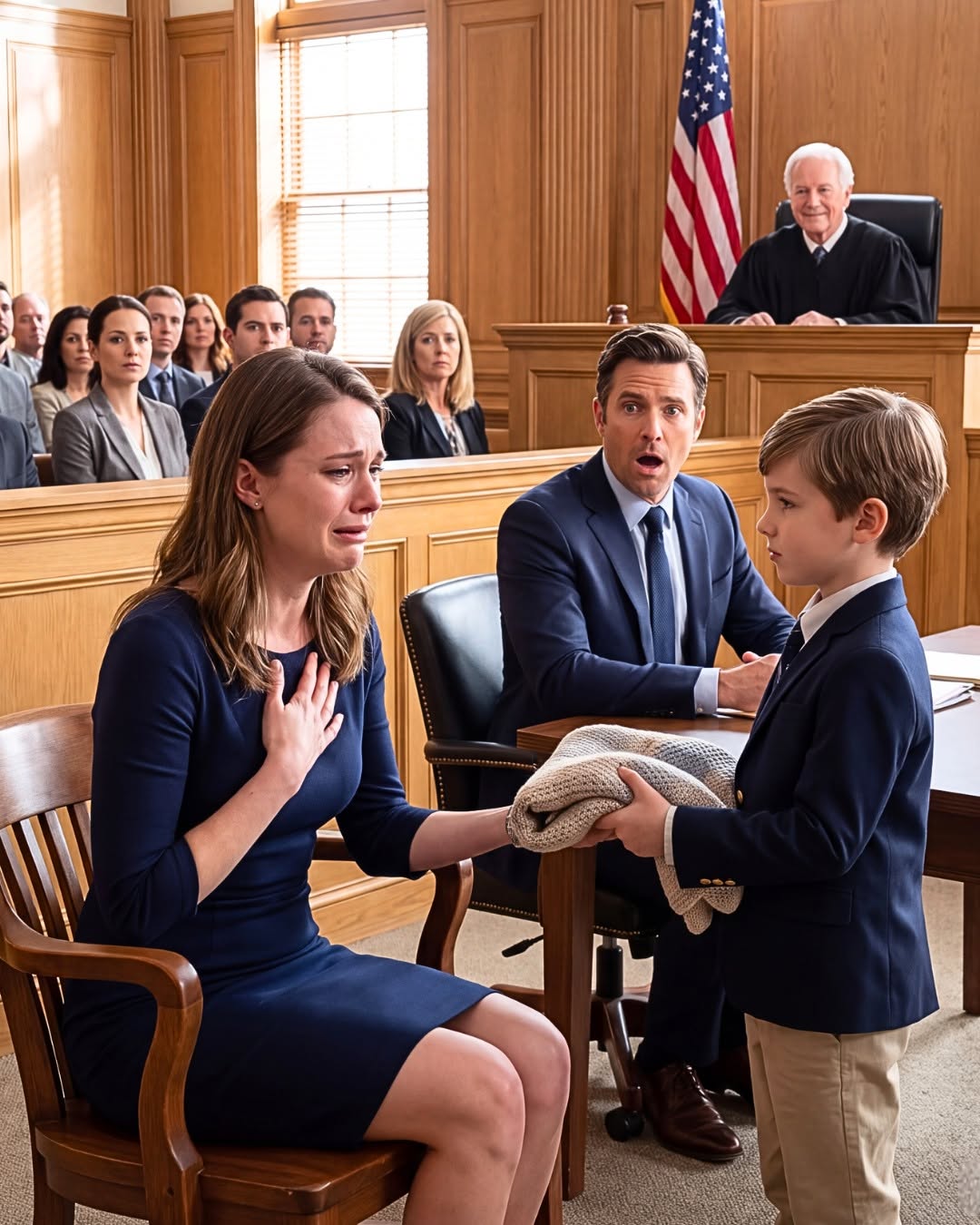
The family courtroom in Lexington, Kentucky, felt colder than the January morning outside.
It was a sterile, unforgiving place that smelled faintly of lemon cleaner and old coffee, the kind of room where families were reduced to evidence and children’s futures were decided by strangers in black robes.
I sat at a narrow wooden table with my eight-year-old son, Ethan, pressed close beside me. His sneakers did not reach the floor, so his legs swung beneath the heavy chair whenever his nervous energy became too much for him to contain.
That morning, I had dressed him in his cleanest jeans, a navy-blue shirt with a small silver star embroidered near the pocket, and winter shoes I had polished with a damp towel until my fingers hurt.
The shirt was not new. The collar had softened after many washes, and a faint mark remained near the bottom seam no matter how hard I scrubbed.
Across the aisle sat my former husband, Charles Donovan, beside his attorney.
Charles wore a perfectly tailored charcoal suit, polished Italian shoes, and the silver watch he had purchased weeks after claiming he could not afford to send child support.
He looked calm, successful, and completely prepared.
He looked like a man who believed he owned the room.
I wore a secondhand cream blazer over a plain black dress.
I had no attorney because I could not afford one. All I had was a worn manila folder filled with school records, medical appointment summaries, rent receipts, work schedules, and printed text messages documenting every promise Charles had broken to our son.
His attorney, Harrison Blake, rose from his chair and approached the bench.
He moved with the polished confidence of a man who charged more in an hour than I earned in a week.
“Your Honor,” he began, “this hearing is not about whether Mrs. Donovan feels affection for her child. We do not question that. The issue is whether affection can compensate for a serious lack of financial stability, safe housing, and responsible decision-making.”
My hand tightened around the edge of the table.
Judge Warren, a stern man with deeply lined features, peered over his glasses.
“Proceed, Mr. Blake.”
The attorney lifted a large photograph mounted on a glossy board and placed it on an easel facing the judge.
It showed Ethan walking home from school three days earlier.
He was wearing the same navy shirt he had on in court, but in the photograph, something dark and sticky covered the front. His hair was disheveled, and his face looked exhausted.
“This image was taken by a licensed private investigator,” Harrison announced. “It reflects the child’s daily reality. He repeatedly appears in dirty, worn clothing. His mother works unstable hours, lives in a cramped apartment, and cannot provide him with even the most basic level of presentability.”
Several people in the gallery shifted uncomfortably.
Ethan stopped swinging his feet.
His ears turned bright pink as he looked down at his lap.
In that moment, I understood the full scale of what Charles had planned.
He was not simply asking for additional visitation.
He had constructed an expensive campaign to portray me as an unfit mother. He wanted to take Ethan from me entirely and use the poverty he had helped create as proof that I loved our child less.
But as I stared at the photograph, another realization came over me.
I knew exactly when it had been taken.
I knew how the stain had gotten on Ethan’s shirt.
And I suddenly understood how deeply Charles had manipulated everything.
For two years, I had been living under a quiet siege.
When Charles left our marriage, he did not simply pack a bag and move out. He dismantled our life carefully.
He took his expensive clothes, the bedroom television, the espresso machine, and nearly everything he considered valuable. Then he moved into a modern townhouse across Lexington and smiled as though we were having an ordinary conversation.
“We’re mature adults, Madeline,” he told me. “There is no reason to complicate this with lawyers. I’ll take care of you and Ethan.”
Within three months, the payments stopped.
Then he stopped answering my calls.
My mother, Helen, moved in shortly afterward. She arrived during a rainstorm with one battered suitcase, her slow cooker, and enough determination to hold our collapsing life together.
“You can fall apart later,” she told me as she gathered the unpaid bills from my hands. “Right now, Ethan needs dinner, and you need to learn how to fight.”
Our apartment was above a bakery and a small medical office.
The windows rattled whenever delivery trucks passed. The radiator hissed loudly but produced little warmth. The kitchen was barely wide enough to open the oven.
Still, we made it a home.
I worked breakfast shifts at a diner, always smelling of coffee and cooking oil. In the evenings, I cleaned executive offices at Briarwood Holdings, one of the largest firms downtown.
I was exhausted, but the office-cleaning job covered the rent and groceries Charles had stopped helping with.
Then, three months before the hearing, I arrived at Briarwood and discovered my security badge no longer worked.
The building manager handed me a termination letter citing anonymous complaints of unprofessional conduct and petty theft.
The accusations were completely false.
I had never stolen so much as a pen.
I begged them to investigate, but the decision had already been made.
Losing that income devastated us.
We fell behind on rent. I began skipping meals so Ethan and my mother could eat. At night, I stared at the ceiling, wondering how much longer I could keep the electricity on.
Weeks later, a former coworker sent me a message.
The complaints had not been random.
One of the vice presidents at Briarwood Holdings was Andrew Mercer.
Andrew Mercer played golf with Charles every Saturday.
My former husband had not simply left us and moved on.
He had reached into my life and cut away the job keeping us afloat. Then he used the financial instability he created as evidence against me.
He had built the problem and was now pointing to it as proof of my failure.
Even before the hearing began, Harrison had mocked Ethan’s clothing in the hallway.
“Clearance-rack fashion,” he murmured to Charles with a smirk.
If he had known what that navy shirt had cost me, perhaps he would have been ashamed.
Perhaps not.
Four months before the hearing, Ethan’s eighth birthday was approaching.
He had become fascinated with space after a school trip to a planetarium. He talked constantly about galaxies, Saturn’s rings, and the unimaginable distance light traveled before reaching Earth.
I had almost no money.
Charles was months behind on his promises, and rent was due.
But I could not bear the thought of Ethan waking on his birthday to nothing but an apology.
One afternoon, I entered a pawnshop in downtown Lexington and removed the only valuable thing I owned: an antique gold locket that had belonged to my grandmother.
My hands shook as I placed it on the counter.
The pawnbroker gave me forty dollars.
It was worth far more, but forty dollars was enough to become hope.
I bought a small grocery-store cake, a book about constellations, and the navy shirt with the silver star that I had seen hanging on a clearance rack.
It cost twelve dollars.
I should have saved the money for the electric bill.
But I wanted Ethan to have one thing that had never belonged to another child.
That night, I folded the shirt and placed it at the foot of his bed.
I stood in the doorway, listening to him breathe beneath his thin green blanket.
I was terrified about our future.
I was exhausted beyond words.
But when I looked at that little shirt, I felt a desperate kind of pride.
I had given my son something new.
I leaned against the doorframe and cried quietly.
I believed Ethan was asleep.
I did not know he was watching me.
Harrison’s voice pulled me back into the courtroom.
“Your Honor, we have shown unstable employment, poor financial management, and unsuitable housing. To provide further evidence regarding the child’s living conditions, we call Mr. George Whitman.”
My blood turned cold.
The courtroom doors opened, and my landlord entered wearing a wrinkled brown suit.
George complained about nearly everything, but he had sometimes allowed me an extra week to pay the rent.
As he walked toward the witness stand, he refused to look at me.
“Mr. Whitman,” Harrison began, “you own the building where Mrs. Donovan lives?”
“Yes.”
“Would you describe the apartment as suitable for a child?”
George swallowed.
His eyes briefly moved toward Charles, who gave him a small nod.
“It’s cramped,” George said. “The heating is unreliable, the windows leak air, and there are smells from the bakery downstairs. She is frequently late on rent. There has also been noise late at night.”
The late-night noise was usually me cleaning because anxiety would not let me sleep, or my mother singing softly to Ethan when the apartment became too cold.
Harrison continued.
“Did you consider evicting her because of the condition of the apartment?”
“I did.”
It was a lie.
He had threatened eviction because of late rent, never because the apartment was dirty. My mother kept it spotless.
I looked at Charles.
He stared down at the table, hiding a smile.
I understood immediately.
He had paid George.
Perhaps he covered the missing rent. Perhaps he simply handed him cash.
Either way, Charles had purchased testimony designed to make poverty look like a moral failure.
When I was allowed to question George, I stood without knowing exactly what to say.
“Have I ever left the building dirty?” I asked. “Have you ever seen Ethan frightened or uncared for?”
George stared at his hands.
“I can only say what the records show, Madeline. I’m sorry.”
He left the stand quickly.
Then Harrison called my mother.
Helen walked forward with her head held high, wearing a navy cardigan and her best pearl earrings.
Harrison tried to portray her presence in our apartment as proof that I could not care for Ethan on my own.
“Would you say you are the child’s real parent because your daughter is constantly working?”
My mother looked directly at him.
“Helping my daughter does not replace her,” she said. “It means our family supports one another.”
Harrison began to interrupt, but she continued.
“A larger house does not guarantee a kinder home. You keep discussing what my daughter cannot buy. You have not once mentioned what this child is afraid to lose.”
Judge Warren’s expression softened slightly.
But the pile of manufactured evidence remained overwhelming.
Late rent.
Job loss.
The landlord’s testimony.
The photograph of Ethan appearing dirty and neglected.
The judge shuffled his papers and sighed.
“If there is no additional evidence—”
“Wait.”
The word was quiet, but it cut through the courtroom.
Ethan stood.
His chair scraped against the floor.
His small fists tightened against his jeans.
“Ethan, sweetheart, sit down,” I whispered, reaching for him.
He shook his head.
“I need to say something about that picture.”
Harrison immediately rose.
“Your Honor, the child is a minor and clearly under emotional pressure. Allowing him to make an unsworn statement would be highly inappropriate.”
“Sit down, Mr. Blake,” Judge Warren said.
Then he leaned toward Ethan.
“You do not have to speak. But if you want to tell me something, I will listen.”
Ethan took a trembling breath and pointed toward the photograph.
“That picture is a lie.”
Charles shifted in his chair.
“Ethan, buddy, don’t do this.”
“Let him speak,” the judge warned.
“My dad came to my school that day,” Ethan said. “Mom didn’t know. He told me it was a secret visit.”
I stared at my son.
Charles had never told me he had seen him.
“He bought me a giant chocolate milkshake,” Ethan continued. “I didn’t want all of it, but he kept telling me to drink faster.”
His eyes filled with tears.
“Then when we were walking, he bumped into me really hard. The milkshake spilled all over my shirt.”
The courtroom became silent.
“I cried because Mom worked hard to buy it for me. I asked Dad to help clean it in the gas-station bathroom, but he said we had to go to the corner.”
Ethan pointed at the photograph.
“There was a man waiting in a car with a camera. Dad told me to look sad. Then the man took pictures.”
My hand flew to my mouth.
Charles had not merely hired someone to follow us.
He had staged the photograph.
He had humiliated his own child in order to create false evidence against me.
Judge Warren slowly turned toward him.
“Mr. Donovan, is that true?”
Charles adjusted his tie.
“Your Honor, he is confused. Children misunderstand situations. His mother has obviously coached him.”
“She didn’t coach me!” Ethan shouted. “She didn’t know anything.”
His voice echoed through the courtroom.
“You told me not to tell because you said I would get a puppy if I came to live at your big house.”
Charles’s face went pale.
Harrison stood again.
“This is an emotional accusation from a child. It does not change the documented concerns about the mother’s finances.”
“Be quiet, Mr. Blake,” Judge Warren said sharply.
Then he looked at Ethan.
“Is there anything else?”
Ethan nodded.
“This shirt has something inside it.”
He gripped the hem of his navy shirt.
Then he looked at me.
“Can I show him?”
I had no idea what he meant.
Still, I nodded.