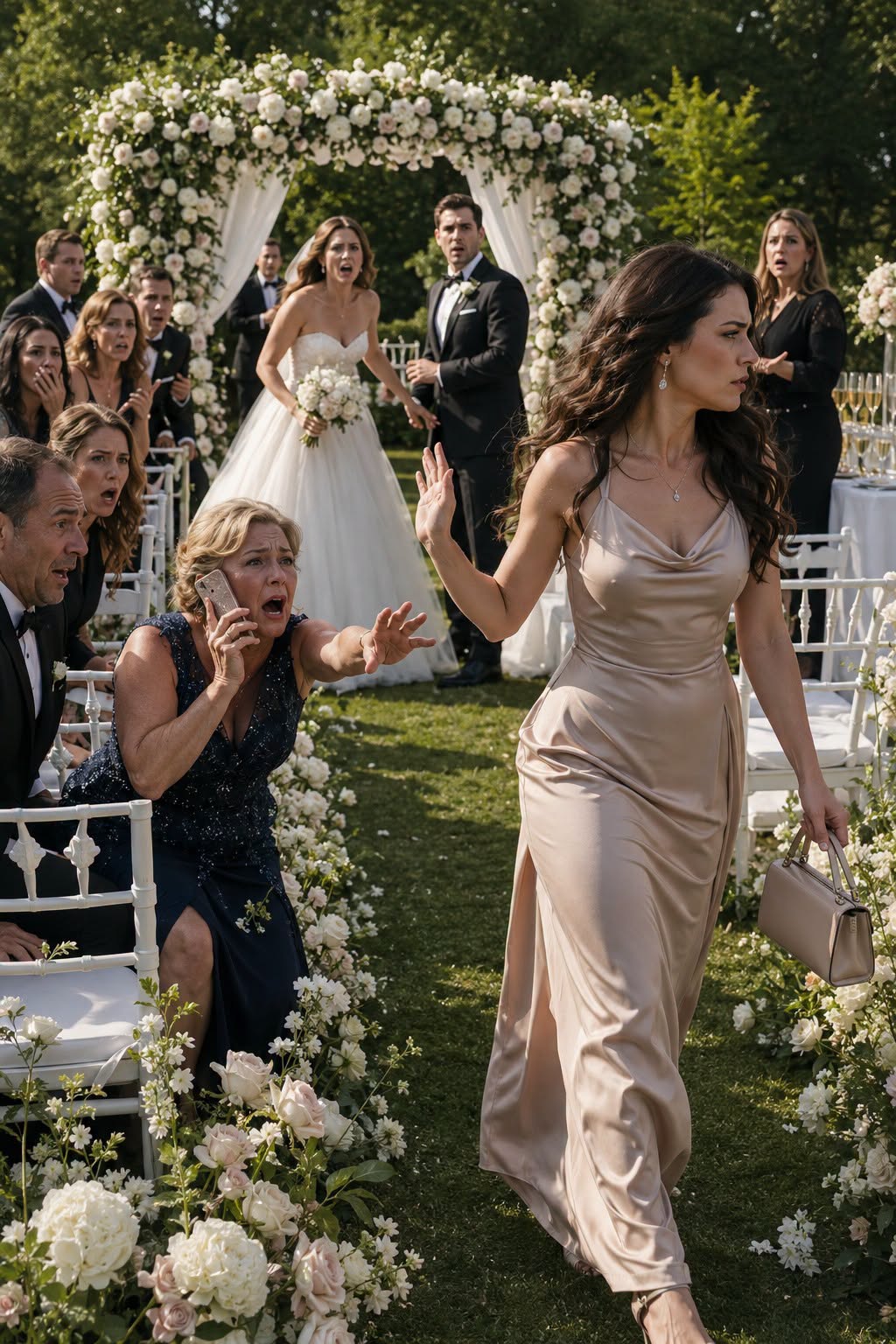
I Arrived At My Sister’s Wedding, Gave My Name, And The Coordinator Froze. “I’m Sorry… You Were Removed From The Guest List This Morning.” I Looked At My Mom. She Smiled. “Why Would We Invite Someone Who Isn’t Really Family?” I Nodded Once, Then Said, “Today Is The Last Time You’ll Ever See Me As Family.” I Turned Around And Left. But During The Ceremony, Mom’s Phone Started Ringing Nonstop.
### Part 1
The wedding coordinator looked at her tablet, looked at me, then looked at the tablet again.
For half a second, I thought she had simply misspelled my name.
Behind her, sunlight spilled through the tall glass doors of Willow Creek Estate, turning the white roses lining the entrance almost silver. Somewhere beyond the courtyard, a string quartet was warming up, repeating the same four notes while waiters carried trays of champagne across the lawn.
Everything smelled like cut flowers, summer grass, and expensive perfume.
I had spent the entire drive there telling myself not to be nervous.
My younger sister was getting married.
After everything our family had been through, I was supposed to be happy.
“Madeline Carter,” I repeated.
The coordinator swallowed.
She was young, maybe twenty-seven, wearing a black headset and holding the kind of professional smile people use when they know something terrible but are hoping someone else will deal with it.
“I’m sorry,” she said quietly. “Could you wait here for just one moment?”
That was when I knew.
Something was wrong.
She stepped away and whispered into her headset.
I stood alone near the entrance holding a small walnut box wrapped with a cream ribbon.
Inside it was my father’s wristwatch.
I had spent nearly a year having it restored.
The watch hadn’t worked since the week he died.
Twelve years earlier.
I wanted to give it to my sister, Lily, before she walked down the aisle.
Not because it was valuable.
It wasn’t.
But Dad had worn it everywhere.
When he fixed the porch.
When he grilled hamburgers on Sunday afternoons.
When he drove Lily to soccer practice.
When he hugged me after I got accepted into nursing school.
I had imagined Lily opening the box and recognizing it immediately.
Maybe she would cry.
Maybe I would cry.
Maybe, after years of being more like strangers than sisters, we would finally find our way back to each other.
Instead, I watched the coordinator return with fear in her eyes.
“Ms. Carter,” she said, “I’m very sorry, but your name was removed from the guest list this morning.”
For a moment, the noises around me seemed to disappear.
“What?”
She lowered her voice.
“You were originally listed. I can see that here. But someone from the wedding party requested a change.”
“Who?”
She hesitated.
I already knew before she answered.
A familiar voice came from behind me.
“There’s really no reason to make this difficult.”
I turned.
My mother, Diane, stood beneath an archway covered in pale roses.
She wore a silver-blue gown, pearl earrings, and the satisfied expression of someone arriving exactly when she intended to.
For years, people had told me how elegant my mother was.
How strong.
How brave.
The widow who had raised two daughters after losing her husband.
People loved telling me what an extraordinary woman she was.
I used to agree.
“Mom,” I said.
She glanced at the walnut box in my hands, then at my dress.
“You came.”
“You knew I was coming.”
Her mouth tightened.
Apparently even that was too much truth for her.
The coordinator shifted uncomfortably between us.
“Mrs. Bennett,” she said, “I explained that Ms. Carter was originally on the list—”
“I know.”
My mother said it brightly.
Then she looked directly at me.
“Things changed.”
“What things?”
Several guests were beginning to glance in our direction.
My mother noticed.
She always noticed an audience.
Her posture straightened.
Her voice became calmer.
More polished.
More dangerous.
“Madeline, today is Lily’s wedding. We are not doing this here.”
“Doing what?”
“You know exactly what.”
Actually, I didn’t.
That was one of the most exhausting parts of dealing with my mother.
She could punish you for crimes she never explained.
“I received an invitation.”
Her eyebrows lifted.
“From whom?”
“Lily.”
That landed.
Only for a second.
But I saw it.
A flicker behind her eyes.
“She mailed it herself,” I added.
Eight weeks earlier, the invitation had arrived at my apartment in a plain cream envelope.
Inside, beneath the printed details, Lily had written one sentence in blue ink.
“Are you coming, please? I mailed this one myself.”
I had read it at my kitchen counter after a fourteen-hour hospital shift.
Then I had sat down and read it again.
And again.
For years, I had convinced myself Lily didn’t want me around.
That she had simply grown up.
Built a life.
Moved on.
That note had made me question everything.
Now my mother stepped closer.
“Lily has enough to worry about today.”
“She invited me.”
“She felt obligated.”
“You don’t know that.”
“I know my daughter.”
The words were deliberate.
My daughter.
Not daughters.
The coordinator stared at the ground.
I felt something cold settle inside my chest.
“Then ask Lily,” I said. “If she tells me she doesn’t want me here, I’ll leave.”
My mother’s face changed.
Barely.
But enough.
“No.”
“Why not?”
“Because I will not have you upsetting her before the ceremony.”
“I’m her sister.”
My mother laughed softly.
It wasn’t a kind laugh.
It was the same sound she had made years earlier when I told her I might apply for a graduate nursing program.
As if my hopes were inconvenient.
Then she said the sentence I would remember for the rest of my life.
“Why would we invite someone who is not really family?”
I stared at her.
A waiter passed behind us carrying crystal glasses.
One clinked against another.
The quartet started playing again.
Somebody nearby laughed.
The whole world continued moving as if mine hadn’t just stopped.
“Not really family,” I repeated.
My mother crossed her arms.
“You’ve made your choices, Madeline.”
“What choices?”
“Missing birthdays. Missing Christmas dinners. Never calling. Always working. Lily needed a sister, and you were never there.”
My throat tightened.
There were answers.
So many answers.
I could have told her where I had been during those birthdays.
What I had been paying during those Christmas dinners.
Why I had worked weekends.
Why I had worked nights.
Why I had stopped buying new clothes for nearly three years.
Why my first apartment had contained a mattress, one chair, and a folding table.
But twelve years of habit is difficult to break.
So I said nothing.
My mother mistook silence for defeat.
She always had.
“I think it would be best if you left.”
I looked past her toward the estate.
Rows of white chairs waited on the lawn.
Hydrangeas and roses surrounded the ceremony arch.
A violinist adjusted her music stand.
Beyond the reception hall, I could see the enormous floral installation Lily had sent me a picture of months earlier.
She had written, “Mom says it’s ridiculous, but I love it.”
I had paid for those flowers.
I had paid for those chairs.
I had paid for the hall where my mother was currently telling me I didn’t belong.
But standing there, I still didn’t feel angry.
Not yet.
I felt tired.
The kind of tired sleep doesn’t fix.
I looked at my mother and realized I had spent most of my adult life waiting for her to become someone she had never been.
“If that’s really what you believe,” I said, “then this is the last time you’ll ever have to pretend I’m your family.”
Her expression twitched.
Maybe she expected an argument.
Maybe tears.
Maybe another apology.
I gave her none.
I set the walnut box carefully on the welcome table.
“For Lily.”
Then I turned around.
The coordinator called after me.
“Ms. Carter?”
I kept walking.
My heels clicked against the stone path.
One step.
Then another.
By the time I reached my car, my hands were shaking so badly I dropped my keys.
I sat behind the steering wheel without starting the engine.
Through the windshield, I could see the top of the ceremony arch above the hedges.
Twelve years.
That was how long I had protected them.
Twelve years of overtime.
Twelve years of secrets.
Twelve years of letting my mother receive gratitude for things she had never done.
And all of it had ended with five words.
“You’re not really family.”
I started the car.
What I didn’t know was that inside the venue, the coordinator had already opened the event contract.
And beside the words PRIMARY CLIENT was a name my mother had apparently forgotten.
Mine.
### Part 2
Twelve years earlier, my father died on a Tuesday morning.
I remember that because Tuesdays had been ordinary before that.
Afterward, nothing about them ever felt ordinary again.
I was twenty-three and three months away from finishing nursing school.
Lily was fifteen.
Dad had complained about a headache before leaving for work.
By noon, he was in an emergency room.
By sunset, machines were breathing for him.
The hospital smelled like disinfectant and burnt coffee.
I understood enough medical language to know what the doctors were trying not to say too bluntly.
The stroke was catastrophic.
There would be no recovery.
I held Lily while she cried.
Mom stood at the foot of the bed staring at Dad’s shoes under the chair.
Three days later, he was gone.
Everyone told us grief would be the hardest part.
They were wrong.
The bills arrived before the flowers from the funeral had died.
Mortgage notices.
Credit cards.
Medical expenses.
A home equity loan I hadn’t known existed.
Dad had handled almost everything financial, and it turned out he had been holding our family together with more desperation than any of us understood.
One night, about two weeks after the funeral, I came home and found Mom sitting on the kitchen floor.
Papers covered the tile around her.
The overhead light was off.
Only the yellow bulb above the stove was burning.
She looked older than she had at the funeral.
“We’re going to lose the house,” she whispered.
I sat beside her.
“How far behind?”
“Three months.”
I picked up the mortgage statement.
My stomach dropped.
“Why didn’t Dad tell us?”
“I don’t know.”
That became the answer to almost everything that year.
I don’t know.
What I did know was that Lily had already lost her father.
I couldn’t stand the thought of her losing her bedroom, her school, her neighborhood, and every remaining piece of normal life too.
“I’ll help.”
Mom grabbed my wrist.
“No.”
“I’m graduating soon.”
“You need to start your own life.”
“I can do both.”
She cried then.
Not loudly.
That somehow made it worse.
Then she made me promise something.
“Lily can never know.”
“Why?”
“She’s fifteen.”
“She knows Dad died.”
“She doesn’t need to know everything else is falling apart too.”
I understood the instinct.
At least, I thought I did.
So I promised.
After graduation, I took a position in intensive care at St. Catherine’s Medical Center.
Night shift paid more.
Weekends paid more.
Holidays paid more.
So I worked all of them.
My first paycheck arrived on a Friday.
By Saturday morning, nearly half of it was in Mom’s account.
The mortgage payment cleared Monday.
That should have been temporary.
It wasn’t.
The house needed a new furnace that winter.
I paid for it.
Lily needed braces.
I paid for them.
There was a school trip to Washington she thought she would have to miss.
Mom called me crying.
I covered it.
When Lily needed a laptop for college applications, I bought one and had Mom give it to her.
Every time, Mom repeated the same thing.
“She’s been through enough.”
And every time, I agreed.
At first, I didn’t mind.
I loved my sister.
If staying invisible made her feel safe, I could live with that.
The problem was that invisibility became convenient for my mother.
At Thanksgiving three years after Dad died, I arrived two hours late because a patient had crashed near the end of my shift.
I hadn’t even taken off my coat when Lily said, “Nice of you to show up.”
She was eighteen then.
I thought she was joking.
She wasn’t.
“I was working.”
“You’re always working.”
Mom stood at the sink carving leftovers into containers.
She didn’t look at me.
Lily continued.
“Mom manages everything and you just send a text every few weeks.”
I stared at her.
“Is that what you think?”
“What else am I supposed to think?”
I looked toward Mom.
She gave me one small shake of her head.
The promise.
Lily can never know.
So I swallowed the truth.
“I’m sorry.”
That became the beginning.
Or maybe the beginning had happened long before and I simply hadn’t noticed.
Invitations stopped reaching me.
Mom would call afterward.
“Oh, honey, I thought Lily told you.”
Or, “I assumed you were working.”
Or, “It was last minute.”
Birthdays.
Graduations.
Family dinners.
Photographs appeared online afterward.
Mom and Lily smiling together.
Aunts and cousins.
Neighbors.
Sometimes people I barely recognized.
Everyone except me.
Meanwhile, the money kept moving.
When Lily got accepted to college, Mom told everyone she had been saving for years.
I said nothing.
Tuition came due every semester.
I transferred the money.
Books.
Housing.
Lab fees.
I transferred more.
One winter, after three consecutive twelve-hour shifts, I fell asleep in my car in the hospital parking garage.
A security guard knocked on my window at 7:20 in the morning.
“You okay, ma’am?”
I blinked at him, confused about where I was.
Then my phone buzzed.
Mom.
“I hate asking this,” she said.
She always began that way.
Lily needed another payment by Friday.
I sent it before driving home.
The strange thing was, I still didn’t resent my sister.
I told myself she was young.
She didn’t know.
The anger I should have felt had nowhere to go because the whole arrangement had been built around secrecy.
Then Lily graduated.
I watched the ceremony through a livestream from the nurses’ station because somehow my ticket had “been misplaced.”
Afterward, Mom sent me a photograph.
Lily in her cap and gown.
Mom beside her.
The caption underneath read, “We did it.”
I stared at those three words for a long time.
We did it.
That night, one of my coworkers, Jonah, found me eating vending-machine crackers during break.
“You look like you want to fight the wall.”
“I’m fine.”
He looked at the crackers.
“That’s usually what people eating cheese-flavored cardboard at two in the morning say.”
I laughed despite myself.
Jonah became one of the first people in years who noticed when I was hurting.
Not because I told him much.
I didn’t.
I had become very good at silence.
Years passed.
Lily built a career in graphic design.
I became a charge nurse.
Mom remodeled the kitchen.
People praised her resilience.
Then Lily met Noah Mercer.
I first heard about him through Mom.
“He’s wonderful,” she said. “Stable. Kind. Good family.”
Six months later, Lily called me herself.
That was unusual enough that I stepped into an empty supply room to answer.
“I’m engaged.”
For one bright second, she sounded like the little sister who used to steal my sweaters.
“Lily, that’s amazing.”
“Thank you.”
Silence followed.
Then she said, “I know we’re not close anymore.”
The sentence hurt more than she probably intended.
“I know.”
“I’d still like you there.”
“I’d like that too.”
Three weeks later, Mom called.
She had found a venue.
Willow Creek Estate.
Lily had apparently fallen in love with it.
“It’s perfect,” Mom said.
“Then book it.”
Another silence.
“We can’t.”
“How much?”
“Twenty-one thousand.”
I leaned against my kitchen counter.
My savings account could handle it.
Barely.
That money was supposed to become a down payment on a townhouse.
A place with more than one bedroom.
A life that finally belonged entirely to me.
Mom lowered her voice.
“She’s had such a hard life, Maddie.”
I closed my eyes.
There it was again.
The same sentence in a different form.
She’s been through enough.
“What exactly does the twenty-one cover?”
“Venue, tables, chairs, catering deposit, ceremony setup.”
“And the rest?”
“We can manage.”
I knew we meant me.
Still, I said, “Send me the contract.”
The venue required the person providing the payment method to sign as primary client.
So I did.
Mom was listed as planning contact.
I barely read the administrative language.
Cancellation.
Guest modifications.
Vendor authorization.
Client approval.
I signed between two ICU shifts and emailed it back.
Then I transferred the deposit.
I didn’t know that signature would become the first thing in twelve years my mother could not talk her way around.
### Part 3
Eight weeks before the wedding, an envelope appeared beneath my apartment door.
No return address.
Cream paper.
My name written by hand.
I almost tossed it onto the counter with the grocery advertisements until I recognized the handwriting.
Lily.
Inside was the wedding invitation.
And beneath the printed schedule, she had written:
“Are you coming, please? I mailed this one myself.”
I sat at my kitchen table for several minutes.
The apartment was quiet except for the refrigerator humming and rain tapping the fire escape.
I read those words until the ink blurred.
I mailed this one myself.
That sentence bothered me.
Why emphasize it?
I called her.
She didn’t answer.
Two hours later she texted.
“Crazy busy. Talk soon?”
We never did.
Every time I tried after that, something interrupted.
A deadline.
A dress fitting.
A meeting.
Once, Mom answered Lily’s phone.
“She’s overwhelmed,” she said.
“Why do you have her phone?”
“She left it here.”
“Tell her I called.”
“Of course.”
Something in her tone made the hairs on my arms rise.
Still, I ignored it.
I had spent twelve years ignoring small alarms.
The wedding became another thing happening around me.
I wasn’t invited to the bridal shower.
Mom said it was “very small.”
Pictures later showed nearly forty people.
I wasn’t included in the rehearsal dinner.
Mom said the restaurant had limited seating.
A cousin posted a photograph of three empty chairs at their table.
I noticed.
I said nothing.
Then, four days before the ceremony, Lily called.
I was washing my hands after a shift.
Her voice sounded strained.
“You’re coming Saturday, right?”
I froze.
“Yes.”
“Good.”
“Why?”
“No reason.”
“Lily.”
Someone spoke near her.
I heard Mom’s voice in the background.
Lily quickly said, “I have to go.”
The call ended.
That should have told me everything.
Instead, I chose hope.
Saturday morning, I woke before my alarm.
For once, I wasn’t exhausted.
I drank coffee by the window and watched the city brighten.
Then I took Dad’s watch from my dresser.
It had been sitting there for months.
A repair specialist had rebuilt the movement, cleaned the scratched crystal, and replaced the worn leather strap with one almost identical to the original.
On the back was a tiny engraving Dad had gotten years ago.
For time well spent.
I used to think it was sentimental.
After twelve years, it felt like a question.
Had mine been?
At Willow Creek Estate, I found out exactly how my mother valued those twelve years.
“You’re not really family.”
After I drove away, I headed nowhere in particular.
I crossed two intersections before realizing I was crying.
Not dramatically.
No sobbing.
Just silent tears sliding down my face while the air conditioner blew too cold against my hands.
At a red light, my phone vibrated.
Unknown number.
I ignored it.
Then again.
Then again.
I finally pulled into the parking lot of a small grocery store.
The phone rang a fourth time.
“Hello?”
“Ms. Carter?”
It was the wedding coordinator.
Her name was Rachel.
Her voice was tight.
“I’m very sorry to bother you.”
“You’re not bothering me.”
“I need to confirm something regarding today’s event.”
I wiped my cheek.
“What?”
“You are the primary client on the Willow Creek contract, correct?”
I looked through the windshield at shopping carts rattling in the wind.
“I paid for it, yes.”
“And you did not authorize your removal from the event?”
My sadness shifted.
Not into anger.
Into confusion.
“No.”
A pause.
“Mrs. Bennett informed our team this morning that you would no longer be attending and directed staff to remove your name.”
“So?”
“So our event agreement requires written authorization from the primary client for any material changes affecting client access or event administration.”
I almost laughed.
It sounded absurd.
“My mother removed me from a guest list. I don’t care about the paperwork.”
“I understand. But legally and operationally, you’re not simply a guest.”
That sentence changed the air around me.
Rachel continued.
“You’re the contracting client.”
I closed my eyes.
Of course.
I had signed everything.
“What does that mean?”
“It means we cannot continue under a conflicting instruction from someone who does not have authority to exclude the primary client.”
I rubbed my forehead.
“What are you saying?”
“The ceremony is currently paused.”
I sat upright.
“What?”
“Please understand, this wasn’t done as retaliation. We have compliance requirements.”
“Rachel, start the wedding.”
“We need your written authorization confirming that the event may proceed without your presence.”
For twelve years, my mother had used my silence as permission.
Now a stranger was asking me to formally provide it.
“Email me whatever you need.”
Another pause.
“Your sister is asking what happened.”
My stomach turned.
“Don’t tell her today.”
“I’m afraid she already knows you were removed.”
Of course she did.
“How?”
“The groom was informed because he is also listed on the event file.”
I leaned back in my seat.
This had become exactly what I never wanted.
A scene.
A spectacle.
My sister’s wedding turning into a family disaster.
“I don’t want Lily punished because of Mom.”
“I understand.”
“Then let them continue.”
“I’ll send the authorization.”
Before she hung up, Rachel said something else.
“There’s another matter.”
“What?”
“Mr. Mercer’s father heard your name.”
Noah’s father.
“Okay.”
“He says he knows you.”
I searched my memory.
“Who is he?”
“Thomas Mercer.”
The name meant nothing for two seconds.
Then everything clicked.
Room 714.
Two years earlier.
Massive heart attack.
Complications.
A terrified wife.
A son who came every night after work.
And a patient named Thomas Mercer who once grabbed my hand at three in the morning and whispered, “Don’t let me die while my family’s asleep.”
I remembered sitting beside him after my shift officially ended.
Talking about baseball.
Old cars.
His son’s upcoming promotion.
Anything to keep him calm.
“You’ve got to be kidding me,” I whispered.
Rachel gave a nervous laugh.
“He recognized your name immediately.”
Back at the venue, events were apparently unfolding faster than anyone could control.
Thomas told Noah how he knew me.
Noah asked why his fiancée’s supposedly selfish, absent sister had once spent hours comforting a stranger’s family without being paid to stay.
Then Rachel explained that I was also the person who had paid the venue invoice.
Noah asked Lily whether she knew.
She didn’t.
Lily asked Mom.
Mom tried to deflect.
Then my sister started asking questions she should have asked years earlier.
Who paid for college?
Who paid for the house after Dad died?
Why had Mom always said there was never enough money while somehow every emergency disappeared?
Why had I missed so many family events?
Why did Mom always seem to know when I was working before invitations were sent?
The story my mother had built over twelve years suddenly had cracks.
And once Lily saw one, she started looking for the others.
My phone rang again twenty minutes later.
This time, Lily’s name appeared.
I stared at it until the final ring.
Then I answered.
I heard crying before she spoke.
“Maddie?”
“Yeah.”
One breath.
Then another.
“Was it all true?”
I knew exactly what she meant.
The mortgage.
College.
The wedding.
The years.
My silence.
I could have softened it.
I could have protected Mom one more time.
Instead, I looked at my reflection in the rearview mirror and finally stopped carrying a promise that had destroyed me.
“Yes.”
Nothing on the other end.
Then Lily whispered, “Oh my God.”
### Part 4
Lily didn’t ask me to explain everything.
Not immediately.
That surprised me.
Instead, she asked one question.
“Will you come back?”
I gripped the steering wheel.
“I don’t think that’s a good idea.”
“Please.”
“Lily—”
“I need you here.”
“You’re getting married.”
“I know.”
“Then get married.”
Her breathing shook.
“I don’t know what’s true anymore.”
I understood that feeling better than she could possibly know.
“Your relationship with Noah is true.”
“Yes.”
“Then start there.”
She began crying harder.
Behind her, I heard voices.
Doors opening.
Someone saying the guests were waiting.
Then Lily spoke more quietly.
“Mom told me you hated us.”
I shut my eyes.
“She said after Dad died, you wanted your own life. She said you helped at first, then got tired of us.”
I felt the first real flash of anger.
Not because my mother had taken credit.
I already knew that.
But because she hadn’t merely erased me.
She had replaced me with someone cruel.
“That’s not what happened.”
“I know that now.”
“No, you know part of it.”
“Then tell me the rest.”
“Not today.”
“Maddie—”
“This is your wedding day. If I come back, it’s because you want your sister there, not because everyone suddenly discovered who paid the invoice.”
“I wanted you there before I knew.”
That stopped me.
“How do I know that?”
“The invitation.”
I remembered the handwriting.
I mailed this one myself.
Lily continued.
“I found out Mom never sent the first one.”
A cold wave moved through me.
“What?”
“I asked her about the guest list two months ago. She said you had already declined.”
“I never received anything.”
“I know.”
“So you mailed another.”
“Yes.”
“Why secretly?”
“Because she kept telling me to leave you alone.”
I said nothing.
“I thought you hated me,” Lily whispered.
“I never hated you.”
“I hated you sometimes.”
That hurt.
But at least it was honest.
“I know.”
“I thought you couldn’t be bothered to show up for anything.”
“Sometimes I couldn’t.”
“Because you were working?”
“Yes.”
“For us?”
The answer caught in my throat.
“For a long time.”
Lily cried quietly.
Then she said, “The box.”
“What?”
“The gift you left.”
My chest tightened.
“I opened it.”
I pictured Dad’s watch in her hands.
“He wore this all the time.”
“I know.”
“It’s running.”
“Yes.”
“How long did you have it?”
“Since Dad died.”
Another silence.
Then Lily said, “Please come back.”
I looked at the grocery store entrance.
People walked past carrying paper bags and cases of soda.
Normal lives.
Normal Saturdays.
For once, I wanted one.
But I also knew that if I drove home, this day would become another story my mother could rewrite later.
Madeline caused a scene.
Madeline ruined the wedding.
Madeline refused to come back.
So I started the car.
“I’ll come.”
When I returned to Willow Creek, the atmosphere had completely changed.
Guests still sat on the lawn, but conversations had become restless.
The quartet had stopped playing.
Staff members moved quickly between the ceremony area and reception hall.
Rachel met me near the entrance.
“I’m so sorry.”
“You didn’t do anything.”
“I should have handled it more discreetly.”
“You were doing your job.”
That seemed to surprise her.
Most people expected anger to look for somewhere to land.
Mine had finally found the right person.
Mom was standing near the bridal suite.
The moment she saw me, she stormed forward.
“What did you do?”
There she was.
Not the grieving widow.
Not the elegant mother of the bride.
Just Diane Bennett, furious because the person she controlled had stopped cooperating.
“I came back because Lily asked me.”
“You’ve turned this into a circus.”
“I left.”
“You knew exactly what would happen.”
“No, Mom. I didn’t.”
She lowered her voice.
“You’re enjoying this.”
I almost admired the accusation.
“How could I possibly enjoy this?”
“Everyone is looking at me like I’m some monster.”
I looked past her.
Thomas Mercer stood near the reception doors with his wife.
When our eyes met, recognition softened his face.
He gave me a small wave.
My mother noticed.
“You’ve poisoned them against me.”
“I haven’t spoken to anyone.”
“That’s not the point.”
“It actually is.”
She stepped closer.
“I did what I had to do after your father died.”
“So did I.”
“You volunteered.”
The words hit harder than I expected.
I stared at her.
“Yes,” I said slowly. “I did.”
“So stop acting like I forced you.”
“I never said you did.”
“You always wanted to be the martyr.”
I laughed.
For the first time that day, I actually laughed.
Not because it was funny.
Because twelve years of confusion suddenly became simple.
My mother did not feel guilty.
She felt entitled.
To the money.
To the credit.
To my silence.
To my loyalty.
Even to my absence.
“You know what?” I said. “You’re right about one thing.”
Her eyes narrowed.
“I volunteered.”
I took one step back.
“And now I’m done.”
Her face lost color.
“What does that mean?”
“It means after today, you don’t call me when the roof leaks.”
“Madeline.”
“You don’t call me when property taxes are due.”
“Stop.”
“You don’t call when you need a new car, a furnace, a loan, a credit card paid, or a family emergency fixed.”
People nearby had started listening.
I didn’t raise my voice.
I didn’t need to.
“You wanted me outside the family,” I said. “Congratulations.”
Mom’s mouth opened.
Nothing came out.
For once, silence belonged to her.
Then Lily appeared.
She was wearing her wedding dress.
For a moment, every angry thought disappeared.
She looked beautiful.
Not magazine beautiful.
Lily beautiful.
Her dark hair pinned loosely.
Dad’s small silver charm attached to her bouquet.
Tears had ruined part of her makeup.
In her right hand, she held his watch.
“Maddie.”
Mom turned sharply.
“Go back inside.”
Lily didn’t move.
“Mom, stop.”
“Your guests are waiting.”
“They can wait another minute.”
“You are letting her ruin your wedding.”
Lily’s face changed.
“No.”
She looked at me.
“She saved it.”
Mom scoffed.
“You don’t understand.”
“I understand enough.”
Then Lily did something neither of us expected.
She handed her bouquet to Rachel.
Walked toward me.
And held out Dad’s watch.
“I want you to keep this for now.”
I frowned.
“It’s yours.”
“I know. But I need you to do something first.”
“What?”
She swallowed.
“Walk me down the aisle.”
My heart seemed to stop.
Mom made a sound behind her.
“No.”
Lily turned.
“Dad can’t do it.”
“I was going to.”
“I know.”
“I’m your mother.”
“And she’s my sister.”
Mom stared at her.
Lily turned back to me.
“I spent twelve years believing she chose me and you chose yourself.”
Her voice broke.
“But that wasn’t what happened.”
I looked at the aisle stretching beyond the doors.
Hours earlier, I had been denied permission to walk through the entrance.
Now my sister was asking me to walk beside her toward the beginning of her new life.
“Are you sure?”
Lily nodded.
“Completely.”
I took Dad’s watch.
Fastened it around my wrist.
Then offered her my arm.
As the doors opened, every guest stood.
No one applauded.
No one spoke.
The only sound was the quartet beginning again and Lily taking one trembling breath beside me.
Halfway down the aisle, she whispered, “I’m sorry.”
I looked straight ahead.
“We’ll talk later.”
It wasn’t forgiveness.
Not yet.
Maybe not for a long time.
But it was the first honest thing between us in years.
And sometimes honesty is the only place a relationship can begin again.
### Part 5
The wedding continued.
That mattered to me.
For all the damage my mother had caused, I refused to let her become the most important person in Lily’s marriage story.
Noah stood at the end of the aisle with tears in his eyes.
When Lily reached him, he took her hand and quietly said, “You okay?”
She nodded.
Then she looked at me.
For once, there was no confusion in her expression.
Only recognition.
I took my seat in the front row.
Not beside Mom.
Rachel had arranged another chair.
Thomas Mercer sat behind me.
Before the ceremony began, he leaned forward.
“I knew I remembered you.”
I turned.
He smiled.
“You sat with me all night when I thought I wasn’t going to make it.”
“That was a long time ago.”
“Not to me.”
His wife touched his arm.
“You remembered our son’s name every time you walked in,” she said. “That meant more than you knew.”
Across the aisle, Mom heard every word.
I didn’t look at her.
For years, I had wanted her to understand my worth.
Standing there, I realized I no longer needed her to.
The ceremony was simple after everything that preceded it.
Noah promised patience.
Lily promised honesty.
That word nearly made me laugh.
Honesty.
What an expensive lesson it had become.
When they kissed, everyone stood.
I stood too.
And for the first time that day, I was simply happy for my sister.
The reception was more complicated.
People approached me cautiously.
An aunt I hadn’t spoken to in three years touched my elbow.
“I had no idea.”
I smiled.
“That was the point.”
A cousin apologized for assuming I avoided the family.
A neighbor told me she had always wondered why Mom seemed to have so much money while claiming she had none.
Everyone wanted the story.
I gave almost nobody one.
I had spent too many years allowing my family’s private pain to consume my life.
I wasn’t going to spend another evening performing it for an audience.
Then Thomas found me near the terrace.
He handed me a glass of sparkling water.
“You’re still rescuing people who don’t deserve the effort?”
I laughed.
“Occupational hazard.”
“You look tired.”
“I work nights.”
“No. Not that kind.”
That landed differently.
Before I could answer, someone called him for a photograph.
He squeezed my shoulder and left.
I stood alone watching the sun lower over the field.
That was when Jonah texted.
The coworker who once found me eating vending-machine crackers at two in the morning had become one of my closest friends over the years.
“How bad is the family wedding?”
I typed back.
“You would not believe me.”
His response came immediately.
“Try me.”
I smiled.
For the first time all day, the expression felt natural.
I didn’t realize Lily had approached until she stood beside me.
“Who’s making you smile?”
“A friend.”
Her eyebrow lifted.
“A friend?”
“Don’t start.”
For a second, we were sisters again.
Then her expression became serious.
“Can we talk?”
We walked beyond the reception tent toward a small garden.
Music drifted behind us.
Someone had started dancing.
The scent of roses mixed with warm grass.
Lily sat on a stone bench.
I remained standing.
“I asked Mom everything,” she said.
I waited.
“She admitted the mortgage.”
I nodded.
“College.”
Another nod.
“The braces.”
“Yes.”
“The Washington trip.”
“Yes.”
“My laptop?”
“Yes.”
Lily covered her mouth.
“And the wedding.”
“You already knew that.”
“Twenty-one thousand dollars?”
“That was the venue package.”
Her eyes widened.
“There was more?”
I winced.
“Some.”
“How much?”
“It doesn’t matter.”
“It matters to me.”
“The flowers. Part of the catering. Your photographer’s second payment.”
She stared at me.
“Why?”
There are questions that sound simple until you have lived twelve years inside the answer.
“Because you were my little sister.”
“That’s it?”
“At first.”
“And later?”
I looked toward the reception.
Mom was visible through the open tent, surrounded by people but somehow alone.
“Later, I think I got trapped inside the promise.”
“What promise?”
“That you wouldn’t know.”
Lily’s face crumpled.
“Why would Mom ask that?”
“She thought she was protecting you.”
“She was protecting herself.”
I didn’t answer.
Because Lily was right.
Maybe it had started differently.
Maybe in those first terrible weeks after Dad died, Mom truly believed secrecy would preserve Lily’s childhood.
But somewhere along the way, protection became possession.
My sacrifice became her reputation.
And once people admired her for surviving alone, she couldn’t bear to lose the story.
“She told me you didn’t want me,” Lily said.
“I know.”
“She said you thought I was spoiled.”
“I never said that.”
“She said you resented paying anything after Dad died.”
“I never said that either.”
Lily wiped her face.
“I believed her.”
“You were fifteen.”
“I wasn’t fifteen forever.”
“No.”
“I should have called.”
“Yes.”
Her eyes lifted.
She clearly hadn’t expected me to agree.
“I should have asked you.”
“Yes.”
“I should have noticed.”
“Yes.”
Tears returned.
I sat beside her then.
Not because she was innocent.
Because she was finally taking responsibility.
“I can’t pretend the last twelve years didn’t happen,” I said.
“I know.”
“I love you, Lily.”
She cried harder.
“But loving you doesn’t mean I can immediately trust you.”
She nodded.
“I understand.”
“And I’m not going back to how things were.”
“I don’t want that either.”
“We start from here.”
“How?”
“Slowly.”
That was all I could promise.
With Mom, there was even less to say.
She approached me near the end of the reception.
Most guests were dancing.
Lily and Noah had disappeared for photographs.
Mom looked exhausted.
Her perfect hair had loosened.
Her lipstick was gone.
For the first time, she looked closer to her real age.
“We need to talk,” she said.
“No.”
Her eyebrows rose.
“Madeline.”
“Not tonight.”
“When?”
I thought about it.
“Maybe never.”
She stared at me.
“I’m your mother.”
Hours earlier, that sentence might have controlled me.
Now it sounded like a job title from a company I no longer worked for.
“You told me I wasn’t really family.”
“I was angry.”
“You had me removed before I even arrived.”
“I knew you would make Lily uncomfortable.”
“She invited me herself.”
“I didn’t know that.”
“Yes, you did.”
Her silence answered.
I continued.
“You intercepted the first invitation, didn’t you?”
She looked away.
That was enough.
Something inside me closed.
Not violently.
Quietly.
Like a door clicking shut.
“You didn’t just lie about me,” I said. “You actively kept us apart.”
“I was trying to keep peace.”
“No. You were trying to keep control.”
“That is not fair.”
“Fair?”
I almost laughed.
Then I realized I didn’t care enough to argue.
That was the strangest part.
For years, I had imagined confrontation as something explosive.
Shouting.
Accusations.
Tears.
Instead, the end arrived softly.
I simply stopped wanting anything from her.
No apology.
No confession.
No understanding.
Nothing.
“You should enjoy the rest of Lily’s wedding,” I said.
“Madeline, please.”
“I’ll transfer the remaining venue authorization to Lily and Noah tomorrow. After that, our financial connection ends.”
Fear flashed across her face.
“What about the house?”
“The house is in your name.”
“I can’t afford everything by myself.”
“You should have considered that before deciding I wasn’t family.”
Her face hardened.
“There it is.”
“What?”
“The punishment.”
“No.”
I shook my head.
“This is the consequence.”
She stared at me for several seconds.
Then she whispered, “After everything I’ve been through.”
Once, that sentence would have worked.
I would have remembered Dad.
The kitchen floor.
The unpaid bills.
Her grief.
I still remembered all of it.
I simply no longer believed suffering gave someone permission to use other people forever.
“I hope you figure things out,” I said.
And I walked away.
Three months later, Mom sold the house.
Not because I forced her.
Because without my monthly transfers, maintaining it no longer made sense.
She moved into a smaller condo twenty minutes away.
Several relatives suggested I should help.
I declined.
Some called me cold.
That bothered me less than I expected.
Lily and I started having coffee every other Sunday.
The first few were awkward.
We talked about work.
Weather.
Noah.
Anything safe.
Eventually, we talked about Dad.
Then college.
Then the years we lost.
Sometimes she apologized too much.
I started stopping her.
“If we’re going to rebuild something, we can’t spend every conversation at a funeral for the old version.”
So we built something new.
Not the relationship we might have had.
A different one.
More careful.
More honest.
Real.
Six months after the wedding, Lily invited me to dinner.
When I arrived, Noah opened the door carrying a bottle of wine.
“Your sister is burning something.”
From the kitchen, Lily yelled, “I heard that.”
I laughed.
The apartment smelled like garlic, smoke, and bread.
It felt imperfect.
Normal.
On the table sat the walnut box.
Lily opened it after dinner.
Dad’s watch was inside.
“I think you should have it,” she said.
“It belongs to you.”
“No.”
She shook her head.
“You carried this family long enough. Dad would want you to keep something.”
I ran my thumb across the scratched crystal.
Then I fastened the watch around my wrist.
The second hand moved steadily.
For time well spent.
I finally understood the engraving.
Not all time is well spent because the people you give it to deserve it.
Sometimes the value comes from learning when to stop giving.
I eventually bought the townhouse I had postponed for years.
Nothing extravagant.
Two bedrooms.
A small balcony.
A kitchen with morning light.
Jonah helped me move.
He complained about the stairs, dropped a box of towels, and ordered terrible pizza afterward.
Our friendship changed slowly after that.
No dramatic confession.
No sudden fairy-tale ending.
Just dinners after work.
Walks on Sundays.
His toothbrush beside mine one morning almost a year later.
For once, love didn’t feel like sacrifice.
It felt like being met halfway.
Mom called occasionally.
I rarely answered.
When I did, our conversations were polite and short.
She apologized once.
Maybe she meant it.
Maybe she didn’t.
I told her I accepted that she was sorry.
I never told her everything was forgiven.
Because it wasn’t.
Forgiveness, I learned, is not the same as reopening a door.
Some doors close because hatred is inside them.
Others close because peace is waiting on the other side.
The last time I visited Lily, she had framed a wedding photograph in her hallway.
Not the kiss.
Not the first dance.
It showed the two of us at the beginning of the aisle.
Her hand looped through my arm.
Dad’s watch visible on my wrist.
Both of us looking forward.
I stood there longer than I meant to.
Lily came up behind me.
“You okay?”
I smiled.
“Yeah.”
And I was.
For twelve years, I believed silence was love.
I believed protecting someone meant carrying pain where they could never see it.
I believed family meant staying, paying, forgiving, explaining, and accepting whatever came next.
I was wrong.
Love without truth becomes a hiding place for lies.
Sacrifice without boundaries becomes permission.
And family is not determined by who demands your loyalty the loudest.
It is determined by who still values you when you stop being useful.
My mother crossed my name off a wedding guest list because she thought she had the power to decide whether I belonged.
In the end, the wedding continued.
My sister got married.
The truth came out.
And I walked away with something far more important than revenge.
I stopped begging to belong in a family I had spent twelve years secretly holding together.
Then I finally went home and started building a life that belonged to me.
THE END!