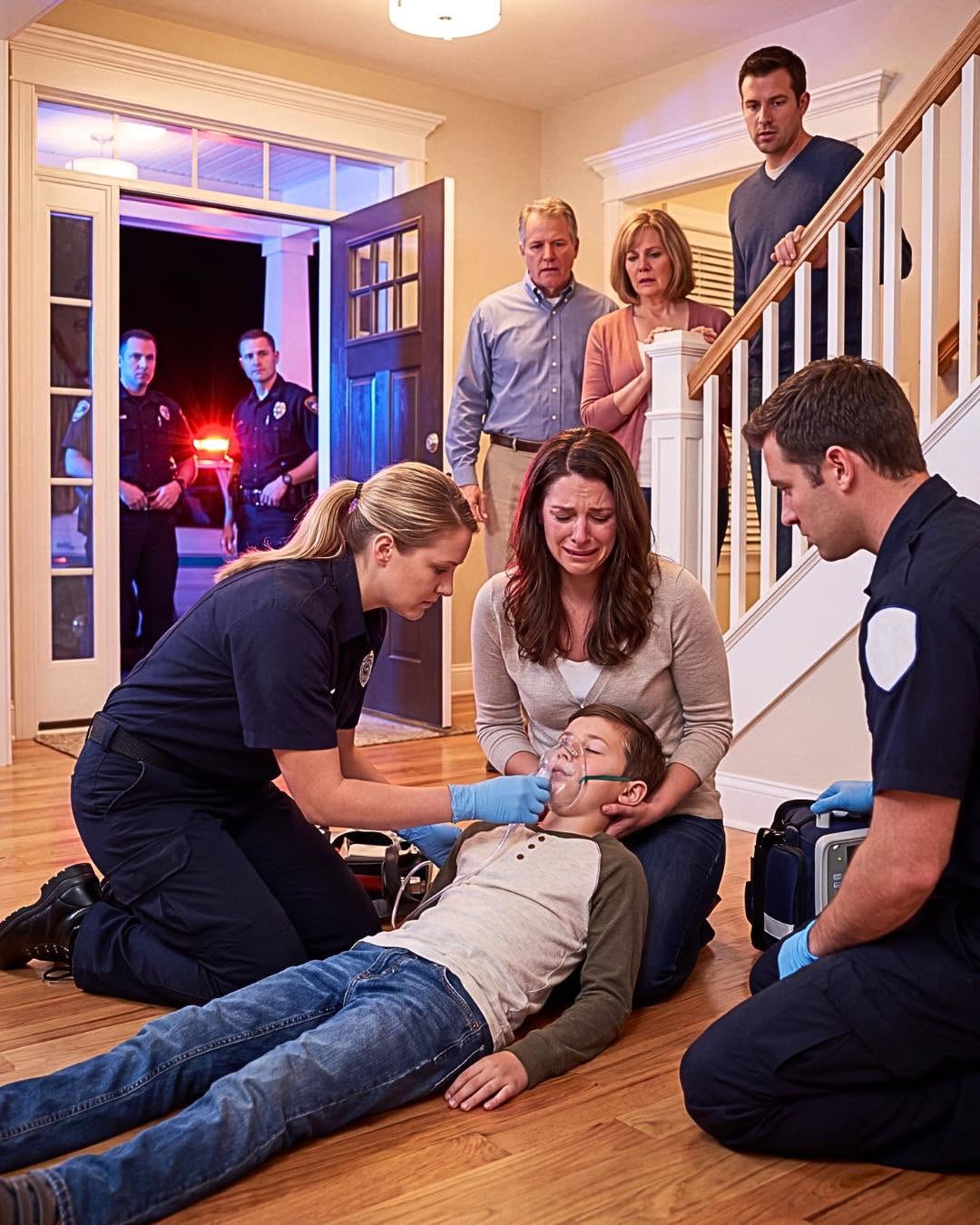
The hallway smelled of fresh pine and peppermint, a cruelly cheerful contrast to the nightmare unfolding across the polished hardwood floor.
I stood motionless, staring at the man who had raised me.
“I held the door shut while he begged for you.”
My father’s confession did not echo.
It sank into the house.
It seeped into the wallpaper covered with tiny Christmas wreaths, into the garlands wrapped around the staircase, and into the foundation of the home where I had spent my childhood believing at least one parent would protect me.
No one moved.
The silence was broken only by the mechanical rhythm of the paramedics working over my son.
The oxygen mask hissed over Owen’s face.
My nine-year-old boy looked impossibly small on my parents’ living room floor. His chest rose in shallow, uneven movements while red and blue light from the police cruisers outside swept across the walls.
The flashing colors passed over framed family photographs that suddenly looked less like memories and more like evidence.
One showed my older brother, Caleb, and me standing beside a Christmas tree when we were children.
His arm was wrapped around my shoulders.
The photograph made us look close.
I remembered that day differently.
Seconds before the camera flashed, Caleb had pinched the back of my neck and whispered that if I cried, Dad would blame me for ruining Christmas.
Another photograph showed my parents holding Owen when he was a baby. My mother had placed it inside a heavy silver frame.
Family, the engraved word beneath the glass said.
The sight of it filled my mouth with a sour, metallic taste.
The senior police officer, a tall man with a hard jaw and steady eyes, looked directly at my father.
“You physically prevented the child from leaving the house?”
My father’s lips shook.
The wrinkles around his mouth seemed to deepen in front of me.
“Yes.”
My mother stepped forward, fluttering her hands as though she could wave the truth away.
“He’s making it sound worse than it was. It was a misunderstanding. Caleb only wanted to talk to him.”
The officer turned toward her.
His expression remained calm, but his eyes went cold.
“How should we describe it, ma’am? What version of a nine-year-old requiring an ambulance sounds better?”
My mother opened her mouth.
Nothing came out.
For the first time in my thirty-four years, she had no prepared story capable of rewriting reality.
The female paramedic fastened the final strap around Owen’s body.
The buckle snapped into place with horrible finality.
“We need to transport him immediately,” she said.
I grabbed my coat from the floor.
“I’m going with him.”
Caleb had been leaning against the archway with his arms crossed, looking irritated rather than frightened. As the paramedics began lifting the stretcher, he stepped forward.
“Claire, before you turn this into something permanent, you need to calm down.”
I stopped.
Then I slowly turned toward him.
For my entire life, Caleb had known exactly which words to use to control a room.
Calm down.
You’re confused.
You’re overreacting.
You misunderstood.
He used those words after kicking through my bedroom door when we were teenagers.
He used them after taking my car without permission and returning it with a shattered taillight.
He used them after emptying the emergency account our grandmother had left me, arguing that he had only taken money that would eventually be shared by the family anyway.
And every time, my parents stood beside him.
They touched my arm.
Asked me to be reasonable.
Reminded me that Caleb had always been sensitive and that I should not make matters worse.
I looked at his annoyed face.
Then I looked at Owen, unconscious beneath the oxygen mask.
There would be no reasonable version of this.
Not that night.
Not ever again.
“I am calm,” I said quietly. “That’s why you should be afraid.”
Something shifted in Caleb’s expression.
It was barely noticeable, only a twitch in his jaw and a flicker of uncertainty in his eyes.
But I saw it.
For the first time, he understood that I would not argue inside the false family story they had created around me.
I would not explain myself until I became too exhausted to continue.
I would not accept a partial apology in exchange for silence.
The officer stepped toward Caleb and reached for the handcuffs attached to his belt.
“Sir, turn around and place your hands behind your back.”
My mother’s coffee mug slipped from her fingers.
It hit the floor and shattered, spraying dark liquid across the white baseboards.
Caleb stared at the officer.
“You can’t be serious.”
“Turn around.”
“This is a family misunderstanding. I’m the boy’s uncle. I was watching him.”
“Turn around.”
Caleb’s voice rose.
“You have no idea who you’re dealing with.”
A stocky paramedic who had been packing the emergency equipment stopped and looked closely at my brother.
Then he gave a dry, humorless laugh.
“I know exactly who we’re dealing with.”
The room became still.
Caleb’s face lost its color.
The paramedic stood.
“Three months ago, we responded to an apartment on the south side of Baltimore. A teenage boy had been injured during what the adults called discipline. You were there.”
Panic flashed across Caleb’s eyes.
“That had nothing to do with me.”
“You told us you were the boy’s uncle,” the paramedic continued.
“I was helping a friend.”
“You answered every question for the family. You stood in the doorway and kept insisting the kid had fallen because he was clumsy.”
The police officer immediately touched his radio.
“Was a report filed?”
“Yes,” the paramedic answered. “The boy was hospitalized, and child protective services opened a case. But the family disappeared before investigators returned.”
Caleb shook his head wildly.
“He has me confused with someone else. I’ve never seen him before.”
“No,” the paramedic said. “I remember your voice. You don’t forget a man who smiles while a child is bleeding.”
The room seemed to shrink around him.
My mother rushed forward.
“This is ridiculous. Caleb volunteers at the recreation center. He coaches Little League. He helps children who don’t have fathers.”
The paramedic looked at her with open disgust.
“That does not make this better. It makes it much worse.”
The officer caught Caleb by the shoulder and turned him toward the wall.
My brother looked at me as one wrist was pulled behind his back.
“Claire, tell them this is unnecessary. Tell them I live here. Don’t let them do this.”
The handcuffs closed with three sharp metallic clicks.
Once, that sound might have terrified me.
I had spent my entire childhood being trained to protect our family’s reputation, no matter what happened behind closed doors.
That night, the sound felt like a locked gate finally opening.
“I already told them what was necessary,” I said. “Everything belongs in the report.”
Caleb’s face twisted with rage.
“You’ll regret humiliating this family. You’re dead to me.”
The officer pushed him toward the porch.
I turned away and followed the stretcher.
“No,” I said loudly enough for my parents to hear. “The family should regret what it did to my son.”
The December air struck my face as soon as I stepped outside.
Neighbors stood under porch lights wearing coats over their pajamas. Some held up phones. Others watched in stunned silence as Caleb, the neighborhood’s beloved baseball coach, was placed inside a patrol car.
My mother had always taught me that a family’s reputation was a fortress.
You protected it.
You reinforced it.
You never allowed anyone outside to see what happened within its walls.
That night, the fortress collapsed in front of the entire neighborhood.
And I was the one who had finally stopped rebuilding it.
I climbed into the ambulance beside Owen.
His eyelids fluttered when the doors closed.
“Mom?”
His voice was barely more than air.
“I’m here, sweetheart.”
I brushed the damp hair from his forehead.
“Are you mad at me?”
The question almost destroyed me.
I took his bruised hand carefully.
“No. Never at you.”
“I tried to call.”
“I know. You were incredibly brave.”
“Uncle Caleb said you would be embarrassed if people came. He said the police take bad children away.”
“He lied.”
I leaned close enough that my face filled his vision.
“You did exactly the right thing. Calling for help is never shameful. It was the smartest and bravest thing you could have done.”
He searched my eyes.
“Grandma said I ruined Christmas.”
Christmas was six days away.
I pictured the decorated house we had left behind. Perfectly coordinated lights covered the windows. Expensive gifts waited beneath a massive tree. A crooked gingerbread house Owen had built at school sat on the counter.
Now it all seemed obscene.
A beautiful stage covering something rotten.
“You didn’t ruin anything,” I told him. “The adults who were supposed to protect you made terrible choices. This is their fault, not yours.”
“Is Grandpa going to jail?”
I could have lied.
Our family had survived for decades by telling comforting lies to the people with the least power.
But Owen deserved better.
“I don’t know what will happen to Grandpa,” I said. “But everyone has to tell the truth now. There will be no more secrets.”
“Even Grandma?”
“Especially Grandma.”
He squeezed my fingers as the medication began pulling him back toward sleep.
My phone vibrated.
Mom.
I stared at her name and held down the power button until the screen went black.
Then the male paramedic began examining the bruising along Owen’s ribs.
His expression changed.
He looked at me.
“Ma’am, these marks aren’t all from tonight. How long has he been staying with your parents?”
At the hospital, everything became fluorescent lights, quiet questions, forms, and professionals who understood how to speak to a frightened child without making him responsible for what adults had done.
A pediatrician named Dr. Benjamin Shaw examined Owen while a trauma nurse distracted him with questions about his favorite games.
I paced outside the room until a hospital social worker approached.
Her name was Rebecca Lane. She had kind brown eyes, but they missed nothing.
She led me into a small consultation room and opened a notebook.
“I need to ask difficult questions. Who was responsible for Owen tonight?”
“My parents,” I answered. “My company had its annual holiday dinner. My mother insisted on babysitting.”
“Did you know your brother would be there?”
“No. Caleb lives across town. He was not supposed to be near Owen without me present.”
“Does he usually have access to your son?”
“Never alone. I limit their contact even during holidays.”
“Has Owen ever seemed frightened of him?”
The question stopped me.
Two weeks earlier, while I packed Owen’s overnight bag, he had stood in his doorway twisting the bottom of his shirt.
He asked whether he could stay with his friend Tyler instead of going to my parents’ house.
I had been distracted by work and the holiday party.
I reminded him that Grandma had bought his favorite cereal and rented movies.
I briefly asked whether something was wrong.
He said no.
And I accepted it.
Because I was busy.
Because it was easier.
Because I had been raised in a family where children quickly learned that expressing discomfort rarely changed an adult’s decision.
“I should have asked again,” I whispered.
My face collapsed into my hands.
“I knew he didn’t want to go.”
Rebecca leaned forward.
“Claire, look at me.”
I forced myself to raise my head.
“This is not the moment to place the responsibility of the people who harmed him onto yourself. That is how abusive systems survive. They depend on good parents blaming themselves instead of the people who made deliberate choices.”
“But I drove him there.”
“You left him with his grandparents, people you reasonably believed would keep him safe.”
“I should have known.”
“Did you know they would prevent him from calling emergency services?”
“No.”
“Did you know Caleb would physically harm him?”
“No.”
“Then the responsibility belongs to the adults who chose to do those things.”
Her words were simple.
They were also the opposite of everything I had been taught.
In my family, responsibility always rolled downhill.
My father avoided conflict.
My mother became hysterical.
Caleb became violent.
And eventually, the blame landed on whoever was easiest to silence.
Usually me.
That night, the cycle reached Owen.
And it stopped.
Dr. Shaw returned when the scans were finished.
“Owen has a mild concussion,” he explained. “There is significant bruising along the left side of his ribs and irritation in his throat consistent with being grabbed forcefully around the collar or neck.”
“My God.”
“He is breathing normally now, but we are watching the swelling closely. He will need observation, rest, and trauma follow-up.”
The careful way the doctor spoke made the truth even clearer.
A few more minutes behind that locked door might have changed everything.
I signed the paperwork.
At 2:13 in the morning, a detective arrived.
Her name was Naomi Grant. She wore a navy coat over plain clothing and carried an old leather notebook.
She did not rush me.
She did not call the situation emotional or dramatic.
She asked exact questions.
When did I leave?
Who had a key?
Who agreed to supervise Owen?
Had Caleb ever behaved violently before?
Had my parents previously covered for him?
That final question unlocked twenty years of memories.
“Yes,” I said.
Then I told her everything.
I told her about the money missing from my grandmother’s account and how my mother forged my signature so Caleb could pay off business debts.
I told her about the damaged car my father secretly repaired before an insurance investigation could begin.
I told her about Caleb shoving me down the basement stairs when I refused to let him copy my college application essay.
I broke my wrist.
My parents told the emergency room I tripped over a laundry basket.
I told her about the girlfriend Caleb once cornered in our driveway.
My mother physically blocked the woman from getting into her car until she promised not to call police.
Detective Grant wrote without interrupting.
When I finished, she asked whether any documentation existed.
“My father saves every bank record,” I said. “My mother keeps every text and email because she likes proving how close the family is. And Caleb has sent years of threatening messages.”
“Do not delete anything,” she said. “Do not contact your brother. Do not return to your parents’ house, and do not stay anywhere they can access.”
“My home belongs to me.”
“I understand. But your family has keys and security codes. Right now, your life is compromised.”
Compromised.
Not a misunderstanding.
Not a family dispute.
A crime with a scene, evidence, and witnesses.
Owen was admitted overnight.
I sat beside him wearing the company badge I had forgotten to remove after leaving the party.
The plastic was bent because he had gripped it during the ambulance ride.
The hospital room door opened.
I expected a nurse.
Instead, my mother stood there holding Owen’s favorite stuffed bear.
I immediately placed myself between her and the bed.
“Leave.”
“Claire, please. The police questioned me for hours. I only want to see my grandson. I brought Jasper.”
“If you step farther into this room, I will call security.”
“I’m his grandmother. I was protecting him.”
“By allowing Caleb to choke him? By standing there while Dad kept the door locked?”
“Caleb didn’t mean to hurt him. He wanted Owen to show respect. You know how your brother becomes when people disrespect him. You should have taught your child better manners.”
For one second, I could not breathe.
She stood in a pediatric trauma ward looking at an injured child and still blamed him.
I pressed the emergency call button.
“You have ten seconds to leave before I tell security you are a threat.”
She stared at me.
The old power she held over me was gone.
She dropped the stuffed bear and retreated as a nurse approached.
“Do not let her return,” I said. “She is banned from this floor.”
An hour later, my father appeared.
A police officer stopped him until I agreed to speak outside the room.
He looked twenty years older.
He carried a brown grocery bag containing Owen’s light-up sneakers and blue coat.
The sight of those little empty shoes almost brought me to my knees.
“What happened after we left?”
“The police searched the house. They took our phones, Caleb’s computer, and the landline.”
“And you?”
“I gave a statement.”
I looked at him.
“You held the door shut.”
“Yes.”
“You heard Owen begging.”
“Yes.”
“You heard him calling for me.”
“Yes.”
“Why?”
He stared at the floor.
Then he answered.
“Because I spent forty years disappointing the person least likely to punish me.”
The hospital corridor seemed to fall silent.
“When Caleb became angry,” he continued, “your mother panicked. She threatened to leave or harm herself. I gave her whatever she wanted to stop the screaming. What she wanted was for everyone else to adapt to Caleb.”
“You kept adapting until your grandson could not breathe.”
“I know.”
“You only know because there are hospital records and police officers.”
“No,” he whispered. “I knew when Owen was asking me to open the door.”
That honesty hurt more than an excuse.
He reached into his coat and removed a black flash drive.
“The house cameras recorded everything,” he said. “I copied the footage before police seized the system.”
“What does it show?”
“The argument, Caleb taking Owen’s phone, your mother blocking the camera, me holding the deadbolt, and Caleb lying to the first responders.”
“Why give me this if police already have it?”
“They will build the criminal case. You need it for your attorney. Your mother has already begun changing the story.”
I accepted the drive.
“You may be charged too.”
“I know.”
“I will not ask anyone to be lenient.”
“I understand.”
“You will never see Owen unless a court and his therapist say it is safe.”
His face broke.
Still, he nodded.
“I thought you were the good parent,” I said. “You were not safer. You were only quieter. Your silence gave them room to grow.”
He did not argue.
For the first time, my father told the truth without asking me to make it comfortable.
I did not hug him.
I returned to my son.
While Owen slept, I opened the footage.
Caleb grabbed his collar, blocked him from the door, and smiled directly at the camera.
Then I noticed something worse.
My mother stood close behind him, whispering instructions.
Three days later, Owen left the hospital.
We did not return home.
Caleb had been released on bail, and my parents knew our codes and routines.
My closest friend, Jenna, opened her guest room to us.
She filled the refrigerator with Owen’s favorite foods and placed a soft lamp beside his bed because total darkness made his chest tighten.
My employer gave me open-ended emergency leave.
My supervisor called once, only to assure me that my position was secure.
For the first time, I understood the difference between support and control.
Support did not ask me to minimize the truth.
It did not demand a timeline.
It simply made space for us to survive.
I hired a family attorney named Natalie Pierce, a former prosecutor with a calm voice and a ruthless understanding of safety.
She watched the security video without looking away.
When it ended, she closed the laptop.
“We are filing emergency protective orders against your brother and both parents.”
“My father cooperated.”
“That may matter to the prosecutor. It does not automatically make him safe.”
“He confessed.”
“Remorse is an emotion. Safety is a boundary. A man who watches a child being harmed and only responds after the consequences arrive is not currently safe.”
I looked through the glass wall toward Owen, who was coloring beside Jenna.
“File against all of them.”
During the next two days, I removed every connection my family had to our lives.
The locks.
The garage code.
The alarm system.
The emergency contacts at Owen’s school.
Their access to his medical records.
I separated my phone from the family plan my father had paid for since college, the same plan they used to examine my call history.
I removed my mother from the shared calendar and cloud storage.
Every financial tie.
Every digital thread.
Every emotional trap disguised as closeness.
I cut them all.
The protective orders were granted before New Year’s Eve.
Before she was formally served, my mother left twelve voicemails.
First, she begged me not to destroy the family.
Then she blamed Caleb.
Then Dad.
Then alcohol, though no one had been drinking.
Finally, she accused Owen of being oversensitive and dishonest.
I forwarded every message to Natalie.
Detective Grant’s investigation expanded because of the video.
The assault had not been a brief loss of control.