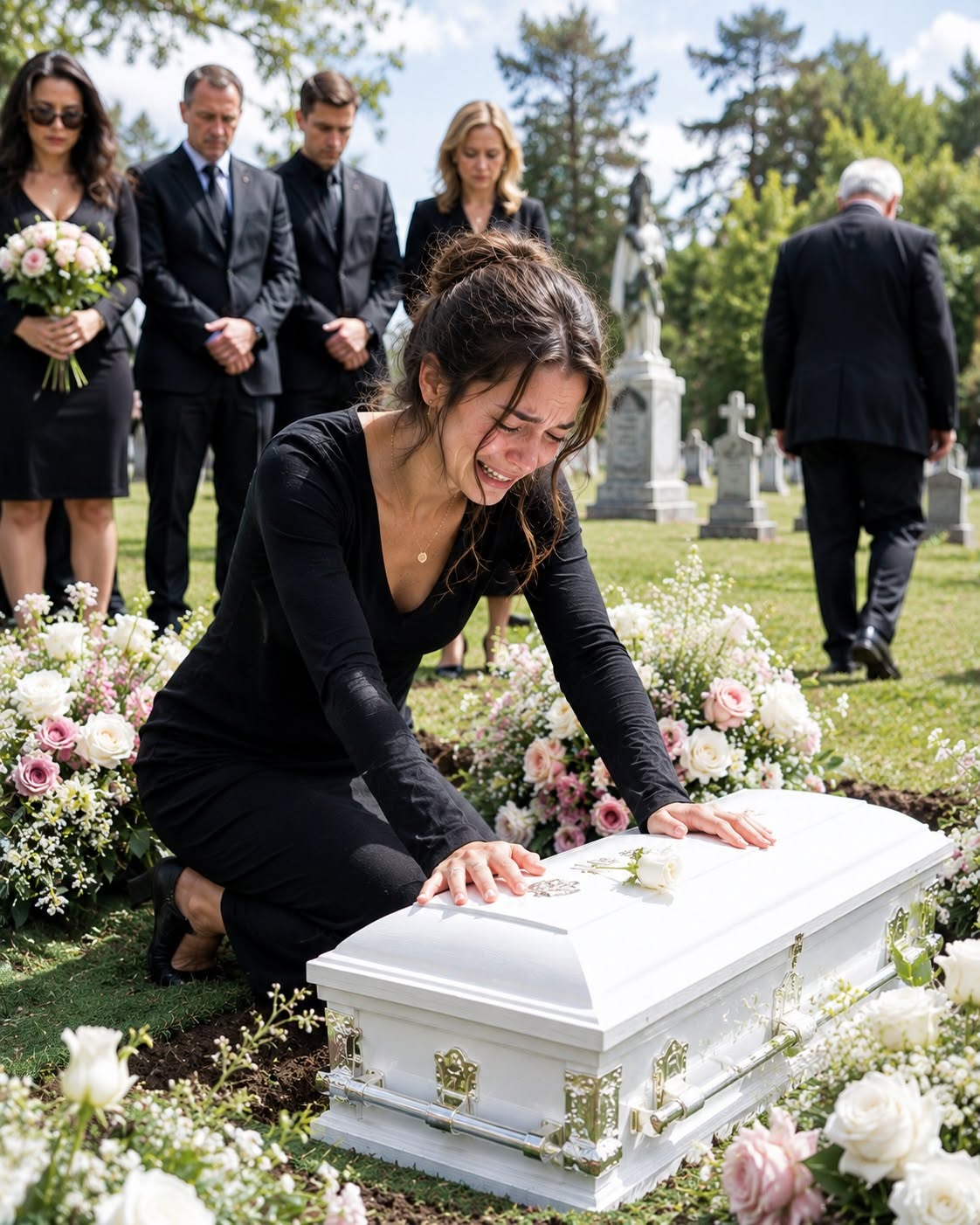
Standing entirely alone beside a tiny white coffin, Caroline was left to bury her twenty-three-day-old daughter after her parents chose to attend a family cookout instead of the funeral.
But before that unbearable Saturday came to an end, a secret buried for years and three carefully placed phone calls triggered a legal catastrophe her family never imagined was possible.
There comes a point when grief stops feeling like an emotion and becomes something physical, a crushing weight that settles over a mother’s chest and makes every breath feel impossible.
For Caroline, that moment came on a bright, airless Saturday morning in Richmond, Virginia. She stood outside a small funeral chapel in a simple black dress, clutching a folded infant blanket that still carried the faint scent of baby soap—the last physical trace of a life that had ended almost as soon as it began.
Her daughter’s name was Grace.
She had lived for exactly twenty-three days.
Those twenty-three days had been filled with the steady beeping of hospital monitors, whispered prayers in the middle of the night, and the constant movement of NICU nurses adjusting tubes and checking numbers. Caroline spent every possible hour beside her daughter, learning how to love her through a haze of fear.
Grace had been born with a severe heart defect that no one had detected during the pregnancy. At first, the doctors spoke cautiously about procedures, treatment plans, and hope.
Then their language changed.
Hope became preparation.
Caroline memorized everything about her daughter: the soft curve of her eyelashes, the perfect shape of her tiny fingernails, and the quiet sigh she made whenever she rested against her mother’s chest.
Then, on a rainy Tuesday at 2:14 in the morning, the monitors fell silent.
Grace was gone.
The burial took place four days later.
Despite years of tension and disappointment, Caroline called her mother.
It was not because she expected warmth. It was an instinctive act rooted in the belief that when a child dies, family is supposed to come.
Her father answered first. He sounded distracted and passed the phone to her mother without asking what was wrong.
Caroline’s voice trembled as she explained that the service would begin at eleven that morning. She told her mother honestly that she did not think she could survive the burial alone.
Through the phone, Caroline heard no concern.
She heard conversation in the background.
Glasses clinked.
Someone laughed.
“Today?” her mother asked casually.
“Yes,” Caroline said. “Today.”
There was a short silence before her mother let out an irritated breath.
“Your brother already invited everyone over for the Labor Day cookout. We bought the food earlier this week, Caroline. We can’t cancel when nearly forty people are coming.”
Caroline tightened her grip on the phone.
“Mom, I’m burying my daughter.”
Her mother responded as though Caroline were creating an unnecessary inconvenience.
“Caroline, I understand that you’re emotional, but she was only a baby. You can have another one. Your brother has forty guests coming.”
Then her father took the phone again.
He offered a string of weak explanations about traffic, family responsibilities, and the need to avoid upsetting her brother.
A moment later, the call ended.
Grief shows you what has been taken from you.
Betrayal shows you what you never truly possessed.
Caroline stood outside the chapel doors, staring through the glass at the tiny white coffin positioned near the altar.
Her legs nearly gave way.
It was not only the pain of losing Grace.
It was the terrible certainty that she had no real family standing behind her.
Caroline entered the chapel with her head held upright.
There were no grandparents seated in the first row.
There was no brother waiting to steady her.
There was no line of relatives prepared to walk behind the coffin.
A few close friends and distant acquaintances sat quietly throughout the room, speaking in lowered voices, but the people who should have been her foundation were absent.
When the pastor asked whether anyone wanted to say a few words, Caroline rose from her seat.
She walked to the podium with trembling hands and somehow found the strength to speak about the twenty-three days her daughter had lived.
She did not collapse.
She did not sob in front of the room.
Instead, something inside her became hard and unbreakable.
That afternoon, Caroline drove home alone beneath the blazing sun.
Her mother’s words repeated themselves in her mind.
She was only a baby.
You can have another one.
By sunset, the thick fog of grief had sharpened into something colder.
Resolve.
Caroline sat at the desk in her kitchen, opened the closet beside the pantry, and pulled out a locked metal file box.
Inside was a folder she had not touched in years.
For decades, her parents had controlled the family by presenting themselves as the source of all financial security.
They treated Caroline as though she were an inconvenience while giving her brother endless money, including the funds used to purchase the house where dozens of people were now eating grilled food and drinking in the backyard.
But her parents had forgotten one critical fact.
Or perhaps they had simply assumed Caroline would never be brave enough to act on it.
The family properties and business interests did not legally belong to them.
Years earlier, after the death of Caroline’s maternal grandmother, a large estate had been transferred into a complicated family trust.
Her grandmother had understood exactly how selfish and irresponsible her daughter and grandson could be.
Without announcing it to the rest of the family, she named Caroline the primary co-trustee.
She also designated Caroline as the sole beneficiary of the land and property deeds once she reached her late twenties.
Caroline’s parents had minimized that detail for years.
They treated the trust documents as meaningless technical paperwork, confident that Caroline would never study them closely.
What they did not realize was that Caroline had eventually begun paying attention.
For the previous five years, her parents had been secretly withdrawing money from the trust to support their expensive lifestyle and rescue her brother’s failing businesses.
Whenever Caroline’s signature was required, they presented the documents as harmless family paperwork that needed to be completed quickly.
At the time, Caroline signed because she trusted them.
But she had also kept copies.
Every ledger.
Every bank transfer.
Every altered document.
Every signature that did not belong to her.
At six o’clock that evening, only hours after her daughter’s burial, Caroline placed her first phone call.
She contacted Evelyn Hart, a senior attorney specializing in trust and estate litigation.
“I want an emergency injunction filed against every trust account,” Caroline said, her voice calm and controlled. “Freeze all assets. Begin a complete forensic audit. And issue formal eviction notices for every property being occupied with unauthorized trust funds.”
Her second call went to a forensic accountant.