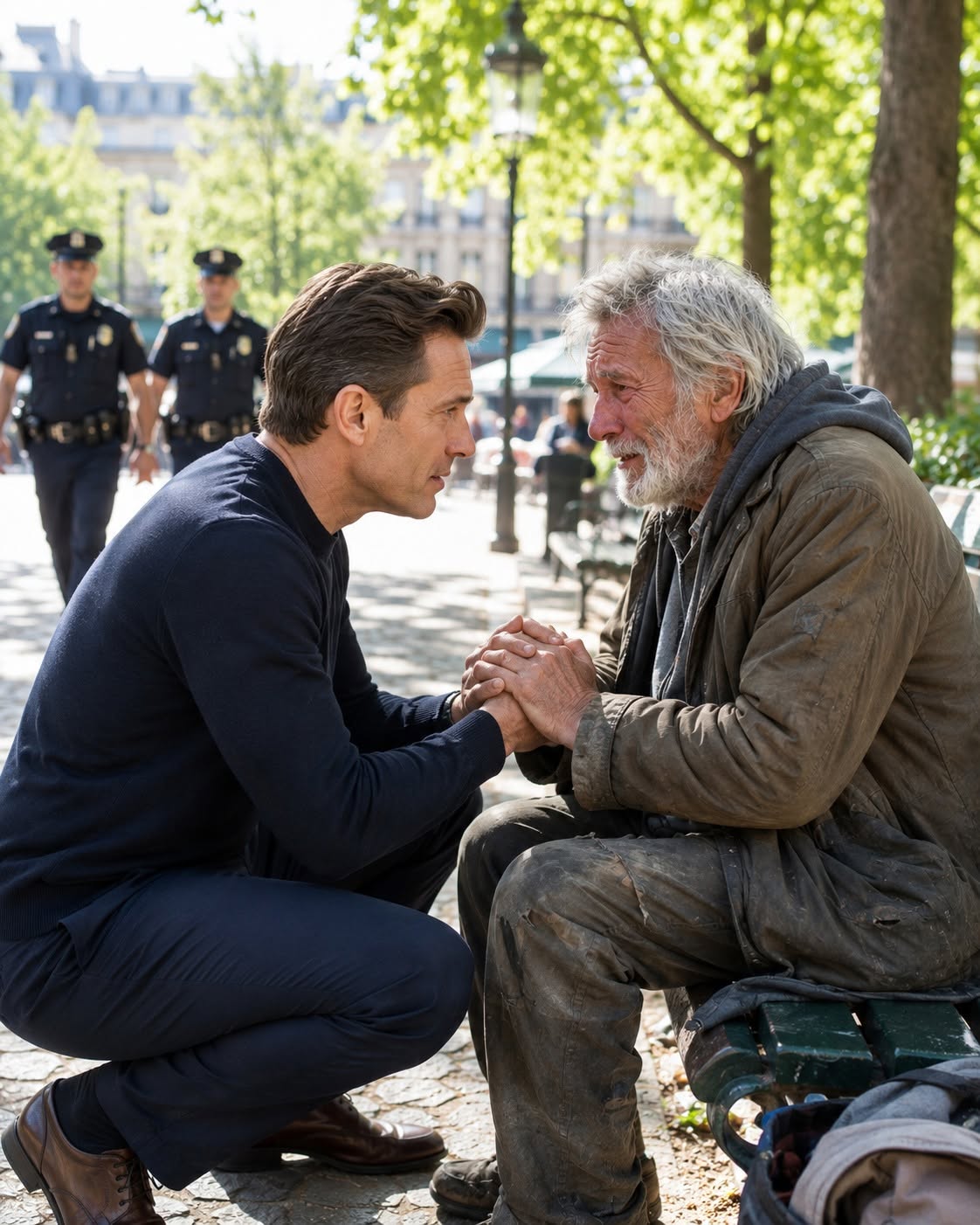
“Please… even if it’s only for a few minutes, pretend you’re my son.”
Daniel Whitmore studied the elderly man with the same careful suspicion he brought to a contract before putting his signature on it.
The man sat on a bench outside Willowbrook Senior Living, along a quiet street in Chicago’s Lincoln Park neighborhood. He wore a faded gray jacket, shoes polished with obvious care, and a thin blue scarf that offered little protection against the cold December morning.
Daniel was 53 and ran one of the largest construction firms in Chicago. He was comfortable negotiating with investors, purchasing properties worth millions, and making decisions that could reshape entire neighborhoods.
What he was not accustomed to was having a stranger ask him to pose as his son.
“I’m afraid you’ve mistaken me for someone else.”
“No, Mr. Whitmore. I’ve been waiting here for you for three days.”
Daniel’s fingers tightened around the handle of his briefcase.
“How do you know who I am?”
“Your photograph was in the paper after your company restored the Grand Regent Theater. And someone told me that you occasionally walk along this street in the afternoons.”
That part was true. After his wife died, Daniel had developed a habit of wandering through the city after work with no particular destination. Returning to his apartment too early meant confronting a dining table meant for two, a piano that had fallen silent, and the untouched bedroom of a child who had never been born.
“Why exactly do you need a pretend son?”
The elderly man looked down.
“My name is Walter Hayes. I’m 79, and I live here with my younger brother, Henry. He has an illness that is slowly taking away his memory.”
Daniel glanced toward the residence.
“Alzheimer’s?”
Walter nodded.
“Some days, he can’t remember my name. On other days, he believes we’re still young men working in our father’s carpentry shop. But the moment he hears my voice, he becomes calm. When everything else disappears, I’m the only face he can still find.”
“What does any of that have to do with me?”
“The residence plans to move him into a specialized memory-care unit in another building. They say he’ll receive better treatment there. I’ll remain here because I don’t require the same level of care.”
“Perhaps that really is the best thing for him.”
“For his body, perhaps. But not for his heart.”
Walter pointed toward a window on the second floor.
“When Henry wakes up and I’m not there, he believes our parents have just died. He experiences the loss all over again as though it happened that very morning. He screams, tries to leave the building, and refuses to eat. If they separate us, he won’t understand that I’m still alive.”
Daniel looked at his watch.
He was supposed to meet with a group of investors in 40 minutes.
“Don’t either of you have family?”
“Henry never married. I had a wife and a son, but I lost them both many years ago.”
The old man’s voice faltered.
“The director says we can’t remain together unless a close relative agrees to take legal and financial responsibility for us. If you walk inside with me and claim you’re my son, perhaps she’ll give us a few more days.”
“That would be a lie.”
“Yes.”
Walter raised his eyes and met Daniel’s gaze.
“But separating two brothers after 75 years would be another kind of lie. Everyone would insist it was for our own good, even though neither of us ever asked for it.”
A frantic voice came from somewhere inside the building.
“Walter! Where is Walter?”
The old man shut his eyes.
“That’s Henry.”
Daniel checked the time again.
Then he put his phone away.
“All right. I’ll go inside with you.”
Walter’s face brightened with such sincere gratitude that Daniel felt strangely uncomfortable. Not one of his employees had ever looked at him that way, not even after being promoted.
Together, they entered the residence.
The lobby smelled of disinfectant, stale coffee, and artificial flowers. A woman of about 50 stepped out from behind the reception desk. She wore a navy uniform and held a folder tightly against her chest.
“Mr. Hayes, we’ve been looking everywhere for you.”
The director’s attention shifted to Daniel.
“He’s my son,” Walter said.
The woman lifted one eyebrow.
Daniel offered his hand.
“Daniel Hayes Whitmore.”
Using Walter’s surname stirred an unfamiliar feeling inside him.
“I’m Patricia Collins, the director of Willowbrook. Your father has never mentioned that the two of you were in contact.”
Daniel held her gaze steadily.
“I allowed my work to keep me away. I’m here now to correct that mistake.”
Patricia did not look convinced, but before she could question him further, the desperate voice rang through the hallway again.
“Walter!”
The old man hurried down the corridor.
Henry sat near a window, gripping a blue scarf identical to Walter’s. He was 75, with disheveled white hair and the frightened expression of a lost child.
As soon as he saw his brother, relief washed over his face.
“I thought you had gone.”
“I would never leave without telling you goodbye.”
Walter took Henry’s hands in his own.
Henry looked over at Daniel.
“Who is he?”
Walter hesitated briefly.
“He’s family.”
Henry smiled.
“Then he should sit with us.”
Daniel lowered himself into the chair across from them.
For several minutes, he listened as the brothers talked about growing up in a small Vermont town. Walter described homemade kites, apple trees, and long afternoons spent in their father’s woodworking shop. Henry confused names and dates, but whenever his memories wandered, Walter gently guided him back.
“You always find me,” Henry said.
Walter squeezed his hand.
“Always.”
Patricia appeared at the entrance to the room.
“Mr. Hayes, we need to speak.”
When Walter and Patricia stepped into the hallway, Daniel stayed beside Henry.
The elderly man stared out at the garden.
“My brother always keeps his word.”
“It’s obvious that he cares about you deeply.”
“When we were boys, I became lost during a storm. Everyone else returned to town, but Walter kept searching. He found me beneath a bridge.”
Henry turned to Daniel.
“He always comes back for me.”
Those words remained in Daniel’s thoughts when Walter returned with all the hope gone from his face.
“The transfer is scheduled for Friday,” he said. “They won’t allow us any additional time.”
Daniel asked to meet privately with the director.
Patricia led him into her office.
“We are not heartless people, Mr. Whitmore. Henry requires constant supervision. He has attempted to leave the building four times. Walter no longer has the strength to restrain him, and Walter also has medical needs of his own.”
“They don’t want to be separated.”
“Love cannot solve every practical problem. We need trained employees, proper resources, and someone who can accept legal responsibility whenever serious decisions must be made.”
Daniel understood her argument. He had run companies for 30 years and knew perfectly well that compassion alone did not cover payroll or ensure anyone’s safety.
Even so, when he looked through the office window and saw the two brothers dividing an orange between them, something within him refused to accept the situation.
“I’ll return tomorrow.”
“Before you do, Mr. Whitmore, I’ll need documents proving that you are related to Mr. Hayes.”
Daniel met her eyes without flinching.
“You’ll receive them.”
As Daniel prepared to leave, Walter accompanied him to the entrance.
“You don’t have to return. You’ve already done far more than I expected.”
“I told your brother I belonged to the family.”
“It was only a harmless lie.”
Daniel looked back through the hallway. Henry was still watching him.
“Perhaps even harmless lies come with responsibilities.”
The following morning, Daniel canceled three meetings and called Rebecca Morgan, his company’s lead attorney.
“I need your help preventing two elderly brothers from being separated.”
Rebecca went silent for a moment.
“Did you buy a retirement home?”
“Not yet.”
After Daniel explained the situation, the attorney slowly shook her head.
“You cannot legally present yourself as the son of a man you’ve never met. That could create serious consequences.”
“Then find me a legal solution.”
“We’ll have to examine their medical records, Willowbrook’s policies, their financial circumstances, and arrange an independent medical assessment.”
“Begin today.”
That afternoon, Daniel returned to Willowbrook with Rebecca.
Walter was waiting in the lobby.
“I was beginning to believe you wouldn’t come.”
“I said I would return.”
“It has been a very long time since anyone kept a promise that quickly.”
Over the following two weeks, Daniel visited Willowbrook every day.
Eventually, Henry stopped asking who he was.
Whenever Daniel entered the room, Henry smiled.
“There’s our Daniel.”
The businessman began spending time with the brothers in the garden. He listened to the same memories again and again and was surprised to discover that the repetition did not bother him. Each version contained a slightly different detail, as though Henry’s memory were a puzzle whose pieces never fit together in precisely the same arrangement.
Daniel also became acquainted with several other residents.
One woman spent her days waiting for telephone calls from three children who lived less than an hour away. A retired teacher continued writing letters to former students who would most likely never see them. Another man repeated his dead wife’s name constantly because he was terrified that one day he might forget it.
For the first time, Daniel understood that keeping someone’s body alive was not the same as remaining beside them through their life.
Rebecca arranged for Henry to be assessed by an independent specialist. The conclusions were unmistakable: Henry required advanced memory care, but removing Walter from his daily life would heighten his anxiety and cause his condition to deteriorate faster. The brothers could safely remain together if a specially trained nurse were assigned to them and their room was properly adapted.
“I’ll cover every expense,” Daniel said.
Rebecca studied him.
“Money isn’t the only issue. The residence requires someone to accept legal responsibility.”
“Then I’ll do it.”
“You’ve known these men for only two weeks.”
“My wife died nine years ago. We also lost the child we were expecting. Ever since then, I’ve hidden inside my work so that no one would ever depend on me again.”
Daniel stared toward the garden.
“Maybe I’m tired of being someone no one waits for.”
Later that evening, as Rebecca examined Walter’s records, she noticed something unusual.
“There’s something here you should look at.”
Among Walter’s documents was an old photograph. It showed him decades earlier, standing beside a pregnant woman and a boy who appeared to be about eight.
Daniel suddenly felt unable to breathe.
Around the boy’s neck hung a small wooden whistle carved in the shape of a bird.
It looked exactly like the whistle Daniel had owned for as long as he could remember.
“Where did this come from?”
“It was stored with Walter’s personal belongings.”
Daniel drove back to Willowbrook immediately.
He placed the photograph on the table in front of Walter.
“Who are these people?”
The color disappeared from Walter’s face.
“That’s my wife, Margaret… and our son, Jonathan.”
“What happened to them?”