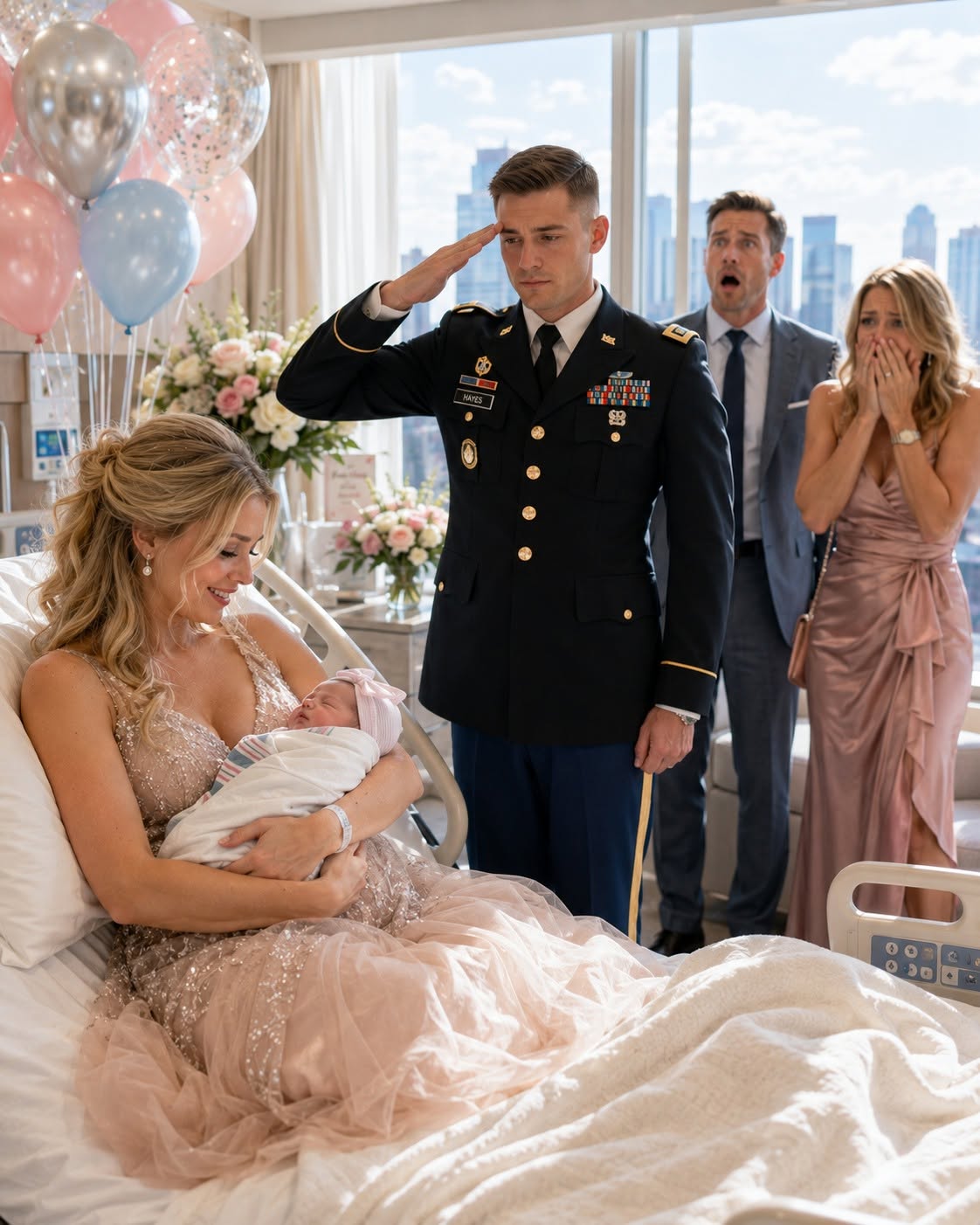
The first contraction struck Colonel Rebecca Hayes shortly after ten o’clock at night inside a house in McLean, Virginia, a home that had felt colder than the rain outside its windows for months.
Rebecca was preparing ginger tea when a sharp pain tore through her lower back and forced her to grip the kitchen counter. Her doctor had been very clear: because of her dangerously high blood pressure, she needed to reach the hospital the moment labor began.
Her husband, Marcus Reed, remained seated in front of his laptop.
He wore a brand-new dress shirt, far too much cologne, and had placed his phone facedown beside him as though hiding it had become instinctive.
“Marcus, it’s starting. I need you to drive me to the hospital.”
He did not even get out of his chair.
“Not tonight, Rebecca. It’s probably another false alarm.”
She stared at him in disbelief.
During twelve years of military service, she had managed complex operations without losing control. But no training could have prepared her for the moment when the man who had promised to protect her looked at her as though she were nothing more than an inconvenience.
Marcus believed Rebecca was a mid-ranking administrative officer assigned to offices near the Pentagon.
He had never cared enough to learn that she was actually a decorated colonel selected to lead a new strategic command within the Department of Defense.
He also had no idea that three months earlier, her grandfather, William Hayes, had died and left her a private trust valued at nearly twenty million dollars.
The attorneys required complete secrecy until the final legal review was finished.
Rebecca followed their instructions.
At first, she stayed silent out of caution.
Later, she remained silent because the situation revealed something far more painful.
Marcus no longer asked about her work, her ambitions, or her life.
He only wanted to know how much money she could contribute to their household.
By the seventh month of her pregnancy, he had stopped attending medical appointments, started returning home after midnight, and answered text messages while locked inside the bathroom.
Every argument ended with the same sentence.
“I have problems you wouldn’t understand.”
Another contraction forced Rebecca to her knees.
Marcus disappeared into his home office and returned carrying a folder.
“I’m tired of carrying you,” he said, dropping separation papers onto the table. “Your schedule, your secrets, the baby—everything is always about you.”
The word carrying hurt more than the contraction.
“I’m in labor.”
“Call an ambulance. And when you come back, find somewhere else to live.”
His phone lit up.
A name appeared across the screen.
Lauren.
Rebecca did not ask him again.
She picked up her hospital bag, called emergency services from the front porch, and waited in the freezing rain while Marcus closed the door behind her.
At 10:51 p.m., she was admitted alone to Walter Reed National Military Medical Center with dangerously high blood pressure and active labor.
At 3:27 a.m., her daughter was born.
She was small, strong, and furious, as though she had entered the world already demanding justice.
Rebecca named her Emma Grace Hayes.
She believed Marcus might come once he heard the news.
He arrived eleven hours later.
But he was not alone.
Lauren walked beside him wearing an enormous engagement ring and the satisfied smile of someone convinced she had won.
Just as they entered the room to humiliate Rebecca in front of her newborn daughter, the sound of military boots came to a stop outside the door.
Marcus barely looked at Emma.
Lauren, however, deliberately lifted her left hand so the engagement ring would catch the bright hospital light.
“We thought it would be better if you heard the news now,” she said. “Marcus and I are getting married.”
Rebecca was exhausted.
An IV line ran into her arm, and her daughter slept against her chest.
She did not scream.
She did not cry.
She simply looked at the man who, less than twenty-four hours earlier, had still legally shared her life and who was now bringing his mistress into her hospital room like a trophy.
“I don’t want a scene,” Marcus added. “Just accept that it’s over. Lauren understands what I need.”
“And what exactly do you need?” Rebecca asked. “Someone who won’t expect you to be present when your daughter is born?”
Lauren gave a smug laugh.
“Oh, don’t be so dramatic. Marcus told me the two of you were already separated. He said you were just an office employee who cared more about work than your marriage.”
Rebecca looked down at Emma.
“Then he lied to you too.”
Before Lauren could respond, the door opened.
Major General Jonathan Brooks entered with two officers and an attorney dressed in a gray suit.
Marcus recognized the uniform instantly and moved aside without being asked.
The general approached the bed, stood at attention, and saluted.
“Colonel Hayes, congratulations on the birth of your daughter and on your appointment as commander of the new Strategic Defense Operations Unit.”
All the color disappeared from Marcus’s face.
“Colonel?” he whispered.
Lauren slowly lowered the hand displaying the ring.
Rebecca returned the salute with her free hand.
The general glanced toward Marcus and Lauren.
“Are we interrupting something?”
“No, General,” Rebecca replied. “You arrived just as my husband was explaining why he left me alone in the rain while I was in labor.”
The attorney placed a folder on the bedside table.
“Colonel, the legal review of William Hayes’s trust was completed at 9:40 this morning. Effective immediately, you have full legal control over assets, investments, and real estate with an estimated value of approximately twenty million dollars.”
The silence became suffocating.
Marcus stared at the folder.
Then he looked at Rebecca.
Then at the general.
It was as though he expected someone to laugh and reveal that the entire thing was a joke.
“Twenty million dollars? Why didn’t you tell me?”
“Because the information was confidential,” Rebecca answered. “And because it never belonged to a man who called me a burden while his daughter was being born.”
One of the officers opened another file.
“We also have the hospital admission record from 10:51 last night. Colonel Hayes reported that her husband refused to transport her to the hospital despite explicit instructions from her physician.”
“That isn’t what happened,” Marcus protested.
The nurse checking Rebecca’s monitor looked up.
“I took her statement personally. She arrived alone, soaked from the rain, in active labor, with dangerously elevated blood pressure. Every detail is documented.”
Lauren turned toward Marcus.
“You told me she left because she was having a tantrum.”
“You don’t know what she’s like,” Marcus said desperately. “She hides everything from people.”
Rebecca gave him a humorless smile.
“You’re accusing me of hiding the fact that you abandoned me while criticizing me for keeping military information I was legally prohibited from sharing.”
The general did not raise his voice.
“Colonel Hayes has served this country with distinction for twelve years. Her service record is protected for operational reasons. Confusing professional discretion with dishonesty says far more about the person making the accusation than it does about the person serving.”
Rebecca’s phone vibrated.
It was a message from her civilian attorney.
The separation petition was ready.
The house, the accounts, and temporary custody of Emma could be legally protected the moment Rebecca gave authorization.
“Proceed,” Rebecca said.
Marcus stepped toward the bed.
“Wait. We can work this out. I didn’t know about your rank or the inheritance.”
“That is exactly the problem,” she replied. “You only want to repair the marriage now that you know what I’m worth on paper.”
“This isn’t about the money.”
Lauren removed the engagement ring.
The movement was slow, but final.
She placed it in Marcus’s palm and stepped backward.
“You promised me a house, vacations, and a perfect life,” she said. “You told me she depended on you.”
Rebecca looked at her with quiet exhaustion.
“I don’t owe you sympathy, Lauren, but listen carefully. A man who leaves a woman alone while she is in labor does not become a decent person simply because he buys you a ring.”
Lauren left without saying goodbye.
Marcus stared at the ring as though its return were the true tragedy.
Not the labor.
Not the rain.
Not his daughter.
The ring.
A hospital administrator arrived several minutes later and asked him to leave.
Marcus tried to approach Emma.
“I have the right to see her. I’m her father.”
“Those rights will be determined through the legal process,” the attorney said. “For now, the priority is the safety of the mother and the newborn.”
Marcus clenched his fists.
One of the officers stepped forward quietly.
Marcus immediately understood that intimidation would not work in that room.
“Rebecca, think about our daughter.”
She kissed Emma’s forehead.
“That is exactly what I have been doing since the moment you decided her birth was an inconvenience.”
Once the door closed behind him, General Brooks no longer seemed like a distant military authority.
He stepped closer and looked at the baby with genuine affection.
“I knew your grandfather,” he said. “William helped many service members without ever asking for recognition. He spoke about you with extraordinary pride.”
The attorney handed Rebecca an envelope.

