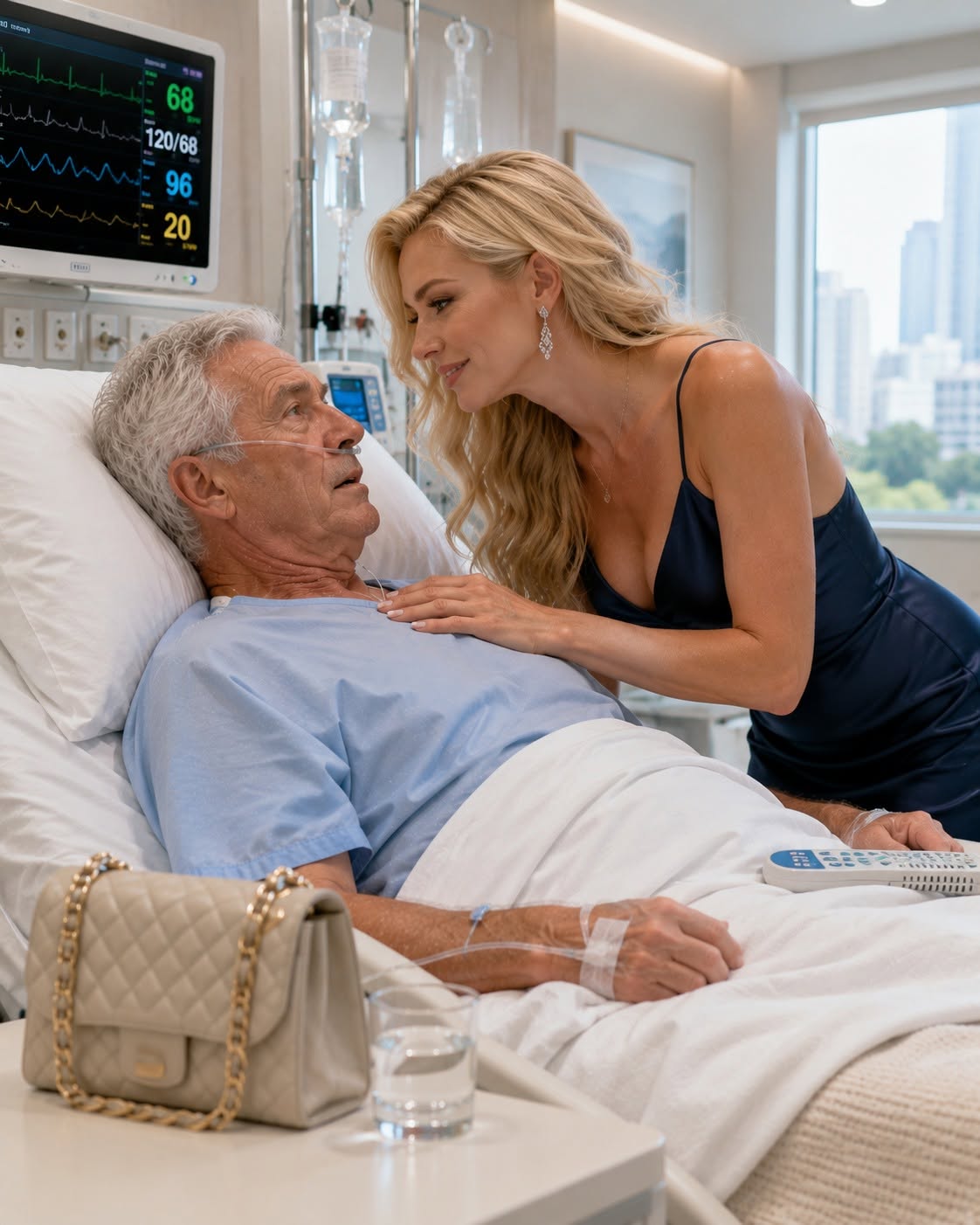
“You’re finally going to die, Richard. I was getting tired of pretending I ever loved you.”
Richard Bennett forced his eyes open just enough to see his wife leaning over his hospital bed.
Rain struck the floor-to-ceiling windows of St. Matthew Medical Center so hard that it sounded as though the entire city of Seattle were trying to break into the room and warn him—far too late.
The heart monitor beside him traced a weak, irregular rhythm.
Earlier that morning, Richard had overheard his cardiologist speaking quietly to a nurse outside the door.
“Five days at most,” the doctor had said. “Possibly less. The damage to his heart is too severe.”
Richard was fifty-eight years old.
He owned a large commercial furniture company in Tacoma, a waterfront mansion on Mercer Island, two luxury condominiums in downtown Seattle, and investments worth more than eighty-two million dollars.
He also had a wife seventeen years younger than him.
Lauren was always perfectly dressed, always gentle when the nurses entered, and always holding his hand whenever a doctor came into the room.
For five years, Richard had believed that tenderness was real.
Lauren checked the door to make sure it was completely shut.
Then she turned back toward him with a slow, frozen smile that held no affection at all.
“Your company, the properties, the investment accounts—all of it will belong to me,” she whispered. “Derek and I already found a house in Malibu. Right on the water. You worked yourself to death building everything, and we’re going to enjoy every last dollar.”
Richard tried to answer, but only a dry breath escaped his throat.
His chest felt as though a concrete block had been placed on top of it.
“Don’t waste your energy,” Lauren said, brushing his cheek with practiced tenderness. “The digoxin worked exactly the way it was supposed to.”
The heart monitor quickened.
Lauren lowered her voice.
“In the correct amount, it supports the heart. In the amount I gave you every night, it destroys the heart little by little.”
She tilted her head.
“Do you remember the vitamins I brought you before bed? You never questioned them. You trusted me much too easily.”
Richard’s eyes filled with tears.
Lauren placed one hand on his chest as though comforting him.
“Calm down, sweetheart. Don’t die before I finish saying goodbye.”
She removed a compact mirror from her purse, examined her lipstick, and touched it up carefully.
Then she kissed his forehead.
“The funeral will be simple,” she said. “It would be foolish to spend too much money on a dead man when I have an entirely new life waiting for me.”
After she left, Richard stared at the ceiling.
Tears slipped silently from the corners of his eyes.
He was not crying because he feared death.
He was crying because every kiss, every breakfast tray, every whispered “I love you” had been part of a performance.
Several minutes later, Noah Carter entered the room.
Noah was twenty-six and worked as a hospital orderly. His navy scrubs were wrinkled, dark circles shadowed his eyes, and exhaustion followed him everywhere.
But he always treated Richard with patience.
“Good evening, Mr. Bennett,” Noah said as he adjusted the blanket. “Would you like some water?”
Richard remembered hearing the nurses talk about him.
Noah worked double shifts at the hospital and spent many nights unloading freight at a wholesale produce warehouse. Every dollar went toward medication for his fifteen-year-old sister, Lily.
Lily had been born with a serious heart defect. She needed an advanced reconstructive surgery that would cost more than two million dollars.
It was an impossible amount for a family that could barely pay rent.
“Come closer, Noah,” Richard whispered. “I need you to do something for me.”
Noah frowned.
“If you’re asking for private care, sir, I can’t accept money outside the hospital.”
“That is exactly why I chose you.”
Richard gathered what remained of his strength.
“Call my attorney. Tomorrow, I’m changing my will.”
Noah stared at him, convinced the medication had confused him.
Then Richard unlocked his phone with a trembling thumb and showed him property records, investment portfolios, corporate documents, and bank accounts.
“I’m leaving everything to you,” Richard said.
Noah stepped backward.
“What?”
“You will pay for your sister’s surgery. Then you will use what remains to do something worthwhile.”
“Mr. Bennett, I barely know you.”
“I know enough.”
Richard looked directly at him.
“You work sixteen hours a day to keep your sister alive. My wife poisoned me so she could buy a beach house.”
His voice cracked.
“Tell me which one of you deserves to decide what happens to everything I built.”
Noah remained frozen.
Richard continued.
“My wife is killing me. If she inherits everything, then cruelty wins.”
Noah stood in silence for several seconds.
Then he pulled out his phone.
At ten o’clock the next morning, a man wearing a white medical coat entered Richard’s room, appearing to be a consulting specialist.
Inside his briefcase were estate documents, recording equipment, notarization forms, and the legal mechanism that would destroy Lauren’s plan.
While she sat at an expensive hotel bar in Bellevue drinking champagne with Derek and celebrating the death she believed was inevitable, Richard lifted a pen with his trembling hand.
And signed the document that would transform her dream of becoming a wealthy widow into a criminal investigation.
Richard’s attorney, Michael Dawson, had handled his business and personal affairs for fourteen years.
To make the process legally secure, he arrived with a certified physician who formally evaluated Richard’s mental capacity.
The company’s chief financial officer, Hannah Price, and Richard’s longtime business partner, Paul Jenkins, were also present.
Michael read the assets aloud.
The Tacoma furniture company.
The Mercer Island mansion.
The downtown condominiums.
The vehicles.
The stock portfolio.
The investment accounts.
The estimated total value was eighty-two point three million dollars.
“All assets will be transferred into a trust for the benefit of Noah Carter,” Richard confirmed. His voice was weak, but his words were clear. “Lauren receives nothing.”
He paused for breath.
“If evidence proves she caused my death, provide this recording to the King County Prosecuting Attorney and the Seattle Police Department.”
Noah looked as though the room had shifted beneath him.
Richard pointed toward the smartwatch beside his bed.
Several days earlier, he had activated its voice recorder when Lauren entered the room.
Her confession had been captured clearly.
The digoxin.
Derek’s name.
The Malibu property.
Her plans for the money.
Michael created an encrypted copy, sealed the new will, and promised to notify authorities the moment Richard died.
Noah tried one final time to refuse.
Richard gripped his wrist with surprising strength.
“You are not inheriting luxury,” he whispered. “You are inheriting responsibility.”
Three days later, just before sunrise, Richard Bennett died.
Lauren received the hospital call at 6:18 that morning.
Derek was sleeping beside her in the master bedroom of the Mercer Island mansion.
She listened to the nurse’s condolences, ended the call, and released a laugh she could not fully hide.
“It’s done,” she said, pouring champagne. “It’s finally over.”
She arranged a small, inexpensive funeral.
In front of longtime employees, executives, suppliers, and business partners, she performed polished grief with astonishing skill.
She wore a black veil.
She held a white handkerchief.
She lowered her voice at all the correct moments.
But she never shed a real tear.
Near the rear of the chapel, she noticed Noah standing by the entrance with his hands folded.
He looked tired and uncomfortable, as though he did not belong among the wealthy guests.
For some reason, the sight of him sent a cold sensation down her spine.
One week later, the family, attorneys, and business representatives gathered at Michael Dawson’s office in downtown Seattle for the reading of Richard’s estate.
Lauren arrived in a designer black dress with Derek beside her and a powerful inheritance attorney on the other side.
Noah was already seated in the glass conference room with Hannah and Paul.
Michael opened a red leather folder.
“Under the direct instructions of Richard Bennett, executed six days before his death, all business interests, properties, financial accounts, investments, and personal assets are transferred exclusively to Noah Carter through a legally protected trust.”
Lauren blinked.
For several seconds, she seemed unable to understand the sentence.
“To a hospital orderly?” she screamed.
She slammed both hands on the table.
“I am his wife! This is ridiculous! Richard was not mentally competent!”
“The documents were signed after an independent medical evaluation,” Michael replied. “A notary was present. The entire procedure was recorded on video.”
He looked toward her calmly.
“There is also sufficient evidence to begin a criminal investigation into Mr. Bennett’s death.”
Michael pressed a button.
Lauren’s voice filled the room.
“I was getting tired of pretending I loved you.”
Then:
“The digoxin did what it was supposed to do.”
And finally:
“Derek and I are going to enjoy every last dollar.”
Derek’s face turned white.
Lauren rushed toward the speaker, but Paul stepped between her and the table.
“That is fake!” she shouted. “It was created by artificial intelligence!”
“The authorities will determine its authenticity,” Michael said. “The hospital has preserved toxicology samples. Investigators are already seeking access to prescriptions, financial records, and communications.”
Lauren stormed out.
In the parking garage, she grabbed Derek’s jacket and pushed him against his sports car.
“You said Richard would never suspect anything!”
“We can challenge the trust,” Derek said. “We’ll hire better attorneys. We can keep this in court for years.”
“And what happens if the toxicology report is positive?”
Derek looked toward the elevator.
Noah had just emerged, walking alone toward the exit with his shoulders lowered beneath the weight of a fortune he had never wanted.
“Then we force him to sign everything over,” Derek muttered.
His eyes remained fixed on Noah.
“Or we make sure he doesn’t live long enough to receive it.”
That night, Noah sat beside Lily’s bed in the pediatric cardiac unit.
He told her she would finally receive the operation she needed.
Lily began crying against his chest.
Their mother, Margaret, sat beside them and spoke about the future without her voice breaking for the first time in years.
But six days later, after Noah completed an overnight shift, a black SUV stopped beside the curb.
Two masked men jumped out.
They dragged him into an alley and beat him until three of his ribs broke.
Before leaving, one attacker placed his boot against Noah’s chest.
“You sign the documents tomorrow,” he said. “Otherwise, the next visit will be to your sister’s hospital room.”
Bleeding and barely conscious, Noah crawled toward the sidewalk and dialed emergency services.
Then his hand touched a phone lying on the pavement.
One of the attackers had dropped it.
The screen was still lit.
A message from an unsaved number had just appeared.
Make sure he understands tonight. If he refuses to sign, you know what to do with the girl in the hospital.
Noah woke in the emergency department with his chest wrapped in bandages.
Commander Natalie Reyes of the Seattle Police Department’s Major Crimes Unit stood beside him holding the recovered phone inside an evidence bag.
“It belongs to a low-level enforcer named Jason Cole,” she said. “The location history, payments, and text messages lead directly to Derek Collins.”
Noah tried to sit up.
Pain shot through his ribs.
“They threatened my sister.”
“Two plainclothes officers are stationed outside her room,” Natalie replied. “No one will get close to her.”
She pulled a chair toward the bed.
“Now tell me everything from the beginning.”
Noah described Richard’s confession, the revised will, the recording, and the estate meeting.
Natalie then told him that the preliminary toxicology report had arrived.
Richard’s heart tissue contained accumulated, lethal levels of digoxin.
His death had not been a natural cardiac event.
It had not been a medication error.
He had been poisoned repeatedly over several months.
That afternoon, police executed search warrants at the Mercer Island mansion, Derek’s luxury apartment in Bellevue, and the private fitness club where he was a financial partner.
Inside Lauren’s bathroom, investigators found empty digoxin bottles, forged prescriptions, and a handwritten notebook listing dates, doses, and Richard’s daily pulse readings.
Her computer contained searches involving cardiac toxicity, slow-acting poisons, estate law, and methods of avoiding detection.
Derek’s phone included conversations about selling the company, liquidating the investments, and moving to Southern California.
It also contained messages sent after the will was read.
That miserable orderly stole our future, Lauren had written.
I’m handling it, Derek replied.
Natalie showed Noah a photograph recovered from Derek’s cloud account.
It showed Lily leaving a cardiology appointment.
The image had been taken from across the street.
“They were watching your family,” Natalie said. “We are not giving them another opportunity.”
Lauren was arrested that afternoon at a luxury spa in downtown Seattle while receiving a facial treatment.
“This is absurd!” she shouted as detectives pulled her arms behind her. “My attorneys will destroy every one of you!”
“Lauren Bennett, you are under arrest for first-degree murder, criminal conspiracy, and threats connected to aggravated assault,” Natalie said as she secured the handcuffs.
Derek was arrested at the fitness club.
He attempted to escape through the rear entrance, but two detectives were already waiting in the alley.
Inside his office, police found stacks of cash, Noah’s personal records, Margaret’s address, and Lily’s medical schedule.
Facing charges of assault, extortion, and attempted kidnapping, the two hired men quickly agreed to cooperate.
They confirmed that Derek had paid them to attack Noah.
They also admitted that their next assignment was to abduct Lily if Noah refused to surrender the trust.
The trial lasted five months.
Lauren’s lawyers attempted to exclude Richard’s recording, arguing that he was heavily medicated and mentally confused.
They also claimed Noah had manipulated a dying man to obtain his fortune.
Forensic experts confirmed that the audio was authentic and had not been edited.
The physician who examined Richard testified that he was lucid, fully oriented, and legally competent.
The video showed him identifying his assets, explaining his decision, and signing voluntarily.
Hannah Price, the company’s chief financial officer, presented documents proving that Lauren had transferred more than four hundred thousand dollars from a shared account into a shell company linked to Derek before Richard’s death.
The most difficult day of the trial drew a packed courtroom.
Factory employees filled several rows.
Hospital nurses sat together near the back.
Reporters crowded the press section.
Families of children with serious heart conditions, who had followed the case online, occupied every remaining seat.
Lauren entered wearing a perfectly tailored cream suit.
Her hair and makeup were immaculate.
She never looked at Noah.
Derek sat several rows away.
He appeared smaller than the confident entrepreneur shown in his social media photographs.
The prosecutor played the recording.
“You’re finally going to die, Richard.”
Lauren’s voice filled the courtroom.
No one moved.
Then the jury saw the medication bottles.
The forged prescriptions.
The dosage notebook.
The messages arranging the attack.
The surveillance photographs of Lily.
A toxicology expert explained that Richard had not suffered an ordinary heart failure.
He had been slowly poisoned.
When Noah took the stand, Lauren’s attorney approached him aggressively.
“Mr. Carter, is it not true that you received more than eighty-two million dollars after accusing Mrs. Bennett of murdering her husband?”
“No.”
“But you inherited the money.”
“Yes.”
“You benefited from Richard Bennett’s death.”

