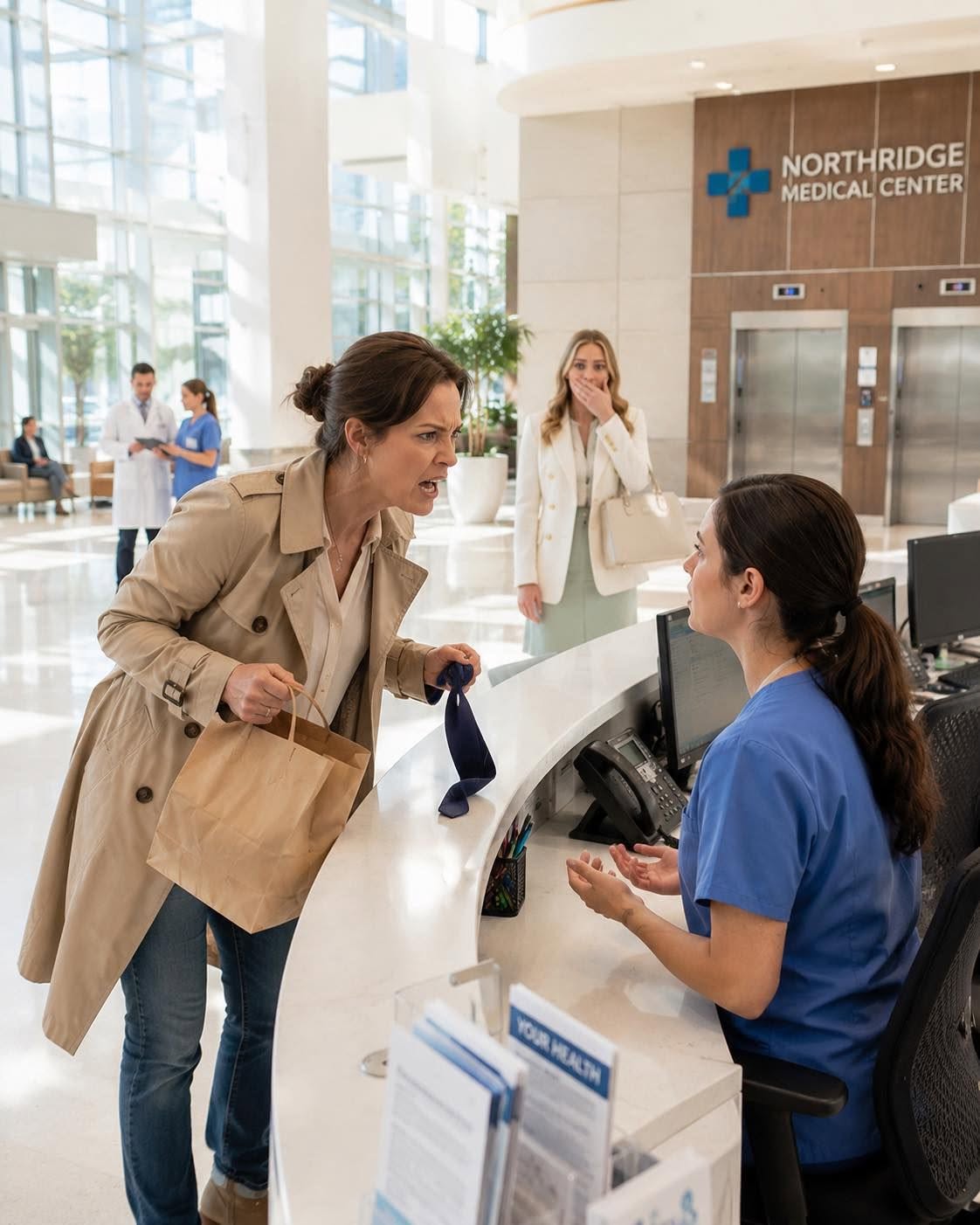
I went to the hospital where my husband worked as chief of surgery and said I was his wife. The receptionist looked at me as if I were lying and whispered, “That’s impossible… the doctor’s wife just walked in wearing his ID badge.”

“That’s impossible, ma’am… Dr. Carter’s wife signed in just ten minutes ago.”

The receptionist delivered the words with an uneasy smile—the kind people use when they believe they are correcting someone irrational but do not want to sound impolite.


I stood frozen in front of the reception desk at St. Catherine Medical Center in the Westbridge neighborhood, clutching a paper bag containing the turkey sandwich Daniel always bought from the café around the corner and the navy tie he had left lying across our bed that morning.

“I’m sorry,” I said as my throat tightened. “I don’t think I understood you correctly.”

The young woman glanced at her computer screen and then looked back at me. Her name badge read Emily Brooks. She appeared to be in her mid-twenties, with her hair pulled into a neat ponytail and the courteous sense of urgency common among people who spend their days handling anxious families, powerful physicians, and emergency phone calls.

“She said she had come to see Dr. Daniel Carter,” Emily repeated. “And she identified herself as his wife.”

“I’m his wife.”

Her hands stopped above the keyboard.

Inside that hospital, the name Daniel Carter carried more authority than any white coat ever could. He was chief of surgery—the man residents followed as though he were leading them toward greatness. He appeared in medical magazines, delivered speeches at international conferences, hosted fundraising dinners, and, according to nearly everyone who knew him, had saved more patients than he could possibly remember.

I had been married to him for twelve years.

Twelve years of learning when to smile at formal events, when not to interrupt his phone calls, and when not to ask too many questions after he arrived home late smelling of antiseptic and expensive bourbon.

“Perhaps there’s been some misunderstanding,” Emily said.

“What was her name?”

The receptionist lowered her gaze toward the visitor registry. She hesitated.

“I’m not sure I’m allowed to show you…”

I gave her a gentle smile, pretending there wasn’t something wild pacing beneath my ribs.

“Daniel is always telling me how seriously this hospital takes security. I’m relieved to hear that’s true.”

That seemed to put her slightly more at ease.

She turned the computer monitor just enough for me to see it.

“She registered as Mrs. Carter. Her name was Rebecca.”

Rebecca.

She was not a patient. She was not another doctor. She was not a friend Daniel had ever mentioned to me.

“What did she look like?” I asked.

Emily swallowed.

“Tall. Blonde. Wearing a beige coat. Very sophisticated. She said Dr. Carter had asked her to retrieve some documents from his office.”

A high-pitched ringing filled my ears.

“And you allowed her upstairs?”

“She had his identification badge.”

“Daniel’s badge?”

The color drained from Emily’s face.

“She was holding it. She wasn’t wearing it around her neck. I assumed… because she said she was his wife…”

Three days earlier, Daniel had told me he had misplaced his badge somewhere in the parking garage.

I drew in a slow breath.

I did not shout. I did not cry. I did not cause a scene.

Years of living with a man like Daniel had taught me that silence often unlocked more doors than panic ever could.

“Thank you, Emily.”

I picked up the paper bag and headed toward the private elevators.

The surgical administration floor smelled of premium coffee, polished tile, and influence. Photographs along the walls showed Daniel posing with senators, business leaders, and hospital executives. On another wall, his portrait appeared beside a quotation about integrity in medicine.

The irony nearly made me laugh.

His assistant was nowhere in sight. She had probably stepped out for lunch.

The door to Daniel’s office was locked.

But marriage teaches a woman many things: anniversaries, deceptions, passwords… and the place where her husband hides a spare key when he assumes no one is paying attention.

I unlocked the door.

His desk was perfectly organized, apart from the upper drawer.

It had been left slightly ajar.

A folder was missing from inside. The vacant space was marked by a label attached to the wooden divider:

Clinical Incident Review — L. Parker.

The name meant nothing to me.

The empty space meant everything.

Someone had entered that office specifically to take that file.

My phone vibrated.

Daniel.

Where are you?

I stared at the lunch bag, the forgotten tie, the open drawer, and the small label that seemed to be watching me from the polished wood.

I typed:

At the hospital.

Three dots appeared on the screen.

Then vanished.

Then appeared again.

At last, his message arrived:

“Stay where you are.”

And in that exact moment, I realized my husband was not furious.

He was frightened.

So I moved.

Not because I suddenly became fearless. Part of me wanted to run back to the parking garage, lock myself inside the car, and persuade myself that Rebecca had never existed.

But Daniel had ordered me not to move.

After twelve years as his wife, I knew the difference between the voice he used when exercising control and the voice he used when trying to hide fear.

I pushed the drawer closed exactly as I had found it, wiped the handle with a tissue, and stepped into the corridor.

At the nurses’ station, an older woman was organizing patient files. Her badge identified her as Margaret Collins, Head Nurse.

“Excuse me,” I said. “I’m trying to find Rebecca.”

The nurse raised her eyes.

Her response was subtle. One blink too many. A tightening around her mouth. A brief glance in the direction of the elevators.

“Rebecca who?”

“That’s what I’m hoping to find out.”

Her gaze moved over my wedding ring, my coat, and finally my face.

“You’re Mrs. Carter.”

“The actual one, apparently.”

Margaret looked down.

Before she could respond, a door opened at the far end of the corridor.

Daniel emerged from Conference Room B wearing a perfectly pressed white coat. Walking beside him were the hospital’s attorney, Richard Hale, and two members of the board whom I recognized from fundraising dinners in Brookhaven.

When Daniel noticed me, his expression remained unchanged.

His eyes did not.

For the first time in years, my husband looked like a man who had been caught.

“Claire,” he said, approaching much too quickly. “You’re not supposed to be here.”

I raised the paper bag.

“I brought your lunch.”

“This is not a good time.”

“Clearly.”

The attorney shifted his attention from Daniel to me.

“Doctor, we need to resume the meeting.”

Daniel continued staring at me.

“Go home. I’ll explain everything tonight.”

“Explain it now.”

His jaw tightened.

Then I noticed her.

Near the vending machines at the opposite end of the corridor, a blonde woman in a beige coat stood partially concealed beside the stairwell door.

Tall.

Elegant.

Pale.

Our eyes locked.

She ran.

I chased her.

Daniel shouted my name, but I was already inside the stairwell. My heels struck the metal steps while the smell of damp concrete and industrial bleach closed around me.

“Rebecca!”

She raced down one flight, lost her footing, and grabbed the handrail. I reached her before she could pull open the next door.

“Who are you?” I demanded.

She struggled to catch her breath. There was fear in her face, but there was no shame.

“My name is Rebecca Parker.”

Parker.

The label inside Daniel’s drawer crashed through my thoughts.

“L. Parker,” I whispered. “The missing file.”

Tears rose in her eyes.

“Lauren Parker was my sister.”

The stairwell door opened above us.

Daniel’s voice echoed down the concrete walls.

“Claire.”

Rebecca stepped closer and pushed something into my palm.

It was a small black USB drive, cold against my skin.

“He ruined her career,” she whispered. “Then he stood by and let her die.”

Daniel appeared three steps above us, breathing heavily. The mask of the untouchable surgeon had fallen away.

“Claire,” he said, extending his hand. “Give that to me.”

I looked at my husband.

Then I closed my fingers around the flash drive.

For several seconds, no one moved.

The fluorescent lights buzzed overhead. Beyond those concrete walls, the hospital continued operating as usual: stretchers rolling through corridors, nurses hurrying between rooms, announcements sounding over the intercom, and families praying in crowded waiting areas.

But inside that stairwell, time had stopped.

Daniel stood three steps above me.

Rebecca stood one step below.

And I remained between them, holding a truth my husband needed to recover before it escaped the building.

“Claire,” Daniel said with carefully practiced calm, “you have no idea what you’re doing.”

Rebecca gave a humorless laugh.

“Of course. That’s always how it begins.”

Daniel did not acknowledge her.

“That device could contain confidential patient records. If you leave the hospital with it, you may expose yourself to serious legal consequences. She’s manipulating you.”

“What’s stored on it?” I asked.

“Nothing you would know how to understand.”

Even trapped in a stairwell and sweating beneath his white coat, Daniel’s first instinct was still to diminish me.

I turned toward Rebecca.

“What’s on the drive?”

“Internal correspondence. Minutes from board meetings. Copies of altered reports. An audio recording. And the formal complaint Lauren submitted before she died.”

Daniel’s stare became cold.

“Lauren Parker died from complications following surgery. It was tragic, but the case was properly reviewed.”

“It was concealed,” Rebecca replied. “My sister was a surgical resident. She discovered you had allowed a representative from a medical equipment company into procedures where he had no right to be. He wasn’t merely watching. He was giving directions because his company financed your research division.”

“That’s a lie.”

“Lauren reported it. Afterward, her evaluations changed almost immediately. Suddenly, she was described as emotionally unstable. Difficult. Hostile. Then she was given impossible schedules and abandoned during a case she had already objected to handling.”

Lauren Parker.

The name stirred something in my memory.

Two years earlier, Daniel had come home unusually quiet for several nights. He told me a young physician had died after undergoing emergency surgery. He described it as an unavoidable tragedy, the kind of loss that even the world’s finest hospitals could not always prevent.

I had prepared tea for him.

I had sat beside him.

I had comforted him.

Now the memory made my stomach turn.

“What happened to her?” I asked.

Rebecca swallowed.

“She developed sepsis following an operation. There were delays in treatment, phone calls that went unanswered, and warnings that were never passed up the chain of command. According to the official timeline, Daniel was notified twice.”

Daniel descended one step.

“That’s enough.”

I stepped away from him.

That small retreat wounded him more deeply than any insult could have.

“Claire,” he said, softening his tone. “You know who I am.”

“I believed I did.”

The door opened again.

Richard Hale entered the stairwell with a security officer behind him.

The attorney’s face had gone pale, but he struggled to maintain an air of authority.

“Mrs. Carter, surrender the flash drive.”

“Why should I?”

“It may contain legally protected information.”

“Then perhaps you should also be concerned that a woman entered this hospital using my husband’s security badge and removed documents from his office.”

Richard compressed his lips into a thin line.

Rebecca raised her chin.

“I didn’t steal anything you hadn’t already duplicated and buried. Lauren sent copies of some of the evidence to herself before she died. I came here for the original report because someone warned me that the board planned to destroy the remaining drafts today.”

“That accusation is ridiculous,” Richard said.

“Is it?” I asked.

No one responded.

Daniel stretched his hand toward me.

“Claire, give me the drive. Come home with me. We can discuss this privately. Whatever she believes, whatever she has said to you—there is a reasonable explanation for all of it.”

His voice became warmer when he said the word home.

Once, that would have been enough.

But I had already seen too much.

The missing badge.

The woman pretending to be his wife.

The absent folder.

The hospital lawyer.

The board members gathered behind closed doors.

And Daniel’s first message had not asked, Are you all right? or What happened?

It had ordered me:

“Stay where you are.”

He had never been worried about me.

He had been worried about what I might discover.

I placed the flash drive inside the inner pocket of my coat.

Daniel watched every inch of the movement.

“Claire,” he whispered so quietly that only I could hear, “consider what you’re doing. Your home, your lifestyle, your position on every important committee in this city… all of it exists because of my name.”

There he was.

Not the celebrated surgeon.

Not the refined husband.

Not the man who kissed my forehead beneath the chandeliers at charity galas.

The owner.

I smiled at him in the same calm way I had smiled at Emily downstairs.

“You’re forgetting something, Daniel.”

His nostrils flared.

“I had a name before I ever took yours.”

Then I faced the security officer.

“Please escort me to the lobby. I don’t want to be alone with my husband.”

The guard glanced at Richard.

Richard looked at Daniel.

Daniel remained silent.

That silence became the first visible fracture in the empire he had built.

When we reached the lobby, Emily looked up from her desk. Her face turned white as soon as she saw us.

“Mrs. Carter?”

“Yes,” I replied. “The real one.”

I walked out of the hospital with my heart pounding against my ribs and called my older brother, Michael Bennett.

Michael was not a physician. He did not charm donors over dinner, wear custom Italian suits, or pretend to admire men who issued threats in soft, controlled voices.

But he was a criminal attorney who had spent years handling cases involving medical corruption and corporate fraud.

He answered after the second ring.

“Claire.”

“I need your help.”

His voice changed immediately.

“Where are you?”

“Outside St. Catherine. I have a flash drive. It may contain evidence of fraud, retaliation, and the death of a doctor.”

The line went quiet.

“Do not give it to anyone. Do not return home. I’ll meet you in twenty minutes.”

We gathered in a secluded booth at the back of a coffee shop two blocks from the medical center: Michael, Rebecca, a trusted digital forensics specialist named Sophie, and me.

Rebecca kept the beige coat folded across her knees. Without the disguise of “Mrs. Carter,” she looked much younger. She did not appear glamorous or threatening.

She looked like a woman exhausted by grief and forced by that grief to become brave.

“I’m sorry I used your name,” she said.

I believed that she meant it.

But forgiveness was not the first emotion I experienced.

Rage was.

Sophie inserted the flash drive into a laptop that was not connected to the internet.

The files appeared gradually.

Emails.

Medical reports.

Audio files.

Multiple versions of an edited internal investigation.

Daniel’s voice emerged through the speakers, cold and irritated.

“We need to be cautious about our wording. Dr. Parker was emotionally compromised. Her recollections cannot be considered reliable.”

Another person asked:

“What about the company representative?”

Daniel answered:

“He attended strictly as a technical observer. Nothing beyond that.”

A third voice said:

“Lauren has screenshots.”

After several seconds of silence, Daniel replied:

“Then her system access should have been terminated sooner.”

Rebecca covered her mouth with both hands.

I could not move.

The next file was even worse.

An early draft of the internal investigation stated that Lauren had reported unsafe medical practices six weeks before her operation. That entire section was absent from the final version.

Another email showed Daniel advising a different hospital not to hire Lauren because of what he described as “concerning emotional instability.”

Attached below were her earlier performance reviews: disciplined, gifted, meticulous, and expected to have an extraordinary career.

Then we opened the timeline from the night she died.

Treatment delays.

Unanswered calls.

Missing medical notes.

Daniel’s name appeared twice.

Not as the operating surgeon.

As the senior authority who had been contacted when Lauren’s health deteriorated.

He had told me he knew almost nothing about the case.

He had lied beneath the warm lights in our kitchen while holding the cup of tea I had made for him.

“This is sufficient to submit a formal criminal complaint,” Michael said. “And it may support far more than that.”

“Why did this happen today?” I asked Rebecca.

She wiped the tears from her cheeks.

“A nurse contacted me. She said the board was meeting to approve a confidential settlement and that today might be my final opportunity to retrieve the evidence.”

“Which nurse?”

“Margaret Collins.”

The head nurse from the administration floor.

That same afternoon, Margaret gave an official statement. She had preserved copies of several records because she had never believed the circumstances of Lauren’s death were legitimate. She admitted that she had warned Rebecca after overhearing Richard discuss a “document purge” before the board meeting.

By midnight, Daniel had called me nineteen times.

I answered none of them.

At 1:18 in the morning, he sent me a message:

“You are making the greatest mistake of your life.”

I read it while sitting in Michael’s guest bedroom, dressed in borrowed clothing, with my wedding ring resting on the nightstand.

For years, I had mistaken Daniel’s certainty for strength.

But genuine strength does not depend on forcing everyone else into silence.

It does not require locked drawers, erased correspondence, terrified nurses, or dead women whose reputations are destroyed by calling them unstable.

The following day, the complaint was submitted to the District Attorney’s Office and the appropriate state health department. The hospital received formal demands for documentation. By that afternoon, the story had already reached the press.

Chief of Surgery at St. Catherine Medical Center Suspended During Investigation into Alleged Fraud and Alteration of Medical Records.

Daniel immediately tried to control the public version of events.

Through his attorney, he declared that the allegations were false, defamatory, and driven by private marital disputes. He referred to me as “my estranged wife,” although we had not been estranged until the moment I opened his desk drawer.

Two days later, I returned to the house with Michael and two police officers so I could collect my belongings.

Daniel was waiting beneath the outrageously expensive chandelier we had purchased in Charleston.

His suit remained flawless.

His face did not.

“You brought police officers into my house?”

“Our house—”

Leave a Reply

Your email address will not be published. Required fields are marked *